Key takeaways
- Overwatering and root rot cause around 80% of drooping, soft snake plants
- Water only every 2 to 6 weeks and let the compost dry out completely first
- A soft, mushy base that smells sour means root rot, not thirst
- Snake plants need bright light and temperatures above 10C to stay firm and upright
- Repot into a gritty cactus or succulent mix that drains freely within seconds
- A recovered plant firms up over 4 to 8 weeks once roots regrow
A drooping snake plant is alarming because this is meant to be the toughest houseplant you can own. When the stiff sword leaves start to splay outward, flop over the pot rim or feel soft near the soil, something has gone wrong at the roots. The good news is that a snake plant drooping is almost always fixable once you find the cause. In most UK homes the culprit is overwatering, made worse by low winter light and cold windowsills.
This guide walks through every reason a snake plant goes floppy. You will learn to diagnose the problem in minutes, rescue a rotting plant, and firm it back up. For more indoor rescue advice, see our problems section.
What a healthy snake plant should look like
A healthy snake plant (Dracaena trifasciata, long sold as Sansevieria and nicknamed mother-in-law’s tongue) holds its leaves stiff and upright. The sword-shaped leaves stand almost vertical, with a firm texture like thick rubber. Variegated types show crisp yellow margins and dark green banding. A gentle push should meet resistance, not give way.
When a plant is thriving, the base where leaves meet the soil is firm and pale green. Roots are bright white or orange and fill the pot loosely. New leaves emerge from the centre as pointed spears and grow upward, not sideways.
Drooping is the opposite of all this. Splaying means the leaves fan outward from the centre and lean over the rim. Softness at the base means the supporting tissue has started to break down. Knowing the healthy benchmark makes diagnosis far quicker. If your plant has firm leaves that merely lean, the fix differs from a plant going soft and mushy at the soil line.
Gardener’s tip: Press a finger gently against the base of each leaf where it meets the compost. Firm and springy is healthy. Soft, spongy or wet means rot has started, and that plant needs action today rather than next week.
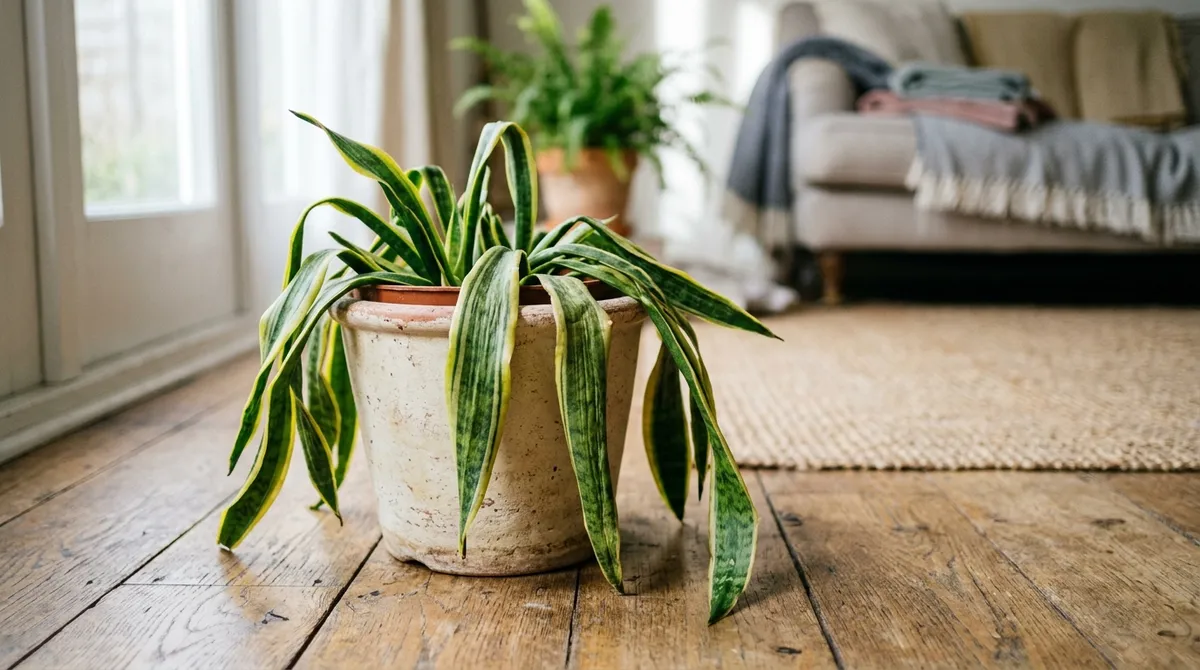
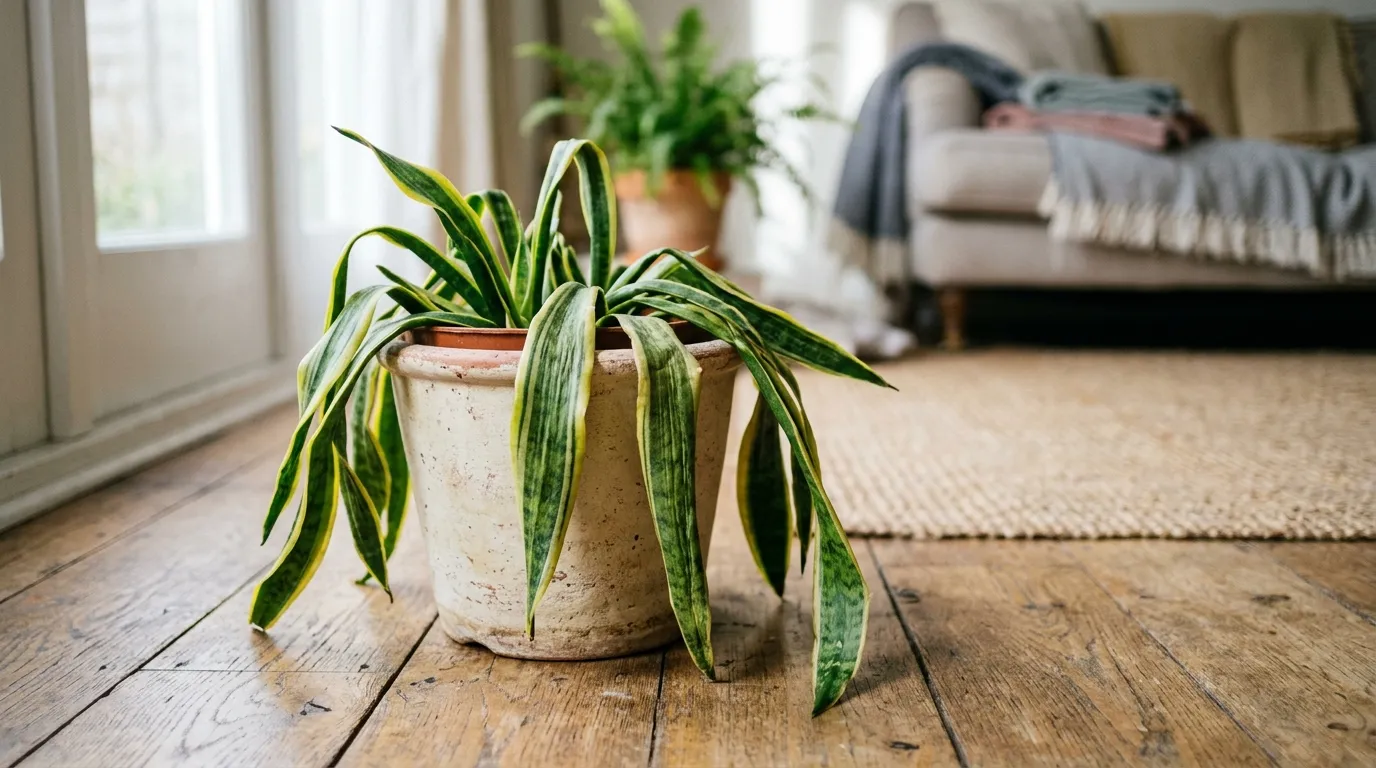 A snake plant drooping and splaying outward. Leaves that fan away from the centre and flop over the rim usually point to soggy roots below.
Diagnosing why your snake plant is drooping
Work from the soil upward. The base and roots tell you almost everything. Start by feeling the base of the leaves, then check the compost, then the light and the room temperature. The table below matches each symptom to its likely cause and the fix.
| Symptom | Likely cause | Fix |
|---|---|---|
| Soft, mushy base, sour smell, leaves splay and fall flat | Overwatering and root rot | Repot into dry gritty mix, trim rotted roots, withhold water |
| Whole plant leans, new leaves thin, pale and floppy | Too little light (etiolation) | Move within 1 to 2m of a bright window |
| Leaves soft, wrinkled, with brown mushy patches after cold | Cold damage below 10C | Move away from cold glass, remove damaged leaves |
| Pot bulging or cracked, water runs straight through | Severely root-bound | Repot into a container 2 to 3cm wider |
| Leaves wrinkled, curling, very light pot | Underwatering (less common) | Water thoroughly, then let drain fully |
| One or two leaves bent or creased, rest firm | Physical damage | Support or remove the damaged leaf only |
The main cause overwatering and root rot
Overwatering kills more snake plants than any pest or disease. These plants store water in their thick leaves and evolved in dry, rocky ground. Their roots need air. Sitting in wet compost, the roots suffocate and rot, and fungal decay then spreads up into the base of the leaves.
The signs follow a clear order. First the base softens. Then the leaves lose rigidity and splay outward. Finally they flop over and may pull away from the plant with a gentle tug. The compost stays wet for days, often with a sour smell or a white mould crust on top.
Tip the plant out of its pot to confirm. Healthy roots are firm, white or pale orange. Rotted roots are brown, grey or black, soft, and slide apart between your fingers. The rhizome, the chunky underground stem, may also have gone soft and brown.
Act quickly. Remove all wet compost from the roots. Using a clean knife or scissors, cut away every soft, brown or slimy root and any mushy section of rhizome until only firm pale tissue remains. Let the plant air-dry for a few hours, then repot into fresh, dry, gritty compost as described below.
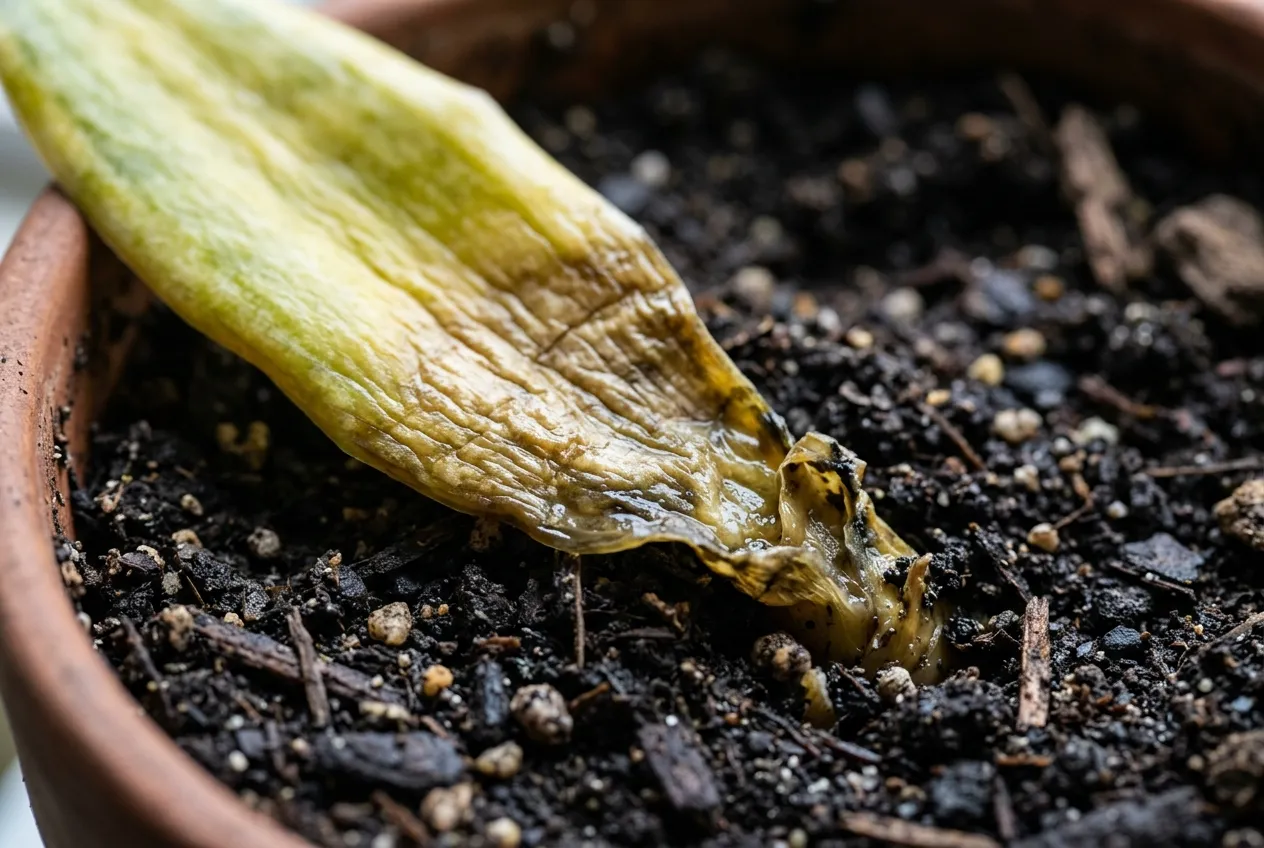 The soft, yellowing base of a drooping leaf. Once tissue collapses like this, the leaf cannot recover and should be cut away at soil level.
How to check the base and roots
Checking the roots takes five minutes and removes all guesswork. Lay newspaper down, then ease the plant out of its pot. Hold the base of the leaves, tip the pot sideways, and slide the rootball free. A healthy rootball holds together. A rotted one falls apart and smells stale.
Look closely at three things. The rhizome should be firm and pale, like a fresh ginger root. The roots should be white or orange and springy. The base of each leaf should be solid where it joins the rhizome. Anything brown, soft, hollow or foul-smelling is dead and must come out.
Separate the leaves gently and inspect each one. Snake plants grow as clumps connected underground, so one rotted section does not doom the whole plant. Healthy offsets often survive even when the parent leaf has collapsed. Keep every firm, white-rooted piece.
Warning: Never repot a rotted plant back into its old wet compost or the same unwashed pot. The old mix is full of fungal spores and holds water. Wash the pot in hot soapy water, and always start with fresh, dry, gritty compost to give the surviving roots a clean start.
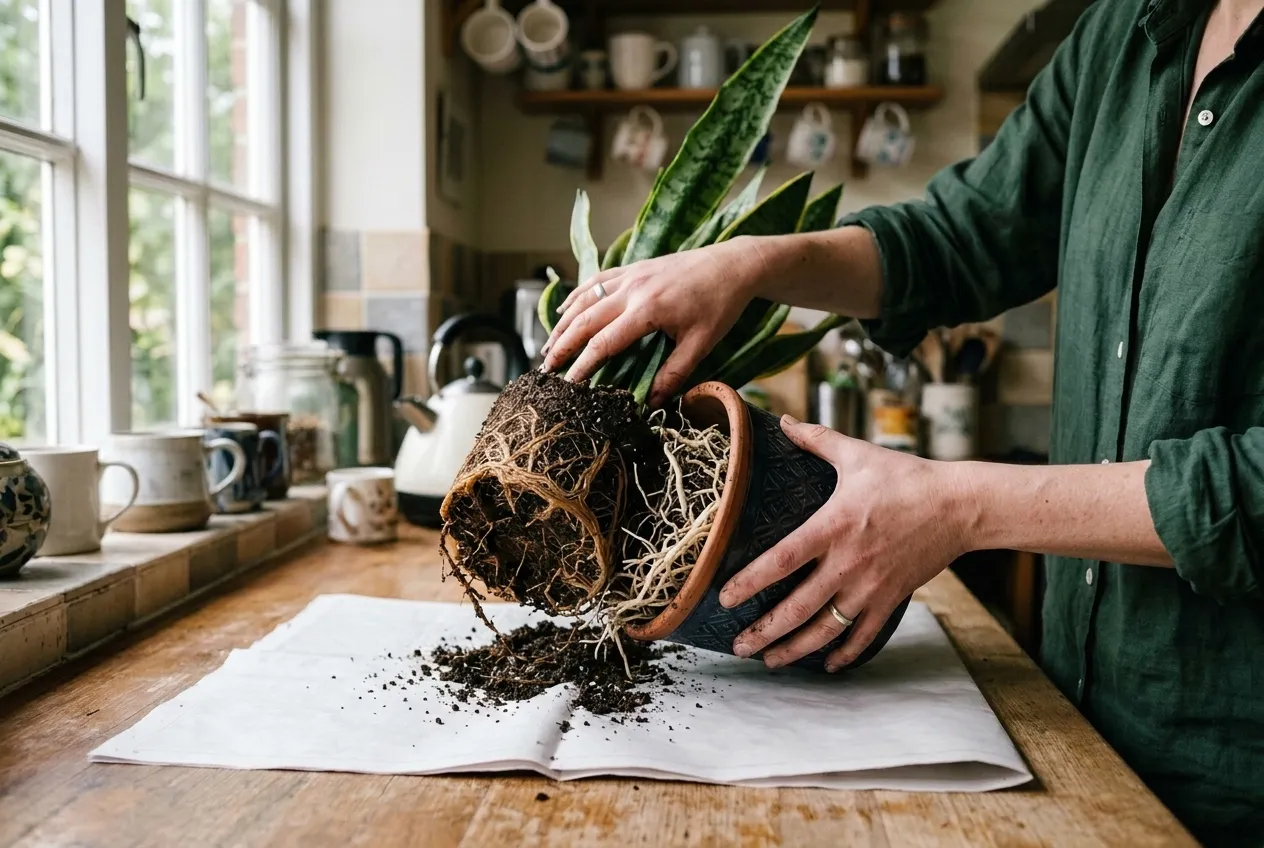 Tipping the plant out reveals the truth. Firm white roots on the right are healthy. The brown, collapsed roots on the left have rotted and must be removed.
Too little light and weak floppy growth
Light is the second biggest reason a snake plant droops, and it bites hardest in UK winters. Although these plants tolerate shade, tolerate is not the same as thrive. In dim conditions the plant stretches towards the nearest light source, a process called etiolation. New leaves grow thin, pale and weak, then lean rather than standing stiff.
You can tell light-related drooping from rot easily. The base stays firm and the compost is not soggy. Instead the whole plant leans one way, and the newest leaves are noticeably floppier and lighter in colour than older growth. Variegation also fades in poor light.
The fix is simply more light. Move the plant within 1 to 2 metres of a bright window. An east or west-facing sill is ideal, and a south-facing spot suits them well over a dull UK winter. They cope with some direct sun once acclimatised. Avoid deep corners and north-facing rooms that get no direct light at all.
Existing leaning leaves rarely straighten fully, but new growth will come up firm and upright once light improves. Rotate the pot a quarter turn each week so the plant grows evenly rather than reaching to one side.
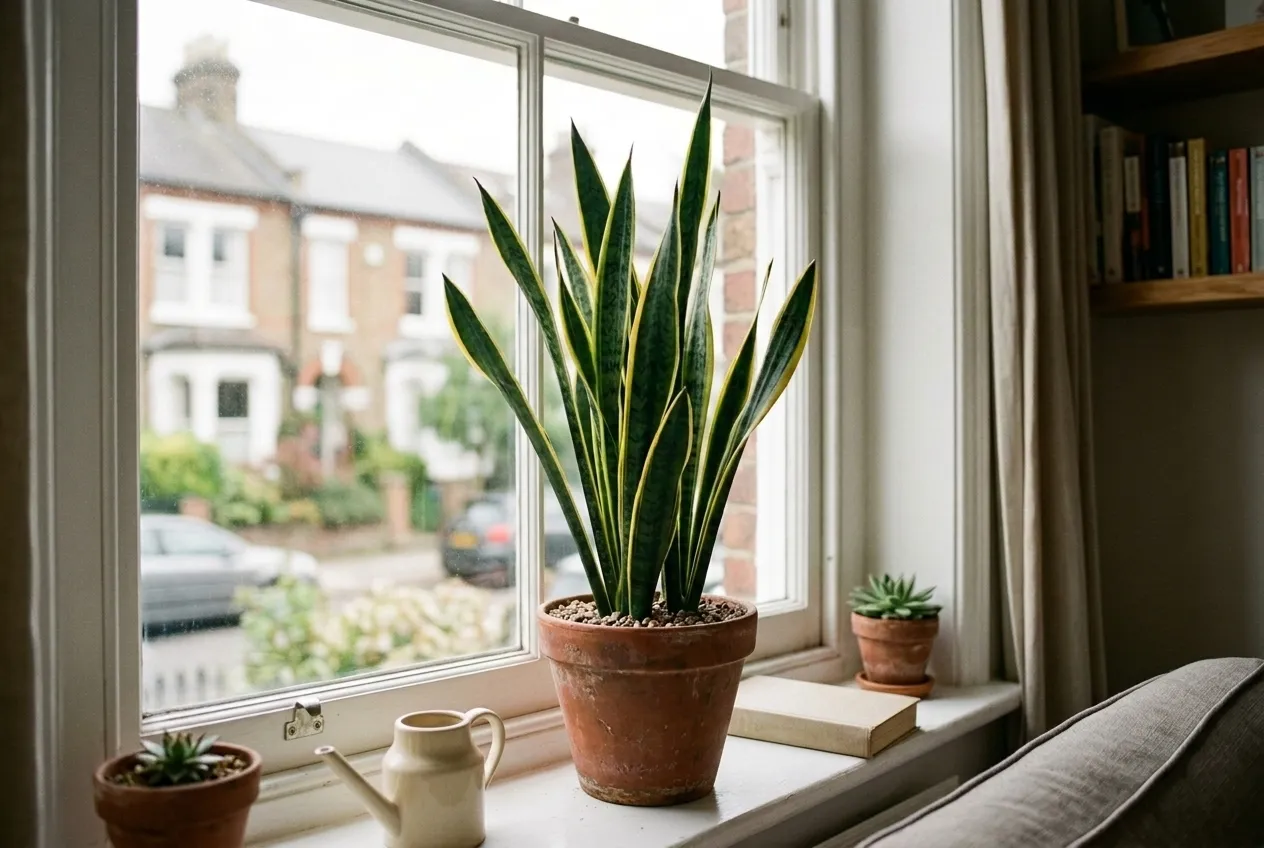 Bright light keeps growth stiff and upright. A spot within 1 to 2 metres of a window gives a UK snake plant the light it needs through winter.
Cold damage and other causes
Snake plants are tropical and hate the cold. Sustained temperatures below 10C damage the leaf tissue. Cells rupture, and within days you see soft, mushy patches, often pale or translucent, followed by drooping. In UK homes this happens on cold windowsills in winter, in unheated hallways, or near a draughty door.
Move any plant away from cold glass and draughts. Keep snake plants in rooms that stay between 15C and 27C. Central heating suits them, though avoid placing them directly above a hot radiator, which dries the compost unevenly. Trim away any leaf with soft cold-damaged patches, as that tissue will not recover.
A severely root-bound plant also droops. When roots completely fill the pot, they cannot take up water properly, and the pressure can crack a plastic pot or bulge a thin one. Water runs straight through without wetting anything. Repot into a container just 2 to 3cm wider in spring. Snake plants flower and grow best slightly snug, so resist jumping up several pot sizes.
Finally, physical damage and old, tired compost play a part. A knocked or creased leaf may bend permanently. Old compost that has broken down holds water like a sponge and stops draining, which quietly leads back to root rot.
Repotting and trimming a rotted snake plant
Repotting is the rescue step that saves most drooping snake plants. Do it as soon as you find soft roots. You will need fresh gritty, free-draining compost, a clean pot with drainage holes, and a clean knife.
Follow these steps:
- Remove the plant and shake or wash off all old compost from the roots.
- Cut away every brown, soft or slimy root and any mushy rhizome, back to firm pale tissue.
- Remove any leaf that is soft at the base by slicing it off cleanly at soil level.
- Let the trimmed plant air-dry in a shady spot for 2 to 24 hours so cuts seal over.
- Repot into dry, gritty compost, setting the rhizome just below the surface.
- Do not water for at least 7 days, then water lightly and let it drain fully.
Use a cactus or succulent compost, or make your own by mixing two parts peat-free houseplant compost with one part horticultural grit or perlite. The mix should feel open and drain within seconds, never staying claggy. A heavy multipurpose compost on its own holds far too much water for this plant.
Choose a pot only slightly larger than the surviving rootball. A pot that is too big holds a reservoir of damp compost the roots cannot reach, which invites rot all over again. Terracotta is ideal because it breathes and dries faster than plastic.
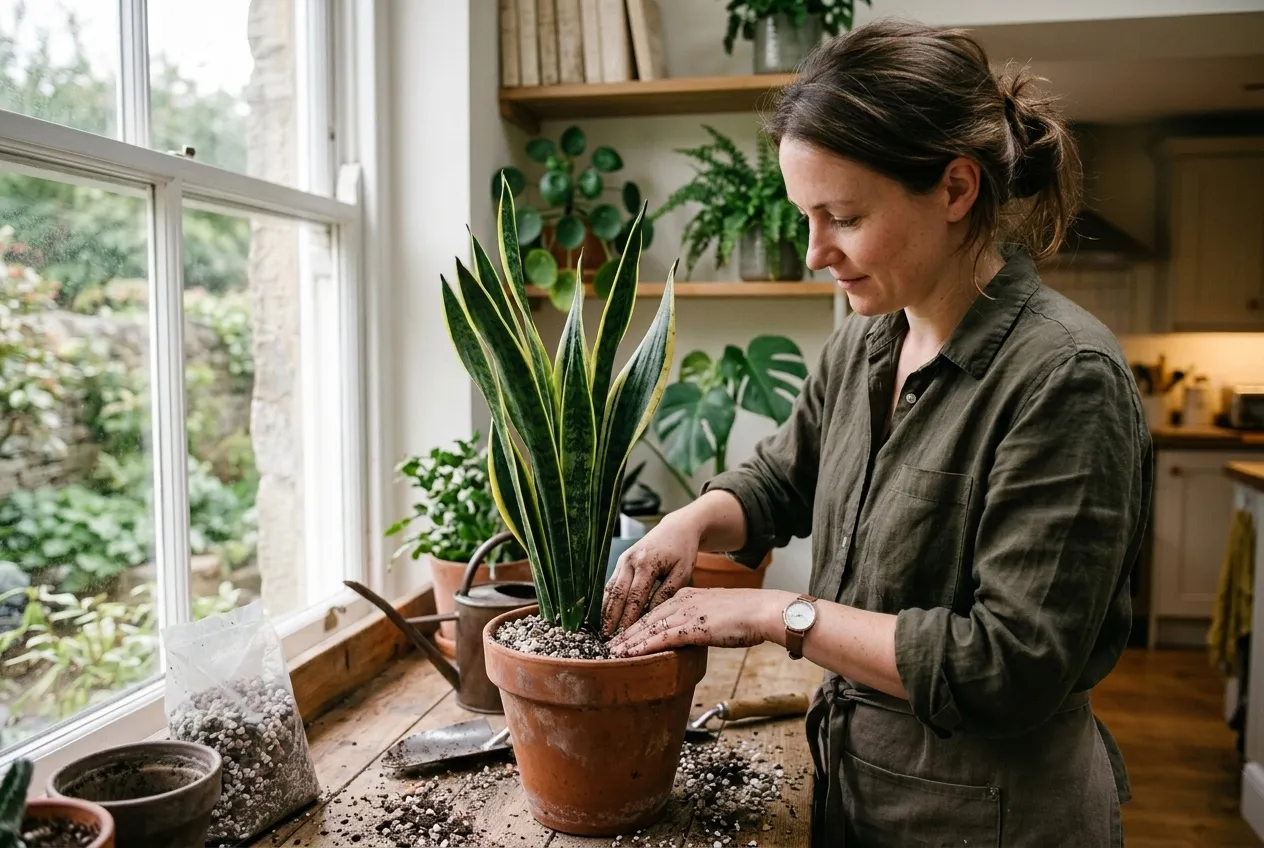 Repotting into a gritty cactus mix. An open, free-draining compost lets the roots breathe and is the single best defence against future rot.
If a leaf has rotted only at the base but is firm higher up, you can still save the plant by propagation. Cut the leaf into 8 to 10cm sections, let them dry for a day, then push them upright into dry gritty compost. Each section will root and form a new plant over a few months. Remember that variegated cuttings often root as plain green.
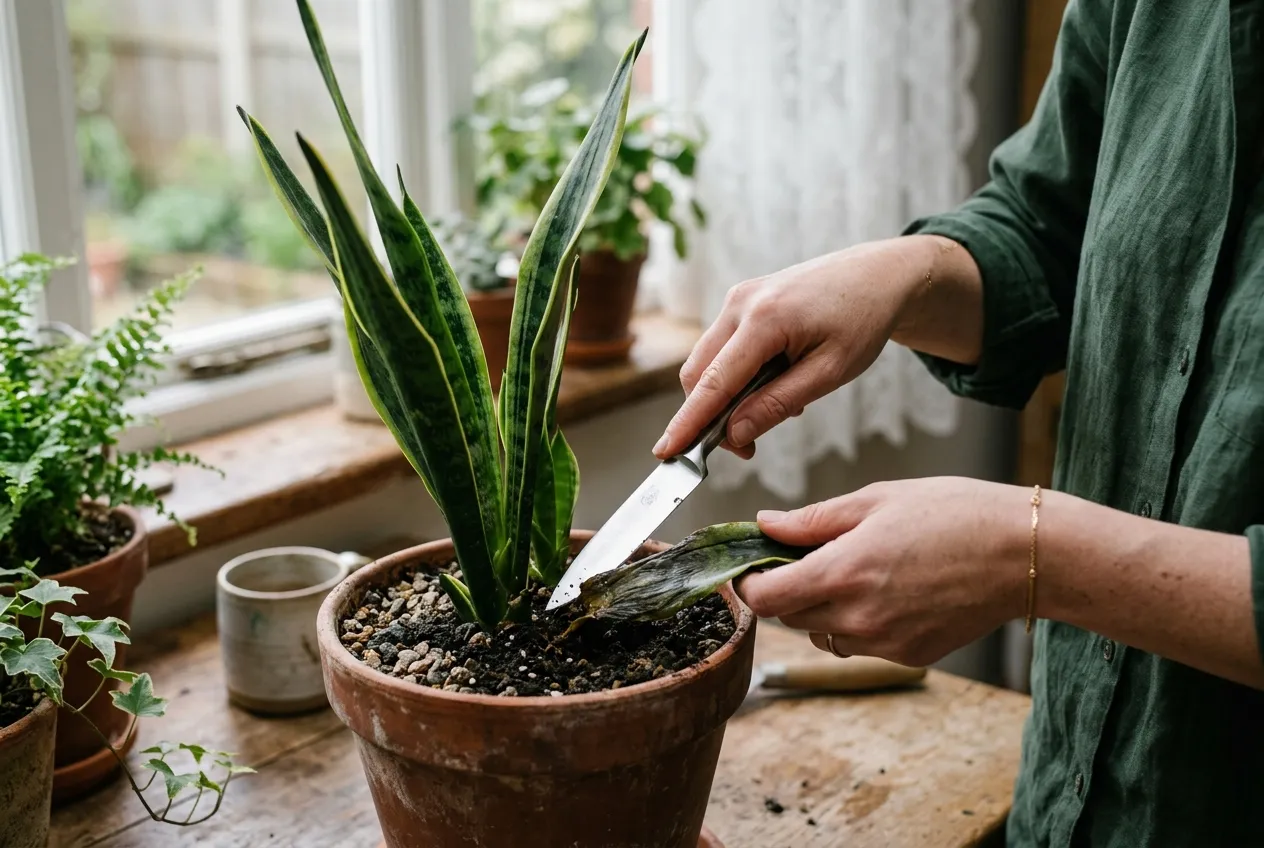 Cutting a soft leaf away at the base with a clean blade. Always sterilise the knife between cuts to avoid spreading rot to healthy tissue.
Correct watering to prevent drooping
Watering is where most people go wrong, and getting it right prevents nearly all future drooping. The rule is simple. Let the compost dry out completely, then water thoroughly, then wait. A snake plant would rather be bone dry than damp.
In practice this means watering every 2 to 6 weeks depending on the season and your home. Through the warmth of summer, every 2 to 3 weeks suits most plants. Over a cool, dim UK winter, every 4 to 6 weeks is plenty, and some plants want even less. Always check first by pushing a finger 5cm into the compost. If you feel any moisture, wait.
When you do water, water generously. Pour until it runs from the drainage holes, let it drain fully, then empty the saucer. Never leave the pot standing in water. This soak-and-dry approach mimics the plant’s native climate of long dry spells broken by occasional downpours.
The seasonal table below gives a UK-specific routine. Adjust for your own conditions, as a warm centrally heated flat dries faster than a cool north-facing room.
| Season | Watering frequency | Light and care |
|---|---|---|
| Spring (Mar to May) | Every 2 to 3 weeks | Light improving, growth resumes, repot now if needed |
| Summer (Jun to Aug) | Every 2 to 3 weeks | Brightest light, peak growth, feed once or twice |
| Autumn (Sep to Nov) | Every 3 to 4 weeks | Light fading, slow watering down, no feeding |
| Winter (Dec to Feb) | Every 4 to 6 weeks | Lowest light, keep above 10C, away from cold glass |
Gardener’s tip: Lift the pot before watering. A dry snake plant feels surprisingly light, while a recently watered one feels heavy. After a few weeks you will judge watering by weight alone, which is far more reliable than any fixed schedule.
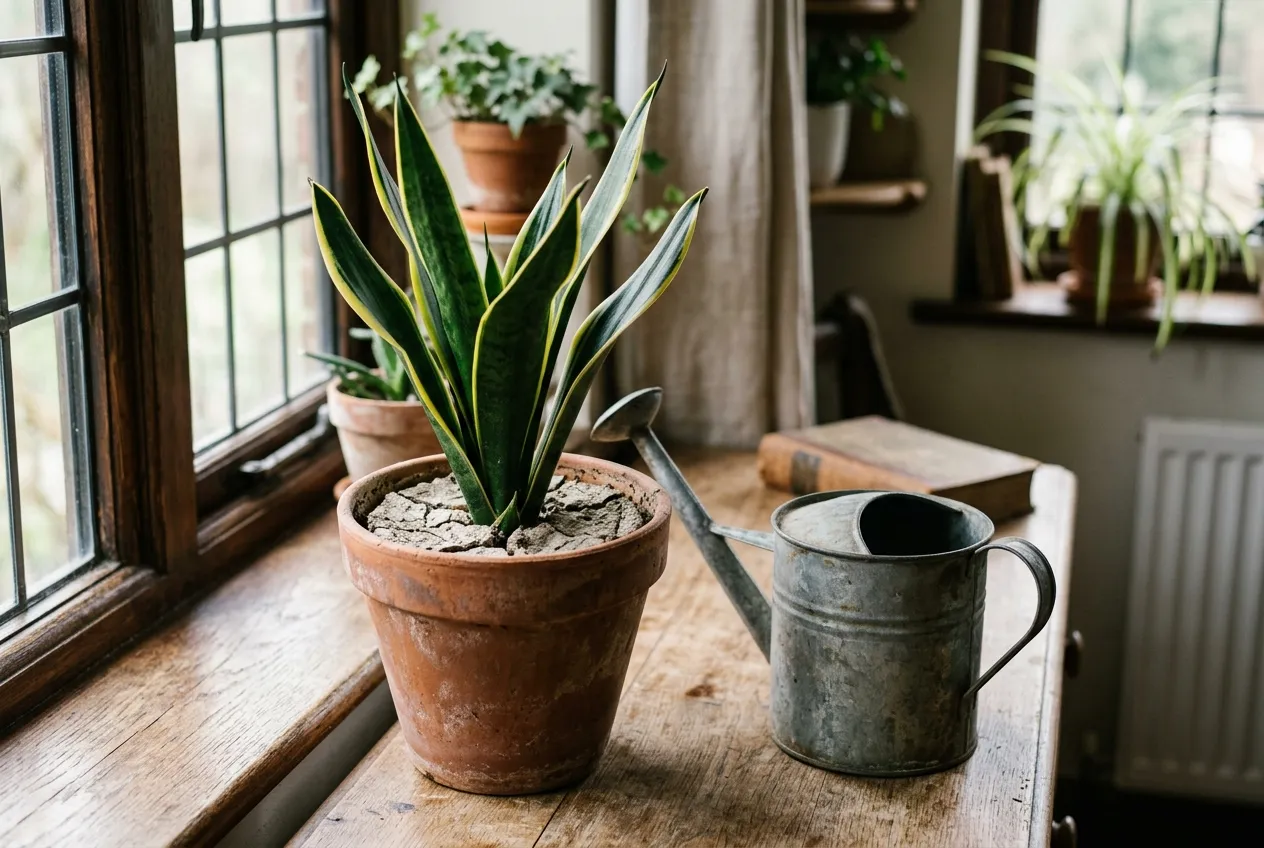 Water only when the compost has dried out completely. The visibly dry surface here shows a plant that is ready for an occasional thorough soak.
How to firm up a recovered plant
Once you have repotted and corrected the watering, recovery takes patience. A rescued snake plant firms up over 4 to 8 weeks as new roots establish and fresh leaves emerge. Do not expect the old splayed leaves to stand back up. The recovery shows in the new central spears, which should come up stiff and upright.
Give the plant the conditions it wants. Bright light, warmth above 15C, and a long dry gap before the first proper watering. Hold off feeding until you see new growth, then use a balanced houseplant feed at half strength once or twice over summer only. Never feed a plant that is still recovering from rot.
Support badly splayed leaves temporarily if they bother you. A loose plant tie or a stake holds them upright while the centre regrows, but remove ties before they cut into the leaf. Many people simply trim the worst leaves at the base and let the firm new growth take over.
If only a few healthy roots survived, the plant will be smaller for a while. This is normal. A compact, firm snake plant in the right compost is far healthier than a large one rotting in soggy soil. Keep watering sparingly and it will slowly bulk out again.
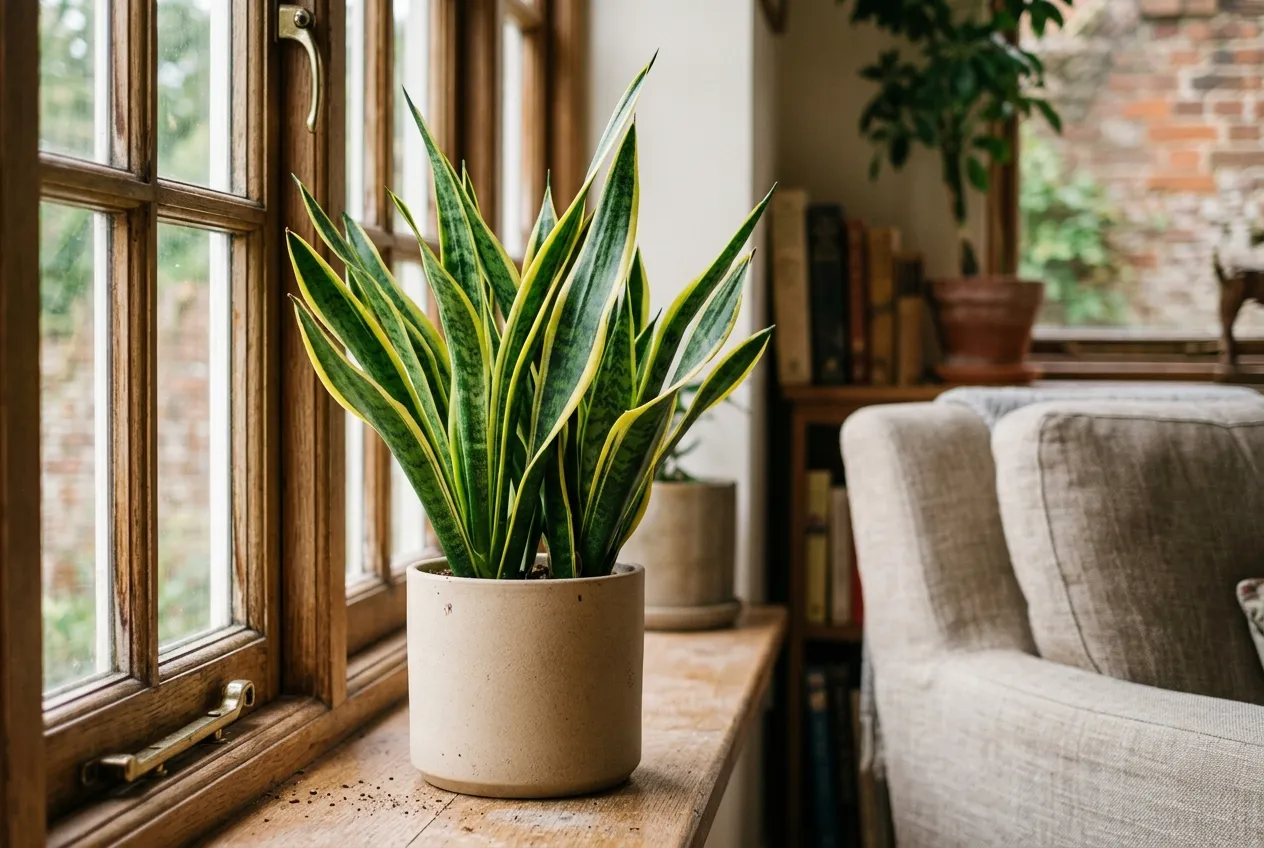 The goal: stiff, upright, variegated leaves. A recovered plant grows new firm spears from the centre over 4 to 8 weeks of correct care.
Common mistakes that cause drooping
Most drooping comes down to a handful of avoidable errors. Recognising them stops the problem returning.
Watering on a fixed schedule
Watering every week regardless of conditions is the fastest route to rot. Snake plants use water far more slowly in winter and in low light. Always check the compost first and water by need, not by calendar. When unsure, wait another week.
Using heavy, water-retentive compost
Standard multipurpose compost holds too much water for a snake plant. It stays wet for days and starves the roots of air. Always plant into a gritty cactus mix, or cut ordinary compost with at least one third grit or perlite to improve drainage.
Pots without drainage holes
A decorative pot with no holes traps water at the bottom where you cannot see it. The roots sit in a hidden puddle and rot. Always plant into a pot with drainage holes, and tip away any water that collects in an outer cover pot.
Leaving the plant in deep shade
A dark corner produces weak, floppy, stretched growth over time. Snake plants survive low light but never firm up in it. Give them a bright spot within 1 to 2 metres of a window, especially through the dim UK winter months.
Overpotting
Moving a plant into a much larger pot surrounds the roots with damp compost they cannot use. That reservoir stays wet and triggers rot. Pot up only 2 to 3cm at a time, and keep snake plants slightly snug, which they prefer anyway.
Related reading: Jade plants sulk in the same wet compost, so see our guide to jade plant care in the UK.
Frequently asked questions
Why is my snake plant drooping and falling over?
Overwatering and root rot are the most common causes. Soggy compost rots the roots and base, so the leaves lose support and splay outward. Check the base for softness and a sour smell. If you find rot, repot into dry gritty compost and trim the rotted roots. Too little light is the next most likely cause, producing weak, floppy growth.
Can a drooping snake plant recover?
Yes, most drooping snake plants recover with the right care. If healthy white roots remain, repot into dry gritty compost, place it in bright light, and water sparingly. New growth firms up over 4 to 8 weeks. If the base has rotted completely, save the plant by cutting firm sections of leaf and rooting them as cuttings in dry compost.
How often should I water a snake plant in the UK?
Every 2 to 6 weeks depending on the season. Water roughly every 2 to 3 weeks in summer and every 4 to 6 weeks over winter. Always let the compost dry out completely first, then water thoroughly and drain fully. When in doubt, wait. Snake plants cope with drought far better than with constantly wet roots.
Should I cut the drooping leaves off my snake plant?
Only remove leaves that are soft, mushy or yellow. Cut them off at the base with a clean, sterilised knife. Firm leaves that merely lean from low light may not straighten, but you can leave them while new upright growth comes through. Never remove more than a third of the plant at one time.
Why is the base of my snake plant soft and mushy?
A soft, mushy base signals root rot caused by overwatering. The tissue collapses as fungal rot spreads up from waterlogged roots. Tip the plant out, cut away every brown or slimy root, and remove affected leaves at soil level. Repot into dry cactus compost and withhold water for at least a week afterwards.
Does a snake plant droop from too little light?
Yes, low light causes weak, stretched and floppy growth. New leaves grow thin and pale, then lean rather than standing stiff. This is common in UK homes through winter. Move the plant within 1 to 2 metres of a bright window. Existing leaning leaves rarely straighten, but new growth will come up firm.
Will a root-bound snake plant droop?
Yes, a severely root-bound snake plant can splay and droop. Packed roots cannot take up water properly and may crack the pot or push the plant upward. Repot into a container just 2 to 3cm wider in spring. Snake plants flower and grow best slightly snug, so avoid jumping up several pot sizes at once.
Our team produces practical UK gardening guidance from source research, contributor records and established horticultural practice. Editorial standards are overseen by Matt W.