Key takeaways
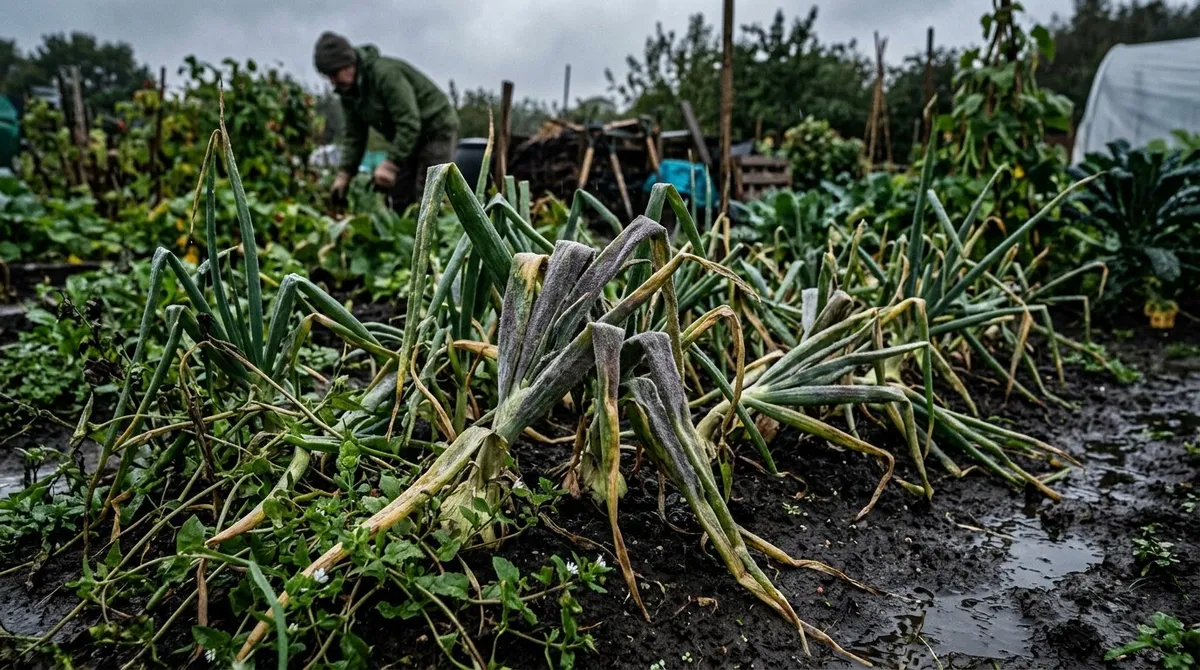
- Onion downy mildew causes pale patches on leaves that turn grey-purple, then leaf tips collapse and die
- The pathogen spreads explosively in cool wet weather between 8-15C with leaf wetness lasting 6+ hours
- Spores travel up to 20km on wind, so local crop rotation alone cannot prevent infection
- Infected bulbs fail to cure properly and rot in storage within 4-8 weeks
- No fungicide is approved for amateur use in the UK; prevention is the only viable approach
- Autumn-planted onion sets avoid the worst infection period and mature before peak disease pressure
Onion downy mildew is the single most destructive disease of onion crops in wet UK summers. It can wipe out an entire bed in less than three weeks when conditions favour the pathogen. The characteristic pale leaf patches, followed by grey-purple sporulation and collapsing foliage, have become a familiar sight on allotments across Britain in recent wet seasons.
The disease is caused by Peronospora destructor, an oomycete (water mould) rather than a true fungus. It thrives in exactly the cool, damp conditions that define a typical British June and July. There is no fungicide available to home gardeners. Prevention through timing, spacing, variety choice, and rotation is the only viable defence.
What causes onion downy mildew?
Peronospora destructor is an obligate parasite, meaning it can only grow on living allium tissue. It cannot survive independently in soil or on dead plant matter for extended periods. The pathogen overwinters as thick-walled oospores in infected crop debris and, critically, as systemic mycelium inside infected onion sets and bulbs.
When infected sets are planted the following spring, the pathogen grows through the emerging leaves systemically. These primary infections produce spores (sporangia) on the leaf surface, which are then carried by wind to infect neighbouring plants. This is why planting clean, healthy sets is the single most important prevention step.
Secondary spread is explosive in the right conditions. Spores germinate when leaf surfaces remain wet for 6 or more hours at temperatures between 8-15C. A single sporulating lesion produces millions of sporangia. Wind carries these spores enormous distances. Research by Warwick Crop Centre documented viable spore dispersal up to 20km from infected commercial onion fields.
The disease affects all cultivated alliums: onions, shallots, garlic, leeks, and chives. Spring onions and salad onions are particularly vulnerable because of their thin leaves and fast growth during the peak disease window.
How to identify onion downy mildew
Pale oval patches on leaf surfaces are the first visible symptom. These patches are lighter green or yellowish compared to the surrounding healthy tissue. They appear most often on older, outer leaves first. In early stages, the patches can be mistaken for nutrient deficiency or wind damage.
Within 2-4 days of the initial pale patches, the diagnostic grey-purple sporulation develops on the underside and sometimes the upper surface of the lesion. This fuzzy growth is the spore-producing layer. It is most visible in the morning when humidity is high. By midday on a warm day, the spores may have been released and the fuzzy layer looks less obvious.
Leaf tips yellow and collapse from the top downward. Severely affected leaves fold over and lie flat on the soil. The progression from first pale patch to total leaf collapse can take as little as 10-14 days in warm, wet weather. An entire bed of spring-sown onions can go from healthy-looking to devastated within three weeks.
Bulb symptoms are often hidden at harvest. Affected bulbs may look normal when lifted, but the neck tissue is soft and watery. Outer scales may show brown streaking. These bulbs will not cure properly and rot in storage, typically within 4-8 weeks. If you squeeze the neck of a freshly lifted bulb and it feels spongy rather than firm, downy mildew has likely affected the internal tissue.
The pattern of infection within a bed is informative. Downy mildew typically appears first on plants in the centre or lowest-lying area of a bed, where air circulation is poorest and leaf wetness persists longest. It then radiates outward. This distinguishes it from other common allium diseases, which tend to affect plants in irregular patches or follow old infection zones in the soil.
When does onion downy mildew strike in the UK?
Peak infection occurs in June and July when cool, wet weather coincides with the main bulbing period. The pathogen requires temperatures between 8-15C and prolonged leaf wetness (6+ hours) for spore germination. These conditions are common in British summers, especially in the north and west.
The disease calendar follows a predictable pattern. Primary infections from systemically infected sets appear in April-May. These produce the first spores, which spread to neighbouring plants. Secondary spread accelerates through June as day length, humidity, and temperature align to favour the pathogen. July is typically the worst month for crop losses.
Dry, warm summers suppress the disease dramatically. In 2022, a hot, dry June and July in the Midlands kept downy mildew at very low levels. In 2024, persistent rain through June created epidemic conditions across central England. Year-to-year variation is enormous, driven almost entirely by summer rainfall.
Early autumn is a secondary risk period. October-planted sets and late-maturing spring onions can be infected if cool, wet weather returns in September. However, autumn infections are generally less severe than summer epidemics because spore loads are declining.
Regional differences matter. Western and northern parts of the UK (Wales, northwest England, Scotland) experience higher downy mildew pressure than eastern areas because of greater rainfall. Coastal sites with persistent sea mists are particularly vulnerable. In the Midlands, proximity to the Trent and Severn river valleys creates localised humidity that favours the disease.
How to prevent onion downy mildew
Prevention is the only strategy available to home gardeners because no fungicide is approved for amateur use. The most effective approach combines several cultural methods, each reducing disease risk incrementally.
Remove infected plants immediately. Pull the entire plant, bag it, and dispose of it in household waste. Do not compost infected material. Every day a sporulating plant remains in the ground, it produces millions of spores that infect its neighbours. Early, aggressive removal of the first 2-3 infected plants can slow an outbreak by weeks.
Maintain a strict 4-year crop rotation. Do not grow any allium crop (onions, shallots, garlic, leeks) in the same bed more than once in four years. This breaks the cycle of oospore survival in soil debris. Rotation does not prevent windborne spore arrival, but it removes the local reservoir of primary infection.
Which onion varieties resist downy mildew?
No onion variety offers complete resistance to Peronospora destructor, but tolerance levels vary significantly. Choosing a tolerant variety does not guarantee a clean crop, but it reduces the severity of infection and extends the productive period before symptoms appear.
| Variety | Type | Downy mildew tolerance | Skin colour | Storage (months) | Notes |
|---|---|---|---|---|---|
| Santero F1 | Spring set/seed | Strong | Brown-yellow | 4-5 | Best published tolerance; consistent in trials |
| Centurion F1 | Spring set | Moderate | Golden brown | 5-6 | Good all-round variety; some tolerance |
| Sturon | Spring set | Low-moderate | Golden brown | 6-8 | Excellent storage but susceptible |
| Hercules F1 | Spring set | Low-moderate | Golden brown | 5-6 | High yield but average disease resistance |
| Setton F1 | Spring set | Low-moderate | Golden brown | 7-8 | Outstanding storage; no mildew tolerance |
| Red Baron | Spring set | Low | Dark red | 3-4 | Red varieties generally more susceptible |
| Radar | Autumn set | N/A (avoids disease) | Yellow-brown | 2-3 | Matures before peak infection period |
| Senshyu Yellow | Autumn set | N/A (avoids disease) | Straw yellow | 1-2 | Early maturity; poor storage |
| Shakespeare | Autumn set | N/A (avoids disease) | Brown | 2-3 | Reliable overwinterer; harvest late June |
The most effective strategy is combining tolerance with timing. Grow Santero F1 as a spring crop for its inherent tolerance, and grow Radar or Shakespeare as autumn sets that mature before the disease arrives. This gives two harvests and reduces total risk.
For garlic varieties, hardneck types planted in autumn are less affected than softneck types because they mature earlier. Elephant garlic (Allium ampeloprasum) is highly susceptible to downy mildew and should be avoided on allotments with a history of the disease.
How does onion downy mildew spread?
The pathogen spreads through two routes: systemic infection in planting material and windborne spores during the growing season. Understanding both routes is critical for effective prevention.
Systemic infection is the more insidious route. When infected sets or bulbs are planted, the pathogen is already inside. It grows through the plant as the leaves emerge, and the first spores appear 4-6 weeks after planting. These primary infections seed the entire outbreak. Always buy sets from reputable suppliers. Discard any sets that are soft, mouldy, or show brown streaking at the base.
Windborne spread is the visible route. Sporangia (asexual spores) are produced on leaf surfaces overnight when humidity is above 95%. They are released into the air from mid-morning as the humidity drops and the leaf surface dries. Wind carries them to new plants, where they germinate if the leaf surface stays wet for 6+ hours at 8-15C.
The distance spores can travel is remarkable. Under moderate wind conditions, viable spores have been recovered 20km from the nearest known source. This means your crop rotation and hygiene measures cannot prevent wind-delivered spores from commercial onion fields or other allotments. They reduce local inoculum, but they cannot create a disease-free zone.
Oospores (sexual spores) form inside infected leaf tissue at the end of the season. These thick-walled survival structures persist in soil and debris through winter. They germinate the following spring to initiate new primary infections. Removing and destroying all infected plant debris in autumn reduces, but does not eliminate, oospore carryover. The RHS onion downy mildew page provides additional photographs of spore structures for identification.
Why do infected onion bulbs rot in storage?
Downy mildew compromises the neck tissue of onion bulbs, stopping proper curing and allowing secondary rots to establish. Even bulbs that look healthy at harvest may carry internal infection that only becomes apparent weeks later in storage.
During curing, onion skins dry and the neck seals shut, creating a barrier against pathogens. Bulbs with downy mildew damage have weakened, watery neck tissue that does not dry properly. Bacteria and secondary fungi (particularly Botrytis allii, neck rot) enter through the uncured neck, and the bulb softens from the top down.
To identify at-risk bulbs at harvest, squeeze the neck gently. A sound bulb has a firm, dry neck. An infected bulb feels soft or spongy at the neck, even if the rest of the bulb appears firm. Sort ruthlessly at harvest. Any bulb with a soft neck should be used immediately, not stored.
Curing in warm, dry, well-ventilated conditions helps marginally. Lay bulbs on wire racks in a sunny greenhouse or polytunnel for 2-3 weeks until the outer skins rustle and the neck is completely dry. Even with good curing, infected bulbs will still deteriorate. The best insurance is growing mildew-tolerant varieties and harvesting before the disease takes hold. See our guide to growing onions in the UK for full harvesting and curing advice.
What is the difference between downy mildew and other onion diseases?
Downy mildew causes top-down leaf death with grey-purple sporulation, while other onion diseases attack from the base or show different symptoms. Knowing the difference prevents wasted effort on the wrong treatment.
Onion white rot attacks the base of the plant. Leaves yellow from the bottom up, and white fluffy mycelium with tiny black sclerotia appears around the bulb base. White rot is soil-borne and persists for 20+ years. Downy mildew attacks leaves from the top down and does not produce white mycelium.
Onion neck rot (Botrytis allii) appears during storage, not in the field. Bulbs soften from the neck, developing grey mould. It often follows downy mildew because the damaged neck tissue is vulnerable to secondary Botrytis infection. Neck rot is a storage disease. Downy mildew is a growing-season disease.
Onion rust (Puccinia allii) produces raised orange-brown pustules on leaves. It does not cause the pale patches or grey-purple sporulation of downy mildew. Rust rarely kills plants. It reduces vigour but bulbs usually store adequately.
| Disease | First symptom | Sporulation | Leaf death pattern | Bulb impact | Soil persistence |
|---|---|---|---|---|---|
| Downy mildew | Pale oval leaf patches | Grey-purple fuzz on leaves | Top-down collapse | Neck rot in storage | 1-2 years (oospores) |
| White rot | Yellowing from base up | White mycelium at bulb base | Bottom-up yellowing | Total bulb rot in ground | 20+ years (sclerotia) |
| Neck rot | None visible in field | Grey mould during storage | N/A (storage disease) | Softening from neck | Seed/set-borne |
| Rust | Orange-brown pustules | Raised pustules on leaves | Gradual browning | Reduced size, stores OK | Spreads on wind |
| Smut | Black streaks in leaves | Dark spore masses in tissue | Leaf distortion | Misshapen bulbs | Up to 5 years |
For a full overview of all vegetable pests and diseases, see our dedicated guide covering identification and organic treatments across common UK crops.
Frequently asked questions
What does onion downy mildew look like?
Pale oval patches appear on leaf surfaces, usually on older outer leaves first. Within days, grey-purple fuzzy sporulation develops on the patch undersides. Leaf tips yellow and collapse from the top down, eventually lying flat on the soil. Badly affected plants look as though they have been scalded. Bulbs may appear normal at harvest but deteriorate rapidly in storage, rotting within 4-8 weeks.
Does downy mildew spread through the soil?
Onion downy mildew does not persist long in soil as a free-living organism. It survives between seasons as oospores in infected plant debris and as systemic infection inside onion sets and bulbs. Infected sets planted the following year introduce the disease directly into the new crop. Spores spread on wind during the growing season, travelling up to 20km from infected fields.
Can I eat onions with downy mildew?
Onions affected by downy mildew are safe to eat if the bulb flesh is firm. Trim away any soft or discoloured outer layers. However, infected bulbs will not store. Use them within 1-2 weeks of lifting. Do not attempt to cure or dry them for winter storage because internal rot will develop within 4-8 weeks even if the bulb looks sound externally at harvest.
Are there onion varieties resistant to downy mildew?
No onion variety is fully resistant, but several show useful tolerance. Santero F1 has the strongest published downy mildew tolerance. Centurion F1 shows moderate tolerance. Sturon has average susceptibility. Red onions generally perform worse than yellow varieties. Autumn-planted sets like Radar and Senshyu avoid peak infection periods rather than resisting the pathogen directly.
Does crop rotation prevent onion downy mildew?
Crop rotation reduces disease pressure but cannot prevent infection alone. A 4-year rotation breaks the cycle of oospores in soil debris. However, because windborne spores travel up to 20km, new infections arrive from neighbouring gardens, allotments, and commercial fields regardless of your rotation. Rotation combined with wide spacing, site selection, and resistant varieties gives the best protection.
Can I spray onions for downy mildew in the UK?
No fungicide is approved for amateur use against onion downy mildew. Professional growers use mancozeb and metalaxyl-based products under licence. Home gardeners must rely entirely on cultural prevention: wide spacing, autumn planting, resistant varieties, removing infected plants immediately, and strict 4-year rotation for all allium crops.
Should I remove onion plants with downy mildew?
Remove infected plants immediately and bin them in household waste. Do not compost infected material. Leaving diseased plants in the ground allows spore production to continue, infecting neighbouring healthy plants. Pull the entire plant including the bulb. Bag and bin the material. Early removal of the first affected plants can slow an outbreak by several weeks.
Our team produces practical UK gardening guidance from source research, contributor records and established horticultural practice. Editorial standards are overseen by Matt W.