Key takeaways
- Roses need at least 4 hours of direct sun a day to flower reliably - shadier spots will only produce leaf
- Nitrogen-heavy lawn fertiliser drifting onto rose beds is the most common UK cause of all-leaf, no-flower growth
- Blind shoots (stems ending in leaves not buds) appear on 5-15% of canes in a normal year - prune them out by half
- Roses pruned after April lose that year's flowers on once-flowering varieties because buds form on old wood
- Suckers from the rootstock have 7 leaflets instead of the cultivar's 5 - dig out below the graft, never just snip at ground level
- Newly planted bare-root roses often skip flowering in year one as energy goes to root establishment - normal, not a fault
Most non-flowering roses recover within one growing season once the right cause is identified. The exception is dieback on very old plants, which can take two or three years of staged renewal pruning to restart full production.
Cause 1: Pruning at the wrong time
The single most expensive mistake on once-flowering roses is summer pruning. Old garden roses, ramblers, and any rose described as flowering on “old wood” set their buds the previous summer. Prune in May or June and you cut off this year’s flowering wood. The plant looks tidier and produces a foaming flush of fresh green growth, but no flowers.
For all UK rose types, the safe pruning window is late February to early March. The big spring growth flush starts when soil temperatures reach 7-8C, usually mid-March in the Midlands. Prune before that and the plant directs its first push of energy into the cuts you have just made.
Repeat-flowering modern hybrid teas, floribundas and David Austin English roses tolerate a wider window because they form buds on the current season’s wood. Even so, March pruning produces the largest first flush.
The fix: hold your secateurs from April to February. Deadhead through summer but resist any structural pruning. If you have already over-pruned a once-flowerer, the plant will flower normally the following year - you have lost a season, not the rose. For repeat-flowering varieties, switch to feeding and watering routinely and a second flush often arrives in August.
For a full month-by-month routine, see our year-round pruning calendar and the dedicated how to prune roses guide.
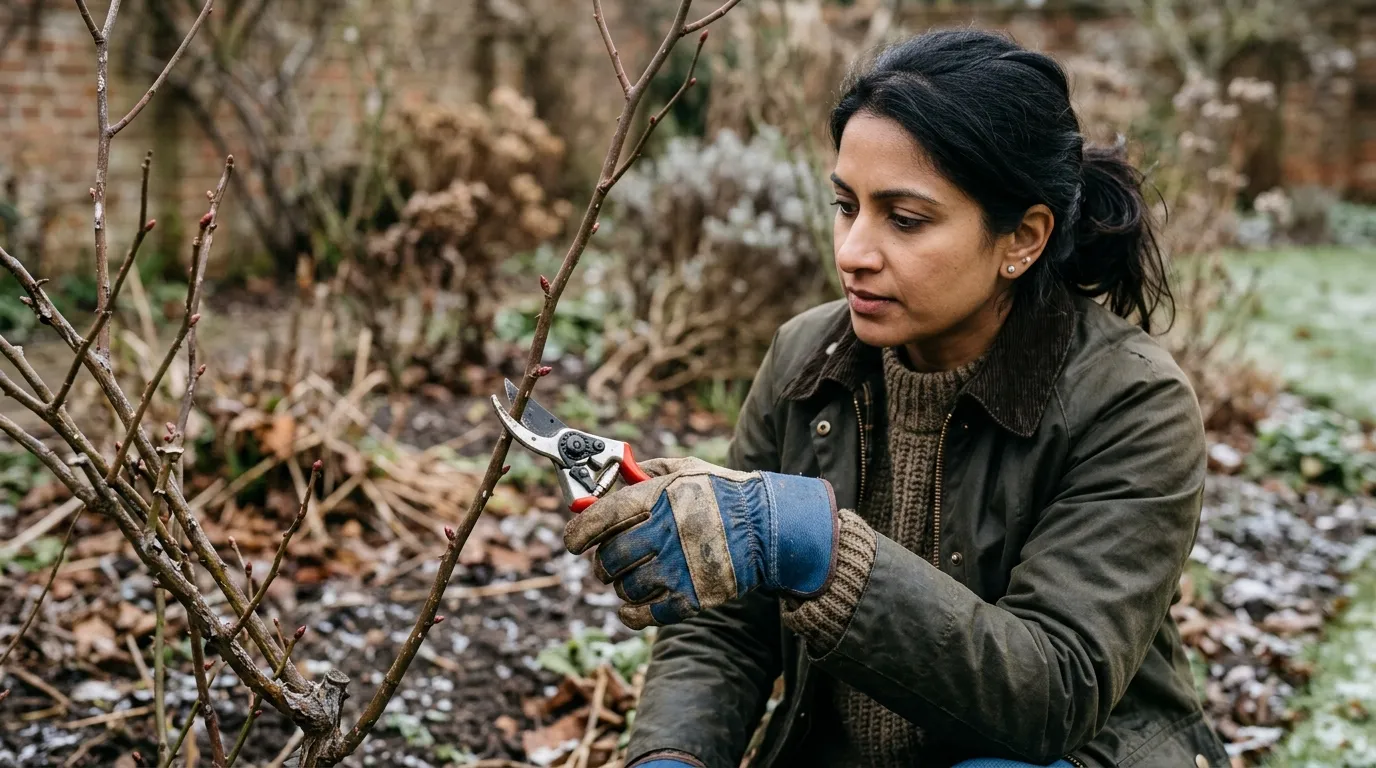 A clean angled cut, 5mm above an outward-facing bud, made in late February. The angle sheds water away from the bud and prevents stem rot.
Cause 2: Too much nitrogen
Nitrogen pushes leaf. Potash promotes flower. Get the ratio wrong and a rose becomes a leafy bush with no bud. The most common UK source of excess nitrogen is lawn feed running off into adjacent rose beds. A 25-5-5 weed-and-feed applied to a lawn six times a year delivers more nitrogen to neighbouring roses than the roses can balance.
Other sources catch UK gardeners out: fresh manure used as mulch (use only well-rotted), mushroom compost (slightly alkaline and nitrogen-rich), and general-purpose fertilisers with high N values like Growmore at 7-7-7.
The fix is twofold. First, stop the nitrogen at source - move lawn feeding to a slow-release granular applied only twice a year, and pull mushroom compost or fresh manure away from the rose root zone. Second, switch the rose feed to a potash-led NPK around 6-9-6. Vitax Q4, Toprose and Levington Rose Feed all sit in this range. Apply at 35g per square metre in late March and again in late June.
Bonemeal at planting helps long-term phosphorus levels (the P in NPK), which supports root and bud development. A handful (50g) worked into the planting hole at bare-root planting time is enough.
Cause 3: Blind shoots
A blind shoot is a stem that grows to full length and terminates in a tight fan of leaves instead of a flower bud. The shoot is healthy and green - it just refuses to flower.
A normal year sees 5-15% of canes go blind. A bad year can push that to 30%. The plant is not faulty - it is reacting to the weather.
The fix: identify blind shoots through May and prune each one back by half to a strong outward-facing leaf bud. The plant pushes a fresh sideshoot from that bud, and around 70% of these second-attempt shoots produce a flower bud successfully. Leave blind shoots in place and they just keep growing as foliage.
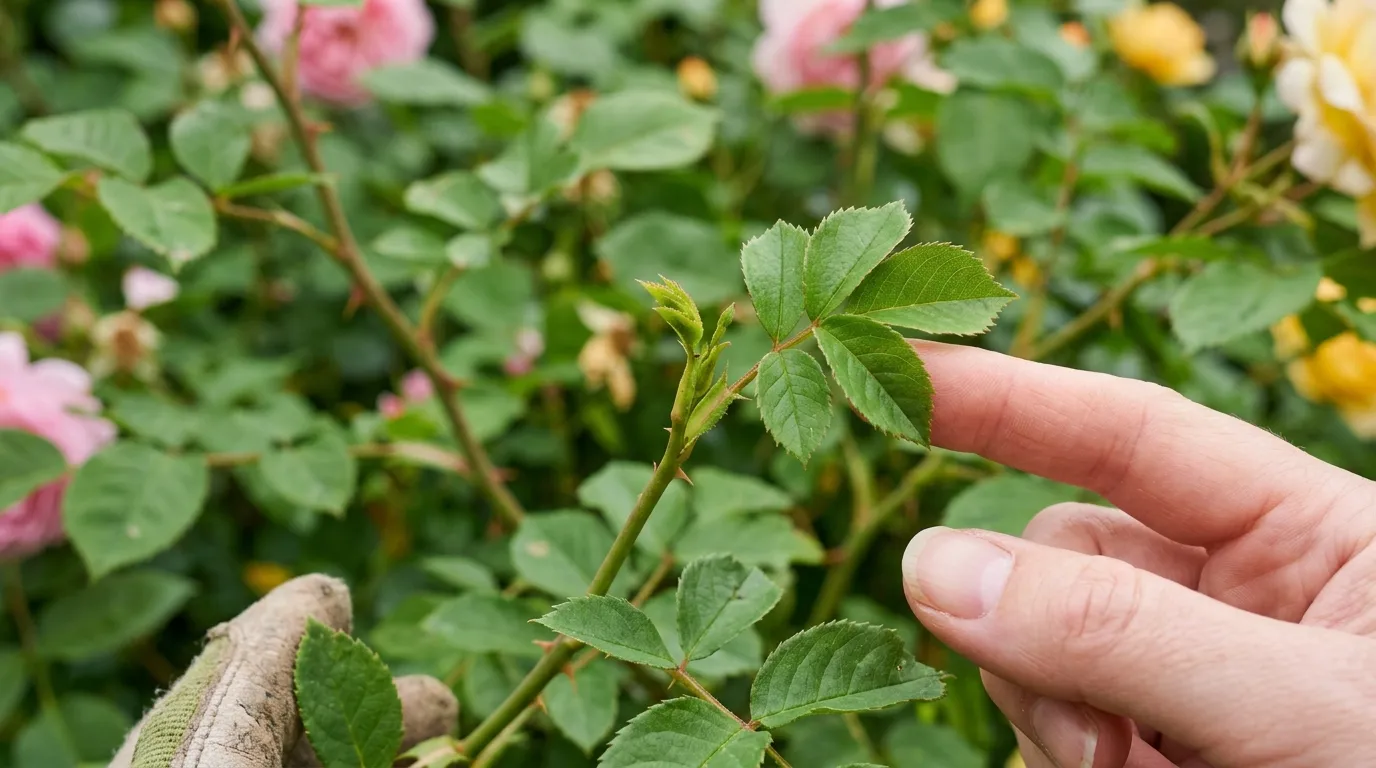 A textbook blind shoot. The stem is healthy and well-grown but terminates in leaves rather than a bud. Cut back by half to restart the bud-forming process.
Cause 4: Rootstock suckers taking over
Most named roses in the UK are grafted - the cultivar (the named rose you bought) is joined to a rootstock species (usually Rosa laxa or R. canina) at a graft union just below soil level. The rootstock is chosen for vigour and root tolerance, not for flowers.
If the rootstock throws its own shoots - suckers - and you do not remove them, the rootstock outgrows the cultivar within two to four seasons. The visible plant becomes a vigorous, leafy, near-flowerless wild rose.
The diagnostic signs of a sucker:
- Seven leaflets per leaf instead of five on cultivar wood
- Paler green leaves with a slightly matt finish
- Denser, smaller thorns than the cultivar
- Origin point below the graft union, often emerging from the soil itself rather than from the main stem
The fix is not to snip the sucker at ground level - that encourages it to send up more shoots. Trace the sucker back to the rootstock by carefully scraping away soil, grip the base where it joins the root, and tear it off cleanly. The torn wound seals faster than a cut and the rootstock is less likely to resprout from that point. Reseat the soil around the graft union.
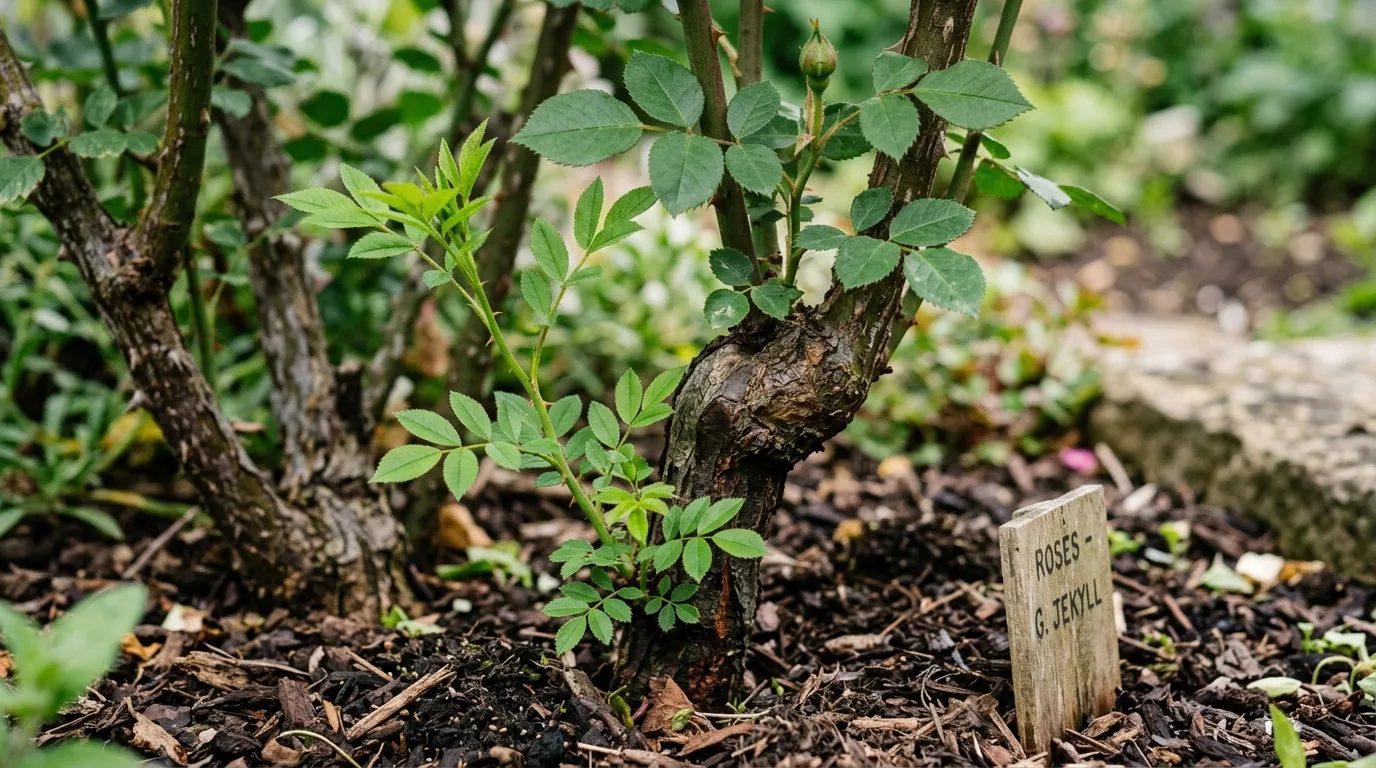 A rootstock sucker, identifiable by the seven leaflets and paler matt-finish leaves, emerging from below the graft union.
Cause 5: Deer, rabbits or muntjac browsing
The diagnostic sign: clean, slightly angled cuts on the soft tip of new shoots, usually at 200-400mm above the ground (rabbits) or 600-1500mm (muntjac, roe deer). No insect damage, no fungal symptoms, just missing tips.
The fix:
Cause 6: The rose is still too young
A bare-root rose planted between November and March puts most of its first-year energy into root establishment. Year-one flowering is usually three to seven blooms, sometimes none. By year two the plant should produce twenty to fifty flowers. Full production starts at year three.
Container-grown roses planted in summer are even slower to flower because they spend their first year recovering from the move and pushing roots into the new soil.
The fix is patience and the right feeding routine. Do not deadhead in year one - let the rose form hips and complete its hormonal cycle, which signals the plant to mature into bud-bearing wood faster. Apply potash feed in spring (March) and again at midsummer (late June). Water deeply weekly through June, July and August.
For the planting basics see when to plant roses in the UK and how to grow roses for the full lifecycle routine.
Cause 7: Too shady a position
Roses are sun plants. A position with under four hours of direct sun a day pushes growth into leaf at the expense of bud. The result is the same leggy, leafy, flower-shy plant that excess nitrogen produces. The diagnostic difference is location: the plant is in a shaded spot rather than near a feeding source.
Direct sun matters more than total daylight. A bed that receives dappled light all day under a tree canopy will flower less well than a bed with four hours of full sun and the rest in shade.
Some rose types tolerate part shade better:
- Rosa rugosa varieties (Hansa, Roseraie de l’Hay) - flower well on 3-4 hours direct sun
- R. moyesii and species roses - tolerant of dappled light under high oak canopy
- Modern shade-tolerant shrub roses like ‘Penelope’ and ‘Buff Beauty’
The fix is either to move the rose (best done November to February as bare root, or autumn for established plants) or to thin the overhead canopy. A 30% crown lift on a deciduous tree can be enough to bring a struggling rose into productive sun.
If a move is needed, see how to grow roses for the transplant routine.
Cause 8: Drought stress
Roses are deep-rooted once established, but they will not produce buds under sustained drought. A rose receiving under 25mm of rain a fortnight in June, July and August will abort developing buds to conserve water. The first sign is dull, slightly droopy leaves on warm afternoons. The second is a flush of buds that brown and drop before opening.
UK summers are increasingly hitting drought territory. The 2018 and 2022 summers both delivered six-week stretches under 15mm rainfall across the Midlands and South-East. Both years produced widespread bud abortion in client gardens.
The fix is a deep weekly soaking, not daily sprinkling. A mature shrub rose needs around 9 litres of water at the root zone once a week through dry spells. Apply with a watering can directed at the soil, not the foliage (wet leaves encourage black spot). A 50-75mm mulch of well-rotted manure or composted bark in March holds spring soil moisture into June.
Drip irrigation set to 30 minutes twice a week on a timer is the lowest-effort option for a rose bed. A 5-rose bed needs around 200-250 litres a week through July and August.
For drought-tolerant garden design see no dig on heavy clay soil, which builds the water-holding humus layer roses need.
Cause 9: Stem dieback and old wood
On roses over six or seven years old, internal stem decay (dieback) starts to limit bud-bearing surface. A dieback-affected cane shows blackened tips and a brown core when cut across. Buds either fail to form on the affected wood or open weak and drop early.
The fix is a staged renewal pruning over two to three years:
- Year one (late February): identify the three oldest, woodiest canes at the base. Cut them out at ground level. Cut all dieback back to clean green wood, going down a fresh 50-100mm at a time until the core shows uniform white-green pith.
- Year two: remove a further two of the older canes. The plant should be pushing fresh young basal shoots from the renewed pruning.
- Year three: cut out any remaining old wood and shape the new growth. Flowering should be back to full production by the third summer.
Painting cuts with bituminous sealant is no longer recommended in the UK - clean angled cuts heal faster on their own and sealants can trap moisture against the wound.
For diagnosis help see our guide to black spot on roses, as fungal dieback and black spot often co-occur.
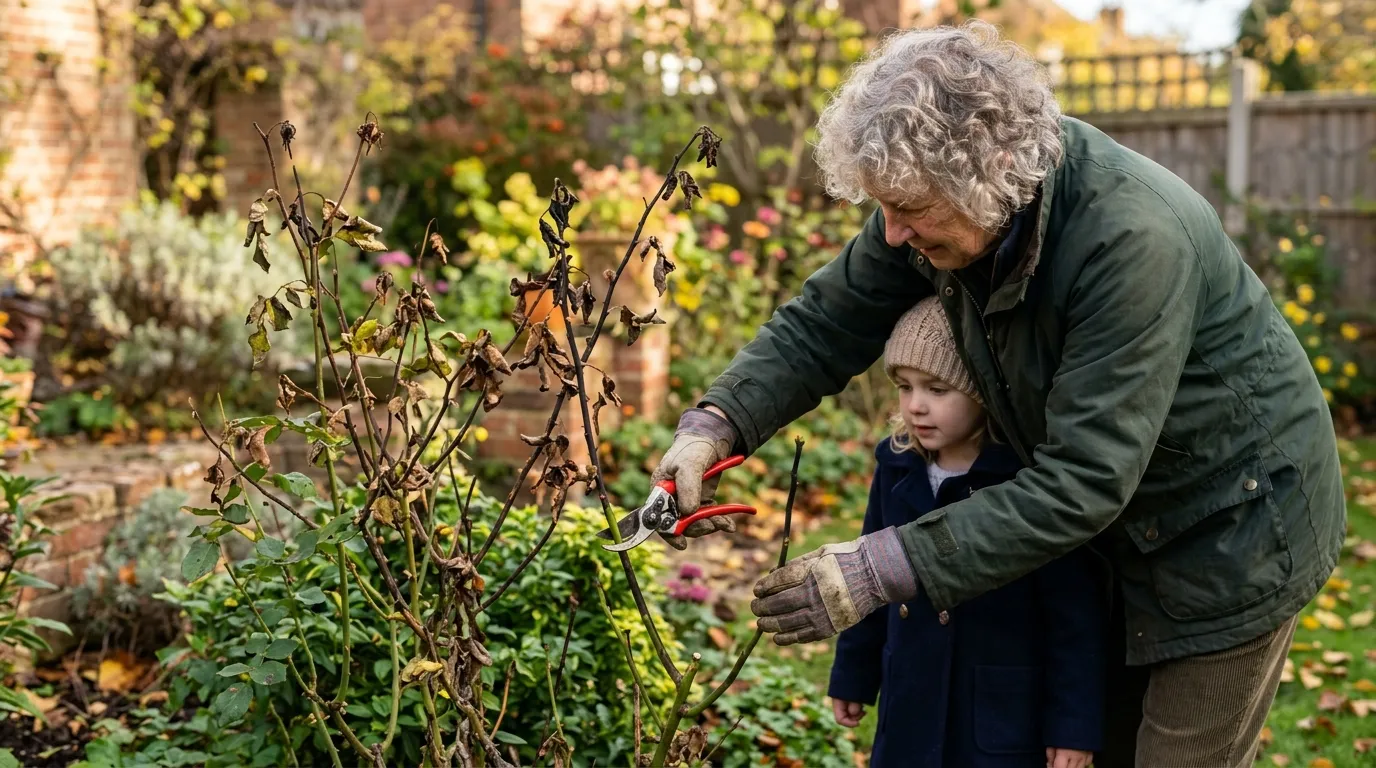 Dieback cut back to clean green-cored wood. The pith should be uniform white-green, not brown or grey, before stopping.
Quick diagnostic table - cause, sign, fix
| Cause | Diagnostic sign | Quick fix |
|---|---|---|
| Wrong pruning time | All-leaf after a hard May/June prune | Wait until late February next year |
| Excess nitrogen | Lush leaves, no buds, near a fed lawn | Switch to potash-led 6-9-6 feed |
| Blind shoots | Stems ending in a fan of leaves | Prune back by half to a leaf bud |
| Rootstock suckers | 7-leaflet leaves, paler, denser thorns | Tear out below the graft, not cut |
| Wildlife browsing | Clean nibbled tips, no other damage | Mesh barrier + Grazers G1 spray |
| Plant too young | Bare root in year one, few or no blooms | Wait for year three for full bloom |
| Too shady | Leggy plant, under 4hr direct sun | Move plant or thin tree canopy |
| Drought stress | Buds abort or brown before opening | 9 litres deep weekly, 50mm mulch |
| Stem dieback | Black tips, brown core in cut canes | Staged renewal pruning, 3 years |
Month-by-month flowering recovery calendar
| Month | What to do |
|---|---|
| January | Order replacement feed (NPK 6-9-6). Check planting position for shade. |
| February | Prune main structural cuts late month once frosts ease. Remove dieback to clean wood. |
| March | Apply potash feed at 35g per m2. Mulch 50mm well-rotted manure, kept 50mm clear of stems. |
| April | Watch for blind shoots forming. Spray Grazers G1 if deer or rabbit pressure. |
| May | Prune all blind shoots back to a leaf bud. First buds should be forming on healthy wood. |
| June | Deepwater 9 litres per plant weekly. Apply second potash feed at end of month. |
| July | Deadhead spent flowers on repeat-flowering varieties. Continue weekly deep watering. |
| August | Continue deadheading. Watch for drought stress on light soils. |
| September | Stop feeding to allow wood to harden before winter. |
| October | Light tip-prune long shoots to prevent wind rock. |
| November | Bare-root planting season opens. Plant replacements deep with graft union at soil level. |
| December | Apply winter mulch over root zone once frosts arrive. |
Common mistakes to avoid
Five mistakes account for most failed flower recovery in UK gardens:
- Pruning every rose the same. Once-flowering roses set buds on old wood. Repeat-flowering moderns set on new wood. Pruning both in March works for repeats and ruins once-flowerers.
- Using mushroom compost as mulch around roses. The alkalinity and nitrogen push leafy growth and shift soil pH against the rose. Use well-rotted manure or composted bark instead.
- Snipping suckers at ground level. This stimulates more sucker production. Always trace down and tear off the sucker at its origin on the rootstock.
- Watering little and often. Daily light watering wets the surface and encourages shallow roots that fail in drought. Once a week, 9 litres, directly at the root zone.
- Giving up after one bad year. The 2024 cold spring caused a national surge in blind shoots. The same plants flowered normally in 2025. Weather-driven non-flowering is usually a one-year event.
Frequently asked questions
Why is my rose growing leaves but no flowers?
Excess nitrogen is the most common cause in UK gardens. Lawn fertiliser, mushroom compost or fresh manure pushes leafy growth and suppresses flower-bud formation. Switch to a potash-led rose feed at NPK 6-9-6, stop nitrogen-heavy mulches, and most roses recover by the following summer.
When should I prune roses in the UK to make them flower?
Late February to early March for most roses, when the worst frosts have passed but before active growth. Pruning after April removes the flowering wood on once-flowering ramblers and old roses. Repeat-flowering modern roses tolerate a wider window but spring is still best.
How do I tell a rose sucker from a normal shoot?
Suckers come from below the graft union, usually below soil level, and have seven leaflets per leaf instead of five on cultivar roses. The bark is paler and the thorns are denser. Dig down to the sucker’s origin and tear it off the rootstock - cutting at ground level only encourages regrowth.
How much sun does a rose actually need?
At least four hours of direct UK sunshine, six is better. Under four hours of sun, most roses produce leaf without bud. Some shrub roses (Rosa rugosa, R. moyesii) tolerate part shade but climbing and hybrid tea varieties always need more light.
Will my new bare-root rose flower in its first year?
Usually only lightly. A bare-root rose planted in November to March puts most of its energy into roots during year one. Expect three to seven flowers in the first summer, twenty to fifty by year two, and full production from year three. Resist deadheading in year one to allow the plant to build reserves.
Next steps
Now you have identified why your rose is not flowering, the next step is fixing the underlying soil and routine. Read our guide on black spot on roses - the same nitrogen-heavy beds that cause flower failure also drive black spot outbreaks, and treating both at once is the fastest route back to healthy bloom.
Our team produces practical UK gardening guidance from source research, contributor records and established horticultural practice. Editorial standards are overseen by Matt W.