Key takeaways
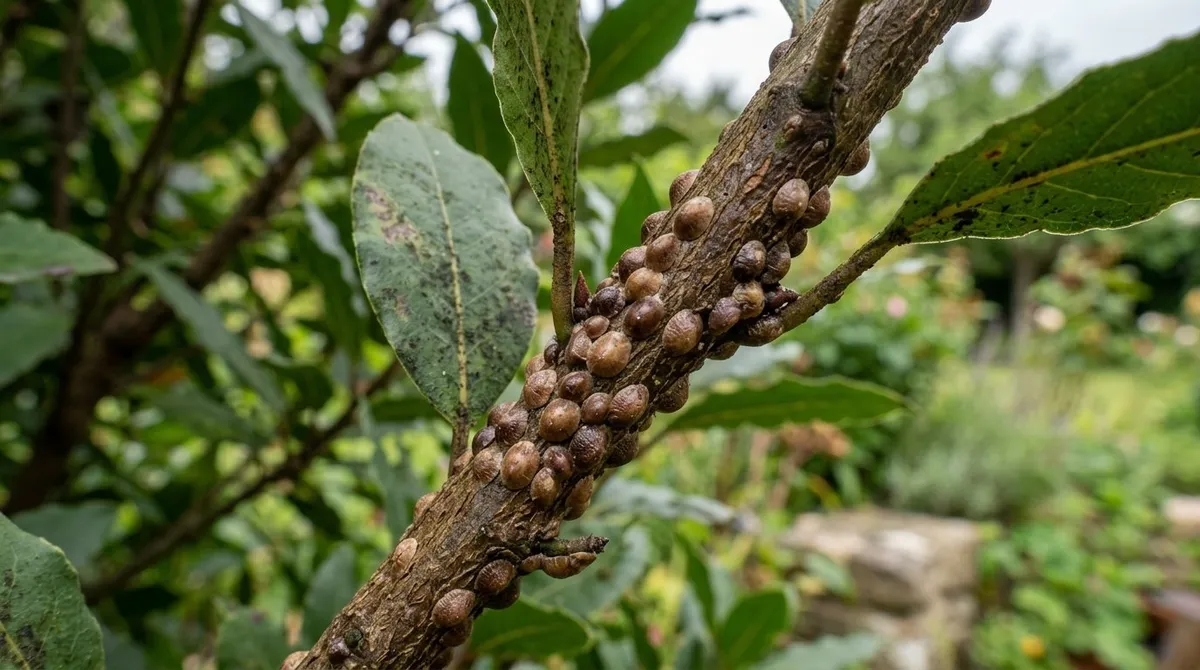
- Scale insects look like small brown or grey bumps on stems and leaves, often mistaken for part of the plant
- Over 25 species occur in the UK, divided into soft scale (Coccidae) and hard scale (Diaspididae) families
- Honeydew excretion causes black sooty mould on leaves below the infestation, reducing photosynthesis
- Scrubbing with an old toothbrush and dilute washing-up liquid is the most effective home treatment
- Bay trees, camellias, citrus, hollies, euonymus, and houseplants are the most commonly attacked plants
- Biological control with Metaphycus helvolus works in heated greenhouses but needs sustained temperatures above 20C
Scale insects are among the most overlooked pests in British gardens. They sit motionless on stems and leaf undersides, disguised as small brown, grey, or white bumps that most gardeners mistake for bark, dried sap, or part of the plant itself. Beneath each bump is a sap-sucking insect that feeds continuously, weakening the host plant month after month.
The first clue is usually not the scale itself but the sticky residue it leaves behind. Honeydew drips onto lower leaves, pavements, and windowsills. Black sooty mould colonises the honeydew, turning surfaces dark. By the time you notice the mould, the infestation may have been building for a year or more.
What are scale insects?
Scale insects belong to the superfamily Coccoidea, a group of sap-sucking true bugs (Hemiptera) with over 8,000 species worldwide. More than 25 species occur in UK gardens and glasshouses. They divide into two main groups: soft scale (family Coccidae) and hard or armoured scale (family Diaspididae).
All scale insects share a distinctive lifecycle. Mobile first-instar nymphs, called crawlers, emerge from eggs and disperse across the plant. Once they find a feeding site, they insert their mouthparts into the plant tissue and become permanently attached. They never move again. Over weeks, they develop a protective covering — either a waxy shell fused to their body (soft scale) or a separate armoured plate they secrete over themselves (hard scale).
Adult females are the bumps you see on plants. Males are tiny, winged insects that live only a few days and are rarely noticed. Most UK species reproduce without mating (parthenogenesis), so a single scale insect can start a new infestation.
Scale insects are extremely common on bay trees, camellias, citrus, holly, euonymus, and a wide range of houseplants. They also attack ivy, viburnum, olive trees, and ornamental shrubs grown against warm walls.
How to identify scale insects on UK plants
The most reliable way to confirm scale insects is the fingernail test. Scrape a suspicious bump with your thumbnail. If it comes away from the stem and leaves a wet mark or a tiny yellowish insect underneath, it is scale. If it does not move or is clearly part of the bark, it is not.
Brown soft scale (Coccus hesperidum) is the most common species on houseplants and conservatory plants. Adults are oval, 3-5mm long, flat, and glossy brown. They cluster along midribs on leaf undersides and in the angles where leaf stalks meet stems.
Mussel scale (Lepidosaphes ulmi) is the most common outdoor species. It attacks apple trees, cotoneaster, dogwood, and many ornamental shrubs. Adults are grey-brown, 2-3mm long, and shaped like tiny mussels. Heavy infestations make bark look grey and scaly.
Cushion scale (Pulvinaria floccifera) is unmistakable. Females produce a large white, cottony egg sac that protrudes behind the body. Common on camellia, rhododendron, and holly. The white egg masses are often the first thing gardeners notice, usually in May-June.
Woolly vine scale (Pulvinaria vitis) appears on grape vines, ornamental trees, and shrubs. Similar to cushion scale but with a more elongated egg sac. Heavy infestations on deciduous trees are most visible in winter when leaves have dropped.
Comparison: common UK scale insect species
| Species | Common name | Size | Colour | Main hosts | Honeydew? |
|---|---|---|---|---|---|
| Coccus hesperidum | Brown soft scale | 3-5mm | Glossy brown, flat oval | Houseplants, bay, citrus, ferns | Yes, heavy |
| Saissetia coffeae | Hemispherical scale | 3-4mm | Dark brown, domed | Houseplants, ferns, orchids | Yes |
| Parthenolecanium corni | Brown scale | 4-6mm | Reddish-brown, convex | Fruit trees, ornamentals | Yes, moderate |
| Lepidosaphes ulmi | Mussel scale | 2-3mm | Grey-brown, mussel-shaped | Apple, cotoneaster, dogwood | No |
| Pulvinaria floccifera | Cushion scale | 3-5mm + white sac | Brown body, white egg mass | Camellia, holly, rhododendron | Yes |
| Diaspis boisduvalii | Boisduval scale | 1-2mm | White, circular | Orchids, palms, ferns | No |
| Aspidiotus nerii | Oleander scale | 2mm | White-grey, circular | Bay, oleander, ivy, olive | No |
What damage do scale insects cause?
Scale insects cause damage through three mechanisms: sap loss, honeydew production, and secondary infections. A single scale insect does negligible damage. Populations of hundreds or thousands, building over months and years, create a cumulative drain on the host plant.
Sap loss is the primary injury. Each scale insect feeds continuously through a needle-like stylet inserted into the phloem. Heavily infested plants show yellowing leaves, reduced vigour, poor flowering, and dieback of smaller shoots. Growth slows noticeably. Container plants are more affected than those in open ground because they have limited root reserves.
Honeydew is the secondary problem. Soft scale species excrete large quantities of this sugary waste product. It coats leaves, stems, and anything beneath the plant. Black sooty mould (Capnodium spp.) quickly colonises the honeydew layer. The mould blocks light, reducing photosynthesis and making plants look unsightly. Hard scale species produce little or no honeydew.
Sooty mould does not parasitise the plant directly. It feeds only on the honeydew. Remove the scale and the honeydew stops. The mould then gradually weathers off over several months. Wiping leaves with a damp cloth speeds the process.
Ants are often the first visible indicator of a scale problem. They farm soft scale for honeydew, just as they farm aphids. If you see ant trails running up and down a stem, check for scale at the top. Ants also protect scale from natural predators, making infestations worse.
How to remove scale insects by hand
Physical removal is the most effective control method available to home gardeners. No spray penetrates the waxy shell of adult scale insects reliably. Scrubbing them off is crude but it works.
Use an old toothbrush or a small nail brush dipped in a solution of dilute washing-up liquid (1 teaspoon per litre of water). Work along each stem, scrubbing both sides. Pay special attention to branch junctions, leaf axils, and the undersides of leaves where scale cluster.
For bay trees and camellias, start at the top of the plant and work downward. Check every stem. Scale insects blend in extraordinarily well and it is easy to miss patches. A hand lens (x10 magnification) helps spot young nymphs that are only 1-2mm across.
Repeat every two weeks from April to September. Consistency matters more than thoroughness on any single session. You will miss some each time. Fortnightly scrubbing catches new crawlers before they mature and develop their protective covering.
For houseplants, dab individual scale insects with a cotton bud soaked in methylated spirits. The alcohol dissolves the waxy covering and kills the insect underneath. This is precise but time-consuming. It works well on orchids and small foliage plants where a toothbrush might damage delicate stems.
Prune out heavily infested branches entirely. Burn or bin the prunings. Do not compost them. If more than 50% of a stem’s surface is covered in scale, pruning is faster and more effective than scrubbing.
Does neem oil work against scale insects?
Neem oil provides partial control of scale insects, mainly against the crawler stage. It is not a standalone solution for established infestations but can reduce crawler survival when applied during the June-July emergence window.
Mix neem oil at the manufacturer’s recommended rate (typically 5-10ml per litre of water) with a few drops of washing-up liquid as an emulsifier. Spray all surfaces of the affected plant, including stems and leaf undersides, until dripping. Apply in the evening to avoid leaf scorch. Repeat every 7-10 days during the crawler period.
Neem works through contact and as an anti-feedant. It disrupts the growth hormones of young nymphs, stopping them from developing properly. However, the oil does not penetrate the hardened shell of mature adult scale. Adults survive neem sprays and continue breeding.
For more on using neem oil in the garden, see our dedicated guide covering dilution rates, timing, and safety precautions for edible crops.
Horticultural soap sprays (potassium salts of fatty acids) work similarly to neem. They kill soft-bodied crawlers on contact but do not affect shielded adults. Winter plant oil washes applied to dormant deciduous trees and shrubs smother overwintering nymphs and can reduce spring populations. Apply in December-January when the plant is fully dormant.
What biological controls target scale insects?
Metaphycus helvolus is a parasitic wasp used commercially against soft scale in heated glasshouses. It lays eggs inside soft scale insects, and the developing wasp larva kills the host from within. It requires sustained temperatures above 20C to be effective, which limits its use to heated greenhouses and conservatories.
Order Metaphycus from biological control suppliers between May and September. Release directly onto infested plants. The wasps are tiny (1-2mm), harmless to humans, and do not survive British winters outdoors. They establish best in enclosed spaces where temperatures are stable. In a heated greenhouse, a single release can provide ongoing control for the season as the wasps breed and parasitise successive generations of scale.
For outdoor plants, natural predators provide some control. Ladybirds, particularly the two-spot ladybird, eat scale crawlers. Parasitic wasps from the genera Aphytis and Encarsia attack various scale species in the wild. Encourage these by avoiding broad-spectrum pesticide sprays and maintaining diverse planting. Our guide to organic pest control covers how to build natural predator populations.
In the UK, no scale-specific chemical insecticide is available to amateur gardeners since the withdrawal of several systemic products. Professional operators have access to spirotetramat-based products under licence, but these are not sold in garden centres.
How to manage scale insects on indoor plants
Indoor scale infestations are harder to control because there are no natural predators and conditions suit rapid breeding. Warm, dry indoor environments with no wind or rain allow scale populations to build unchecked. A single infested plant introduced from a garden centre can spread scale to every houseplant in a collection within a year.
Isolate any plant where you find scale. Move it away from other houseplants immediately. Scale crawlers are small enough to travel between plants whose leaves touch. They also spread on hands, tools, and watering cans.
For mild infestations on sturdy plants, wipe down every leaf and stem with a cloth soaked in dilute washing-up liquid. For delicate plants like orchids, use a cotton bud with methylated spirits on each individual scale. Check the plant weekly for 8 weeks after treatment. Scale insect eggs can hatch over an extended period.
Shower houseplants monthly under a lukewarm tap. The water pressure dislodges crawlers and washes off honeydew. This alone will not eliminate an infestation, but it slows population growth and removes sooty mould.
Avoid systemic insecticide sticks (imidacloprid products) that were previously popular for houseplant pest control. Most have been withdrawn from sale in the UK following neonicotinoid restrictions.
Can scale insects spread to other plants?
Scale insects spread primarily during the crawler stage, which lasts only a few days. Crawlers are tiny (0.5mm), six-legged, and mobile. They walk to new feeding sites on the same plant or travel to adjacent plants whose branches or leaves touch. They are also dispersed by wind, carried on clothing, and transferred on tools.
Once a crawler settles and begins feeding, it never moves again. This means established adult scale cannot walk to a new plant. The risk of spread exists only during the brief crawler window, mainly June-July for most UK species.
In greenhouses, scale spreads readily because plants are close together, temperatures are warm, and wind is minimal. Inspect all new plants before placing them in the greenhouse. Quarantine new arrivals for 3-4 weeks and check weekly before introducing them to your main collection.
Buying infested plants from garden centres and nurseries is the most common way scale insects enter a garden. Always inspect the stems, leaf undersides, and pot rim of any plant before purchasing. Brown bumps on a bay tree in a garden centre are not a sign of character. They are scale insects.
Related reading: Jade plants are a favourite scale target, so read our guide to watering and feeding jade plants.
Frequently asked questions
What do scale insects look like on plants?
Scale insects appear as small raised bumps on stems and leaf undersides. Brown soft scale is oval, 3-5mm long, and glossy brown. Mussel scale is grey, elongated, and mussel-shaped. Cushion scale has a white waxy egg sac trailing behind it. Many gardeners mistake scale for natural bark growths or dried sap. Scrape a bump with a fingernail. If it comes off and leaves a wet mark, it is scale.
Why do my plants have sticky leaves and black mould?
Sticky leaves with black sooty mould indicate a sap-sucking pest above. Scale insects excrete honeydew, a sugary liquid that drips onto leaves below. The sooty mould fungus (Capnodium) colonises the honeydew, turning surfaces black. The mould itself does not parasitise the plant, but it blocks light and reduces photosynthesis. Removing the scale stops honeydew production and the mould eventually weathers off.
How do I get rid of scale insects on a bay tree?
Scrub scale off bay tree stems with an old toothbrush dipped in dilute washing-up liquid. Work systematically from the top of each branch downward. Repeat every 2 weeks from April to September. Target young crawlers in June-July when they are most vulnerable. Prune out heavily infested inner branches to improve air circulation. Neem oil spray provides temporary knockback but does not penetrate the adult shell.
Do scale insects kill plants?
Scale insects rarely kill mature plants outright but cause a slow decline over years. Heavy infestations weaken plants through constant sap loss, causing yellowing leaves, poor growth, and dieback of branch tips. Young plants and houseplants in pots are more vulnerable because they have fewer reserves. Containerised citrus trees can be killed by severe scale infestations within 2-3 seasons if untreated.
What is the difference between soft scale and hard scale?
Soft scale insects produce honeydew and their shell is fused to their body. Hard or armoured scale produce a separate waxy cover that is not attached to the insect underneath. You can lift the armour off hard scale with a needle to reveal the insect below. Soft scale is more common on indoor plants and bay trees. Hard scale species like mussel scale and oleander scale attack outdoor plants.
When are scale insect crawlers active in the UK?
Scale insect crawlers emerge mainly in June and July. This is the only mobile life stage. Once crawlers settle and begin feeding, they become immobile for life. Crawlers are the most vulnerable stage and the best window for spray treatments. They are 0.5mm long, pale, and barely visible without a hand lens. Sticky tape wrapped around infested stems traps crawlers and confirms timing.
Can I use neem oil to treat scale insects?
Neem oil spray provides partial control, mainly against crawlers and young nymphs. It works best during the crawler window in June-July. Spray fortnightly, covering all surfaces. Neem does not penetrate the waxy covering of mature adult scale. For established infestations, physical removal with a toothbrush is more effective than any spray. Use neem as a supplement to scrubbing, not a replacement.
Our team produces practical UK gardening guidance from source research, contributor records and established horticultural practice. Editorial standards are overseen by Matt W.