Key takeaways
- Asymmetric yellowing (one side of the plant first) is the classic Fusarium wilt symptom
- Cut the stem lengthwise - brown vascular discoloration confirms Fusarium
- There is no cure - infected plants must come out within days of diagnosis
- Resistant varieties marked F or F1F2 (e.g. Sungold F1, Shirley F1) avoid the disease
- Grafting onto Beaufort or Maxifort rootstock is the most reliable solution for repeat infections
- Fusarium survives in soil for 5-7 years - rotate or replace greenhouse soil
- Bin infected plants - never compost. Hot composting at 60C+ might work but home heaps rarely reach that
The first sign of Fusarium wilt on a tomato plant is one yellow leaf where the others are green. Within a week the entire side of the plant has turned yellow. By the time you slice the stem and see the brown vascular ring, the plant is already finished. There is no cure and no rescue.
For the broader picture of UK tomato problems, our tomato blight prevention and treatment UK guide covers the other major UK tomato disease.
What Fusarium wilt is
Fusarium wilt of tomato is caused by Fusarium oxysporum f. sp. lycopersici - a soil-borne fungus that enters the plant through the roots, blocks the xylem (water-conducting vessels), and kills the plant by drought-shock from the inside.
The fungus is host-specific to tomato, with related forms attacking peppers (f. sp. capsici), aubergines, and certain ornamentals. Lycopersici only attacks tomatoes - it does not spread to other crops, but it stays in soil for 5-7 years even with no tomato host present.
Three races of the fungus are recognised:
- Race 1 - the original and most common. Resistance is widely available in F1 hybrids.
- Race 2 - emerged in the 1940s. Resistance available but requires F1F2 designation.
- Race 3 - emerged in the 1970s, mostly in commercial production. Rare in UK gardens.
Most UK garden Fusarium is race 1, occasionally race 2. Resistant F1 hybrids handle both.
The fungus spreads via:
- Infected soil (the main route)
- Infected plant debris (foliage, stems, roots left in soil)
- Contaminated tools (secateurs, trowels, hands)
- Water runoff between beds
- Infected seedlings (rare with reputable suppliers)
Once present in soil, Fusarium thrives in warm conditions. Soil temperatures above 21C trigger the most severe outbreaks. UK greenhouse soils typically reach this temperature from late June to early September - the peak Fusarium season.
How to identify Fusarium wilt
Five signs distinguish Fusarium from other tomato problems.
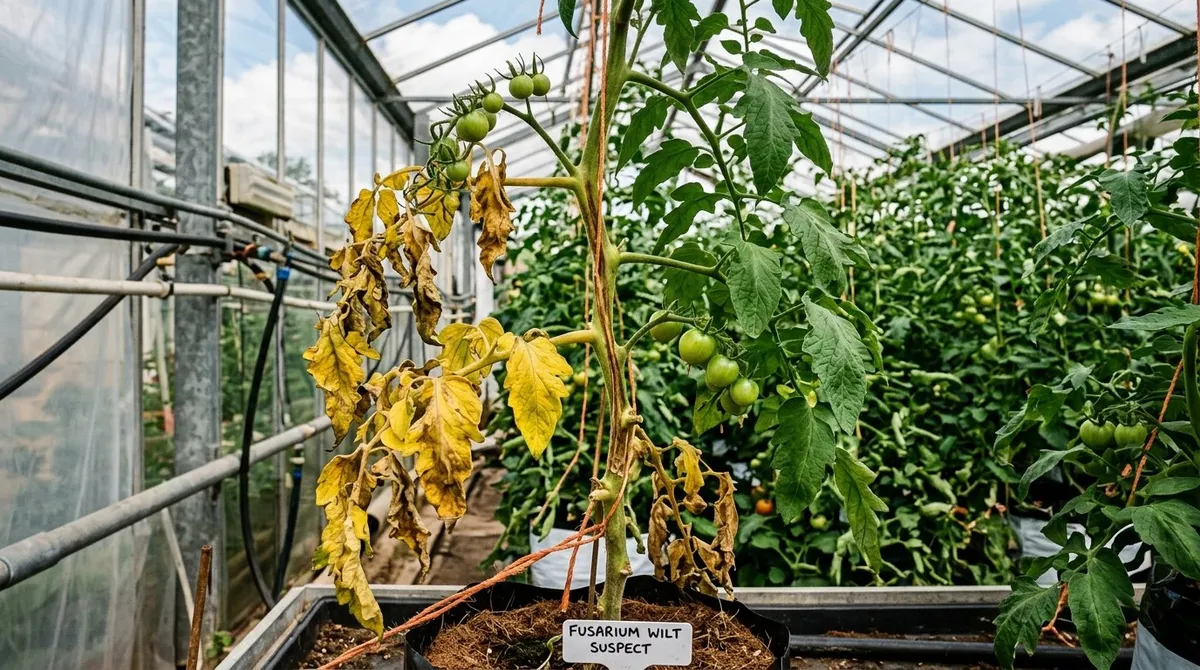
1. Asymmetric yellowing. This is the classic and almost diagnostic symptom. One side of the plant turns yellow while the other stays green. Often a single branch or one half of the plant is affected first. Yellowing progresses outward from the centre of leaves.
2. Yellowing starts low, moves up. Lower leaves yellow first. Upper leaves and growing tip stay green for several days. As the disease progresses, the whole plant wilts.
3. Wilt that does not recover at night. In early Fusarium, plants wilt in midday heat and partially recover overnight. By day 7-10 they no longer recover - permanent flagging of leaves even in cool morning temperatures.
4. Brown vascular ring. Slice the stem lengthwise (a 5cm cut from below the lowest yellowing leaf is enough). Look for brown discoloration in a ring just under the bark. This is the most reliable confirmation. Healthy stems are pale green throughout. Fusarium-affected stems show brown streaks.
5. No fruit or split fruit. Plants in the late stages of Fusarium produce small, malformed, or stunted fruit. Existing fruit may split or drop. Fruit that does ripen often has internal browning.
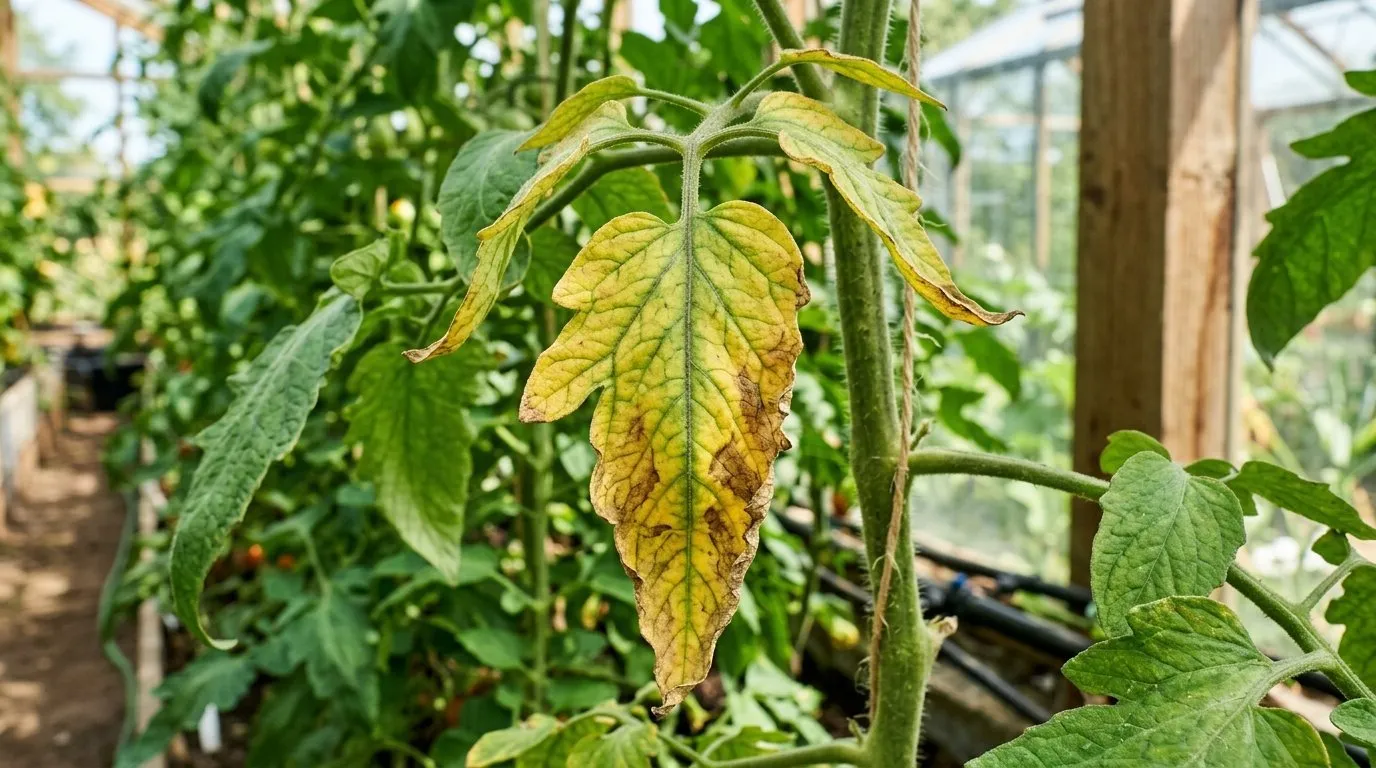 The classic Fusarium wilt yellowing pattern. The chlorosis starts at the leaf edge and works inward in a V-shape, often affecting one side of the leaf or one side of the plant before the other. Yellowing of one branch on a plant with green growth elsewhere is almost diagnostic.
Distinguishing Fusarium from look-alikes
Several other problems cause similar symptoms. Here is how to tell them apart.
| Disease | Yellowing pattern | Stem cross-section | Speed | Soil temp |
|---|---|---|---|---|
| Fusarium wilt | Asymmetric, one side first | Brown vascular ring | Fast (2-4 weeks) | 21C+ |
| Verticillium wilt | Symmetric, both sides | Brown vascular ring | Slower (4-8 weeks) | 17-22C |
| Bacterial wilt | Sudden total wilt | Brown ooze when squeezed | Very fast (1-2 weeks) | 20C+ |
| Magnesium deficiency | Between veins, both sides | Healthy green | Slow, recovers | Any |
| Drought stress | Whole plant simultaneously | Healthy green | Recovers with water | Any |
| Late blight | Brown patches, no yellowing | No vascular damage | Very fast | 15-20C |
The stem cross-section test (cut lengthwise, look for brown ring) confirms Fusarium or Verticillium and rules out the other look-alikes. Both wilts are treated the same way (resistant varieties, grafting, rotation), so a precise distinction is rarely necessary for garden growers.
For a confirmed laboratory diagnosis, send a sample to the RHS plant pathology service. Members can submit free; non-members pay around £35 per sample.
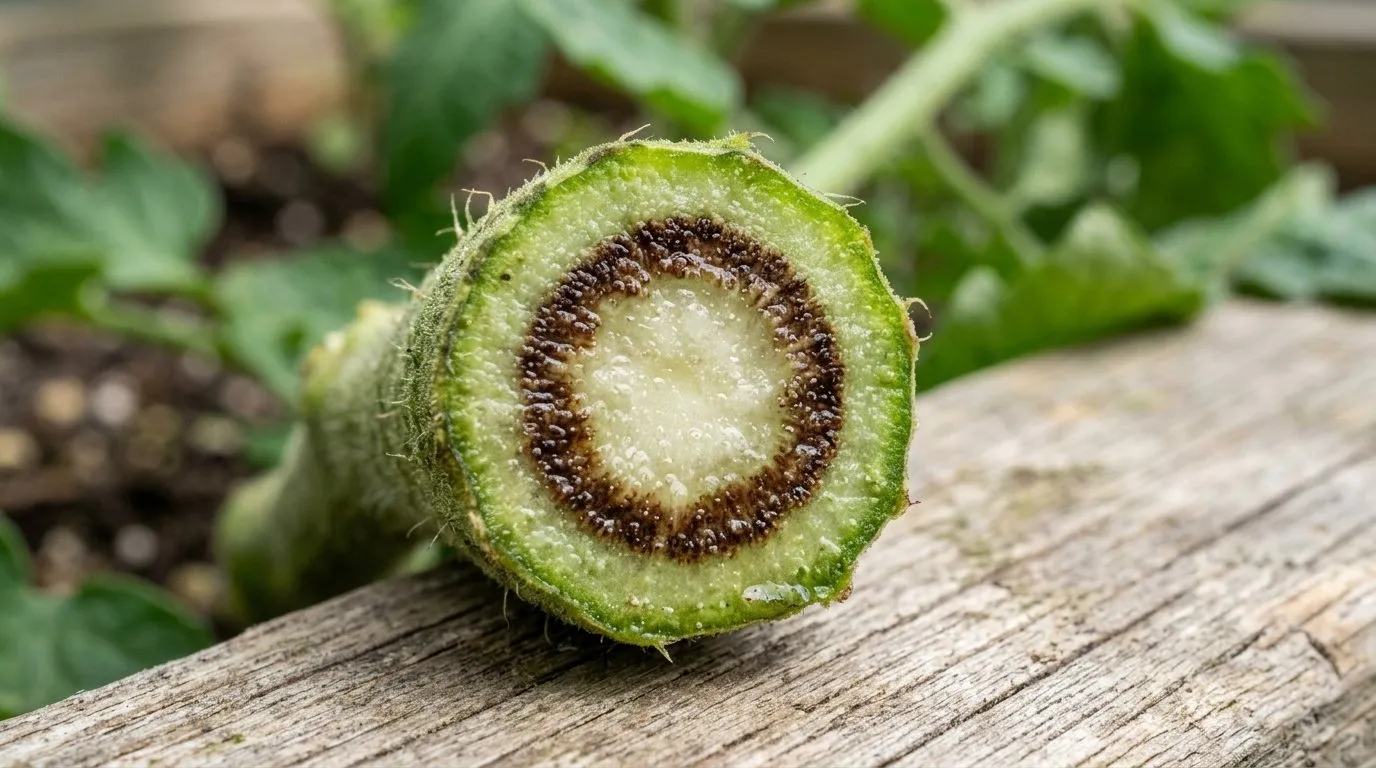 The diagnostic test. Cut a tomato stem lengthwise, 5cm below the lowest yellowing leaf. A brown ring of discoloured tissue under the bark confirms Fusarium (or Verticillium) wilt. Healthy stems are pale green throughout the cross-section. This test takes 30 seconds and saves entire crops.
What to do when you find it
Speed matters. Once Fusarium is confirmed, every day the plant remains in soil is more fungus released into the bed.
Step 1: Bag the plant entire. Including roots, soil clinging to roots, and any leaves on the ground. Use a heavy-duty rubble sack or two refuse bags doubled. Tie tightly.
Step 2: Dispose in household waste. Council green-waste collections often hot-compost at temperatures that may kill Fusarium - check with your council. Home compost heaps rarely reach the 60C+ needed to kill the spores. Bin or municipal collection only - never home compost.
Step 3: Disinfect tools and hands. Secateurs, trowels, gloves used on the plant. Wash with soap and water, then wipe with surgical spirit or bleach solution (1:10 in water).
Step 4: Mark the affected bed. A small label or note about the year of infection. Fusarium stays in soil for 5-7 years - the marker reminds you when planning rotations.
Step 5: Monitor neighbouring plants. Fusarium can spread plant-to-plant via water splashing or root contact. Check adjacent plants every 2-3 days for the next month.
Step 6: Plan recovery for next season. Decide between rotation, soil replacement, or grafted plants (covered next).
The biggest mistake new growers make is leaving the infected plant in place hoping it will recover. It will not, and every day it stays it releases more fungus into the soil and increases the risk to neighbours.
Three ways to grow tomatoes again in affected soil
After a confirmed Fusarium outbreak, three options for the following season.
Option 1: Grafted plants on resistant rootstock
The most reliable solution. Buy or graft tomatoes onto rootstock varieties bred specifically for Fusarium resistance.
Best UK rootstocks:
- Beaufort F1 - the most common. Resistant to Fusarium races 1 and 2, Verticillium, root-knot nematode, and tobacco mosaic virus. Vigorous - feed and water well.
- Maxifort F1 - similar resistance profile to Beaufort, slightly more vigorous. Best for greenhouse growing.
- Estamino F1 - Fusarium and Verticillium resistance plus excellent cool-tolerance. Good for outdoor UK growing.
Where to buy grafted plants:
- Suttons Seeds - delivers grafted plants in May
- Plants of Distinction - specialist tomato grafting
- Marshalls Garden - mainstream grafted plant range
- Local garden centres in spring
Pricing: Grafted plants cost £5-7 each versus £2-3 for ungrafted. For a 6-plant greenhouse, that is £24-30 extra - cheap insurance against a £200 loss.
Option 2: Soil rotation
If you have multiple tomato beds or alternative growing space, rotate.
- Wait 5 years minimum before growing tomatoes in the affected soil
- Grow other crops in the affected bed - alliums (onions, garlic, leeks), brassicas, beans
- Avoid related crops in the same bed: peppers, aubergines, potatoes (different Fusarium types)
For a single greenhouse with no alternative space, rotation is impractical without other steps.
Option 3: Soil replacement
The most expensive but the most thorough solution.
- Remove the top 30cm of soil from the affected bed
- Replace with fresh topsoil mixed with well-rotted compost (50:50)
- Cost: roughly £80-150 for a 4m x 1m bed depending on local soil prices
Worth the investment for a small greenhouse where rotation is impossible and grafted plants are not available. Fusarium stays in deeper soil layers but rarely affects tomato roots beyond 30cm depth.
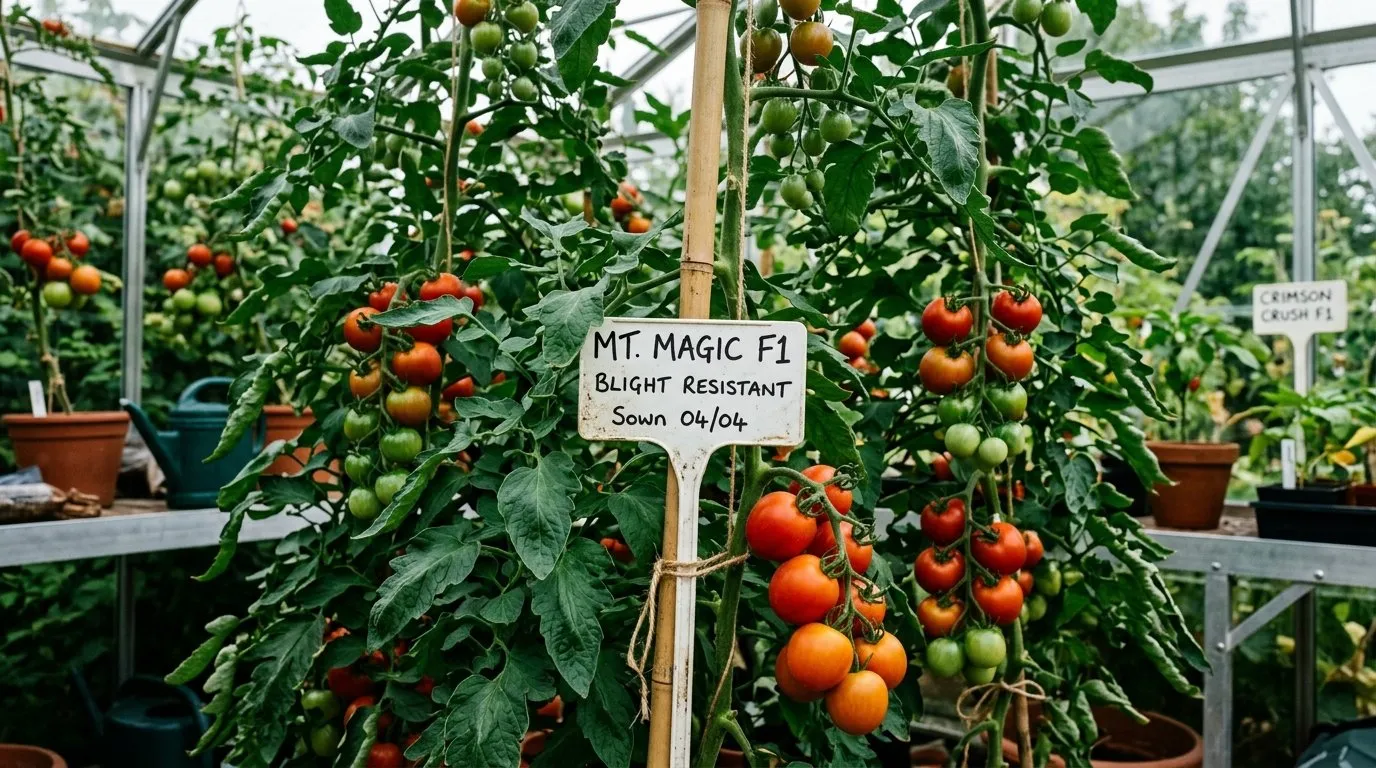 Resistant F1 hybrid varieties marked F (Fusarium) or F1F2 (both races) avoid Fusarium altogether. Sungold F1, Shirley F1, Ferline F1, and Crimson Crush F1 are reliable UK choices. For heritage cultivars in affected soil, grafting onto Beaufort or Maxifort rootstock is the practical answer.
Resistant varieties: read the F-codes
Tomato seed catalogues use letter codes to indicate disease resistance. Look for F or F1F2.
| Code | Resistance |
|---|---|
| F | Fusarium race 1 |
| F2 | Fusarium race 2 |
| F1F2 or FFF | Both races (sometimes all three) |
| V | Verticillium wilt |
| N | Root-knot nematode |
| T | Tobacco mosaic virus |
| TY | Tomato yellow leaf curl virus |
| LB | Late blight resistance |
A variety labelled “VFN” resists Verticillium, Fusarium, and Nematodes - a strong all-round profile.
Reliable UK F1 hybrids with Fusarium resistance:
- Sungold F1 - cherry, sweet, prolific. F resistance.
- Shirley F1 - mid-size, classic flavour. F1F2 resistance.
- Ferline F1 - large, blight-tolerant. F1F2VN resistance.
- Crimson Crush F1 - huge fruit, blight-resistant. F1F2 resistance.
- Mountain Magic F1 - cherry, late-blight resistant. F1F2 resistance.
- Sweet Aperitif F1 - very sweet small cherry. F1F2 resistance.
Heritage and open-pollinated varieties rarely have built-in resistance. If you want Brandywine, Black Krim, Cherokee Purple, or other heritage flavours in affected soil, graft onto Beaufort or Maxifort rootstock.
For variety choice across the full UK tomato range, see our best greenhouse tomato varieties UK guide.
Prevention: keeping Fusarium out
For gardens that have not had Fusarium yet, three measures keep it that way.
Buy clean plants. Reputable nurseries are unlikely to sell infected stock, but cheap supermarket tomato plants occasionally arrive with disease pressure. If you buy and a plant looks tired or has yellow lower leaves, return it.
Sterilise tools between gardens. If you visit other allotments or community gardens, clean secateurs and trowels with surgical spirit before working in your own. Fusarium spreads on contaminated tools.
Avoid fresh manure on tomato beds. Composted manure is fine, but fresh manure carries soil microbes from neighbouring fields. Some manure suppliers’ fields have Fusarium pressure. Always use manure that has been composted for at least 6 months.
Rotate even when healthy. Avoid growing tomatoes in the same soil more than 3-4 years running. Rotation reduces the chance of any disease (Fusarium, Verticillium, late blight, eelworm) building up.
Avoid overhead watering when stems are wet. Reduces leaf-to-soil water transfer that can carry fungal spores into the soil.
For a guide to crop rotation generally, see our crop rotation planner UK guide.
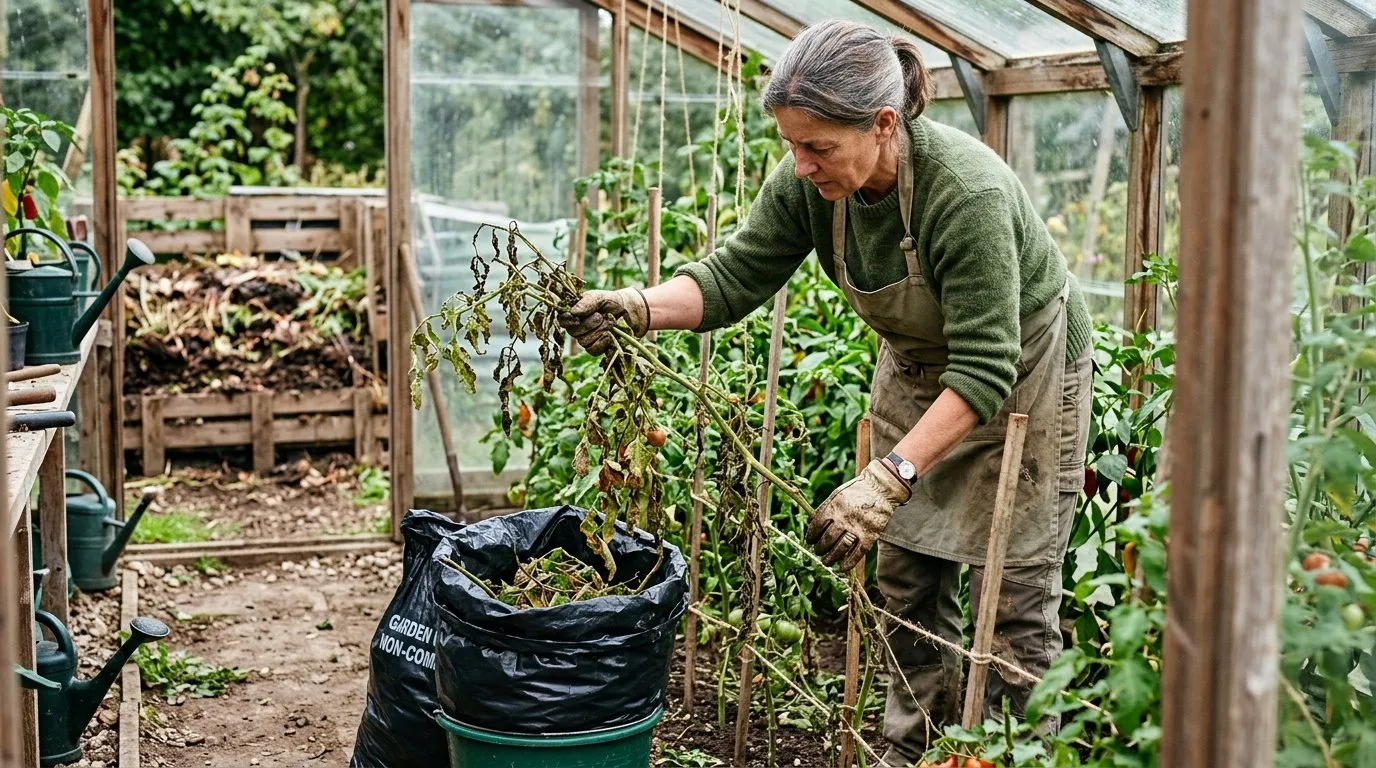 Disposal is critical. Bag the entire plant including roots, dispose in household waste or council green collection. Never home compost - typical home heaps do not reach the 60C needed to kill Fusarium spores. Disinfect tools immediately afterwards with surgical spirit or 1:10 bleach solution.
Soil treatment options
If you cannot rotate or replace soil and grafted plants are not feasible, three soil treatments may help (though none eliminates Fusarium completely).
Solarisation. Cover the affected bed with clear (not black) plastic during peak summer (late June to early September). Soil temperatures under the plastic can reach 50-60C in sunny weather, which kills surface fungal populations. Effectiveness is partial - Fusarium spores in deeper soil survive. Best for shallow beds and compact greenhouse soil.
Mustard green manure. Sow a thick mustard green manure (Sinapis alba) and dig in green just before flowering. Mustard releases isothiocyanates as it decomposes - mild biofumigants that suppress fungi. Reduces but does not eliminate Fusarium populations. Best as a recovery measure in autumn after a Fusarium year.
Trichoderma soil amendments. Beneficial fungi available as soil amendments (e.g. Trichoderma harzianum products). Compete with Fusarium in the soil microbiome. Mixed evidence in UK conditions - works in some gardens, not others. Worth trying as part of a multi-layered approach.
None of these is a substitute for rotation or grafted plants. They reduce pressure but do not solve the underlying problem.
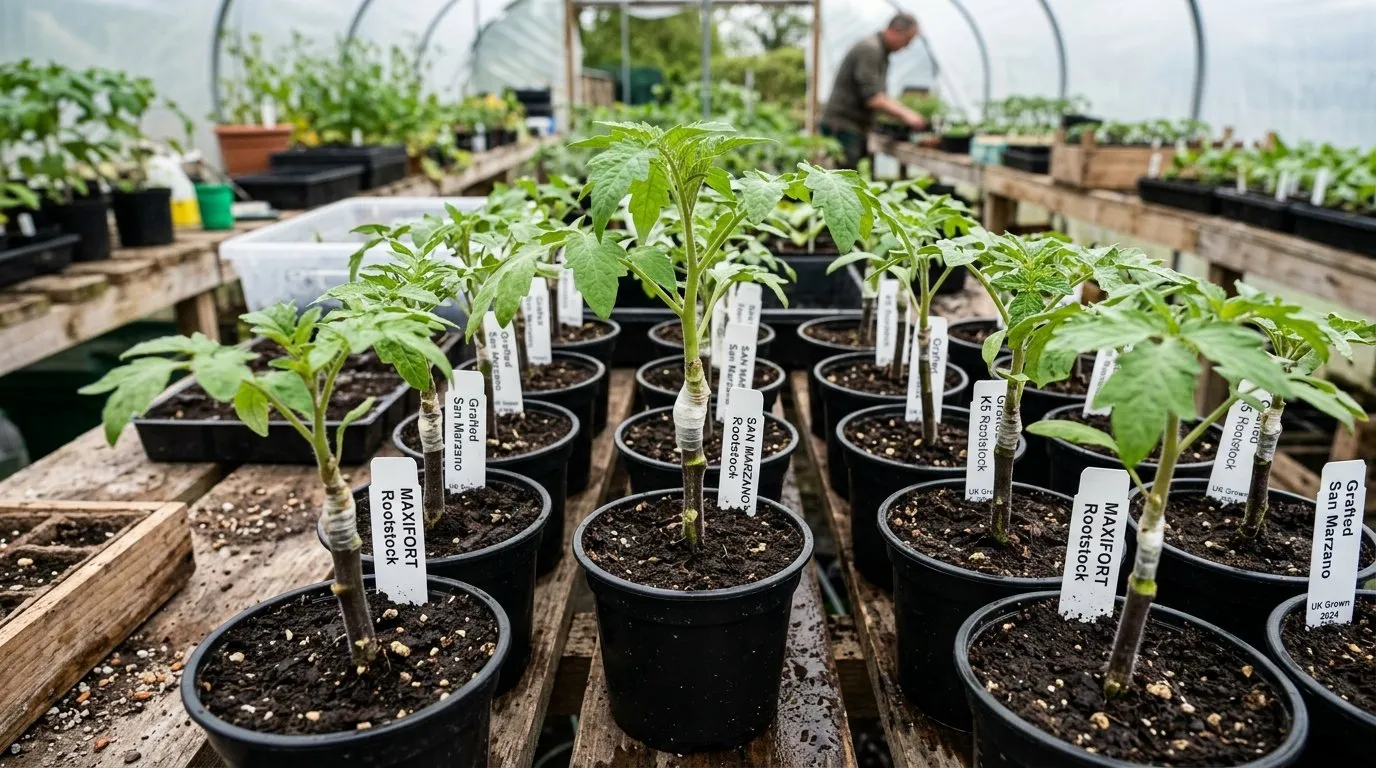 A grafted tomato plant. The visible graft union shows where the resistant rootstock (Beaufort, Maxifort, or Estamino) joins the chosen fruiting variety. £5-7 per plant from specialist suppliers - the most reliable single intervention for any garden that has had Fusarium once.
Recovery timeline
After a Fusarium outbreak, what to expect over the following 12 months.
Days 1-7: Confirm diagnosis (stem cross-section). Remove and bag plants. Disinfect tools. Mark bed.
Weeks 2-8: Monitor neighbouring plants. Be ready to remove additional infected plants. Maintain healthy plants on full feeding to support resistance.
End of season (October-November): Clear the bed completely - remove all roots, fallen leaves, plant debris. Bag and bin. Add 5cm of municipal compost (hot-composted, lower disease pressure than home compost).
Winter (December-February): Plan next season - source grafted plants or resistant F1 hybrids. Decide on rotation if possible.
Spring (March-May): Plant grafted or resistant varieties. Continue rotation if other beds available. Watch carefully through July-August when soil warms.
Year 2 onwards: Continue with grafted plants or resistant varieties. By year 5-7 the fungus population in soil declines naturally if rotation maintained.
Quick checklist
If you suspect Fusarium wilt:
- Cut a stem lengthwise to check for brown vascular ring ✓
- Bag and bin the entire plant including roots ✓
- Disinfect tools used on the plant ✓
- Monitor neighbours for 2-3 weeks ✓
- Mark the bed for the 5-7 year rotation period ✓
- Plan grafted plants or resistant F1 hybrids for next season ✓
- Clear all debris from the bed at season end ✓
- Top up soil with hot-composted municipal compost ✓
For broader greenhouse pest and disease problems, the RHS tomato problems guide covers the full range of UK issues. For prevention more generally, our companion planting guide UK discusses pairings that reduce disease pressure.
Related articles
Our team produces practical UK gardening guidance from source research, contributor records and established horticultural practice. Editorial standards are overseen by Matt W.