Key takeaways
- A summer worker honeybee lives about 6 weeks, so a grounded bee in August is usually old rather than thirsty
- Sugar water contains no pollen, which means it supplies none of the protein a colony needs to raise brood
- Never offer honey to bees: it can carry American foulbrood spores, and an infected UK colony must be destroyed
- A shared sugar station can pull in bees from several colonies plus wasps, spreading disease between them
- The one real exception is a grounded bumblebee queen in early spring: one drop of 50:50 white sugar and water, once
- A honeybee colony uses up to 25 litres of water a week in summer, so a 3cm-deep pebble dish does more good than any bee bar
A bee bar is a shallow dish of sugar water, set somewhere sunny, meant to revive tired bees. The idea has spread quickly across UK gardens, and the impulse behind it is a good one. The method is wrong. A grounded bee in August is almost never thirsty. It is old. Sugar water does nothing for a worn-out forager, carries none of the pollen a colony actually needs, and a shared feeding station can pass disease between nests. Honey is worse again, and genuinely dangerous.
This guide covers what a bee bar is, why the sugar-water story took hold, and the one narrow case where it is the right call. It also covers the version of the trend that does work: plain water, built properly, and the forage that makes the real difference.
What a bee bar is and where the idea came from
A bee bar is a shallow dish of sugar solution, usually white granulated sugar stirred into water, left out for bees to drink. Better versions add pebbles or corks as landing pads. Some are sold as small ceramic dishes that clip onto a fence or a plant pot rim.
The advice behind it runs like this: you find a bee sitting still on a path, so it must be exhausted, so you give it sugar water and it flies away restored. The claim is often attributed to a famous broadcaster who never said it. That misattribution is part of why it travelled so far, so fast.
The impulse is sound, and bee decline is real. Britain has lost roughly 97% of its wildflower meadows since the 1930s. Two bumblebee species have gone from these islands altogether, Bombus cullumanus and Bombus subterraneus, leaving 24 species still with us. People see that, then see a bee on the ground, and want to do something.
What fails is the diagnosis, not the motive. A bee bar treats a bee on the ground as a first aid case. In almost every summer instance, it is not one.
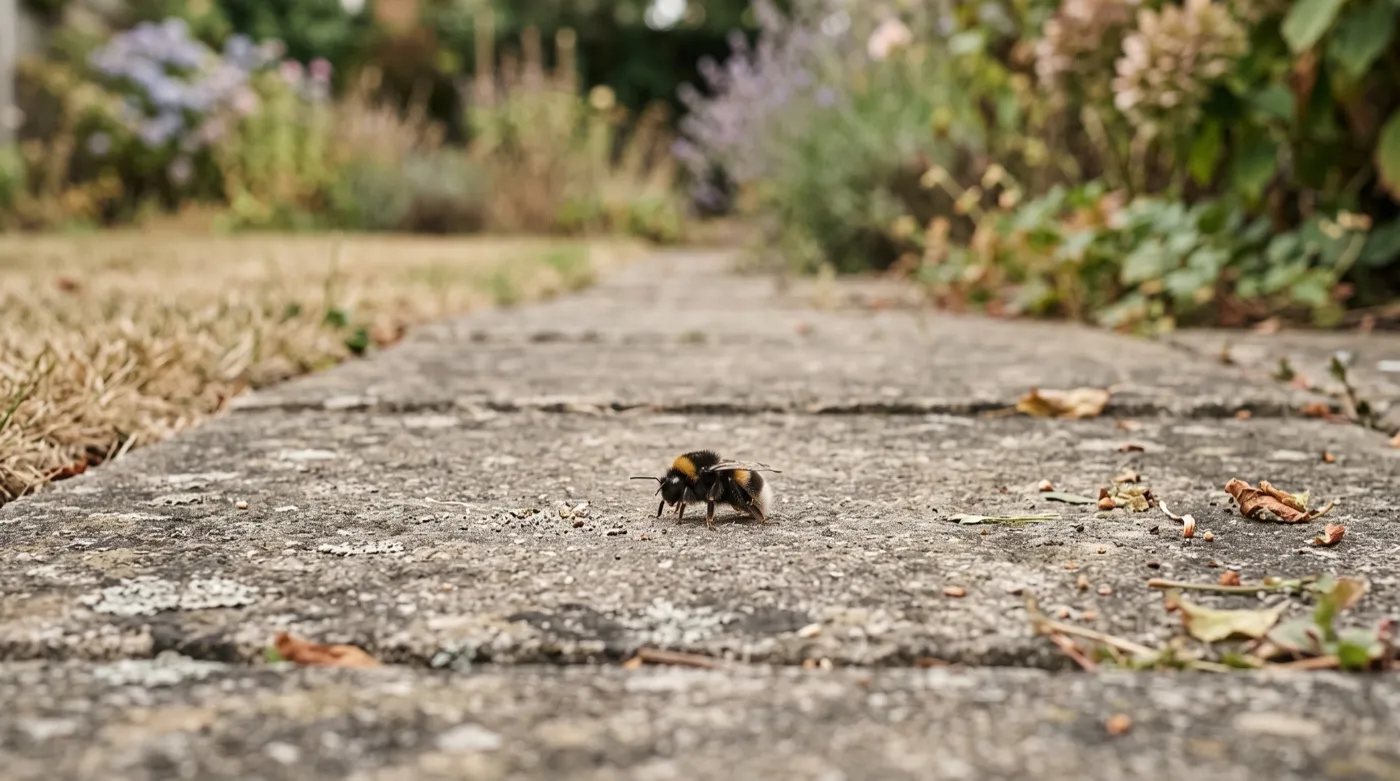 A bee sitting still on a path in August. This is the moment the sugar water advice kicks in, and it is usually the wrong reading of what you are looking at.
Why that grounded bee is probably just old
A worker honeybee born in summer lives about six weeks. She spends roughly the first three of those inside the hive and the last two or three flying. Flying is what kills her. Her wings fray at the trailing edge, her flight muscles wear out, and one afternoon she does not make it home.
That is not a malfunction. It is the design. A colony runs through tens of thousands of workers a year precisely because each one is spent hard and briefly. The bee you found on the paving in August has almost certainly reached the end of that run.
You can often see it. Hold your eye close and look at the wing margins. A young forager has clean, entire wings. An old one has ragged, nicked edges and a bald, shiny thorax where the hair has rubbed away. That wear is mechanical and permanent. No feed reverses it.
This matters because the whole bee bar premise rests on the opposite assumption: that the bee is a full tank running on empty, and sugar refills it. Occasionally, in a cold snap or after rain, a bee genuinely is grounded and recoverable. Far more often in high summer, you have found a bee at the natural end of a six-week life, and the kindest thing available is to move her off the path onto a leaf.
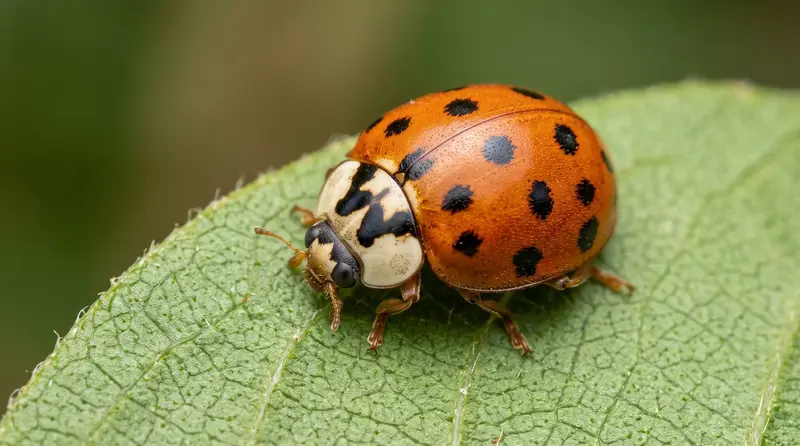
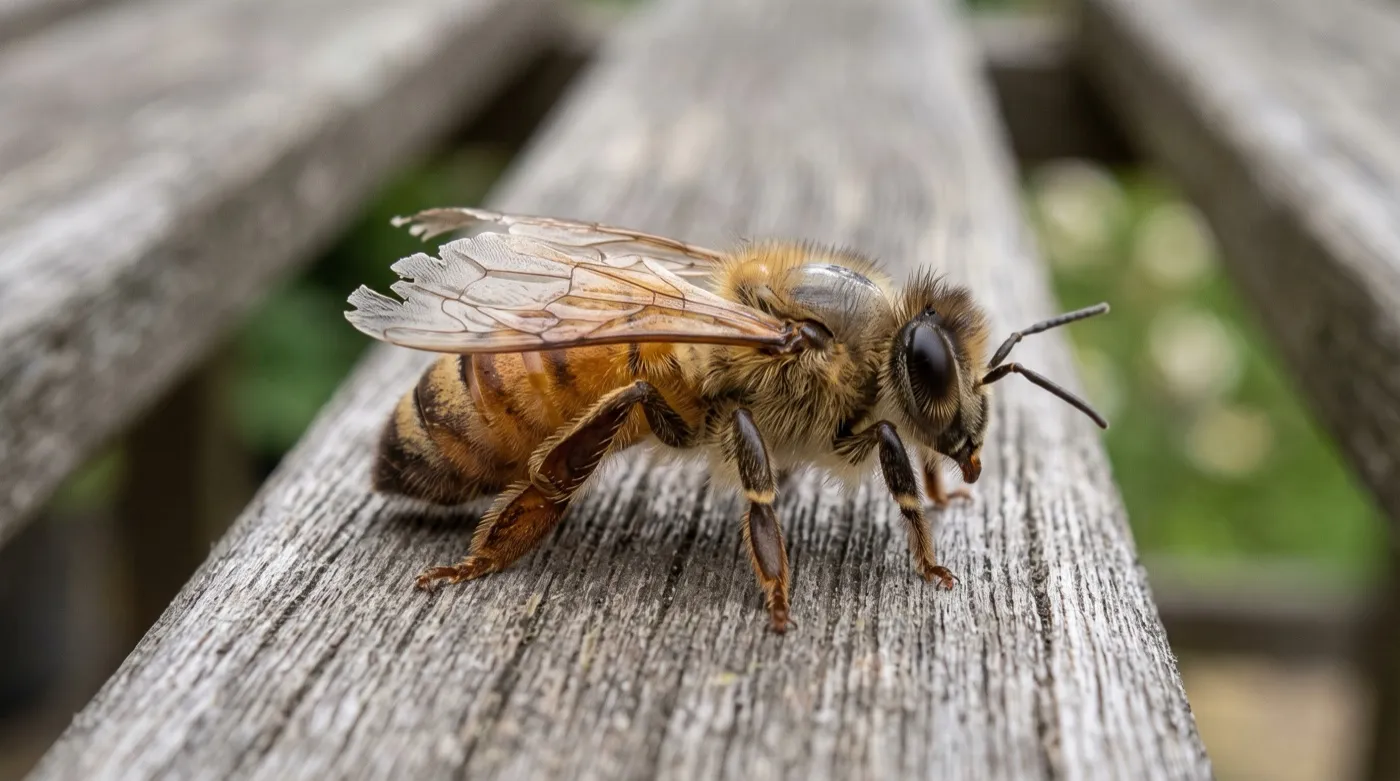 Ragged wing margins and a rubbed, shiny thorax. This forager is worn out, not thirsty, and sugar water will not undo mechanical wear.
The forager lifecycle: why bees wear out in six weeks
Understanding the sequence is what separates a useful response from a well-meant one. A summer worker honeybee moves through fixed stages, and the job changes with age.
- Egg, days 1 to 3. Laid by the queen in a cell, standing upright, then toppling over.
- Larva, days 4 to 9. Fed constantly by nurse bees. Grows about 1,500 times its starting weight.
- Capped pupa, days 10 to 21. The cell is sealed and the adult body forms.
- Emergence, day 21. She chews out and immediately starts cleaning cells.
- House bee, days 1 to 3 after emerging. Cleaning and tidying only.
- Nurse bee, days 4 to 12. Feeding larvae, which requires pollen, not nectar.
- Wax and receiving, days 12 to 18. Building comb, taking nectar from returning foragers.
- Guard, days 18 to 21. Standing at the entrance, checking arrivals.
- Forager, days 22 to 42. Flying out, and flying until the wings give out.
The critical mistake sits at stage 9. People assume a grounded forager is at stage 1 of a problem, when she is at the last stage of a life. Wing wear is cumulative and irreversible. A bee that has flown for three weeks cannot be reset with a drop of syrup.
Winter changes everything. Bees raised in autumn are physiologically different: they carry fat bodies, do not forage, and live four to six months rather than six weeks. That is how the colony crosses to spring. It also means the bee you find in October is a different animal from the one you find in July.
| Air temperature | What bees can do |
|---|---|
| Below 10C | Honeybees stay in the hive; bumblebees can still fly |
| 10 to 13C | Bumblebees forage freely; honeybees mostly grounded |
| 13C and above | Honeybees fly normally |
| 30C and above | Water carriers ramp up; cooling demand climbs |
| 35C and above | Brood nest at risk; water use peaks |
The colony holds its brood nest at 34 to 35C year-round, within about half a degree. That single fact explains the water demand covered further down, and it explains why water, not sugar, is the thing a colony actually cannot make for itself.
What sugar water actually does to a bee
Sugar solution is pure carbohydrate. That is the whole problem.
A colony needs two inputs: nectar for energy and pollen for protein. Nurse bees cannot raise brood on carbohydrate alone. A bee bar delivers a crude imitation of the first and none of the second. Feeding it to a garden’s bees is like leaving out a bowl of sugar for a family and calling it dinner.
There is a second effect, and it is worse. Bees are efficient. A forager that finds a strong, reliable, effortless food source recruits others to it. Honeybees dance the location back at the nest. So a bee bar does not just fail to help: it actively pulls foragers off flowers and onto a source that carries no pollen and pollinates nothing. You have taken working bees out of the garden economy.
Then there is the crowd. A standing sugar source draws bees from multiple colonies, plus wasps, plus ants. Bees from different nests do not normally share a feeding surface at that density. Concentrating them is a recognised route for passing pathogens between colonies, including deformed wing virus and nosema. It can also trigger robbing, where a strong colony that has learned to take easy sugar starts raiding a weaker hive nearby, which frequently kills the weaker colony outright.
The Bumblebee Conservation Trust counsels against routine feeding for exactly these reasons. So does the beekeeping side: the British Beekeepers Association treats open feeding of sugar as something to avoid, not encourage.
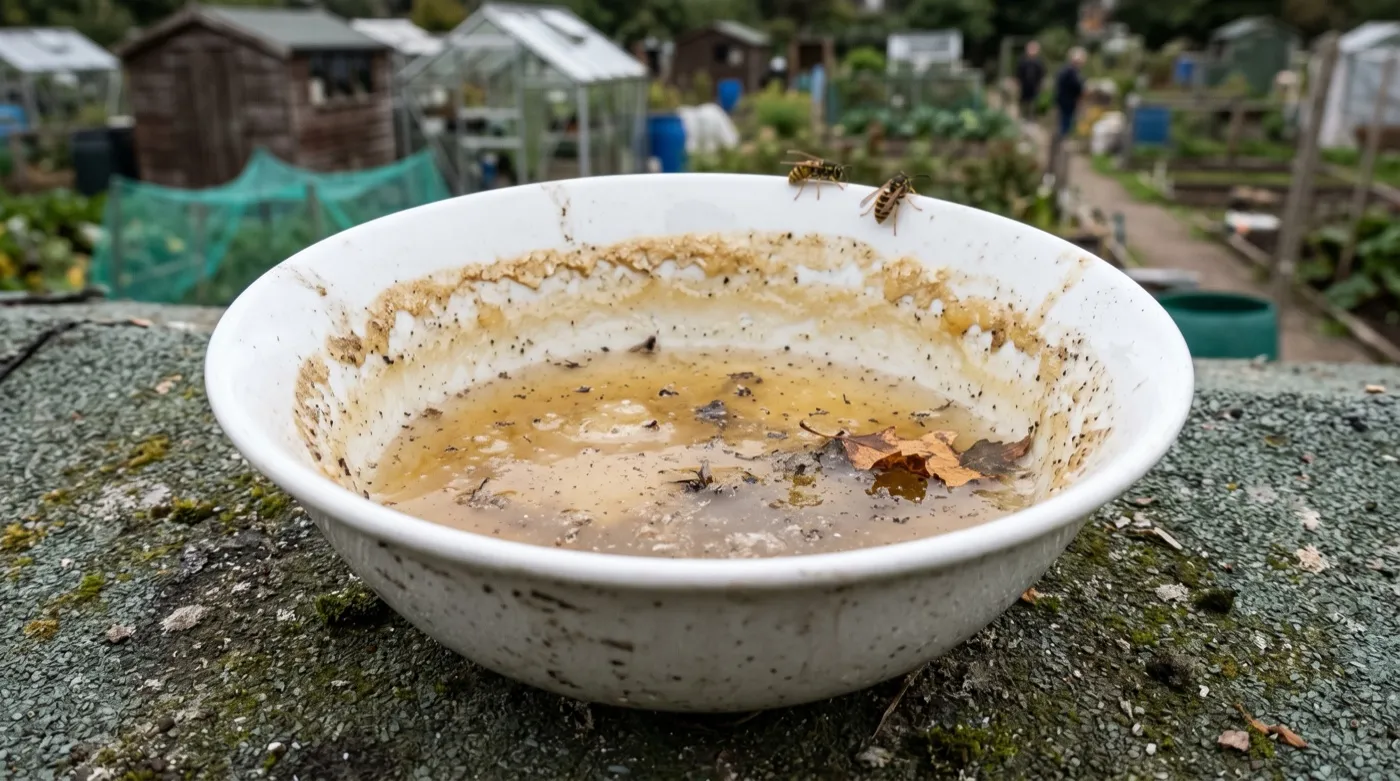 The usual end state of a bee bar: cloudy syrup, drowned debris and a couple of wasps working the rim. Open sugar water offers no landing surface and no pollen.
Never give honey to bees
This one is not a matter of degree. It is a hard line.
Warning: Never put honey out for bees. Honey can carry the spores of American foulbrood (Paenibacillus larvae), a bacterial brood disease that liquefies larvae inside the cell. The spores stay viable for decades, survive in shop-bought and imported honey, and cannot be washed off. American foulbrood is a notifiable disease in the UK. When an inspector confirms it, the colony is normally destroyed and the hive burned. A single jar of imported honey left on a bird table can reach every hive within flying range.
People offer honey with the best of intentions, reasoning that it is the bee’s own food. It is, but not that bee’s, and not from that colony. Honey is the one substance that carries brood disease directly. The National Bee Unit tracks foulbrood outbreaks across England and Wales precisely because the disease spreads so easily and costs so much to contain.
If you keep bees, this is already familiar. If you do not, the rule is simply this: no honey outdoors, ever. Not in a bee bar, not on a saucer, not smeared on a bee house. Rinse honey jars before they go in the recycling.
The one time sugar water is the right call
There is a genuine exception, and it is narrow enough to state precisely.
A bumblebee queen found on cold ground in February, March or early April is a different case from an August worker. She is not old. She has just come out of hibernation, she is the entire future of a colony that does not exist yet, and she may be genuinely out of fuel on a cold morning before there is much in flower. Losing her loses everything she would have founded.
If you find one, and she is sluggish rather than dying, this is what works:
- Mix 50:50 white granulated sugar and water, roughly 50g of sugar into 50ml of warm water. Stir until it clears and let it cool.
- Put one drop on a teaspoon and set it on the ground beside her head. Do not pour it on her. Sugar in the hairs mats her coat and stops her flying.
- Move her somewhere sheltered and sunny, out of the wind, off any path.
- Leave her. She will usually drink and fly within 15 minutes if she is going to.
- Do it once. This is a one-off intervention, not a feeding station.
Never use honey, brown sugar, or golden syrup. White sugar and water only.
That is the entire legitimate territory of the sugar-water advice: one queen, one drop, one time, in early spring. Everything else the trend has grown into sits outside it. For help telling a queen from a worker, and one species from another, our guide to UK bumble bee species covers the identification.
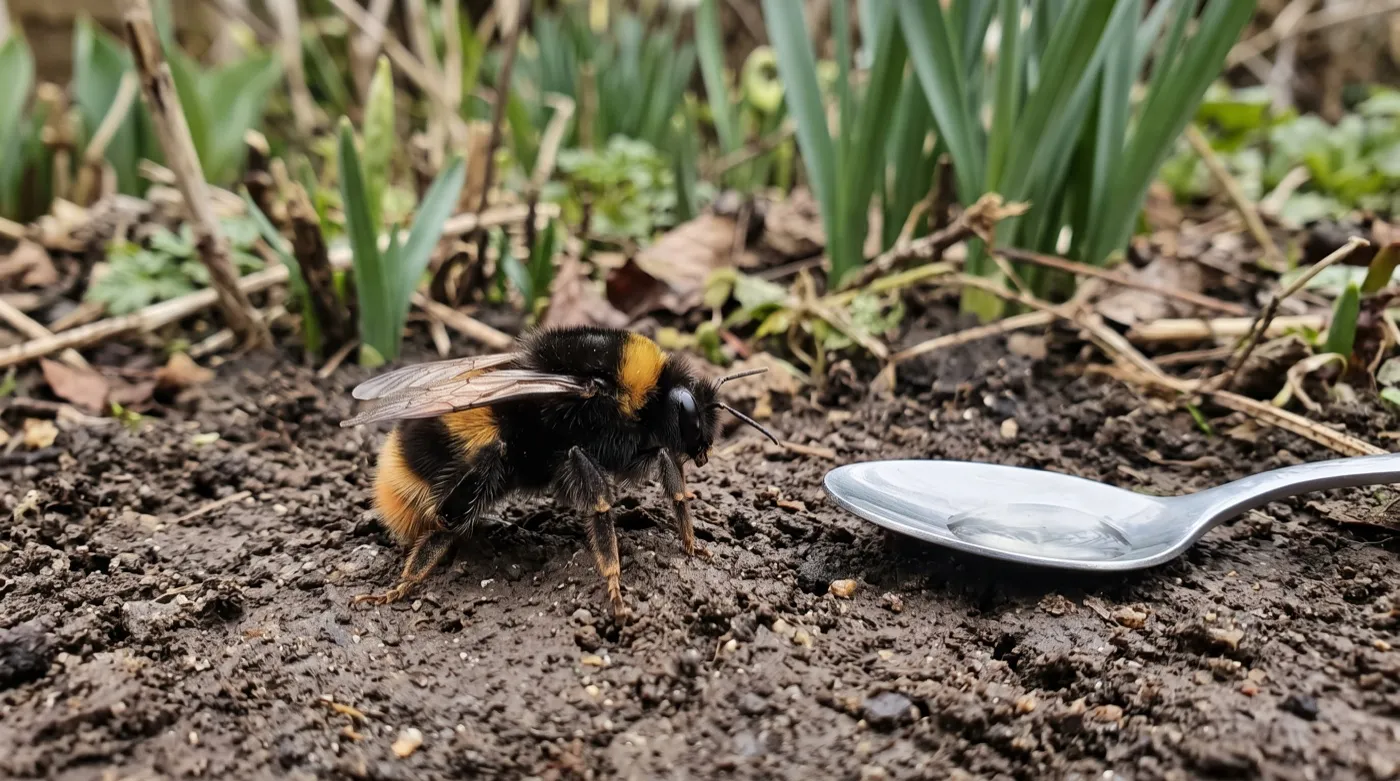 A bumblebee queen on cold ground in March. This is the one case where a single drop of 50:50 sugar water is the right call, offered once.
Building a bee water station that works
Here is the part of the trend worth keeping. Bees genuinely do need water, and they genuinely do drown getting it.
A honeybee colony uses up to 25 litres of water a week in summer. Specialist water carriers fly it back all day. The colony uses it for evaporative cooling, holding that 34 to 35C brood nest steady when the outside air is 30C, and to dilute crystallised stores so nurse bees can feed larvae. Water is the one input a colony cannot manufacture. Sugar it can find. Water it must fetch.
The build is trivial and costs about £3.
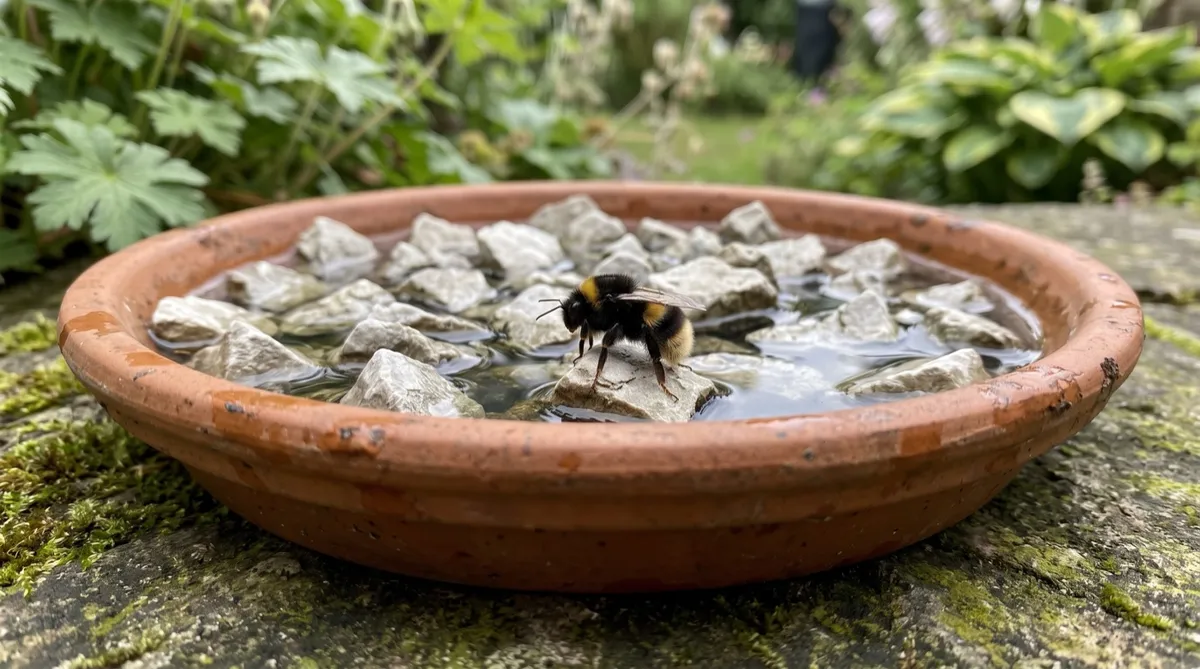
- Dish: a terracotta saucer, an old baking tray, a plant pot drip tray. Under 3cm deep.
- Fill: clean pebbles, glass marbles, wine corks, or coarse gravel around 20mm across. Pack it so the stones stand proud of the waterline. Bees drink from the wet film between dry stones, standing on something solid.
- Water: plain tap water, filled to just below the top of the stones. Nothing added. No sugar, no honey, no salt.
- Upkeep: top up daily in hot weather, scrub it out weekly. A dry dish loses the bees for good, because they memorise the location and stop checking once it fails twice.
A standard bird bath does not work for this, and it is the commonest well-meant mistake in the garden. It is too deep, the sides are too steep and smooth, and bees cannot swim. They land on the surface film, slip, and go under. If you already have one, drop in a flat stone that breaks the surface and a handful of corks. Our bird bath placement and cleaning guide covers the siting rules that keep it safe for birds at the same time.
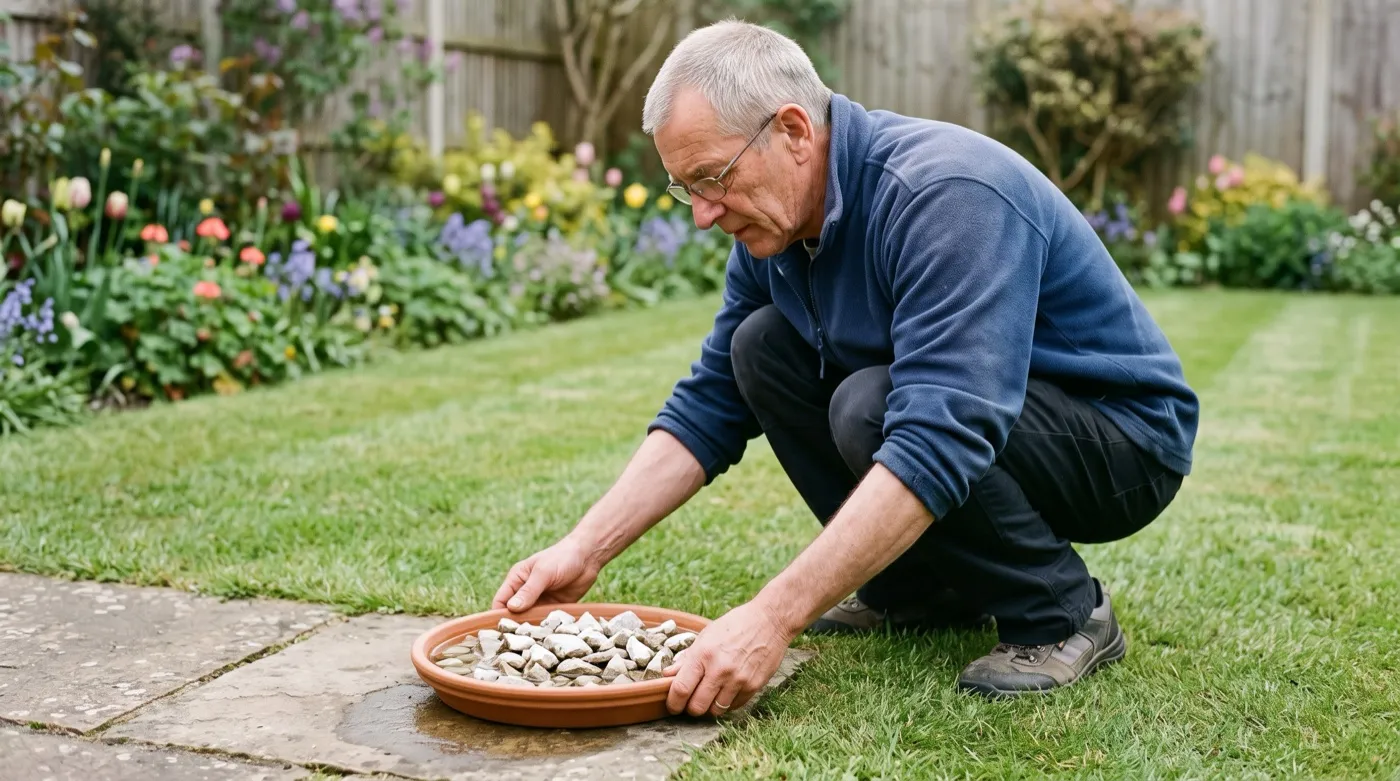 The whole build, about £3 of terracotta saucer: under 3cm deep, angular grit standing proud of the waterline, topped up daily. Bees stand on dry stone and drink the film between.
Where to site the dish and how often to top it up
Placement decides whether the station gets used or ignored.
Put it in full sun, and out of the wind. Bees prefer warm water, and a shaded dish in a draught gets passed over. Site it near flowering plants rather than in an empty corner, because bees find it while working the flowers, not by searching.
Keep it away from where people sit. This is the practical bit most guides skip. A busy water station brings a steady stream of bees to one spot from May to September. Ten metres from the back door is neighbourly. On the patio table is not, and it is how a good idea turns into a wasp complaint.
Height barely matters. Ground level, a wall top, a shed roof: all work. Consistency matters far more than position. Bees memorise a reliable source and return to it for weeks, which is exactly why letting it run dry is worse than never starting. Two dry visits and they write it off.
Bee bars and the alternatives compared
Ranked by what each one actually achieves for bees in a UK garden, best first.
The gold standard is forage planting. Nothing else comes close, because it is the only option on the list that feeds bees both nectar and pollen, supports brood, and works whether or not anyone is watching. The water station is a genuine and worthwhile second: cheap, quick, and the one thing a colony cannot supply itself. Everything below those two is either situational or counterproductive.
The real answer is forage, and the UK gaps are February and October
If a bee bar is the wrong answer, this is the right one, and it is less glamorous: flowers, across the whole season.
Midsummer is rarely the problem. A UK garden in June is usually swimming in nectar. The shortages sit at the two ends, and they are where gardens fail bees:
- February and March. Bumblebee queens come out of hibernation when the air hits about 10C, weeks before most gardens have anything open. She has to find fuel fast enough to start a nest. This is the gap that decides how many colonies your area gets.
- September and October. Colonies are building stores and raising next year’s queens as the borders finish. Ivy is the single most important plant in the UK autumn, and it flowers exactly when almost nothing else does.
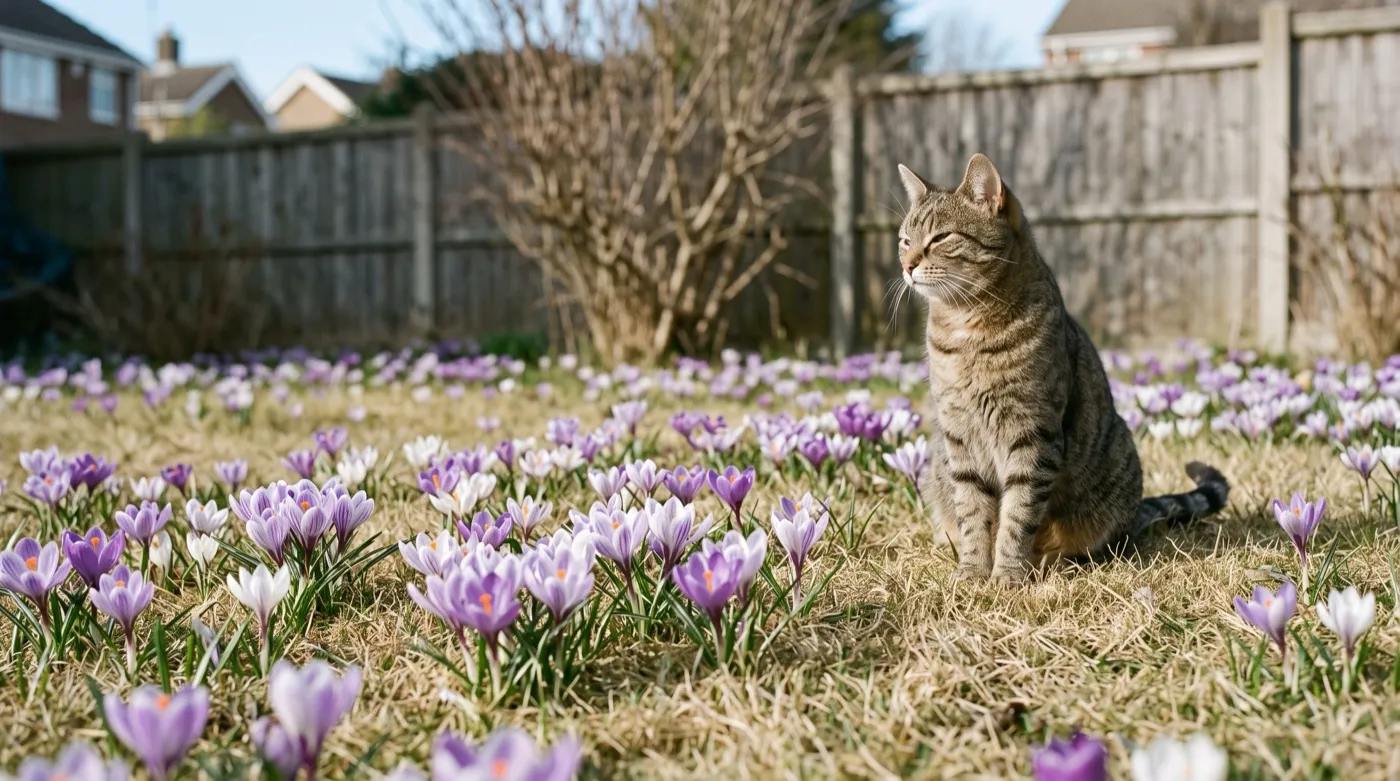 Crocus naturalised straight into the lawn, open in February sunshine. This is the gap that decides how many colonies your area gets, and about £8 of corms fills it.
The plants that fill those windows are specific: crocus, snowdrop, pussy willow, lungwort and winter heather at the front end; ivy, single-flowered asters, sedum, verbena bonariensis and mahonia at the back. Singles, not doubles. Double-flowered cultivars are bred for petals and are frequently sterile, so they look generous and feed nothing.
A month-by-month calendar for helping bees
| Month | What to do |
|---|---|
| January | Leave ivy and dead stems standing. Plan February gaps. Order crocus for autumn planting |
| February | Watch for queens on cold ground at 10C. Crocus and snowdrop should be open |
| March | Peak queen emergence. Pussy willow and lungwort earn their place. One-drop rescues apply here |
| April | Set the water dish out. Colonies start climbing. Fruit blossom covers most needs |
| May | Top the dish daily once air hits 20C. Forage is rarely short now |
| June | Water demand climbs. Scrub the dish weekly. Leave clover in the lawn |
| July | Peak colony size and peak water use, up to 25 litres a week. Never let the dish run dry |
| August | Grounded workers appear. Most are old, not thirsty. Move them off paths, do not feed them |
| September | Ivy starts. Wasps peak, so remove anything sugary. Asters and sedum working |
| October | Ivy at full flower and carrying the whole month. Leave it unclipped |
| November | Last ivy. Keep the dish going while air stays above 10C. Mahonia opens |
| December | Leave stems and leaf litter for hibernating queens. Do not tidy the border |
Root cause: a forage problem treated as first aid
Here is why the bee bar took hold, and it is not stupidity. It is a mismatch of visibility.
The actual cause of bee decline is forage supply across the countryside: 97% of wildflower meadows gone since the 1930s, hedges removed, verges cut in flower, and gardens that peak in June and offer nothing in March or October. That is the problem. It is diffuse, slow, invisible, and nobody can see it happening from a kitchen window.
A single bee on a path is the opposite. It is right there, it is individual, it looks like it needs something, and you can act on it in 30 seconds. So the trend attached itself to the visible thing rather than the real one. That is a very human error, and it explains why the advice spread faster than any correction has.
The permanent fix is boring and it works: plant the two gaps. Four square metres of ivy on a back fence, and 200 crocus corms in the lawn, will do more for the bees near you than every bee bar in the county. Both are cheap, both are one-off jobs, and both keep working every year without you doing anything.
Common mistakes with bee bars
The economics are hard to argue with. About £17 all in, once, versus a bag of sugar every fortnight and a wasp problem by August.
Common ground with a well-meant idea
The people setting out bee bars are on the right side of this, and that deserves saying plainly.
The instinct behind the trend is correct in every respect except the mechanism. It notices that bees are struggling, which is true. It assumes gardens can do something about it, which is also true. It just picks the one intervention that does not work, because it is the one that looks like helping.
Keep the instinct. Move the effort. Put the dish out, fill it with grit and plain water, keep it topped up, and then spend the rest of the attention on flowers in February and October. That is the same impulse, aimed at the thing that actually limits bees. Nobody has to feel foolish about the sugar. Most of us tried it, including me, and the plot told me the answer over about three summers.
Frequently asked questions
Should I give sugar water to a tired bee?
Usually no. A grounded bee in summer is normally old, not dehydrated. A worker honeybee lives about six weeks and dies with frayed wings at the end of it. Sugar cannot reverse worn flight muscles or torn wing margins. The exception is a bumblebee queen found on cold ground in early spring.
Do bee bars actually work?
No. Bee bars supply no pollen and can spread disease between colonies. Sugar solution is pure carbohydrate, so it feeds none of the protein a colony needs for brood. A shared station also concentrates bees from different nests in one place, which is exactly how pathogens move. Most bee bars end up feeding wasps.
Can I give honey to bees?
Never. Honey can carry American foulbrood spores that destroy entire colonies. The spores stay viable for decades and survive in shop-bought and imported honey. American foulbrood is a notifiable disease in the UK and an infected colony is usually destroyed. Leaving honey out risks passing it to every hive within flying range.
What is the right sugar water ratio for a bumblebee queen?
Fifty-fifty white granulated sugar and water, one drop, offered once. Mix roughly 50g of sugar into 50ml of warm water and let it cool. Offer a single drop on a teaspoon beside her, never poured over her. Do not use brown sugar, honey or syrup. This is a one-off, not a feeding station.
How do I make a bee water station that works?
Use a dish under 3cm deep, filled with pebbles standing above the waterline. A terracotta saucer costs about £3 and works better than anything sold as a bee bar. Bees land on dry stone and drink from the film of water between. Top it up daily in hot weather and scrub it weekly.
Why do bees drown in bird baths?
Bird baths are too deep and too steep, and bees cannot swim. A bee lands on the water surface, takes a droplet into its crop and flies off. Smooth sloping sides give it nothing to grip when it slips. Pebbles, corks or a floating twig turn a death trap into a drinking station.
What actually helps bees most in a UK garden?
Flowers in February, March, September and October, when UK gardens run out of forage. Midsummer is rarely the problem. The shortage sits at each end of the season, when queens emerge and when colonies build stores. Crocus, pussy willow, ivy and single-flowered asters fill those gaps better than any feeding station.
Our team produces practical UK gardening guidance from source research, contributor records and established horticultural practice. Editorial standards are overseen by Matt W.