Key takeaways
- House martins are Amber-listed, with UK numbers down around a third since the 1980s
- Each mud-cup nest is built from roughly 1,000 beak-carried mud pellets
- Site artificial nest cups 2m or higher, on a north or east-facing wall, in groups
- A wet mud patch within 30m in spring is often the missing piece
- Active nests are protected by the Wildlife and Countryside Act 1981
- Fit a droppings board 60cm below a nest, and only clear old nests in winter
House martins are the small blue-black birds that build mud nests under the eaves of UK houses. If you want house martins over your garden each summer, the work starts on the ground, not in the air. These are colonial birds. They nest in groups, feed entirely on flying insects, and come back from Africa to the same walls year after year. Get three things right and a colony will find you: safe nest sites high on the wall, wet mud to build with in spring, and an insect-rich garden below. This guide covers how to tell a house martin from a swallow or swift, how to put up artificial cups, and the nest etiquette that keeps you on the right side of the law. Most of it is simple. The birds do the hard part.
How to tell a house martin from a swallow or swift
The house martin (Delichon urbicum) is a small hirundine, about 12 to 13cm long, with a wingspan of 26 to 29cm and a weight near 19g. It is glossy blue-black above, clean white below, and carries one clinching feature: a bright white rump above a short forked tail. The legs are covered in white feathers, unusual among UK birds.
Two lookalikes cause most confusion. The swallow (Hirundo rustica) has a deep red throat, a dark breast band and long trailing tail streamers. It nests inside barns, porches and outbuildings, not on the outer wall. The swift (Apus apus) is larger, all dark brown-black, with long sickle wings and a screaming call. Swifts nest in roof cavities and never perch on wires or walls. A fourth bird, the sand martin (Riparia riparia), is brown above with a brown breast band, and digs nest burrows in riverbanks and quarry faces.
| Species | Nest site | Key appearance | UK arrival | How to help |
|---|---|---|---|---|
| House martin | Mud cup under house eaves | Blue-black, white rump, white legs | Late April | Artificial cups, mud source |
| Swallow | Inside barns, porches, sheds | Red throat, long tail streamers | Early April | Leave outbuildings open |
| Swift | Roof cavities and soffit gaps | All dark, screams, never perches | Early May | Swift bricks and boxes |
| Sand martin | Burrows in sandy riverbanks | Brown, brown breast band | Mid March | Sand martin nesting banks |
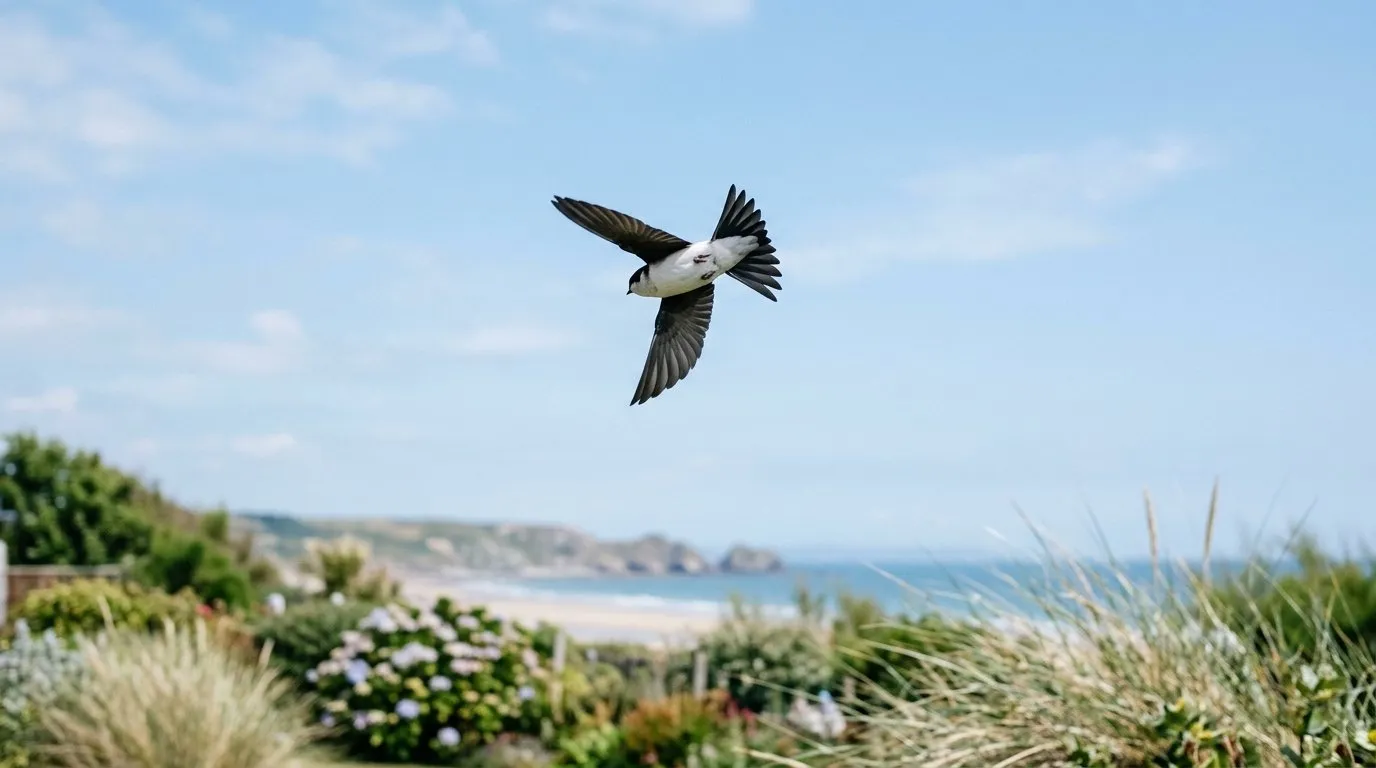 A house martin banking overhead, white rump catching the light. The rump is the feature that separates it from a swallow at a glance.
Why house martin numbers are falling
House martins sit on the UK Amber list of birds of conservation concern. The BTO Breeding Bird Survey shows numbers down around a third since the 1980s, with a sharp long-term slide in England. The current UK breeding population is roughly 510,000 pairs. Understanding why they are struggling tells you exactly what your garden can put back.
Three root causes drive the decline. The first is lost nest sites. Modern soffits, plastic fascia boards and smooth render give mud nothing to grip, and some homeowners knock nests down. The second is fewer flying insects. Intensive farming, garden insecticides and tidy sterile plots cut the aerial midges, aphids and small flies that martins eat. The third is harder access to mud. Paved front gardens, dry springs and drought leave the birds no puddle edge to gather building material.
Each cause has a garden-scale fix. You cannot rebuild an insect population alone, but a pond, native planting and a no-spray rule lift local numbers fast. The RSPB house martin advice gives the national picture. The point for gardeners is that martins fail for practical, fixable reasons, not mysterious ones.
How house martins build a mud nest
A house martin nest is an engineering feat. Both birds of a pair build an enclosed mud cup under an overhang, closed except for a small entrance hole at the top. Each nest takes roughly 1,000 mud pellets, carried one beakful at a time from a wet patch nearby. Understanding the build explains why mud matters more than anything else you can offer.
The process runs in clear stages:
- Gathering (days 1 to 3). Both birds collect wet mud from puddle edges, ponds and ditches. Wet, sticky, clay-rich mud holds; dry or sandy mud crumbles.
- Foundation (days 3 to 6). They fix a mud ledge to the wall under the eave, letting each layer dry before adding the next.
- Walls (days 6 to 12). Layer on layer builds the cup upward, leaving a narrow entrance slot at the top.
- Lining (days 12 to 14). The pair line the cup with grass, straw and feathers before laying.
A pair then raises two or three broods of four or five young each. Incubation runs 14 to 16 days, and chicks fledge at 22 to 32 days. Martins reuse and repair a sound nest across years, which is why an existing nest is worth protecting.
Warning: A nest under construction is already legally protected. Do not scrape off half-built mud in the hope of stopping martins settling. Interfering with a nest the birds are building is an offence, and it wastes days of their effort in a short breeding season.
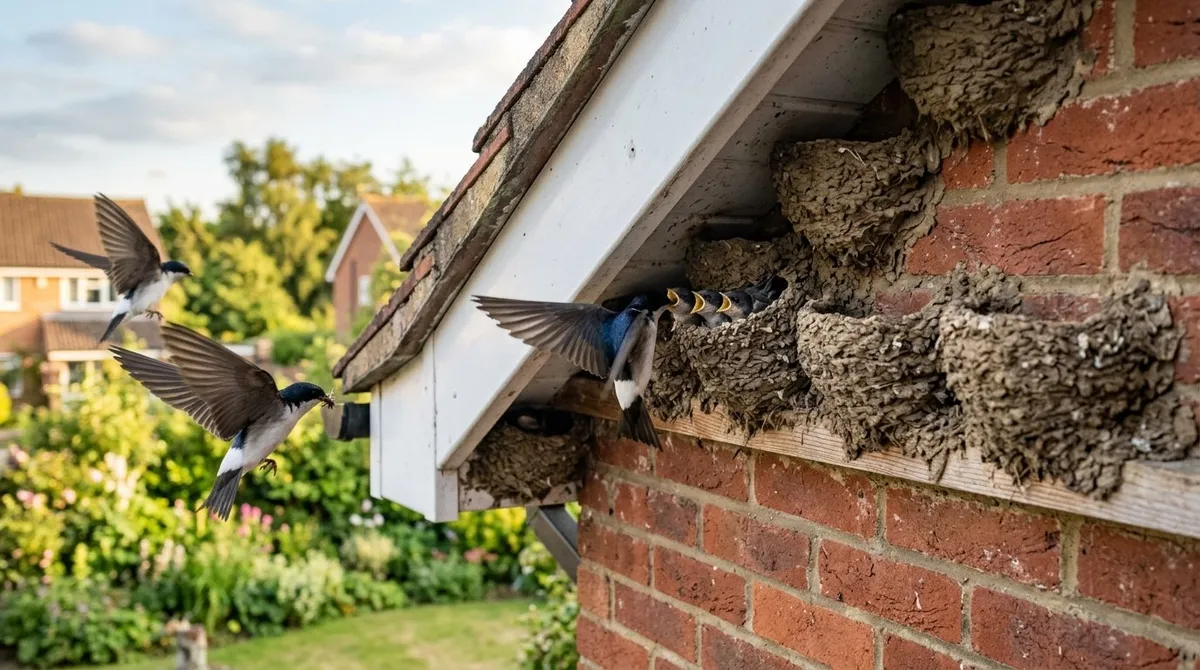
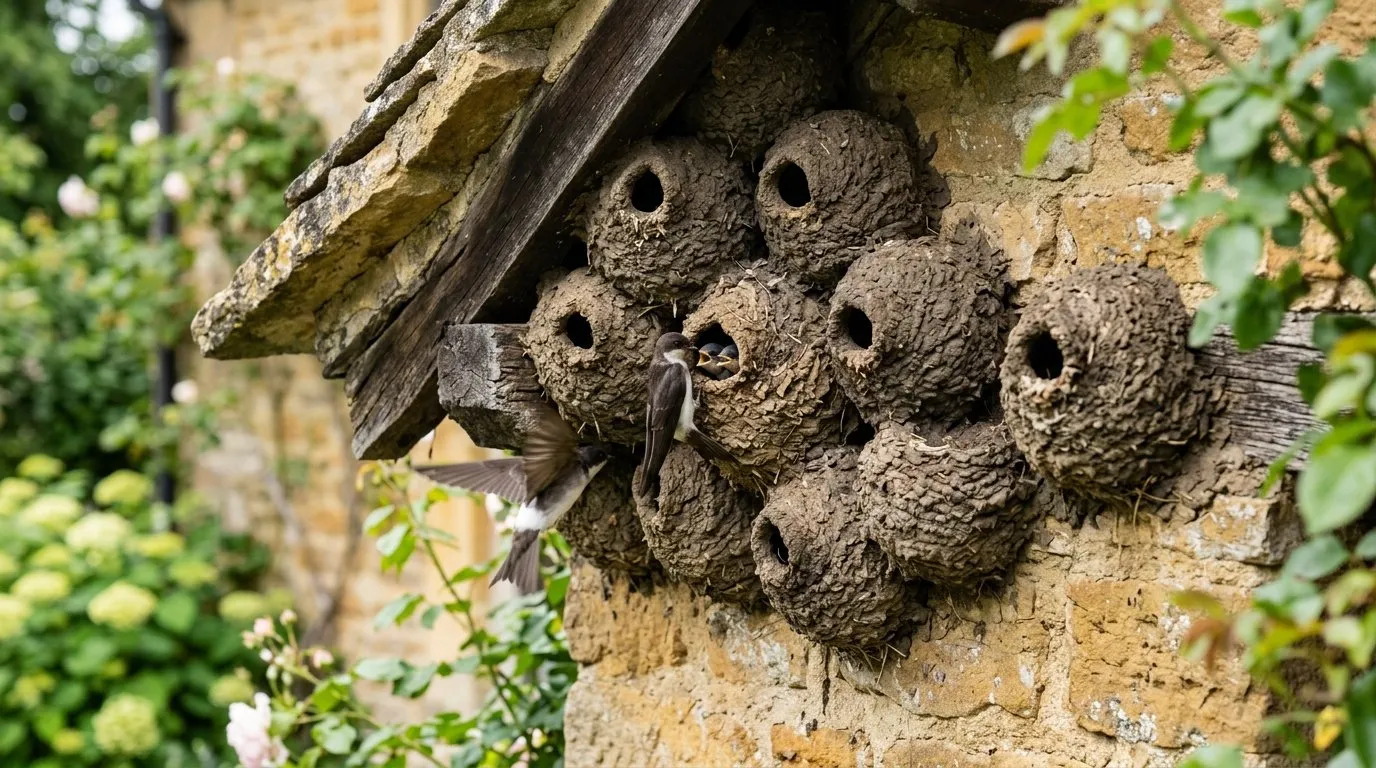 Natural mud cups packed under a cottage eave. Each closed nest is built from around 1,000 mud pellets, with the entrance hole set at the top.
Putting up artificial house martin nest cups
Artificial nest cups are the fastest way to draw a colony to a new wall. A ready-made cup gives martins a sound structure straight away, and even established birds will adopt cups beside natural nests. Because martins are colonial, put up cups in groups, never singly.
Site them well and they work far better:
- Height. Mount cups 2m or higher, ideally 4 to 5m up, tight under an overhanging eave or gable.
- Aspect. Choose a north or east-facing wall so the nest stays shaded and cool. A hot south wall can cook chicks in a heatwave.
- Grouping. Fit two to six cups in a run, 15 to 30cm apart, to mimic a colony.
- Overhang. The eave must shelter the cups from direct rain and sun.
Good cups cost around £15 to £30 each. Reliable UK suppliers include Vivara Pro, NHBS and the Schwegler woodcrete range, all of which sell double and quadruple units. A house martin sound-lure, playing the call from a small speaker at dawn through May, raises the odds of a first colony taking. Do not expect instant results. Occupation often takes two or three seasons.
Gardener’s tip: Fit cups in autumn or winter, well before the birds return in late April. Freshly drilled holes and new fixings above your head are a two-minute job on a dry January day, and the cups look weathered and settled by spring.
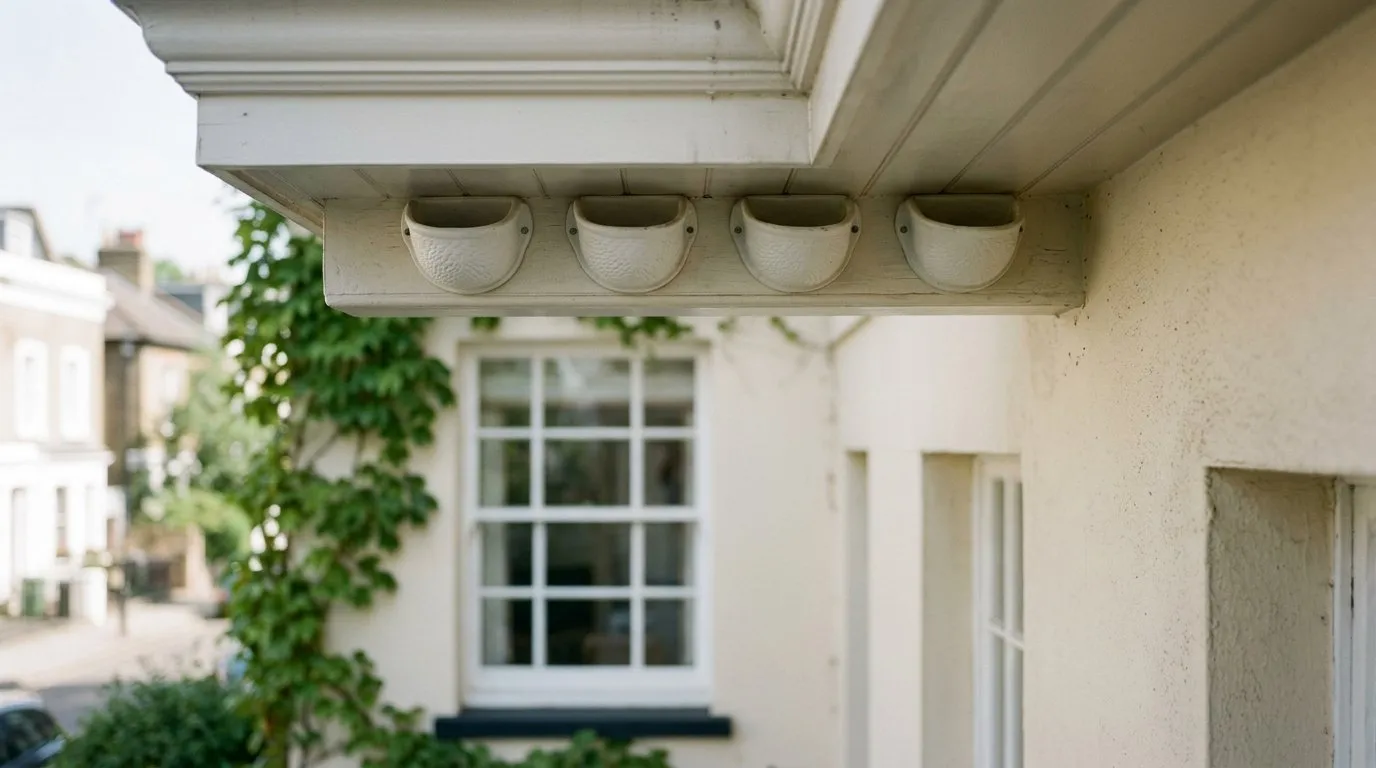 A quad set of artificial cups under a townhouse eave. Grouped cups on a shaded wall read as a colony and settle martins faster than a single unit.
Giving house martins a mud source in spring
Wet mud is the piece most gardens miss. Martins need sticky, workable mud through the building weeks of late April, May and June, and a run of dry weather stops them cold. Providing mud within about 30m of the nest site can be the single change that starts a colony.
The method is simple. Scrape a shallow depression in an open, sunny spot, ideally clay-rich soil, and keep it wet. A dustbin lid or seed tray filled with garden soil and topped up with water works on a paved plot. Aim for the texture of soft modelling clay, not soup. Keep it damp daily from mid-April to late June, then let it dry once the nests are built.
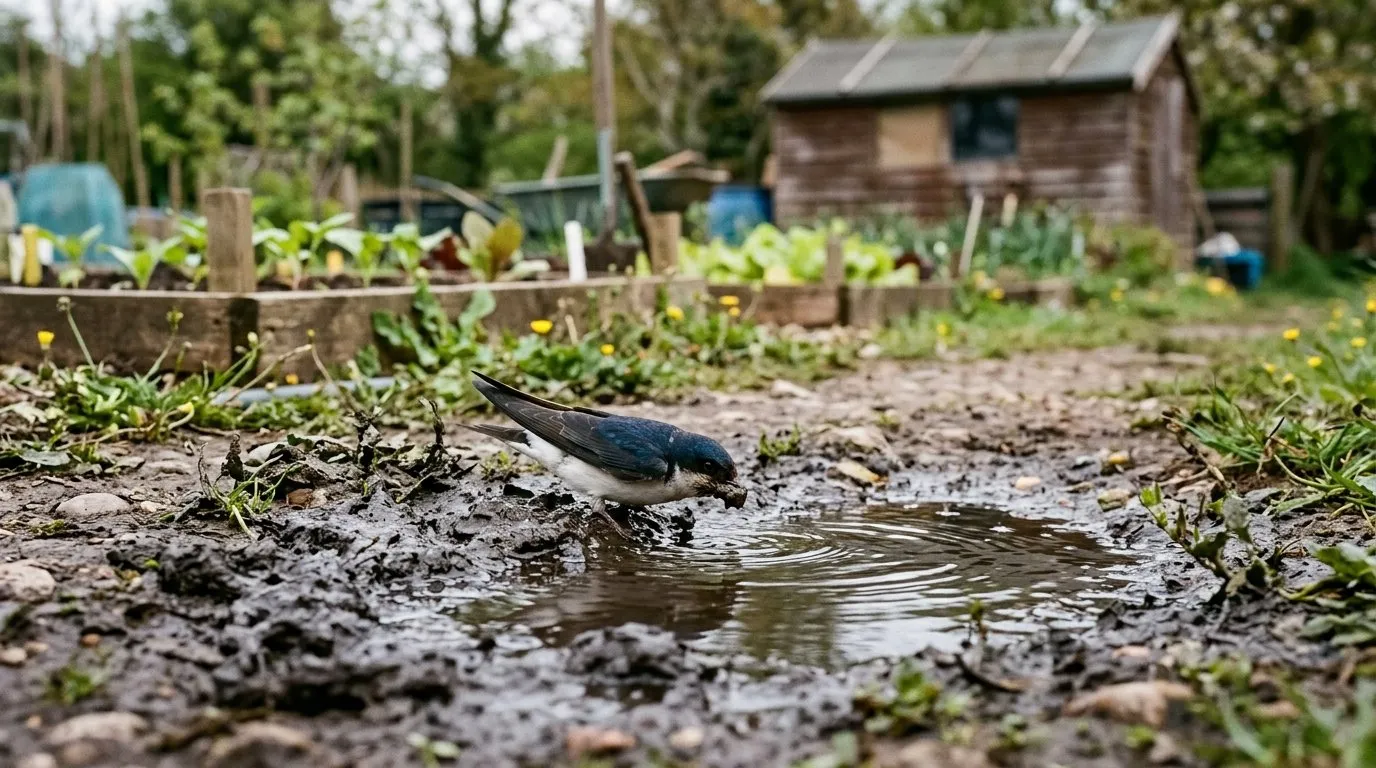 A kept-wet mud scrape on open ground. Clay-rich, sticky mud within 30m of the cups gives martins the building material a paved garden lacks.
Feeding the colony: insects, ponds and a pesticide-free garden
House martins feed entirely on aerial insects taken on the wing: midges, aphids, small flies, flying ants and tiny beetles. You cannot put food out for them. What you can do is grow the insects they hunt, which is where the wider garden earns its keep.
Water is the biggest lever. A pond throws up clouds of midges and hoverflies from spring onward, and martins hawk low over open water on cool days. Our guide to building a wildlife pond covers the dig and the planting; even a small pond lifts the insect count sharply. Native trees, long grass and a nectar border feed the food chain the birds rely on.
 A garden pond is a house martin feeding station. Open water breeds the midges and small flies the birds take entirely on the wing.
Nest etiquette and the law you must follow
House martins and their nests carry firm legal protection, and the etiquette matters as much as the wildlife value. Under the Wildlife and Countryside Act 1981, it is an offence to intentionally take, damage or destroy a nest while it is in use or being built. It is also an offence to obstruct the birds from reaching their nest.
In plain terms, once martins start bringing mud to your wall, that nest must stay until the birds finish and leave. You cannot knock it down, board over it, or net the eave to keep them off while a nest is active. Penalties can reach an unlimited fine and up to six months in prison per offence. Deterrents, such as netting a bare wall, are only lawful before any nest is built and where they do not trap birds.
Old, empty nests can be removed, but only in winter, roughly November to February, once you are certain no bird is using them for roosting. If you do take one down, fit an artificial cup in its place. That keeps the colony loyal to the wall and avoids losing a site the martins may have used for years.
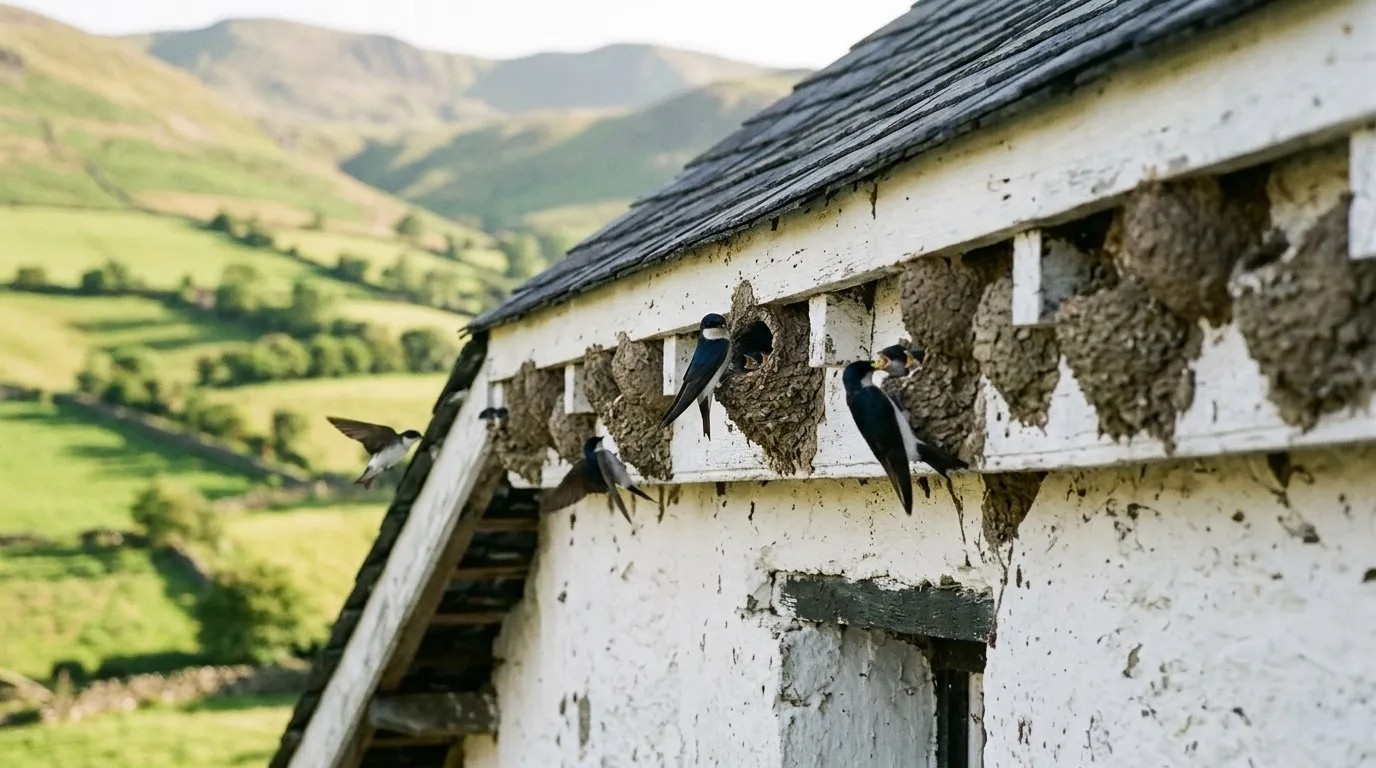 An established colony strung along a farmhouse eave. Every active nest here is protected by law from the first beakful of mud until the birds depart.
Dealing with droppings without harming the birds
The honest downside of a colony is the droppings below the nests. A busy nest of chicks produces a steady fall of white droppings onto the wall, windowsill or path beneath. The wrong response, knocking the nest down, is illegal. The right response is a droppings board.
Fix a shelf or board to the wall about 60cm below the nest. A plank 15 to 20cm wide, angled slightly and painted to match the wall, catches the droppings before they reach the surfaces you care about. You then clean the board, not the brickwork, and the nest stays untouched. Position it far enough below that it does not block the birds’ approach flight to the entrance hole.
For the few weeks of peak feeding, a little tolerance goes a long way. The droppings wash off masonry with plain water once the birds leave in autumn. Many long-standing colonies survive simply because a neighbour was talked round with a droppings board rather than a broom.
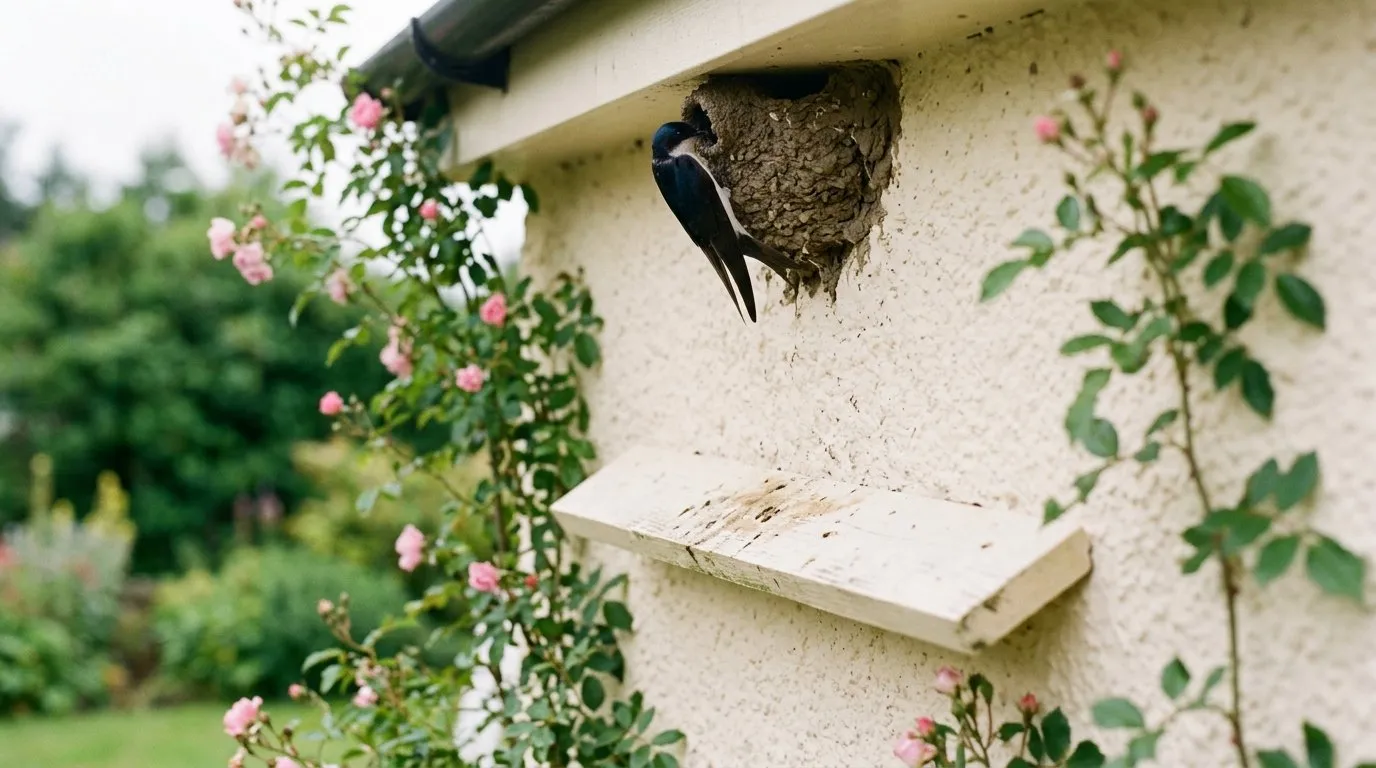 A droppings board fitted below the nest. It catches the mess for easy cleaning and keeps you legal, where knocking the nest down would not.
Month-by-month house martin calendar
| Month | What is happening and what to do |
|---|---|
| January | Colony in Africa. Fit or repair artificial cups now. Remove old, empty nests only if needed. |
| February | Clean droppings boards. Check cup fixings and overhangs are sound before the birds return. |
| March | First martins may reach southern coasts. Start a mud scrape if the ground is drying. |
| April | Main arrival from late April. Keep the mud patch wet daily. Play a sound-lure at dawn. |
| May | Nest building peaks. Do not disturb walls or eaves. First eggs laid mid to late month. |
| June | First broods hatch. Keep mud damp for second-nest builders. Avoid all insecticides. |
| July | First young fledge; second clutches begin. Ponds and long grass feed the hungry colony. |
| August | Second and third broods in the nest. Colony at its noisiest and busiest overhead. |
| September | Birds gather and start moving south. Late broods may still be in the nest. |
| October | Last martins depart, some very late. Nests now empty for the winter ahead. |
| November | Wash droppings off walls with plain water. Plan cup positions for next year. |
| December | Fit new cups on dry days. The wall is ready and weathered for the April return. |
Common mistakes when attracting house martins
- Putting cups too low. Martins want height and an overhang. A cup at 1.5m on a bare wall feels exposed. This happens because people fit at ladder-comfortable height. Mount cups 2m or higher, tucked under the eave.
- Offering no mud. People buy cups but forget the building material. In a dry spring the birds have nowhere to gather mud, so the cups stay empty. Keep a wet scrape within 30m from mid-April.
- Giving up after one summer. Colonies form slowly, and a first take often needs two or three seasons. Gardeners assume failure and take the cups down early. Leave them up and wait.
- Fitting a single cup. A lone cup ignores the birds’ colonial instinct. It looks like a dead-end site. Always group two or more together to read as a colony.
- Spraying insecticide in spring. A May spray for aphids wipes out the flying insects martins feed to chicks. It happens because the timing clash is invisible. Drop garden insecticides entirely near a colony.
Bringing it all together
Attracting house martins comes down to three honest needs: a safe, shaded, high nest site, wet mud within reach in spring, and a garden full of flying insects. Fit grouped cups under a north or east eave, keep a mud scrape damp through May and June, and lose the insecticides. Then protect what arrives, because the law and the birds both depend on you leaving active nests alone. A colony is slow to start and loyal once settled.
Now you have your martin colony started, read our guide to a wildlife log pile for another easy feature that lifts the insect life a colony feeds on.
Frequently asked questions
How do you attract house martins to your house?
Fit artificial nest cups high under the eaves and provide wet mud nearby. House martins are colonial, so put up cups in groups of two or more, 2m or higher, on a shaded north or east wall. Keep a muddy patch wet through spring within about 30m. An insect-rich, pesticide-free garden below does the rest.
Are house martin nests protected by law?
Yes, active house martin nests are protected under the Wildlife and Countryside Act 1981. It is an offence to destroy, damage or block a nest while it is being built or used, or to obstruct the birds from reaching it. You can only remove an old nest in winter, once it is empty and unused.
What is the difference between a house martin and a swallow?
House martins show a white rump; swallows have long tail streamers. House martins are blue-black above and white below, with a short forked tail and white feathered legs. Swallows have a red throat, dark blue breast band and deeply forked tail. Martins nest under the eaves; swallows nest inside barns and porches.
How do I stop house martin droppings without breaking the law?
Fit a droppings board about 60cm below the nest. The shelf catches droppings before they hit walls, windows or a path, and you clean it rather than the wall. Never knock down or block an active nest. Tolerating the mess for a few weeks is the legal and kinder route.
When do house martins arrive and leave the UK?
House martins arrive in late April and leave by October. Most reach UK colonies through late April and May, breed through summer, then gather and depart in September and early October. They fly around 9,000km to winter in sub-Saharan Africa. Late second and third broods can still be in the nest into October.
Why won’t house martins use my nest cups?
Usually they cannot find wet mud nearby, or the cups sit too low. Cups need to be 2m or higher under an overhang, ideally in a group, on a shaded wall. A dry spring with no puddles leaves the birds no building material. Occupation often takes two or three seasons even when everything is right.
Can I remove an old house martin nest?
Only in winter, once the nest is empty and unused. Between roughly March and October the birds are protected while nesting, so the nest must stay. If you must clear one, do it from November to February and, ideally, put up an artificial cup in its place to keep the colony.
Our team produces practical UK gardening guidance from source research, contributor records and established horticultural practice. Editorial standards are overseen by Matt W.