Key takeaways
- No flower is truly black; the best 'blacks' are the deepest purples, maroons and browns
- Tulip 'Queen of Night' flowers black-maroon in April and May at 55 to 60cm tall
- Dark flowers recede, so plant within 1m of a path and against a pale or lime foil
- Dahlia 'Karma Choc' and 'Sam Hopkins' carry near-black blooms from July to the first frost
- Chocolate cosmos is a tender tuber; lift it or protect the crown once nights drop below 3C
Black flowers give a UK garden a moody, gothic edge that no other colour can match. The catch with black flowers is simple: not one of them is truly black. Every dark bloom you can buy is really the deepest possible purple, maroon, red or brown. Grown well and placed with care, these tones read as black from a few paces. Grown badly, they sink into the soil and vanish completely.
Why there is no truly black flower
No flower makes true black pigment. Petals colour themselves with three main pigment groups. Carotenoids give yellow and orange. Betalains give some reds and magentas. Anthocyanins give the reds, purples and blues, and they do all the heavy lifting for dark flowers.
To read as black, a petal has to pack in an extreme amount of red-purple anthocyanin, usually a delphinidin type, over a dark base. The pigment stacks so densely that it absorbs almost all visible light. Your eye reads the result as black. Hold a ‘Queen of Night’ tulip up to strong sun, though, and the maroon undertone shows through at once.
This matters for planting. A “black” flower is really a very dark red, purple or brown. That undertone decides its best partner. Oxblood-red blacks like Dahlia ‘Karma Choc’ sing next to orange. Purple-blacks like Viola ‘Bowles’s Black’ prefer silver and lime. Knowing the true base colour is the first step to using dark flowers well.
Read the “how black” column carefully. Anything scoring 5 clearly shows its maroon or brown base in daylight. Plants scoring 7 or more hold their black even under a grey Staffordshire sky. If you want one plant that never lets the theme down, start with black mondo grass and build the flowers around it.
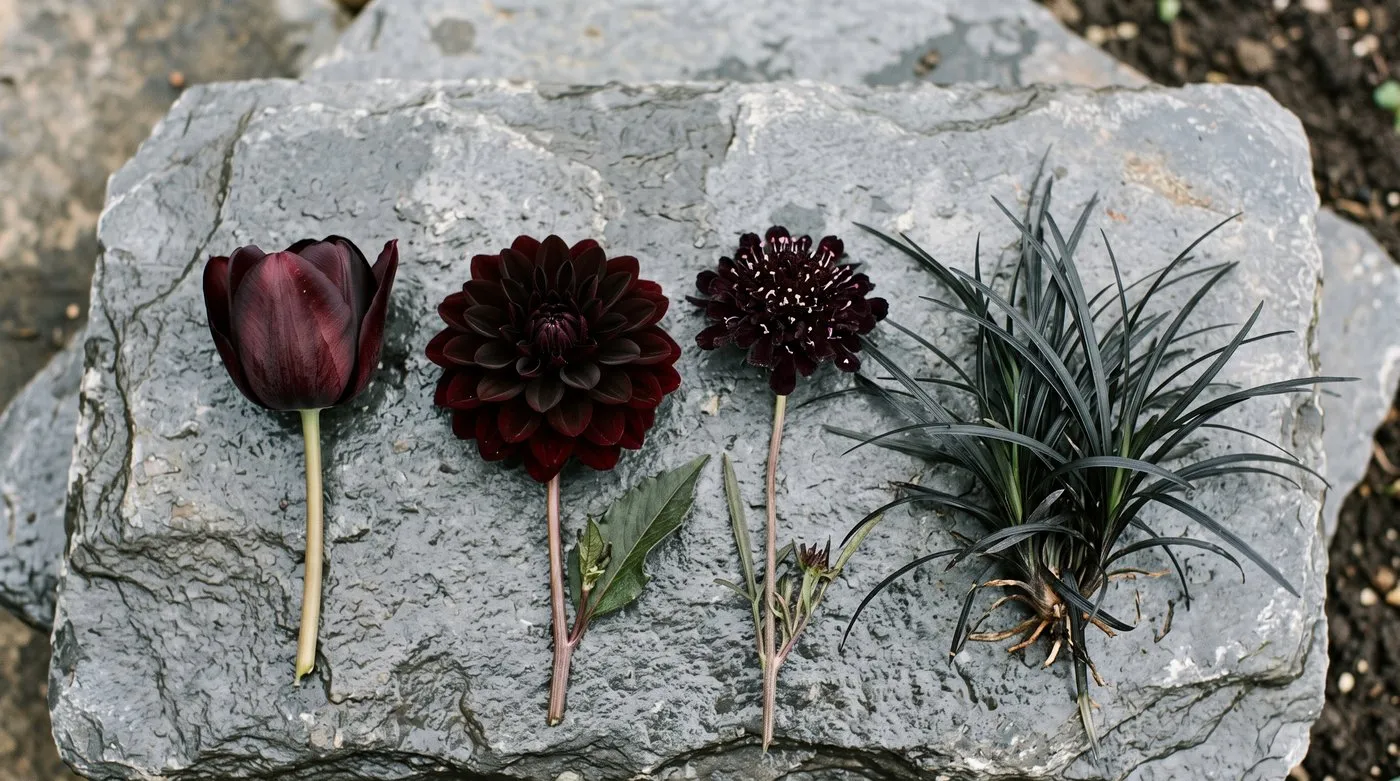 A side-by-side of the darkest performers. Black mondo grass foliage, front, reads far blacker than any of the flowers behind it.
Spring black flowers: tulips, fritillaries and aquilegia
Spring is where the black theme starts. The black tulips do the most work for the least money. Tulip ‘Queen of Night’ is the classic, a single late tulip in deep black-maroon, flowering April to May at 55 to 60cm. It is widely sold and cheap, at roughly £6 to £9 for 10 bulbs. Plant in November at 15cm deep and it opens around the third week of April on our clay.
Tulip ‘Black Parrot’ is the flamboyant partner. Its petals are feathered and twisted, purple-black, at 45 to 55cm. Both tulips are best treated as annuals on heavy soil, or lifted and dried after flowering. For the full method see our guide on how to grow tulips in the UK, which covers depth, spacing and lifting.
For height, Fritillaria persica ‘Adiyaman’ carries a 80 to 100cm spike of plum-black bells in April. It wants sharp drainage and full sun, and it looks its best rising through lime-green euphorbia. Aquilegia ‘Black Barlow’ follows in May and June, a double maroon-black granny’s bonnet at 75 to 90cm that self-seeds gently. Save seed only from the darkest plants to keep the black coming true year on year.
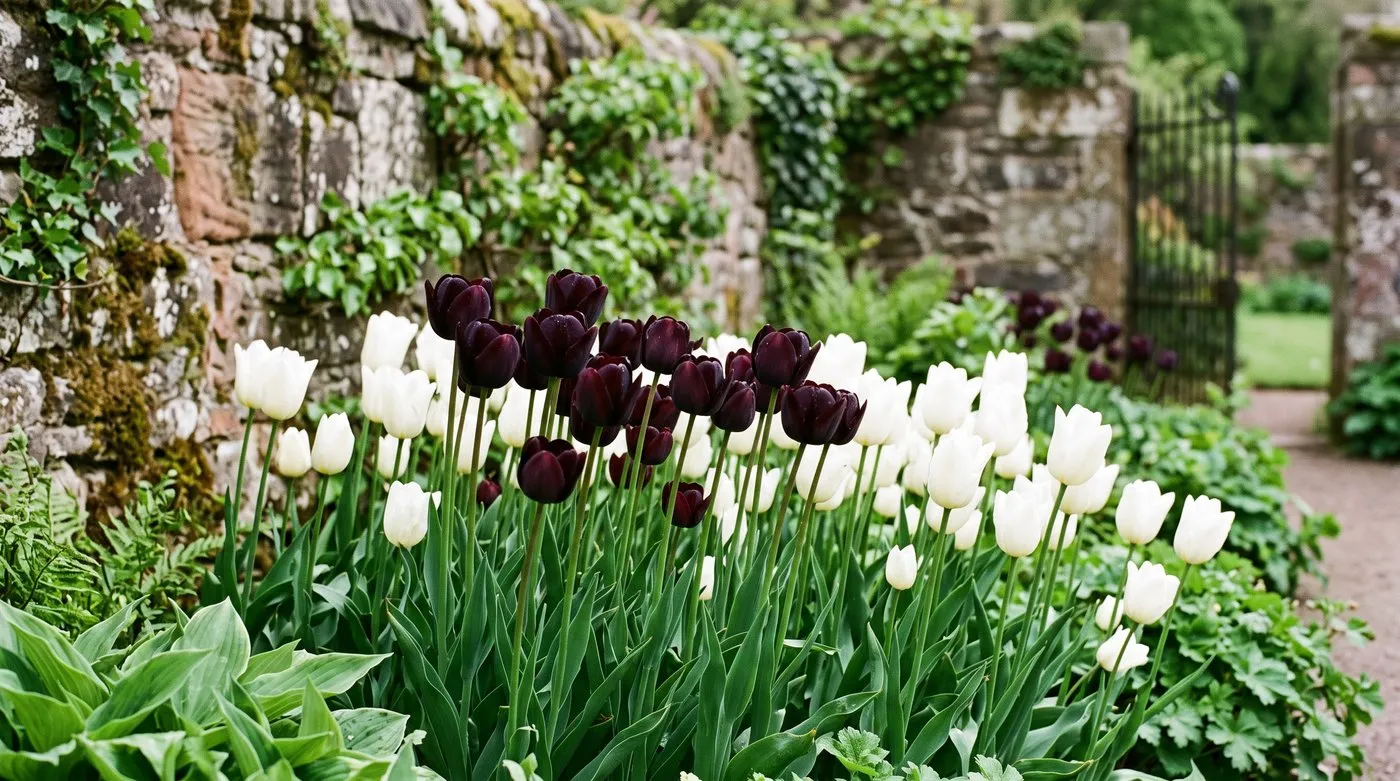 Tulip ‘Queen of Night’ set against white tulips in a walled spring garden. The pale neighbours push the dark tulips forward instead of letting them recede.
Summer and autumn blacks: dahlias, cosmos and scabious
The dark theme peaks from July to the first frost, and dark dahlias lead it. Dahlia ‘Karma Choc’ is a dark red-black waterlily type at 90 to 110cm, bred as a cut flower so the stems are long and strong. Dahlia ‘Sam Hopkins’ is a semi-cactus in the same oxblood-black, slightly shorter. Both flower non-stop from July until frost cuts them down, often into early November here.
Dahlias are tubers, lifted or heavily mulched over winter in cold gardens. Our full method sits in the guide to growing dahlias in the UK. Slugs love the young shoots, so protect them from the moment they emerge.
Chocolate cosmos, Cosmos atrosanguineus, is the scented one. Its maroon-brown flowers genuinely smell of dark chocolate on a warm afternoon. It reaches 60 to 75cm and flowers July to October. It is a tender tuber, though, and needs winter care, which we cover in how to grow chocolate cosmos.
For airy height, Scabiosa atropurpurea ‘Chat Noir’ and its sibling ‘Black Cat’ carry deep maroon-black pincushions on 60 to 75cm wire stems from June to October. Sweet pea ‘Black Knight’ and ‘Beaujolais’ climb to 1.8m in the same dark tones, both richly scented. Lower down, Viola ‘Bowles’s Black’ and ‘Molly Sanderson’ give near-black faces at 10 to 15cm all summer, and Petunia ‘Black Velvet’ does the same job in pots.
Gardener’s tip: Cut chocolate cosmos and dark scabious for the vase regularly. Both flower harder the more you pick, and a single black bloom in a jar of silver eucalyptus shows the colour off far better than a whole clump lost in the border.
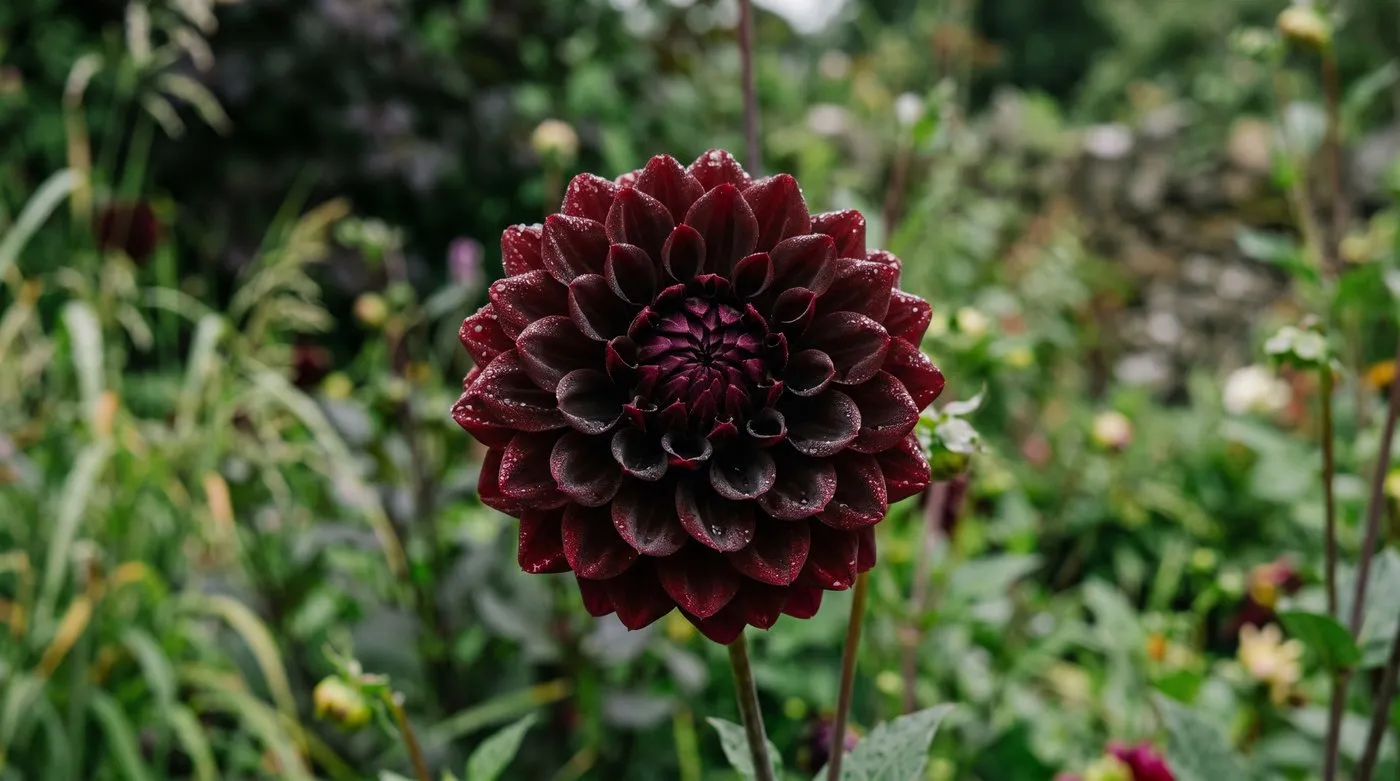 Dahlia ‘Karma Choc’ close up. The oxblood-red base shows clearly here, which is why it partners so well with orange and lime.
The foliage that reads blackest of all
Flowers come and go. Black foliage holds the theme all season, and it reads far darker than any petal. The champion is black mondo grass, Ophiopogon planiscapus ‘Nigrescens’. This slow, evergreen sedge-like plant makes tufts of near-black strap leaves at 15 to 20cm. It spreads by runners into a dark mat over three or four years.
For a shrub, Sambucus nigra ‘Black Lace’ gives clouds of finely cut black-purple foliage on a plant that reaches 2 to 3m if left unpruned. Cut it hard each spring for the biggest, darkest leaves. Pale pink flowers in June lift the dark canopy.
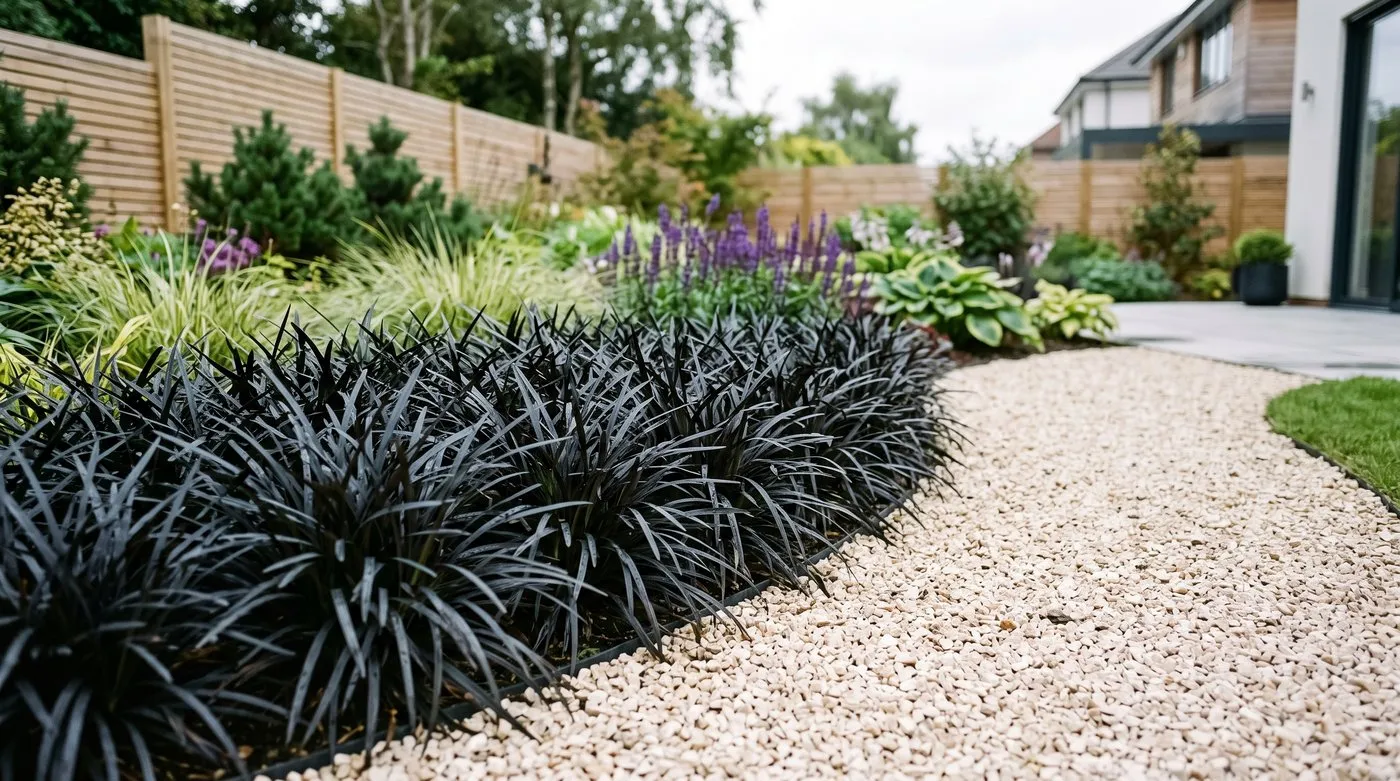 Black mondo grass edging a gravel path. As foliage it holds its near-black colour every day of the year, unlike any flower.
Winter drama: Helleborus ‘Onyx Odyssey’
The black theme need not stop in autumn. Dark hellebores carry it through winter. Helleborus ‘Onyx Odyssey’ is a double, slate-black to deep purple, flowering February to April at 40 to 45cm. On a frosty morning the dark cups against bare soil are genuinely striking.
Hellebores want humus-rich soil in part shade, the opposite of the sharp, sunny drainage the tulips and dahlias like. Plant them where you pass in winter, near a door or a path, because the flowers nod downward and are easy to miss from a distance. Cut off the tatty old leaves in January so the flowers show clearly.
Set dark hellebores against snowdrops or pale-flowered hellebores for contrast, the same pale-foil rule that governs the whole scheme. Our guide to growing hellebores in the UK covers soil, division and the leaf-spot disease to watch for. A single clump of ‘Onyx Odyssey’ with snowdrops around it bridges the long gap before the first black tulips open.
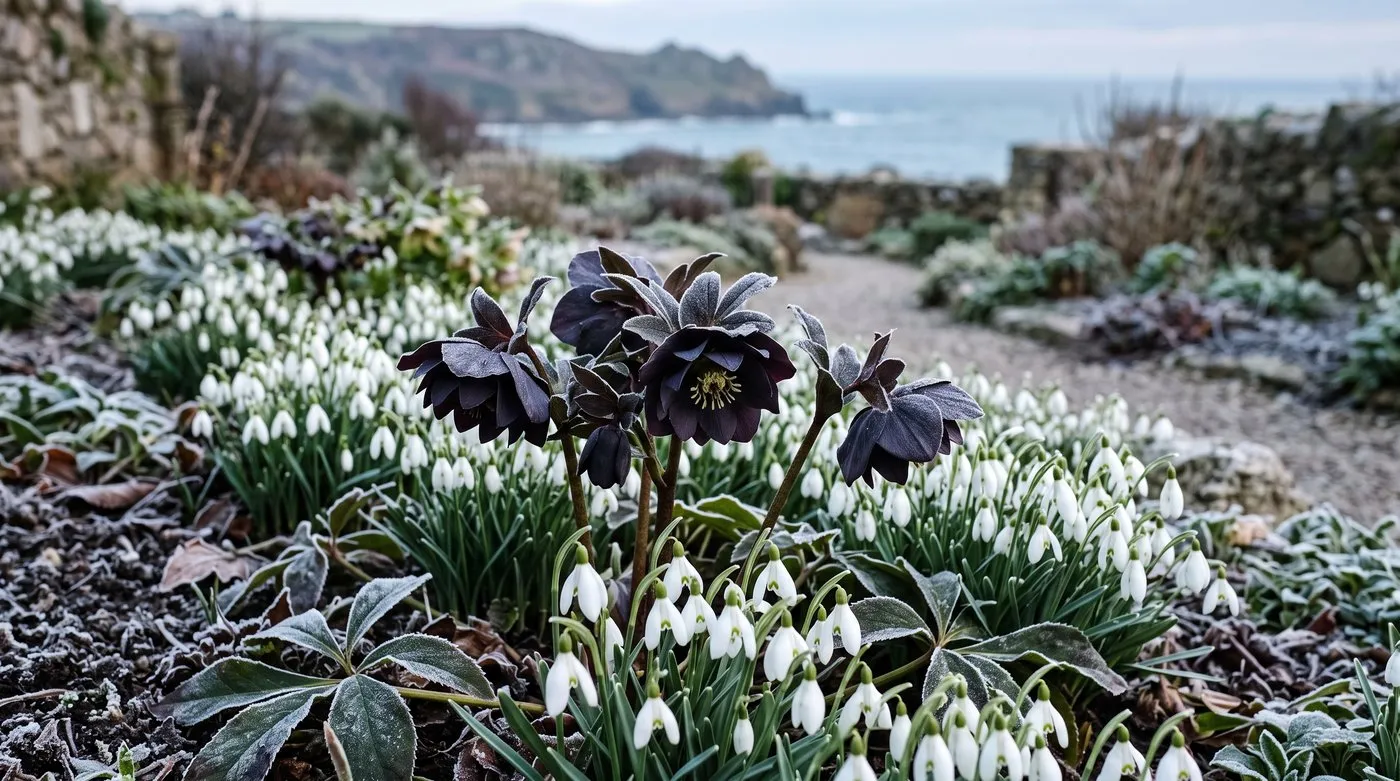 Helleborus ‘Onyx Odyssey’ with snowdrops in late winter. Dark hellebores extend the black theme right back to February.
How to stop black flowers disappearing in the border
Here is the design problem nobody warns you about. Black flowers recede. Dark tones absorb light instead of reflecting it, so from a distance a black flower reads as a hole, not a bloom. Massed together against soil, dark flowers simply vanish. This is the single most common reason a gothic scheme fails.
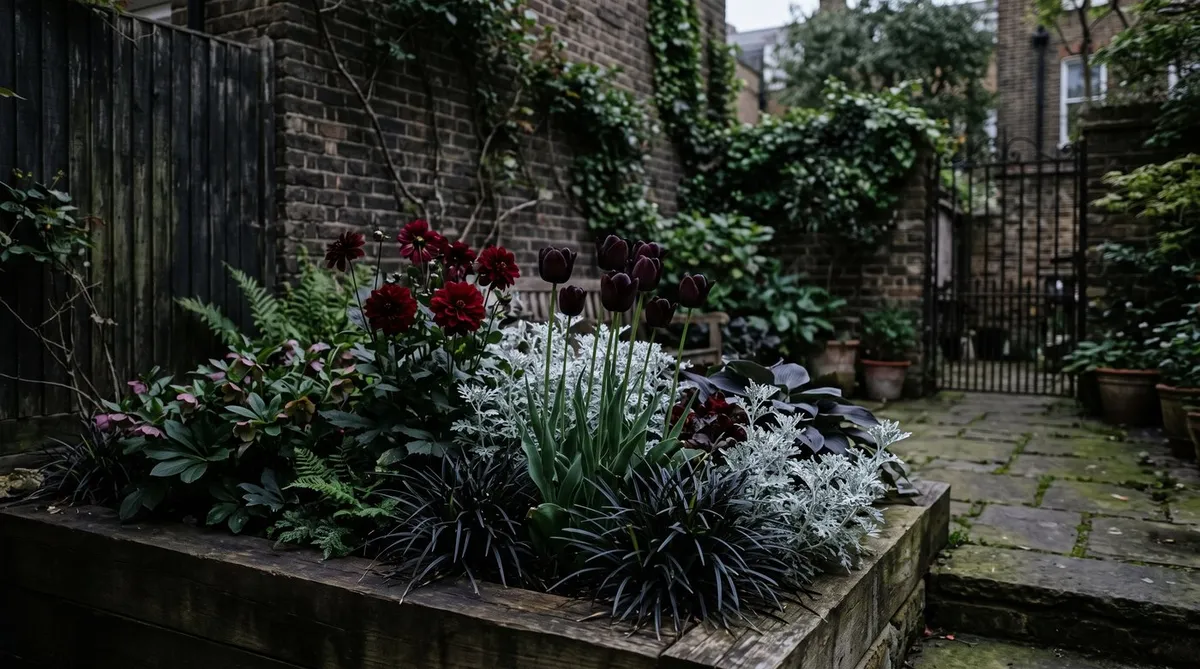
Keep black flowers within 1 metre of where you stand. Put them beside a path, a seat or a doorway, at or near eye level. Detail this dark is wasted at the back of a deep border. Raised beds, tall pots and wall-top troughs all help lift the flowers into view.
Use black as an accent, never as mass. A few dark flowers punctuate a scheme and add depth. A whole bed of them turns into a dull, sooty patch on a grey day. Aim for dark flowers as roughly one plant in seven, scattered as full stops through brighter colour. For more on building schemes around a single strong colour, browse the garden design hub.
Warning: Never plant black flowers in deep shade to “match the mood”. Low light kills the little contrast they have, and most dark flowers stretch and flower poorly without sun. Give the tulips, dahlias and scabious six or more hours of direct sun. Save the shade for hellebores and mourning widow geranium only.
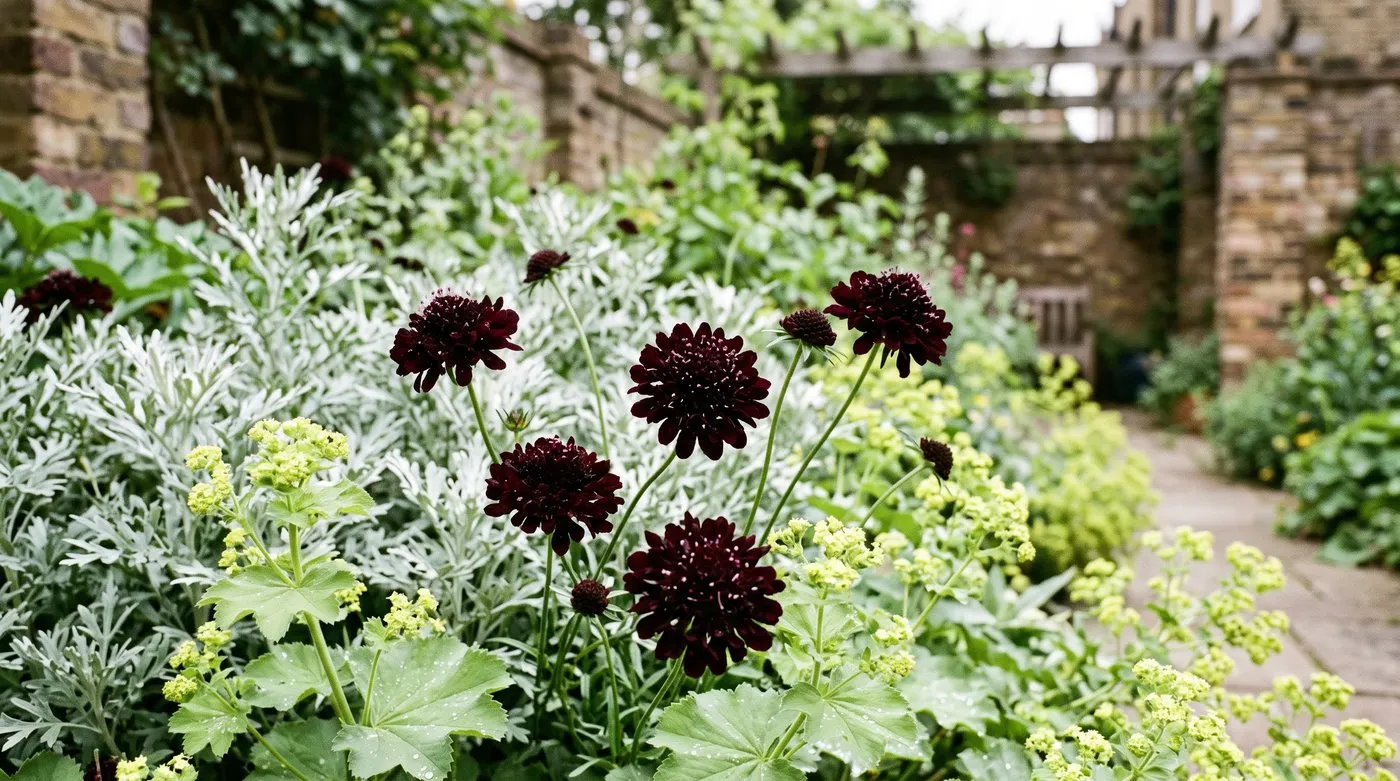 The contrast trial in practice. The same dark flowers read as black against silver and lime, but disappear against bare soil to the right.
The logic is simple. The mondo grass gives a permanent, genuinely near-black base at ground level. The tulips supply the seasonal flower colour above it. Because the flowers sit against dark foliage and not bare earth, they gain a lit-from-within quality that a tulip alone in soil never has. Add a silver Artemisia or a lime Alchemilla nearby and the group carries from right across the garden.
A season-by-season plan for a gothic border
A good black scheme runs from late winter to autumn frost. Plant for a relay, so something dark is always in flower. The table below sets out what to plant and when, and what carries the theme each month in a typical UK garden.
| Month | What carries the black theme | Job to do |
|---|---|---|
| February | Helleborus ‘Onyx Odyssey’, black mondo grass | Cut old hellebore leaves; tidy mondo grass |
| March | Hellebores fading, mondo grass | Start dahlia tubers indoors at 15C |
| April | Tulip ‘Queen of Night’, ‘Black Parrot’, Fritillaria persica | Stake tall fritillaries; feed tulips |
| May | Aquilegia ‘Black Barlow’, late black tulips | Sow scabious and chocolate cosmos under cover |
| June | Iris chrysographes, Geranium phaeum, hollyhock buds | Plant out dahlias and cosmos after frost risk |
| July | Dahlias, chocolate cosmos, scabious, hollyhock ‘Nigra’ | Deadhead dahlias; support tall stems |
| August | Peak dahlias, cosmos, Viola ‘Bowles’s Black’ | Keep picking for the vase to prolong flowering |
| September | Dahlias, scabious, Sambucus ‘Black Lace’ foliage | Take dahlia cuttings; save seed from violas |
| October | Late dahlias, chocolate cosmos, mondo grass | Lift chocolate cosmos before hard frost |
| November | Black mondo grass only | Plant next year’s black tulip bulbs at 15cm |
| December | Black mondo grass, dark seedheads | Leave seedheads standing for winter structure |
| January | Black mondo grass, first hellebore buds | Order dark cultivars; plan gaps |
Notice how the black mondo grass appears in every single row. That is the point of a permanent foliage backbone. The flowers hand the theme from one to the next across the months, but the grass never drops it.
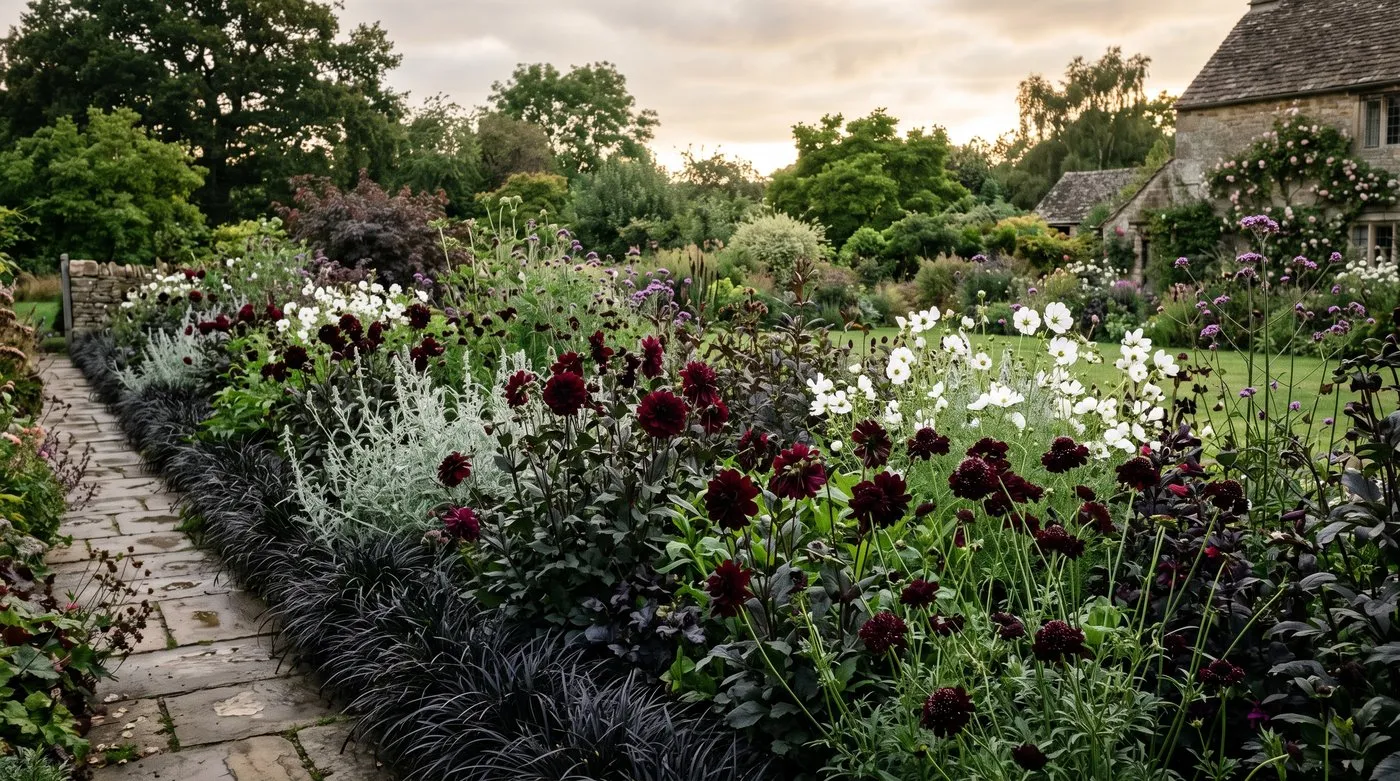 A full gothic border in late summer. Dark dahlias and scabious rise from a base of black mondo grass, lifted by threads of silver.
Common mistakes with a black planting scheme
- Expecting a literally black flower. Buyers feel cheated when a “black” tulip opens dark maroon. No petal is truly black. Read plant descriptions as “the darkest possible purple or red” and you will never be disappointed.
- Massing dark flowers together. A whole bed of black reads as a flat, sooty gap, especially under grey UK skies. Use dark flowers as accents, about one plant in seven, dotted through brighter colour.
- Skipping the pale foil. Black against bare soil disappears from a few paces. Always set silver, lime, white or bright euphorbia directly behind the dark flowers to throw them forward.
- Planting them too far away. Dark detail is wasted at the back of a deep border. Keep black flowers within a metre of a path, seat or door where you can actually see them.
- Growing sun-lovers in shade. Tulips, dahlias and scabious need six-plus hours of sun to flower well and hold their colour. Only hellebores and mourning widow geranium belong in the shade.
Avoid those five and a black scheme becomes one of the most striking things in a garden. For hardiness and cultivation detail on any of these plants, the RHS Plant Finder is a reliable cross-check before you buy.
Frequently asked questions
What is the blackest flower you can grow in the UK?
No flower is truly black; black mondo grass foliage comes closest. Ophiopogon planiscapus ‘Nigrescens’ reads about 95 percent black to the eye. Among true flowers, Iris chrysographes and Tulip ‘Queen of Night’ are the darkest reliable choices. Everything sold as black is really deep purple, maroon or brown.
Are there any true black flowers?
No, true black flowers do not exist in nature. Petals cannot make black pigment the way they make red or blue. The darkest blooms pack in so much red-purple anthocyanin that they read as black. Look closely in strong light and you always find a maroon, plum or oxblood undertone.
What is the best black flower for a gothic garden?
Tulip ‘Queen of Night’ is the most reliable black flower for UK gardens. It flowers black-maroon in April and May at 55 to 60cm, and it is cheap and easy. For a longer season, pair it with dark dahlias and black mondo grass foliage that carry the theme through to autumn.
Why do my black flowers look invisible in the border?
Black flowers recede and merge with soil and shade. Dark tones absorb light instead of reflecting it, so from a distance they read as a hole, not a flower. Move them within 1 metre of a path or seat, lift them to eye level, and set a pale or silver foil directly behind them.
What colours go with black flowers?
Is chocolate cosmos hardy in the UK?
No, chocolate cosmos is a tender tuber that needs winter protection. Cosmos atrosanguineus dies back in autumn and rots if left cold and wet. Lift the tuber, or mulch the crown deeply once nights drop below 3C. In mild, free-draining gardens it can survive outside under a thick dry mulch.
When do black tulips flower in the UK?
Our team produces practical UK gardening guidance from source research, contributor records and established horticultural practice. Editorial standards are overseen by Matt W.