Key takeaways
- Growing tables sit at 75-90cm tall - no kneeling or bending needed
- Standard 1.8m XL holds 150 litres compost, grows 12-15kg/year of mixed produce
- Right crops: salads, herbs, dwarf vegetables, tomatoes (bush), strawberries
- Wrong crops: deep-rooting (parsnip, sprouting broccoli), tall (sweetcorn, runner bean)
- Best UK value: VegTrug Classic 1.8m at £180; cheapest: Greena 1m at £65
- Annual maintenance: re-oil with linseed/danish oil, top up compost 2-3cm
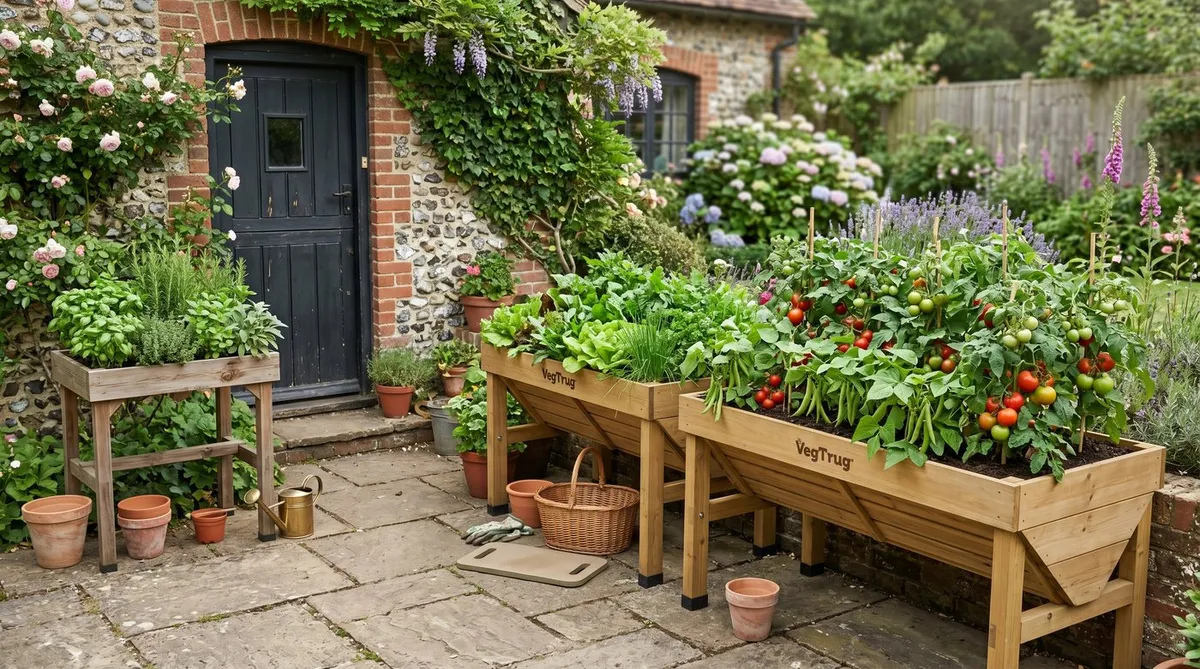
Growing tables are waist-height raised beds on legs, designed for patio, balcony or accessible UK growing. The standard 1.8m VegTrug XL holds about 150 litres of compost and grows roughly 12-15kg of mixed produce a year - tomatoes, salads, herbs, dwarf beans, strawberries. They replace the need to kneel, dig, or use ground space, and they suit gardeners with back, knee or hip problems.
For wider patio-growing options see our container vegetable gardening UK and patio garden ideas small spaces guides.
Growing table sizes and capacities
UK retailers sell growing tables in three broad size categories:
| Size | Length | Width | Depth | Compost capacity |
|---|---|---|---|---|
| Mini/herb | 70-90cm | 30-40cm | 18-22cm | 30-40 litres |
| Standard | 1.0-1.2m | 40-55cm | 25-30cm | 80-100 litres |
| Large/XL | 1.6-2.0m | 55-75cm | 30-40cm | 140-180 litres |
The V-shaped VegTrug Classic has a clever profile - 18cm deep at the edges, 30cm in the centre. Deep enough for tomato roots in the middle, shallow enough at the sides for shallow-rooting salad and herbs.
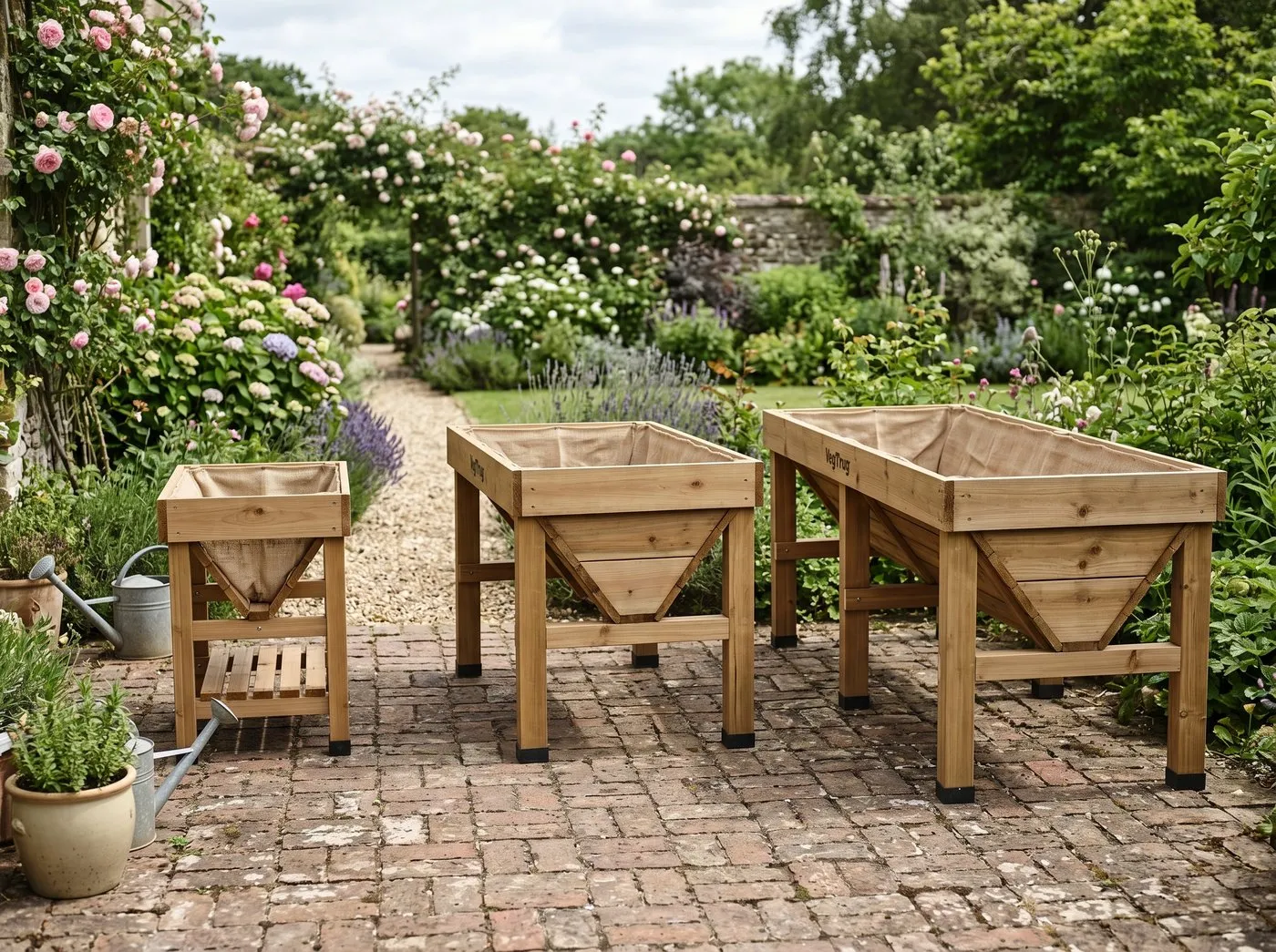 Three growing table sizes. The 1.8m XL on the right holds 150 litres of compost - enough for serious patio vegetable production.
1. VegTrug Classic 1.8m XL
- Price 2026: £180 retail (often £150-£170 on offer)
- Material: FSC-certified fir
- Capacity: 150 litres
- Build time: 45 minutes one person
- Best for: mixed-crop patio growing for 2 adults
Issues: the FSC fir needs annual oiling (linseed or Danish oil, £6 a tin). Without it the timber greys and starts to soften at the leg bases within 3 years. Built-in liner has fixed drainage holes that you can’t move.
2. Greena Wooden Planter 1m
- Price 2026: £65 retail
- Material: pressure-treated pine (food-safe ACQ)
- Capacity: 80 litres
- Build time: 25 minutes one person
- Best for: budget-conscious small-space growing
The cheapest reliable UK option. Rectangular profile (no V) so easier to plant in rows. ACQ pressure treatment is food-safe but the colour is the green tinge of treated softwood, which fades to grey in year 2.
Issues: 80-litre capacity is half the VegTrug XL - good for salads, herbs and dwarf veg but cramped for tomatoes. Pressure-treated pine still lasts only 4-6 years even with care.
3. Forest Garden Mendip 1.2m
- Price 2026: £140 retail
- Material: FSC spruce
- Capacity: 100 litres
- Build time: 40 minutes one person
- Best for: mid-budget customers who want square-profile planting
Spruce is harder than fir and lasts a year or two longer with the same care. Square rectangular profile holds 100 litres - between the Greena and the VegTrug XL.
Issues: the legs are spread wider than the planting box, making it visually awkward on a small patio. Drainage drilled in factory but not optimally placed.
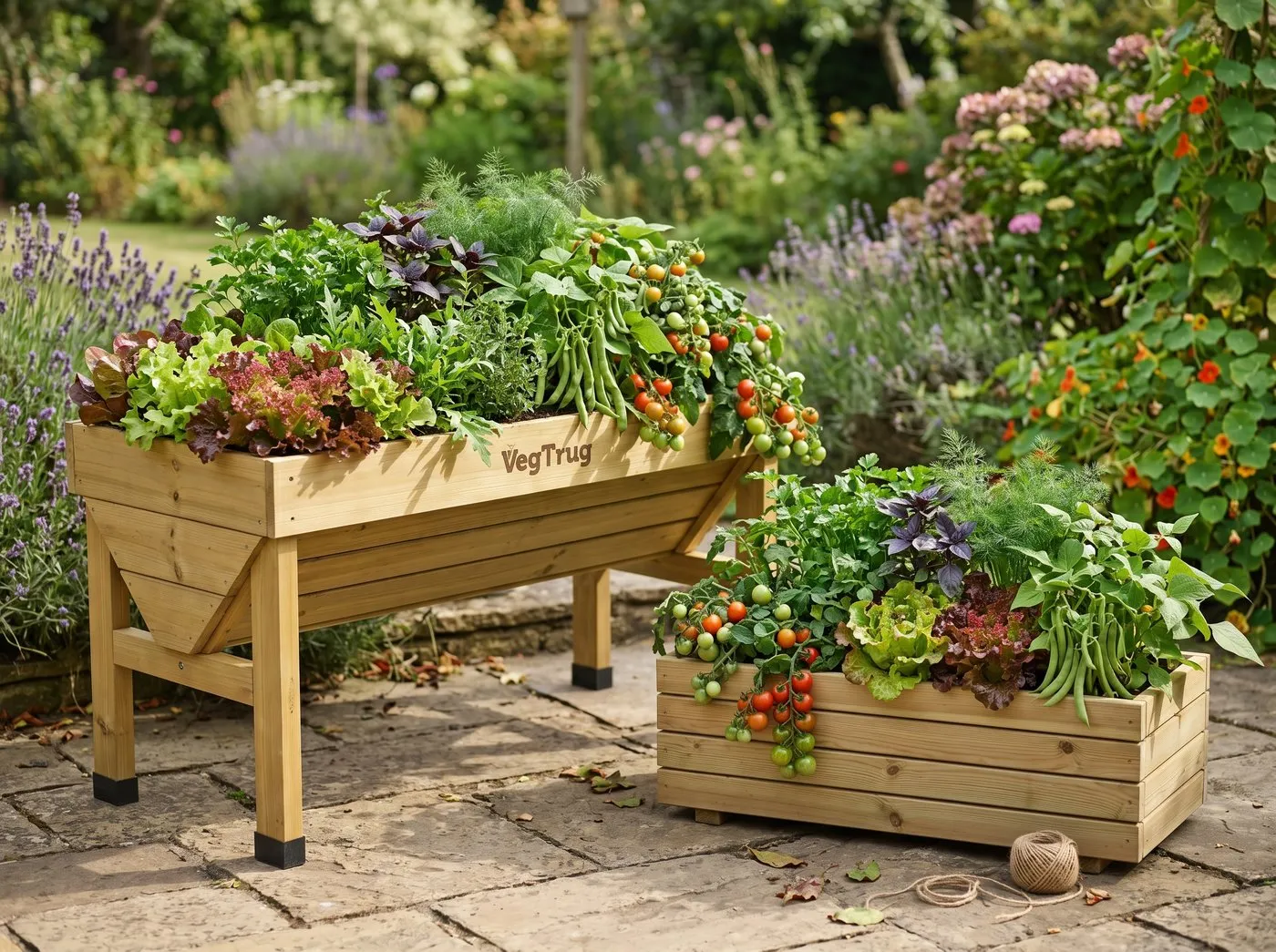 VegTrug Classic 1.8m XL (left, £180) vs Greena 1m (right, £65) - the VegTrug holds almost twice the compost and roughly twice the yield for under three times the price.
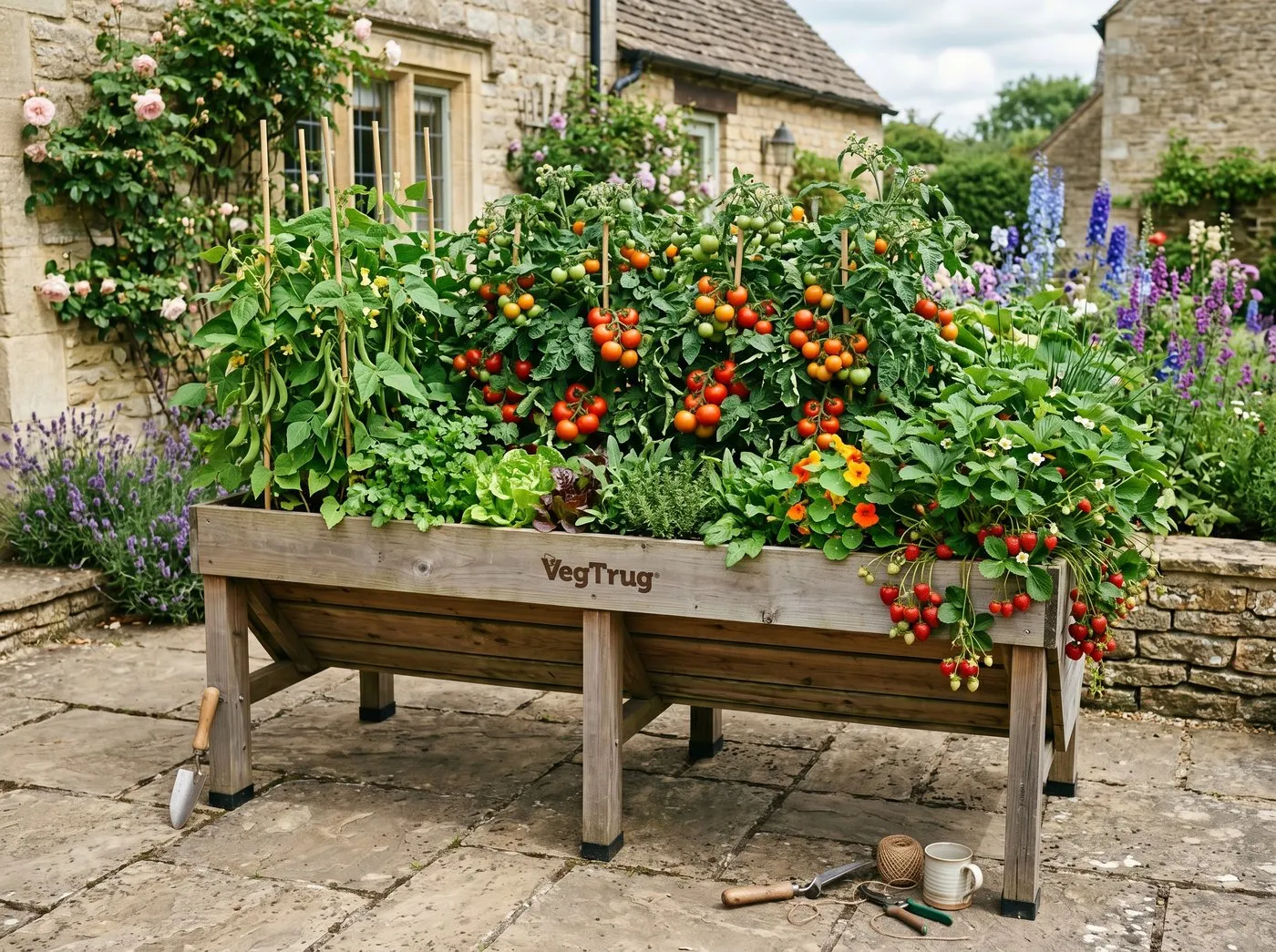 A planting layout that uses the V-profile - tomatoes and bush crops in the deep centre, salad leaves and herbs around the shallow edges.
Yields - what one table actually produces
2024 season totals from the VegTrug Classic 1.8m XL (150 litres of compost, 50% topsoil/30% MP/20% home compost):
| Crop | Plants | Yield |
|---|---|---|
| Bush tomatoes (Roma + Sungold) | 3 | 4.0kg |
| Dwarf French bean (Tendergreen) | 8 plants | 2.1kg |
| Strawberries (Cambridge Favourite) | 4 plants | 0.5kg |
| Mixed salad leaves | rolling sowings | ~3kg over season |
| Basil, parsley, chives, coriander | 1 pot each | continuous |
| Spring onions (White Lisbon) | rolling sowings | ~0.8kg |
| Radish | rolling sowings | ~0.6kg |
| Beetroot (multi-sown) | 6 clusters | 1.4kg |
| Dwarf kale (Redbor) | 2 plants | 0.9kg autumn-winter |
| Total | - | ~13kg + season-long herbs |
The yield is roughly equivalent to a 6m² ground bed at intensive cropping, achieved in 1m² of patio footprint. Productivity per square metre is high because vertical access is easy - succession sowing and weekly harvesting happen routinely rather than getting skipped.
What works well in a growing table
Salad leaves. Cut-and-come-again at waist height is the easiest crop to harvest in any UK garden. 4-6 cuts a season per square metre. Use the shallow edges of a V-profile table.
Herbs. All Mediterranean herbs (basil, parsley, thyme, oregano, sage). Mint is dangerous - it will spread to fill the whole table within 2 seasons. Keep mint in its own separate pot inside the table.
Bush tomatoes. Determinate varieties (Roma, Stupice, Tumbling Tom Red) crop heavily in 30cm of compost depth. Cordon varieties (Sungold, Gardener’s Delight) are too tall for most growing tables - they reach 1.8m and the table itself adds 90cm so the truss tips become inaccessible.
Dwarf beans. Tendergreen, Speedy, Purple Queen. Self-supporting - no canes needed. Heavy-cropping in 30cm depth.
Strawberries. 4-6 plants per 1.8m table. Lift them from slug damage. Pickable at standing height.
Beetroot, short carrots, spring onions, radish. Shallow-rooting crops that mature in 60-80 days.
Chard, dwarf kale, pak choi. Cut-and-come-again leaf crops that crop through winter in milder UK winters.
What doesn’t work in a growing table
Sprouting broccoli, Brussels sprouts. 1m+ tall plants. The table sets them at 1.8m height. Wind catches them and they topple. Crop period 10+ months ties up valuable bed for too long.
Parsnips, swede, salsify. Need 30cm of root depth - your table only offers 25-30cm and the V-profile means much of it is less.
Sweetcorn. Needs block planting of 16+ plants for pollination. A table only fits 4-6.
Runner beans, climbing peas. Need canes - canes need stability. Putting 2m+ canes in a growing table makes the whole table top-heavy and prone to blowing over.
Main-crop potatoes. Will grow but compete for the entire compost volume - one plant fills a table and crowds everything else out. Use a separate 50-litre potato bag instead.
Permanent crops. Rhubarb, asparagus, globe artichokes - they live for 6-15 years and the table won’t.
Compost mix and refilling
A growing table starts to deplete after one season of heavy cropping. By year 2 you’ll notice slower growth and pale leaves regardless of feeding.
Starting mix (year 1):
- 50% good topsoil (Westland Top Soil or local loam)
- 30% peat-free multi-purpose compost
- 20% home garden compost or well-rotted manure
- A handful of slow-release fertiliser pellets per 50 litres
Annual top-up (year 2 onwards):
- Remove the top 3-4cm of spent compost
- Replace with fresh peat-free multi-purpose plus a handful of chicken manure pellets
- Stir gently to mix
- Don’t dig out and refill the whole table every year - it’s wasteful and disrupts the soil ecosystem
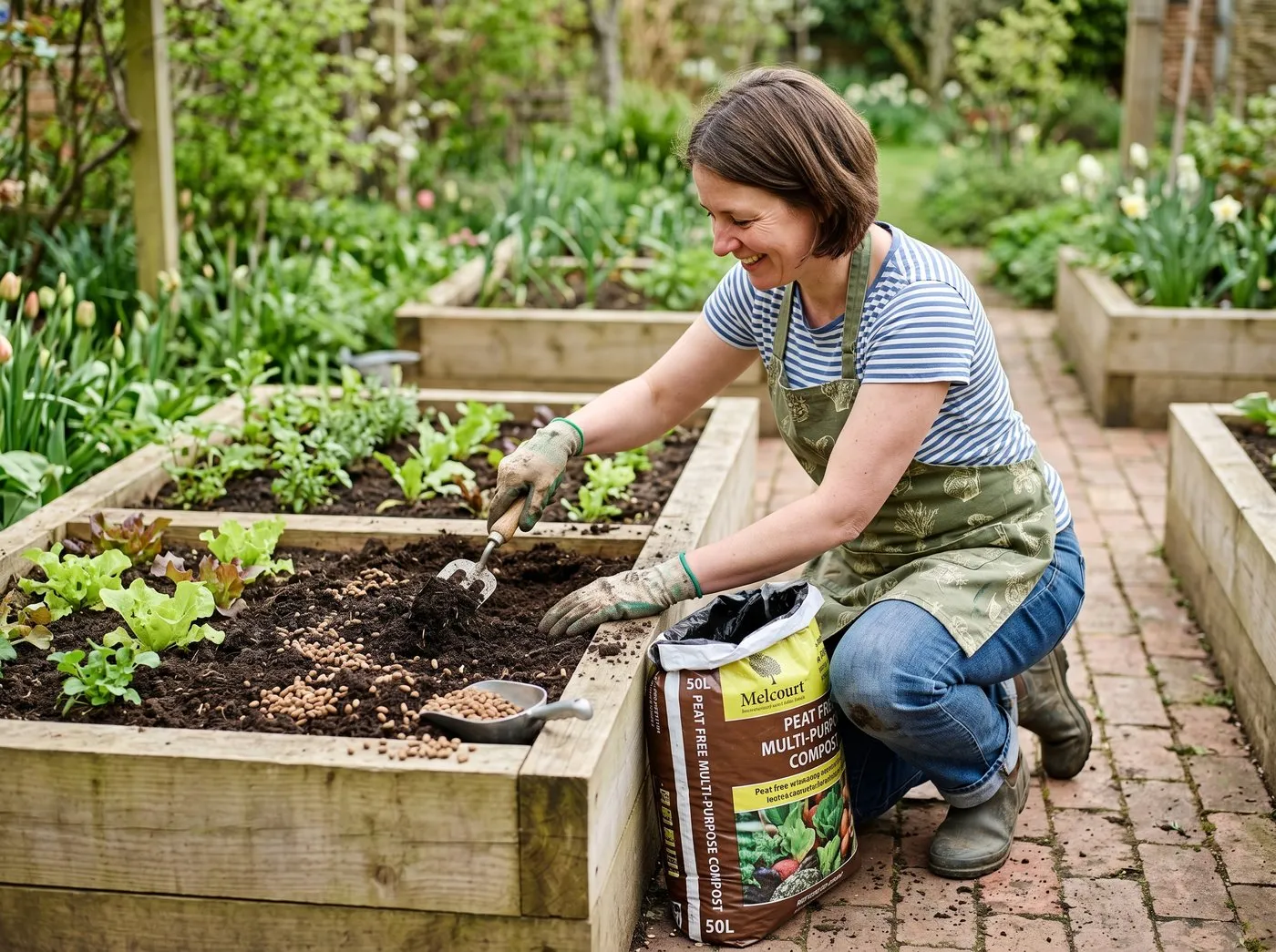 Annual compost top-up - remove 3-4cm of spent material, add fresh peat-free multi-purpose plus a handful of chicken manure pellets per 50 litres.
Watering routine
Growing tables dry faster than ground beds because air circulates underneath. The legs raise the planting medium above the cool ground temperature buffer.
| Conditions | Watering frequency |
|---|---|
| Cool/cloudy April-May | Every 2-3 days |
| Warm/sunny June-September | Daily |
| Hot (25C+) June-September | Twice daily |
| Wet autumn weather | Every 4-5 days |
A drip irrigation kit (£30-£50) with a tap timer transforms a growing table - water in the morning regardless of whether you’re home. Pays back in time saved within one summer.
Annual maintenance
End of season (October-November):
- Clear all spent annual crops to the compost heap
- Pick out slug eggs and overwintering pests
- Cover with horticultural fleece if growing winter salads
Spring (March):
- Oil the timber frame with linseed oil or Danish oil (£6 a tin, covers 2 tables)
- Check and replace the liner if damaged (£15 for VegTrug)
- Top up compost as described above
- Check leg stability
Mid-summer (July):
- Top-dress with chicken manure pellets after the first heavy crop comes off
- Re-stake any leaning plants
A well-maintained FSC fir table lasts 5-8 years. Neglected it lasts 3-4.
Accessible gardening - the real win
The waist-height working surface is the strongest argument for a growing table. For gardeners with:
- Back problems (slipped disc, sciatica, chronic lower back pain)
- Knee problems (osteoarthritis, ACL/meniscus issues, post-replacement)
- Hip problems (arthritis, post-replacement)
- Wheelchair users (90cm clearance under most tables fits a standard chair)
…a growing table is the difference between gardening and giving up.
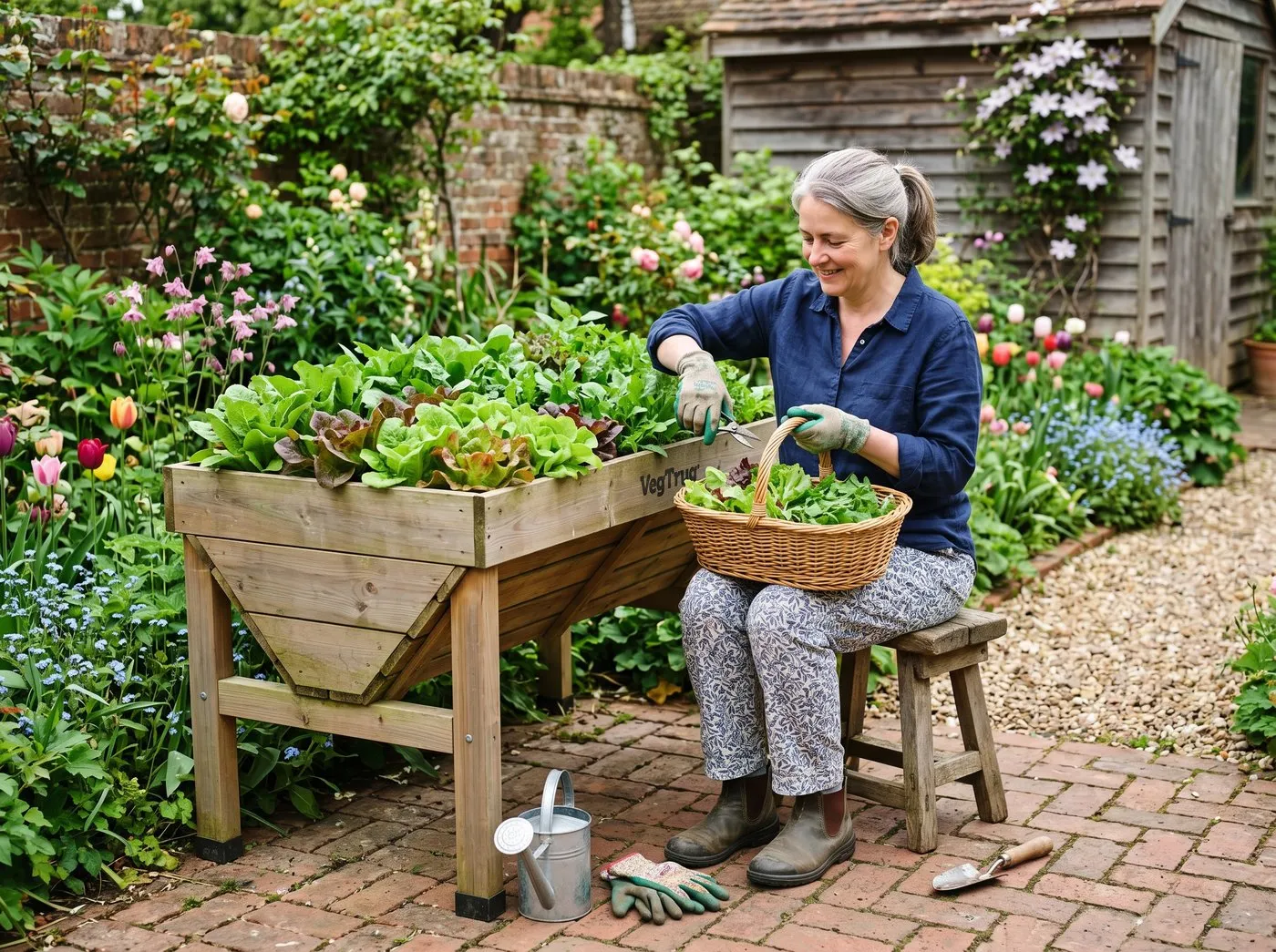 Waist-height harvest - no kneeling, no bending. Growing tables transform gardening for anyone with back, knee or hip pain.
The British Standards Institute notes a working height of 85-95cm suits the majority of UK adults for prolonged hand work. Most growing tables hit 80-90cm at the bed surface, which puts the crop within easy reach without straining the lower back.
Cost vs alternative
A 1.8m VegTrug at £180 fills with about £40 of compost (140 litres at £4-£5 per 75-litre bag for peat-free, plus topsoil). Total first-year outlay: roughly £220.
Compare to:
| Alternative | Setup cost | Drawback |
|---|---|---|
| 6m² in-ground bed | £80 (compost + soil improvers) | Needs garden ground, kneeling, digging |
| 8 large patio pots (40l each) | £200 | More watering, less yield per m² |
| Wooden raised bed (1.8m on ground) | £100 build | Still needs kneeling |
| 1.8m VegTrug growing table | £220 | Higher cost, oiling maintenance |
For non-accessible gardeners with ground space, a wooden raised bed is cheaper. For patio-only, balcony, or accessible growing, the growing table is the right tool.
Field note: Thrive (the gardening for health charity) publishes accessibility-focused growing-bed guidance and runs trial gardens with raised-bed setups for wheelchair users and arthritis sufferers.
Cheapest reliable option
If budget is tight, the Greena 1m at £65 is a solid starter. It holds half the compost of an XL VegTrug but grows a useful amount: salads year-round, herbs, dwarf beans, one bush tomato, strawberries. Expected lifespan 4-6 years.
Add a £15 drip irrigation kit and an annual £8 of fresh compost and you’re growing £30-£50 worth of produce a year off a £65 table. Payback within 2 seasons.
Best UK growing table 2026: VegTrug Classic 1.8m XL
For the average UK patio gardener with £180-£200 budget, the VegTrug Classic 1.8m XL is the best growing table in the 2026 UK market. The V-profile works for mixed cropping, the capacity supports realistic family-sized output, the build quality is sound at the price point, and the spare parts (liners, replacement legs, side panels) are still in production for repair.
Annual maintenance: 30 minutes of oiling and a £10 top-up of compost. Lifespan: 5-8 years. Total cost over 8 years (table plus annual maintenance and consumables): about £350 = £44/year. Yield over 8 years: roughly 100kg of produce at £4-£8/kg supermarket equivalent = £400-£800 of food. The table pays back its full lifecycle cost within 4-6 years, then runs free.
Now you’ve sized up the format
For more on what to plant in a growing table or alongside it, our container vegetable gardening UK, dwarf vegetables small spaces UK and grow your own vegetables UK guides cover the variety choices that fit waist-height growing.
Our team produces practical UK gardening guidance from source research, contributor records and established horticultural practice. Editorial standards are overseen by Matt W.