Key takeaways
- Stroll garden differs from karesansui zen garden: you walk it, you do not just look at it
- Minimum useful plot size 80 square metres, ideal 150 to 400 square metres
- Stepping stone spacing 300 to 600mm centre to centre with 50mm clearance
- Acer palmatum needs soil pH 5.5 to 6.5, achieved with 50g sulphur per square metre
- Water feature budget £800 for liner pond, £3,500 for natural stream with pump
- Maintenance averages 6 to 12 hours per month including raking and pruning
Building a Japanese stroll garden in the UK climate makes more sense than most British gardeners realise. The kaiyu-shiki style relies on shade, damp air, moss-friendly conditions and acid soils, all of which UK plots offer in abundance. This guide covers the design principles, the right plants for UK weather, path and stone layout, water features, and what the build actually costs.
What a stroll garden actually is
A stroll garden is a walking garden. The Japanese term is kaiyu-shiki teien, sometimes shortened to kaiyu-shiki. The visitor follows a circular path of 30 to 80 metres minimum that loops past a series of staged scenes. Each scene is hidden until you turn the next corner. This deliberate sequencing is called miegakure, literally “hide and reveal”.
It is not the same as a karesansui dry garden such as Ryoan-ji. Karesansui is a viewing garden, usually 4m by 6m or smaller, enclosed by a wall and seen from a veranda. The stones and raked gravel stay still. The visitor stays still. In a stroll garden, the visitor moves and the garden unfolds.
The form developed under the Edo-period daimyo lords from 1603 to 1868. Three of the surviving Edo examples are still considered the master references: Korakuen at Okayama (built 1700, about 13 hectares), Kenrokuen at Kanazawa (1620s onward, 11.4 hectares) and Ritsurin at Takamatsu (1625, about 75 hectares). All three are open to the public.
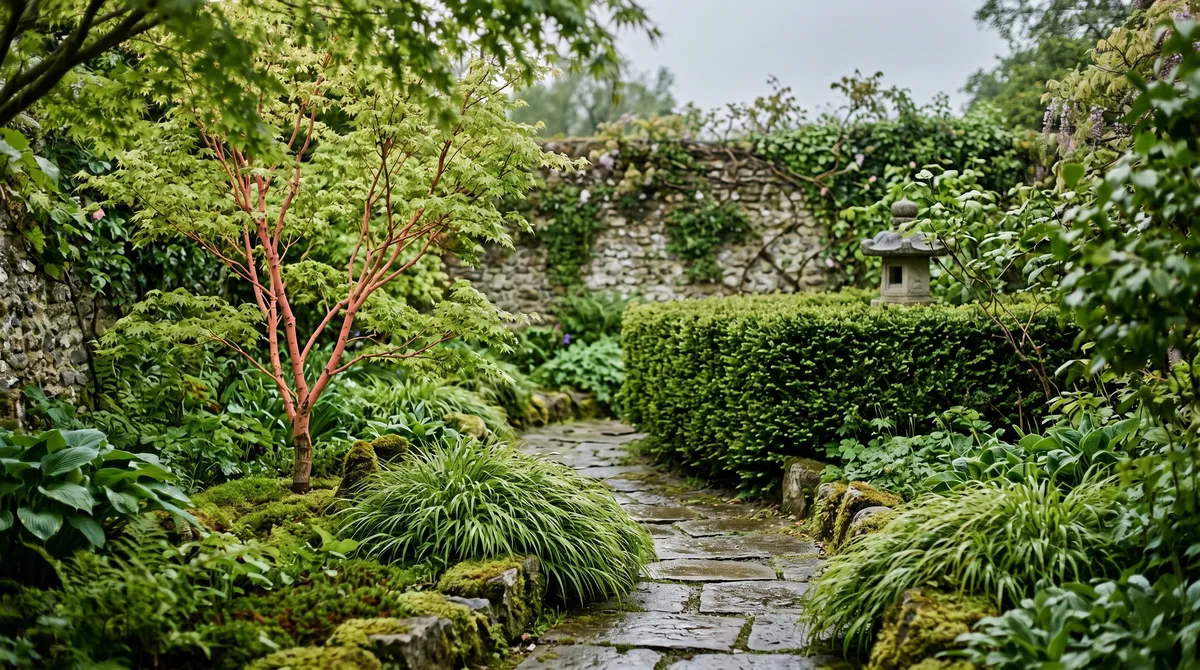
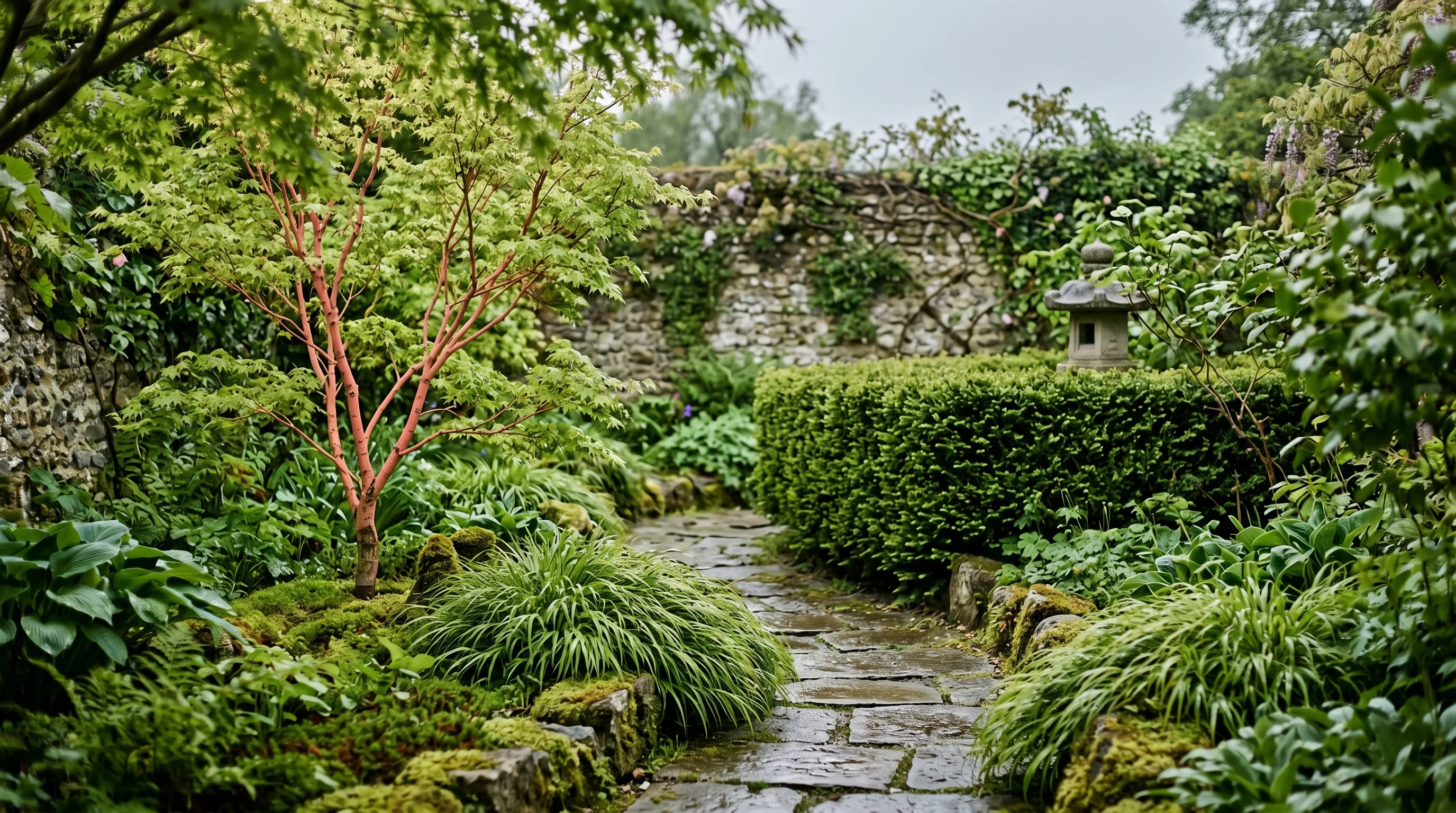 The opening view sets the tone. Here a ‘Sango-kaku’ Acer leads the eye along the path while a stone lantern hints at what comes next.
Why the UK climate suits this style
UK growing conditions match the natural habitat of most kaiyu-shiki plants better than the south of England matches its Mediterranean planting trend. Average UK rainfall sits at 1,154mm per year (Met Office 1991 to 2020 baseline), which is enough to keep moss alive without irrigation in shaded plots.
Three climate factors line up:
- High humidity keeps moss and Hakonechloa happy. East Asian forest-floor plants evolved with humidity above 70 per cent for much of the year.
- Acidic soils are common across the north and west. Acer palmatum wants pH 5.5 to 6.5. Many UK plots already sit close to this without amendment.
- Mild winters. Minimum temperatures rarely drop below minus 10C in lowland England. All the standard stroll-garden trees and shrubs are hardy to at least minus 15C.
The one weak point is late spring frost. UK May can still produce a minus 3C night that damages just-emerged maple foliage. The fix is siting, not fleece: plant acers on the cold side of a hedge so they break bud one to two weeks later.
The core design principles
Five principles drive every kaiyu-shiki layout. Get these right and the garden reads as Japanese even with limited budget.
Miegakure (hide and reveal)
Nothing important should be visible from the entrance. The path turns, a hedge or rock interrupts the view, and the next scene only opens at the right point. This is the structural backbone of the style. Plan the path first and the planting second.
Shakkei (borrowed scenery)
The garden incorporates the view beyond its boundary. A neighbour’s mature oak, a distant church tower, or hills outside the fence become part of the composition. Keep the boundary planting low at that sightline. In a London suburban plot the borrowed scene might be a single mature lime; in a Welsh valley garden the whole hillside opposite can read as part of the composition.
Sequence of vistas
A traditional kaiyu-shiki gives you between three and seven distinct stopping points around the loop. Each one has its own set piece: a stone group, a water view, a single specimen tree, or a built feature such as a lantern or tea house. The path widens or pauses at each stop.
Asymmetry
There is no central axis. Stones, trees and lanterns are arranged in odd-numbered groups (three, five, seven) at unequal distances. The Japanese term is fukinsei. Symmetry feels artificial in this style.
Suggestion, not imitation
A small pond stands in for a lake. A pruned pine reads as a wind-shaped tree on a coast. A 1.5 metre group of basalt boulders reads as a mountain. Scale is collapsed deliberately. Trying to copy a real Japanese site at full size fails on a UK plot.
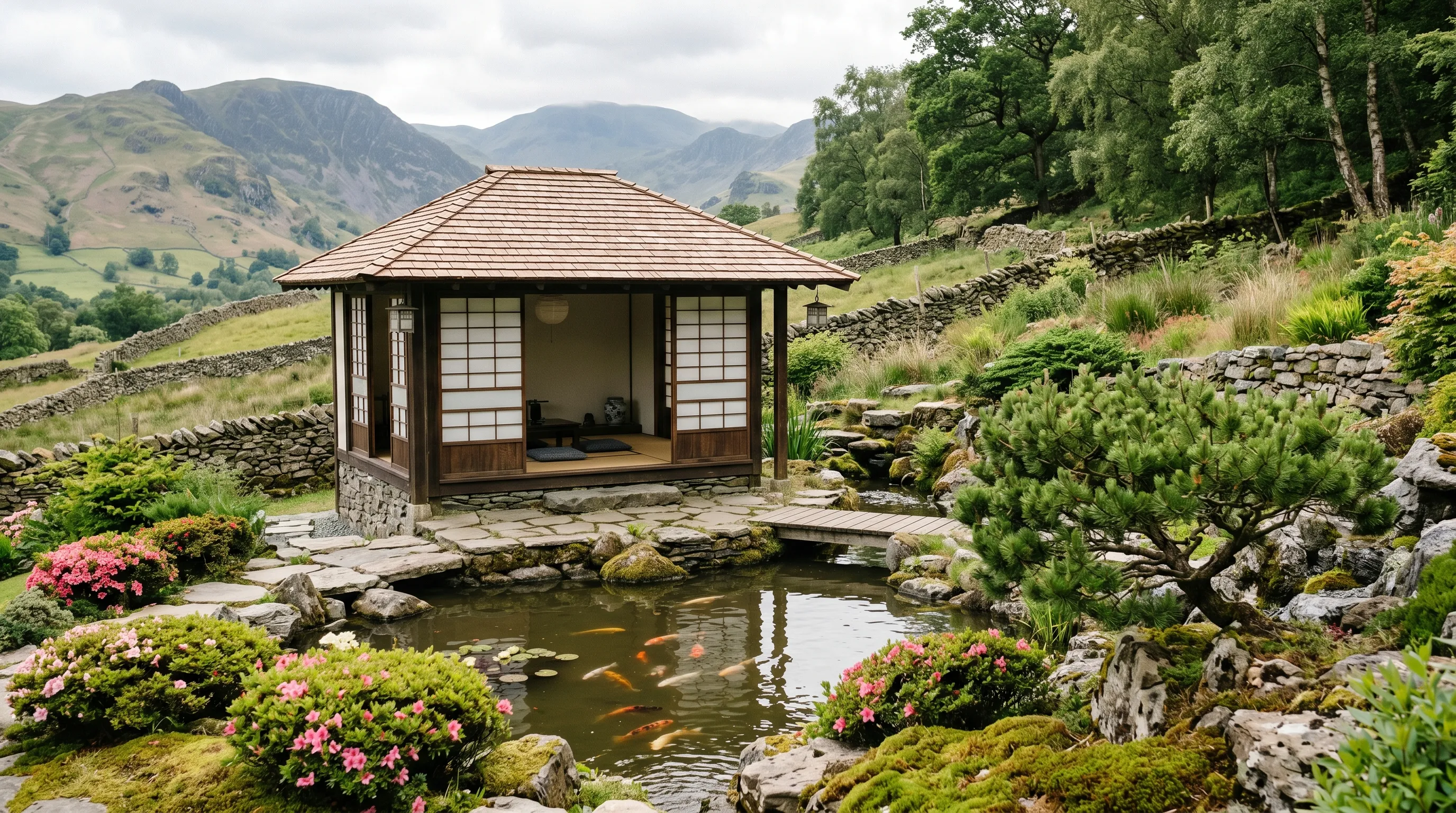 A British summerhouse with a low pitched roof and timber screens reads as a tea house without the cost of importing one.
Planning the path
The path is the design. Get the path layout right before you choose a single plant.
Aim for a loop of 30 metres minimum, 50 to 80 metres ideal on a 200 to 400 square metre plot. The path should never run straight for more than 4 metres without a turn or interruption. Each turn hides the next view.
- Start the loop with a soft right turn within 2 metres of the entrance. The first scene is the surprise.
- Build at least three viewing pauses where the path widens to 800mm or 1,000mm.
- Use stepping stones for slow stretches, flagstone or compacted gravel for the faster connecting runs.
- Avoid loops that double back within sightline of themselves. If you can see two parts of the path at once, the trick is broken.
Stepping stone spacing
Stones should be 350 to 500mm across at the widest point, irregular, and set 300 to 600mm apart centre to centre. The Japanese standard is yatsu-bashi (eight stones): deliberately uneven spacing forces the walker to look down. A walker who is looking down is moving slowly, which is the point.
Set each stone 50mm proud of the surrounding ground. UK rainfall means the stones sit in periodically saturated soil. Slightly raised stones drain and stay non-slip. Use a 50mm sharp sand bedding course under each stone for stability.
Granite is the traditional material. UK-sourced Cornish or Aberdeen granite runs £180 to £260 per square metre for sawn pieces, £80 to £140 per tonne for reclaimed irregular stones. Reclaimed York stone also works at £100 to £180 per square metre and weathers convincingly in three winters.
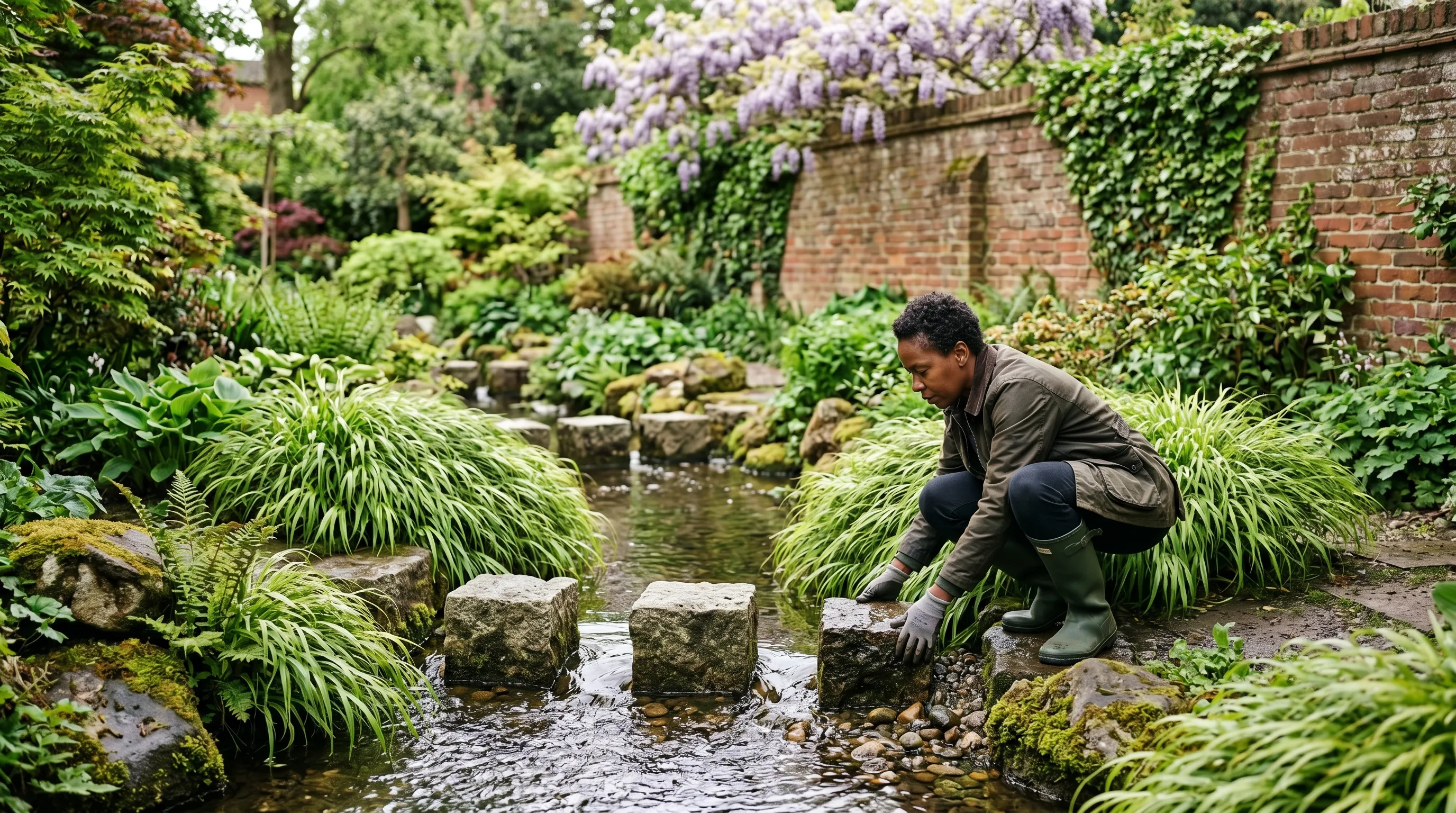 Stones set 450mm centre to centre across the stream. The slight gap to the water surface stops algae and keeps the stones non-slip.
UK-hardy plants for a stroll garden
Trees: the structural set
| Species | Mature height | UK hardiness | Notes |
|---|---|---|---|
| Acer palmatum ‘Bloodgood’ | 4-5m | H6, minus 20C | Reliable deep red, hardiest of the red forms |
| Acer palmatum ‘Sango-kaku’ | 5-6m | H6, minus 20C | Coral-bark winter colour, slow growth |
| Acer palmatum dissectum ‘Garnet’ | 1.5-2m | H5, minus 15C | Weeping form, smaller plots, late-frost prone |
| Pinus mugo ‘Pumilio’ | 1-1.5m | H7, minus 30C | Substitute for Japanese black pine, easier in UK |
| Pinus sylvestris (Scots pine) | 8-15m | H7 | Native, takes Japanese-style cloud pruning well |
| Prunus ‘Tai-haku’ | 6-8m | H6 | Great white cherry, AGM, single April bloom |
The pine is the workhorse. Pinus mugo ‘Pumilio’ is the easiest specimen for UK gardeners and takes the midori-tsumi (May candle-pinch) and momi-age (autumn needle plucking) techniques without sulking. Japanese black pine (Pinus thunbergii) is the textbook species but struggles in UK clay and high rainfall.
Shrubs and ground
- Azalea japonica ‘Hino-crimson’, ‘Mother’s Day’ and ‘Vuyk’s Scarlet’ for May colour, hardy to minus 15C, want pH 4.5 to 5.5.
- Camellia japonica ‘Adolphe Audusson’, ‘Donation’, and the smaller ‘Spring Festival’, flowering February to April, hardy to minus 10C.
- Pieris japonica ‘Forest Flame’ for spring red new growth and lily-of-the-valley flowers, 2 to 3m mature.
- Skimmia japonica ‘Rubella’ for winter buds, evergreen ground structure to 1m.
Grasses and ground cover
- Hakonechloa macra ‘Aureola’ or the plain species. The single best UK substitute for the bamboo grasses you see in Japanese photos. Wants moisture-retentive soil, partial shade. Hardy to minus 15C.
- Soleirolia soleirolii (mind-your-own-business) as a moss alternative. Spreads quickly in damp shade, tolerates light foot traffic, dies back in hard winter but regenerates fully each spring.
- Dryopteris erythrosora (autumn fern) and Polystichum setiferum (soft shield fern) for shaded edges.
- Ophiopogon planiscapus ‘Nigrescens’ (black mondo grass) for contrast against pale gravel.
True moss is achievable in deep shade on acidic ground but takes three to five years to establish from spores. Soleirolia is the realistic UK substitute at 80 to 95 per cent of the visual effect and full coverage within one season.
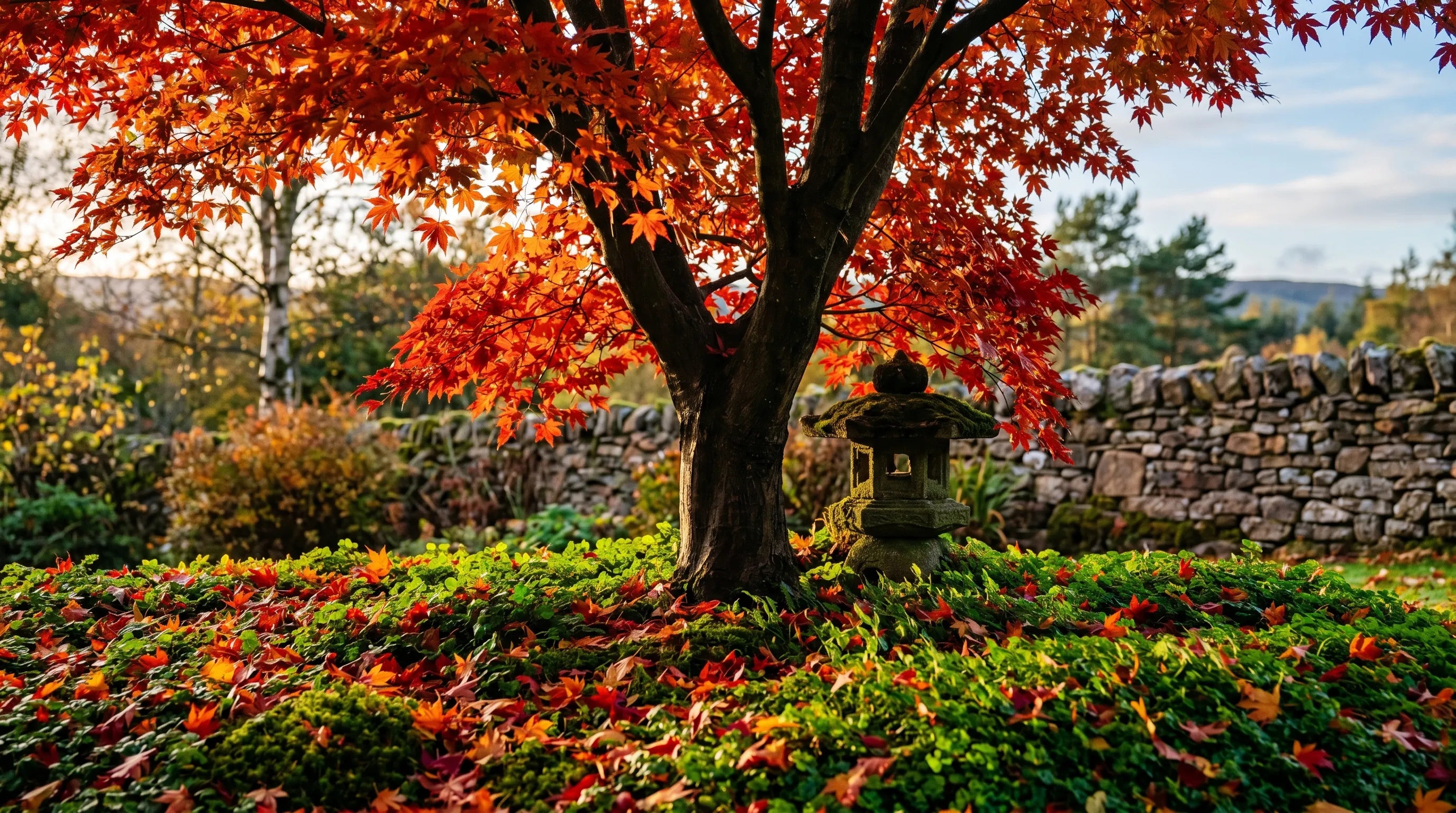 ‘Osakazuki’ is the most reliable autumn-colour Acer for the UK. The leaves turn scarlet for two to three weeks in mid October even after grey summers.
Getting the soil right for acers
Acer palmatum cultivars want soil pH 5.5 to 6.5. UK soils across Wales, the Pennines, the Lake District, much of Scotland and parts of Surrey already sit in this range. Chalky and limestone areas (Cotswolds, Chilterns, South Downs) do not.
Test before you plant. A £6 chemical kit gives a one-decimal reading good enough for this.
If your soil reads pH 7.0 or above, acidification is possible but persistent:
- Sulphur: apply 50g per square metre of horticultural elemental sulphur to drop pH by 0.5 unit on a loamy soil. Re-apply every 18 months.
- Acidic compost: top-dress with ericaceous compost annually, 30mm depth.
- Avoid tap water in hard-water areas: it raises pH over time. Collect rainwater into a 200 litre butt for watering established acers.
Above pH 7.5 on chalk, do not plant acers in the ground. Use 60 to 80 litre glazed ceramic pots filled with ericaceous compost instead. Repot or top dress every two to three years.
Water features and budget
A water element is not strictly required but most kaiyu-shiki gardens have one. Three workable UK budgets:
£800 entry: liner pond
A 2m by 3m butyl-lined pond at 600mm depth costs about £800 in materials: butyl liner £180, underlay £50, a small 1,500 litre-per-hour pump £85, gravel and edging stones £200, planting £280. Add three water iris (Iris ensata) and three pickerel weed.
£1,800 mid: pre-formed pond with bog edge
Use a 1,000 litre rigid liner, pump and bog filter (about £450 combined), a small recirculating waterfall feature (£280), edging boulders sourced locally at £6 to £12 per stone, and 12 plants (£180). Add labour at half a day with a digger hire (£140) and you land around £1,800.
£3,500 full: stream and pond
A 6 to 8 metre recirculating stream with three 200mm step drops, terminating in a 3m by 2m pond. Materials including a 5,000 litres-per-hour pump (£420), butyl roll (£380), underlay (£90), 2 to 3 tonnes of stone (£560 to £840 delivered), rigid pond at the base (£260), plants (£280), and digger hire for two days (£420) plus general installation labour comes to £3,180 to £3,500 ex VAT.
A tsukubai stone water basin is the cheapest authentic water element: £80 for reconstituted stone, £300 to £500 for natural granite, plus a low-flow recirculating pump at £45 to £80.
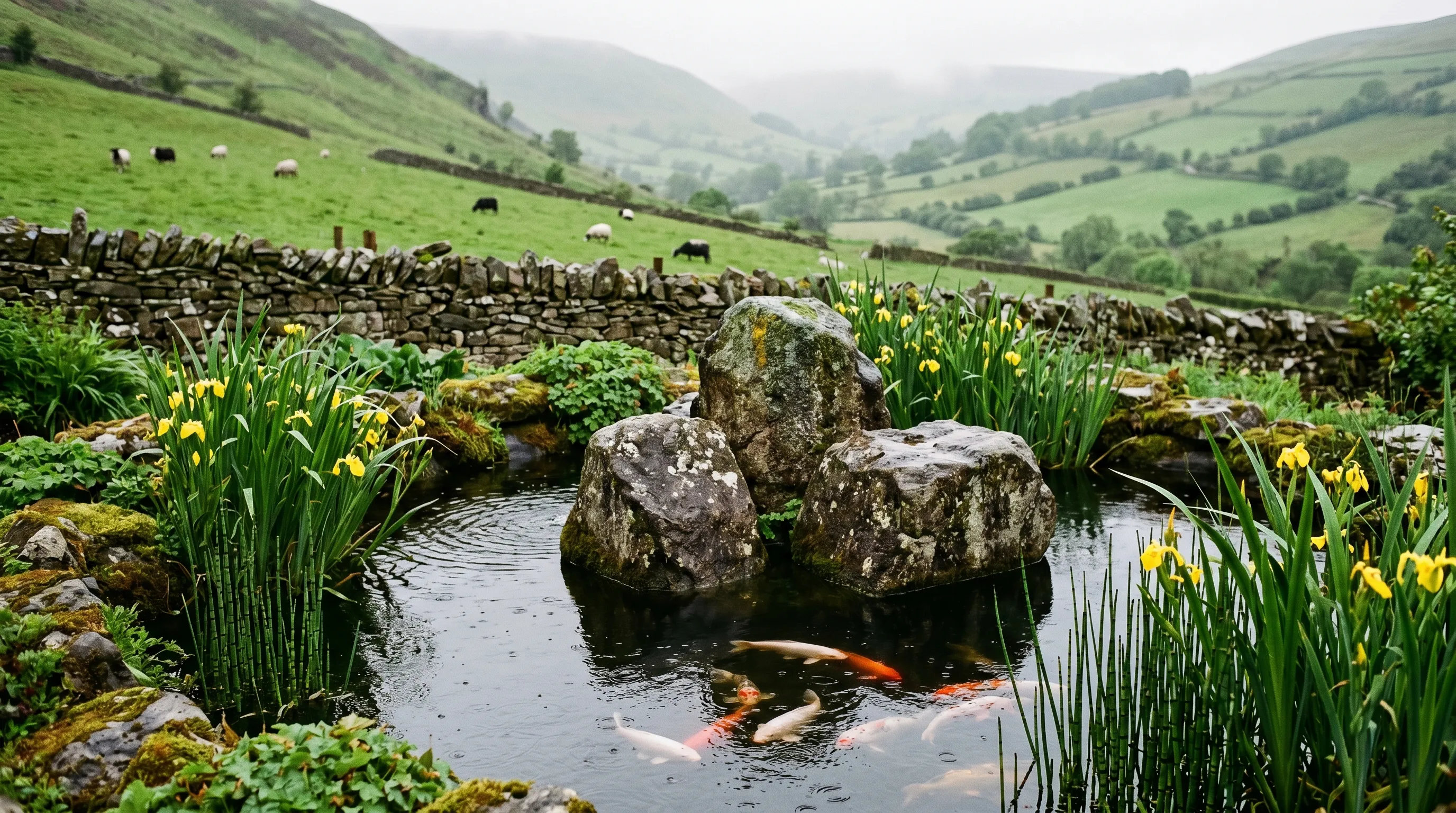 Three weathered granite boulders standing out of the water echo the rocks of a coastal scene. The composition is asymmetric, with the tallest stone off-centre.
Tea house alternatives
A genuine chashitsu (tea house) costs £8,000 to £20,000 imported, plus planning consent in many districts. The realistic UK alternative is a timber summerhouse with a pitched roof and a simple low opening.
What to specify:
- Pitched roof, 25 to 35 degrees, dark stained shingles or cedar shakes.
- Single sliding door rather than french doors (closer to shoji proportions).
- Internal floor at platform height 300 to 450mm above ground (closer to traditional zashiki).
- Footprint 2m by 2m to 3m by 3m. Anything larger reads as a shed.
- No decorative side trim, no fancy finials. Restraint is the look.
UK supplier prices for this style: £1,800 to £3,500 base unit, £600 to £1,200 for upgraded roof and platform. Stain with a matt charcoal-black finish (yakisugi style) for £40 in materials.
Maintenance: what the hours actually look like
The Staffordshire log over 2024 ran to 142 hours total across the year, about 11.8 hours per month average. Breakdown by task:
| Task | Hours/year | Peak season |
|---|---|---|
| Leaf removal (acer and pine) | 24 | Oct-Nov |
| Pine candle-pinching (midori-tsumi) | 6 | May |
| Pine needle plucking (momi-age) | 8 | Oct |
| Soleirolia weeding and edge trim | 22 | Apr-Sep |
| Gravel raking and topping up | 14 | Year-round |
| Stepping stone re-bedding | 4 | Mar |
| Pond and stream cleaning | 18 | Year-round |
| Acer pruning (structural) | 6 | Feb |
| Hedge cutting (the boundary screen) | 12 | Jun and Sep |
| Replanting and ground cover infill | 14 | Mar-Apr, Sep-Oct |
| General weeding, edging, tidying | 14 | Year-round |
Two tasks dominate: autumn leaf removal and summer Soleirolia weeding. A leaf vacuum (£140 to £220) cuts the leaf hours from 24 to about 14.
Raked gravel borders and dry-stream elements
Even a stroll garden often includes a small area of raked gravel as a transition or a viewing pause. This is sometimes called a karesansui inset within the larger kaiyu-shiki frame.
Specifications:
- Gravel: angular granite 10 to 14mm holds rake patterns. Avoid rounded pea gravel. £60 to £85 per tonne delivered in the Midlands. One tonne covers about 4 to 5 square metres at 50mm depth.
- Depth: 50 to 80mm over a woven membrane.
- Edge restraint: low timber or steel edging set 20mm above the gravel surface.
- Rake: a Japanese-style timber rake (4 to 7 teeth) at £30 to £55. Plastic-toothed garden rakes do not produce clean lines.
- Pattern: concentric ripples around one or two upright stones is the standard. Re-rake weekly in summer, fortnightly in winter.
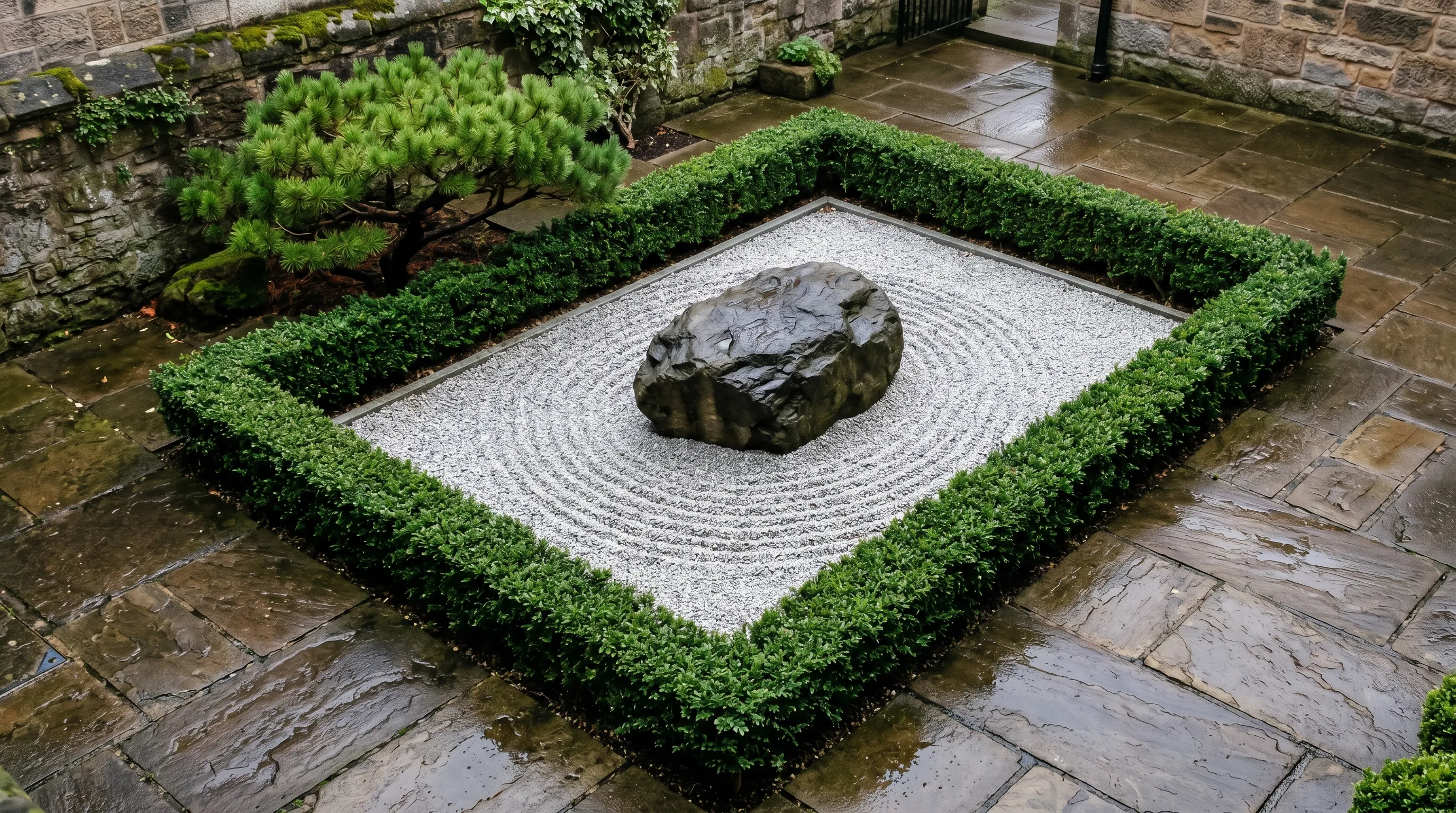 Concentric ripple patterns around a single basalt boulder. The pattern lasts about ten days in dry weather, less after heavy rain.
Stone lanterns and ornaments
A single stone lantern (toro) anchors a scene. Types:
- Yukimi (snow-viewing lantern): low and broad, 500 to 800mm tall, the classic by-water lantern.
- Kasuga: tall, six-sided, 1 to 2m. Originally for shrine gardens.
- Oki-doro: small portable lantern, 300 to 500mm, sits on a stone or in moss.
UK prices for reconstituted stone start at £55 (Yukimi) to £180 (Kasuga). Natural granite carved lanterns run £280 to £950. One lantern per garden is enough; two compete with each other.
Place the lantern in odd company with two or three rocks of contrasting height, never centred and never on a path. The eye should find it after the rocks, not before.
A weathered stone buddha statue works the same way: set it low among ferns or moss at a viewing pause, half-hidden rather than centred. One restrained figure reads as a focal point; a row of them reads as a garden centre display.
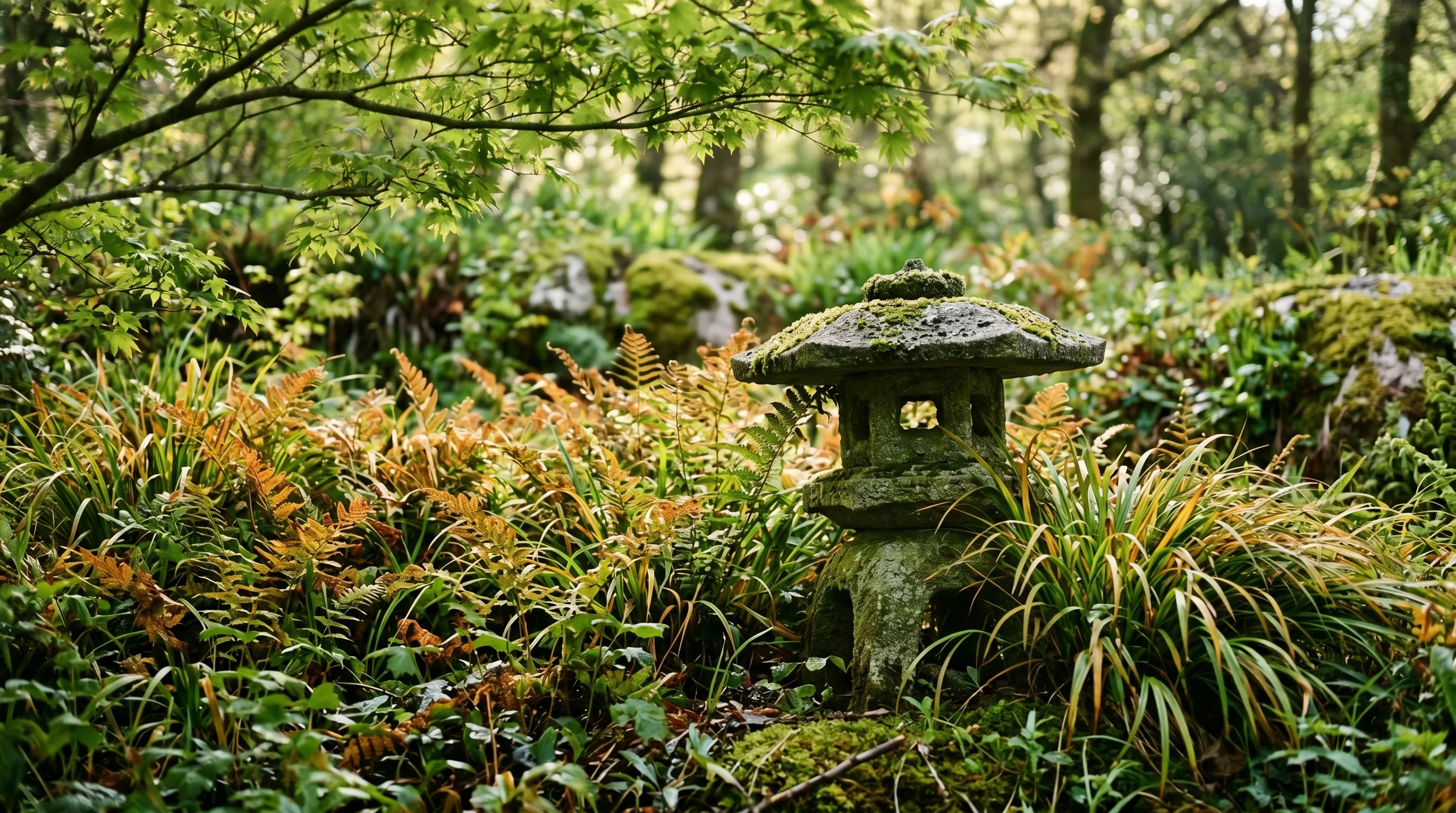 A Yukimi lantern about 600mm tall set among Dryopteris erythrosora ferns. The lantern is partly hidden, which is the point.
Common mistakes
Crowding the plant list. UK gardeners default to packed mixed borders. A kaiyu-shiki garden uses 8 to 14 species total across 150 square metres, repeated rather than mixed. Pick three structural species and three ground species and use them across the whole plot.
Symmetry. Lining stones up, planting in pairs, or running the path on a central axis kills the style. Use odd numbers and unequal spacings throughout.
Importing Japanese black pine. Pinus thunbergii is the textbook species but rarely thrives in UK clay or in regions with rainfall above 1,000mm per year. Use Pinus mugo or native Pinus sylvestris instead.
Skipping the path layout. The single most common mistake is choosing plants before drawing the path. The path is the design. Draw it on a scale plan first, with every viewing pause marked, and only then site the trees.
Buying too many lanterns and ornaments. One lantern, one water basin, and one stone group is enough on a 150 square metre plot. Three lanterns reads as garden centre, not garden.
Forgetting late-spring frost. Acer palmatum is hardy to minus 20C in dormancy but minus 3C after bud break in early May causes severe leaf burn. Plant on the cold side of a hedge so bud break runs late.
Year-round task calendar
| Month | Main task |
|---|---|
| January | Inspect pond pump, clear winter debris from paths |
| February | Structural acer pruning while dormant |
| March | Re-bed stepping stones, top up gravel |
| April | Apply 30mm ericaceous mulch to acers and azaleas |
| May | Pine candle-pinching (midori-tsumi), trim Soleirolia |
| June | First boundary hedge trim, check pond flow rate |
| July | Weed gravel inset, deadhead iris |
| August | Second hedge trim, rake gravel fortnightly |
| September | Reduce pump flow, replant tired ground cover |
| October | Pine needle plucking (momi-age), enjoy acer colour |
| November | Major leaf removal, drain bog filter |
| December | Inspect lantern for frost damage, photograph for spring |
What it adds up to
A kaiyu-shiki stroll garden in the UK is one of the few formal garden styles that gets easier as the climate gets damper and shadier. The acers and Hakonechloa actively prefer Manchester rainfall over Mediterranean drought. The maintenance hours are comparable to a perennial border once the ground cover has filled in.
For external authority on plant hardiness and species choice, the Japanese Garden Society lists 40+ open Japanese gardens in the UK, including Tatton Park, Compton Acres, and Pureland in Newark.
Next step
Now you have the layout and the plant list, read the japanese maple care guide for the detailed siting, soil and pruning instructions you will need for the structural acers.
Our team produces practical UK gardening guidance from source research, contributor records and established horticultural practice. Editorial standards are overseen by Matt W.