Key takeaways
- Chinese garden design is over 1,000 years old; the 1631 manual Yuan Ye by Ji Cheng still guides designers
- Borrowed scenery (jie jing) pulls trees, spires and hills beyond your boundary into the composition for nothing
- A moon gate opening of 1.2-1.5m frames one scene; corten steel versions cost £250-£900 in the UK
- Rocks stand for mountains and water for rivers: the shan shui pairing anchors every classical garden
- Tree peony, bamboo, pine and wisteria all carry set meanings and all grow well in the UK climate
- Chinese gardens use more architecture and bolder colour than Japanese ones, and are walked, not viewed from one spot
Chinese garden design is the oldest living garden tradition, and UK gardeners almost never borrow from it. We copy Japan instead. That is backwards, because Japanese garden-makers learned the craft from China, then edited it down. The original suits British plots surprisingly well. It was built for small walled town gardens, soft light and rain, which sounds familiar.
What is Chinese garden design?
Chinese garden design recreates wild nature in miniature, arranged as a sequence of composed scenes you discover on a walk. The tradition is over 1,000 years old, and its high point is the scholar gardens of Suzhou, where nine gardens are UNESCO World Heritage listed. The largest, the Humble Administrator’s Garden, covers 5.2 hectares. The smallest are barely bigger than a British back garden.
The style even has an instruction manual. Yuan Ye (The Craft of Gardens), written by Ji Cheng in 1631, is the world’s first book on garden design and is still in print. Its central promise holds up: a garden made by people should look as though it grew there by itself.
Two Chinese words carry the whole idea. Shan shui means mountains and water. Every classical garden pairs the two, at whatever scale it can manage: a rock and a bowl of water on a balcony still counts. Nothing is planted in rows and nothing is symmetrical, because the garden is a model of nature, not a display of control.
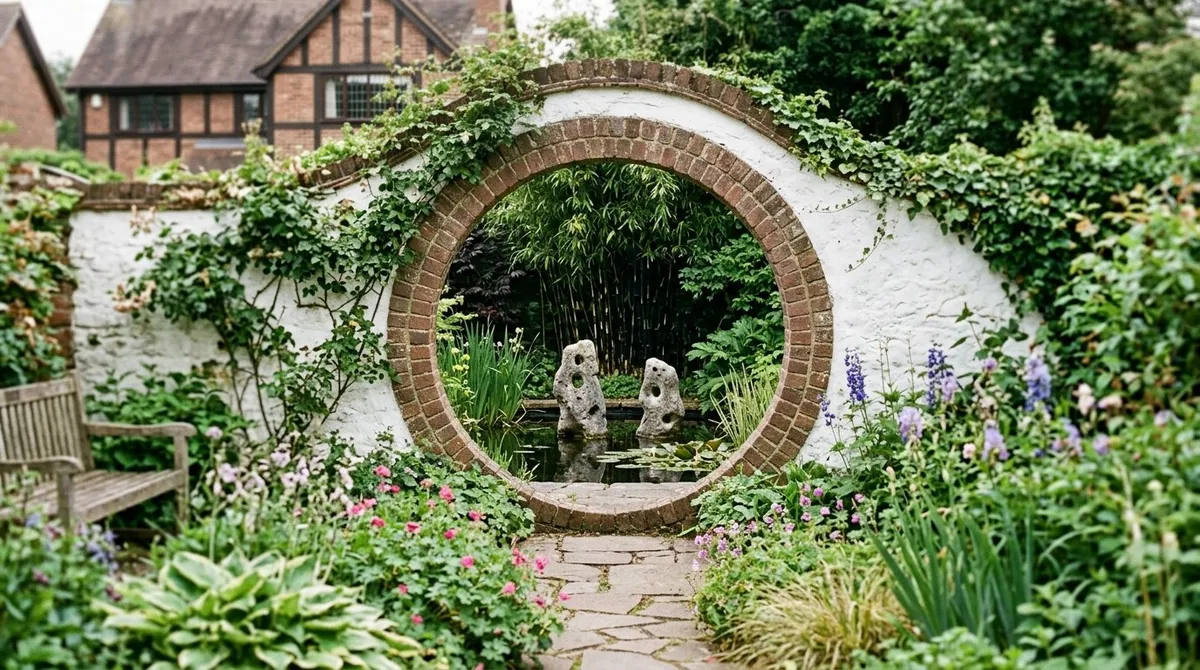
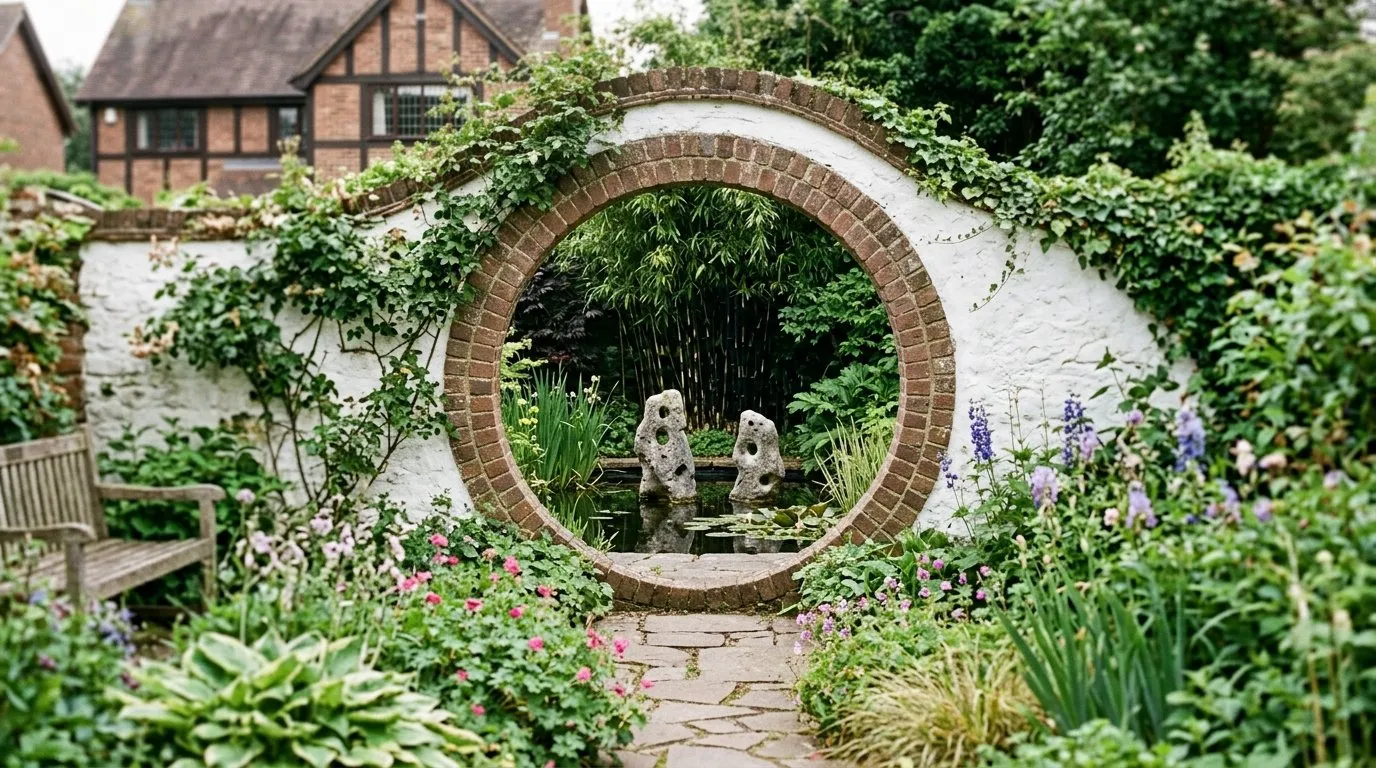 A moon gate does the classic job of Chinese garden design: it turns whatever sits beyond it into a framed picture.
What are the 7 rules of Chinese garden design?
Seven working principles cover almost everything a classical Chinese garden does.
1. Compose scenes, not borders. The garden is a series of pictures, each with a set viewing point: a window, a gate, a bend in the path. Design each picture, then design the walk that links them.
2. Borrow scenery. Anything visible beyond your boundary can be pulled into the composition. Ji Cheng called it jie jing and rated it the most skilful move of all.
3. Conceal, then reveal. Never show the whole garden at once. A screen, a wall or a turn hides the best scene until the last moment, and the garden feels twice its size.
4. Pair rocks with water. Upright stones stand for mountains, still pools for rivers and lakes. The contrast of hard and soft, vertical and flat, drives the whole design.
5. Let buildings join in. Pavilions, walls and covered walkways can take up a third of a classical garden. Structures are how you inhabit the garden, not intrusions on it.
6. Plant for meaning. Peony, bamboo, pine, plum and lotus each carry a fixed symbolic role, so a dozen species do the work of fifty.
How does borrowed scenery (jie jing) work in a small garden?
Borrowed scenery means framing something beyond your boundary so it reads as part of your garden. Ji Cheng listed four kinds: distant borrowing (hills, skylines), adjacent borrowing (a neighbour’s tree), upward borrowing (clouds, the moon) and downward borrowing (reflections in water).
Most UK gardens have more to borrow than their owners notice. A church tower, a neighbour’s mature birch, a green hillside, even a fine street tree will do. The technique is subtraction: you hide the ugly middle ground, usually with a hedge or screen at 1.5-1.8m, and leave a deliberate gap aimed at the good thing.
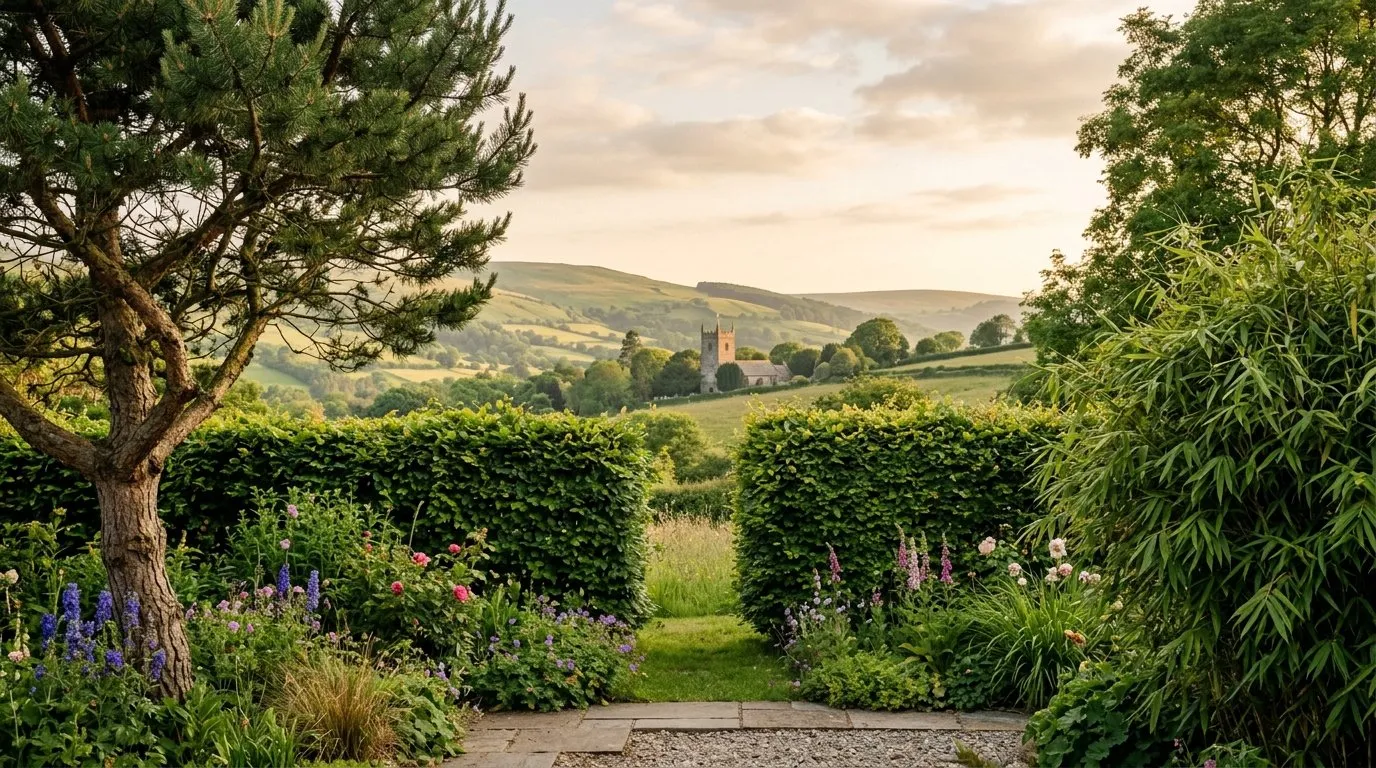 Jie jing in practice: screen the middle ground, aim a gap at the distant feature, and the hillside joins your garden.
What are moon gates and leak windows for?
Moon gates and leak windows are framing devices: they control exactly what you see and when you see it. Both do the concealment-and-reveal work that makes small gardens feel large.
A moon gate is a circular opening in a wall, traditionally symbolising the full moon, reunion and welcome. Garden versions run 1.2-1.5m across. A UK corten steel moon gate costs £250-£900 depending on diameter, and a built masonry one runs £1,500-£3,000. Set it so it frames one strong scene: a rock, a pool, a specimen tree, never a shed.
Gardener’s tip: Before cutting anything, tape a cardboard ring to the fence or hold it on a cane at the proposed spot. Live with it for a week and look through it at different times of day. Framing that works at 10am can be a view of the neighbour’s trampoline by dusk. Moving the ring 40cm left cost me nothing; moving a finished window would have cost a fence panel.
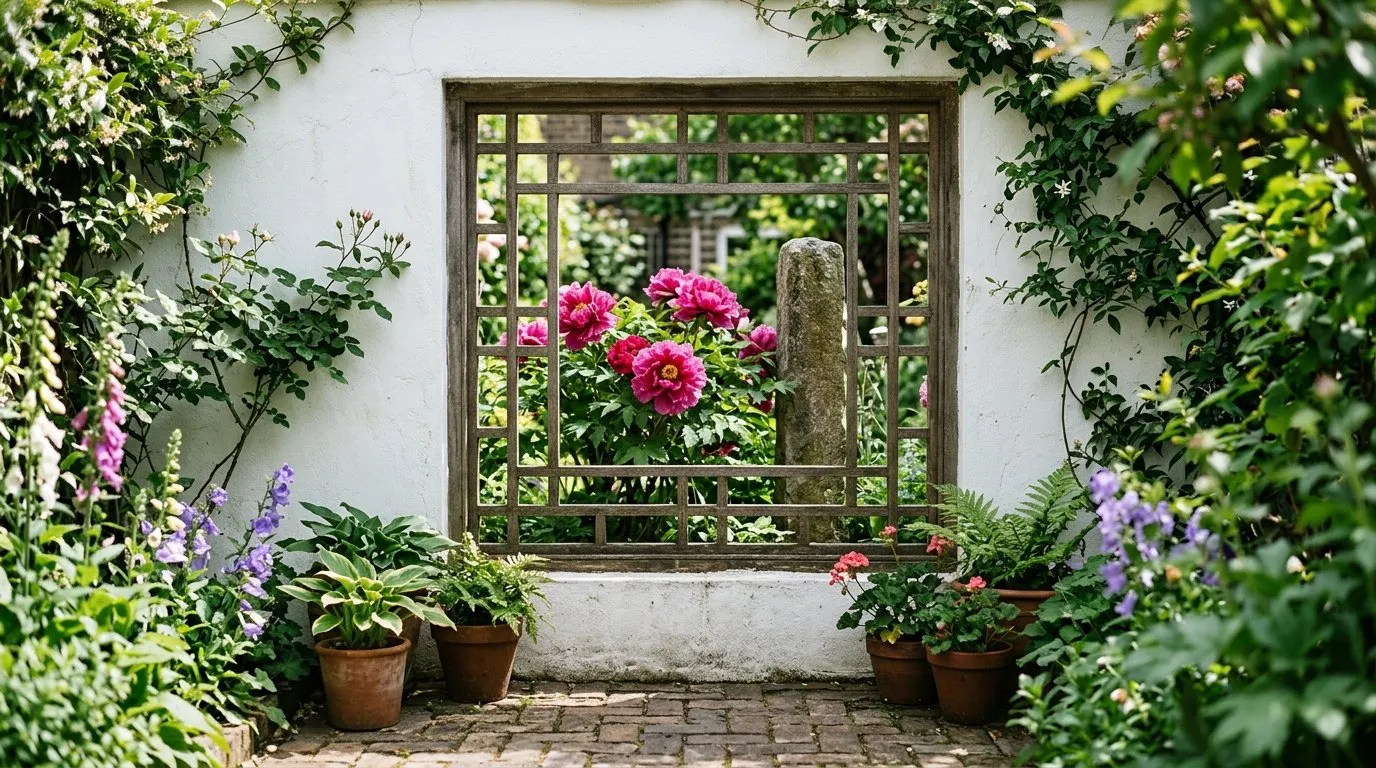 A leak window gives the view in fragments. Lattice patterns were never repeated along a single Suzhou corridor.
Why do rocks and water always sit together?
Rocks and water are the mountains and rivers of the miniature world, and neither reads properly alone. The rock gives the water scale; the water doubles the rock by reflection.
The most prized classical stones are Taihu rocks, limestone dredged from Lake Tai and judged on four qualities: shou (thinness), zhou (wrinkling), lou (channels) and tou (holes you can see through). You cannot buy them here, and water-worn limestone should stay in the ground anyway; UK limestone pavement is legally protected habitat. Quarried gritstone, slate or schist boulders give the same upright drama for £80-£250 per stone delivered.
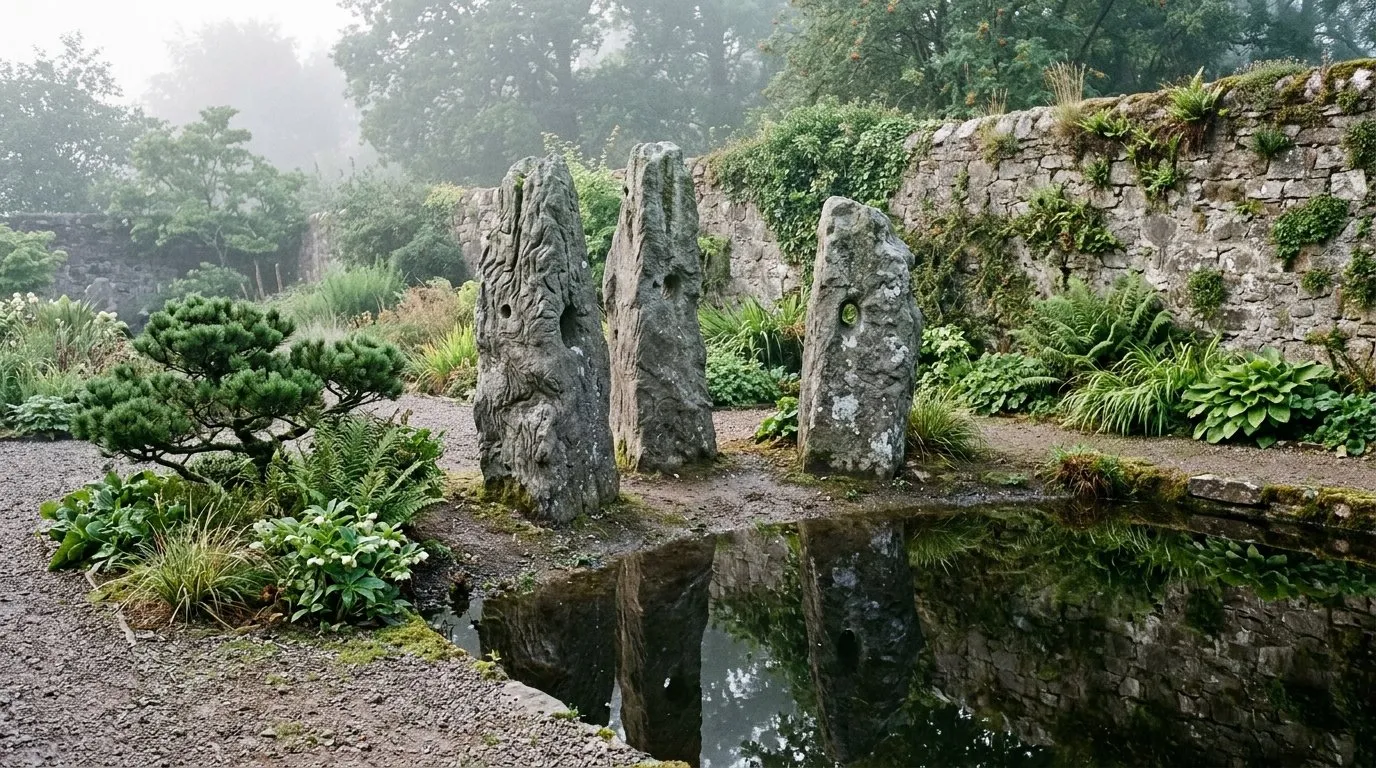 Shan shui at back-garden scale: upright stones, bottom third buried, doubled in still dark water.
What is a zig-zag bridge actually for?
A zig-zag bridge slows you down and changes the view at every turn. Folklore says evil spirits travel only in straight lines and cannot follow you across one. The practical reason is better: each angle re-aims your eye at a different composed scene, so one small pond delivers five or six pictures.
Classical versions are called nine-turn bridges, though three turns are plenty at domestic scale. A low deck of 150mm boards zig-zagging across a pond corner takes a weekend and £200-£400 in timber, sitting on padstones rather than posts in the liner. Keep it low; the boards should almost touch the water.
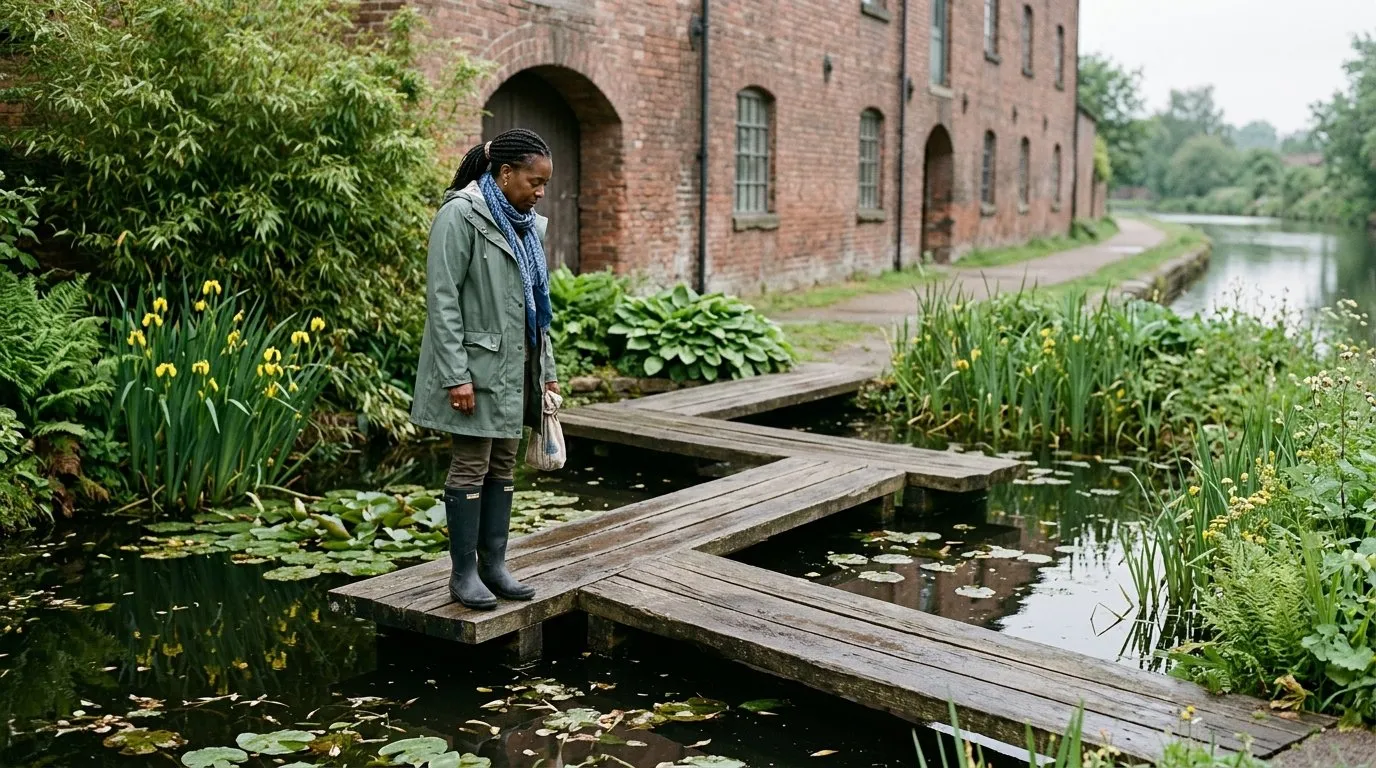 Three turns are enough. Every angle of a zig-zag bridge points you at a different scene.
Which Chinese garden plants grow best in the UK?
Most of the classical palette is fully hardy in the UK, because much of it grows in temperate central China. What changes in a Chinese garden is not the plants but the reason each one is there.
| Plant | Meaning | UK hardiness | Typical UK price |
|---|---|---|---|
| Tree peony (Paeonia suffruticosa) | Wealth and honour, king of flowers | Hardy to about -15C | £25-£45 |
| Bamboo (Phyllostachys nigra) | Integrity that bends, never breaks | Fully hardy | £40-£60 (10L) |
| Pine (Pinus sylvestris) | Endurance and long life | Fully hardy | £30-£80 |
| Plum blossom (Prunus mume) | Courage, flowering in winter | Hardy, flowers Feb-Mar | £35-£60 |
| Wisteria sinensis | Scholarship and longevity | Fully hardy | £25-£50 |
| Lotus (Nelumbo nucifera) | Purity rising from mud | Borderline, needs 30-60cm depth | £20-£40 |
| Ginkgo biloba | Survival, temple tree | Fully hardy | £30-£70 |
| Wintersweet (Chimonanthus praecox) | Perfume in adversity | Fully hardy, here since 1766 | £25-£40 |
Three of these form a set: pine, bamboo and plum are the Three Friends of Winter, honoured because they stay green or flower while everything else stands bare. Plant the trio together and anyone who knows the tradition will read the sentence you have written.
The tree peony is the plant most worth the trouble. Blooms reach 15-20cm across in late May, and an established plant carries 30 or more. The RHS tree peony growing guide covers pruning; for herbaceous alternatives see our UK peony varieties comparison.
Two cautions. Running bamboo like Phyllostachys spreads 5m or more without a 60cm root barrier (£8-£12 per metre), so contain it on day one or plant clumping Fargesia instead. And Chinese wisteria, brought to Britain in 1816, twines anticlockwise, while Japanese wisteria twines clockwise: check which you own before training it using our wisteria growing guide.
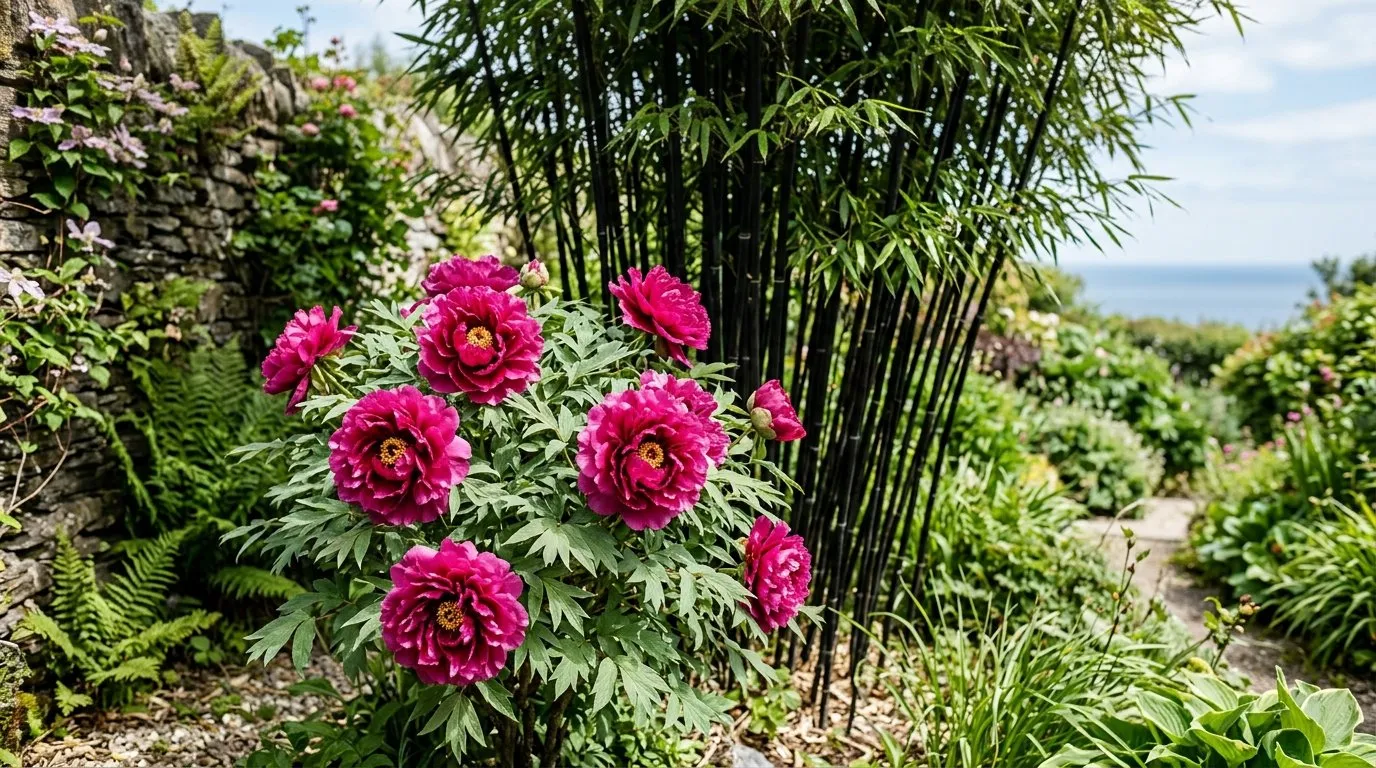 The king of flowers in front of upright bamboo: two symbols, one planting, both fully at home in the UK.
How is Chinese garden design different from Japanese?
Chinese gardens are architectural, colourful and walked through; Japanese gardens are quieter, greener and often viewed from a fixed point. Japan imported Chinese garden ideas from around the 7th century and spent the next thousand years refining them toward stillness. The parent tradition stayed theatrical.
| Element | Chinese garden | Japanese garden |
|---|---|---|
| Buildings | Pavilions and walkways, up to a third of the site | Pushed to the edges, tea house excepted |
| Rocks | Upright, contorted, celebrated as sculpture | Low, part-buried, restrained |
| Colour | White walls, red timber, bold peonies | Subdued greens, moss, maple |
| Experience | A walk through many framed scenes | Often contemplated from one spot |
| Words | Inscriptions and named views everywhere | Rarely any text at all |
| Water | Still lakes with zig-zag crossings | Streams, basins, raked gravel standing in for water |
One honest test: count your walls. Chinese garden design loves enclosure, so a walled or fenced urban plot with high boundaries is an advantage, not a problem.
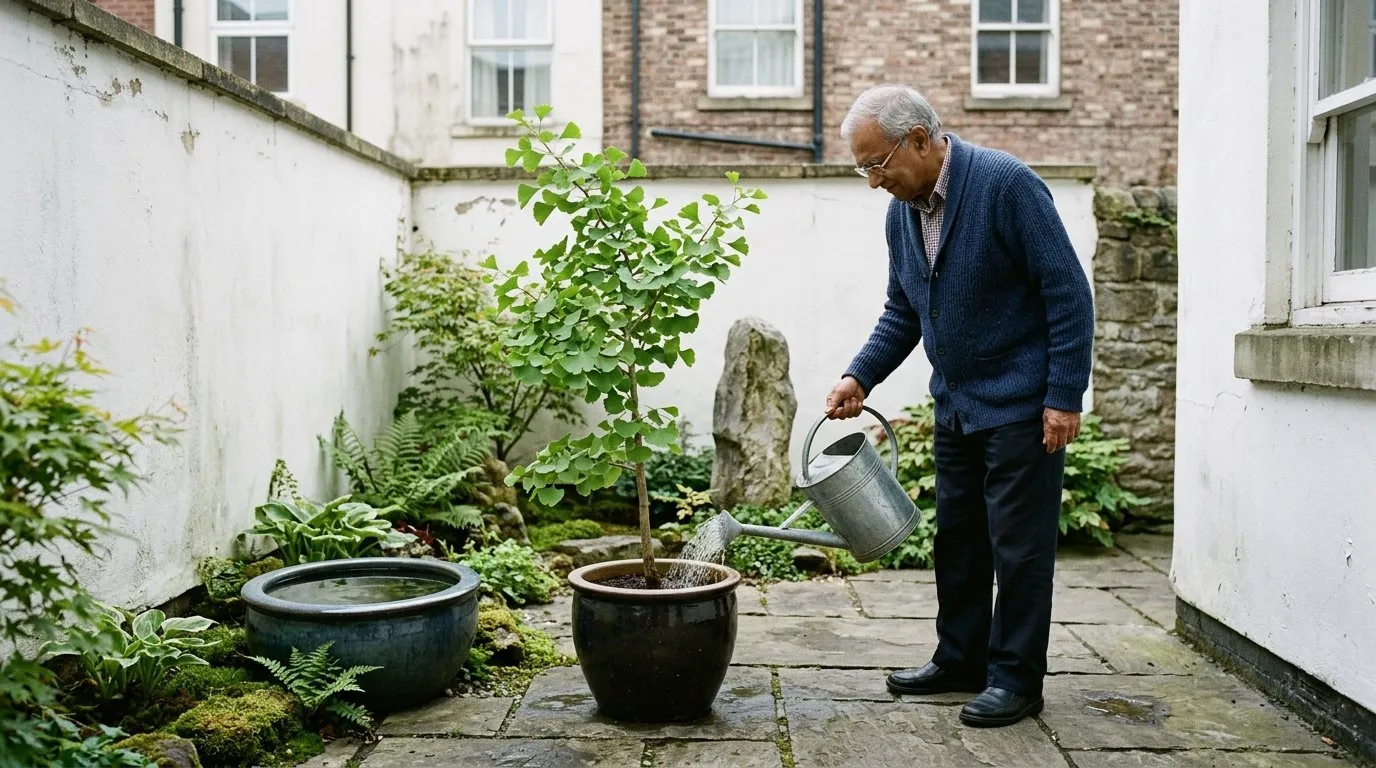 Scholar-garden logic in a city courtyard: enclosure, grey stone, one basin, one tree. High walls help this style.
Where can you see Chinese garden design in the UK?
Liverpool Festival Gardens is the modern counterpart. Two Chinese pagodas formed the centrepiece of the 1984 International Garden Festival, which ran from 2 May to 14 October with 60 individual gardens. After decades of neglect the pagodas were repainted by specialist artists and the site reopened in 2012. Entry is free.
For sheer spectacle there is also the Great Pagoda at Kew: 50m and ten storeys, completed in 1762, with its 80 carved dragons returned in a 2018 restoration.
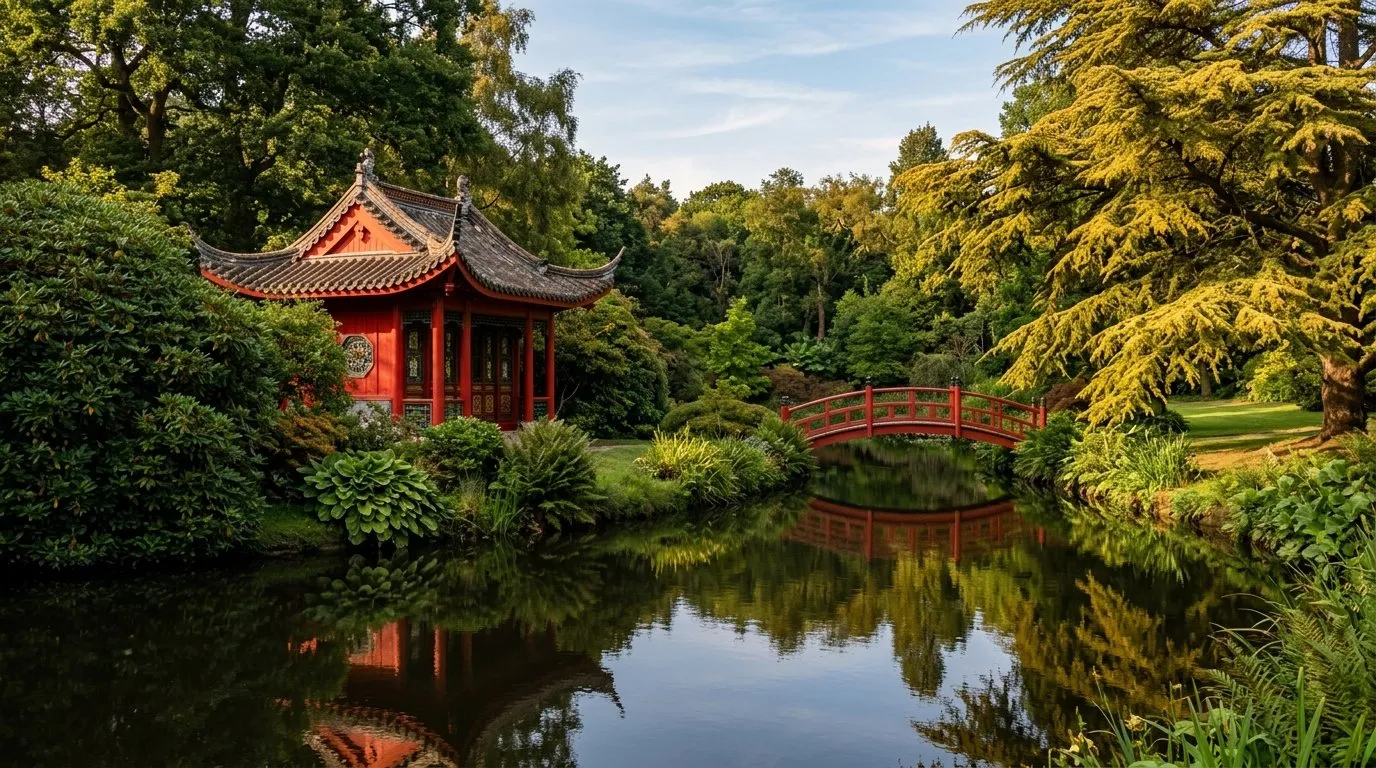 The Victorian version: pagoda, painted bridge and lake. Biddulph Grange hides its China garden behind a rock tunnel.
How much does a Chinese-style garden cost in the UK?
A composed corner costs £150-£300, and that is the honest starting point for this style. One upright stone (£80-£250), a glazed water bowl (£30-£60) and a barrier-planted bamboo (£50-£70) make a legitimate shan shui scene in two square metres.
The middle tier, £1,000-£3,000, buys the signature features: a corten moon gate or two framing windows, three to five feature stones, a small lined pool and the symbolic planting list above. This is where most UK gardens should aim, and a courtyard layout takes the elements especially well.
A full professional build with masonry walls, a pavilion and mature specimens runs £8,000-£20,000. Before spending that, visit Biddulph twice in different seasons. The lesson is free: the style is about deciding what gets seen, and when.
Frequently asked questions
What are the main principles of Chinese garden design?
Framed scenes, borrowed scenery, concealment, and rocks paired with water are the core principles. A classical Chinese garden is composed as a sequence of pictures revealed on a walk, never as one open view. Architecture, symbolic planting and feng shui siting complete the set of seven working rules.
What does a moon gate symbolise?
A moon gate represents the full moon, meaning renewal, reunion and welcome. Practically it is a circular opening, usually 1.2-1.5m across, that frames the scene beyond and marks the passage from one part of the garden to the next. UK corten steel versions cost £250-£900.
Can you grow lotus outdoors in the UK?
Yes, but only just, and most gardeners substitute hardy waterlilies. Nelumbo nucifera needs its rhizome 30-60cm below the surface, safe from ice, plus a hot sheltered summer to flower. In most UK gardens a deep-water waterlily gives the same effect with none of the sulking.
How is a Chinese garden different from a Japanese garden?
Chinese gardens use more buildings, bolder colour and are designed to be walked through. Japanese designs evolved from Chinese ones but became quieter: moss, raked gravel and scenes viewed from a fixed point. Chinese rocks stand upright like mountains; Japanese rocks sit low and part-buried.
Where is the best Chinese garden in the UK?
How much does a Chinese-style garden cost to build?
A single composed corner costs £150-£300; a full professional build runs £8,000-£20,000. In between, £1,000-£3,000 covers a moon gate or framing window, feature rocks, a small pond and symbolic planting. The style rewards restraint, so small budgets go a long way.
Our team produces practical UK gardening guidance from source research, contributor records and established horticultural practice. Editorial standards are overseen by Matt W.