Kitchen Garden Design and Layout UK
Plan your kitchen garden with expert UK layout advice. Sizes from 3x3m to 10x6m, four-bed rotation, paths, and what to grow first. Tested in clay soil.
Key takeaways
- South-facing with wind shelter is non-negotiable: even one hour less sun per day cuts yields by 20-30%
- Beds must be no wider than 1.2m so you can reach the centre without compacting the soil
- Paths need to be 60cm minimum — 90cm if you use a wheelbarrow — between every bed
- A 6x4m kitchen garden will feed a family of four in salads, courgettes, beans and herbs from June to October
- Always place your compost bins at the furthest end from the house but nearest to a water source
Kitchen garden design is the foundation of productive food growing — get the layout wrong and no amount of good compost or careful planting will make up for it. A kitchen garden placed on the wrong site, with paths too narrow to use and beds you cannot reach across, will frustrate you every time you step into it.
I have been designing and modifying kitchen gardens in Staffordshire since 2015, working through three complete layout changes as the plot evolved from a 3x3m starter space to a 10x6m producing garden. This guide covers everything from choosing your site to laying out beds, paths and compost areas — and what to grow in each rotation zone from your first season.
How to choose the right site for a kitchen garden
The single most important decision in kitchen garden design is site selection. Everything else — bed layout, path width, what you grow — can be adapted and changed. But you cannot fix a bad site without starting over.
South-facing is essential. Food crops need 6-8 hours of direct sunlight per day during the growing season. A south-facing plot receives the maximum possible sun from April to October. East or west-facing sites receive roughly 4-5 hours of direct sun and will produce 20-30% lower yields on most crops. North-facing sites cannot support productive vegetable growing in the UK.
Wind shelter protects yields. Open, exposed sites cause crop stress, break bean and tomato plants, and dry out beds rapidly in summer. A solid wall or fence creates turbulence directly downwind — hedging or slatted fencing that filters wind is more effective. Allow at least 1m between any solid structure and your nearest bed to avoid shading.
Level ground saves soil. Sloping sites cause rain and irrigation water to run off before it soaks in. If you have a gentle slope (under 10%), you can lay beds across the slope to slow drainage. For steeper ground, terracing with raised beds is the correct solution, though it adds cost.
Water access within 20 metres. Every kitchen garden needs regular watering from June to August. A standpipe or outside tap within 20m of the centre of your plot is the practical maximum for hose reach. Beyond that, dragging heavy hoses between beds becomes a disincentive to water properly.
What size kitchen garden do you need?
The right size depends on how many people you want to feed and which crops you want to grow. Starting too large is one of the most common mistakes — a poorly maintained large garden produces less than a well-managed small one.
3x3m (9m²): the starter kitchen garden. This size gives you space for four beds of approximately 1m x 1.5m, separated by 60cm paths. It will produce salad leaves, herbs, radishes, spring onions and a few courgette plants from spring to first frost. It will not feed a family in bulk vegetables but it demonstrates whether you enjoy food growing before committing more space. Yield: enough for daily salads and herb harvests for one to two people, May to October.
6x4m (24m²): the family kitchen garden. This is the most practical size for a family of four. It allows four rotation beds of 1.2m x 2.4m each, main paths of 75cm, and space at one end for a compost area. From June to October this size will produce salad leaves, courgettes, dwarf French beans, climbing beans, tomatoes (in a greenhouse or sheltered corner), spring onions, garlic, herbs and root vegetables. Yield: enough to significantly reduce your vegetable shopping bill from June to October.
10x6m (60m²): the serious kitchen garden. This size allows a full four-bed rotation system with beds of 1.2m x 4.8m each, 90cm main paths, a dedicated soft fruit area, compost bays and storage space. With good management this will produce vegetables for a family year-round, including brassicas for autumn and winter and stored crops (potatoes, squash, onions) to last until spring. Yield: 300-500kg of produce per year under normal UK conditions.
| Layout | Dimensions | Beds | Best For | Approximate Annual Yield |
|---|---|---|---|---|
| Starter | 3x3m | 4 small beds | 1-2 people, salads and herbs | 30-60kg |
| Family | 6x4m | 4 standard beds (1.2x2.4m) | Family of 4, summer produce | 80-150kg |
| Serious | 10x6m | 4 large beds (1.2x4.8m) + fruit | Family of 4, year-round | 300-500kg |
| Allotment | 10x10m+ | Multiple beds and rows | Full self-sufficiency target | 500kg+ |
For a deeper look at starting from scratch, see our guide to starting a vegetable garden in the UK.
Kitchen garden layout styles
There are four main approaches to kitchen garden layout. Each has strengths and limitations that depend on your space, your growing goals and how much time you want to spend on maintenance.
Traditional row layout
The simplest approach: parallel rows running north to south (so tall crops shade only their own row, not their neighbours), with a path along one edge. Traditional row growing suits large plots where a rotavator or tractor can be used between rows. In a domestic garden it wastes space on wide paths between every row and makes rotation complicated.
Best for: Allotments, large plots over 20m², gardeners who want maximum flexibility in what they grow each year.
Raised bed layout
Defined beds of 1.2m width separated by permanent paths. This is the standard approach for most domestic kitchen gardens because the beds never get walked on — soil stays uncompacted, drainage improves and you can deep-cultivate each bed independently. For raised bed garden design ideas including materials and dimensions, see our dedicated guide.
The four-bed system (see below) uses raised beds organised around a central path. Beds of 1.2m x 2.4m are the most practical size — they use standard timber lengths without cutting and give you 2.88m² of growing area each.
Best for: Families, clay soil, no-dig growing, anyone who wants defined structure that looks good year-round.
Four-bed rotation system
Four-bed rotation is the gold standard for productive kitchen garden design. It organises crops into four groups that move around the beds in sequence each year:
- Bed 1: Brassicas (cabbage, kale, broccoli, Brussels sprouts, kohlrabi)
- Bed 2: Legumes and fruiting crops (peas, beans, courgettes, sweetcorn, tomatoes)
- Bed 3: Roots and tubers (carrots, parsnips, beetroot, potatoes)
- Bed 4: Alliums and salads (onions, garlic, leeks, lettuce, spinach)
Each group moves clockwise one bed each spring. The logic: brassicas are heavy nitrogen feeders and follow legumes, which fix nitrogen in the soil. Roots follow brassicas on lower-nitrogen soil (excess nitrogen makes roots fork and split). Alliums and salads are flexible and slot into the fourth rotation.
This system prevents clubroot in brassicas, potato cyst eelworm in root crops, and white rot in alliums from building to damaging levels. It also means you are applying compost and fertiliser based on each crop group’s needs rather than treating the whole plot the same. You can read more in our crop rotation planner for UK gardens.
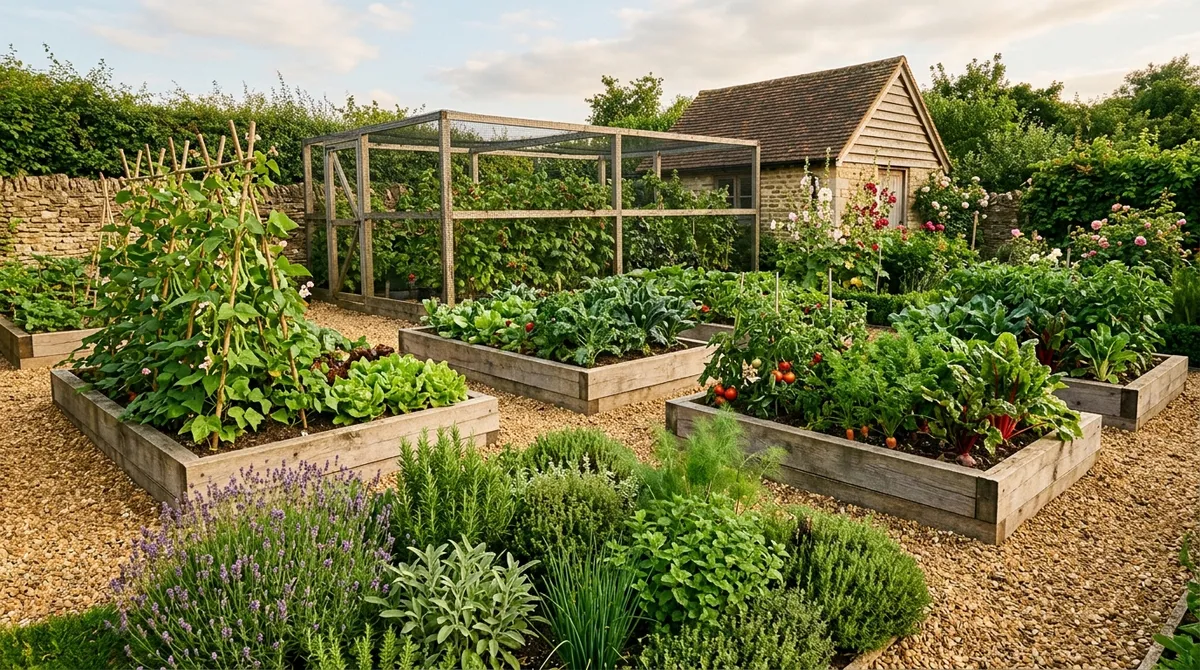
Four raised beds in a kitchen garden layout showing the standard 1.2m width, 60cm gravel paths and a central cross-path for wheelbarrow access.
Potager or ornamental kitchen garden
A potager combines vegetables, herbs and flowers in a formal decorative layout. The name comes from French kitchen garden design — typically a symmetrical layout with a central focal point (standard-trained bay tree, rose arch or water feature), beds edged with low box hedging or lavender, and crops chosen partly for colour and texture as well as productivity.
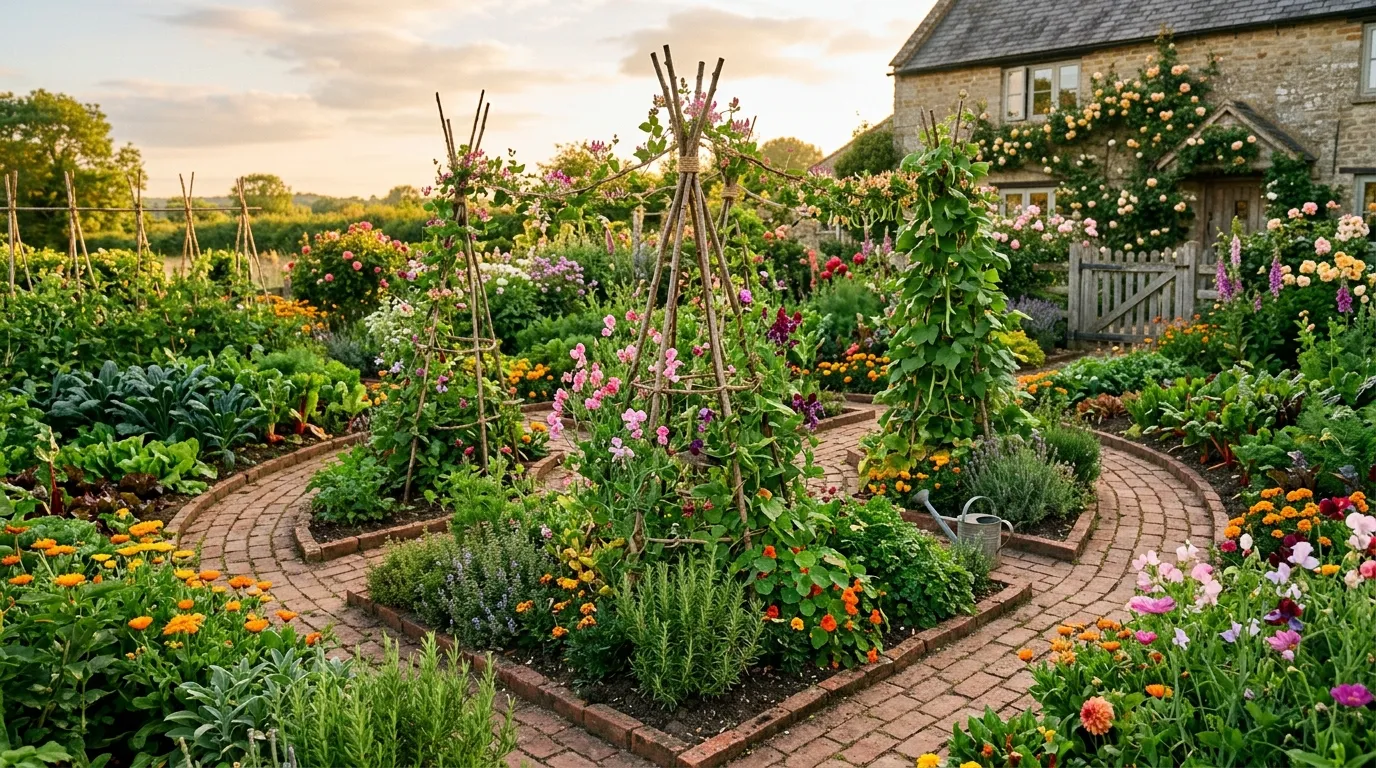
A potager-style kitchen garden where vegetables, herbs and flowers grow together for beauty and productivity.
Potager-style kitchen gardens work particularly well in smaller plots where the kitchen garden is visible from the house or terrace. Growing nasturtiums between lettuce, purple basil beside tomatoes, and marigolds at bed edges adds visual interest and provides companion planting benefits. For companion planting combinations that also look good, see our companion planting guide for UK gardens.
Practical trade-off: Potager gardens sacrifice some growing efficiency for aesthetics. Formal edging takes time to maintain, and mixing ornamental and edible plants can make rotation harder. If maximum yield is your goal, stick with raised beds and rotation. If the kitchen garden is a garden feature as well as a food source, the potager approach is deeply satisfying.
A potager-style kitchen garden integrating purple basil, nasturtiums, salad leaves and climbing beans in a formal bed layout with central grass paths.
Getting paths and access right
Paths are the infrastructure of a kitchen garden. They affect how comfortable it is to work, whether you can use a wheelbarrow, and how the garden looks in all seasons.
Minimum path width: 60cm. This is the minimum you need to crouch, kneel or lean into a bed without standing on it. Anything narrower and you will regularly step onto the bed edges, compacting the soil you have worked hard to improve.
Wheelbarrow paths: 90cm. If you use a wheelbarrow for compost, soil or harvests — and you should — your main access path needs to be 90cm clear width. A standard wheelbarrow is 55-60cm wide; the handles add another 10-15cm on each side when turning.
Main path and secondary paths. Organise your kitchen garden with one central main path (90cm, wide enough for wheelbarrow turns) and secondary paths between beds (60cm). The main path should run from the garden entrance straight through the centre, giving you a clear route with a loaded barrow.
Path materials. Gravel over landscape fabric is the most practical surface — it suppresses weeds, drains freely and gives reliable grip in wet weather. 20mm pea gravel or crushed slate at 50-75mm depth lasts 10 years without significant maintenance. Bark chippings are cheaper but decompose and need topping up every 2-3 years. Mown grass paths look good but become muddy in wet weather and need regular cutting. Concrete or pavers are permanent and low-maintenance but expensive to install. For more path ideas and materials, see our garden path ideas guide.
Edging keeps paths in place. Gravel paths without edging migrate into beds and onto lawns within one season. Use 15cm treated timber edging boards, concrete edging, or steel landscape edging to keep gravel contained.
Bed design: width, length and depth
Width: 1.2m maximum. Regardless of your layout style, no bed should be wider than 1.2m. This is the maximum reach for an average adult from one side — the centre of the bed is 60cm from the edge. If a bed is against a wall or fence and only accessible from one side, reduce to 60cm. You should never step onto a kitchen garden bed; every compacted footprint damages soil structure.
Length: practical and proportionate. Most raised bed timbers come in 2.4m lengths, making this a practical bed length with no waste. For in-ground beds with permanent edges, any length is possible. Keep beds short enough that you can walk around them easily rather than across them.
Depth: 30cm minimum on clay. On heavy clay soil, the top 30cm is often compacted and poorly draining. Raising beds with 30cm of imported topsoil and compost immediately solves drainage and gives roots the loose, uncompacted soil they need. For root crops (carrots, parsnips), 45cm of loose soil depth produces noticeably straighter, larger roots. For beginners’ guidance on raised bed construction, see our step-by-step guide.
Integrating herbs and flowers into a kitchen garden
A dedicated herb area in the kitchen garden reduces the distance between harvest and the kitchen. The most practical place is nearest the house — either as a separate small bed or as the edge planting of your salad rotation bed.
Perennial herbs need a permanent home. Rosemary, thyme, sage, chives, and mint cannot go into a rotation system because they stay in the ground year-round. Create a permanent herb bed outside the rotation — a 0.6m x 1.5m border near the path or kitchen entrance works well. Plant mint in a buried pot to prevent it spreading.
Annual herbs slot into rotation. Basil, coriander, dill and parsley can go into the legumes or allium bed each year and are rotated with everything else. Basil grows well between tomatoes. Dill and fennel attract beneficial insects.
Flowers earn their place. French marigolds planted at bed ends repel aphids and whitefly from nearby crops. Nasturtiums attract blackfly away from beans (and the leaves and flowers are edible). Sweet peas grown on cane wigwams add height and cut flowers while the structure doubles as bean poles the following year. Calendula and phacelia attract hoverflies whose larvae eat aphids. These are not decorative additions — they are pest management tools that happen to look good.
See our full guide to creating a herb garden for detailed planting plans.
Planning a soft fruit and fruit area
Soft fruit is the highest-value crop for the space it takes in any kitchen garden. Raspberries, strawberries, redcurrants and gooseberries produce for 10-15 years once established and require minimal input once the framework is in place.
Dedicate a permanent area outside rotation. Soft fruit stays in the ground for years and cannot be rotated. Create a dedicated area at one end of the kitchen garden, separated from the annual beds. A bed 1.2m x 4m will hold 6-8 raspberry canes, 12 strawberry plants or 2-3 gooseberry/redcurrant bushes.
A fruit cage pays for itself. Bird netting over a frame protects entire crops of soft fruit that would otherwise be stripped before you can harvest them. A simple timber frame with 19mm netting over a 1.2m x 3m bed costs around £80-120 in materials and will recover that cost in the first season’s harvest. For a full guide to growing soft fruit in the UK, including raspberry varieties and pruning, see our dedicated article.
Fruit trees need planning. Full-size apple or pear trees quickly shade a kitchen garden. If you want fruit trees, use step-over (30-45cm high), cordon (single stem at 45°) or fan-trained forms against a wall. A cordon apple on M9 rootstock produces 4-6kg of fruit per year in a 40cm-wide space. For a comprehensive introduction to growing fruit trees in UK gardens, including rootstock selection, see our guide.
A productive kitchen garden integrating permanent herb borders, gravel paths at 75cm width, and a soft fruit bed at the far end of the rotation area.
Compost placement and water access
Compost at the far end, not the entrance. Compost bays are bulky, take time to fill and empty, and are not decorative. Place them at the end of the kitchen garden furthest from the house — this also means the compost is closest to the back fence or hedge where organic material collects. Allow space for two or three bays side by side (1m x 1m each minimum): one filling, one composting, one finished and ready to use.
Water access within the kitchen garden. An outside tap or standpipe inside the kitchen garden boundary is a significant practical upgrade over trailing hoses from the house. If you are designing a new kitchen garden from scratch, run a supply pipe before you lay paths — retrofitting water supply means lifting gravel and digging under existing beds. A rainwater butt positioned under any shed or polytunnel roof supplements mains water and costs nothing to run.
For step-by-step guidance on making compost at home including what to add and what to avoid, see our compost guide.
What to grow first in a new kitchen garden
Starting with the right crops builds momentum and confidence. The worst choice in year one is growing demanding crops that fail — celeriac, Florence fennel, parsnips and leeks all need well-established, deeply cultivated, fertile soil.
Year one priority crops:
| Crop | Time to Harvest | Space Needed | Yield per Plant |
|---|---|---|---|
| Salad leaves (cut-and-come-again) | 4-6 weeks | 15cm spacing | 3-4 cuts per plant |
| Radish | 4 weeks | 5cm spacing | 1 per plant |
| Dwarf French beans | 8-10 weeks | 20cm spacing | 200-400g per plant |
| Courgette | 8-10 weeks | 90cm spacing | 10-15 courgettes |
| Cherry tomatoes | 12-14 weeks | 60cm spacing | 1-3kg per plant |
| Basil | 5 weeks | 20cm spacing | Multiple harvests |
| Mint (in pot) | 4 weeks | 30cm in pot | Regular harvests |
| Spring onion | 8 weeks | 1cm spacing | Bunches |
Use succession planting for salad leaves and radish — sow a small amount every three weeks from March to August rather than one large batch that all matures at once. Our UK vegetable planting calendar shows exactly when to sow and plant each crop through the season.
Vertical growing for small kitchen gardens
In a small kitchen garden of 3x3m or 4x4m, vertical growing doubles your effective growing area without taking any more floor space.
Wigwam or trellis for beans. A 1.8m bamboo wigwam of six canes supports 6 climbing bean plants that will produce 3-4kg of beans through summer from a 60cm diameter footprint. The same floor space in a row of dwarf French beans would produce 1.5kg from six plants. Climbing beans always outperform dwarf varieties in small spaces.
Obelisks and arches for cucumbers and squash. Train cucumbers up a 1.5m cane frame and they stay compact and well-ventilated. Squash trained up an arch produces fruit that can be harvested at eye level — much easier than hunting under large leaves at ground level.
Climbing peas on netting. Mange tout and sugar snap peas trained up 1.5m pea netting produce heavily from April to July. Once finished, cut the haulms and use the space for a late summer brassica or salad crop. This is succession planting and vertical growing working together.
Seasonal planning and year-round productivity
Most kitchen gardens are productive from April to October and dormant through winter. With planning, you can extend harvests at both ends of the season and provide some crops through winter.
Spring extension (February-April). A cold frame or cloche over the salad bed brings first harvests forward by 4-6 weeks. Sow broad beans in November for the earliest spring harvest. Overwintered onion sets planted in autumn give bulbs ready to lift by June.
Autumn and winter crops. Kale, chard, leeks, parsnips and Brussels sprouts all harvest from October to February. These crops go into the brassica rotation bed and are sown in May-June for autumn harvest. Without these, a kitchen garden is largely unproductive for five months of the year.
Polytunnel or greenhouse. A 6x3m polytunnel alongside a kitchen garden transforms year-round productivity. You can grow tomatoes, cucumbers, peppers and aubergines reliably even in the Midlands and North. Salad and herbs overwinter in a polytunnel with minimal heating. This is the biggest single upgrade you can make to a UK kitchen garden. See our design guide for creating a garden from scratch for planning the kitchen garden as part of a wider garden layout.
The RHS has detailed guidance on kitchen garden planning including crop-specific advice, which is useful alongside the layout principles covered here.
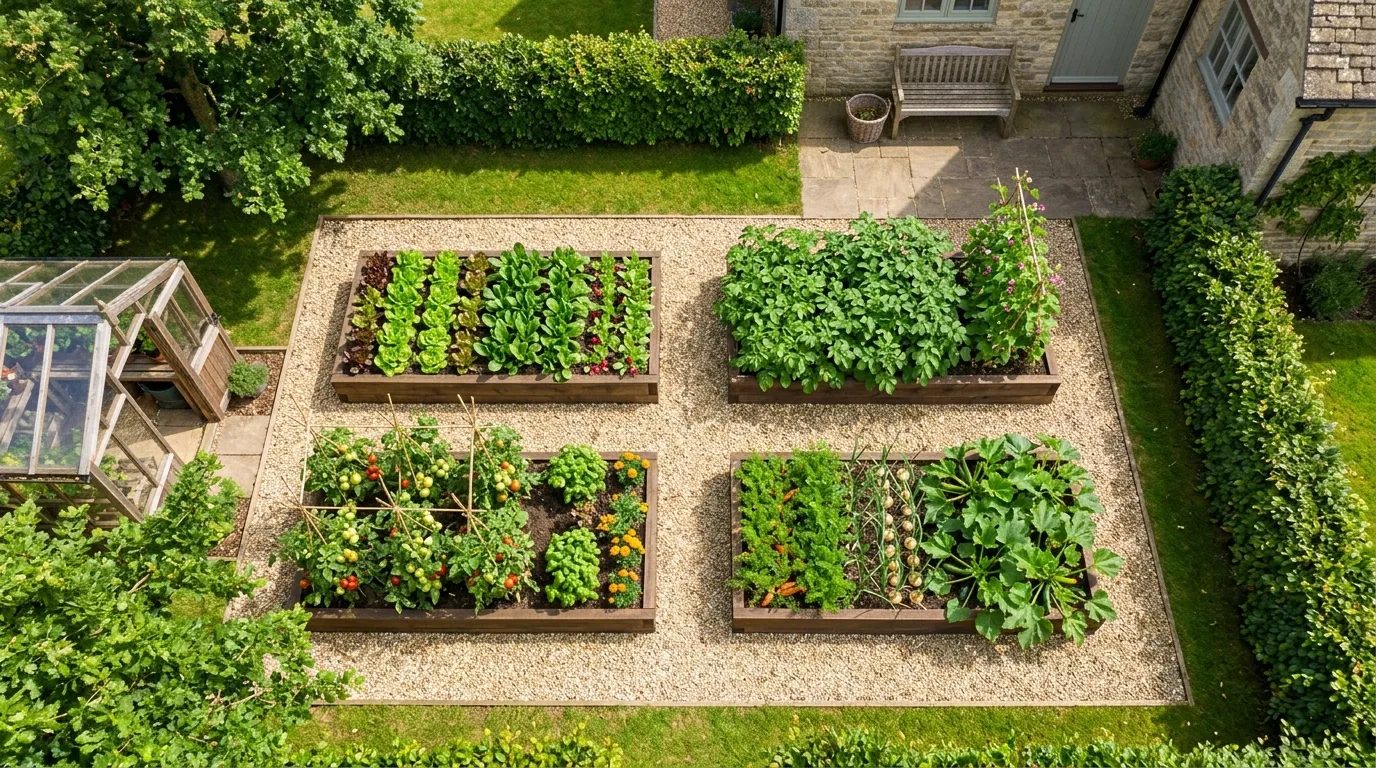
A four-bed rotation layout with 1.2m-wide raised beds and 60cm paths. This 6x4m plot feeds a family of four.
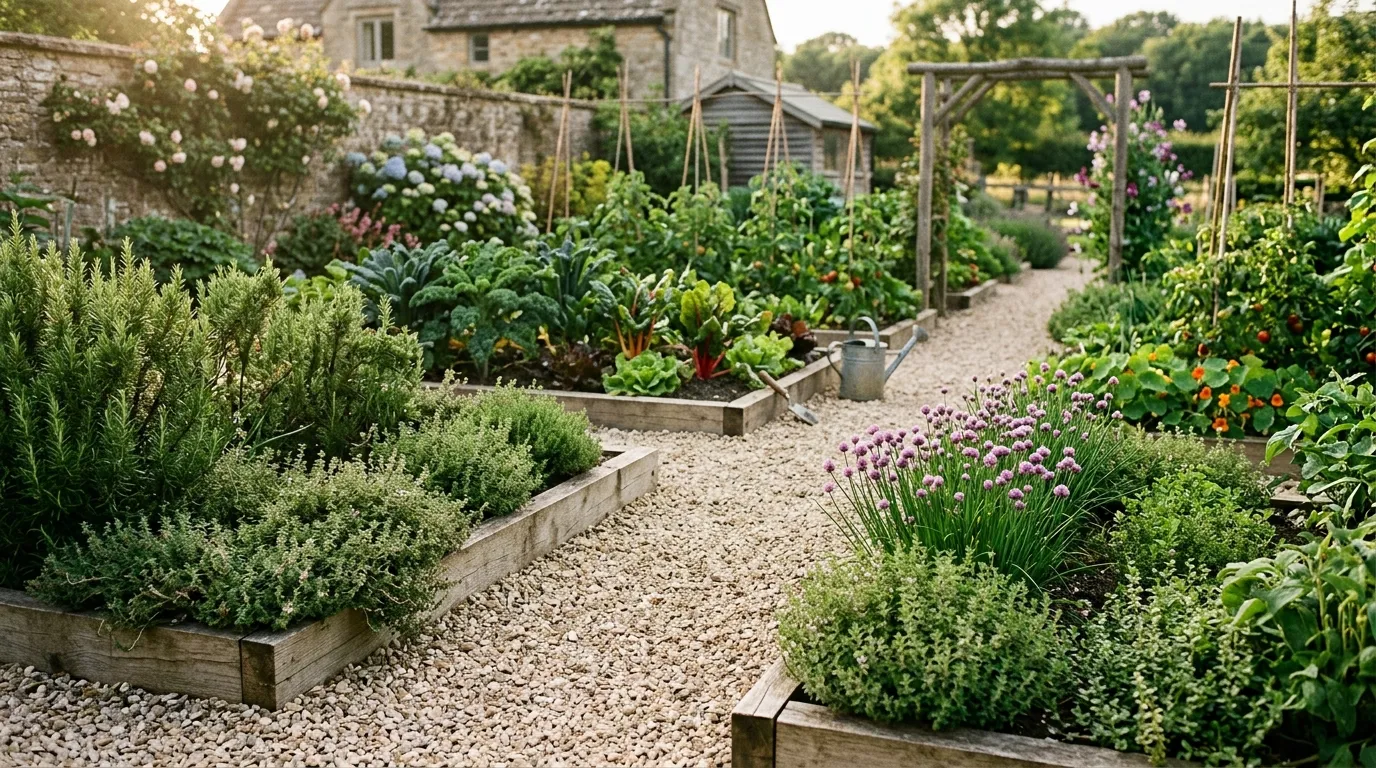
Gravel paths between beds with herb borders. The herbs attract pollinators while the gravel suppresses weeds.
Related reading
Lawrie has been gardening in the West Midlands for over 30 years. He grows his own veg using no-dig methods, keeps a wildlife-friendly garden, and writes practical advice based on real UK growing conditions.