Key takeaways
- Keep the plant list to 6 to 10 species, repeated in blocks of 3, 5 or 7
- Pale gravel (8 to 12mm grey granite) costs £55 to £90 per tonne, covers 4 to 5m square at 50mm
- Silver birch multi-stems give winter bark interest and survive minus 25C across Scotland
- Timber should be untreated or grey-stained: larch and Douglas fir silver naturally in 18 to 24 months
- Build budget runs £600 for a small courtyard to £4,200 for a 60m square garden
- Maintenance averages 3 to 6 hours per month once gravel and ground cover establish
Scandinavian garden design suits the UK better than almost any imported style. The look grew out of Sweden, Denmark and Norway, where summers are short, light is low, and gardens are built for calm rather than colour. UK plots share that grey northern light, the same rainfall band, and the same cool springs. This guide covers the palette, the planting ratios, the timber and gravel choices, the lighting, and what a real build costs.
What makes a garden read as Scandinavian
A Scandinavian garden reads as calm, pale and uncluttered. Three things create that effect. First, a tight palette: greys, whites, soft black and green, with almost no bright colour. Second, restraint in planting: 6 to 10 species repeated, never a crowded mixed border. Third, pale natural materials: silvered timber, grey gravel, and birch bark.
The style traces to the Swedish and Danish design movement of the 1940s and 1950s. Designers built outdoor rooms that mirrored the light, airy interiors now sold worldwide. Function came first. A bench faces the low evening sun. A path takes the shortest honest line. Nothing is added for show.
The UK fit is close. Mean annual UK rainfall sits at 1,154mm (Met Office 1991 to 2020 baseline), almost identical to Gothenburg. Our cloud cover and low winter sun match southern Scandinavia. That grey light, which UK gardeners often fight, is exactly the light this style is built for.
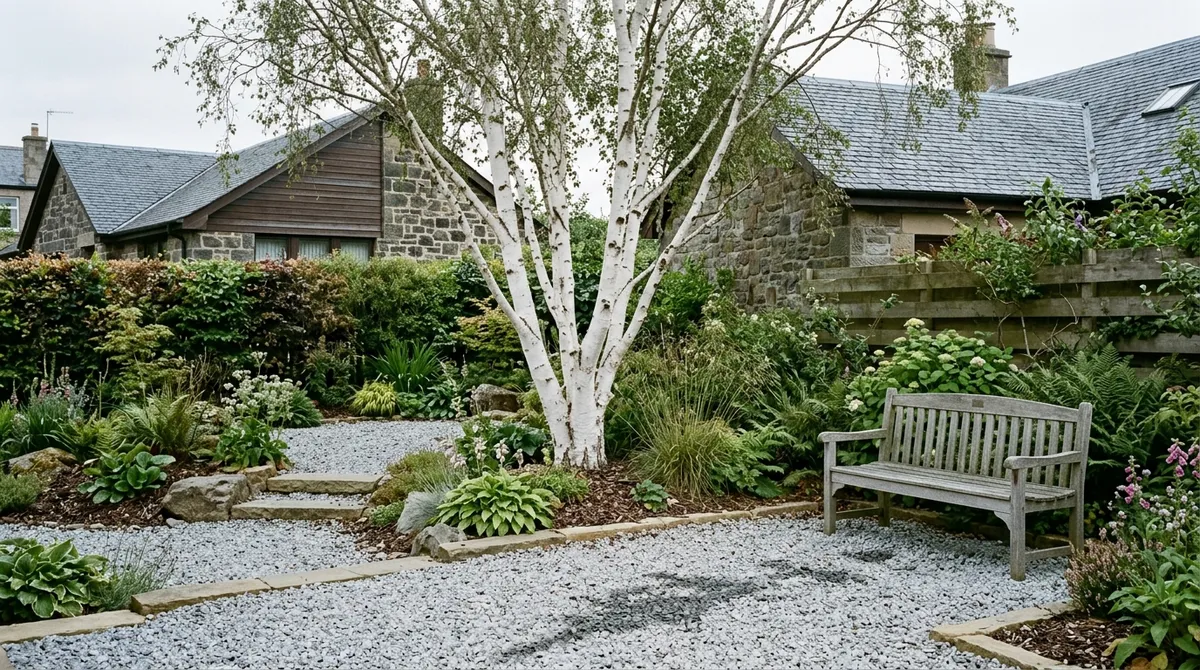
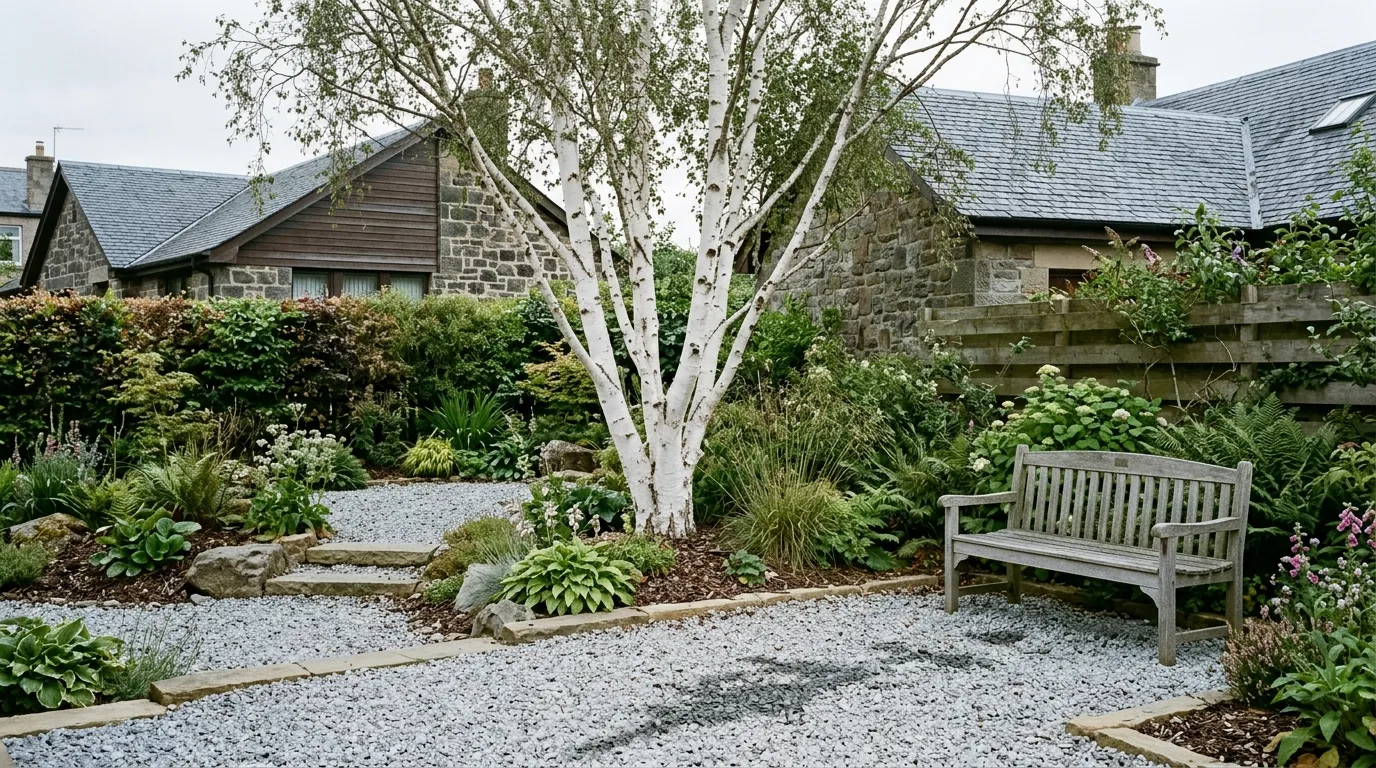 A multi-stem birch, pale gravel and a single weathered bench. The scheme reads calm because the species count stays low and the palette stays muted.
The Scandinavian colour palette and why it works here
The palette is the design. Get it right and a garden reads as Nordic even on a tight budget. The rule is simple: muted, pale, light-reflecting. Strong colour is the enemy.
Hard materials stay grey or off-white. Grey granite gravel, silvered larch, off-white render, soft black metal. Planting stays green, silver and white, with the occasional rust or plum tone for depth. A single block of Astrantia ‘Roma’ or white Geranium ‘Kashmir White’ lifts the scheme without breaking the calm.
The comparison shows the core trade. A Scandi scheme gives up summer colour density and gets back calm, year-round structure and far less work.
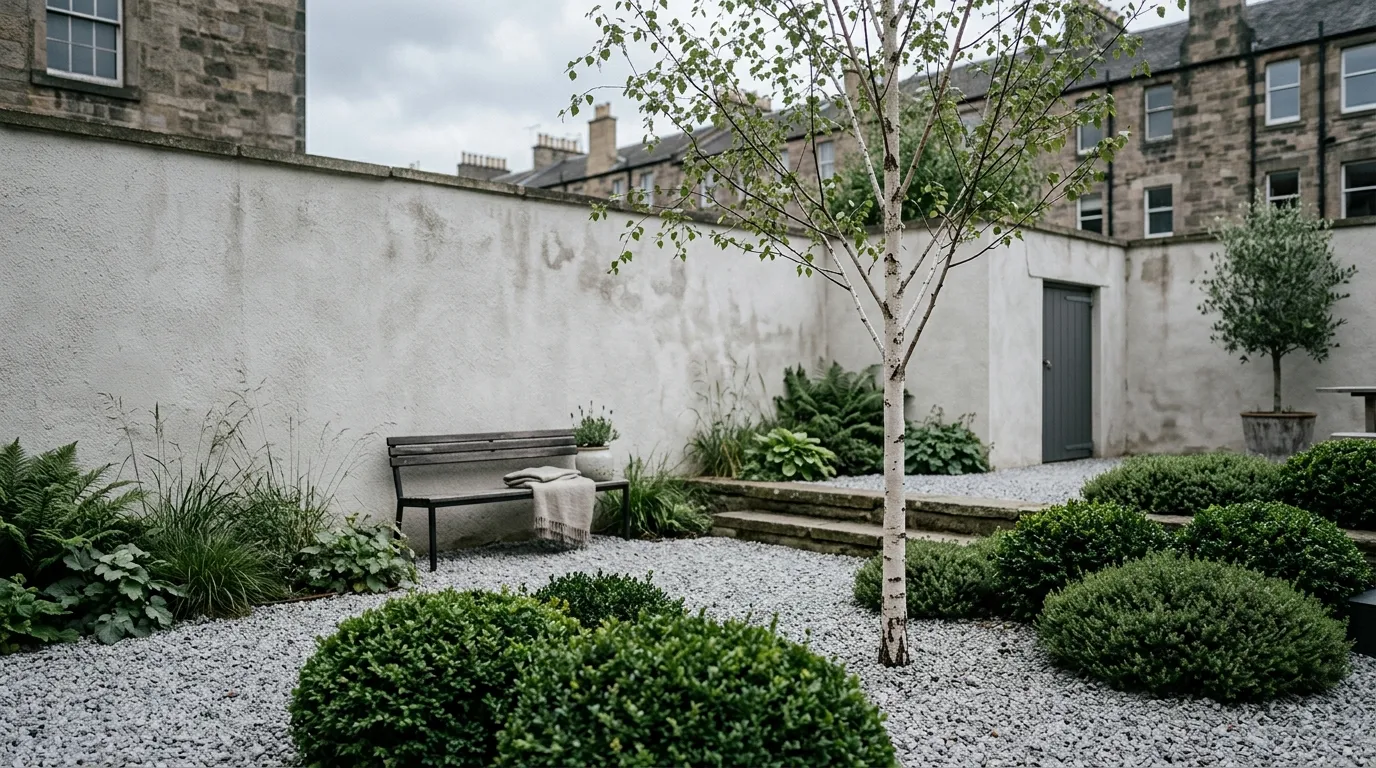 An Edinburgh new-build courtyard. The grey 8mm gravel and off-white wall reflect light into a north-facing space that would otherwise read as gloomy.
Best plants for a Scandinavian garden in the UK
Trees: birch leads, always
Silver birch is the signature tree. The whitest-barked form is Betula utilis ‘Jacquemontii’, hardy to minus 25C and reliable across Scotland. Buy it as a multi-stem for the airy, layered look. A 2.5m to 3m multi-stem costs £140 to £280. Native Betula pendula is cheaper at £40 to £90 but its bark stays greyer and scores lower for winter brightness.
| Species | Mature height | UK hardiness | Role |
|---|---|---|---|
| Betula utilis ‘Jacquemontii’ | 8-12m | H6, minus 25C | Signature white bark, multi-stem |
| Betula pendula (native) | 12-18m | H6 | Budget birch, greyer bark |
| Pinus mugo ‘Mops’ | 1-1.5m | H7, minus 30C | Low evergreen structure |
| Amelanchier lamarckii | 4-6m | H6 | White spring blossom, soft form |
| Sorbus cashmiriana | 5-7m | H6 | White berries, open canopy |
Grasses and ferns: the movement layer
Grasses give a Scandi garden its movement and its winter form. Hakonechloa macra is the single best choice for cool, damp UK shade, hardy to minus 15C, forming soft mounds 350 to 450mm tall. Deschampsia cespitosa ‘Goldtau’ and Molinia ‘Transparent’ give taller, see-through plumes from July to December. Our ornamental grasses guide for UK gardens covers spacing and cutting times in detail.
For ferns, Polystichum setiferum (soft shield fern) and Dryopteris affinis hold structure through mild winters. Plant grasses 400 to 500mm apart, ferns 600mm apart.
Evergreen structure and pale flowers
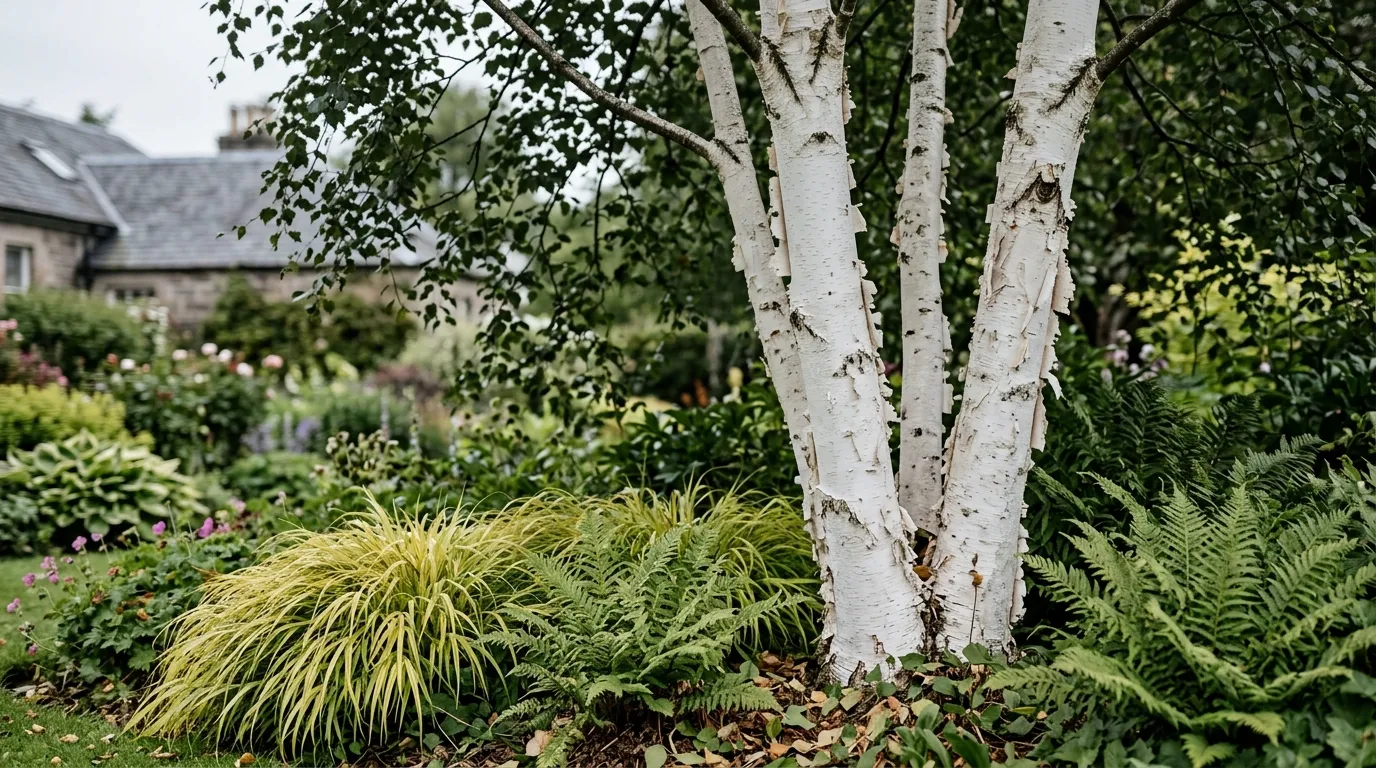 Betula utilis ‘Jacquemontii’ underplanted with Hakonechloa and soft shield fern. Three birch stems plus two ground species, repeated, is the whole picture.
Pale gravel, timber and the hard materials that set the tone
Hard materials carry a Scandi garden as much as the planting. Keep everything pale and matt. Grey granite gravel, silvered timber and soft black metal are the core trio.
Gardener’s tip: Edge gravel with a 20mm proud steel or larch restraint. Without an edge, the gravel migrates onto lawns and beds within one wet winter and you lose the crisp line that makes the style work.
Timber wants to silver, not darken. Untreated larch and Douglas fir weather to soft grey in 18 to 24 months outdoors. Oak silvers too and lasts decades but costs two to three times more. Avoid orange pressure-treated softwood and dark brown stains. If you want instant grey, a translucent grey wood stain works. Charred timber (yakisugi) also reads as Nordic and resists rot.
For metal, choose soft black or raw mild steel left to develop a light surface patina. Bright galvanised and shiny stainless both fight the muted look.
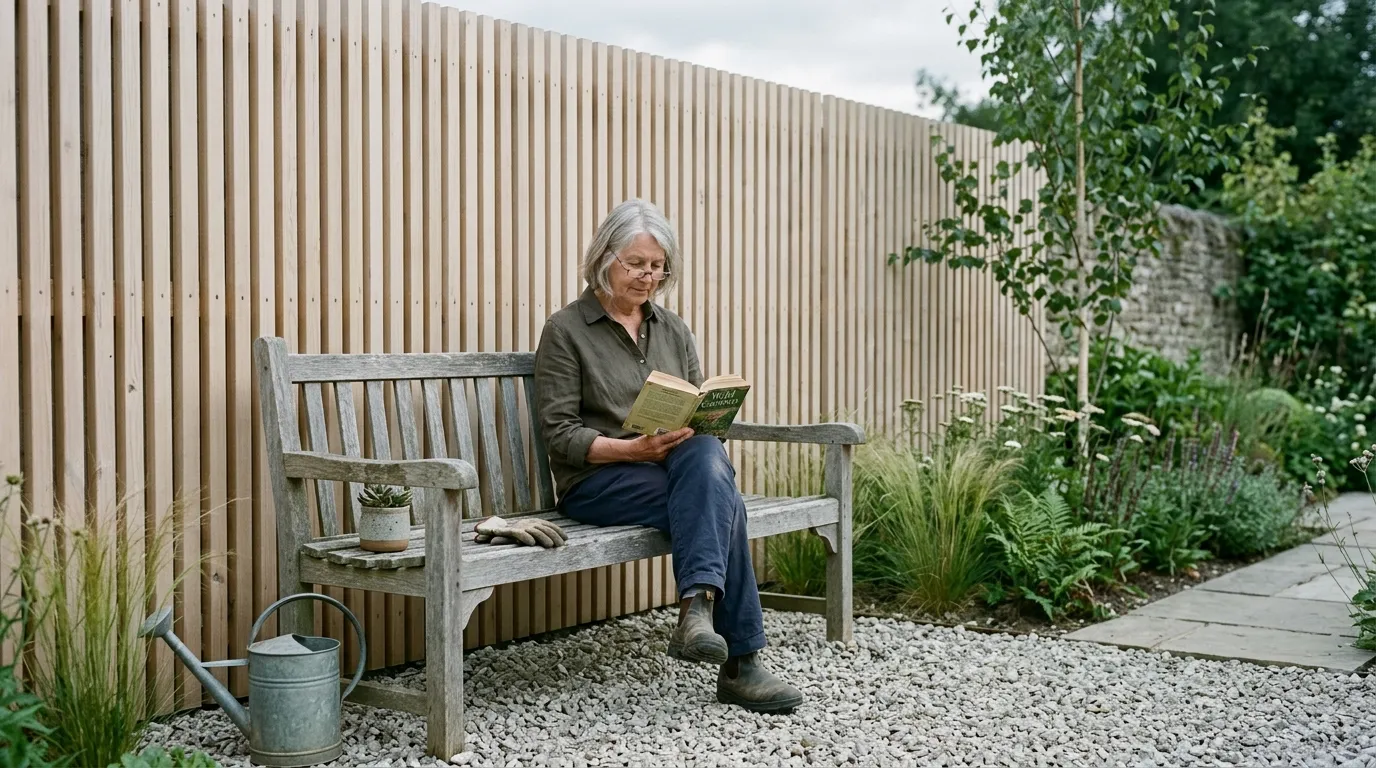 Untreated larch silvered to grey over two winters. No stain was used. The bench faces west to catch the low evening sun, a core Scandi habit.
How to plan a small UK plot the Scandinavian way
The style works at almost any size, from a 25 square metre courtyard upward. Smaller plots actually suit it: restraint reads as deliberate, not bare. Plan in layers, not as a single busy scheme.
Start with the floor. Decide the split between gravel, timber deck or paving, and planting. A common Scandi ratio is roughly 50 per cent hard surface, 35 per cent planting, 15 per cent timber seating or deck. That high hard-surface share is part of the look and keeps maintenance low.
Next, place one focal tree. A single multi-stem birch off-centre anchors the whole garden. Avoid a central axis. Position the tree using the rule of thirds, never dead centre.
Finish with one seat facing the evening light and one or two pale-flowered accent blocks. That is the whole plot. Resist the urge to add more.
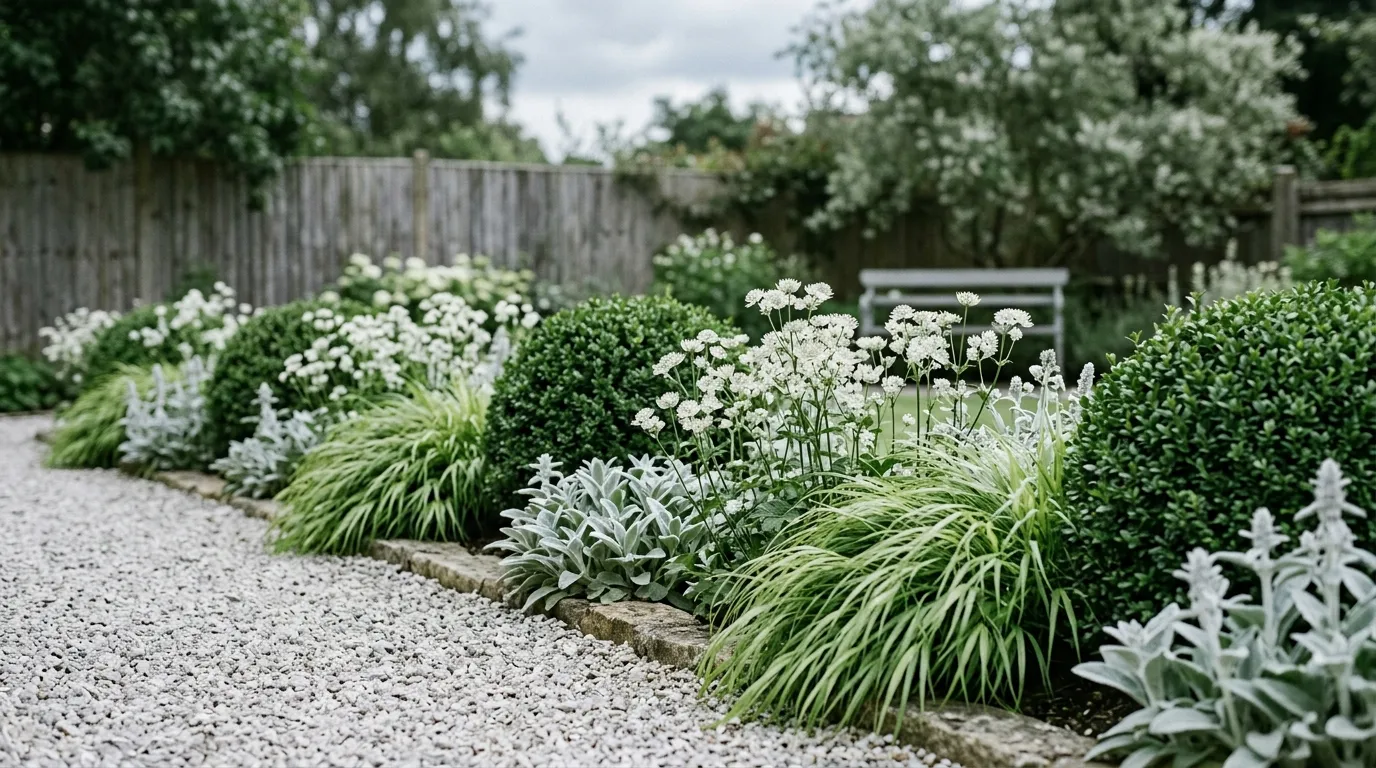 A muted border in white, green and grey. Astrantia, Hakonechloa and clipped Ilex crenata are repeated in blocks rather than mixed.
Scandinavian garden lighting for long UK winters
Lighting matters more in a Scandi garden than in any other style. UK winter daylight runs as short as 7 hours 49 minutes on 21 December in London, less in Scotland. The garden is dark when you most want to see it. Nordic design answers with warm, low, layered light.
Keep the colour temperature warm: 2,700K to 3,000K, never cold white. Cold blue light kills the calm. Layer three types: low path lights at 300 to 450mm, a single uplight on the birch to catch the white bark, and one soft wash on a wall or screen.
Budget realistically. A starter mains-voltage kit runs £200 to £400. A quality 12V plug-and-play system with brass fittings runs £600 to £900 and lasts far longer outdoors. LED draw is tiny, about 2 to 4 watts per fitting, so running costs sit under £15 a year for a small garden.
Avoid the common mistake of over-lighting. Three to five fittings is plenty for a 30 to 60 square metre plot. The dark between the pools of light is part of the effect.
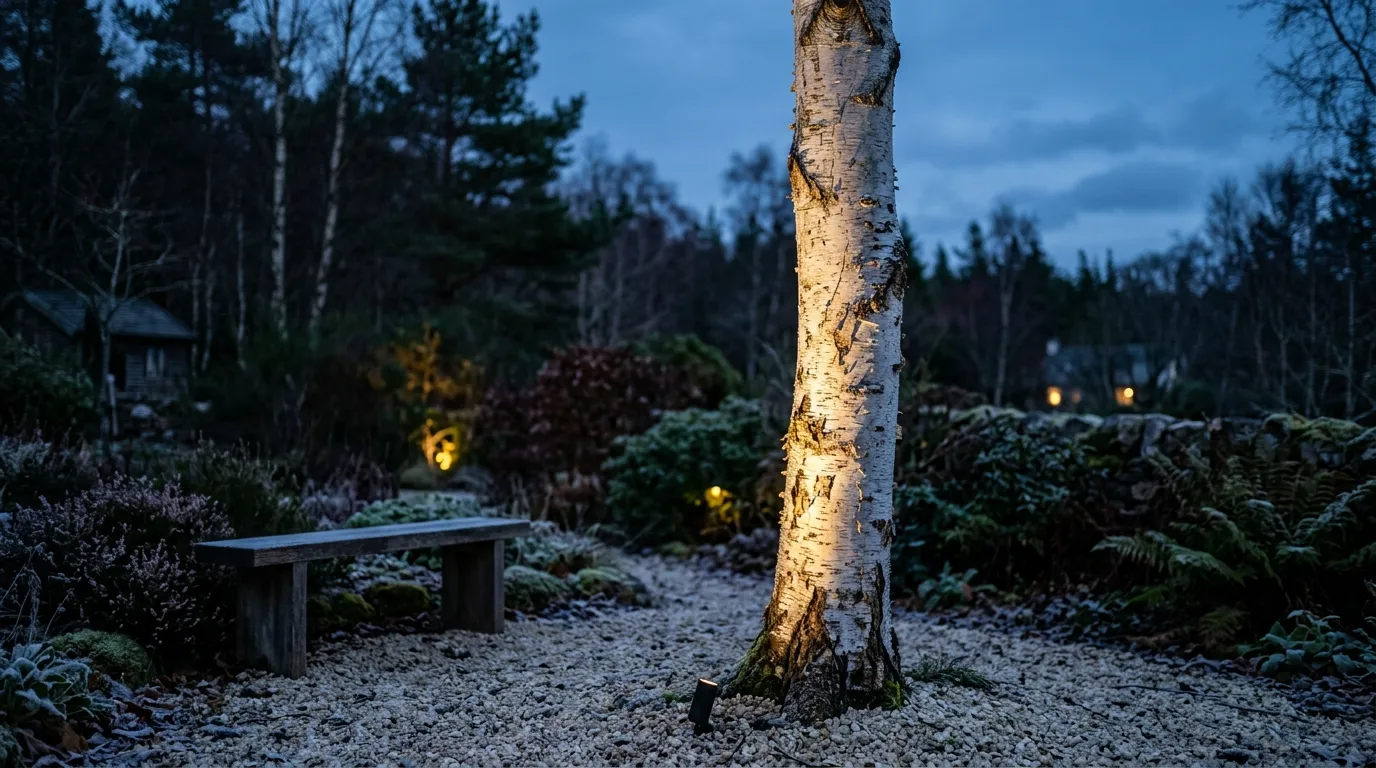 A single 3W uplight on the birch trunk at 2,700K. Warm light on white bark carries the garden through the long Scottish winter evening.
What a Scandinavian garden costs to build in the UK
£600 entry: small courtyard, 25 square metres
A 25 square metre courtyard with gravel and a few key plants. Gravel: 3 tonnes Silver Grey granite at £210. Membrane and edging: £70. One multi-stem birch: £160. Five grasses and three Ilex crenata: £130. That lands around £570 to £620, excluding any existing paving.
£2,100 mid: suburban back garden, 40 square metres
Add a small larch deck (3m by 2m, £620 in timber and fixings), a built bench, and a fuller planting layer. Gravel 4 tonnes (£280), membrane and steel edging (£140), one birch (£220), 18 plants (£340), deck and bench (£780), basic lighting kit (£300). Total about £2,060.
£4,200 full: 60 square metres with lighting and screen
Warning: Do not skimp on the gravel sub-base. Laying gravel straight onto soft soil without a compacted Type 1 layer leads to rutting and weed-through within a year. Budget £8 to £12 per square metre for proper base prep.
Year-round maintenance calendar
Common mistakes UK gardeners make
Too many species. The biggest error by far. UK gardeners default to packed mixed borders. A Scandi scheme uses 6 to 10 species total, repeated in blocks. Pick three structural plants and three ground plants and use them across the whole plot.
Bright colour. A few hot reds or oranges break the calm instantly. Keep flowers white, green, grey, with rust or plum only as occasional depth. If a plant shouts, remove it.
Orange or dark timber. Pressure-treated softwood and dark brown stains read as suburban fence, not Nordic. Use untreated larch, oak, or a translucent grey stain so the wood silvers.
Rounded buff gravel. Pea gravel rolls underfoot and the warm buff colour fights the palette. Use angular grey granite, 8 to 12mm, every time.
Cold white lighting. Blue-white LED at 5,000K or higher destroys the warmth. Stay at 2,700K to 3,000K and light fewer points, not more.
Adapting the style to UK soils and aspect
The Scandi palette works on most UK soils with small tweaks. Birch tolerates a wide pH range, from 4.5 to 7.5, and copes with the heavy clay common across the Midlands and the north. On wet clay, plant birch on a slight 150mm mound to keep the root collar dry.
Hakonechloa and ferns want moisture-retentive soil and partial shade, which makes the style a strong fit for north-facing and shaded plots that struggle with sun-loving borders. On dry, sandy south-east plots, swap Hakonechloa for Deschampsia and Stipa tenuissima, which take more drought.
For winter colour and bark, silver birch is the anchor across all UK regions. If you want a deeper read on birch siting and growth, our guide to growing silver birch covers planting depth and multi-stem training.
For independent guidance on choosing trees and grasses suited to a cool UK climate, the Royal Horticultural Society plant finder lists hardiness ratings and aspect for every species named here. The Woodland Trust gives the native birch profile if you prefer Betula pendula on a budget.
Next step
Our team produces practical UK gardening guidance from source research, contributor records and established horticultural practice. Editorial standards are overseen by Matt W.