Key takeaways
- Split a long plot into 2-4 zones so you never see the full length at once
- Turn the layout 30-45 degrees off the fence line to stretch the apparent width
- Place a focal point part-way down to draw the eye across, not straight to the back
- Offset the path; a centred straight run is the single biggest cause of the corridor effect
- Use 1.5-1.8m planting between zones to block the sightline and create the reveal
- Plant boundaries in drifts so the fence reads as green depth, not two parallel lines
A long narrow garden is one of the most common shapes in the UK, and one of the hardest to get right. The classic mistake turns a long narrow garden into a corridor: one straight path down the middle, two bare fences either side, and the eye shoots straight to the back boundary. This guide is about ideas and zoning, the practical tricks that break that bowling-alley effect and turn a thin plot into a sequence of places worth being in.
The Royal Horticultural Society advice on small and narrow gardens is a useful reference for plant choice in tight spaces. What follows focuses on layout ideas: zoning, diagonals, focal points, and the width tricks that make a corridor feel like a garden.
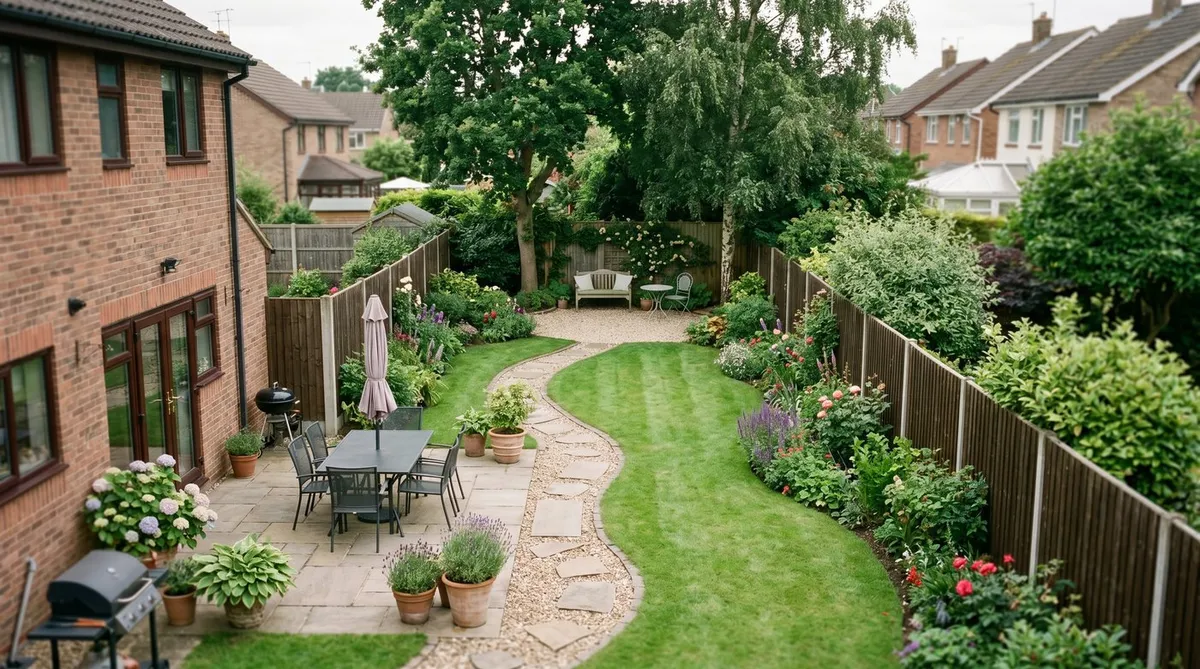
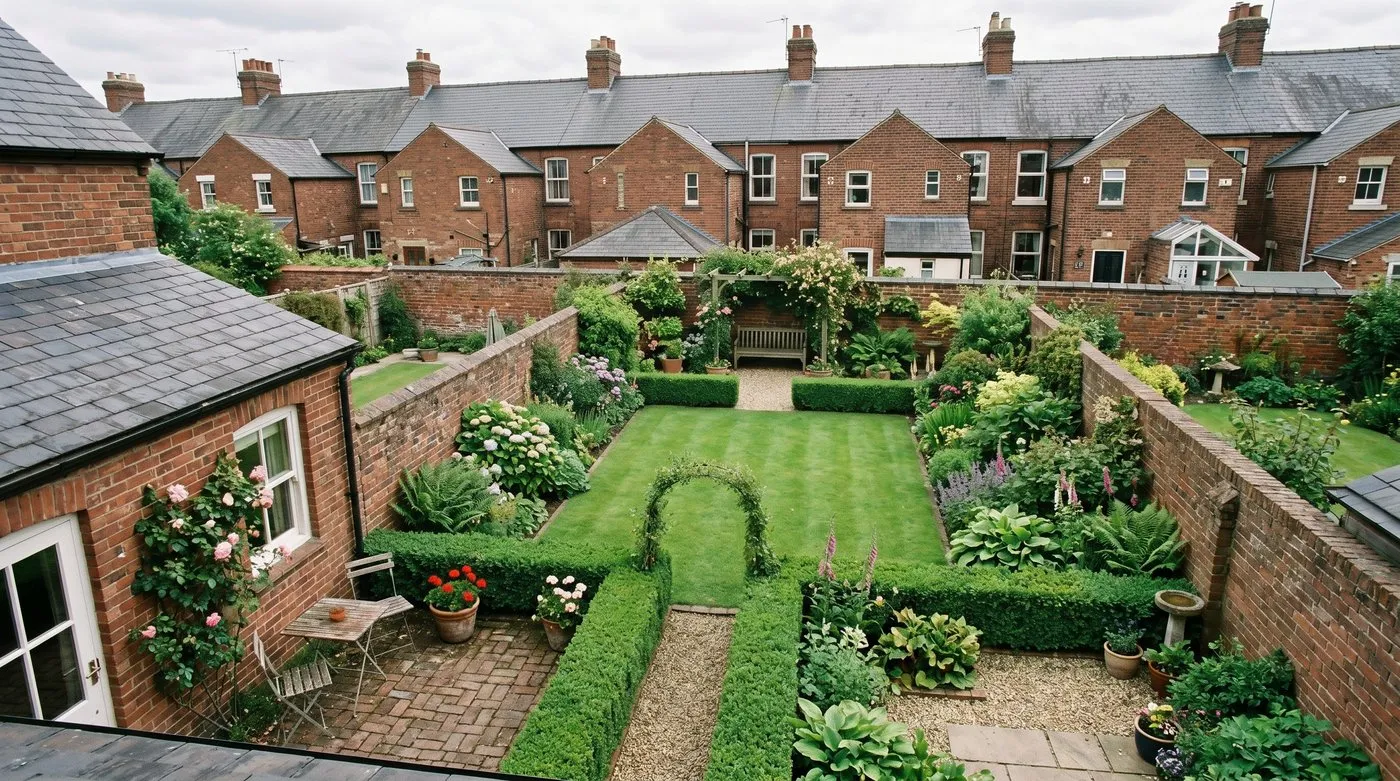 A 7m by 30m plot divided into three rooms: dining patio, central lawn, and a planted seat at the rear. No single view runs the full length.
Why a long narrow garden reads as a corridor
A long thin plot triggers the corridor effect because of how the eye moves. Run a straight path from the back door to the rear fence and you create one uninterrupted sightline. The brain reads that line as length and ignores everything either side. Two parallel fences reinforce it, like the lines of a running track.
Three things drive the effect: the central path, the bare boundaries, and the lack of any cross-feature. Fix those three and the bowling alley disappears.
Zoning the plot into garden rooms
Zoning is the single most effective idea for a long garden. You divide the plot into separate rooms, each with its own purpose, so the reader experiences a sequence rather than one long view. Two to four zones works for most UK gardens. Under 15m, use two. Between 15m and 25m, use three. Over 25m, you can carry four.
Give each zone a clear job
Turn the layout on the diagonal
The diagonal grid is the strongest width trick for a narrow plot. Instead of running paths and beds parallel to the fences, you rotate the whole layout 30 to 45 degrees off the boundary line. This works because the longest straight line across any rectangle runs corner to corner, not end to end. A diagonal layout makes the eye travel that longer cross-distance, so the plot reads as wider.
Diagonal paving, a lawn cut on the angle, and beds that widen into the corners all reinforce the effect. You lose a little usable area to the triangular corners, but those corners become ideal spots for a tree, a bench, or a water feature.
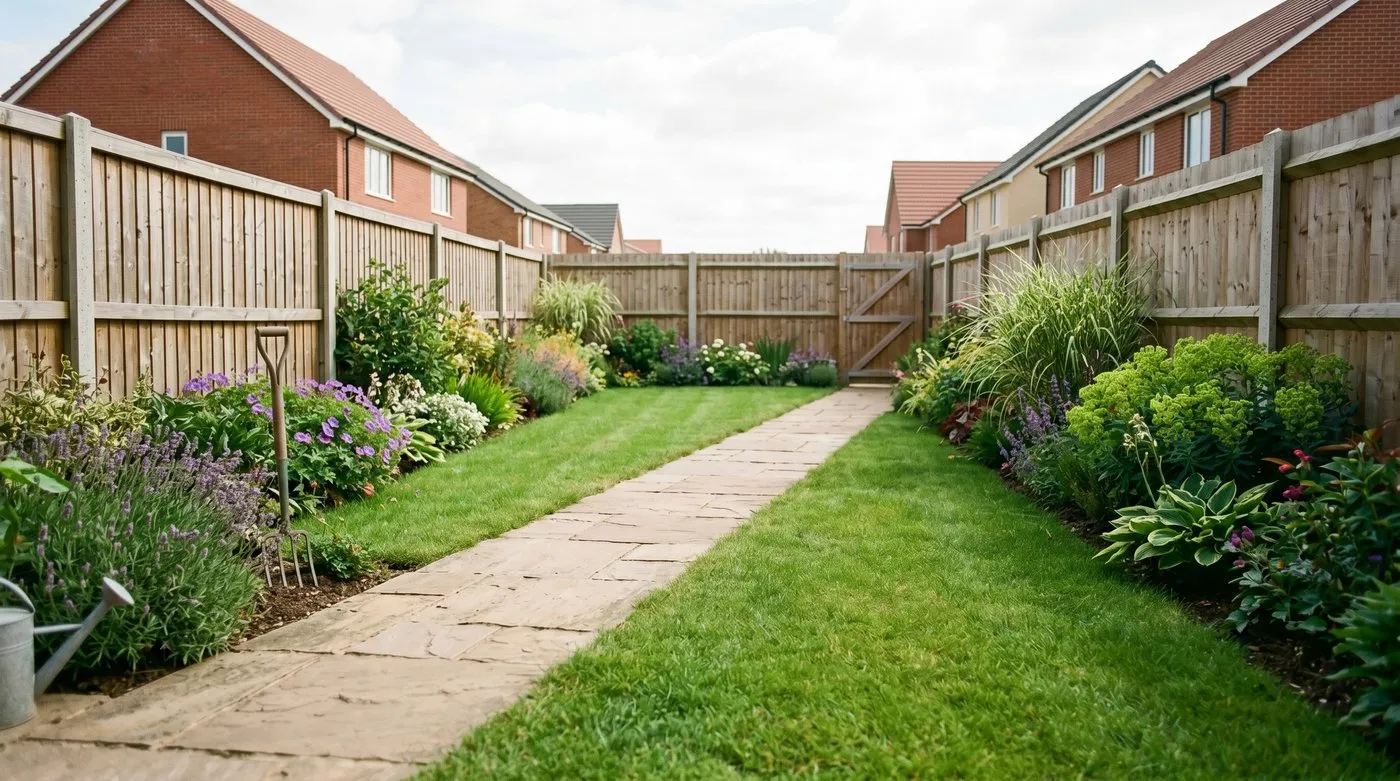 A path set on the diagonal forces the eye across the plot. The corners left over become planting pockets and seating spots.
Dividing screens, arches, and the reveal
Vertical dividers between zones are what stop the long sightline. The trick is to block the view at standing height, around 1.5 to 1.8m, while leaving a gap or arch to glimpse through. That glimpse is the reveal: the reader sees a hint of the next room and wants to walk on.
An arch over the path is the simplest divider. A timber rose arch, a metal hooped tunnel, or a clipped hedge archway all frame the journey and mark the threshold between rooms. Trellis screens planted with clematis or jasmine give a softer break and take up almost no ground. A short run of hedge, such as hornbeam or yew, gives the most solid division but needs a clear gap to walk through.
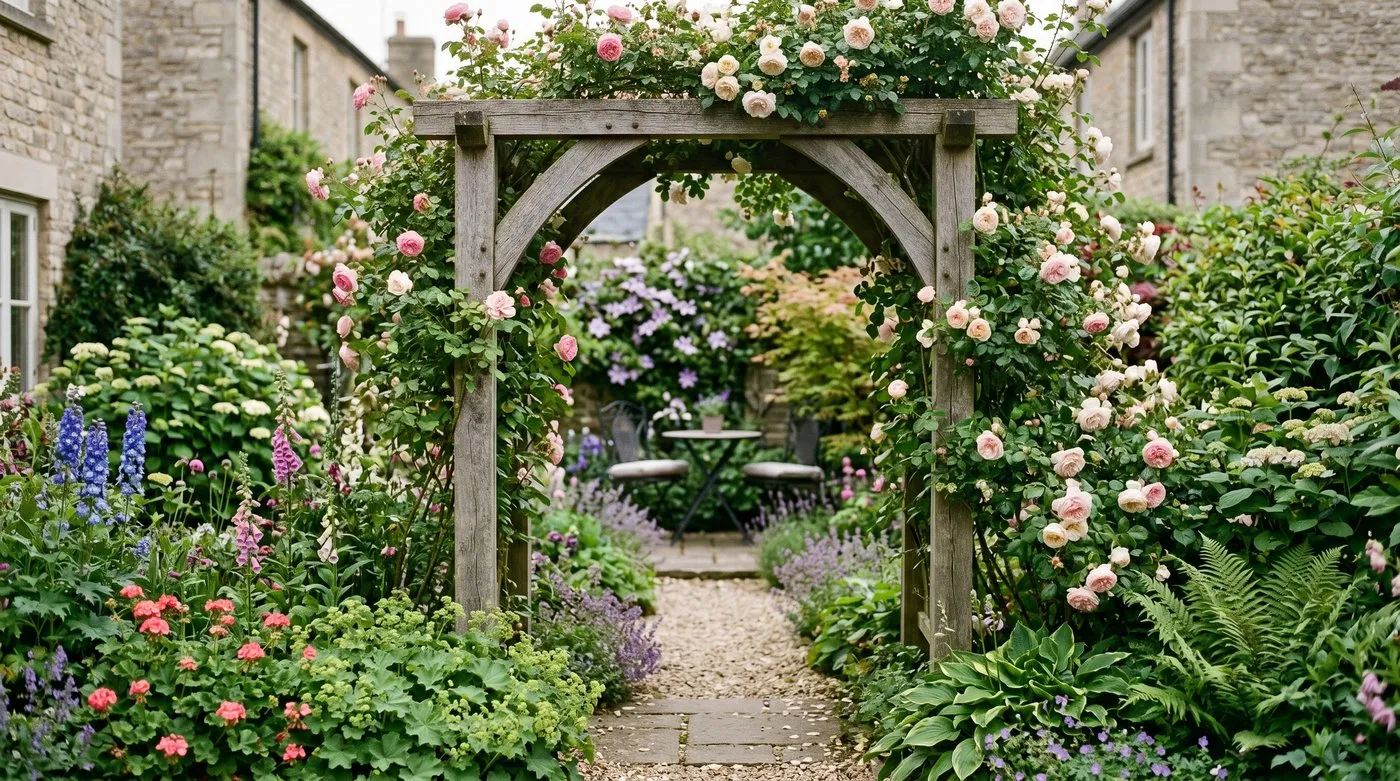 An arch blocks the long view but frames a glimpse of the next zone. That reveal pulls the visitor forward.
Focal points that pull the eye across, not down
A focal point gives the eye a place to rest, and where you put it controls how the garden reads. Place a focal point at the far end on the central axis and you reinforce the corridor: the eye races straight to it. Place it to one side, part-way down, and you pull the gaze across the plot instead.
Strong focal points include a weathered stone urn, a specimen tree, a bench framed by an arch, a water bowl, or a piece of sculpture. Set one in the middle zone, offset from the path, and another tucked into a diagonal corner. The eye hops from one to the next, moving side to side, and the journey feels longer and more varied.
Lighting extends the trick after dark. Uplighting a multi-stem tree or a focal urn in the far zone gives an evening destination. Keep the brightest point away from the dead-centre rear fence, or you simply light up the boundary you are trying to disguise.
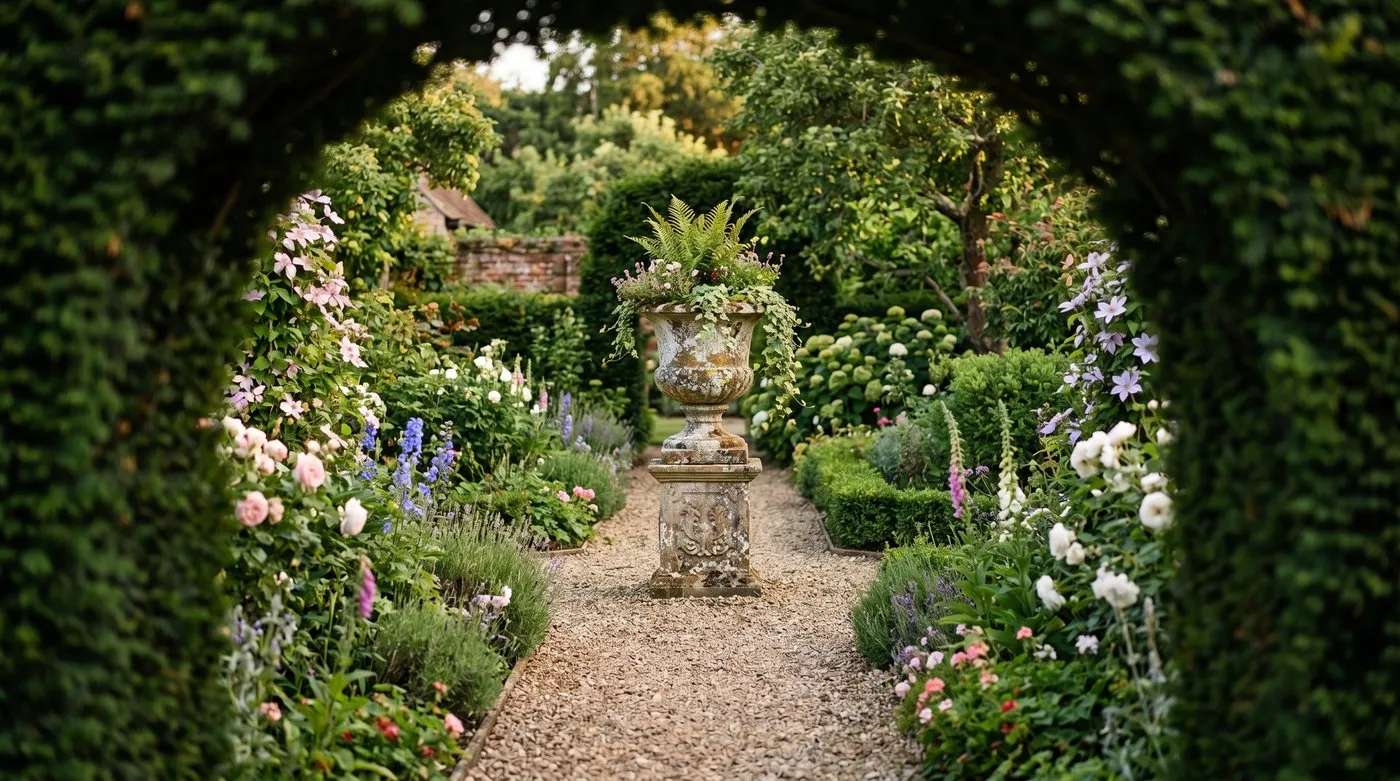 A focal urn set in front of the rear boundary stops the eye landing on the fence and gives the gaze a resting place.
Planting in drifts to disguise the boundaries
Bare fences running the full length are half the corridor problem. The fix is drift planting: flowing groups of mixed heights along the boundaries so the eye reads green depth instead of two hard lines. Avoid a single straight ribbon of one plant along each fence. That only emphasises the length.
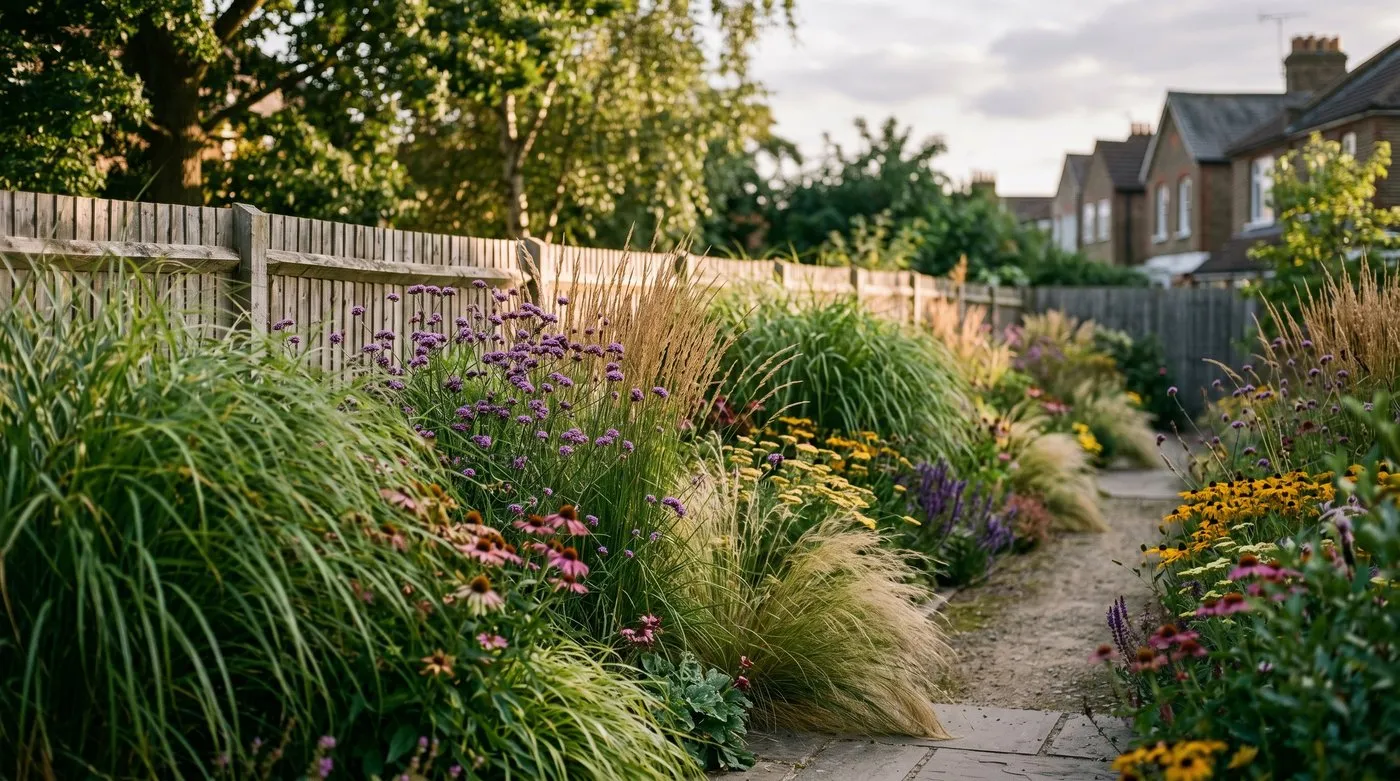 Drifts of mixed heights soften a long fence so the boundary reads as planting depth, not a parallel line.
Hiding the end and building a destination
The rear boundary is where the eye wants to stop, so give it something worth stopping at. Hide the end by planting tall in front of the back fence, then build a destination just short of it. A multi-stem tree, a tall screen, or a group of large shrubs breaks up the boundary so it no longer reads as a hard stop.
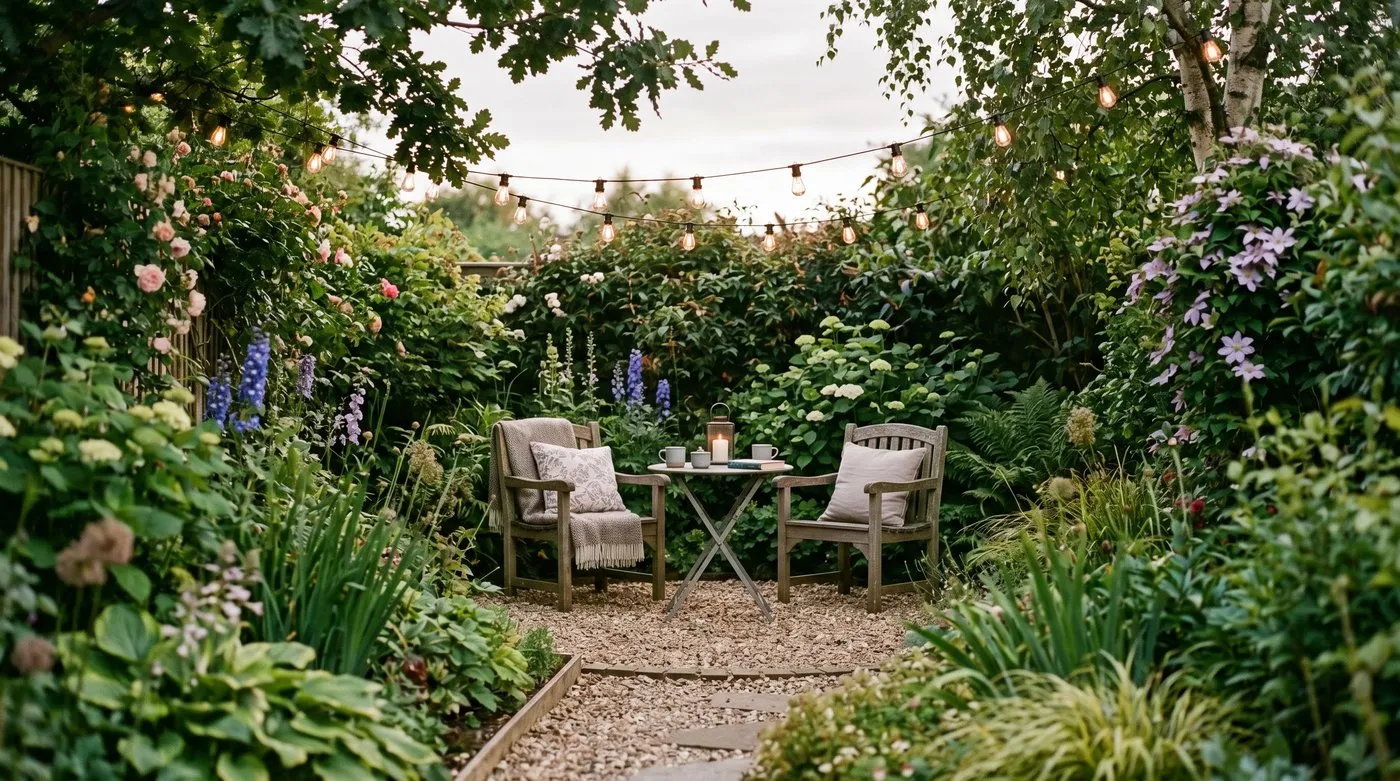 A seating zone at the far end gives the garden a destination. Tall planting hides the rear fence completely.
Ideas compared: how much each trick gains you
Not every idea pulls the same weight. Some change the feel of the whole plot, others are finishing touches. This ranking reflects what made the biggest difference on the 7m by 30m test garden, measured by apparent width and how short visitors judged the plot to be.
| Idea | What it does | Effort | Impact on sense of space |
|---|---|---|---|
| Zoning into rooms | Breaks the long view into short ones | Medium | Very high |
| Diagonal grid | Stretches the longest sightline across the plot | High | Very high |
| Off-centre or weaving path | Stops the straight corridor view | Low | High |
| Dividing screens and arches | Block the sightline, create a reveal | Medium | High |
| Drift boundary planting | Disguises parallel fences | Medium | Medium-high |
| Offset focal points | Draws the eye across, not down | Low | Medium-high |
| Hiding the end | Removes the hard stop, adds a destination | Medium | Medium |
A month-by-month plan for redesigning a long garden
Redesigning a long plot is best spread across a year. Hard work in autumn and winter, planting in spring, and refinement through summer gives the strongest result for the least wasted effort.
| Month | What to do |
|---|---|
| January | Measure the plot accurately. Sketch zones on paper at scale. Test a diagonal grid against a straight one. |
| February | Mark out zones with canes and string in the garden. Stand at the back door and check no view runs the full length. |
| March | Order paving, gravel, and structural plants. Book any contractors early for spring. |
| April | Lay hard surfaces and build dividing screens or arches while the ground is workable. |
| May | Plant trees, shrubs, and structural grasses. Set focal points and check sightlines from the house. |
| June | Plant drifts of perennials along boundaries. Fill gaps with annuals for first-season colour. |
| July | Water new planting in dry spells. Sit in each zone at different times to test how it works. |
| August | Assess which sightlines still feel too long. Note where extra height is needed for autumn planting. |
| September | Plant additional shrubs and grasses for height. Add boundary climbers on trellis. |
| October | Mulch beds. Move or add focal points based on a full season of use. |
| November | Plant bare-root hedging and trees for divisions. Install lighting for evening destinations. |
| December | Review the whole plot. Plan refinements for the next year while the structure is bare and visible. |
Common mistakes in long narrow gardens
A few repeated errors keep the corridor effect alive. Avoiding these matters more than adding clever features.
- Running one straight path down the centre. This is the single biggest cause of the bowling-alley look. The eye follows the line straight to the back fence. Offset the path or let it weave between zones instead.
- Leaving the boundaries bare. Two empty parallel fences read as the lines of a track. Plant them in drifts or green them with climbers so they recede into the background.
- Putting the only focal point dead-centre at the far end. This reinforces the long axis. Set focal points off to the side and part-way down so the eye moves across the plot.
- Making every zone the same size. Equal divisions feel mechanical. Vary the lengths, as with the 9m, 11m and 10m split, so the sequence feels natural.
- Walling the zones off completely. Solid full-height barriers cut the garden into dark boxes. Always leave a gap, arch, or low section so the next room is glimpsed, not hidden.
Gardener’s tip: Before building anything, push canes into the ground where your screens and trees will go, then view the garden from the back door and from an upstairs window. If you can still see the back fence in one glance, raise the heights or shift them off-centre until the long view is broken. Ten minutes with canes saves a season of regret.
How the ideas work together on a real plot
The tricks above are strongest in combination. On the 7m by 30m garden, zoning gave the structure, the 30-degree diagonal stretched the width, offset focal points moved the eye across, and drift planting hid the fences. No single idea carried the result on its own.
The order of work matters. Settle the zones first, because they decide everything else. Then choose the path line and the diagonal angle. Add dividers and focal points to control the sightlines. Finish with boundary planting, which softens and unifies. Built in that sequence, a plot that felt like a passage became a garden of three distinct, usable rooms.
Frequently asked questions about long narrow garden ideas
How do you make a long narrow garden look wider?
Turn the layout diagonally and break it into zones. A diagonal grid set 30-45 degrees off the fence line stretches the longest sightline across the plot, not down it. Add cross-features such as a path that steps side to side, and plant the boundaries densely so the fences disappear behind foliage. On a 7m wide plot this added around 1.2m of apparent width.
How many zones should a long garden have?
Two to four, depending on length. A garden under 15m suits two rooms; 15-25m suits three; over 25m can carry four. Each zone needs a clear purpose, such as dining, lawn, or a quiet seat, so the divisions feel deliberate rather than random. On the 30m test plot, three zones of 9m, 11m and 10m worked best.
What is the bowling-alley effect in a garden?
It is when a long thin plot reads as a corridor. A straight central path and bare parallel fences pull the eye straight to the back boundary in one go. The garden feels like a passage rather than a place to spend time. Zoning, diagonal lines, and dividing screens break that single long view into shorter ones.
Should the path go down the middle of a narrow garden?
No, an off-centre or weaving path works far better. A centred straight path is the main cause of the corridor effect. Offsetting it, or letting it cross from one side to the other between zones, forces the eye to move across the plot. This slows the journey down the garden and makes it feel longer to walk and shorter to view.
What can I use to divide a long garden into rooms?
Arches, trellis screens, hedges, or planting at 1.5-1.8m. The divider needs to block the sightline at standing height without walling the garden off completely. A gap or arch gives a glimpse through to the next zone, which creates a reveal. That reveal pulls the visitor forward and makes the garden feel larger than its true size.
How do I hide the end of a long garden?
Plant tall and place a focal point before the boundary. A tree, large shrub, or screen near the rear fence stops the eye landing on the boundary itself. A focal point such as a seat or urn set a few metres in front gives somewhere for the gaze to rest. Building a seating destination at the end turns a dead stop into an arrival.
What planting works best in a long narrow garden?
Drifts of mixed heights along the boundaries, with a few tall accents between zones. Repeating three or four key plants down the length ties the rooms together. Avoid a single straight ribbon of one plant along each fence, as that emphasises the length you are trying to disguise. Vary heights from 30cm perennials to 1.8m grasses to break the flat fence line.
Our team produces practical UK gardening guidance from source research, contributor records and established horticultural practice. Editorial standards are overseen by Matt W.