Key takeaways
- Divide the plot into 3-4 rooms so you never see the whole length at once
- Offset or curve the path; a centred straight path is the main cause of the corridor effect
- Place a focal point 6-8m down to stop the eye and create a journey
- Plant boundaries 60-90cm deep to blur the long fence lines
- Use full-width cross features to pull the eye across the 5-6m width, not down the length
- Dividing a 5.5m by 22m terrace into zones creates several usable garden rooms
A long thin garden is the default shape behind most UK terraced and Victorian houses, and it is also the hardest to get right. Run a straight path down the middle of a long narrow plot and it reads like a bowling alley, with the eye shooting straight to the back fence. The fix is not more stuff. It is breaking the plot into rooms so you cannot see the whole length at once. This guide covers the design principles that beat the corridor effect, a step-by-step planning process, and a zone-by-zone worked example on a typical 5.5m by 22m terrace garden.
Get the bones right and a narrow plot becomes a sequence of spaces that feels larger than its footprint. Get them wrong and even expensive planting cannot rescue the tunnel.
Why long thin gardens feel like a corridor
The corridor effect comes from one thing above all: an uninterrupted sightline. When you can see from the back door to the rear fence in one glance, your brain reads the plot as a single long tube. A straight central path makes it worse by drawing a literal line to the far end.
Three features stack the problem. First, the centred path acts as a runway for the eye. Second, matching fence panels down both 18-25m sides create parallel walls that exaggerate the length. Third, a single use at the far end, often just a shed, gives no reason to pause anywhere in between.
The principle that breaks all three is mystery and journey. If part of the garden is hidden, the eye stops, the brain assumes there is more, and the space feels deeper and wider than it measures. Every technique below serves that one goal: stop the eye travelling straight to the back fence.
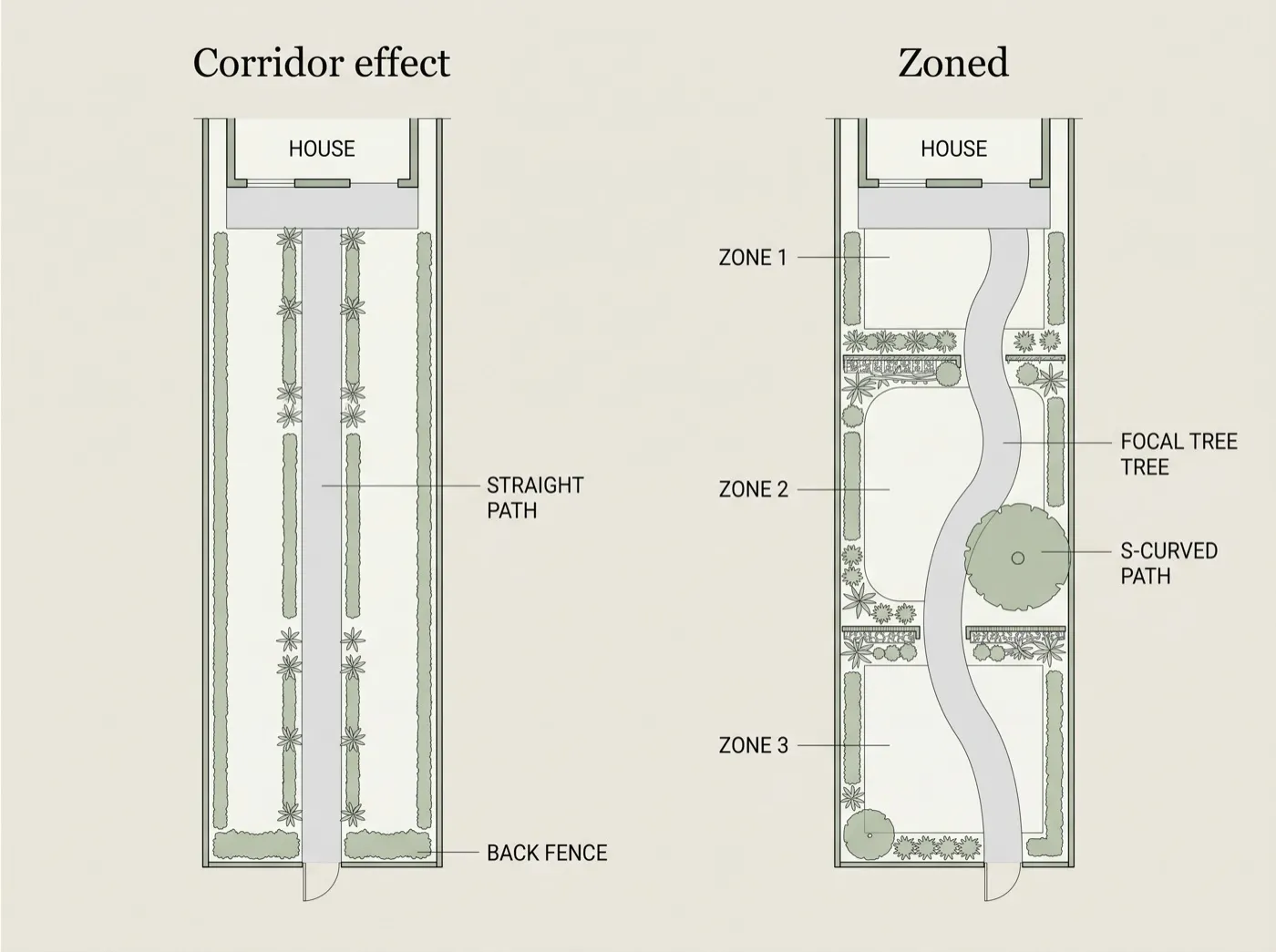 Left: a centred straight path creates the corridor effect. Right: zoning and an offset path break the sightline and add a sense of journey.
How to plan a long narrow garden step by step
Good design on a narrow plot follows a fixed order. Skip the survey and you build mistakes in concrete.
- Measure the plot accurately. Record length, width, and any change of level. A typical UK terrace garden runs 5 to 6m wide by 18 to 25m long. Mark the position of the back door, drains, manholes, and the sunniest corner.
- Track the sun. Note where light falls at 9am, 1pm, and 6pm. In a narrow plot one long fence often shades the bed beneath it for most of the day.
- Decide on rooms. Split the length into three or four zones of 4 to 7m each. Give every room a single job: dining, lawn, growing, or quiet seating.
- Place the dividers. Position a screen, arch, or planting block between each room so the next space is partly hidden.
- Route the path off-centre. Draw an offset or curved path that weaves between the rooms rather than bisecting them.
- Set the focal points. Put one strong feature 6 to 8m from the house and a destination at the far end.
- Plant the boundaries. Layer the long fences with borders 60 to 90cm deep to blur the lines.
- Phase the build. Start with the room nearest the house, then work back as budget allows.
Dividing a narrow garden into rooms
Zoning is the single most powerful move on a long thin plot, so it deserves the most thought. The aim is to interrupt the view at intervals, not to wall the garden into boxes.
A divider can be solid or partial. A 1.8m hazel hurdle, a trellis panel clothed in climbing rose, a pleached tree row, or a low hedge all break the sightline. Changes of level do the same job: a single 150mm step between two terraces signals a new room without any vertical screen at all.
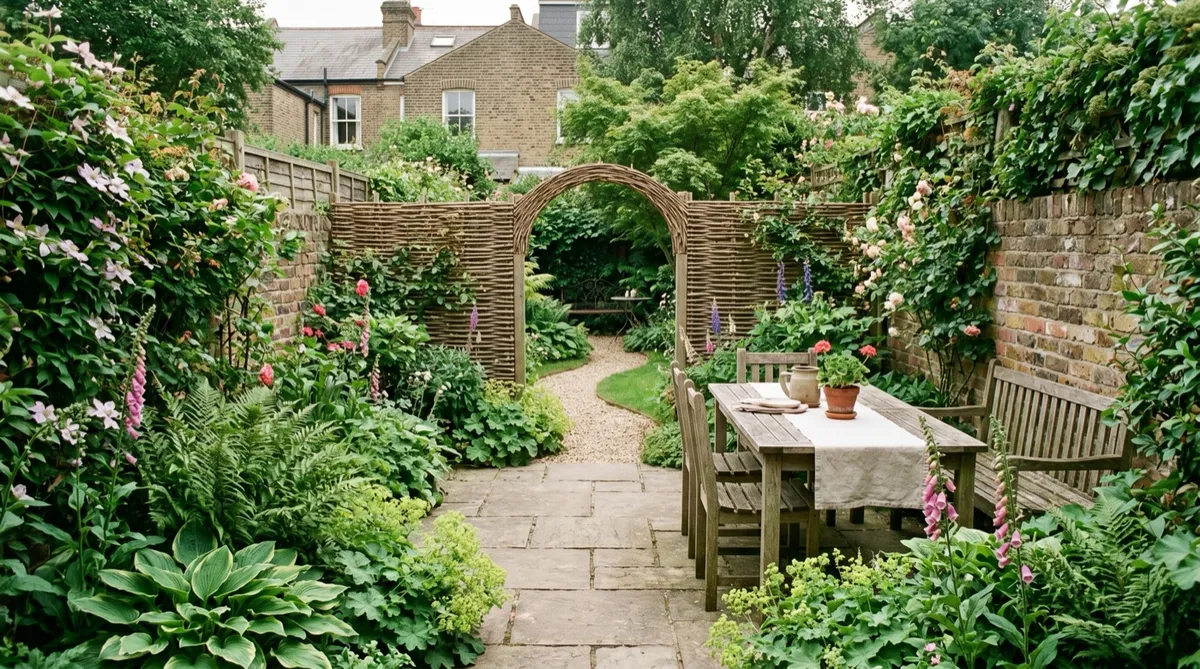
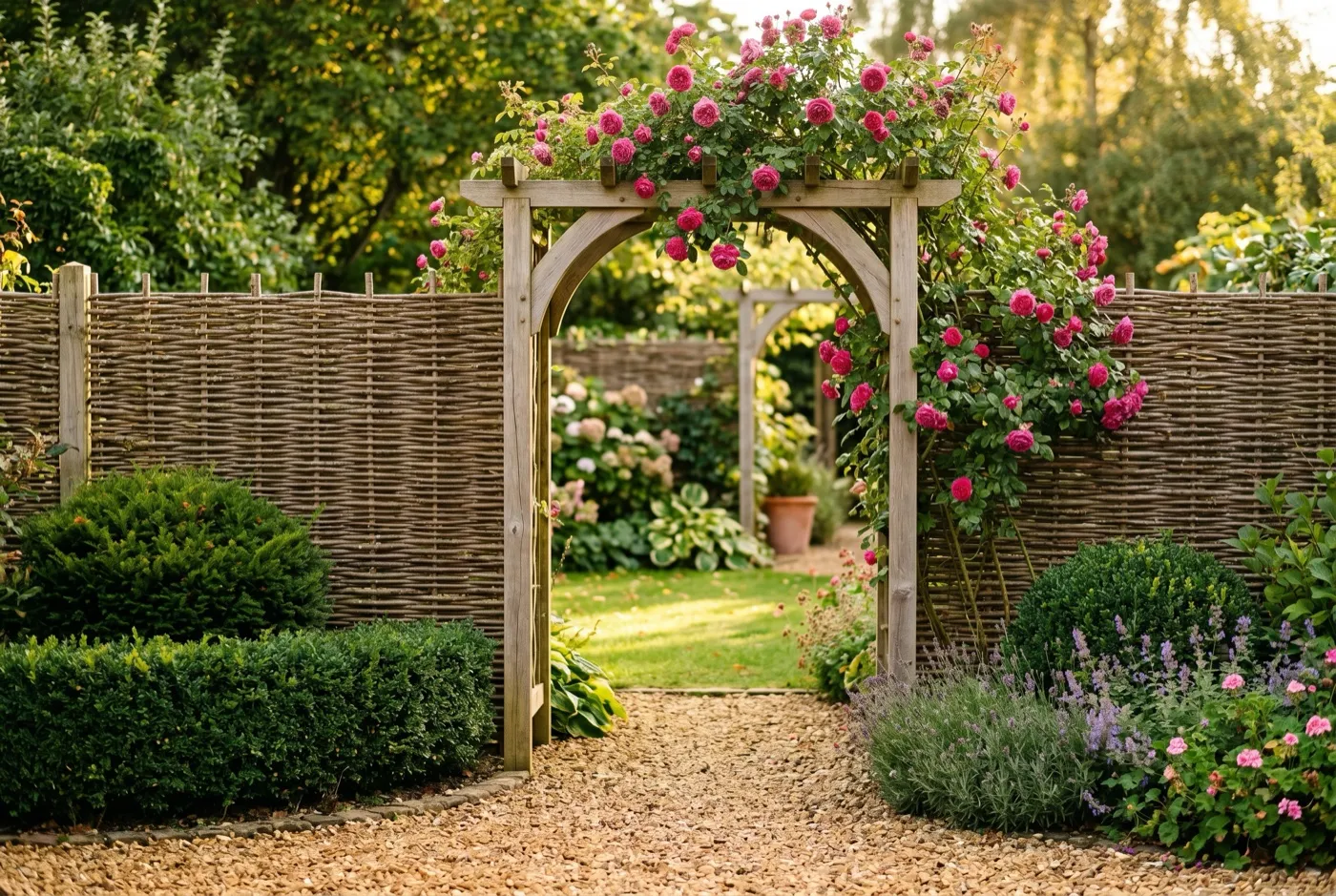 A 1.8m hazel hurdle and a simple arch split this suburban plot into two rooms. The far space stays hidden until you walk through.
Layouts that pull the eye across the width
The second principle is to work the width, not the length. A 5 to 6m width is your hidden asset, and the right layout makes the eye notice it.
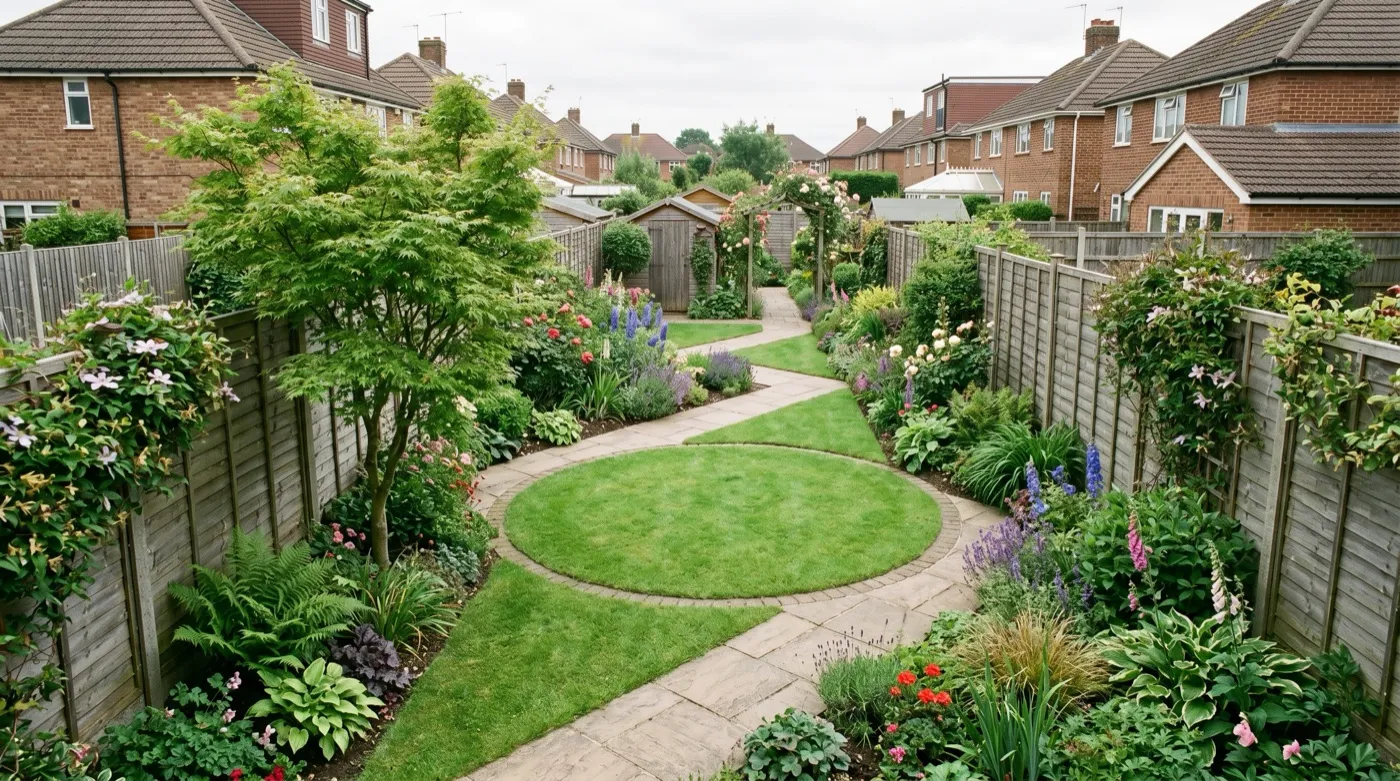 A circular lawn and diagonal paving in this suburban plot work the 5m width, so the garden reads as broad rather than long.
Design techniques to beat the corridor effect
Not every technique pulls the same weight. This table ranks the main moves by how much they reduce the tunnel feeling, what each one does, and where it fits in a scheme.
| Technique | What it does | Best for which plot | Effort | Role |
|---|---|---|---|---|
| Zoning into rooms | Hides part of the length, creates a journey | Any plot over 12m long | High | Gold standard, do this first |
| Offset or curved path | Breaks the central sightline | All narrow plots | Medium | Core move, pairs with zoning |
| Diagonal or circular layout | Pulls the eye across the width | Plots 4-6m wide | Medium | Strong on wider narrow plots |
| Focal point part-way down | Stops the eye, adds a stopping point | Any long plot | Low | Quick win, supports zoning |
| Dense layered boundary planting | Blurs the long fence lines | Plots with bare fence panels | Medium | Maintenance and softening |
| Repeat planting left to right | Ties the two long sides together | Plots over 18m long | Low | Supplementary unifier |
Zoning into rooms is the gold standard because it is the only technique that removes the full-length sightline altogether. Everything else softens or distracts. The catch is that no single trick works alone. A focal point on its own still leaves a corridor behind it, and a curved path through an undivided plot still shows the back fence. The reliable result comes from layering zoning, an offset path, and boundary planting together.
Gardener’s tip: Stand at the back door and take a phone photo before you design anything. If you can see the rear fence clearly, your first job is to place a screen that hides it. Re-take the photo after each divider goes in to check the sightline is broken.
A worked example on a 5.5m by 22m terrace plot
Room one, 0 to 6m, the dining terrace. A 5m by 5.5m porcelain-tiled patio sits against the house for sun and easy access. A raised planter along the shared wall lifts the eye and softens the brick.
Room two, 6 to 13m, the gravel garden. A 1.8m hazel screen with a 90cm arched gap separates it from the terrace. Inside, an offset gravel path curves through grasses and a multi-stem Amelanchier lamarckii, the focal tree, placed 7m from the house so it stops the view from the back door.
Room three, 13 to 19m, the lawn. An oval lawn 4m across pulls the eye sideways. Borders 75cm deep wrap both long edges with mixed shrubs and perennials.
Room four, 19 to 22m, the hidden nook. A low yew hedge screens a small seating area with a bench facing back towards the house, the destination that rewards the walk down.
A focal tree like the Amelanchier earns its place here, stopping the eye 7m down the plot. The mixed border planting plan suits those 75cm boundary beds along both long fences.
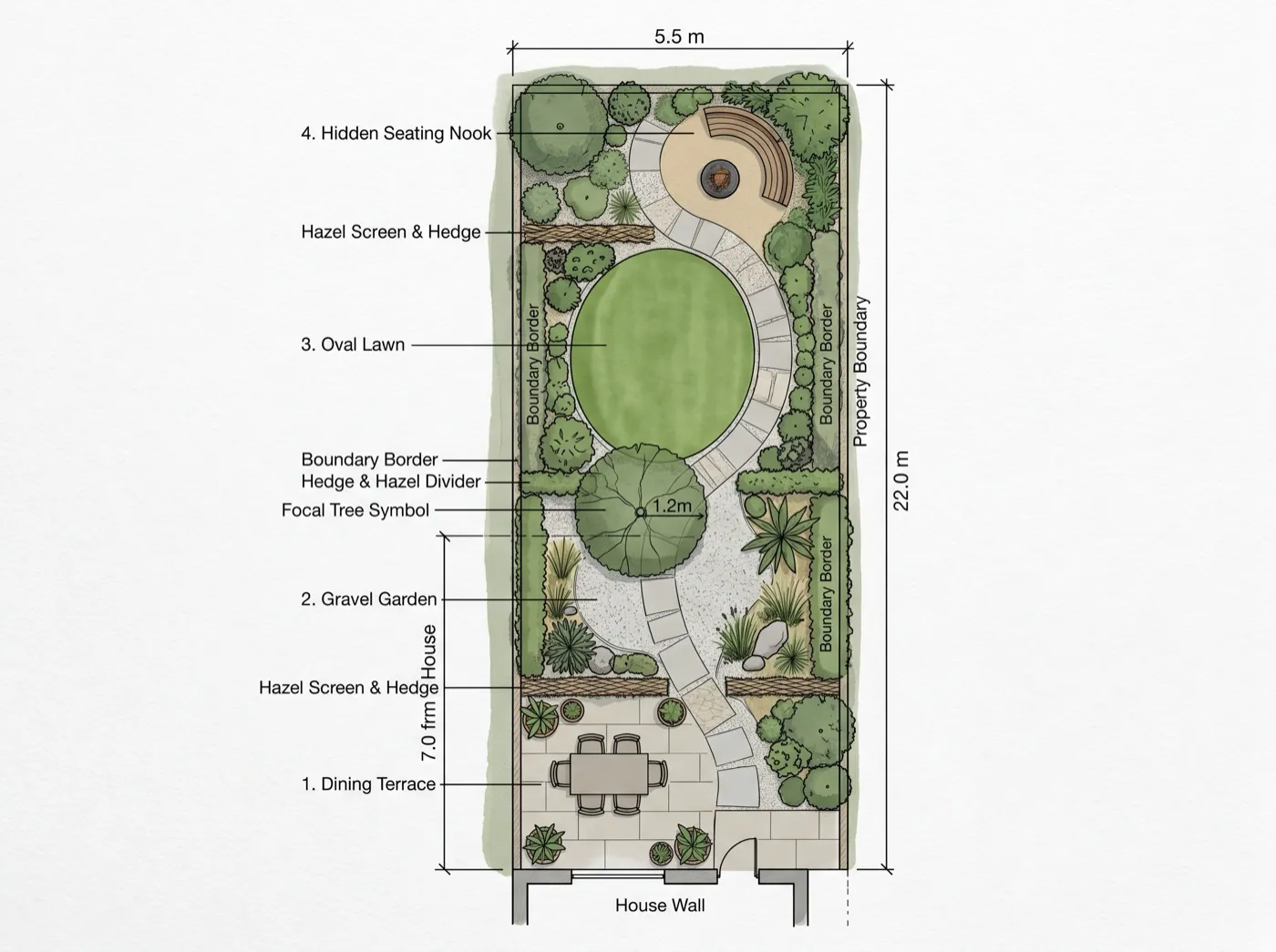 Plan view of the worked 5.5m by 22m scheme: four rooms, an offset S-curve path, and a focal tree placed 7m from the house.
A month-by-month plan for a UK garden redesign
Phasing a narrow garden redesign across a year spreads cost and lets planting establish in the right season. These timings suit most of the UK, shifting a week or two later in the north.
| Month | Task |
|---|---|
| January | Survey, measure, and draw the layout on paper |
| February | Order hard materials and bare-root hedging while dormant |
| March | Plant bare-root hedges and pleached trees before bud burst |
| April | Build the dining terrace nearest the house |
| May | Install screens, arches, and the offset path |
| June | Plant the focal tree and structural shrubs |
| July | Lay the lawn or sow seed in cool, damp weather |
| August | Water new planting through dry spells, mulch beds |
| September | Plant perennials and spring bulbs in the boundary borders |
| October | Add lighting along the path and at the focal point |
| November | Plant bare-root climbers against screens and walls |
| December | Review the finished sightlines, plan next phase |
Boundary planting and screening for narrow plots
The long fences are the feature that shouts corridor loudest, so dressing them matters. Plant borders 60 to 90cm deep down both long sides rather than a thin 30cm strip. Depth lets you layer heights and breaks the flat plane of the panel.
Choose upright, narrow plants that screen without sprawling into the path. Pleached hornbeam or lime gives a clipped 2m screen on a clear stem, ideal where you want height but no width loss at ground level. For evergreen cover, bamboo in a root barrier or a slim yew hedge works. Climbers such as Trachelospermum jasminoides or a climbing rose clothe trellis and fence with no border depth at all.
Avoid a single line of one identical shrub down the fence. It mirrors the fence panels and reinforces the tunnel. Mix leaf shapes, heights, and a few bold foliage plants like Fatsia japonica to make the boundary read as a garden, not a wall. The Royal Horticultural Society’s advice on hedges and screening lists suitable species for tight UK plots.
Warning: Never plant running bamboo without a 60cm-deep root barrier. In a narrow garden the rhizomes reach a neighbour’s plot within two seasons and removal can cost hundreds of pounds.
Use hazel hurdles for quick screening
Woven hazel hurdles give immediate visual separation without the hard, continuous line of a close-boarded fence. They weather to a soft grey and can divide two garden rooms while a hedge or climber establishes behind them. Check current dimensions and expected lifespan with the supplier before buying.
Hurdles also let you test a layout before committing. Move one a metre and judge the new sightline before you dig a single post hole.
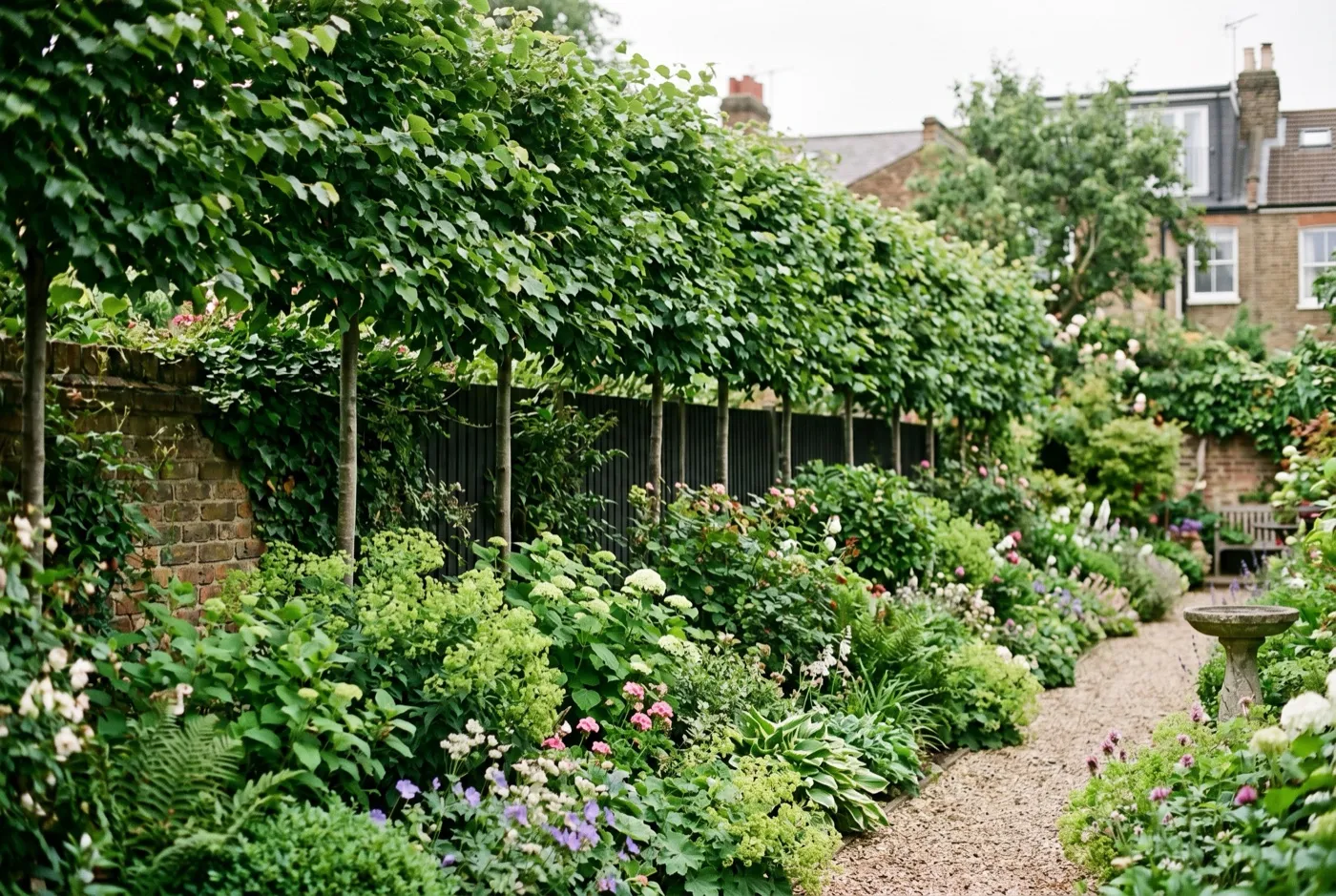 Pleached limes and a 75cm-deep mixed border dress the long fence of a city terrace, so the boundary reads as planting rather than a wall.
Common mistakes that make a narrow garden worse
Most narrow-garden designs fail on the same handful of errors. Each one deepens the corridor it set out to cure.
- Centring a straight path. A path down the middle is the single biggest cause of the tunnel. Offset it to one side or curve it so it disappears between rooms.
- One open view to the back fence. Leaving the full length visible kills any sense of journey. Hide at least one room behind a screen or planting.
- Skinny boundary borders. A 30cm strip of soil cannot hold layered planting, so the fence stays bare and dominant. Give borders 60 to 90cm of depth.
- Cramming in too many features. A narrow plot needs restraint. Three well-spaced focal points beat a dozen competing ones, which only add clutter.
- Matching both long fences identically. Identical panels and identical planting down both sides exaggerate the parallel walls. Vary one side from the other.
How layout and materials affect the budget
Redesigning a long thin garden need not cost a fortune if you phase it. Hazel hurdles run £30 to £50 each, gravel around £60 per tonne, and a multi-stem focal tree £40 to £120. A full DIY zoning scheme on a terrace plot lands between £400 and £1,500 in materials.
Hidden costs catch people out. Base preparation for paving, including a sub-base and bedding, often doubles the cost of the slabs themselves. Soil improvement for narrow borders along old fences matters too, since the ground beside a wall is usually dry and poor. Budget £4 to £6 per square metre for compost and grit to dig in. Phasing room by room, starting at the house, lets you spread these costs across two or three seasons without leaving the garden a building site.
Frequently asked questions
How do you make a long narrow garden look wider?
Pull the eye across the width with cross-axis features, not down the length. Use full-width planting bands, a circular lawn or patio, and bold foliage along both sides. Repeating a plant or material left to right tricks the eye into reading width. Light colours at the far end and warmer tones near the house also flatten the apparent length.
Why does my long garden feel like a corridor?
A straight central path running the full length causes the corridor effect. The eye travels uninterrupted to the back fence, reading the plot as a tunnel. Identical fence panels down both sides reinforce it. Breaking the sightline with screens, an offset path, and a focal point part-way down fixes the problem fastest.
How do you divide a long thin garden into zones?
Use screens, arches, hedges, or changes of level every 5-7m. Each divider should partly block the view so one room is hidden until you reach it. Trellis with climbers, a pleached tree row, or a 1.8m hazel hurdle all work. Leave a 90cm gap or arch to draw people through to the next space.
Should a path go straight down a long garden?
No, offset or curve it so it disappears from view. A path hugging one side, then crossing to the other, breaks the tunnel sightline. An S-curve or staggered stepping-stone run forces the eye to move across the plot. Reserve straight paths for formal designs where you deliberately want a strong axis.
What plants suit a long narrow garden boundary?
Choose upright, layered plants that screen without spreading wide. Pleached hornbeam, bamboo in a root barrier, climbing roses, and mixed shrub borders all suit narrow plots. Avoid a single line of one shrub, which mimics the fence. Mix heights and leaf shapes so the boundary reads as planting, not a wall.
How much does it cost to redesign a long thin garden in the UK?
A DIY zoning scheme costs roughly £400 to £1,500 in materials. Hazel hurdles run £30 to £50 each, gravel around £60 per tonne, and a small tree £40 to £120. Professional design and build for a 100sqm terrace plot typically runs £8,000 to £20,000. You can phase the work room by room to spread the cost.
Our team produces practical UK gardening guidance from source research, contributor records and established horticultural practice. Editorial standards are overseen by Matt W.