Key takeaways
- The colour wheel groups plants into warm and cool tones for intentional planting
- Hot borders using reds, oranges, and yellows feel energetic and shorten visual distance
- Cool schemes with blues, purples, and whites create calm and make small gardens feel larger
- Foliage colour carries borders from March to November when flowers fade
- Complementary colour pairings like purple and yellow create the strongest visual contrast
- A seasonal planting plan ensures at least two colour peaks every month of the year
Colour in garden design is not about scattering pretty flowers and hoping for the best. It is a deliberate decision that changes how a garden feels, how large it appears, and which seasons it performs in. UK gardens benefit enormously from colour planning because our long winters and grey skies make every bloom count. The RHS colour theory guide is a useful starting point for understanding how plants work together visually.
How does the colour wheel work for garden planting?
The colour wheel is the gardener’s most practical design tool. It arranges colours in a circle: red, orange, yellow, green, blue, violet. Warm colours (red, orange, yellow) sit on one side. Cool colours (blue, violet, green) sit on the other.
Three colour relationships matter most in planting design:
- Analogous colours sit next to each other on the wheel. Blues with purples and pinks. Oranges with reds and yellows. These create harmonious, restful borders.
- Complementary colours sit opposite each other. Purple with yellow. Blue with orange. Red with green. These create vibrant contrast and visual energy.
- Monochrome schemes use different shades, tints, and tones of a single colour. All-white gardens, blue-and-silver borders, or graduated pink schemes fall here.
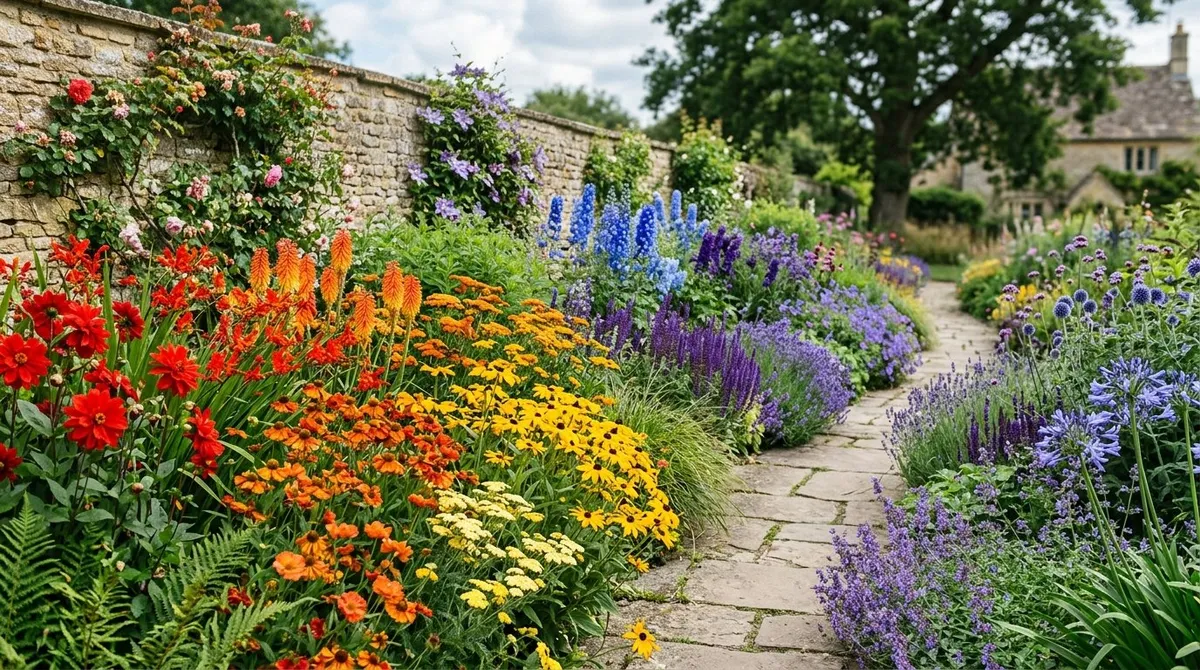
In practice, most successful UK borders use an analogous base with one complementary accent. A blue-and-purple border with a punch of yellow achillea is a classic example. Three colour families is the maximum for a single border. More than that reads as confusion rather than design.
Gertrude Jekyll used a related idea at Munstead Wood, moving from cool colours towards a warmer centre. Our Gertrude Jekyll border design lessons scale that method to a 2m x 4m bed.
What plants work best in a hot border?
Hot borders use reds, oranges, and yellows to create energy, warmth, and drama. They work best in full sun and against dark backgrounds like yew hedges or dark fences. A hot border needs at least 1.5 metres depth to layer plants properly.
The backbone plants for UK hot borders include:
- Tall (back): Helenium ‘Moerheim Beauty’ (deep red, 120cm), Helianthus ‘Lemon Queen’ (soft yellow, 180cm), Canna indica (red or orange, 150cm)
- Mid-height: Crocosmia ‘Lucifer’ (scarlet, 90cm), Rudbeckia ‘Goldsturm’ (golden yellow, 60cm), Dahlia ‘Bishop of Llandaff’ (scarlet with dark foliage, 90cm)
- Front edge: Heuchera ‘Marmalade’ (amber foliage, 30cm), Geum ‘Totally Tangerine’ (apricot, 50cm), Gaillardia ‘Arizona Sun’ (red and gold, 30cm)
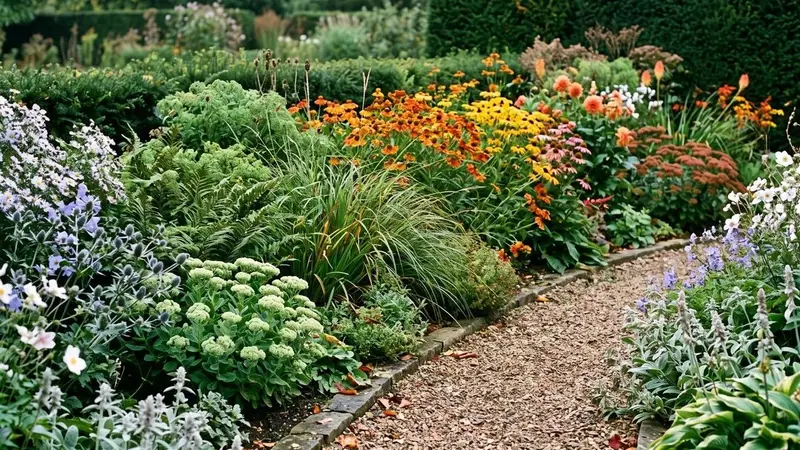
Dark foliage is the secret weapon. Without it, hot borders look flat. Bronze fennel, purple-leaved dahlias, and Actaea ‘Brunette’ ground the bright colours and add depth. Christopher Lloyd’s famous Long Border at Great Dixter is the definitive UK example of hot-colour planting. For a deep maroon accent near the front, chocolate cosmos gives velvety, cocoa-scented flowers from July to October.
How do cool planting schemes create calm?
Cool borders use blues, purples, whites, and silvers to create a sense of calm, space, and sophistication. They recede visually, making boundaries feel further away. This makes them ideal for small gardens where space is limited.
Successful cool-border plants for UK gardens:
- Blues: Salvia nemorosa ‘Caradonna’ (violet-blue spikes, 50cm), Agapanthus ‘Northern Star’ (deep blue, hardy to -15C), Echinops ritro (steel-blue globes, 100cm)
- Purples: Verbena bonariensis (tall, airy purple, 150cm), Allium ‘Purple Sensation’ (May, 90cm), Lavandula angustifolia ‘Hidcote’ (deep purple, 45cm)
- Whites: Cosmos bipinnatus ‘Purity’ (pure white, 90cm), Gaura lindheimeri (white butterflies on wands, 80cm), Hydrangea arborescens ‘Annabelle’ (huge white mopheads, 150cm)
- Silvers: Stachys byzantina (lamb’s ears, ground cover), Artemisia ‘Powis Castle’ (feathery silver, 60cm), Eryngium ‘Big Blue’ (silvery-blue sea holly, 70cm)
Silver foliage is the thread that ties cool borders together. It reflects light, bridges colour transitions, and looks good from spring to late autumn. A cool border without silver feels heavy. One with it feels airy and light.
Vita Sackville-West’s White Garden at Sissinghurst remains the most celebrated example. White flowers glow in twilight and on overcast days, which makes them particularly effective in the UK.
What is a monochrome garden scheme?
A monochrome scheme uses one colour in varied shades, tints, and tones. The result is sophisticated and intentional. It forces the eye to notice texture, form, and height differences rather than colour contrasts.
The most successful monochrome gardens in the UK are:
- All-white gardens: Sissinghurst’s White Garden, Beth Chatto’s white beds. Use pure white, cream, and ivory flowers with silver, grey-green, and variegated foliage.
- Purple borders: Combine deep plum (Cotinus coggygria ‘Royal Purple’), mid-purple (Salvia nemorosa), and pale lilac (Nepeta ‘Walker’s Low’). Vary the purple from near-black to pastel.
- Yellow and gold borders: From acid-yellow Euphorbia to soft primrose narcissus. Golden-leaved shrubs extend the season.
The trap with monochrome planting is monotony. Avoid it by varying plant height, leaf size, texture, and flower form. A ball-shaped allium next to a spiky delphinium next to a flat-topped achillea creates rhythm even when all three are purple.
How does foliage colour carry a border through the seasons?
Flowers last weeks. Foliage lasts months. Any border that relies solely on flower colour will have long periods of green nothingness. Foliage colour is the backbone of year-round interest.
Key foliage colours and the plants that deliver them:
- Purple/bronze: Cotinus coggygria ‘Royal Purple’ (large shrub), Heuchera ‘Palace Purple’ (ground cover), Cercis canadensis ‘Forest Pansy’ (small tree), Berberis thunbergii f. atropurpurea (hedge or specimen)
- Gold/lime: Spiraea japonica ‘Gold Flame’ (compact shrub), Choisya ternata ‘Sundance’ (evergreen), Hakonechloa macra ‘Aureola’ (grass), Philadelphus coronarius ‘Aureus’ (spring gold fading to lime)
- Silver/grey: Lavandula (evergreen), Elaeagnus ‘Quicksilver’ (silvery shrub), Convolvulus cneorum (silver leaves, white flowers), Stachys byzantina (ground cover)
- Variegated: Cornus alba ‘Elegantissima’ (white-edged, red winter stems), Euonymus fortunei ‘Silver Queen’ (evergreen), Hosta (hundreds of variegated cultivars)
The principle is simple. Plant at least one purple-leaved, one golden-leaved, and one silver-leaved plant in every border of 3 metres or more. These three tones give you colour from March leaf-break to November leaf-fall without a single flower.
For more on evergreen shrubs that hold colour through winter, see our dedicated guide.
Which complementary colour pairings work best?
Complementary colours sit opposite each other on the colour wheel and create maximum contrast. Used well, they make both colours appear more vivid. Used badly, they clash.
The best complementary pairings for UK borders:
| Pairing | Example plants | Peak season | Effect |
|---|---|---|---|
| Purple + yellow | Salvia nemorosa + Achillea ‘Moonshine’ | June-August | Classic, strong contrast |
| Blue + orange | Agapanthus + Crocosmia ‘Lucifer’ | July-August | Vibrant, warm-cool tension |
| Red + green | Dahlia ‘Bishop of Llandaff’ + Hakonechloa | August-October | Rich and grounded |
| Pink + lime | Echinacea purpurea + Alchemilla mollis | June-September | Soft, cottage-garden feel |
| Violet + gold | Allium ‘Purple Sensation’ + Euphorbia | May-June | Dramatic spring pairing |
The key to making complementary schemes work is proportion. Use a 70/30 ratio. Let one colour dominate and the other accent. A border that is 50% purple and 50% yellow looks like a fight. One that is 70% purple with 30% yellow accents looks designed.
Read our guide to best plant combinations for UK borders for specific planting recipes using these pairings.
What are common colour mistakes in garden design?
Even experienced gardeners make colour errors. Knowing the common mistakes saves years of trial and error.
Too many colours at once. More than three colour families in one border looks random. Edit ruthlessly. Move plants that do not fit the scheme to a different part of the garden.
Ignoring flower shape with colour. Colour contrast needs form contrast too. Two round flowers in contrasting colours look less effective than a round flower next to a spike in the same two colours. Pair daisy shapes with spires, globes with plumes.
Neglecting winter. Dogwood stems (Cornus alba ‘Sibirica’ for red, Cornus sanguinea ‘Midwinter Fire’ for orange) and white birch bark provide colour from December to March. Evergreen structure in gold (Choisya ‘Sundance’) or silver (Elaeagnus) keeps borders alive.
What colour flowers bloom in each month UK?
Planning for year-round colour means knowing which plants peak when. This table maps the key colour performers to each month.
| Month | Warm colours (reds, oranges, yellows) | Cool colours (blues, purples, whites) | Key foliage |
|---|---|---|---|
| January | Witch hazel (yellow) | Snowdrops (white), Iris unguicularis (purple) | Evergreen structure |
| February | Winter jasmine (yellow), Crocus ‘Orange Monarch’ | Crocus ‘Flower Record’ (purple), Hellebores (white) | Cornus stems (red/orange) |
| March | Daffodils (yellow), Forsythia | Muscari (blue), Pulmonaria (blue/pink) | New leaf growth begins |
| April | Tulip ‘Ballerina’ (orange), Euphorbia (lime) | Bluebells, Brunnera (blue), Cherry blossom (white) | Fresh green everywhere |
| May | Geum ‘Totally Tangerine’, Welsh poppies (yellow) | Alliums (purple), Iris sibirica (blue), Wisteria | Purple Cotinus leafing out |
| June | Roses (red/orange), Hemerocallis (yellow) | Delphiniums (blue), Lavender, Roses (white/pink) | Golden foliage at peak |
| July | Crocosmia (red/orange), Helenium (yellow) | Agapanthus (blue), Campanula, Echinops | Silver artemisia at best |
| August | Dahlia (red/orange), Rudbeckia (yellow) | Salvia (purple/blue), Phlox (white/pink) | Grasses colouring up |
| September | Dahlia, Helenium, Kniphofia (red/yellow) | Aster (purple/blue), Anemone (white/pink) | Autumn tints starting |
| October | Acer (red/orange), Berberis (red) | Aster, Ceratostigma (blue) | Peak autumn colour |
| November | Liquidambar (red), Hawthorn berries | Nerine bowdenii (pink), Cyclamen (pink/white) | Late autumn colour |
| December | Holly berries (red), Ilex (yellow berries) | Viburnum x bodnantense (pink), Hellebores | Evergreen backbone |
How do I create a colour planting plan?
Creating a colour plan for your garden takes one afternoon with a colour wheel and a notebook. Follow these steps:
First, decide on the mood. Hot and energetic? Cool and calming? Sophisticated monochrome? Your choice narrows the plant palette immediately.
Second, pick three colour families maximum per border. For a cool border: blue, purple, and silver. For a hot border: red, orange, and bronze.
Third, choose plants for three seasons minimum. Spring bulbs, summer perennials, and autumn performers. Check our growing calendar for timing.
Fourth, add foliage plants in contrasting tones. Every border needs at least one plant chosen purely for leaf colour.
Fifth, test your plan on paper before buying. Sketch the border and colour in the planting positions. Or use coloured sticky notes on a piece of graph paper at rough scale. This catches clashes before they cost you money.
Sixth, plant in groups of three or five. Single plants of each variety look spotty. Groups create colour impact. Space groups with different flowering times next to each other so gaps left by fading plants are filled by neighbours coming into bloom.
Review the plan annually and adjust. Move plants that clash. Add bulbs to fill spring gaps. Replace short-lived perennials every three years. Colour planning is ongoing, and that is part of the pleasure.
Frequently asked questions
What colours go together in a garden border?
Analogous colours create the most harmonious borders. These are colours next to each other on the wheel: blues with purples and pinks, or oranges with reds and yellows. For stronger contrast, use complementary pairs from opposite sides of the wheel, such as purple salvias with yellow achilleas. Avoid mixing more than three colour groups in a single border, as it looks chaotic rather than designed.
How do I plan a hot border?
Use reds, oranges, and yellows in layers from front to back. Start with low-growing heleniums and rudbeckias at the front. Add mid-height dahlias and crocosmias. Place tall cannas, sunflowers, or Helenium ‘Moerheim Beauty’ at the rear. Include bronze or purple foliage plants like Heuchera ‘Palace Purple’ to ground the bright tones. Hot borders need full sun and at least 1.5 metres depth for proper layering.
What are the best blue flowers for UK gardens?
Delphiniums, agapanthus, and salvias provide the strongest blues. For spring, plant Brunnera ‘Jack Frost’ and forget-me-nots. Summer brings agapanthus, delphiniums, and Salvia ‘Mainacht’. Autumn options include Ceratostigma and Aster ‘Little Carlow’. Echinops ritro gives steel-blue globes from July to September. True blue is rare in plants, so expect shades leaning purple or lavender.
Do white gardens work in the UK?
White gardens work brilliantly in the UK climate. The famous White Garden at Sissinghurst Castle in Kent proves the concept. White flowers glow in the low light and overcast skies typical of British weather. Use a mix of white-flowering plants with silver and grey-green foliage. Cosmos ‘Purity’, Nicotiana sylvestris, white foxgloves, and Hydrangea ‘Annabelle’ provide backbone. White gardens look their best at dusk.
How do I use foliage colour in garden design?
Foliage colour provides structure long after flowers finish. Purple-leaved plants like Cotinus and Berberis anchor warm borders. Golden foliage from Philadelphus ‘Aureus’ and Spiraea ‘Gold Flame’ brightens shady spots. Silver foliage from lavender, Stachys, and artemisia suits dry, sunny positions. Variegated plants add light to dark corners. Mix three foliage tones per border for reliable colour from March to November.
What is the best colour scheme for a small garden?
Cool colours make small gardens feel larger. Blues, purples, silvers, and whites recede visually, pushing boundaries outward. Avoid hot reds and oranges near boundaries, as they advance towards the viewer and shrink the space. A monochrome scheme in one colour family with varied tones looks sophisticated in tight spaces. White flowers reflect light into shaded urban gardens.
When should I plant for year-round colour?
Plant in autumn for the widest colour range. September to November is the best window for perennials, shrubs, and bulbs. Spring-planted additions fill gaps. Plan colour peaks for every month: winter heathers and hellebores in January, crocuses in February, daffodils in March, tulips in April, alliums in May, roses in June, dahlias July to October, and asters into November.
Our team produces practical UK gardening guidance from source research, contributor records and established horticultural practice. Editorial standards are overseen by Matt W.