Key takeaways
- Plant between mid September and mid October so roots establish before the first hard frost
- A 35cm basket holds 5 to 6 plants, a 40cm basket holds 7 to 9
- Winter pansies and violas flower from October to March in mild UK spells
- Use peat-free multipurpose plus 30 per cent grit, never spent summer compost
- Water at midday on dry frosty days, never when the rootball is frozen solid
- Budget £18 to £30 per planted 35cm basket including liner and compost
When to plant a winter basket in the UK
Plant your winter basket between mid September and mid October. This window gives the roots three to five weeks to grip the compost before the first hard frost. A rootball that has knitted into the compost freezes more slowly and thaws without rocking loose. Plant in November and the plants sit cold and inert until March.
Regional timing matters. In Scotland and northern England, aim for mid to late September. In the milder south west, you can stretch to late October. The rule is simple: get them in at least three weeks before your area’s average first frost date.
Buy plants as small plugs or 9cm pots while garden centres still stock them in early autumn. Stock thins out fast once the Christmas lines arrive. If you miss the window, plant anyway, but expect a slow start and treat the first six weeks as establishment rather than display.
Gardener’s tip: Soak every plant in a bucket of water for ten minutes before planting. A dry rootball repels water once it is in the basket, and winter watering is too sparse to fix it later.
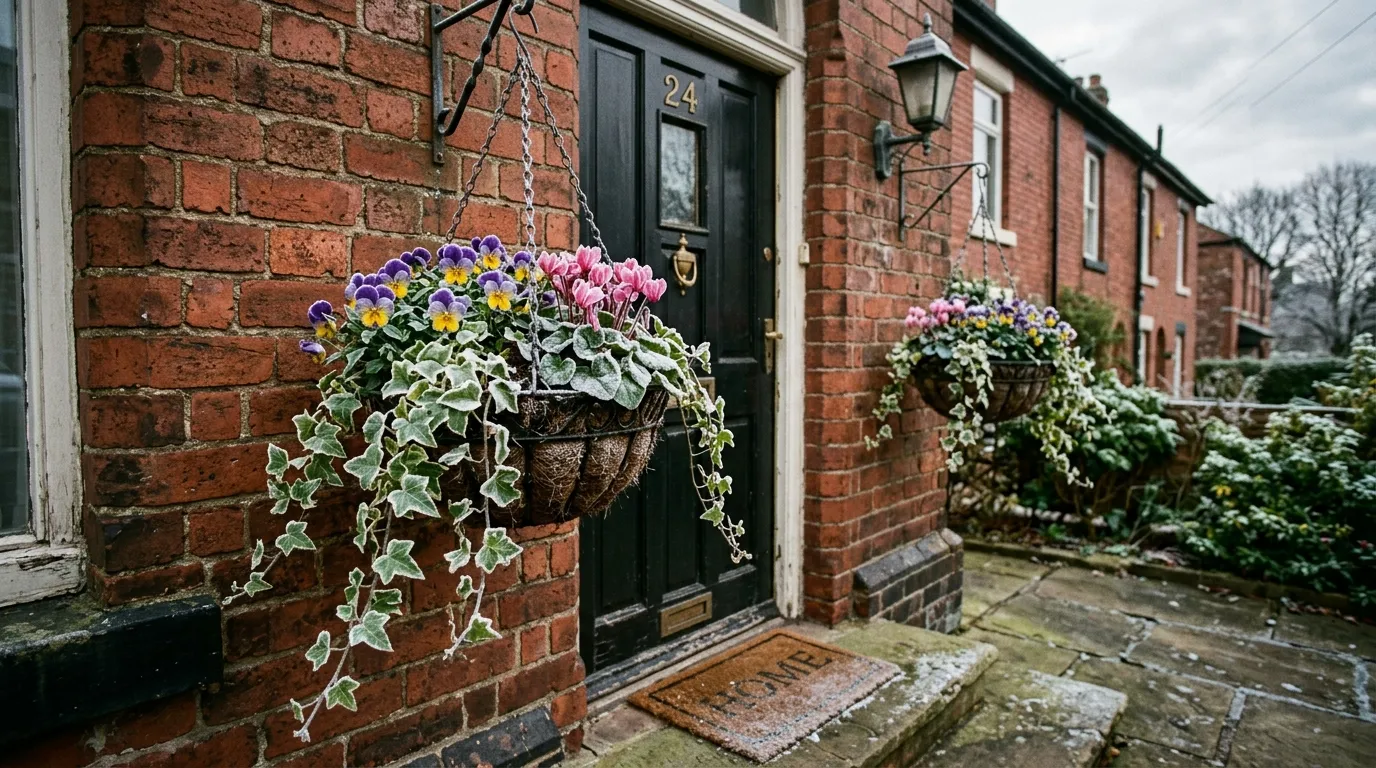 A pair of 35cm baskets either side of a Manchester porch in December. The frost holds on the violas but they keep flowering through it.
Choosing the right basket size
Basket size decides how many plants you fit and how fast the compost dries or freezes. The two practical sizes for a winter display are 35cm and 40cm across the rim.
A 35cm basket holds about 12 litres of compost and takes 5 to 6 plants. It is the right size for a porch, a doorway, or a sheltered wall. A 40cm basket holds around 18 litres and takes 7 to 9 plants. The larger volume of compost is the key advantage in winter: more compost freezes slower and holds a more even moisture level.
Avoid anything smaller than 30cm for winter. A 25cm basket holds so little compost that it freezes solid in a single cold night and dries out on a windy day. Small baskets also rock in wind, which loosens roots.
Solid-sided baskets with a built-in reservoir suit winter better than open wire baskets. The solid side cuts wind chill on the rootball and the reservoir prevents the bone-dry-then-flooded swing that kills winter plants. If you use a wire basket, line it well, which the lining section below covers.
| Basket size | Compost volume | Plant count | Best position |
|---|---|---|---|
| 30cm | 8 litres | 4 plants | Very sheltered only |
| 35cm | 12 litres | 5 to 6 plants | Porch or sheltered wall |
| 40cm | 18 litres | 7 to 9 plants | Doorway, main display |
| 45cm | 25 litres | 9 to 11 plants | Large open frontage |
Plants that flower from October to March
Winter pansies (Viola x wittrockiana) are the obvious flowering choice. They flower in any mild spell from October to April and come in every colour. Violas (Viola cornuta and the ‘Sorbet’ series) carry smaller flowers but far more of them, and they shrug off rain that turns big pansy blooms to mush. Both feature in our winter bedding plants guide, which compares the full cold-season line-up for beds as well as baskets.
Cyclamen coum is the hardy winter cyclamen, not the tender florist type. It flowers December to March in pink, white, or magenta and survives to minus 12C. Erica carnea, the winter-flowering heather, throws pink or white spikes from December to April and is lime-tolerant, unlike summer heathers.
For evergreen structure, use trailing ivy (Hedera helix), Skimmia japonica ‘Rubella’ for its red winter buds, Gaultheria procumbens for red berries, ornamental cabbage and kale for purple and cream rosettes, trailing Vinca minor, heuchera for coloured foliage, and hardy ferns such as Polystichum setiferum for a soft trailing edge.
| Plant | Role | Height | Flowering or display | Hardiness |
|---|---|---|---|---|
| Winter pansy ‘Matrix’ | Filler | 15-20cm | Oct-Apr flowers | minus 10C |
| Viola ‘Sorbet’ | Filler | 10-15cm | Oct-Apr flowers | minus 12C |
| Cyclamen coum | Filler | 8-10cm | Dec-Mar flowers | minus 12C |
| Erica carnea | Filler | 15-20cm | Dec-Apr flowers | minus 15C |
| Skimmia ‘Rubella’ | Thriller | 30-40cm | Red buds all winter | minus 15C |
| Ornamental cabbage | Thriller | 20-25cm | Purple/cream rosette | minus 10C |
| Heuchera ‘Palace Purple’ | Filler | 20-25cm | Bronze foliage | minus 15C |
| Skimmia plus Gaultheria | Thriller | 25-35cm | Red berries | minus 15C |
| Trailing ivy ‘Glacier’ | Spiller | Trails 40cm | Variegated evergreen | minus 15C |
| Vinca minor | Spiller | Trails 50cm | Blue spring flowers | minus 20C |
| Polystichum fern | Spiller | Trails 30cm | Evergreen fronds | minus 15C |
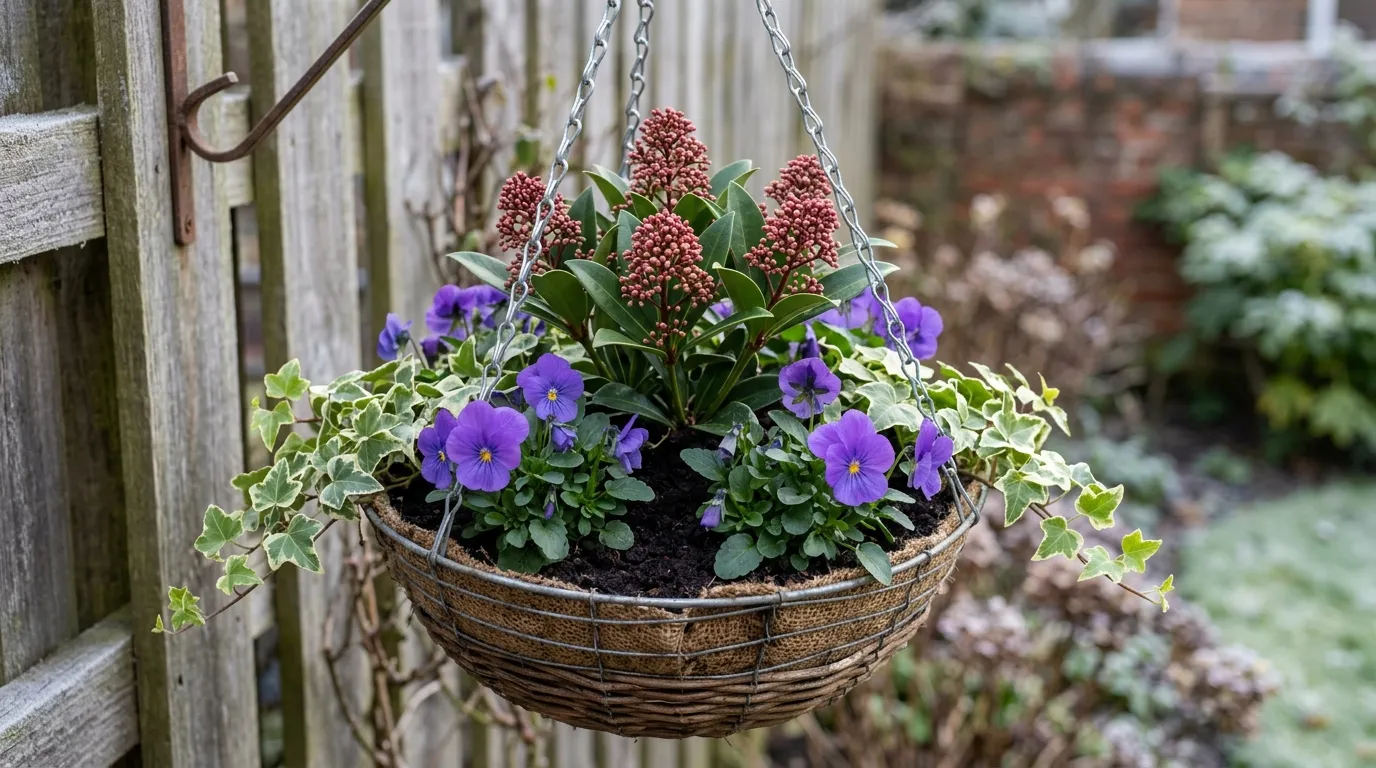 A freshly planted 35cm basket. The Skimmia sits centre as the thriller, violas fill the gaps, and ‘Glacier’ ivy will trail over the rim within a month.
The thriller filler spiller framework
Container designers use a simple three-part formula and it works perfectly for winter baskets. Thriller, filler, spiller keeps a basket balanced rather than a flat dome of one plant.
The thriller is the tall central plant that gives height and structure. In winter, use a Skimmia ‘Rubella’, an ornamental cabbage, or a small evergreen grass such as Carex. One thriller per 35cm basket is enough. Place it dead centre or slightly off-centre.
The filler is the mid-height mass that supplies the bulk of the colour. Winter pansies, violas, Cyclamen coum, and small heathers do this job. Use three to four fillers in a 35cm basket, ringed around the thriller.
The spiller is the trailing plant that softens the rim and hides the basket edge. Trailing ivy, Vinca minor, and trailing ferns are the winter choices. Plant two or three spillers tucked just inside the rim so they cascade over the side.
Gardener’s tip: Plant the spillers at a slight outward angle, almost lying on the compost. They trail over the edge far faster than spillers set upright, and winter growth is too slow to wait for them to flop on their own.
Four tested winter basket recipes
Sunny doorway recipe
For a south or west-facing wall that catches winter sun. One Skimmia ‘Rubella’ as the thriller, four winter pansies ‘Matrix Mixed’ as fillers, and two trailing ivy ‘Glacier’ as spillers. The pansies flower hardest where they get a few hours of low winter sun. This recipe peaks in February and March.
Shady porch recipe
For a north or east-facing position with little direct light. One ornamental cabbage as the thriller, three Cyclamen coum and two violas as fillers, two Polystichum ferns as spillers. Cyclamen and ferns both prefer shade, and the cabbage holds its colour even in deep shade. This recipe carries December to February.
Evergreen structure recipe
For year-round leaf interest with less reliance on flowers. One Skimmia ‘Rubella’ centre, two Gaultheria procumbens and two heuchera ‘Palace Purple’ as fillers, two trailing ivy and one Vinca minor as spillers. The berries, buds, and bronze leaves carry the basket through the dullest weeks with no flowers needed.
Pollinator winter recipe
For early bumblebees that fly on mild winter days. Three Erica carnea ‘Springwood White’, two winter heather ‘Myretoun Ruby’, two violas, and two trailing ivy. Winter heather is one of the few nectar sources for queen bumblebees foraging in February. The Bumblebee Conservation Trust lists winter heathers among the best early-season forage.
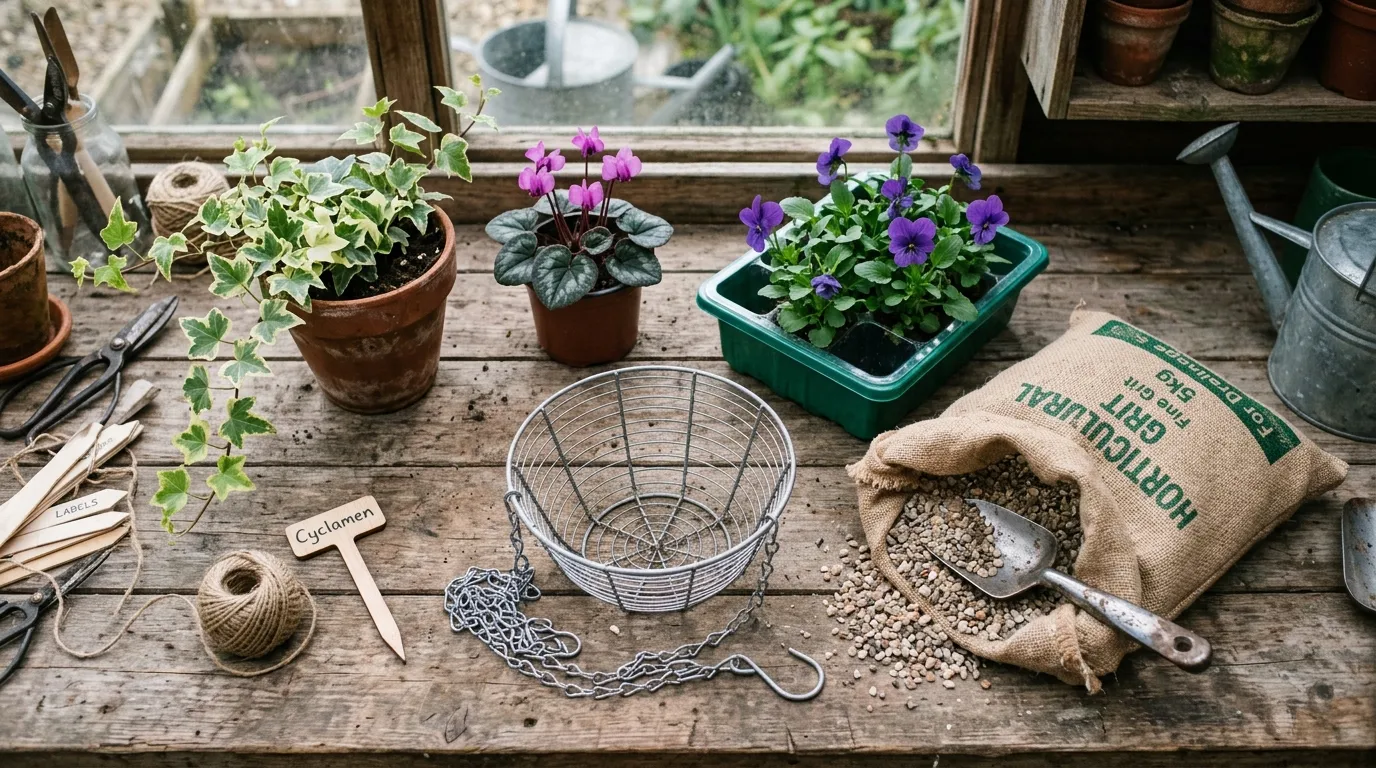 The pollinator recipe before planting. Violas, ivy, a Cyclamen coum, and the grit that keeps the compost open and free-draining.
Compost and drainage for frost resistance
The compost you choose decides whether a basket survives or rots. Use peat-free multipurpose compost mixed with 30 per cent horticultural grit by volume. The grit opens the mix so water drains through rather than sitting cold around the roots.
Never reuse spent summer compost. By autumn it is depleted, full of old roots, and its structure has collapsed into a dense, airless mass that freezes hard and holds water. This single mistake causes more winter basket losses than frost itself. Tip old compost on the borders and start fresh.
Add a layer of broken polystyrene or coarse grit at the base of a solid basket to keep the drainage holes clear. Waterlogged compost expands as it freezes, which tears fine roots. Free-draining compost holds less water, so the freeze does less damage.
Mix a small handful of slow-release fertiliser into the compost at planting. Winter feeding is otherwise minimal, but a slow-release granule gives a gentle background supply that supports root establishment in the mild weeks of October and November.
Lining a winter basket the right way
A good liner cuts wind chill on the rootball and slows water loss. Solid-sided baskets need no liner, but wire and rattan baskets do.
For a wire basket, use a moulded fibre or pressed-wool liner rather than thin coir matting. The thicker liner insulates the compost by a degree or two, which matters on a frosty night. Cut a circle of old compost bag and lay it inside the liner with a few slits for drainage. This plastic layer stops the compost drying through the sides in winter wind.
For a rattan or basketweave container, line it with a punctured bin liner so water drains from the base but not the sides. Trim the liner just below the rim so it does not show.
Avoid sphagnum moss liners for winter. They dry out fast in wind and offer no insulation. They suit summer baskets where evaporation helps cool the roots, the opposite of what you want in January.
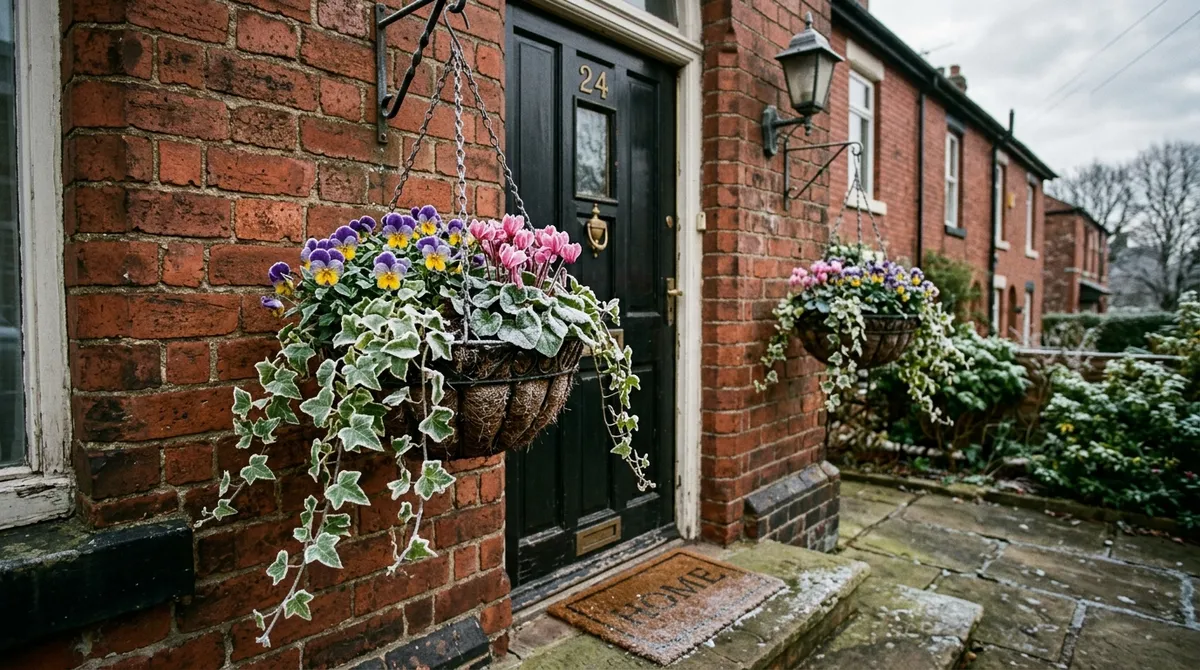
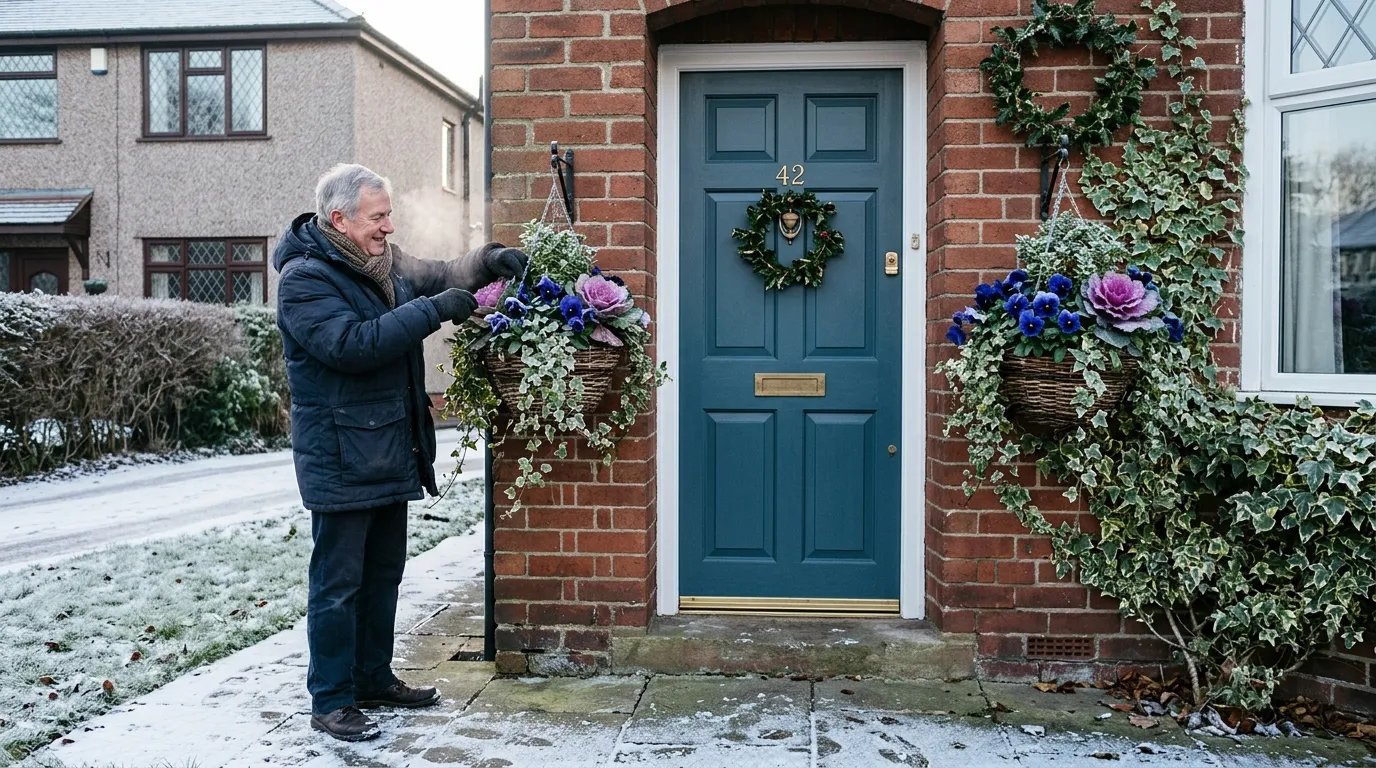 Two finished baskets flanking a Lancashire doorway. The solid sides cut wind chill, and the wall behind lifts the local temperature by a few degrees.
Watering on dry frosty days
Winter baskets still need water, just far less than in summer. Check weekly and water only when the top 2cm of compost is dry. Evergreen plants keep transpiring through winter, and a basket under a porch overhang gets no rain at all.
Time it right. Water at midday on a dry day so the compost is not waterlogged going into a cold night. Water sitting in the compost overnight freezes and tears roots. A midday watering drains and settles before the temperature drops.
Never water a frozen rootball. Pouring water onto frozen compost does nothing useful and can shock the crown. Wait for a thaw. The single biggest cause of winter basket failure is not drought but waterlogging and the rot that follows, so err on the dry side.
On a windy week a sheltered basket can still dry out, especially behind a south wall that stays mild. Lift the basket and judge by weight. A light basket needs water, a heavy one does not, regardless of the calendar.
Feeding through the cold months
Winter feeding is light. The slow-release granules mixed in at planting do most of the work. A high-potash liquid feed once in mild February weather supports the spring flush of pansies and violas as light returns.
Do not feed heavily in deep winter. Soft, nitrogen-fed growth is frost-tender and rots. Hold off liquid feeding entirely from December through to late January when plants are barely growing.
Frost protection for the worst nights
Most winter basket plants survive UK frost unaided. The plants in the table above all tolerate minus 8C to minus 15C. The danger is not occasional frost but prolonged hard freezes and waterlogged roots.
Position is the first line of defence. A basket against a house wall under an overhang sits in a warmer, drier microclimate. Wall heat and shelter lift the local temperature by 2C to 4C, which is often the difference between damage and survival. Avoid open, exposed spots and avoid frost pockets where cold air pools.
For a forecast freeze below minus 8C, wrap the basket loosely in horticultural fleece overnight and remove it by mid morning. Fleece traps a few degrees of ground warmth. Do not use plastic, which traps moisture and causes rot.
The RHS guidance on container protection is sound: the roots in a basket are far more exposed than roots in the ground, so the rootball is the priority, not the leaves. For more detail on shielding tender growth, our guide on how to protect plants from frost in the UK covers fleece, cloches, and microclimates in full.
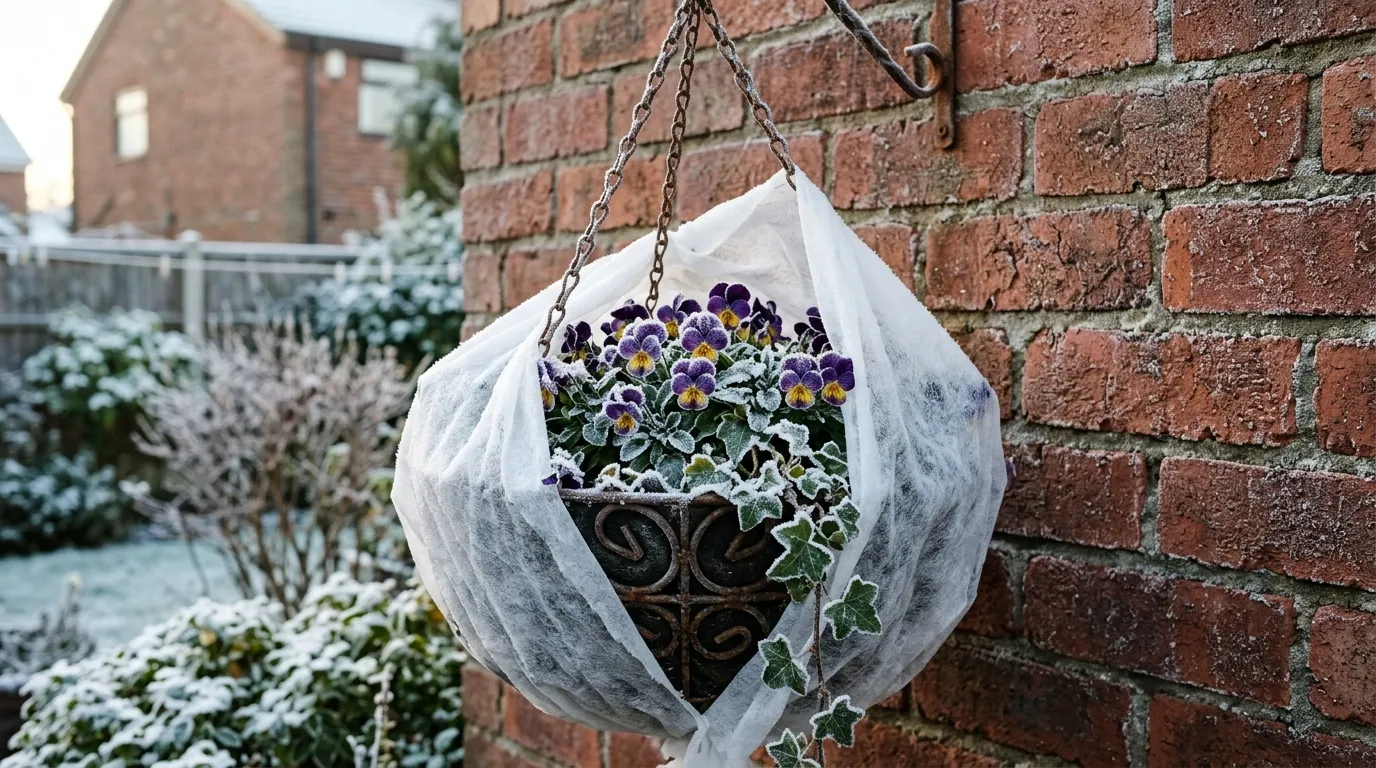 The same basket after a minus 7C night. The violas froze but recovered within a week. The brick wall behind held off the worst of the cold.
Common mistakes to avoid
Five mistakes account for almost every failed winter basket. Each is easy to avoid once you know it.
Reusing spent summer compost. Old compost is depleted, airless, and prone to waterlogging. It freezes hard and rots roots. Always start with fresh peat-free compost cut with grit.
Not watering at all. Many gardeners assume winter rain handles everything. A basket under a porch gets no rain, and evergreens keep transpiring. Check weekly and water at midday when the top is dry.
Hanging in a frost pocket. Cold air sinks and pools in dips and open corners. A basket in a frost pocket sits several degrees colder than one against a wall. Always hang against the house, under an overhang where possible.
Planting too sparsely. Winter growth is slow, so a basket never fills in like a summer one. Plant densely from the start, 5 to 6 plants in a 35cm basket, for an instant display that holds all winter.
Overwatering on cold days. Water sitting in compost overnight freezes and rots roots. This kills more baskets than drought. Water only at midday, only when dry, and never onto frozen compost.
Month by month winter basket calendar
This calendar runs from autumn planting through to the spring changeover. Timings suit central England. Shift two weeks earlier for Scotland and the north, two weeks later for the south west.
| Month | Main task |
|---|---|
| September | Buy plants, plant baskets mid month, soak rootballs first |
| October | Water in well, mix in slow-release feed, position against a wall |
| November | Check weekly, water at midday only when the top is dry |
| December | Wrap in fleece below minus 8C, remove faded blooms |
| January | Minimal watering, no feeding, clear debris from crowns |
| February | First high-potash feed in mild spells, deadhead pansies |
| March | Fortnightly feed, plants flush as light returns, top up gaps |
| April | Decide on summer changeover, lift and split healthy violas |
Costing a winter basket
A planted 35cm winter basket costs £18 to £30 depending on plant choice and whether you reuse the basket and liner. The breakdown helps you budget a pair for a doorway.
A new 35cm solid basket runs £8 to £14, and lasts several seasons, so spread that cost. A liner, if needed, adds £3 to £5. Fresh peat-free compost for one basket costs about £2 to £3, and a bag of grit shared across several baskets adds a pound or two each. The plants are the main cost: six 9cm plants at £2.50 to £4 each comes to £15 to £24.
Reusing the basket, liner, and leftover compost brings a second-year basket down to roughly £12 to £18, almost entirely plant cost. Buying plugs rather than 9cm pots in early autumn halves the plant spend. For year-round container value, our guide to the best plants for pots all year round in the UK shows how to plan a basket that needs replanting only once a year.
Where winter baskets fit in the wider container plan
A winter basket is one slot in a year-round container scheme. The same brackets carry summer baskets, autumn displays, and winter colour in turn. Planning the whole cycle saves money and keeps the frontage interesting every month.
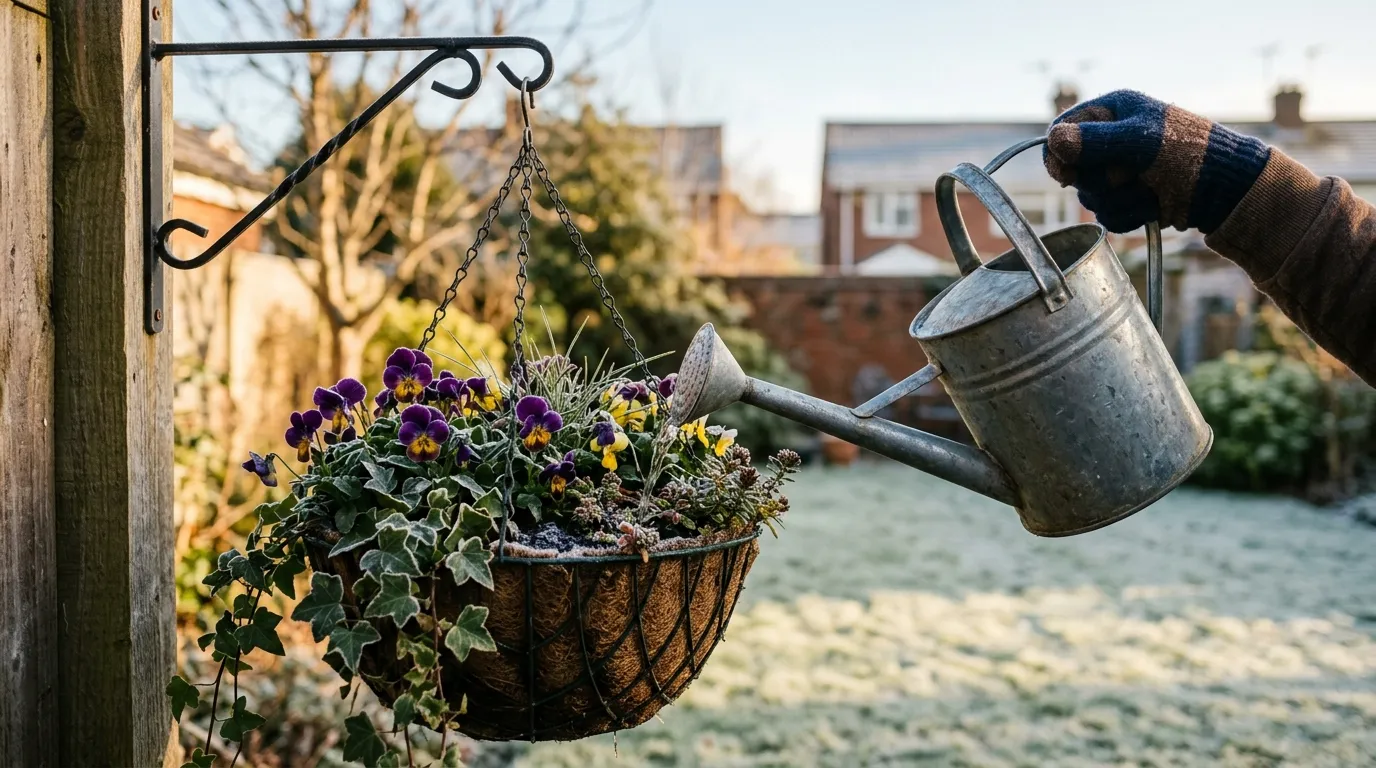 Midday watering on a dry January day. Water now drains and settles before the temperature drops again at dusk.
Frequently asked questions
When should I plant a winter hanging basket in the UK?
Plant between mid September and mid October. This gives roots three to five weeks to establish before the first hard frost. Plant too late and the rootball stays loose, so it freezes through faster and the plants sulk until spring. In Scotland and northern England, aim for the earlier end of that window.
What plants survive winter in hanging baskets?
Winter pansies, violas, trailing ivy, and Cyclamen coum all survive UK winters. Add Skimmia ‘Rubella’, winter heather, Gaultheria, and trailing Vinca for evergreen structure. These plants tolerate minus 8C to minus 12C in a basket. Tender bedding such as petunias and lobelia will not survive past the first frost.
How many plants go in a winter hanging basket?
Five to six plants in a 35cm basket, seven to nine in a 40cm. Winter growth is slow, so plant more densely than a summer basket. The display will not fill in much before spring, so pack it for instant impact. Leave a thumb-width gap between rootballs for watering.
Do you water hanging baskets in winter?
Yes, but far less than summer. Check weekly and water only when the top 2cm is dry. Water at midday on dry days so the compost is not waterlogged overnight. Never water a frozen rootball. Most winter basket losses come from waterlogging and rot, not from drought.
How do I protect a winter hanging basket from frost?
Move baskets against a house wall and under any overhang. Wall heat and shelter lift the local temperature by 2C to 4C. In a hard freeze below minus 8C, wrap the basket in horticultural fleece overnight. Avoid frost pockets and exposed open positions where cold air settles.
Next step
Now you have your winter baskets planted, read our guide on the best winter-flowering plants for UK gardens to carry the same colour through your beds and borders. The same planting logic works at ground level too: see our winter container recipes that hold until March.
Our team produces practical UK gardening guidance from source research, contributor records and established horticultural practice. Editorial standards are overseen by Matt W.