Key takeaways
- Plant between mid-September and mid-October while soil is above 10C; November plantings sulk until spring
- Most winter bedding flowers in autumn, pauses in deep winter, then peaks from February to May
- Violas beat pansies in wet winters: smaller flowers, but more of them and far better weather resistance
- Space winter bedding 10-15cm apart, closer than summer bedding, because plants barely grow before March
- Mini cyclamen give the showiest October to December colour but a hard frost kills them
- Do not feed until February, then a fortnightly liquid feed powers the spring flush
- Six-packs cost £3-4, 20-plug trays £8-12, ready-planted containers £15-25
Winter bedding plants are sold on a promise the label never quite spells out. The pansies and violas filling garden centre benches every September flower hard through autumn, all but stop in deep winter, then peak from February to May. That is not a fault. It is how the plants work, and once you plan around it, a £15 tray gives you seven months of colour.
This guide covers the ten performers worth your money, when each one actually flowers, and the planting window that decides everything. It also covers spacing, bulbs underneath, feeding, pests and honest costs.
Do winter bedding plants really flower all winter?
Most winter bedding flowers in autumn, pauses in the coldest weeks, then peaks in spring. Pansies and violas open fresh blooms in any mild spell above roughly 5C, so a soft January week brings the bed back to life for a few days. But between mid-December and mid-February, in a normal year, expect foliage and the odd brave flower rather than a show.
The plants sold as winter bedding split into three honest groups. Autumn performers such as mini cyclamen and ornamental kales look their best from October to Christmas. All-winter tickers are the pansies and violas, flowering whenever the weather allows. Spring payoffs are the wallflowers, forget-me-nots, bellis and sweet williams, which spend winter as green rosettes and then explode from March.
A good scheme mixes all three groups. That is the whole trick, and it is what the top-10 list below is built around.
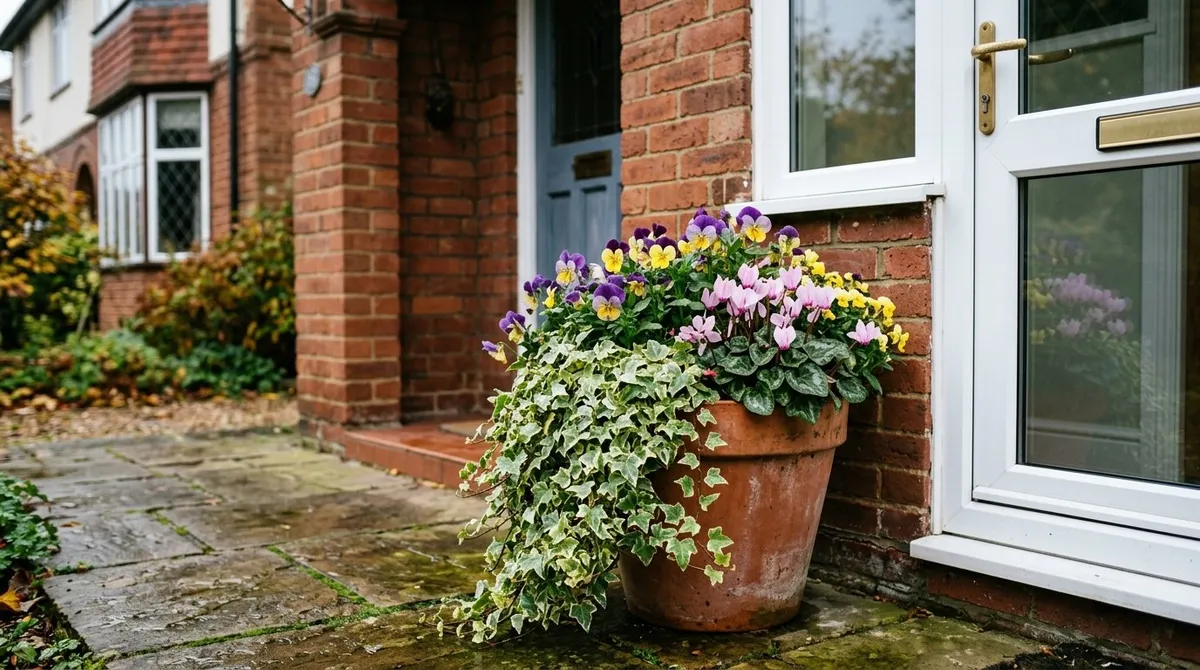
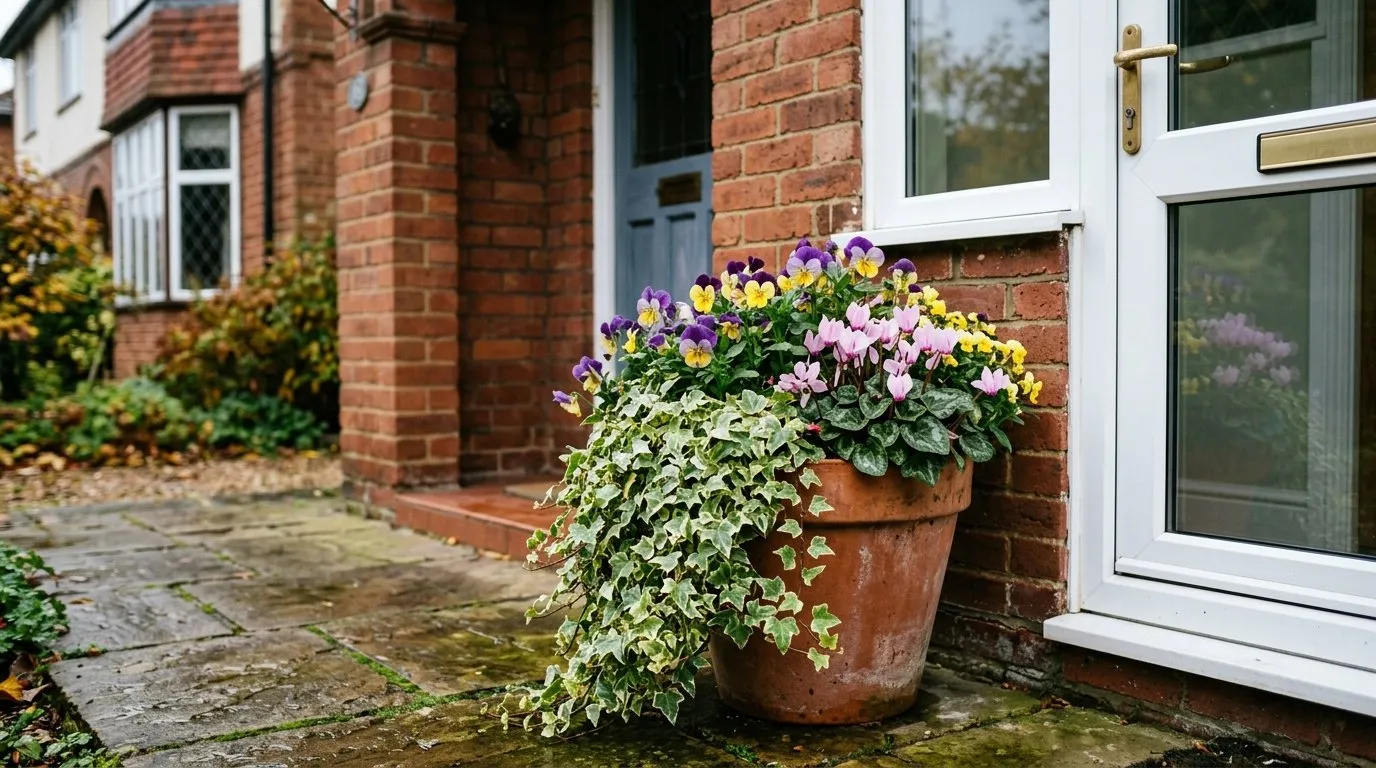 Violas, mini cyclamen and trailing ivy in one pot by the front door. Three groups, one container, colour from October to May.
When should you plant winter bedding plants?
Plant winter bedding between mid-September and mid-October, while the soil still holds summer warmth. This is the single most important decision you will make, ahead of variety choice, feeding, anything. Soil at 10-15C lets roots establish in three to four weeks. Once soil drops below about 8C, root growth more or less stops.
The same window applies to pots. Compost in containers cools faster than open ground, so if anything the deadline is tighter. Buy in September even if the summer display is still going; hold the plants in their trays somewhere bright and plant the moment you clear the pots.
Gardener’s tip: Use Halloween as your hard deadline. Bedding planted before it establishes and earns its keep from day one. After it, spend your money on bigger plants in 9cm pots rather than plugs, because size has to substitute for the root growth that will not happen until March.
Which are the best winter bedding plants? The top 10
Violas top the list for reliability, but every plant below earns a place if you match it to the right spot. Hardiness ratings are RHS ratings, where H5 means hardy to about -15C and H7 means hardy below -20C.
| Plant | Main flowering | Hardiness | Best use |
|---|---|---|---|
| Winter pansies | Oct-Nov, then Feb-May | H5 | Big flowers in beds and boxes |
| Violas | Oct-May in mild spells | H5 | The banker: pots, edges, baskets |
| Primroses and polyanthus | Feb-Apr | H7 | Border edges, shade, under shrubs |
| Wallflowers | Mar-May | H5 | Scent, cottage borders, with tulips |
| Bellis daisies | Feb-May | H7 | Pot toppers, formal edging |
| Forget-me-nots | Mar-May | H6 | Blue haze under spring bulbs |
| Sweet williams | May-Jun | H7 | Cutting, cottage beds, patience |
| Mini cyclamen | Oct-Dec | H2 | Sheltered pots, porches only |
| Ornamental cabbages and kales | Foliage Oct-Feb | H4 | Frost-coloured centrepieces |
| Evergreen fillers (heuchera, carex, ivy, skimmia) | Foliage all winter | H5-H6 | Structure in every container |
1. Winter pansies. The biggest flowers of the season, up to 8cm across on the Matrix and Colossus series. They flower in October, rest, then carry the bed from February. Their weakness is rain: sodden petals rot, and wet winters thin them badly.
3. Primroses and polyanthus. Planted in autumn, they sit as neat rosettes, then peak from February to April. The RHS rates Primula vulgaris H7, as tough as anything on this list. Our primrose growing guide covers varieties; ‘Crescendo’ polyanthus is the bedding standard.
4. Wallflowers. A biennial planted as bare-root bundles in October, flowering March to May with the best scent in the spring garden. ‘Fire King’ and ‘Blood Red’ are the classics at 40-45cm. Full detail in our wallflower guide.
5. Bellis daisies. Button flowers in white, pink and red from February, 10-15cm tall. ‘Tasso’ and ‘Pomponette’ are the tidy pompon forms. Utterly hardy and cheap.
6. Forget-me-nots. Nothing else gives that blue haze under tulips in April. Plant 15cm apart in October and forget them until March. They self-seed for free plants every year after.
7. Sweet williams. The patience pick: planted in autumn, flowering May into June on 45cm stems that cut beautifully. They bridge the gap between spring bedding and summer colour.
8. Mini cyclamen. The honest caveat on this list. Small-flowered Cyclamen persicum types such as the Metis series are the showiest thing you can buy in October, flowering non-stop to Christmas. But they are rated barely H2, and a hard frost kills them outright. Use them in sheltered pots and porches, treat them as a 10-week display, and follow the RHS cyclamen guidance on the truly hardy species for open ground. Our cyclamen guide explains which is which.
9. Ornamental cabbages and kales. Grown for foliage, not flowers, and they improve as it gets colder. Frost below about 5C intensifies the pink, purple and cream centres. ‘Nagoya’ and ‘Northern Lights’ are the common series.
10. Evergreen structure fillers. Not bedding, but no winter container works without them. A £4 heuchera, a carex such as ‘Evergold’, a trailing ivy or a budded skimmia ‘Rubella’ gives every pot a backbone the flowers can rest against.
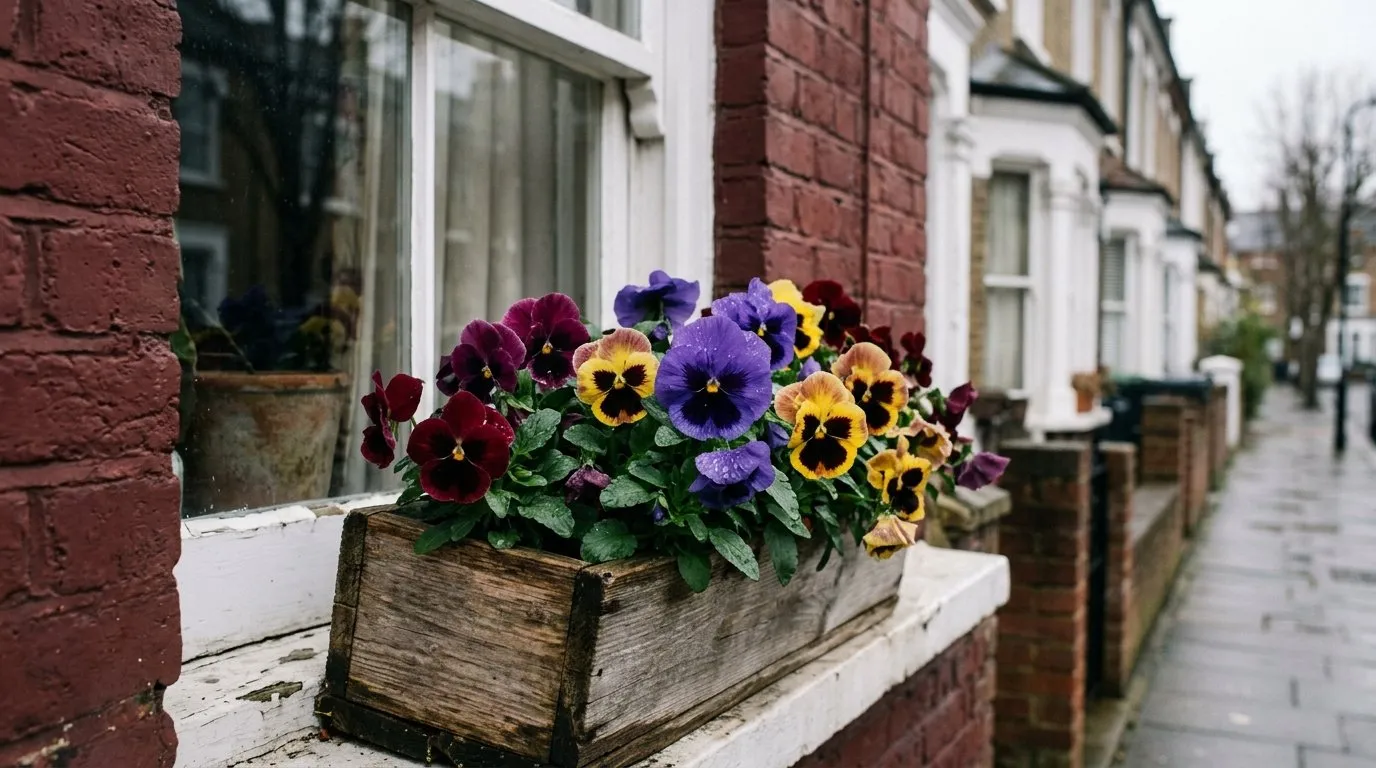 Matrix pansies in a window box on a London terrace. Big flowers in autumn, a pause at Christmas, then the spring show.
Containers or borders: where does winter bedding work best?
Containers give the better return in winter, because they put the colour where you actually see it. Nobody tours the garden in January. A pot by the front door, a window box, a trough beside the path you use daily: that is where winter bedding pays its rent. Our winter container planting guide covers compost and drainage in full, and winter hanging baskets work on the same rules with trailing ivy and violas.
Spacing is the bit everyone gets wrong. Plant winter bedding 10-15cm apart, roughly half the spacing you would give summer bedding. Summer plants triple in size within weeks; winter plants make almost no growth between November and March. Gaps you leave in October are still gaps in February. In a 30cm pot, that means 5-6 violas, not the three you would use for summer.
In borders, stick to the front 30cm where plants are visible from the house. Improve heavy soil with a bucket of grit or compost per square metre first, because winter bedding sat in cold puddled clay rots from the roots up. Raised beds and free-draining edges carry the best winter displays.
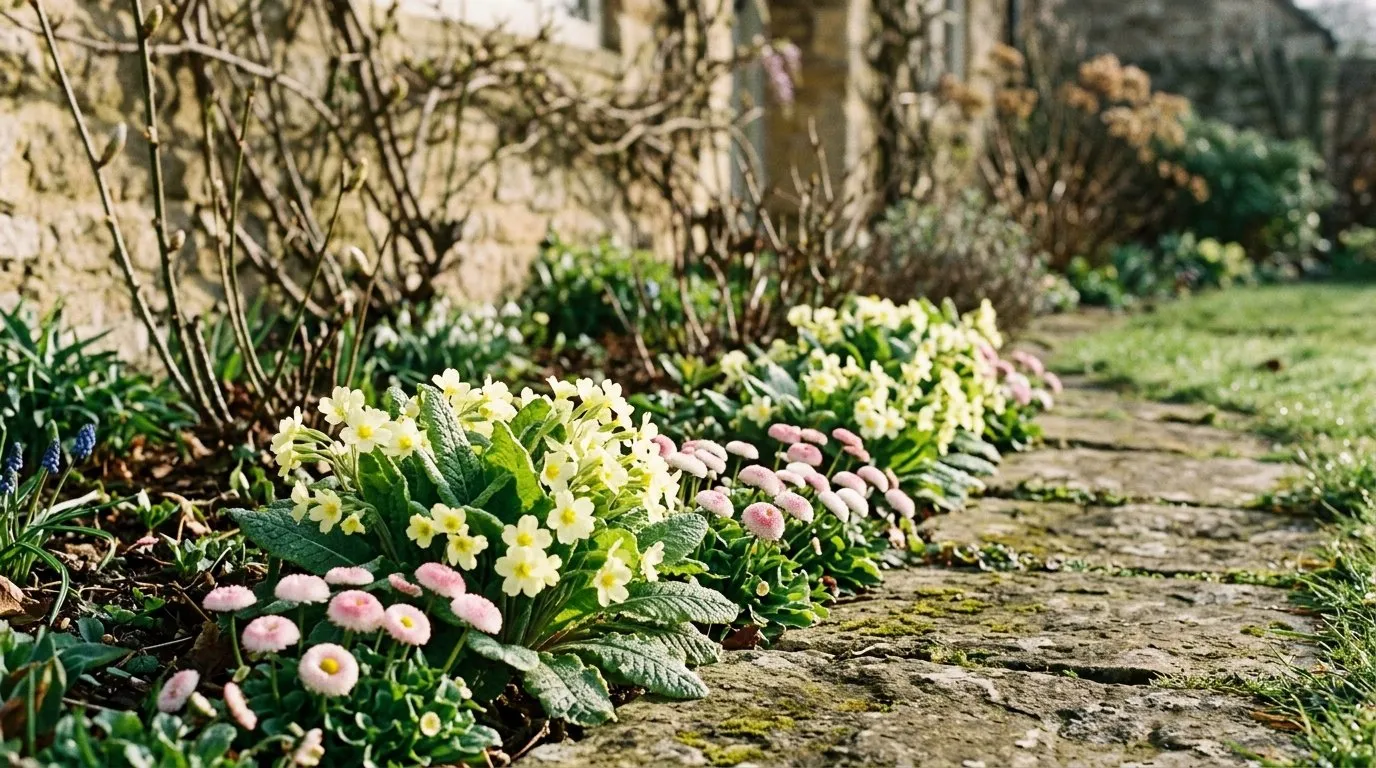 Primroses and bellis along a cottage border edge. Both are hardy to H7 and peak from February to April.
Can you plant spring bulbs under winter bedding?
Yes, and the layered pot is the best-value planting you can do all year. Bulbs go in first: tulips at 20cm deep, daffodils at 15cm, then a layer of compost, then the bedding planted on top at the usual 10-15cm spacing. The violas flower from October, and in March the bulbs push straight up between them for a second display in the same pot.
The bedding actually helps the bulbs. It shades the compost surface, suppresses liverwort and stops heavy rain capping the compost. Squirrels also dig planted pots far less than bare ones.
Stick to violas, bellis and forget-me-nots as the top layer. Big pansy foliage swamps emerging bulb noses, and wallflowers root too deeply. The full method, layer by layer, is in our bulb lasagne guide, and it works in any pot over 25cm across.
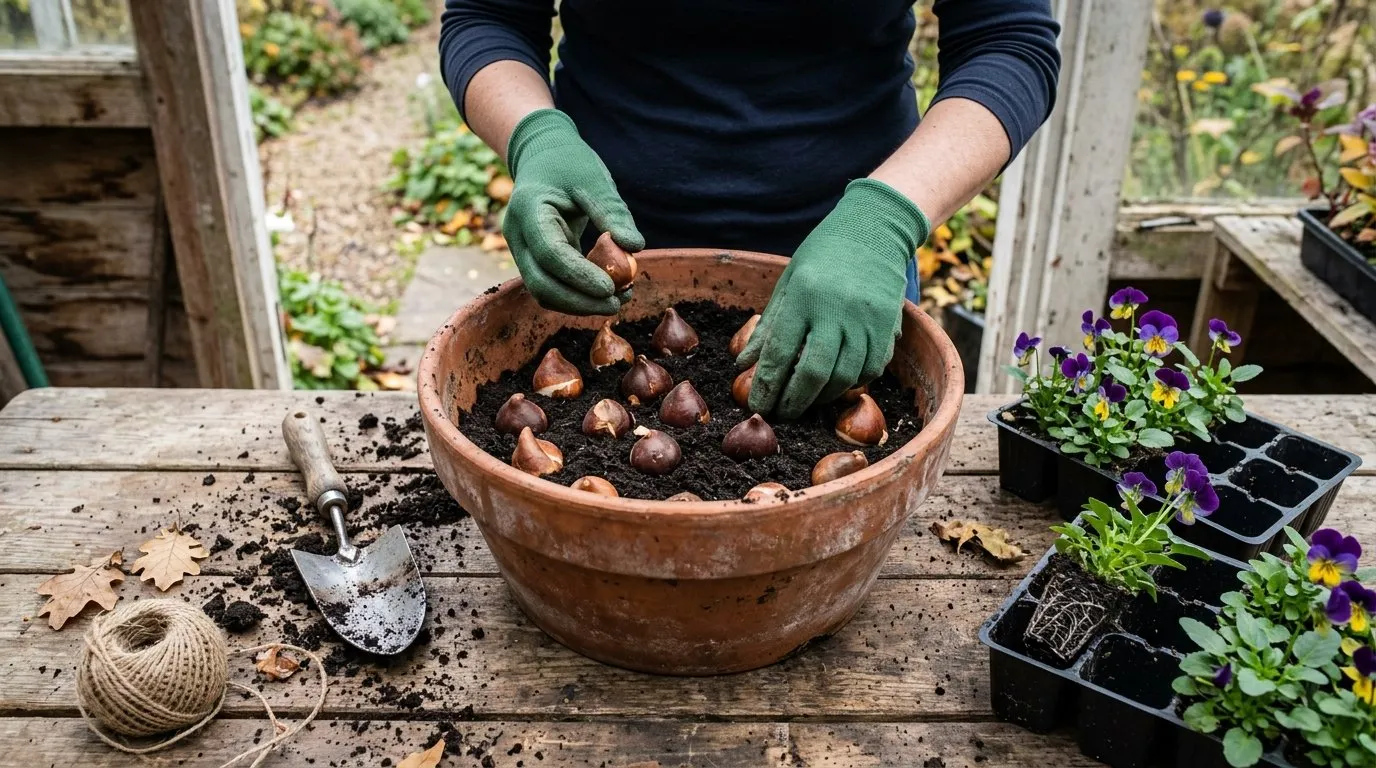 Tulips at 20cm, daffodils at 15cm, violas on top. One October hour, two displays from the same pot.
How do you keep winter bedding flowering?
Deadhead pansies and violas every week through winter, because it is the one job that genuinely changes the result. A faded pansy flower left on sets seed, and seed production tells the plant to stop flowering. Sixty seconds per pot, done whenever you pass with the recycling, keeps the flower supply coming through every mild spell. Wet, mushy blooms come off the same way before grey mould moves in.
Do not feed until February. Roots barely take up nutrients from cold soil, and any soft growth you force in autumn is the first tissue frost destroys. The compost in a fresh planting carries enough nutrition to see plants through.
From late February the rules flip. Feed a liquid tomato feed at half strength every two weeks, and the difference shows within a month: bigger flowers, more of them, deeper colour into the March-to-May peak. Water pots in prolonged dry cold spells too; frozen or dry compost kills more container bedding than frost itself.
 A mixed pansy bed holding a front garden through winter. Weekly deadheading is what keeps displays like this going.
Slugs, leaf spot and vine weevil: the winter pest list
Winter does not switch pests off, it just changes the list. Slugs stay active in any mild spell above about 5C, and a fresh tray of violas is the only soft growth in the garden. Check pots after dark in mild weeks, use wildlife-safe ferric phosphate pellets sparingly, and lift pots onto feet so slugs cannot shelter beneath them.
Pansy leaf spot shows as round brown-black spots that yellow the leaf around them, and it spreads in exactly the still, damp conditions of a UK winter. Pick off marked leaves promptly, avoid wetting foliage when you water, and keep that 10-15cm spacing so air moves. Badly infected plants are cheaper to replace than to nurse.
Vine weevil is the container killer. The grubs eat roots unseen from autumn onwards, and the first symptom is a plant that wilts despite moist compost and lifts out with no roots at all. Cyclamen, primroses and heucheras are their favourite meals. If a winter pot collapses without obvious cause, tip it out and look for the c-shaped white grubs; our vine weevil treatment guide covers the nematode drench that clears them.
 Frost on ornamental kale. Cold below 5C is what turns the centres this colour, so a hard November improves them.
How much do winter bedding plants cost?
A decent winter display costs less than most people expect, because the plants carry it for seven months. Realistic UK prices, checked autumn 2025:
- Six-packs of pansies or violas: £3-4, so roughly 55-65p a plant
- 20-plug trays: £8-12 mail order, 40-60p a plant, potted on for two weeks before planting
- 9cm pots: £1.50-2.50 each, the right buy after Halloween when size matters
- Bare-root wallflowers: £6-8 for a bundle of ten
- Mini cyclamen: £2.50-4 per 10.5cm pot
- Ornamental kales: £3-5 each
- Ready-planted containers: £15-25, convenient but the same plants cost £8 loose
The best-value route is a 20-plug viola tray in mid-September at about £10, grown on for a fortnight and planted in the first week of October. That fills a 30cm pot and 1.5 metres of border edge, and it flowers until you clear it for summer bedding in May.
 Violas taking light snow in a Yorkshire yard. They close down in the freeze and reopen the following mild week.
Frequently asked questions
When should I plant winter bedding plants?
Plant between mid-September and mid-October, while the soil still holds summer warmth. Roots then establish before the cold shuts growth down. Plants that go in during November sit still all winter and flower weeks later in spring. If you miss the window, it is still worth planting, just expect less.
Do winter bedding plants flower all winter?
No, most flower in autumn, pause in deep winter, then peak in spring. Pansies and violas open blooms in any mild spell above about 5C, so you get flashes of colour in January. The real show runs from late February to May. Only mini cyclamen peak before Christmas.
What is the best winter bedding plant?
How far apart should you plant winter bedding?
Space winter bedding 10-15cm apart, noticeably closer than summer bedding. Plants make almost no new growth between November and March, so gaps you leave in October are still gaps in February. Closer planting gives a full display from day one and helps smother winter weeds.
Should I feed winter bedding plants?
No, not until February. Cold soil stops roots taking nutrients up, and soft autumn growth forced by feeding is the first thing frost ruins. From late February, give a liquid feed every two weeks. That powers the big spring flush from March to May.
Do winter pansies come back every year?
Winter pansies are short-lived perennials treated as annuals. Most run out of steam by late May, turning leggy with smaller flowers, and are cleared to make room for summer bedding. A few plants cut back hard will limp on, but fresh plants each autumn give a far better display.
Can you plant winter bedding in November?
You can, but the plants sulk until spring. Soil temperature drops fast in November, roots stop extending, and the plants sit still instead of establishing. They usually survive but flower six weeks or more behind September plantings. Choose the biggest plants you can find to compensate.
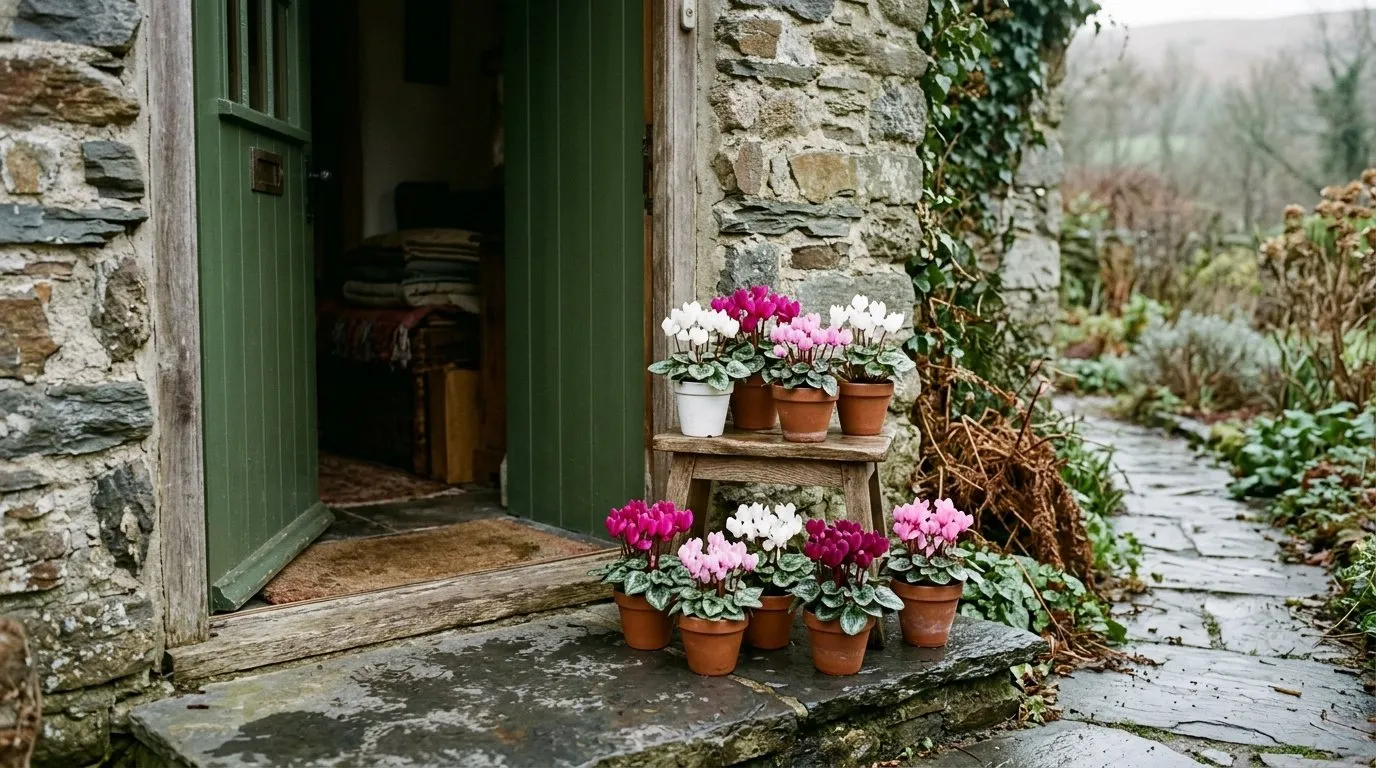 Mini cyclamen in a sheltered Welsh porch, exactly where they belong. Showiest plant of the autumn, dead at the first hard frost outside.
Buy in September, plant by mid-October, space at 10-15cm and hold the feed until February. Get those four things right and winter bedding stops being a gamble. The violas will still be flowering when you finally evict them in May.
Our team produces practical UK gardening guidance from source research, contributor records and established horticultural practice. Editorial standards are overseen by Matt W.