Key takeaways
- 10 common UK garden weeds are edible, with nettle delivering 333mg vitamin C per 100g (5 times more than orange)
- Uprooting any wild plant without the landowner's permission breaks the Wildlife and Countryside Act 1981
- Wild garlic Allium ursinum is sometimes confused with lily of the valley, which is fatally toxic - crush a leaf and smell for garlic before eating
- Ground elder is safe but resembles toxic hemlock and cow parsley - check for stem hairlessness and a triple set of three leaflets
- Best harvest window for most edible weeds is March to June while leaves are young and before flowering turns them bitter
- Wash all foraged leaves in cold water and a splash of vinegar to remove soil particles, slugs, and any dog-traffic risk
Most UK gardens contain a free salad bar that gets pulled up and binned every spring. Edible garden weeds like dandelion, nettle, and wild garlic outperform shop-bought greens for vitamin C, iron, and calcium. They cost nothing, need no sowing, and tolerate the worst summer or winter we can throw at them.
How UK foraging law actually works
Foraging from your own garden carries no legal restriction. Foraging from someone else’s land needs more care.
The Wildlife and Countryside Act 1981 is the main piece of legislation. Section 13 makes it an offence to uproot any wild plant without the landowner’s permission. Picking the leaves, flowers, fruits, or seeds of common species for personal use stays legal under the “four Fs” rule (fruit, foliage, fungi, flowers). The Theft Act 1968 reinforces this by exempting picking from prosecution provided you do not intend to sell.
Selected species are fully protected. Bluebell bulbs cannot be uprooted under any circumstances. Around 100 species sit on Schedule 8 of the Act and cannot be picked at all. None of the 10 weeds in this guide appear on Schedule 8.
Nature reserves, SSSIs, and National Trust land often carry by-laws that restrict foraging beyond the Wildlife Act baseline. Check the site rules before harvesting. On private land beyond your own garden, ask the landowner.
Warning: Never forage from roadside verges within 10 metres of the kerb. Lead, cadmium, and zinc concentrations in roadside soil sit 4 to 10 times higher than background levels. Avoid dog-walking routes for the same reason.
1. Dandelion (Taraxacum officinale)
The most familiar UK weed and the most useful in the kitchen. Every part is edible.
Identification. Deeply toothed leaves arranged in a flat rosette flush against the ground. Hollow milky-sapped stems support a single bright yellow flower head. Seed heads form a perfect grey-white globe (“clock”). Leaves reach 10-30cm long. Flowers run February through November in mild years.
Taste. Young spring leaves taste like rocket with a chicory bitterness. Older leaves turn aggressively bitter once the plant flowers. Roasted root tastes like chicory coffee.
Harvest window. Leaves February to April. Flowers April to June for fritters or wine. Roots October to February for roasting.
Uses. Young leaves in salad mixes, sautéed with garlic, or blanched in soups. Flowers fried as fritters, infused as syrup, or fermented into traditional dandelion wine. Roasted roots ground as a coffee alternative (caffeine-free, slight bitterness). Nutritional load is high: 535mg potassium and 187mg calcium per 100g of raw leaves, with 14,000 IU vitamin A.
Look-alikes. Cat’s ear (Hypochaeris radicata) is the main confuser. Its leaves carry small hairs and the stem is solid, not hollow. Cat’s ear is also edible, so a mix-up here is harmless.
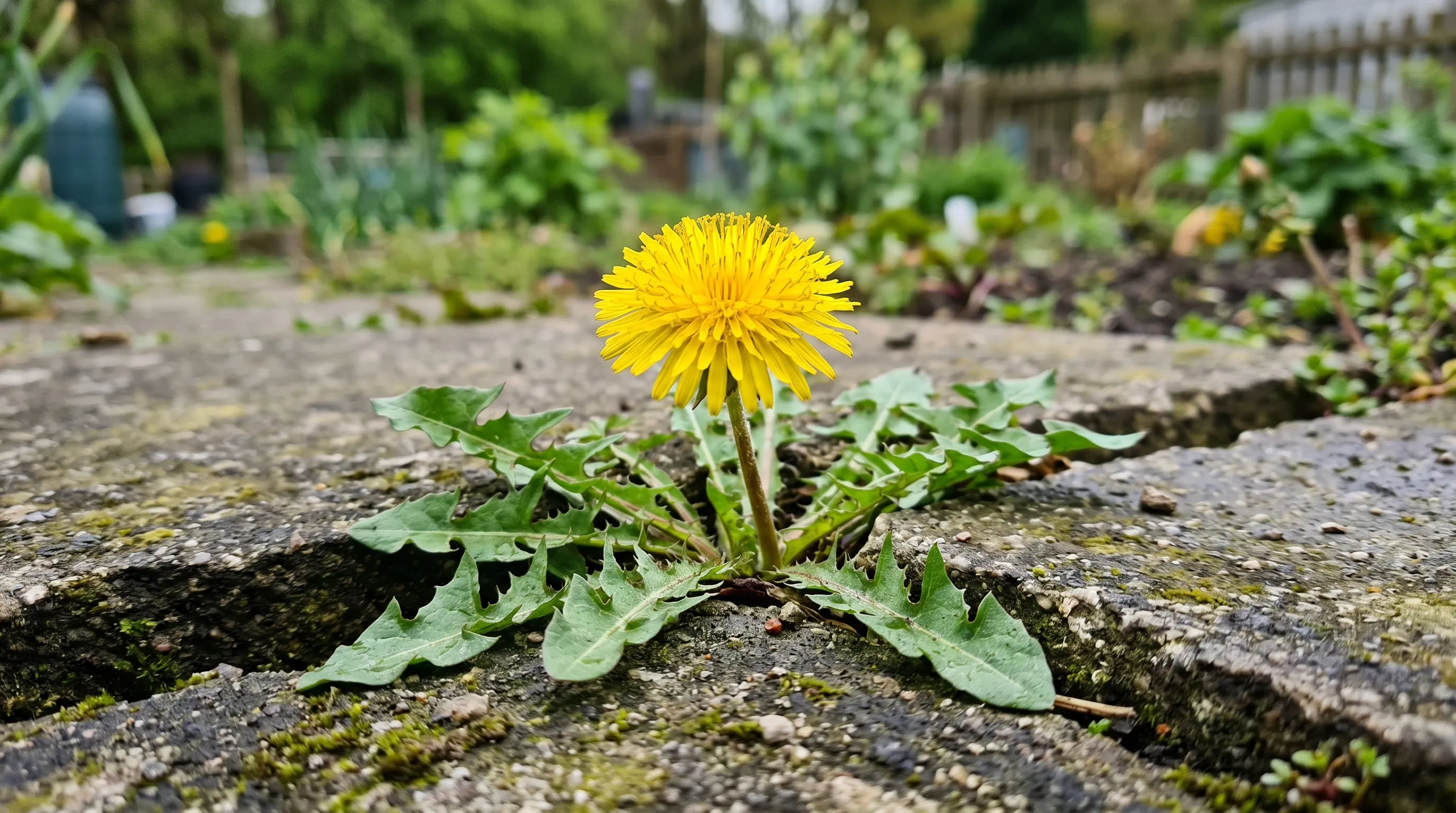 Dandelion Taraxacum officinale on a Sheffield allotment. The deeply toothed leaf rosette and hollow milky stem confirm identification. Pick young leaves before the plant flowers for the mildest taste.
2. Stinging Nettle (Urtica dioica)
The vitamin C powerhouse of the UK weed flora. Stinging nettle delivers 333mg vitamin C per 100g of fresh leaves, more than five times the level in an orange.
Identification. Opposite pairs of heart-shaped leaves with sharply toothed edges, covered in stiff stinging hairs. Square stems reach 60-150cm. Small green flowers hang in catkin-like clusters from May to September. Grows in nitrogen-rich soil, often near compost heaps or chicken runs.
Taste. Cooked, like spinach with a richer, slightly grassy flavour. Earthy and savoury. Dried for tea, it tastes of hay and lemon.
Harvest window. March to early June for kitchen use. After flowering, leaves develop gritty cystoliths (calcium oxalate crystals) that irritate the kidneys.
Uses. Nettle soup is the classic preparation. Pesto (substituting basil), risotto, gnocchi filling, beer, and dried tea. Wear thick leather gloves and use scissors. Pick only the top four leaves of each shoot. Blanch for 60 seconds in boiling water to neutralise the sting permanently.
Look-alikes. White dead-nettle (Lamium album) has the same square stem and toothed leaves but no sting and a white tubular flower. It is also edible. No toxic look-alikes exist.
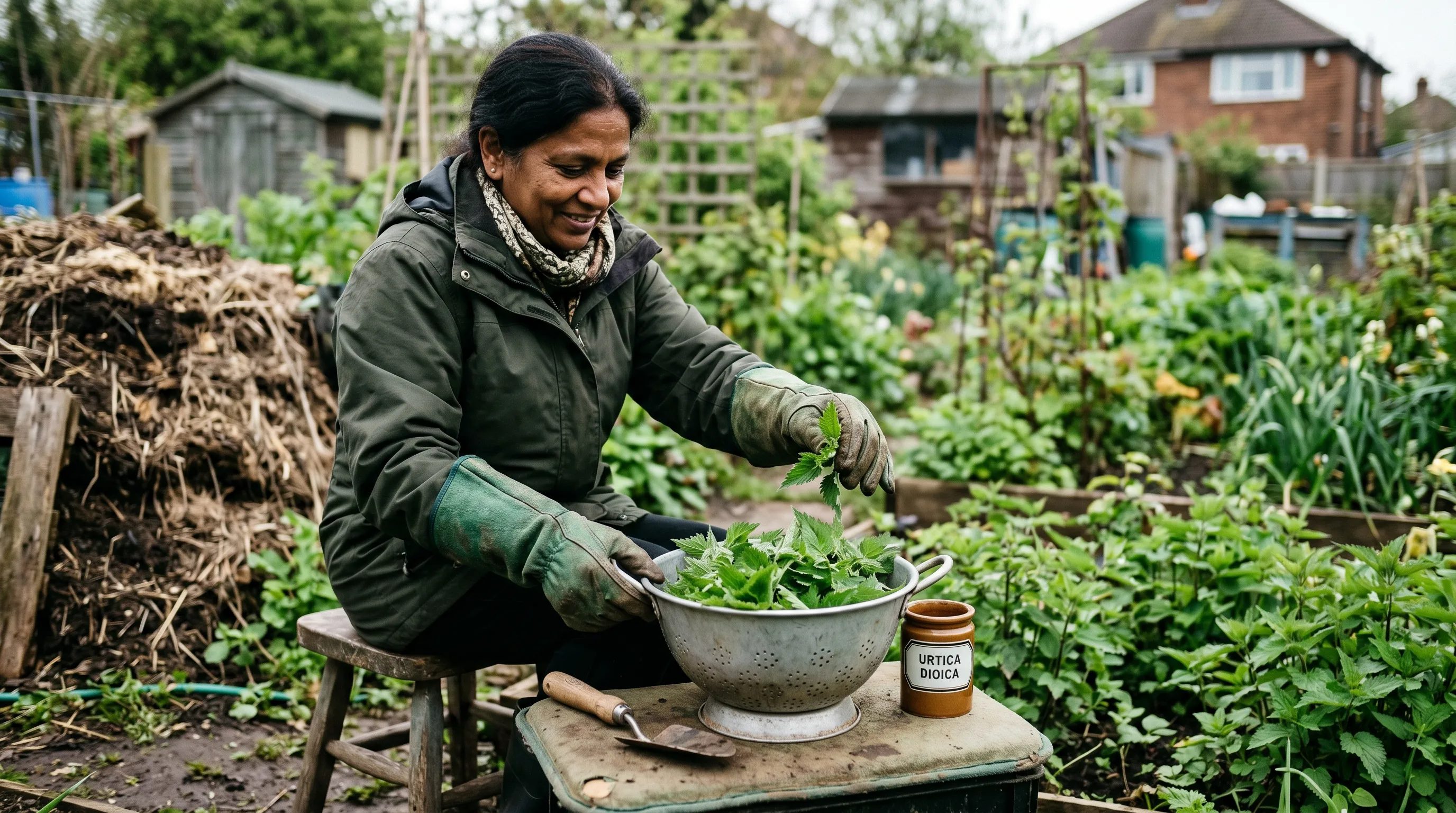 Harvesting nettle tops with thick leather gauntlets. Only pick the top four leaves per shoot for the best flavour and lowest cystolith content.
3. Ground Elder (Aegopodium podagraria)
The gardener’s nightmare turned into dinner. Roman legionaries brought ground elder to Britain as a salad crop. It now infests around 60 percent of older UK gardens.
Identification. Triple sets of three leaflets (“nine in three”). Leaflets are oval, toothed, with a slight asymmetry where they meet the stalk. Stems are hollow, grooved, and hairless. White flat umbel flowers appear June to August, similar to cow parsley but smaller (5-10cm across).
Taste. Young leaves taste like celery and parsley combined. Older leaves develop a strong, almost soapy edge.
Harvest window. March to May. After flowering, leaves coarsen rapidly.
Uses. Chopped into salads, added to soups in the last 2 minutes of cooking, blended into pesto, or stuffed into ravioli. Treat like flat-leaf parsley.
Look-alikes. This is the critical one. Ground elder shares its leaf shape and umbel flowers with two toxic species. Hemlock (Conium maculatum) has hairless stems with purple blotches and smells of mice when crushed. Cow parsley (Anthriscus sylvestris) has hairy green stems and smells of aniseed (cow parsley is safe but tastes bland). Hemlock kills, cow parsley does not. Learn all three before harvesting any umbel.
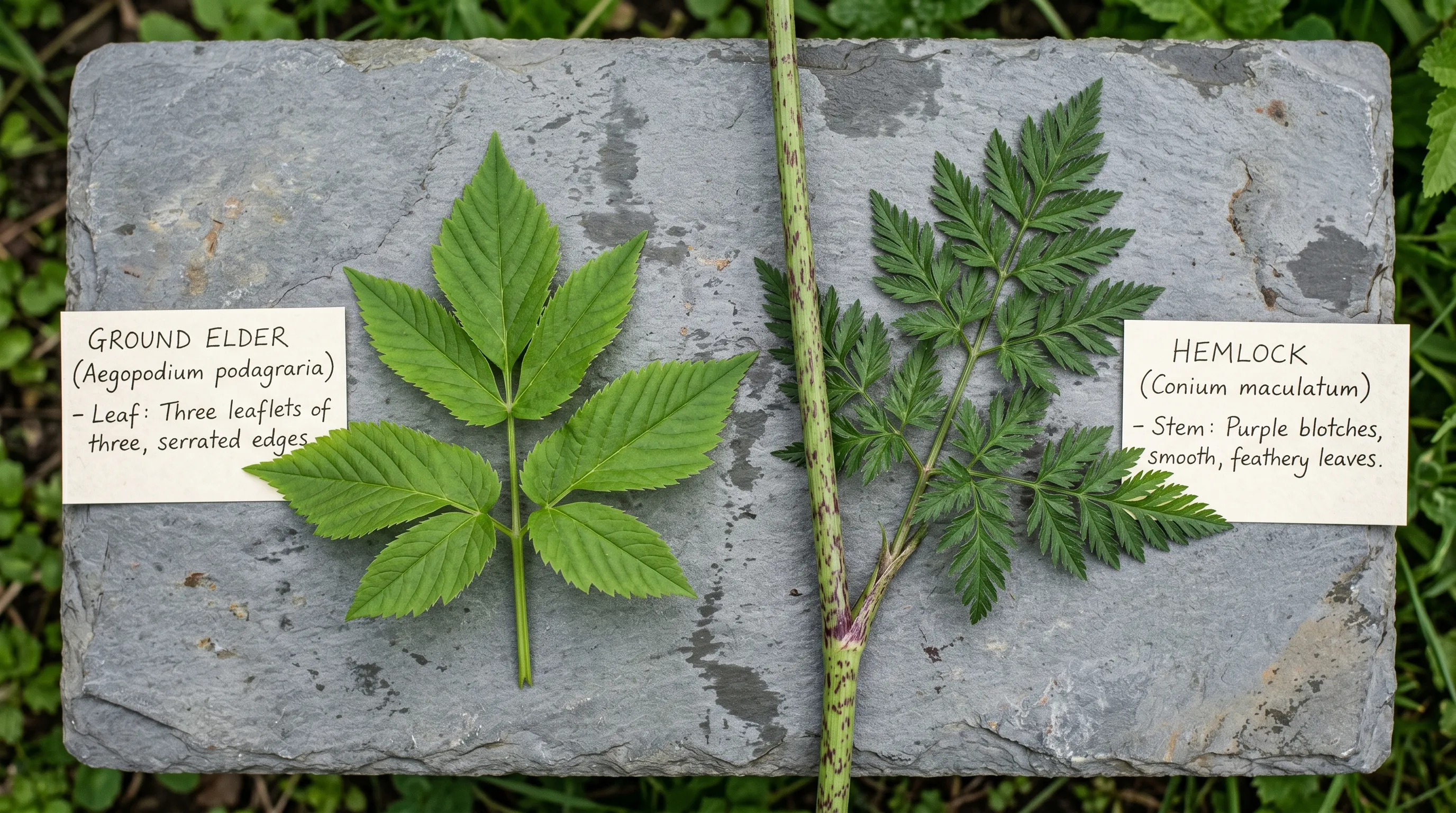 Diagnostic comparison: ground elder (left) shows three leaflets of three with a hollow grooved hairless stem. Hemlock (right) carries purple blotches on the stem and smells of mice. Hemlock is fatal in small doses.
4. Chickweed (Stellaria media)
A delicate sprawling annual that carpets bare soil in raised beds and shady corners.
Identification. Small pointed oval leaves in opposite pairs along a sprawling stem. A single line of fine hairs runs along one side of the stem (shift the stem under a hand lens to find it). White five-petalled flowers that look like ten petals because each petal is deeply split. Reaches 10-40cm sprawl height.
Taste. Mild, fresh, crisp. Closest to baby spinach with a hint of corn-on-the-cob sweetness.
Harvest window. Year-round in mild winters. Best March to June when growth is densest.
Uses. Eat raw in salads, sandwiches, or as a herb topping. Cook briefly in stir-fries. Press juice as a traditional spring tonic. Vitamin C content reaches 375mg per 100g in dried leaves.
Look-alikes. Scarlet pimpernel (Anagallis arvensis) is mildly toxic and easy to confuse. The difference: pimpernel has a square stem and orange or red flowers; chickweed has a round stem with the single hairy line and white flowers.
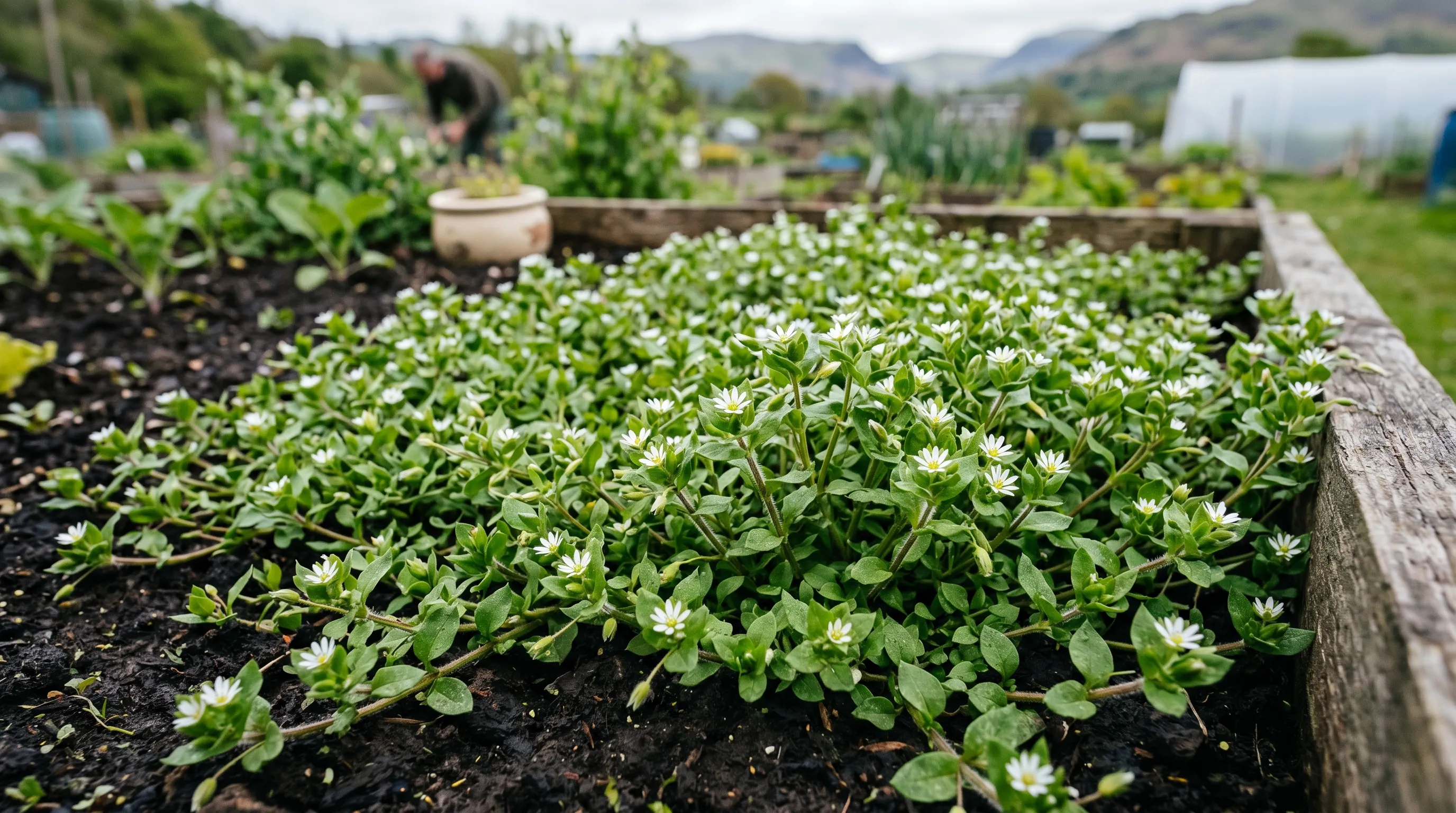 Chickweed carpet on a Lake District allotment raised bed. Look for the single line of hairs along one side of the stem to confirm identification before eating.
5. Wild Garlic (Allium ursinum)
The most exciting spring forage in the UK. Wild garlic carpets ancient woodlands and damp shaded garden corners from late March.
Identification. Broad, lance-shaped leaves emerging individually from the soil on a single long stalk (not a rosette). Bright green, glossy, with a clear central vein. White six-petalled star-shaped flowers in a loose globe head on a separate stem from April to June. Crushed leaves smell unmistakably of garlic.
Taste. Garlic, milder than the bulb. Slightly green and grassy. Flowers carry a more delicate garlic punch.
Harvest window. Leaves March to early May before flowering. Flowers April to June. Bulbs are edible but uprooting is illegal under the Wildlife and Countryside Act 1981 unless you own the land.
Uses. Pesto (the classic), wild garlic butter, soup, risotto, dumpling fillings, capers from the unopened buds, and stir-fries. Around 150mg vitamin C per 100g and significant allicin content for circulatory health.
Look-alikes. Three species can kill or hospitalise you. Lily of the valley (Convallaria majalis) has paired leaves clasping a single stem and bell-shaped flowers - fatally toxic, contains cardiac glycosides. Lords-and-ladies (Arum maculatum) has arrow-shaped leaves with dark spots and a hooded flower - causes severe mouth swelling. Autumn crocus (Colchicum autumnale) has strap-like leaves in spring without flowers - contains colchicine, fatal. None of these smell of garlic. Crush a leaf between your fingers and sniff before every harvest. No garlic smell, no harvest.
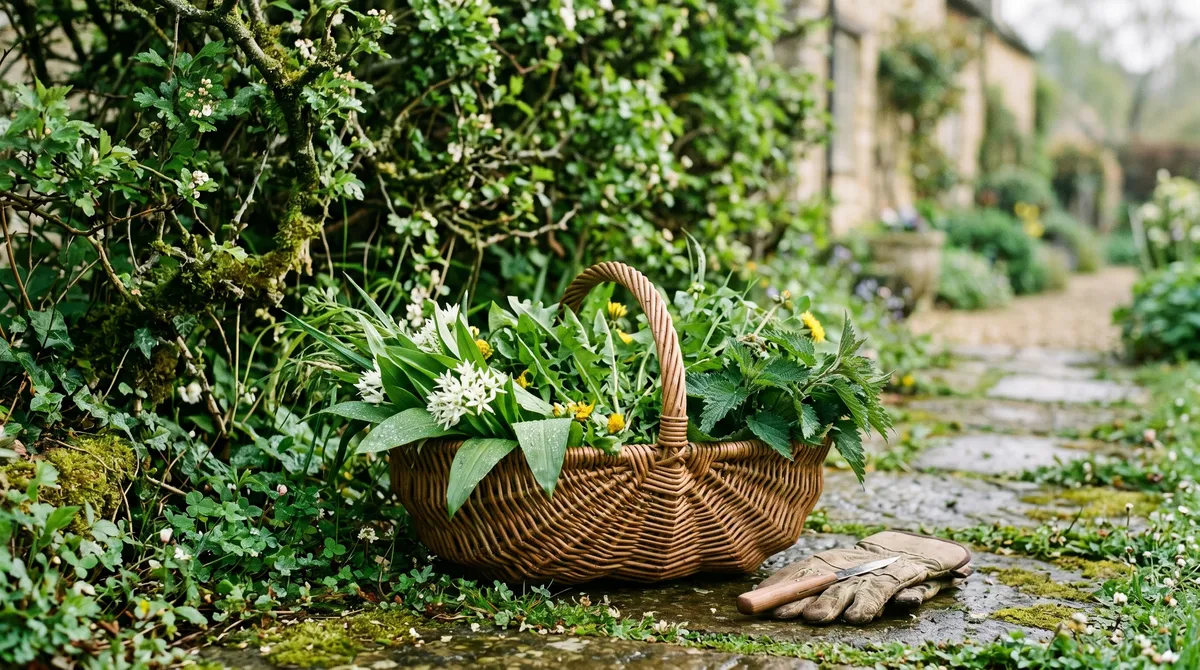
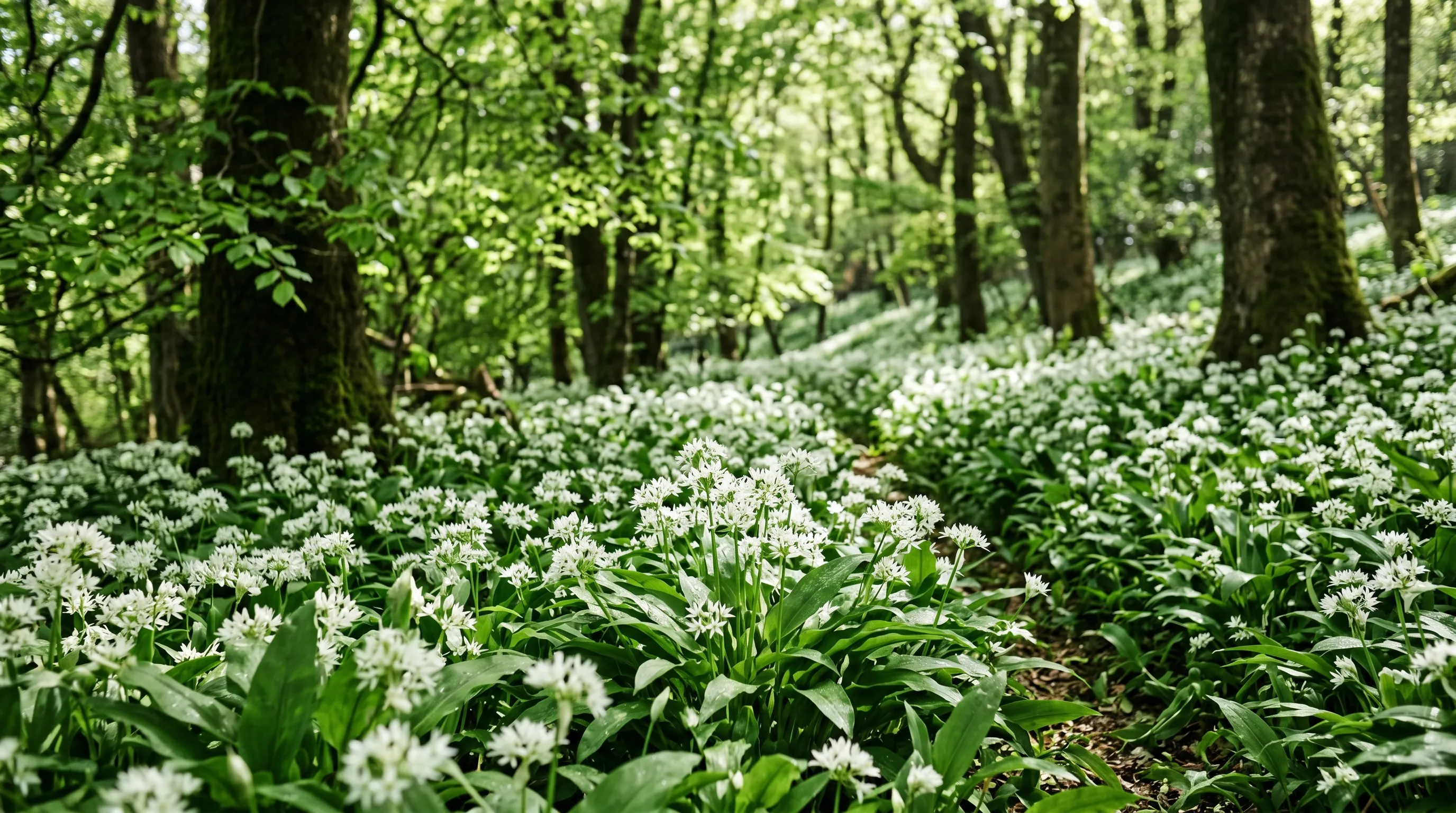 Wild garlic Allium ursinum carpeting a Welsh valley woodland edge. Each leaf emerges separately from the soil on its own stalk - paired leaves on a single stem signal toxic lily of the valley.
6. Garlic Mustard (Alliaria petiolata)
Also called Jack-by-the-hedge. A biennial that smells of garlic but belongs to the cabbage family.
Identification. First-year rosettes show kidney-shaped scalloped leaves. Second-year plants send up a flowering stem 30-100cm tall with triangular-toothed leaves and small white four-petalled flowers from April to June. Crushed leaves smell of garlic and mustard combined.
Taste. Strong, peppery, garlic and horseradish. Heat dissipates the garlic flavour, so use raw or add at the end of cooking.
Harvest window. Leaves February to May. Flowers and unripe seed pods May to July.
Uses. Chopped into salads, sandwich filling, pesto, sauces. Seeds dried and ground as a mustard substitute. Stems peeled and eaten like asparagus when very young.
Look-alikes. No dangerous look-alikes. Garlic mustard belongs to Brassicaceae, all of which are safe.
7. Cleavers / Goosegrass (Galium aparine)
The sticky-stemmed scrambler that clings to clothes and pets. Cleavers has used as a kidney tonic and lymphatic cleanser since Anglo-Saxon medicine.
Identification. Whorls of six to eight narrow leaves arranged star-fashion around a square stem. Both stems and leaves covered in tiny hooked hairs that act like Velcro. Tiny white four-petalled flowers May to August. Sticky round seed burrs follow.
Taste. Raw it is too rough-textured to enjoy due to the hooked hairs. Cooked or juiced, the flavour is mild, grassy, slightly minty.
Harvest window. Young shoots February to May before the hooks toughen.
Uses. Best as a cold-water infusion. Stuff a jar with fresh shoots, top with cold water, refrigerate overnight, strain. Drink as a kidney support tonic. Also blended into green smoothies and pressed into juices. Roasted seeds are a passable coffee substitute.
Look-alikes. No toxic look-alikes. The sticky-hairy stems and whorled leaves are distinctive.
8. Hairy Bittercress (Cardamine hirsuta)
The fastest-growing weed in any UK garden centre’s plant pots. Hairy bittercress sets seed in 5 weeks from germination.
Identification. Small rosette of pinnate leaves (paired leaflets along a central stalk, ending in a larger round leaflet). Slender flowering stem 5-30cm tall topped with tiny white four-petalled flowers. Long thin seed pods that explode on touch, scattering seeds up to 80cm.
Taste. Hot, peppery, like watercress but milder. The Latin name Cardamine relates to its cardamom-like punch.
Harvest window. Year-round in mild winters, peak October to April.
Uses. Whole clean rosettes can go into sandwiches, salads and egg dishes. The hairy bittercress identification guide shows the plant before its pods ripen.
Look-alikes. No dangerous look-alikes. The pinnate leaves and exploding seed pods distinguish it from all toxic species.
9. Fat Hen (Chenopodium album)
Also called lamb’s quarters, white goosefoot, or pigweed. Fat hen was a UK staple crop until the Romans introduced spinach.
Identification. Diamond or goosefoot-shaped leaves with toothed edges, covered in a mealy white powder that rubs off on your fingers. Reddish stem grooves vertically. Reaches 30-150cm tall. Dense green flower spikes July to September. Seeds black, lens-shaped.
Taste. Cooked, identical to spinach. Slightly milder, less metallic. Higher protein (4.2g per 100g) than spinach.
Harvest window. Leaves June to August. Seeds September to October.
Uses. Treat like spinach: sautéed, in saag, blended into soup, layered in lasagne. Young seedlings make tender salad greens. Seeds are edible but tedious to clean - boil in three changes of water to remove saponins.
Look-alikes. Black nightshade (Solanum nigrum) seedlings can resemble fat hen briefly. Black nightshade lacks the mealy white powder and develops glossy dark leaves with small white star flowers and green or black berries (mildly toxic raw).
10. Wood Sorrel (Oxalis acetosella)
The most refreshing wild flavour in the British woodland.
Identification. Heart-shaped leaflets in groups of three (like a small bright-green clover) on slender stalks emerging from the leaf litter. Folds leaflets down at night and in strong sun. Solitary white five-petalled flowers veined with pink, March to May. Grows in damp shaded soil under hedges and trees.
Taste. Sharp, tart, lemony. The oxalic acid content is the source, the same compound that gives rhubarb and sorrel their bite.
Harvest window. Year-round, peak March to June.
Uses. Garnish for fish, salads, sorbets, and cocktails. Infused in vinegar or oil. Frozen into ice cubes for summer drinks. Eat in moderation - high oxalic acid intake interferes with calcium absorption and irritates kidneys in large amounts. A single small handful per day is the practical safe limit for an adult.
Look-alikes. No toxic look-alikes among the heart-shaped trefoils.
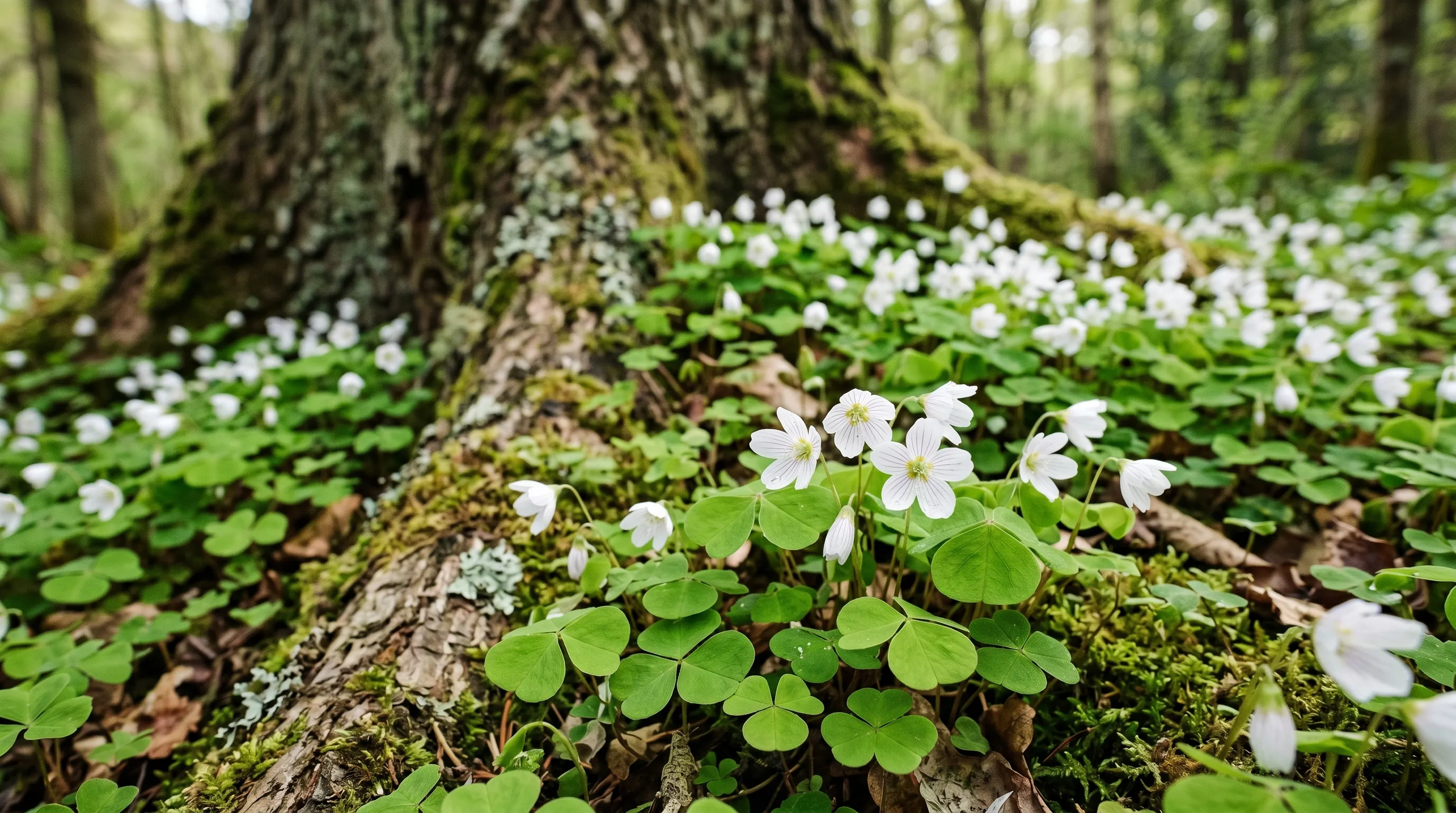 Wood sorrel Oxalis acetosella under a Scottish oak. The folded leaflets and lemon-tart flavour distinguish it from non-edible clovers.
Edible weeds compared
| Weed | Latin name | Key vitamin/mineral | Best harvest | Toxic look-alike risk |
|---|---|---|---|---|
| Dandelion | Taraxacum officinale | Vit A 14000 IU/100g | Feb-Apr leaf | Low - cat’s ear is also edible |
| Nettle | Urtica dioica | Vit C 333mg/100g | Mar-Jun tops | None |
| Ground elder | Aegopodium podagraria | Vit C 109mg/100g | Mar-May | High - hemlock kills |
| Chickweed | Stellaria media | Vit C 375mg/100g (dried) | Mar-Jun | Low - pimpernel mildly toxic |
| Wild garlic | Allium ursinum | Vit C 150mg/100g | Mar-May leaf | High - lily of valley kills |
| Garlic mustard | Alliaria petiolata | Vit C 261mg/100g | Feb-May leaf | None |
| Cleavers | Galium aparine | Silica, vit C | Feb-May shoots | None |
| Hairy bittercress | Cardamine hirsuta | Vit C, sulphur | Year-round | None |
| Fat hen | Chenopodium album | Protein 4.2g/100g | Jun-Aug leaf | Low - nightshade rare |
| Wood sorrel | Oxalis acetosella | Vit C, oxalic acid | Year-round | None |
Anyone harvesting ground elder must learn three plants on the same day: ground elder, cow parsley, and hemlock. All three are members of the carrot family (Apiaceae). All three have white umbel flowers and feathery foliage at first glance. One is dinner. One is bland but safe. One will kill you in under 12 hours.
A 2014 Royal Botanic Garden Edinburgh review identified hemlock as the most-mistaken hedgerow poisonous plant in the UK, with 7 to 12 hospital cases each year attributed to misidentification. Read the Botanical Society of Britain and Ireland species accounts for definitive identification photographs before any umbel harvest.
Foraging month-by-month UK calendar
| Month | Top weeds to harvest |
|---|---|
| January | Chickweed, hairy bittercress, dandelion roots |
| February | Chickweed, hairy bittercress, garlic mustard rosettes, dandelion leaves |
| March | Nettle tops, wild garlic leaves, ground elder, dandelion leaves, cleavers shoots |
| April | Wild garlic leaves and flowers, nettle, ground elder, garlic mustard, dandelion flowers |
| May | Wild garlic flowers, ground elder, nettle (before flowering), elderflower |
| June | Fat hen young leaves, hairy bittercress, nettle (final cut), cleavers |
| July | Fat hen, dandelion flowers, wood sorrel, garlic mustard seeds |
| August | Fat hen leaves and seeds, hairy bittercress, wood sorrel |
| September | Fat hen seeds, chickweed regrowth, hairy bittercress |
| October | Dandelion roots, chickweed, hairy bittercress |
| November | Chickweed, hairy bittercress, dandelion roots |
| December | Chickweed, hairy bittercress (mild winters) |
Common mistakes when foraging garden weeds
Eating umbels without the three-plant comparison. Ground elder, cow parsley, and hemlock all share white umbel flowers. People assume “looks like cow parsley” means safe. Hemlock kills with a leaf or two of ingestion. Learn all three side by side first, ideally with an experienced forager.
Skipping the wild garlic smell test. Lily of the valley sends up paired leaves at exactly the same time as wild garlic, in the same damp shaded soil, with similar leaf shape. Lily of the valley contains cardiac glycosides that stop the heart. There is no garlic smell. Crush one leaf between your fingers every single harvest, not just the first time.
Harvesting after rain in dog-walked spots. Roundworm eggs from fox and dog faeces remain viable on plant surfaces for up to 3 weeks. Wash all foraged greens in cold water with a tablespoon of vinegar per litre, agitate for 30 seconds, rinse.
Pulling up the roots. Section 13 of the Wildlife and Countryside Act 1981 bans uprooting any wild plant on land you do not own. Picking leaves and flowers stays legal. Yanking out a dandelion root on a public footpath does not.
Treating young leaves the same as mature ones. Nettles after flowering accumulate gritty cystoliths that irritate the kidneys. Dandelion leaves turn aggressively bitter once the plant flowers. Ground elder coarsens after May. Stick to the harvest windows in the calendar table.
Storing and preserving foraged weeds
Most edible weeds wilt within 24 hours of picking. Refrigerate in a damp tea towel inside an open bag. Three preservation methods extend the season.
Blanching and freezing. Plunge nettles, ground elder, or fat hen into boiling water for 60 seconds. Drain and refresh in ice water. Squeeze dry, portion into 100g balls, freeze on a tray then bag. Holds 9 months at -18C.
Drying. Dandelion roots, nettle leaves, and cleavers dry well for tea. Spread in a single layer on a baking tray at 40-50C for 4-6 hours in a fan oven, door propped open with a wooden spoon. Store in airtight jars away from light.
Vinegar pickling. Wild garlic buds make capers. Pack into a sterilised jar, cover with 5 percent white wine vinegar plus 1 tsp salt and 1 tsp sugar per 250ml. Leave 4 weeks before eating. Keeps 12 months sealed.
For more detail on preserving home-grown produce, see our guides on drying herbs at home and drying vegetables for winter soup.
Frequently asked questions
What is the most common edible weed in UK gardens?
Dandelion is the most common edible UK garden weed. Every part of Taraxacum officinale is edible. Leaves go into salads, flowers fry into fritters or ferment into wine, and roasted roots make a caffeine-free coffee. Pick young leaves before flowering to avoid the strong bitter chicory taste.
Is it legal to forage weeds from my garden?
Yes, fully legal on land you own or rent. The Wildlife and Countryside Act 1981 only restricts uprooting plants on land you do not own. Picking leaves, flowers, fruits, or seeds from your own garden carries no legal limit. On someone else’s land the “four Fs” rule (fruit, foliage, fungi, flowers) applies for personal use only.
Which UK weeds look like wild garlic but are poisonous?
Lily of the valley, lords-and-ladies, and autumn crocus all resemble wild garlic in early spring. None smell of garlic when crushed. Always tear a leaf between your fingers and sniff before harvesting. If there is no clear garlic smell, the plant is not Allium ursinum. Lily of the valley contains cardiac glycosides and can be fatal.
Can you eat stinging nettle raw?
No, raw nettles still sting. Cooking, blanching, drying, or thorough crushing breaks down the formic acid in the stinging hairs. Boil for 60 seconds or steam for 90 seconds before eating. Young spring tops (the top four leaves) work best for soup, pesto, and tea. Dried nettle leaf makes an iron-rich infusion.
What edible weed has the most vitamin C?
Stinging nettle leads at 333mg per 100g raw. Chickweed reaches 375mg per 100g when dried. Both deliver more than five times the vitamin C in an orange (53mg per 100g). Wild garlic provides 150mg per 100g of fresh leaves, garlic mustard 261mg per 100g.
When is the best time to forage edible weeds in the UK?
March to June for most leaf crops. Wild garlic peaks April to early May, nettles March to early June, dandelion leaves February to April before bitterness sets in. Autumn harvests focus on seeds (fat hen, garlic mustard) and roots (dandelion, burdock). Chickweed and hairy bittercress can be picked year-round in mild winters.
How do you tell hemlock from cow parsley and ground elder?
Check the stem. Hemlock has hairless purple-blotched stems and smells of mice when crushed. Cow parsley has hairy green ridged stems and smells of aniseed. Ground elder shows clusters of three leaflets in threes (“nine in three”) with a hollow grooved hairless stem and a celery-parsley smell. Confirm two features before eating any umbel.
Are there any edible weeds I should never harvest in autumn?
Avoid mature nettles after July. After flowering, nettles develop calcium oxalate cystoliths that irritate the kidneys. Old ground elder leaves turn coarse and soapy. Dandelion leaves become aggressively bitter. Switch to autumn-friendly weeds: fat hen seeds, chickweed regrowth, hairy bittercress, and dandelion roots.
Now you’ve identified your edible weeds, learn how to use them
To turn your harvest into kitchen staples, our walkthroughs on making comfrey and nettle feed and edible hedgerow plants to forage cover the next steps in self-sufficient growing.
Our team produces practical UK gardening guidance from source research, contributor records and established horticultural practice. Editorial standards are overseen by Matt W.