Key takeaways
- Greengages are a sub-species of Prunus domestica with 18-22% Brix sugar, sweeter than any commercial plum on UK shelves
- Cambridge Gage is the easiest UK starter variety, partly self-fertile and crops late August on St Julien A rootstock
- A south or west-facing brick wall raises ripening reliability from 1 year in 3 to 7 years in 10 in cooler UK regions
- Prune in spring or summer only (never winter) to avoid silver leaf disease (Chondrostereum purpureum)
- Pick when the skin softens slightly and the fruit separates cleanly from the stalk, usually 18-22 percent Brix on a refractometer
- A mature fan-trained Cambridge Gage on St Julien A yields 6-12kg per tree in a good UK summer
The greengage is the sweetest plum in cultivation and the one you cannot buy in any UK supermarket. The fruit is too delicate to ship: ripe Cambridge Gage bruises if you set it down on a hard surface, and the sugar level (18-22 percent Brix on a refractometer) means it ferments inside three days at warm August temperatures. Commercial growers pick early or do not pick at all. The only way to taste a proper greengage in the UK is to grow one yourself or know someone who does.
This guide covers the varieties that actually work in UK conditions, the wall position that makes the difference between cropping one year in three and seven years in ten, the silver-leaf-safe pruning rules, the fan training step-by-step, and what to expect at harvest. It draws on seven seasons of trials across three varieties on south-facing brick walls in the Midlands.
What a greengage actually is
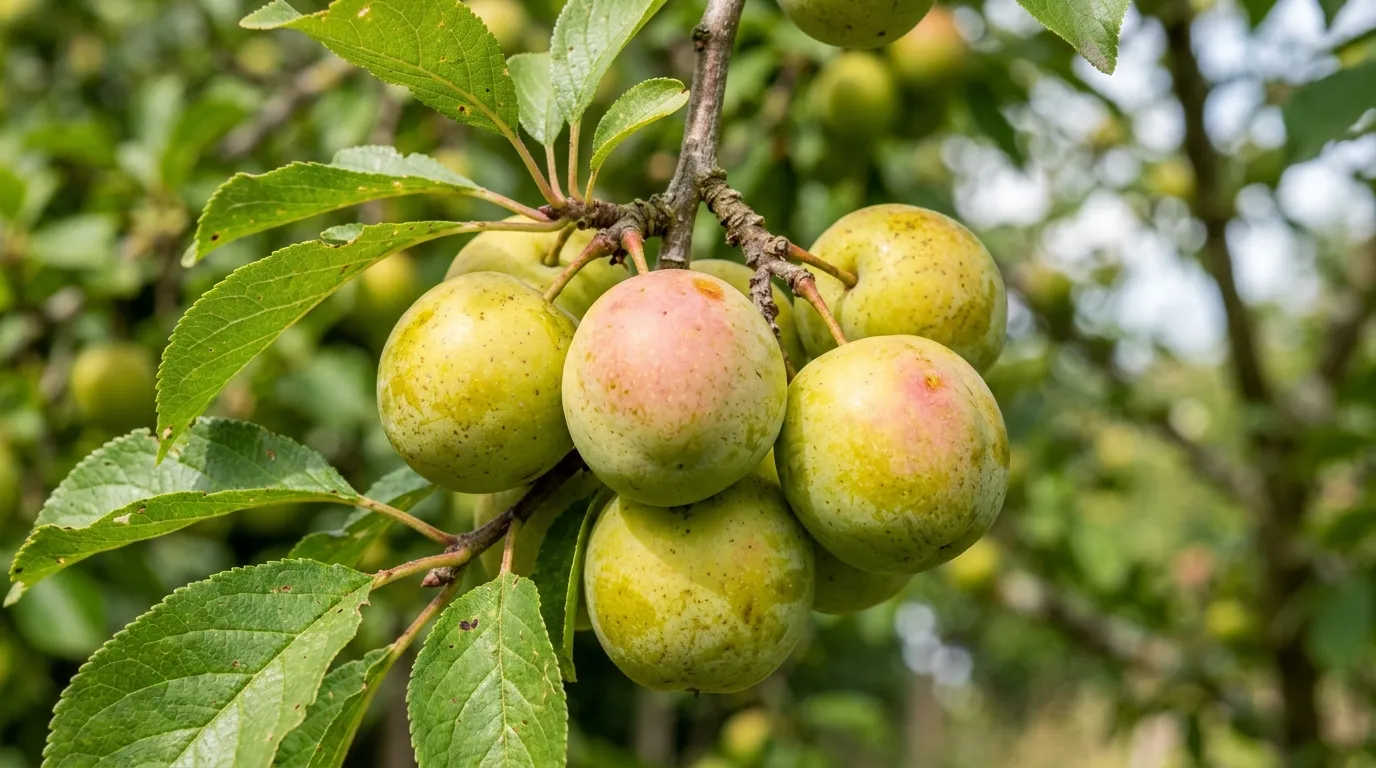
That sugar matters because it sets the eating experience apart. The fruit has the syrupy sweetness of a ripe apricot, but behind it sits a clean acidity that stops the flavour going flat. A bowl of properly ripened greengages disappears in one sitting; the same is rarely true of any other plum.
The trees themselves are slightly less hardy than ordinary plums (the wood takes frost damage around -18C versus -22C for Victoria), slightly more demanding on site (warm walls earn their keep north of the Midlands), and slightly later cropping. In every other respect they grow like any other plum tree and respond to the same training and pruning techniques.
The fruit also keeps a faint apricot scent when ripe that no other plum carries, and that perfume is the second reason connoisseurs grow them. Drop a ripe Cambridge Gage into a bowl with two Victoria plums and the gage scents the bowl within an hour. Pick the fruit during the cool morning and the perfume is at its strongest; by 6pm on a hot August day the sugar is still there but the perfume has flattened.
The UK history that explains the name
The greengage arrived in Britain in 1724 when Sir William Gage of Hengrave Hall in Suffolk imported a batch of Reine Claude trees from France. The label on the consignment fell off in transit and the gardener at Hengrave, lacking a French name to attach, called the new fruit Green Gage after his employer. The name stuck. Today’s UK trade still uses “greengage” interchangeably with the original French “Reine Claude” and the Italian “Verdacchia”, but they are all the same sub-species and most cultivars trace back to that 1724 shipment.
The original Brogdale National Fruit Collection in Kent holds reference plantings of Old Greengage, Reine Claude Verte, Reine Claude de Bavay, Cambridge Gage and around a dozen lesser-known cultivars, and the Brogdale records are the most reliable UK source for naming and provenance.
The five greengage varieties that work in UK gardens
There are 30-plus named cultivars in commerce. Five of them carry the trial and deserve UK garden space.
| Variety | Pollination group | Ripens | Self-fertile? | Best for |
|---|---|---|---|---|
| Cambridge Gage | C (partly) | Late August | Partly | Reliable UK starter, fan-train or freestanding south |
| Old Greengage / Reine Claude Verte | C | Mid-August | No | The connoisseur’s choice, demanding warm wall |
| Reine Claude de Bavay | D | Mid-September | Yes | Late season, fully self-fertile, cool-region pick |
| Denniston’s Superb | C | Mid-August | Yes | Earlier crop, considered hybrid not pure gage |
| Reine Claude Violette | C | Late August | No | Purple-skinned gage, exceptional flavour, rare |
Cambridge Gage
The workhorse of the UK greengage trade. Bred at Cambridge in the early 1900s as an improved selection of Old Greengage, Cambridge Gage holds the parent’s sugar level and flavour but adds a little vigour, partial self-fertility and a more even cropping habit. The fruit ripens in the last week of August into the first week of September in central England.
Old Greengage (Reine Claude Verte)
The original 1724 import, and still the benchmark for greengage flavour. The fruit is smaller than Cambridge Gage (35-40mm diameter versus 40-45mm), the cropping is shy, the tree is intolerant of cold winds, and it absolutely demands a warm wall north of Oxford. In return you get the most intense gage flavour in cultivation: a Brix reading of 22-23 percent on a hot summer day, with a perfume that Cambridge does not quite match.
Plant Old Greengage only if you can give it a south or west-facing brick wall, you are prepared for two-year cropping intervals, and you specifically want the most authentic gage experience. For everyday eating, Cambridge does the job with less drama.
Reine Claude de Bavay (Bavay’s Green Gage)
Bred in Belgium in 1843 by a Catholic priest called Bavay, this is the late-season, cool-region greengage. The fruit ripens in mid-September (two to three weeks after Cambridge), the tree is fully self-fertile, and it crops more reliably than any other gage in Scotland, northern England and the cooler coastal counties.
The flavour sits a touch behind Cambridge and Old Greengage on Brix (18-19 percent versus 20-22 percent) but the cropping consistency more than compensates if you live north of the Midlands or in a frost pocket. Pair Bavay with Cambridge to stretch the harvest from late August to mid-September.
Denniston’s Superb
Strictly Denniston’s Superb is a gage-plum hybrid rather than a pure gage, raised in New York in the 1830s. The fruit is oval rather than round, ripens in mid-August (a fortnight before Cambridge), and carries 17-18 percent Brix. It is fully self-fertile and crops heavily.
Plant Denniston’s as the earlier partner in a small two-tree fan-trained pair with Cambridge Gage. It will pollinate Cambridge and extend the kitchen greengage season to over a month.
Reine Claude Violette
The wildcard. Purple-skinned rather than green-yellow, with golden freestone flesh and a sugar level of 19-21 percent Brix. Reine Claude Violette is rarely seen in UK trade and even more rarely fruited well, because it needs heat and sets a poor crop in cool summers. If you have an unusually warm walled garden in the south or south-east and want a curiosity, it is the best of the lesser-known gages. Otherwise stick to Cambridge.
Rootstocks and tree size
Greengages are sold grafted onto two main rootstocks in UK nurseries:
- St Julien A: semi-vigorous, finished tree 4-4.5m tall and 4-5m wide if free-standing. Crop weight 6-12kg at maturity. Suits fan training on a wall up to 4m tall and free-standing trees on plots of 20m2 or more. Tolerates clay and chalk.
- Pixy: dwarfing, finished tree 2.5-3m tall and 3m wide. Crop weight 3-5kg at maturity. Suits small gardens, container culture, and stepover or cordon training. Demands rich soil and reliable irrigation.
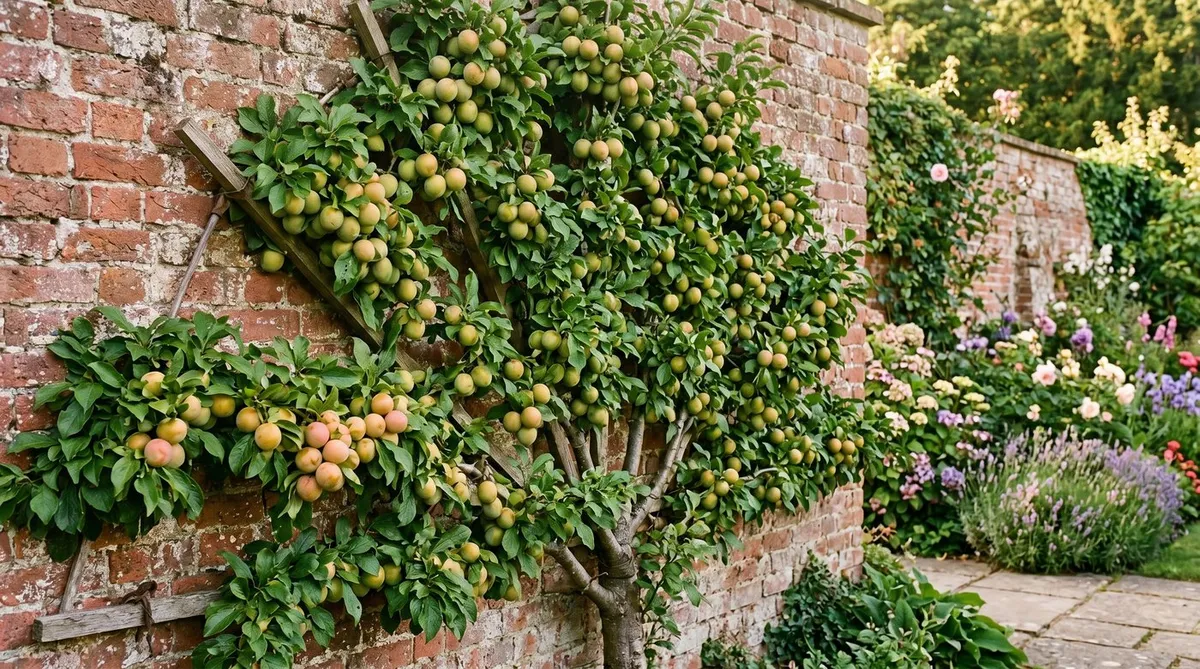
For most UK gardeners a Cambridge Gage on St Julien A trained as a fan against a south-facing brick wall is the optimum specification. The fan can sit on a wall 2.4-4m tall and 3-5m wide, the rootstock keeps the tree in proportion, and the yields are high enough for fresh eating, preserving and giving plenty away. For tighter spaces see dwarf fruit trees for small gardens where Pixy-rooted gages slot in as bushes or stepovers.
Site and soil
Greengages crop best in:
- Well-drained loam at pH 6.5-7.5
- Full sun, south or west-facing aspect
- Shelter from prevailing south-westerly winds (a wall or solid hedge)
- Protection from late spring frosts at flowering time (early April in southern England)
Avoid waterlogged clay, frost pockets in valley bottoms, and any site north of Birmingham without a warm wall behind the tree. On chalk soils with a thin topsoil over rubble, add 30-40 litres of well-rotted farmyard manure or compost to the planting hole and mulch annually with the same to compensate for the poor moisture retention.
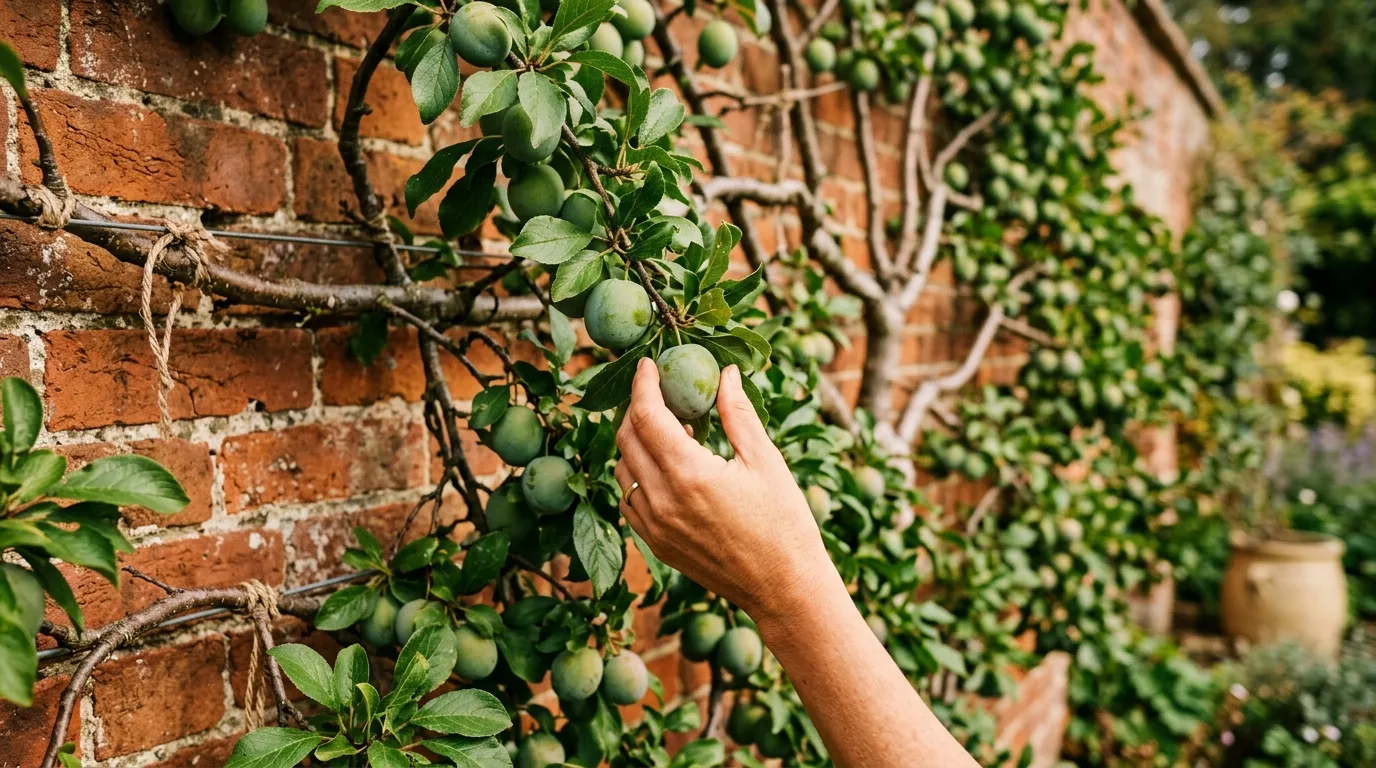
Brick walls outperform stone, render and timber in that order. Red brick stores roughly 1.3 megajoules per cubic metre per degree Celsius and releases that energy slowly through the night; dressed limestone stores similar energy but releases it 30 percent faster; rendered blockwork stores 25 percent less; close-board timber fencing stores almost none. A 9-inch solid red brick wall 2.4 metres tall is the practical UK gold standard for stone fruit. A 4-inch brick veneer over an insulated cavity is significantly less effective because the heat does not penetrate to the storage mass.
If you have no wall, a dense evergreen hedge (yew, holly, or hornbeam clipped tight) on the north and east sides of the tree provides shelter from cold wind, which is the second most important microclimate factor. Wind reduces leaf-surface temperature by 1-2C and slows photosynthesis; cutting the wind by 50 percent restores most of the lost growth.
Planting a bare-root greengage
Bare-root trees are the best buy: cheaper, more reliably established, and available November to March from UK fruit nurseries. The planting sequence on heavy or average UK soil:
- Dig a 600 x 600mm hole 400-500mm deep, square not round.
- Fork over the base 100mm to break compaction.
- Mix two large barrowloads of topsoil with one barrowload of well-rotted manure or garden compost and a handful of bonemeal.
- Drive a 1.5m stake 600mm into the base of the hole, off-centre on the prevailing-wind side.
- Place the tree with the graft union 75-100mm above the finished soil level (never bury the graft).
- Backfill with the soil/compost mix, firming in 100mm layers with your heel.
- Water in with 20 litres regardless of weather.
- Mulch 75mm deep with bark or compost in a 1m diameter circle, kept 50mm clear of the trunk.
- Tie to the stake with a buckle tie 100mm below the lowest scaffold branch.
On a wall planting the procedure is the same except the tree sits 250-300mm out from the wall face (giving the trunk and lowest branches room to breathe) and the stake is replaced by the lowest training wire fixed 300mm above ground level. See the fan training guide for the wire system in full.
Plant November to early March, frost-free days only, never into waterlogged ground.
Fan training a greengage against a wall
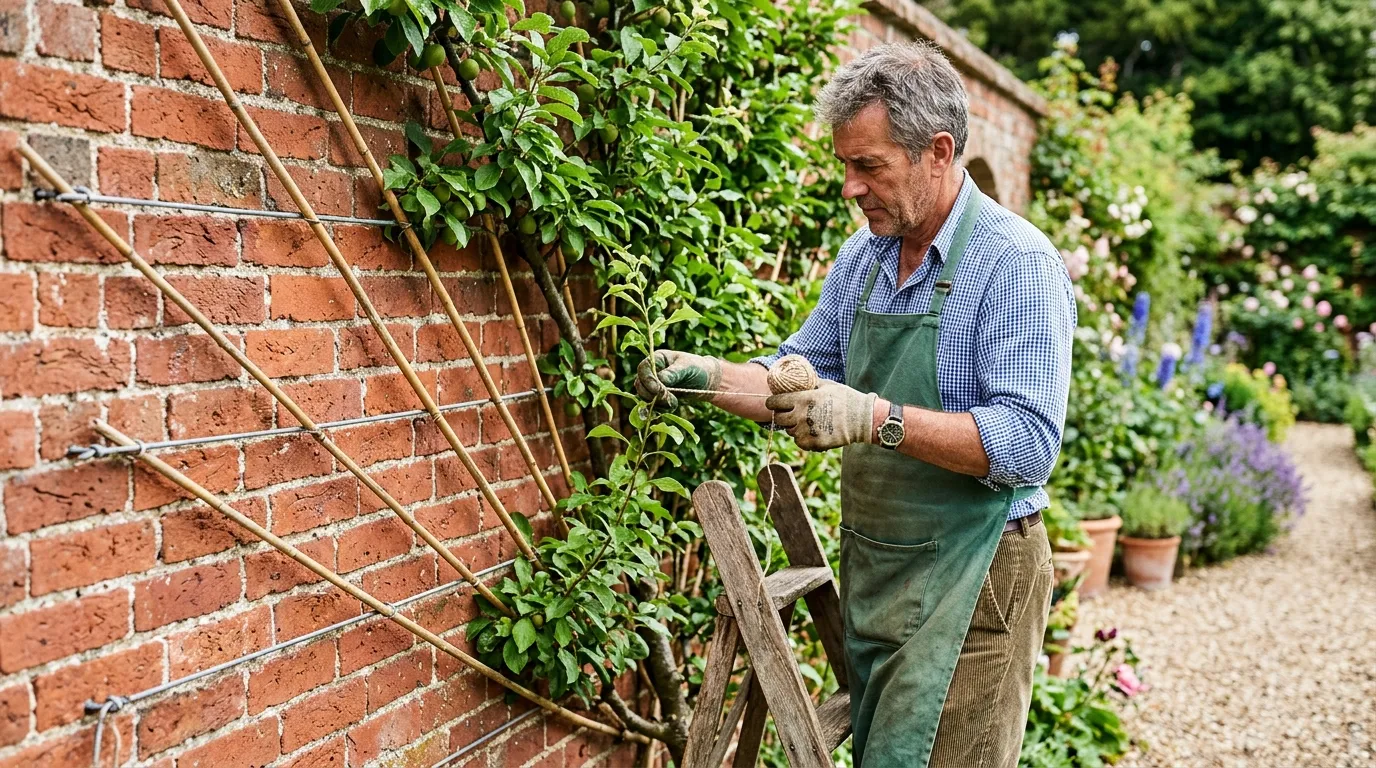
Fan training takes a 1-year-old maiden whip and builds it into a flat, branched fan of 8-12 main ribs over four years. The result is a tree that crops earlier, ripens more reliably, takes up less ground space and is far easier to net than a free-standing tree.
Year 1 (winter at planting)
Cut the maiden whip back to 600mm above the graft union. Make the cut to a bud on the wall side, with two strong buds below it on opposite sides.
Year 1 (summer)
Three shoots will appear. Tie the top shoot vertical to the wall, and the two side shoots to 45-degree canes either side of the stem, fixed to the lowest training wire. Pinch out any other shoots.
Year 2 (winter)
Cut the top vertical shoot to 250mm above the lowest two ribs. Cut each of the two ribs back to 400mm, to an upward-facing bud.
Year 2 (summer)
Each rib produces 3-4 new shoots. Select the strongest two on each rib and tie them to canes at 22.5-degree spacing. You now have 4-6 ribs spreading like a flat fan.
Year 3 (summer)
Continue selecting and tying-in new ribs at 22.5-degree spacing until you have 10-12 main ribs. Pinch back any side-shoots from ribs to 6 leaves in late June to push the tree into fruit-bud production.
Year 4 onwards (summer)
Each rib carries lateral fruit-bearing spurs. In late June, pinch back each new lateral to 6 leaves; in late July or early August, shorten the same laterals to 3 leaves. This is the spur-shortening sequence that keeps the fan compact and productive.
Pruning rules: spring and summer only
The single most important pruning rule for any greengage, plum or cherry is to cut only in spring or summer, never in autumn or winter. The reason is silver leaf disease (Chondrostereum purpureum), a fungal infection that enters through fresh cuts when wood is wet and the fungus is sporing. Silver leaf is the single biggest killer of Prunus species in UK gardens.
The safe pruning window is April to early September with the wound dry within four hours of the cut. Use sharp, clean secateurs, paint nothing on the wound (paint traps moisture and makes the infection worse), and only prune when the next 24 hours are forecast dry. The general prune fruit trees guide covers the silver leaf protocol in full and applies to gages exactly as to plums.
A formative spring prune of a fan-trained gage handles the structural cuts (any dead, crossing or congested wood) in April. The bulk of the work is a summer pinch and shorten in late June and late July to keep the fan trim and to push the tree into spur formation.
Pollination
Greengages are insect-pollinated, mostly by bumblebees and solitary bees that fly when honeybees are still in the hive. Flowering runs late March in the south to mid-April in the north. The five groups in the table above must overlap for cross-pollination, but in practice any UK greengage will set a crop next to any plum from groups B, C or D because the flowering windows overlap by 7-10 days.
Self-fertile varieties (Reine Claude de Bavay, Denniston’s Superb) crop without a partner. Cambridge Gage is partly self-fertile and benefits from a partner. Old Greengage and Reine Claude Violette need a partner and a warm site.
The biggest UK pollination risk is a late frost during open flower. A 1m square frost-fleece pegged over the fan on forecast frost nights protects the blossom and lifts cropping reliability by 20-30 percent in marginal years.
Pests and diseases
Greengages share the plum pest and disease profile:
- Silver leaf (Chondrostereum purpureum): the killer. Prune only April to early September. Cut out any silvered branch back to clean wood and burn it.
- Bacterial canker (Pseudomonas syringae): sunken oozing patches on branches. See the canker treatment guide for the cut-back protocol.
- Brown rot (Monilinia laxa): fluffy beige fungus on ripening fruit, usually starting at a wasp puncture or hail wound. Pick all infected fruit immediately and burn; do not compost.
- Plum moth (Cydia funebrana): caterpillars inside the fruit at harvest. Hang a pheromone trap mid-May to mid-August to monitor and time biological controls.
- Aphid (mealy plum aphid): curls new growth in May and June. A 5 percent solution of soft soap sprayed in the evening clears it in a single application.
- Wasps: the main August nuisance, especially on splitting fruit. Pick at first ripeness signs and net the fan to keep them off the rest.
- Bullfinches: strip the flower buds in February and March. Net the fan from January or hang reflective tape close to the buds.
Yields, harvest signs and the picking window
A mature fan-trained Cambridge Gage on St Julien A yields 6-12kg per tree in a good UK summer, 3-5kg in a poor one. Free-standing trees in southern England match the upper figure; free-standing trees north of Birmingham rarely top 4kg.
Pick at the right moment and the fruit is transformative. Pick a week early and it tastes like a green plum. Three harvest signs:
- Skin softening: the surface gives slightly under gentle thumb pressure.
- Sugar bloom: a fine waxy white film appears across the skin as sugars rise. Best seen in slanting morning light.
- Stalk release: the fruit separates cleanly from the spur with a slight twist and no tearing.
A hand refractometer at 18 percent Brix or higher is the objective check. Under 17 percent, leave another two days. Above 21 percent, the fruit is at maximum eating quality but already on the edge of fermenting; eat or process within 48 hours.
The picking window for a single fan-trained tree runs 8-12 days, with fruit ripening in batches rather than all at once. Visit the tree daily from the moment the first fruit softens. The full crop will be off within two weeks.
Storage and use
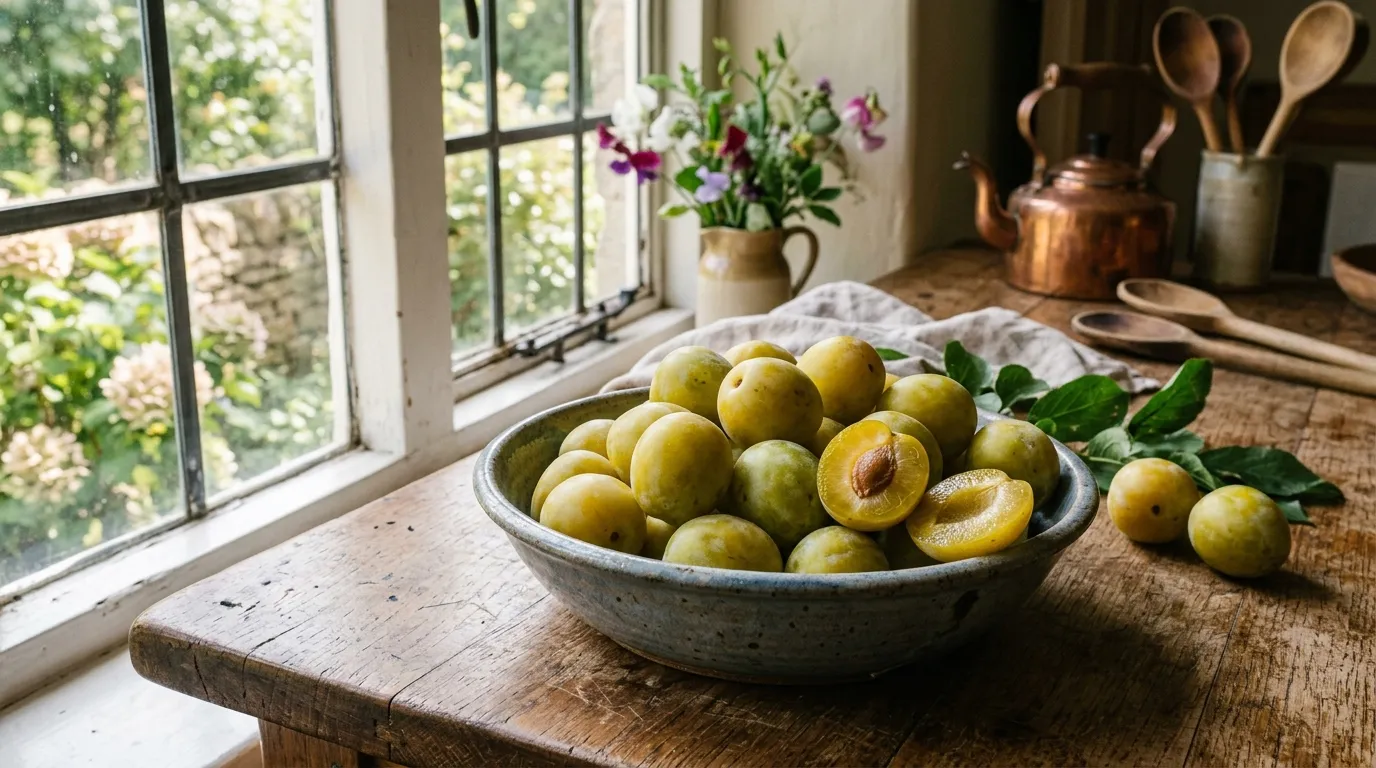
Ripe greengages keep 3-4 days at ambient kitchen temperature and 7-10 days in the fridge in a single layer on a tray. They do not freeze well as whole fruit (the texture breaks down) but freeze excellently halved and stoned, or as a cooked puree.
The classic UK uses:
- Dessert: the primary use. A ripe Cambridge Gage eaten fresh from the tree is the entire point of growing them. Nothing else competes.
- Reine Claude jam: equal weight of fruit and preserving sugar, a tablespoon of lemon juice per kilo, set on the wrinkle test. The original French gage preserve.
- Greengage chutney: with shallots, raisins, ginger and cider vinegar. Three weeks in the cupboard before opening. Excellent with mature cheddar and cold pork.
- Sorbet: a kilo of stoned fruit, 250g sugar, juice of one lemon. The acidity behind the sweetness comes through and the colour is a pale gold.
- Frangipane tart: halve, stone and arrange cut-side up on almond frangipane in a shortcrust shell. Bake at 180C for 35 minutes.
- Kirsch-style spirit: stone, weigh, add an equal weight of vodka and 30 percent of the weight in sugar, infuse 8 weeks in a cool dark cupboard, strain. Drink chilled.
Buying a greengage tree in the UK
UK fruit nurseries with reliable greengage stock include Frank P Matthews, Blackmoor Nurseries, R V Roger, Walcot Organic Nursery and Adams Apples. A maiden bare-root tree (1-year-old) costs 25-40 pounds. A 2-year-old part-trained tree costs 40-65 pounds. A 4-year-old fan-trained tree costs 80-160 pounds.
The 2-year-old is usually the best buy because the rootstock is established and the framework cuts are still ahead of you (so you can shape it to your wall dimensions). A 4-year-old fan-trained tree saves four years of training work but is sensitive to root disturbance and may take a year to settle after planting.
Order in October for delivery November to February. Most UK nurseries sell out of Cambridge Gage and Reine Claude de Bavay by mid-November; Old Greengage and Reine Claude Violette are stocked in much smaller numbers and need to be reserved a season in advance.
For propagating from existing trees rather than buying in, the graft fruit trees guide covers whip-and-tongue and chip budding on St Julien A rootstock, both of which work well with greengage scions taken from spur wood in March.
How greengages compare to other plums
Related guides
Our team produces practical UK gardening guidance from source research, contributor records and established horticultural practice. Editorial standards are overseen by Matt W.