Key takeaways
- Bougainvillea is frost-tender: it needs a winter minimum of 10C and dies at the first frost
- Grow it in a 30-45cm pot of John Innes No 3, because it flowers best with tight roots
- The trick to bright bracts is drought stress: let the leaves droop, then water sparingly
- Feed high-nitrogen from mid-April, then switch to high-potash once the bracts show colour
- It flowers June to October on the current season's growth, so prune in late winter
- Move it under glass before the first frost in October and back out in early June
- Only far south-west Cornwall and the Channel Islands keep it outdoors all year
Learning how to grow bougainvillea in the UK starts with one decision: grow it in a pot. This Mediterranean-looking climber comes from South America, and it hates two things our winters throw at it. Frost and wet feet.
Keep it in a container and both problems solve themselves. You move the plant under glass before the cold arrives, and you control the watering that ruins it in open ground. Grown this way, bougainvillea earns its keep with sheets of magenta, purple or orange bracts from June to October. This guide covers the pot, the position, the feeding, that famous drought-stress trick, pruning, and getting it through a British winter alive.
Can you grow bougainvillea in the UK?
Yes, you can grow bougainvillea in the UK, but almost always in a pot under cover for winter. The plant is frost-tender and rated for a winter minimum of 10C. Below that it drops its leaves. At freezing point it dies.
That rules out permanent planting in the ground for nearly all of us. The exceptions are the very mildest, frost-free pockets: the far south-west of Cornwall, the Scilly Isles and the Channel Islands, against a sheltered south wall. Everywhere else, treat bougainvillea as a container plant that summers outdoors and winters in a conservatory, porch or heated greenhouse.
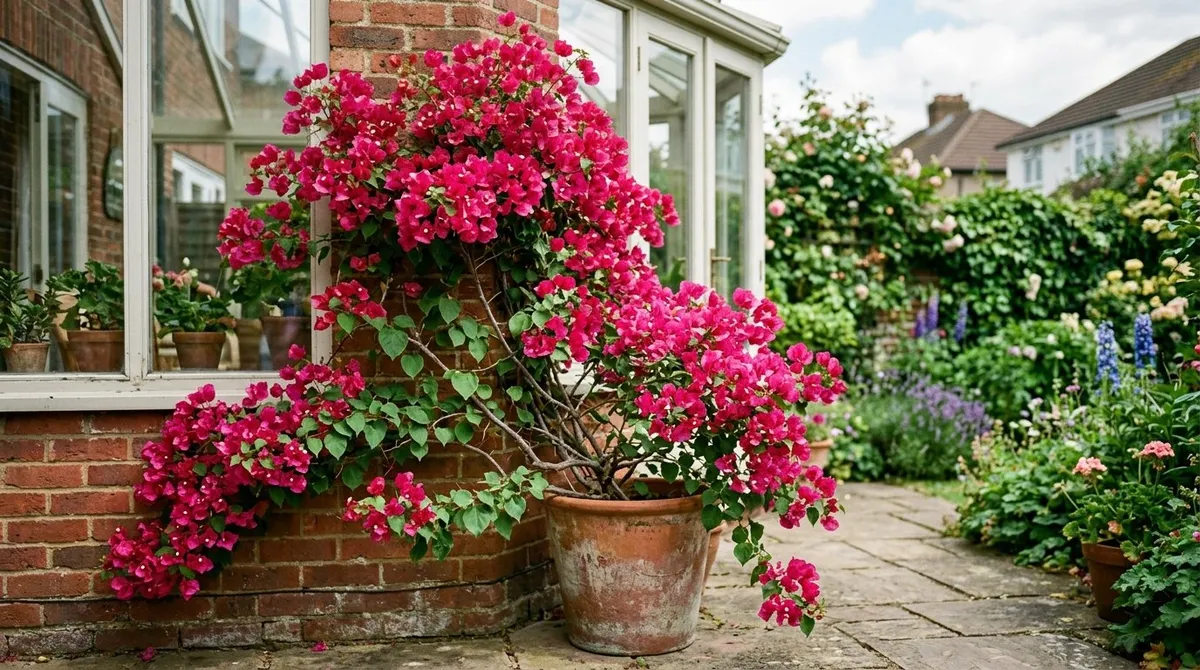
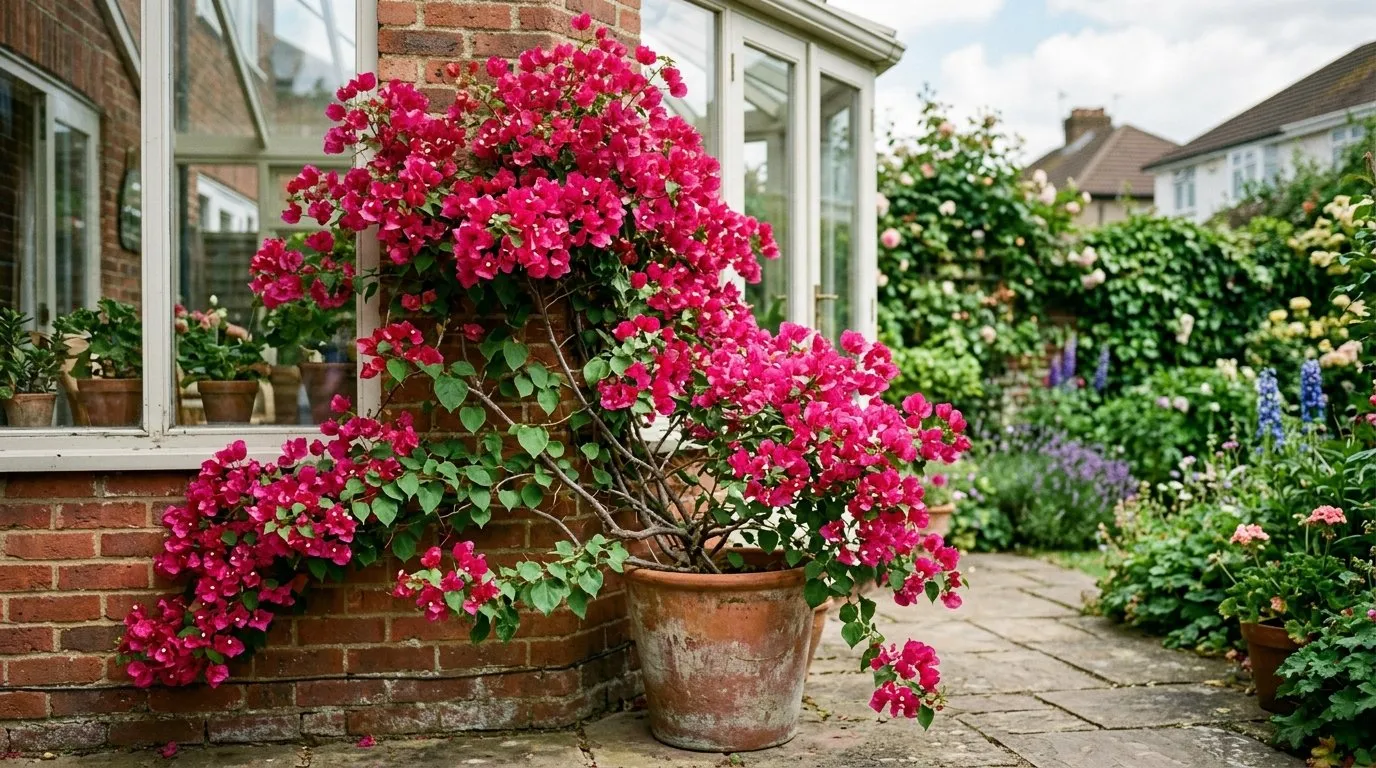 Bougainvillea trained against a warm conservatory wall in a suburban garden. The colour comes from bracts, not the tiny true flowers inside.
The colour you see is not petals. Bougainvillea flowers are the small, cream, trumpet-shaped things in the centre, usually three per cluster. The showy part is a ring of papery bracts, modified leaves that hold their colour for weeks. That structure is why the display lasts so long, and why the plant repays a bit of understanding.
Where should you grow bougainvillea in a UK conservatory or patio?
Give bougainvillea the sunniest, brightest, warmest spot you have. Under glass that means a south or west aspect with at least six hours of direct sun. On the patio it means a suntrap against a warm wall.
A conservatory or garden room is the ideal home. It gives the plant winter warmth and summer heat, which bougainvillea tolerates up to 38C without complaint. If you already grow tender specimens indoors, it slots in beside the usual conservatory houseplants without any fuss, though it wants more light than most.
From early June to late September, stand the pot outside in full sun. The extra light and air movement improve flowering and toughen the growth. Choose a sheltered corner, because wind shreds the soft bracts and dries the pot fast. A south-facing patio, courtyard or balcony is perfect.
Bougainvillea also earns a place in a wider warm-climate scheme. It pairs naturally with the greys and silvers of Mediterranean garden planting, and looks the part beside potted olives and pelargoniums on a sunny terrace. The trick is remembering that unlike those companions, it must come indoors before the first frost.
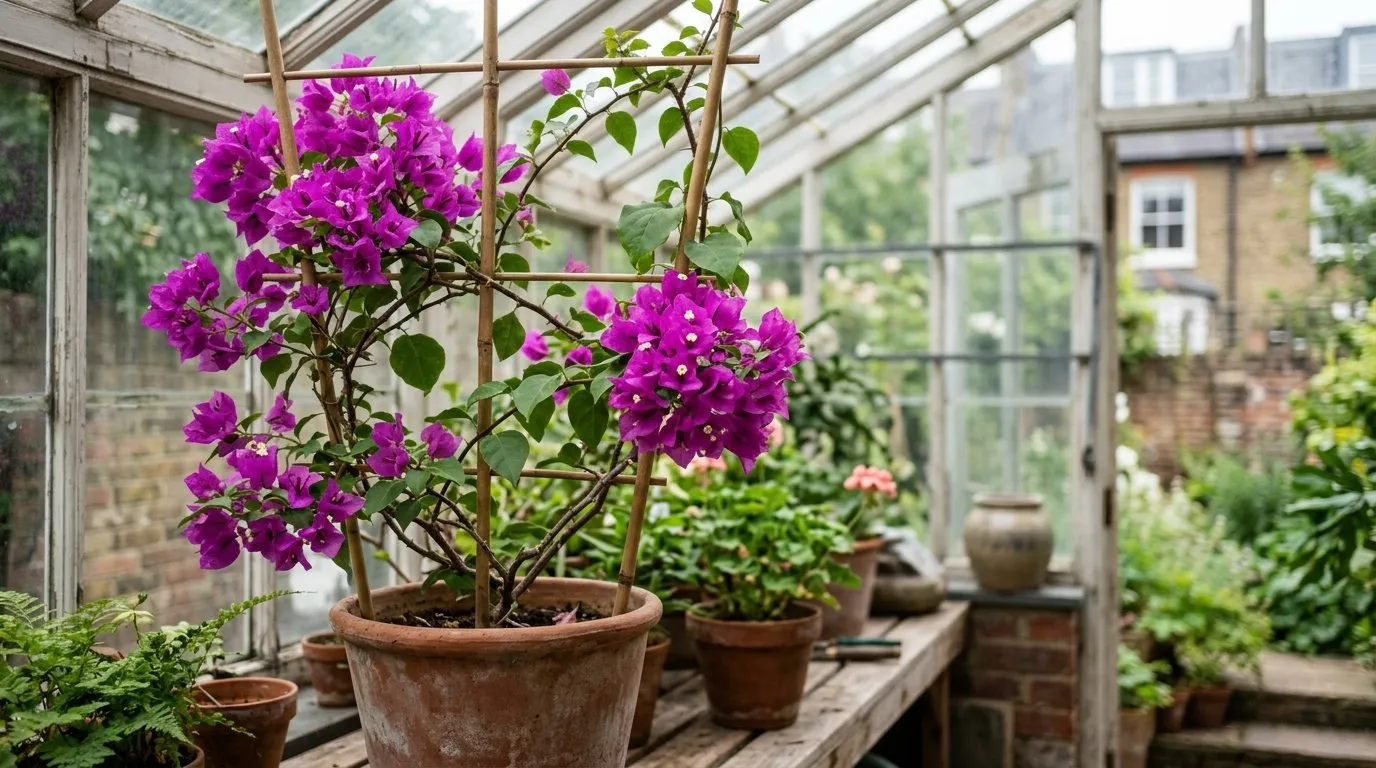 A potted bougainvillea inside a bright city conservatory. Winter warmth here keeps it above the 10C it needs.
Gardener’s tip: Put the pot on a plant caddy with lockable castors from the day you buy it. A mature bougainvillea in a 45cm pot of John Innes weighs a great deal, and you will be moving it twice a year for its whole life. Wheels turn a two-person heave into a one-handed push, and they save your back and your paintwork every October.
What compost and pot does bougainvillea need?
Bougainvillea wants a loam-based John Innes No 3 in a container only slightly bigger than its roots. It flowers best when root-restricted, so the common mistake is a pot that is too large.
Loam-based compost matters for three reasons. It holds nutrients longer than a peat-free multipurpose, it gives weight so a tall trained plant does not blow over, and it drains sharply when mixed with grit. Add a fifth by volume of horticultural grit to be sure. The plant likes a slightly acidic, free-draining root run and rots in anything that stays soggy.
Start a young plant in a 20-25cm pot and move up gradually. Most mature plants are happy in a final 30-45cm pot for years. Only pot on when roots fill the container completely, roughly every two or three years, and go up one size at a time. Repot in early spring, just as growth resumes.
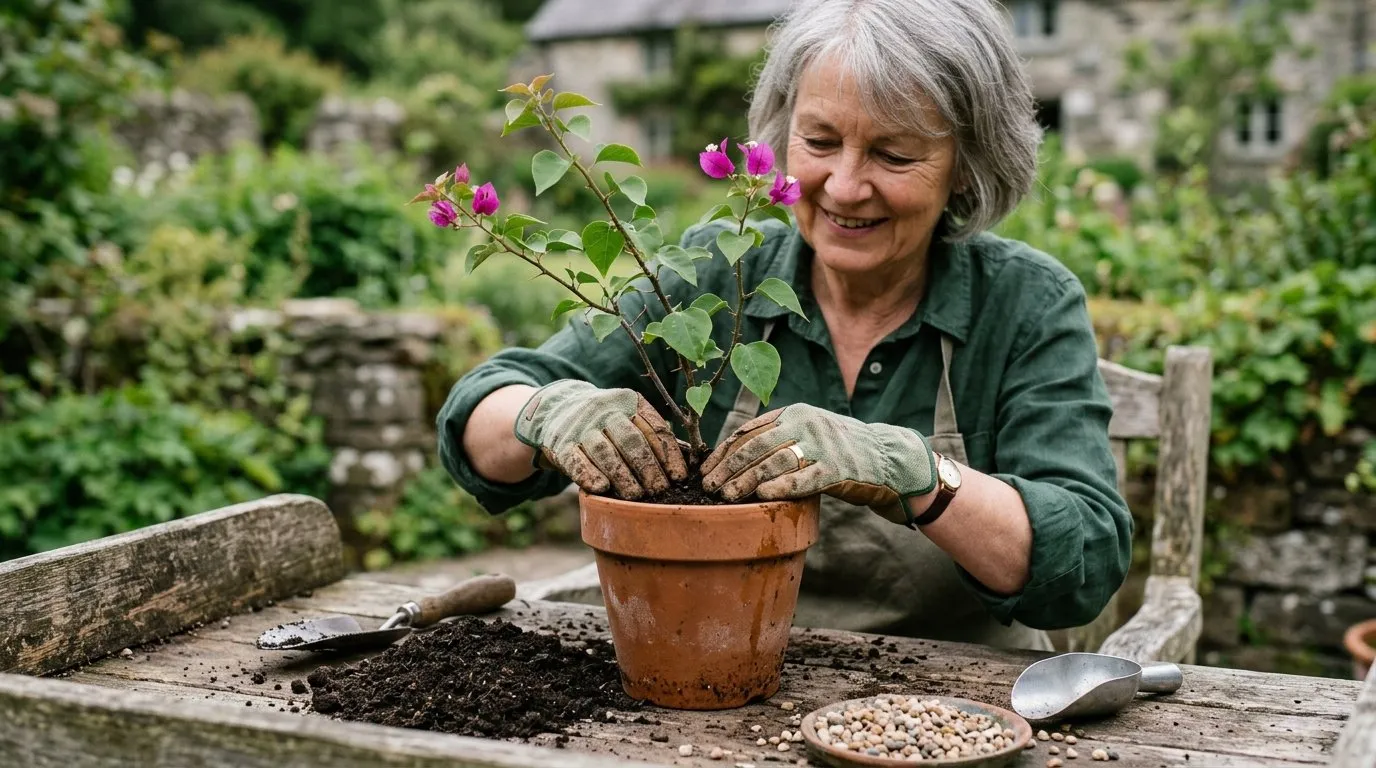 Potting on into loam-based John Innes No 3 with added grit. Go up one pot size only, because tight roots mean more bracts.
How do you make bougainvillea flower?
The single biggest trick is drought stress. Bougainvillea flowers on the current season’s growth, and it produces bracts when it is a little thirsty, not when it is comfortable.
Here is the method. Through summer, water freely while the plant grows, then let the compost dry until the leaves just droop. Water again, lightly, and repeat. This mild stress tells the plant to flower rather than grow leaf. Overwatering is the number one cause of a green bougainvillea with no colour. If yours is all leaf and no bract, ease off the watering can.
Feeding works with the watering, not against it. From mid-April, feed weekly with a high-nitrogen liquid feed to build the framework. Once you see bracts starting to colour, switch to a high-potash feed, such as a tomato food, which costs about £4 to £6 a bottle. Potash drives flowering. Nitrogen drives leaf. Getting the timing right is half the battle.
Light is the third factor. Six hours of direct sun is the minimum for a good display, and more is better. A plant in a shady conservatory corner will grow but sulk. Move it into the light and the bracts follow.
| Growth stage | Watering | Feed |
|---|---|---|
| Mid-April to May (growth) | Water freely, keep moist | High-nitrogen liquid, weekly |
| June to August (flowering) | Dry until leaves droop, then water | High-potash tomato feed, weekly |
| September (winding down) | Reduce frequency | Stop feeding |
| October to March (rest) | Barely moist, water monthly | None |
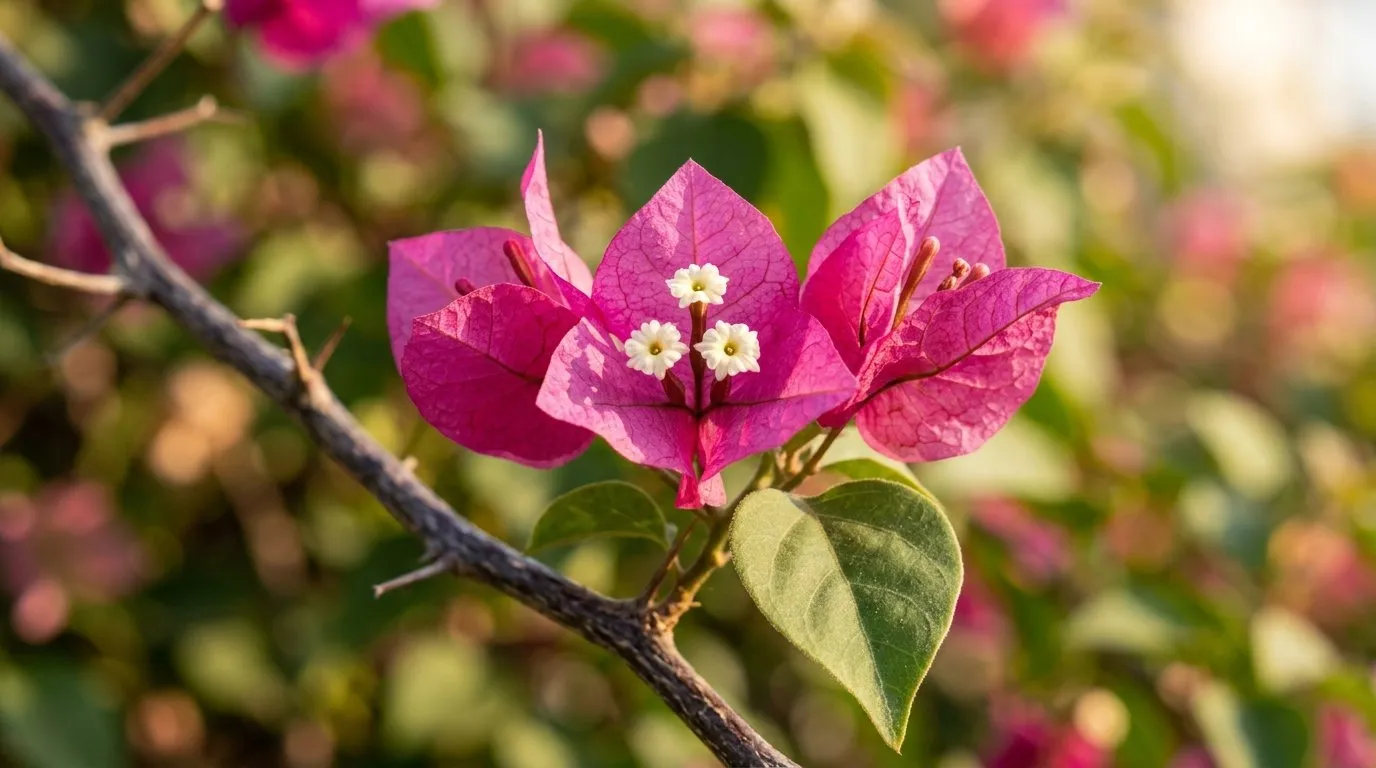 The papery bracts hold their colour for weeks. Mild drought stress through summer is what triggers this show.
How and when do you prune bougainvillea?
Prune bougainvillea in late winter or early spring, before new growth begins. Because it flowers on new wood, a hard prune now means more flowering shoots later.
Cut the previous year’s long stems back to two or three buds from the main framework. This is the main shaping cut, and it keeps the plant compact and floriferous. Take out any thin, weak or crossing growth at the same time. Do not be timid. A well-fed plant recovers fast and flowers harder for it.
During summer, keep it going with lighter cuts. After each flush of bracts fades, shorten the flowered growth by half. This encourages a second and even third flush through the season. Pinch out shoot tips on young plants to build a bushy shape.
Always wear thick leather gloves. Bougainvillea carries sharp, hooked thorns at every leaf joint, and they draw blood and can turn septic. Long sleeves help too. If you are training a plant against a wall or up a frame, tie in the young laterals while they are flexible, because old wood snaps rather than bends. Training a tender climber this way is much like managing a passionflower in a pot: a light frame, regular tying-in, and a hard tidy each spring.
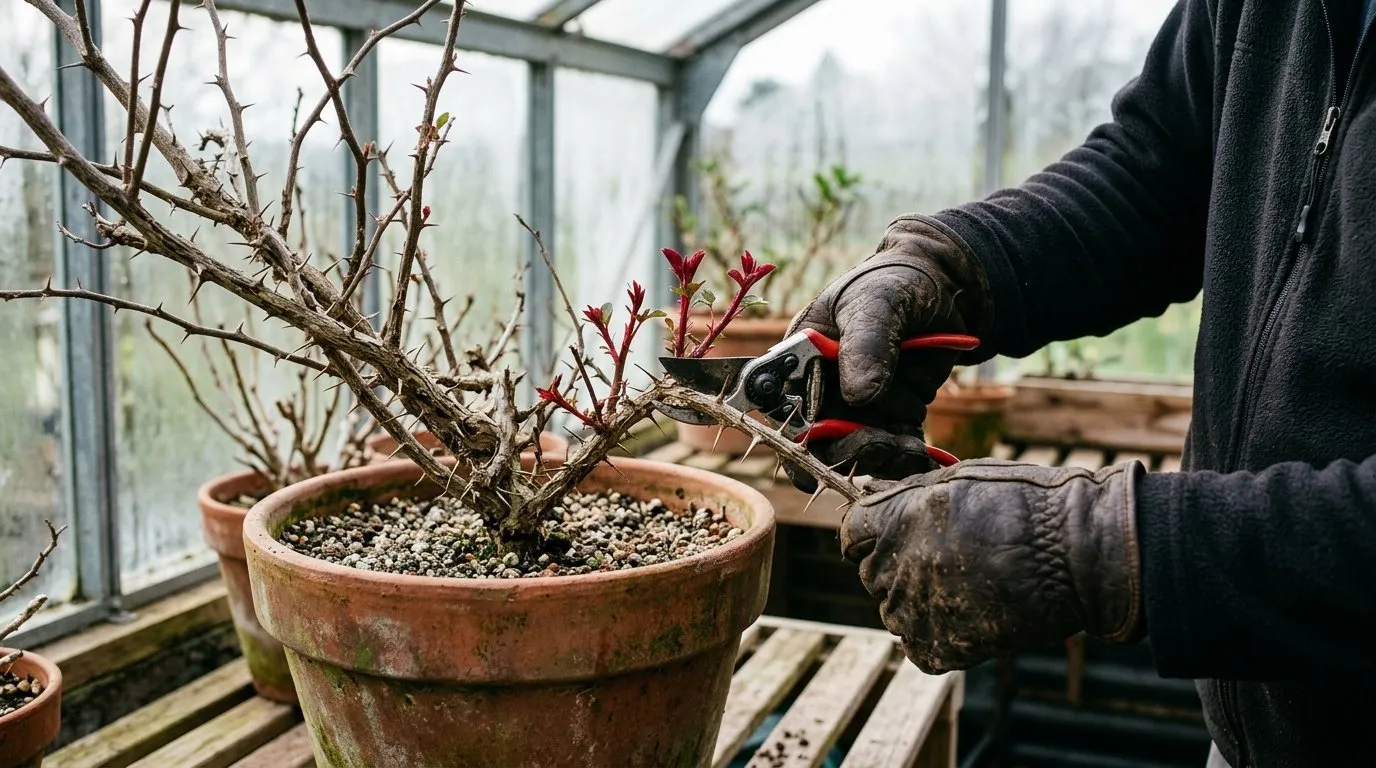 Cutting last year’s stems back to two or three buds. Thick gloves are essential against the hooked thorns.
How do you overwinter bougainvillea in the UK?
Move bougainvillea under cover before the first frost, usually late September or early October, and keep it above 5C all winter. This is the step that decides whether the plant lives or dies.
A frost-free conservatory, porch, garden room or heated greenhouse is ideal. Aim for a winter minimum of 10C if you want the plant to hold some leaf and tick over. At 5 to 7C it survives but goes near-dormant and drops most or all of its leaves. This looks alarming and is completely normal. Do not panic and do not throw it out.
Watering is the make-or-break job. Through winter, keep the compost barely moist, watering perhaps once a fortnight or once a month. A cold, wet rootball rots and kills more overwintered bougainvillea than cold alone ever does. Stop feeding entirely from October until growth resumes.
New red shoots usually appear in April. That is your signal to increase watering, resume feeding, and begin hardening the plant off for its move outdoors. The routine mirrors the one in our guide on how to overwinter plants in the UK, and it is the same discipline that keeps tender pelargoniums going through winter, as the RHS pelargonium guide sets out.
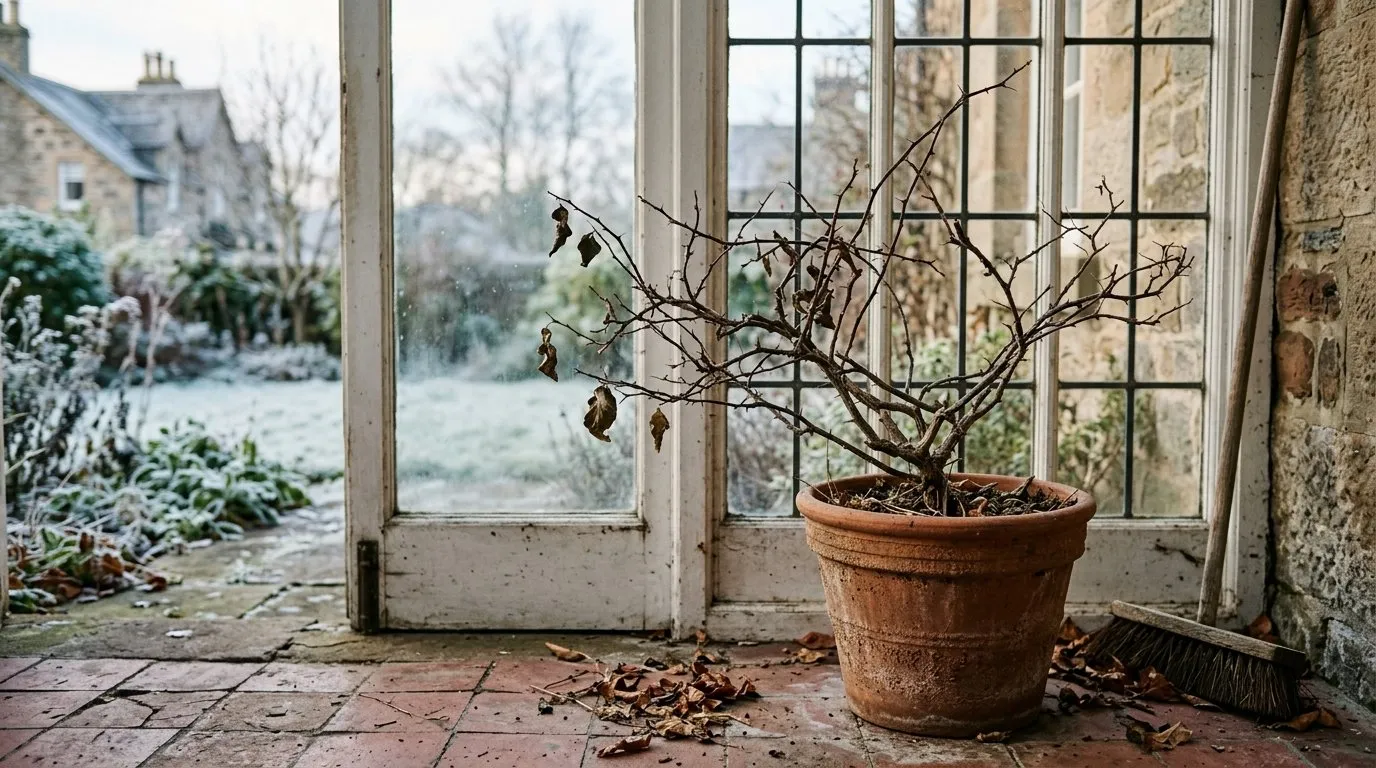 A near-dormant bougainvillea overwintering at 6-8C. Leaf drop is normal, and new red shoots return in April.
Return the plant outdoors only when all frost risk has passed, from early June in most of the country. Harden it off over ten to fourteen days, and never leave it out on a night below 8C. If a late cold snap threatens, our guide on how to protect plants from frost in the UK covers quick fleece cover, though the safest move is simply to wheel the pot back inside.
Can bougainvillea grow outdoors in the UK?
Only in the very mildest, frost-free corners of the country. For the vast majority of UK gardens, a permanent outdoor bougainvillea is not realistic, and pretending otherwise wastes a good plant.
Where it can work, the conditions are strict. You need a sheltered, south-facing wall, sharp drainage, and a genuinely frost-free microclimate. That describes parts of coastal Cornwall, the Isles of Scilly, the Channel Islands and a few urban suntraps in the far south. Even there, a hard winter can finish an established plant.
The honest verdict is that bougainvillea belongs in a container across most of Britain. This puts it alongside other borderline exotics like the olive tree in the UK, which many gardeners also keep potted and move to shelter. The container life is not a compromise. It is how you grow this plant well in a cool climate.
Which bougainvillea varieties grow best in the UK?
Choose vigorous, free-flowering cultivars that colour up reliably in our cooler, shorter summers. A few names have proved themselves in UK pots and conservatories.
‘Barbara Karst’ is the one to start with. It carries magenta-red bracts, grows vigorously, flowers young, and is reckoned one of the hardiest forms worth trying. It also trains beautifully into a standard.
‘Alexandra’ gives a reliable purple-pink and flowers freely even in a mixed summer. It is a sound choice for a first conservatory plant.
Expect to pay £20 to £35 for a young plant in a 2 to 3 litre pot from a specialist UK nursery. A larger, ready-trained standard or pyramid on a cane runs £45 to £90. Buying an established, trained plant saves two or three years of shaping.
| Variety | Bract colour | Habit | Best for |
|---|---|---|---|
| ’Barbara Karst’ | Magenta-red | Vigorous, hardy | First plant, standards |
| ’Alexandra’ | Purple-pink | Free-flowering | Reliable conservatory colour |
| ’San Diego Red’ | Deep red | Strong climber | Bold display against a wall |
| ’Miss Manila’ | Apricot-pink | Moderate | Softer, subtler schemes |
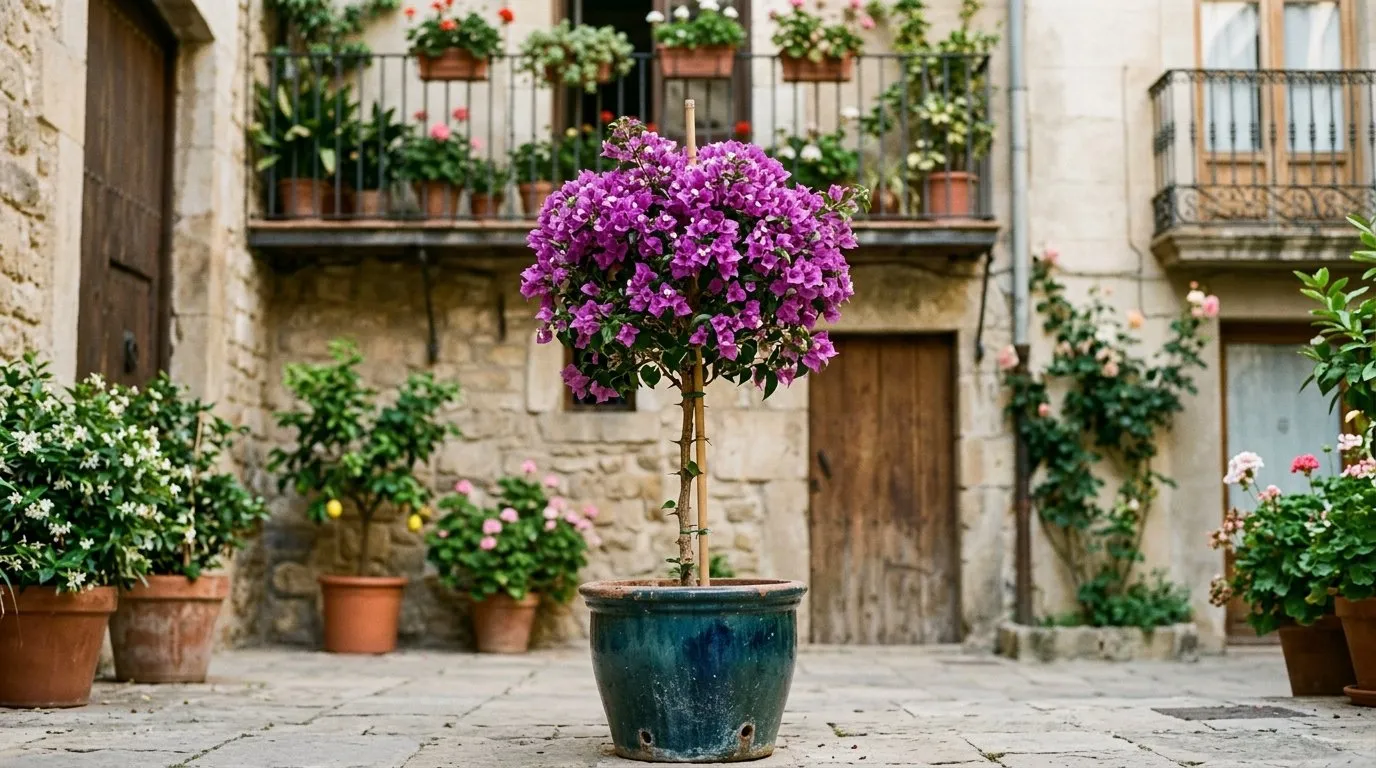 A ready-trained standard ‘Barbara Karst’ in a courtyard pot. Buying one trained saves two or three years of work.
Most bougainvillea trouble comes down to watering, temperature or light, and nearly all of it is fixable. Here are the faults that catch people out.
All leaf and no bracts
The classic complaint, and almost always overwatering plus too little sun. Ease off the watering can, let the leaves droop before you water, and move the plant into the brightest spot you have. Switch to a high-potash feed. Colour usually follows within a few weeks.
Sudden leaf drop
In winter this is normal dormancy. In summer it signals a cold draught, a recent move, or a bone-dry pot. Keep the plant steady, warm and evenly watered. Avoid shifting it about once it is in growth, because bougainvillea dislikes disturbance.
Whitefly, mealybug and red spider mite
Under glass the plant attracts whitefly, mealybug, aphids and red spider mite, all of which multiply in warmth. Check the growing tips and leaf undersides weekly. Wipe off mealybug with a cotton bud dipped in soapy water, and raise humidity to deter spider mite, which thrives in dry heat.
Winter rot
A cold, wet rootball is the biggest winter killer. If the compost stays sodden below 10C, the roots rot and the plant collapses in spring. Keep it barely moist through the cold months and never let it sit in a saucer of water.
Frost damage
One frost is often fatal. Blackened, collapsing growth after a cold night means the plant was left out too late or a heater failed. There is no cure once tissue has frozen, so prevention through timely cover is everything.
Bougainvillea month-by-month in the UK
| Month | Task |
|---|---|
| January | Plant rests under glass at 5-10C; water monthly, no feed |
| February | Check for pests on any leaves; keep barely moist |
| March | Prune hard back to 2-3 buds before growth begins |
| April | New red shoots appear; resume watering and high-nitrogen feed |
| May | Grow on warm and bright; pot on if root-bound; begin hardening off |
| June | Move outdoors after frost risk; place in full sun and shelter |
| July | Peak flowering; drought-stress and feed high-potash weekly |
| August | Keep cutting spent growth for repeat flushes; watch watering |
| September | Flowering winds down; reduce water, stop feeding, plan the move indoors |
| October | Bring under cover before first frost; cut back if needed |
| November | Plant drops leaves and goes dormant; water sparingly |
| December | Rest under glass; keep frost-free and barely moist |
Frequently asked questions
Is bougainvillea hardy in the UK?
No, bougainvillea is frost-tender and not hardy in the UK. It survives outdoors all year only in the mildest corners, such as far south-west Cornwall or the Channel Islands. Everywhere else, grow it in a pot and move it under glass before the first frost. Treat it as a conservatory or patio plant, not a border shrub.
What temperature can bougainvillea tolerate?
Bougainvillea needs a winter minimum of 10C to keep its leaves. It survives down to about 5C if the compost is kept nearly dry, but it sheds its foliage and goes near-dormant. Frost kills it outright. In summer it takes heat up to 38C happily, which is exactly why a sunny conservatory suits it so well.
Why won’t my bougainvillea flower?
Too much water and too little sun are the usual reasons. Bougainvillea flowers best under mild drought stress. Let the compost dry until the leaves just droop, then water sparingly. Overwatering pushes soft green growth instead of bracts. Give it at least six hours of direct sun and switch to a high-potash feed once colour shows.
Why is my bougainvillea dropping its leaves?
Leaf drop is usually a normal winter response to cold and low light. Below about 10C the plant sheds its foliage and rests until spring. Keep it just moist, not wet, and it refoliates in April. Sudden leaf drop in summer means cold draughts, a recent move, or bone-dry roots. Steady warmth and even watering stop it.
When should I prune bougainvillea?
Prune bougainvillea in late winter or early spring, before new growth starts. Cut the previous year’s long shoots back to two or three buds. That is the main shaping cut. After each flush of bracts fades, shorten the flowered growth by half to trigger a second show. Always wear thick gloves, because the thorns are vicious.
Can bougainvillea survive winter outside in the UK?
Only in the mildest frost-free spots, such as coastal Cornwall or the Channel Islands. Even there it wants a sheltered, south-facing wall and sharp drainage. In the rest of the UK, winter wet and frost kill an outdoor plant. Grow it in a container you can wheel under cover from October to May instead.
How big a pot does bougainvillea need?
A 30 to 45cm pot suits most bougainvillea for years. The plant flowers best when its roots are slightly restricted, so do not over-pot. Use loam-based John Innes No 3 for weight and steady feeding. Only pot on when roots fill the container, every two or three years, and go up one size at a time.
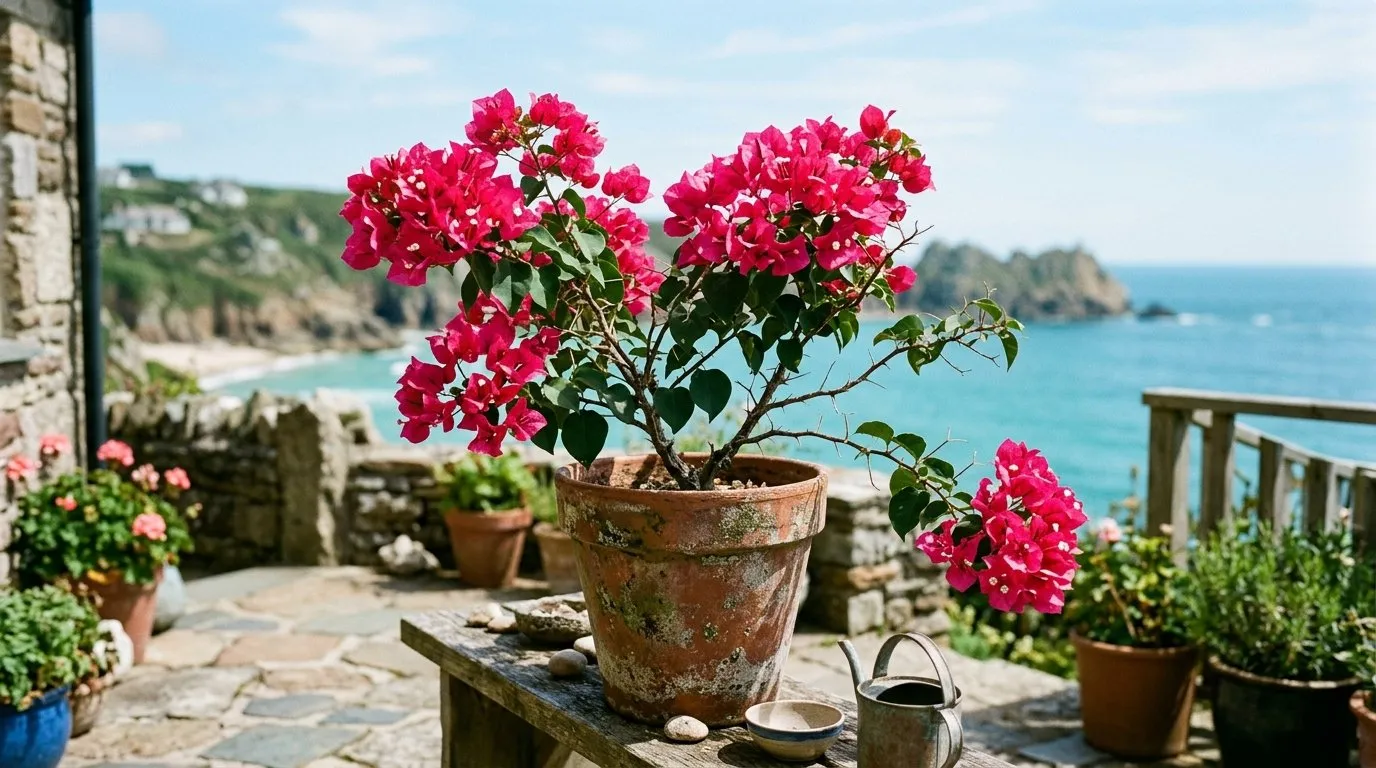 Summering outdoors on a sheltered coastal patio. From October this pot goes back under glass until June.
For the full picture on bougainvillea care, the RHS bougainvillea growing guide is the authority to bookmark. Get the pot, the watering and the winter warmth right, and this South American climber will give you a Mediterranean summer in a British garden, year after year.
Our team produces practical UK gardening guidance from source research, contributor records and established horticultural practice. Editorial standards are overseen by Matt W.