Key takeaways
- Plant chionodoxa bulbs September to November, 8-10cm deep and 5-8cm apart, pointed end up
- Star-shaped blue, pink or white flowers open February to March, one of the first bee-forage bulbs
- It naturalises freely by self-seeding into carpets; leave foliage to die back to feed the spread
- Botanically merged into Scilla now, so Chionodoxa forbesii is sold as Scilla forbesii too
- Thrives naturalising in grass, under deciduous shrubs, at the front of a border, in rockeries and pots
- Near-zero care, pest-free and hardy to -15C; no lifting, only divide congested clumps in the green
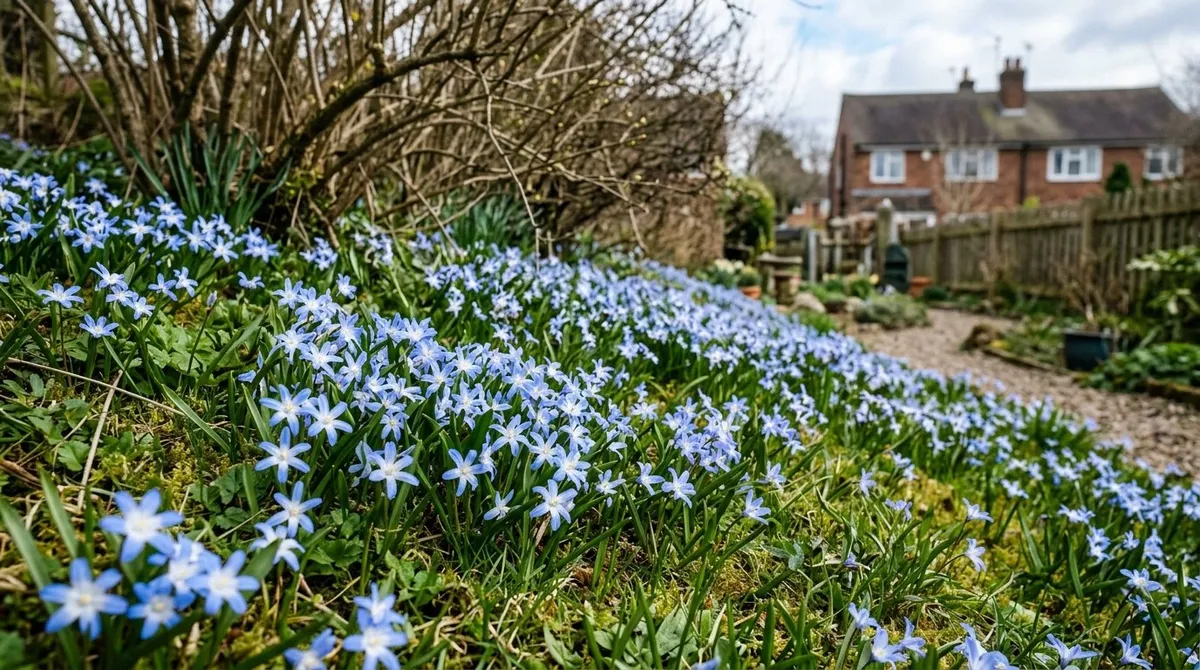
Glory of the snow is the bulb that gets February moving. While the borders are still bare and the soil is cold, chionodoxa throws up its small, upturned stars of clear sky-blue, each with a white eye at the centre. It flowers with the snowdrops and just ahead of the crocus, and once it settles in it spreads on its own into sheets of colour.
It is one of the easiest bulbs you can grow. Plant it once in autumn, leave it alone, and it does the rest. This guide covers the autumn planting window, the depth and spacing that matter, where it naturalises best, what to plant it alongside for a long early-spring show, and why it earns its place as one of the first food sources for bees each year.
What chionodoxa is and why the name keeps changing
Chionodoxa is a genus of small spring-flowering bulbs from the mountains of Crete, Cyprus and western Turkey, where it flowers at the melting edge of the snow. The name comes from the Greek for “snow glory”, and the common name glory of the snow follows directly from that. In the wild it pushes through cold, gritty ground as the thaw begins, which is exactly why it copes so well with a raw British February.
Here is the part that confuses shoppers. Botanists have now folded chionodoxa into the genus Scilla. So the plant most people buy as Chionodoxa forbesii is correctly Scilla forbesii, C. luciliae is Scilla luciliae, and C. sardensis is Scilla sardensis. Garden centres label bulbs both ways, and the RHS lists them under both names. If you cannot find chionodoxa on a supplier’s site, search scilla, and the other way round. It is one plant with two shelf labels.
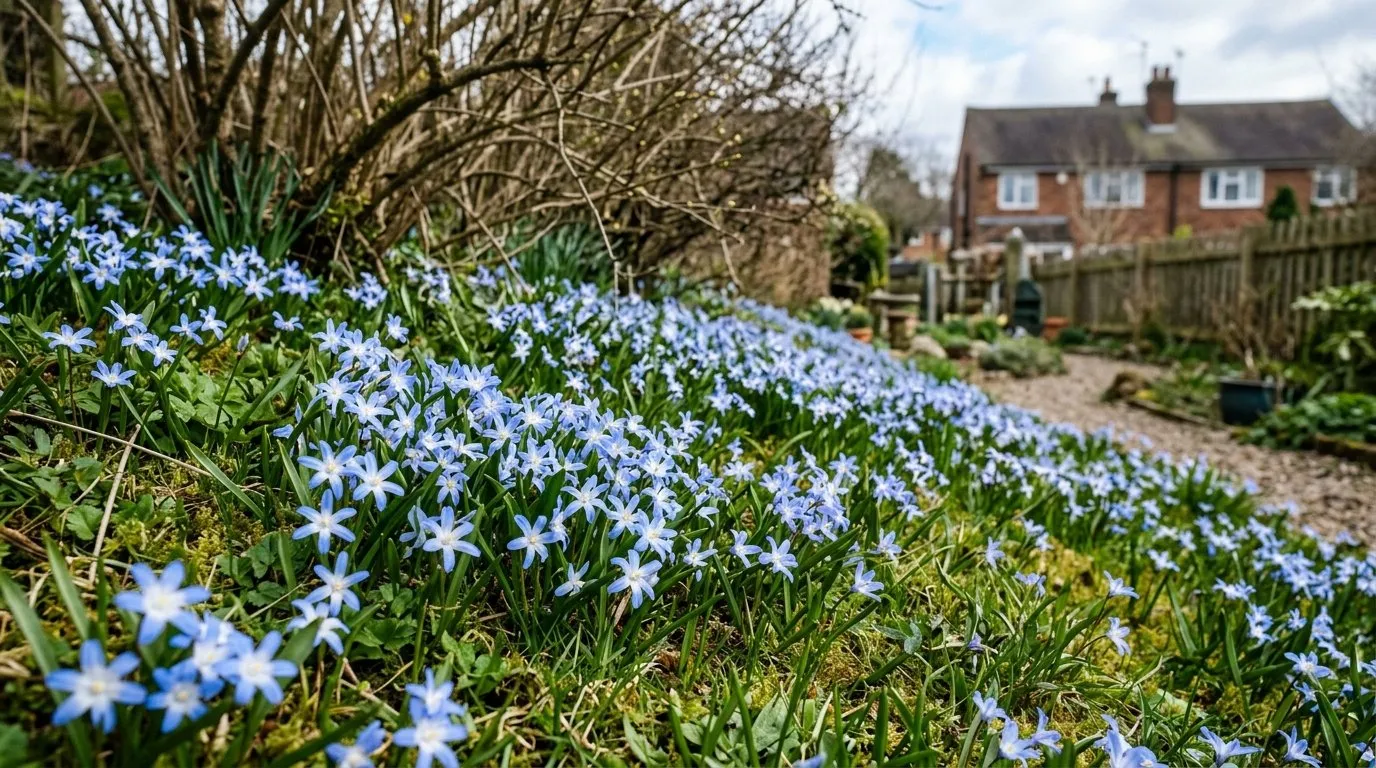 A drift of glory of the snow in late February, opening before the shrubs above it come into leaf.
When to plant chionodoxa bulbs in the UK
Plant chionodoxa bulbs from September to November, while the soil is still holding some warmth. Early autumn planting lets the bulbs push out roots before the ground goes cold, which sets them up for a strong first flowering the following February. Get them in as soon as they arrive.
The bulbs are small, about the size of a hazelnut, and they dry out quickly on a shop shelf. Buy from a supplier with good turnover, and plant within a week or two of getting them home. A shrivelled, papery bulb has lost condition and may flower weakly or skip its first year. If you must delay, keep them cool, dry and in paper, never a sealed plastic bag.
You can still plant into late November if autumn ran away from you, and they usually catch up. What you cannot do is treat them like tulips and leave them in the shed until Christmas. For the wider picture of the autumn bulb season, our guide on when to plant spring bulbs sets out the running order for the whole bed.
How deep and how far apart to plant
Spacing is where people go wrong. These are tiny flowers, so a handful dotted about disappears. Plant in groups of at least 15, and for a real drift think 50 or more in a patch. Set them close, 5cm apart, and let the clump read as one block of colour. The self-seeding then fills in around the edges over the next few springs, so a tight starter planting becomes a spreading colony.
For lawn planting, lift a flap of turf with a spade, loosen the soil beneath, scatter the bulbs randomly and firm the turf back. Random scattering looks natural; a grid looks like a municipal bedding scheme.
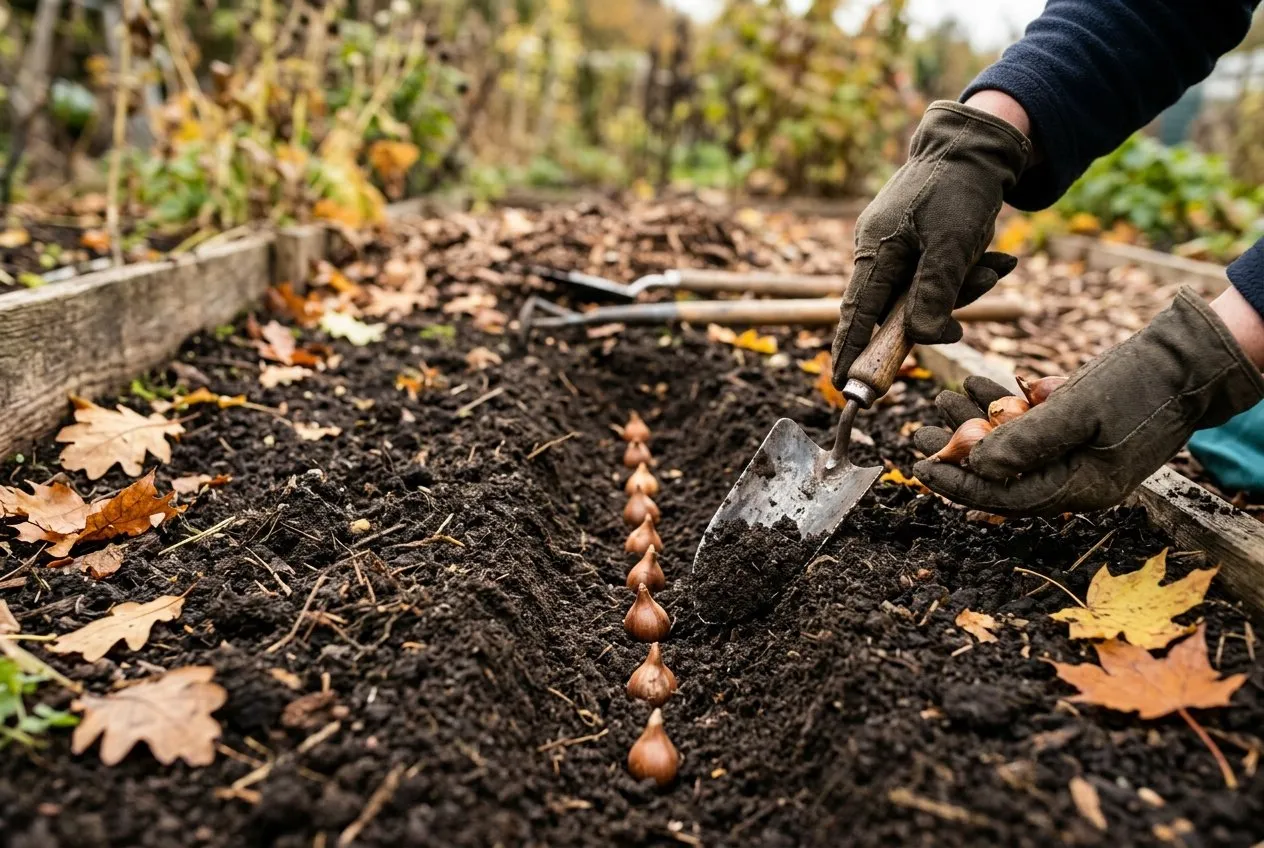 Autumn planting on the allotment. The nose points up, 8-10cm down, in a loose group rather than a neat row.
Where chionodoxa grows best
Chionodoxa thrives in sun or light shade on any well-drained soil. Its great trick is flowering before the leaf canopy closes overhead, so a spot that is shaded in summer can be bright and open in February. That makes it perfect for planting where later plants would sulk.
It performs in five main situations:
- Naturalised in short grass: the classic use, dotting a lawn or the rough grass under trees with early blue.
- Under deciduous shrubs and trees: bare branches in February let the light through; the shrub leafs up after the bulb has finished.
- Front of a border: a low ribbon of blue while the perennials behind are still below ground.
- Rockeries and gravel: the sharp drainage suits it, and the low flowers sit well among stone.
- Pots and pans: a shallow terracotta pan of chionodoxa on a table brings the flowers up to eye level.
The one thing it dislikes is waterlogged winter soil. A bulb sitting in cold standing water rots. On heavy clay, improve the drainage with grit or plant it on a slight slope or raised edge where water drains away. For a fuller list of what copes with early-season shade and cold, see our roundup of early spring flowers for UK gardens.
What to plant chionodoxa with for a February to April succession
The point of glory of the snow is that it starts the show, so pair it with bulbs that carry the colour on into April. Chionodoxa flowers with the snowdrops and just before the crocus, so a well-planned corner runs unbroken from the first February flower to mid-April without a gap.
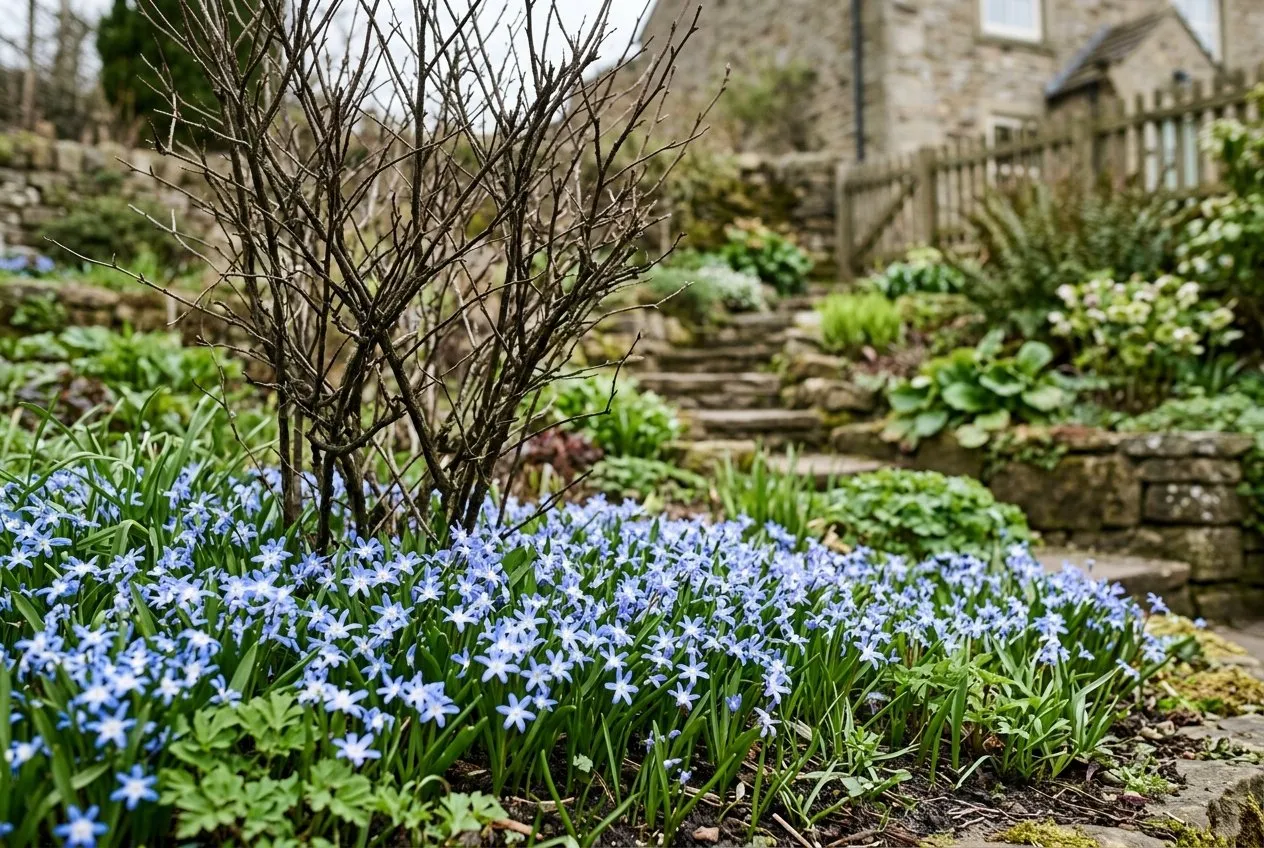 Chionodoxa at the front of a border under a bare shrub, flowering before the perennials behind it wake up.
How to get chionodoxa to naturalise and spread
Chionodoxa naturalises by self-seeding, and the single biggest thing you can do to help is stop tidying. Each flower sets a small seed capsule. If you leave those to ripen and shed, the seed germinates in the soil around the parent and, within a couple of years, throws up new flowering bulbs. A planting of 25 can become several hundred flowers in four years with no extra bulbs bought.
To encourage the spread, do three things. First, leave the foliage to die back completely, which usually means until late May or early June. The dying leaves feed next year’s bulb, and the seed needs time to ripen and fall. Second, do not hoe, mulch or heavily rake the area in spring, or you destroy the young seedlings before they root. Third, if you deadhead at all, hold off until the capsules have browned and split so the seed is already down.
Congested clumps, after several years, can flower slightly less freely in the very centre. If that happens, lift and divide a clump in the green, straight after flowering while the leaves are still up. Tease the bulbs apart and replant them at once, 5-8cm apart, into fresh ground. This is the only maintenance the plant ever really needs.
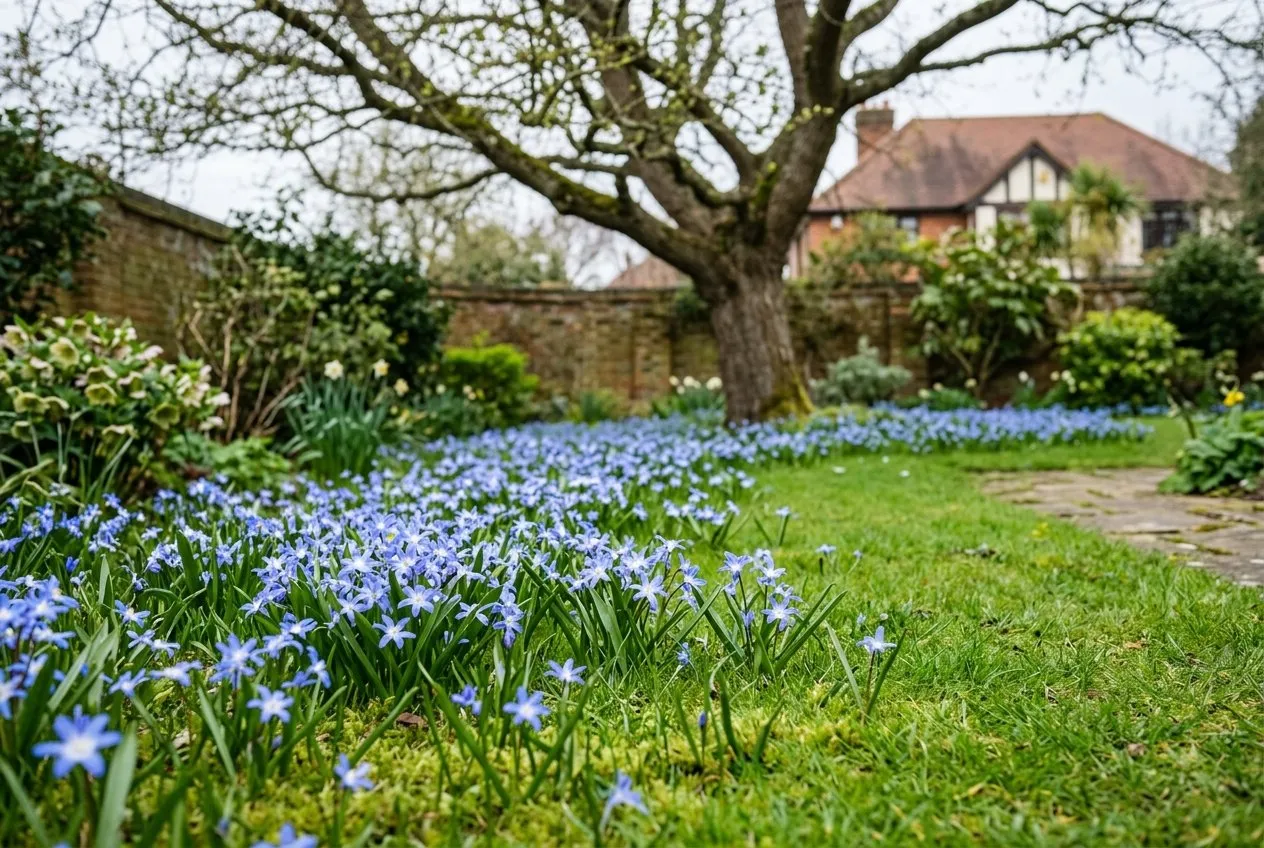 A self-seeded drift through lawn grass. Left un-mown until June, the colony widens a little every year.
Chionodoxa and the first bees of the year
Glory of the snow is one of the earliest nectar and pollen bulbs a UK garden can offer, and that timing is what makes it valuable to bees. It flowers in February and March, exactly when queen bumblebees break hibernation and need to refuel before founding a nest. Early solitary bees and honeybees on mild days work it too.
The flower shape helps. Unlike a deep, tubular flower, chionodoxa opens into a flat, six-pointed star with the pollen and nectar sitting shallow and accessible. A newly emerged queen, low on energy, can land and feed without effort. On the first mild, still afternoon of the year, a drift of it hums.
That early value is why it appears on pollinator planting lists alongside crocus and winter aconite. The Wildlife Trusts rate early bulbs like these among the most useful things you can grow for bees, because they plug the hungry gap before the border proper wakes up (wildlifetrusts.org). If you are planting deliberately for pollinators, our guide to early spring pollinator plants pairs chionodoxa with the other February to April must-haves.
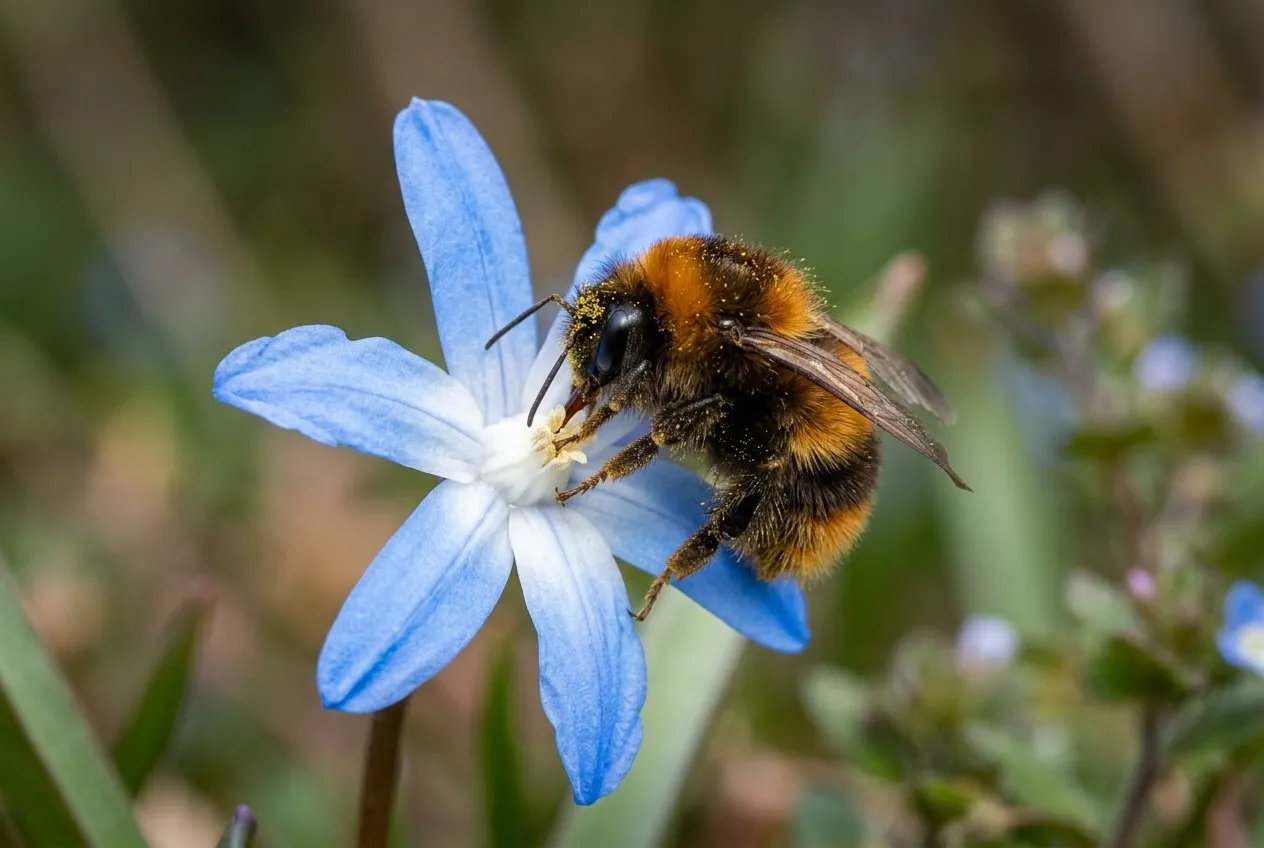 A queen bumblebee refuelling on glory of the snow in February, one of the first meals of her year.
Chionodoxa varieties and colours worth growing
Most chionodoxa is blue, but there are good pink and white forms that mix well in a drift. The blues do the heavy lifting, but a scatter of pink or white lifts the planting and reads well close up in a pot or at a path edge. All flower at the same time and grow identically.
| Variety | Flower colour | Notes | Height |
|---|---|---|---|
| C. forbesii | Sky-blue, white eye | The common form, largest flowers, best naturaliser | 10-15cm |
| C. forbesii ‘Pink Giant’ | Soft pink, white eye | The pink most sold, vigorous, good in pots | 12-15cm |
| C. forbesii ‘Alba’ | Pure white | Clean white, lights a shady corner | 10-12cm |
| C. luciliae | Soft mid-blue | Slightly smaller flowers, holds an AGM | 10-12cm |
| C. sardensis | Deep gentian-blue | Smallest white eye, most intense colour | 10-15cm |
For a naturalised lawn or a big drift, buy the straight C. forbesii in bulk, as it is cheapest and spreads fastest. Save ‘Pink Giant’ and ‘Alba’ for containers and the front edge where you see them up close. C. sardensis is the one to choose if you want the deepest, most saturated blue.
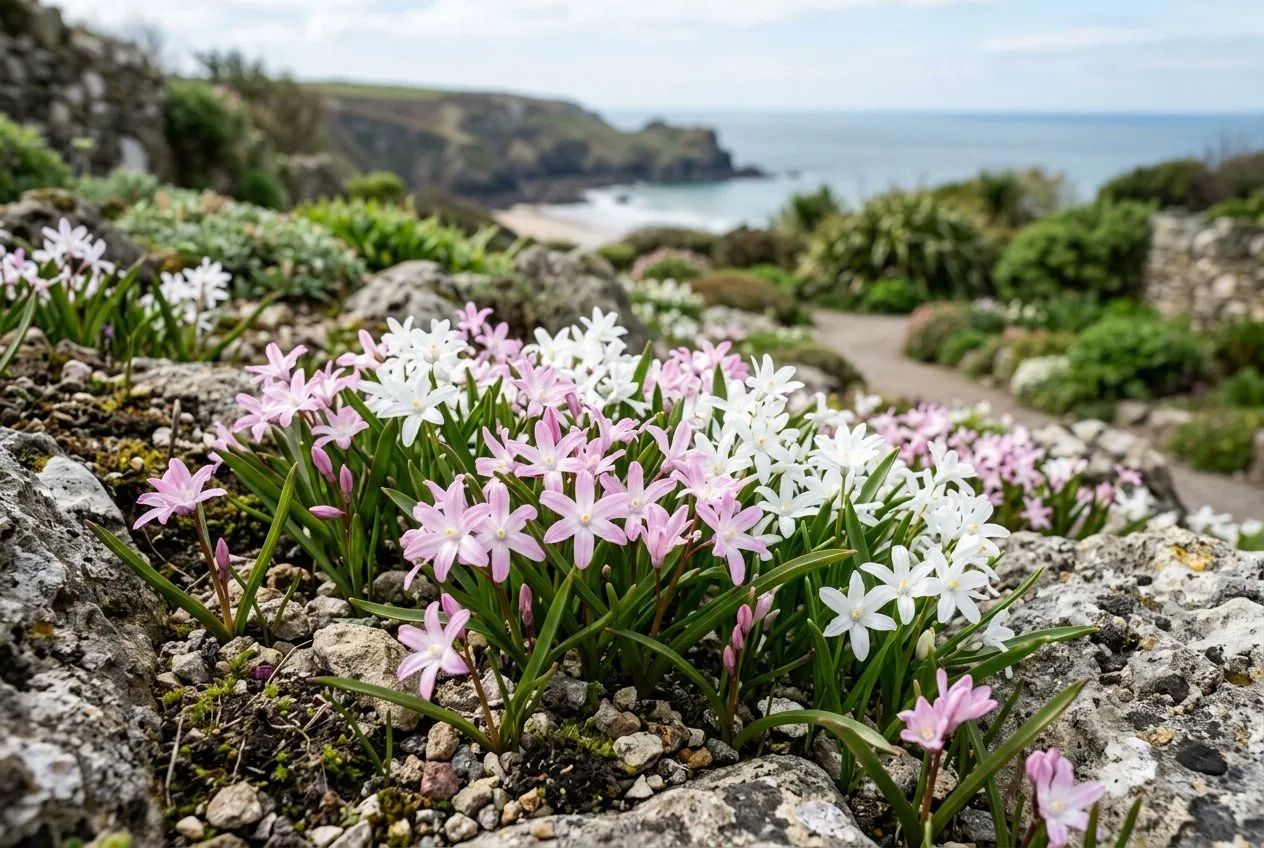 ‘Pink Giant’ and ‘Alba’ together in a gritty rockery. The pale forms show best up close rather than in a big drift.
Chionodoxa in pots and small gardens
Chionodoxa suits pots because a shallow pan brings the small flowers up to where you can see them. Use a wide, low container, a terracotta pan or alpine bowl at least 20cm across, with plenty of drainage holes. The bulbs are small, so a modest pot holds a generous, packed display.
Fill with a gritty, free-draining mix: two parts multipurpose or loam-based compost to one part horticultural grit. Plant the bulbs close, almost touching, 8cm deep, in autumn. Water once, then leave the pot outside in the open through winter; the bulbs need the cold to trigger flowering, so do not bring them into a warm room.
After flowering, either let the pot die back and rest, or, better, tip the whole clump out and plant it into the garden in the green to naturalise. That way the pot bulbs earn a permanent home and you start again with fresh ones next autumn.
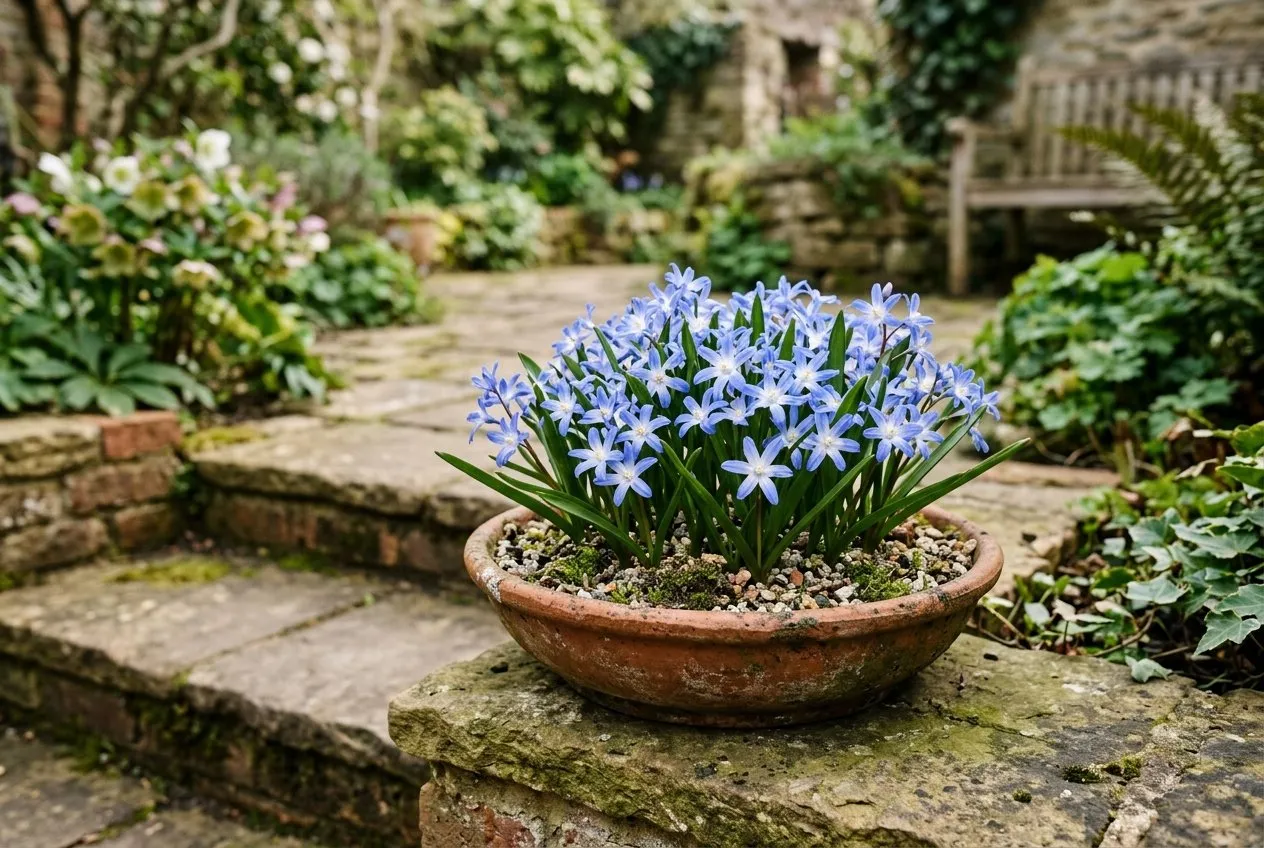 A shallow pan packed with chionodoxa on a patio step, lifting the small flowers to eye level.
Aftercare: the near-zero maintenance routine
Once chionodoxa is in, it needs almost nothing from you. There is no feeding regime, no staking, no lifting and no winter protection. The care amounts to leaving it alone at the right moments, which is harder for tidy gardeners than it sounds.
The whole of the aftercare is this. Let the flowers fade on the plant so they can set seed. Leave the foliage until it yellows and collapses, usually late May, before you mow a naturalised lawn or clear a border edge. Do not cut, knot or pull the green leaves, as they are feeding next year’s bulb and ripening this year’s seed. After the leaves have gone, the site can be mown, mulched or planted over as normal, because the bulbs are dormant and safe below.
A light feed is optional but not required. If a naturalised patch ever looks tired, a scatter of general-purpose fertiliser as growth starts in February does no harm. Otherwise the plant lives on rainfall and neglect. For the general principle across all your bulbs, our guide to spring bulb care after flowering applies directly.
Common mistakes when growing glory of the snow
Chionodoxa is forgiving, but a few habits stop it settling in and spreading as it should.
Mowing or tidying the foliage too soon
This is the big one. Cutting a naturalised lawn or clearing a border edge in April, while the leaves are still green, starves next year’s bulb and destroys the seed before it sheds. Wait until the foliage yellows and flops, usually late May, then mow or tidy. Impatience here is why so many plantings fail to spread.
Planting single bulbs dotted about
One chionodoxa flower is 2cm across. Spread thinly, they vanish. Always plant in groups of 15 or more, set close, so the eye reads a drift of colour, not a few blue specks. Buy in bulk; the straight species is cheap enough to plant by the fifty.
Letting the bulbs dry out before planting
These small bulbs lose condition fast in a warm, dry shop. A shrivelled bulb flowers poorly or not at all in its first year. Buy fresh, from a supplier with quick turnover, and plant within a week or two of purchase.
Planting in ground that floods in winter
Chionodoxa copes with cold but not with waterlogging. A bulb in cold standing water rots. On heavy clay, add grit, plant on a slope or raised edge, or use pots, so winter water drains away from the bulb.
Expecting a carpet in year one
A new planting looks sparse the first spring. The drift comes from self-seeding, which takes three or four years to build. Plant enough to look decent at once, then let the plant do the spreading, and resist digging or heavy mulching over the seedlings.
How chionodoxa compares with scilla and muscari
Chionodoxa, scilla and muscari are the three small blue bulbs most often confused, and knowing them apart helps you plant a proper succession. They overlap, but each has a distinct flower and a slightly different slot in the season, so a bed with all three carries blue from February well into April.
| Feature | Chionodoxa | Scilla | Muscari |
|---|---|---|---|
| Flower shape | Flat, open six-pointed star | Nodding open bells | Tight cluster of urn-shaped bells |
| Main flowering | Feb-Mar | Mar | Mar-Apr |
| Typical colour | Sky-blue, white eye | Deep blue | Cobalt to navy blue |
| Height | 10-15cm | 10-15cm | 15-20cm |
| Habit | Faces upward, star flat to sky | Flowers nod and dangle | Dense upright spike |
| Naturalises by | Self-seeding, freely | Self-seeding, freely | Offsets and seed, can be invasive |
The practical read: chionodoxa is the flat blue star that faces the sky, scilla is the nodding blue bell, and muscari is the fat little blue spike that comes slightly later. Chionodoxa is the earliest and the best of the three for opening flat to feed early bees. Muscari is the most thuggish, so keep it away from choicer neighbours. Scilla sits neatly between the two in both timing and vigour.
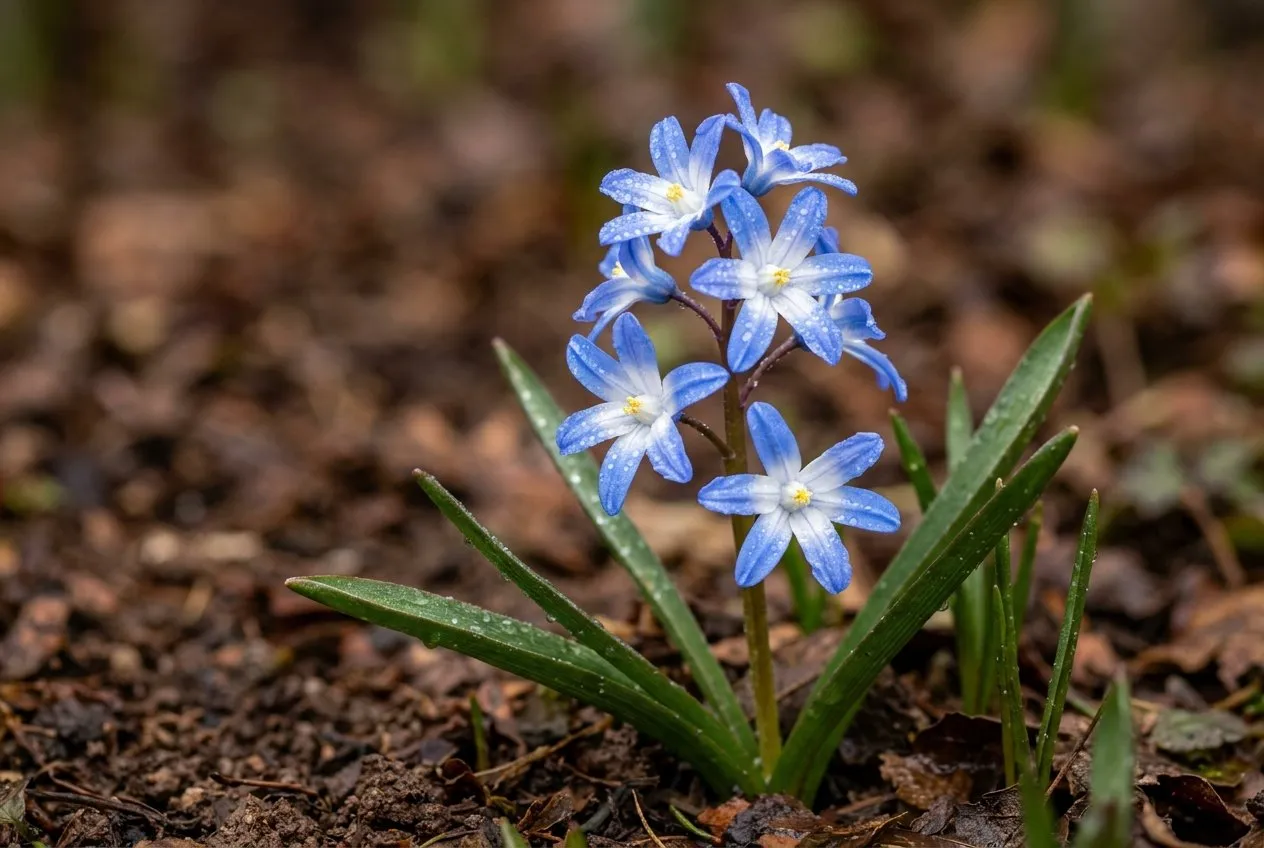 The flat, upward-facing star that tells chionodoxa apart from the nodding bells of scilla.
Frequently asked questions
When should I plant chionodoxa bulbs?
Plant chionodoxa bulbs September to November. Get them in during early autumn while the soil is still warm, so roots form before winter. The bulbs are small and dry out fast, so buy fresh and plant promptly. Later planting into November still works, but the earlier they root, the better the first spring flowering.
How deep and how far apart do you plant chionodoxa?
Plant 8-10cm deep and 5-8cm apart. That is roughly two to three times the bulb’s own depth, pointed end up. Plant in groups of 15 or more for impact rather than dotting singles. Tight spacing gives an instant drift, and self-seeding fills the gaps within two or three seasons.
Is chionodoxa the same as scilla?
Botanically, yes; chionodoxa is now merged into the genus Scilla. Chionodoxa forbesii is correctly Scilla forbesii, and C. luciliae is Scilla luciliae. Garden centres still label both ways, so search under either name. In practice, gardeners treat them as separate for their look, but the plant is one and the same.
Does chionodoxa spread and naturalise?
Yes, chionodoxa naturalises freely by self-seeding. A small planting bulks up by offsets and scatters seed that germinates around the parent. Over three to four years a handful of bulbs becomes a carpet. To encourage it, leave the foliage to die back fully and avoid hoeing or mulching over the seedlings in late spring.
Is glory of the snow good for bees?
Yes, it is one of the earliest nectar bulbs of the year. The open, star-shaped flowers appear in February and March when little else is out. Emerging queen bumblebees and early solitary bees feed on the accessible pollen and nectar. Planting it in drifts gives foraging insects a concentrated food source in the hungriest weeks.
Where does chionodoxa grow best?
In sun or light shade on any well-drained soil. It thrives naturalised in short grass, under deciduous shrubs and trees, at the front of borders, in rockeries and in pots. It flowers before the tree canopy closes, so a spot under a bare deciduous shrub is ideal. Avoid ground that stays waterlogged in winter.
Do I need to lift chionodoxa bulbs after flowering?
No, leave them in the ground permanently. Chionodoxa is fully hardy and resents disturbance, so lifting and storing is unnecessary and harmful. Only lift to divide a congested clump, and do that in the green just after flowering. Otherwise leave the bulbs alone to self-seed and spread year on year.
Now the glory of the snow is in and spreading, keep the early show going with our guide to the best spring flowers for UK gardens for what to plant around it.
Our team produces practical UK gardening guidance from source research, contributor records and established horticultural practice. Editorial standards are overseen by Matt W.