Key takeaways
- Kniphofia need full sun and sharp drainage; on clay, dig in 30% grit and plant on a slight mound
- Plant the crown level with the soil, never buried, spaced 45-60cm apart for air movement
- A spread of species and cultivars flowers from late May right through to October
- Divide congested clumps in mid-spring every 4-5 years, never in autumn
- Leave the foliage uncut over winter; it protects the crown from frost and wet
- Each flower spike holds 200-400 tubular florets that feed bees and late butterflies
Red hot pokers (Kniphofia) are among the most architectural perennials you can grow in a UK garden. Native to southern and eastern Africa, these clump-forming plants throw up torch-like spikes of tubular flowers in fiery orange, red, coral, lemon and cream. With the right choice of species and cultivars, a border can carry kniphofia spikes from late May right through to the first frosts of October.
They are tougher than their exotic looks suggest. Most are hardy to around -12C, drought-tolerant once established, and happy on poor, sandy or coastal soil. The one thing they will not forgive is a cold, wet crown in winter. Get the drainage right and a single plant will reward you for well over a decade.
What kniphofia are and why they earn border space
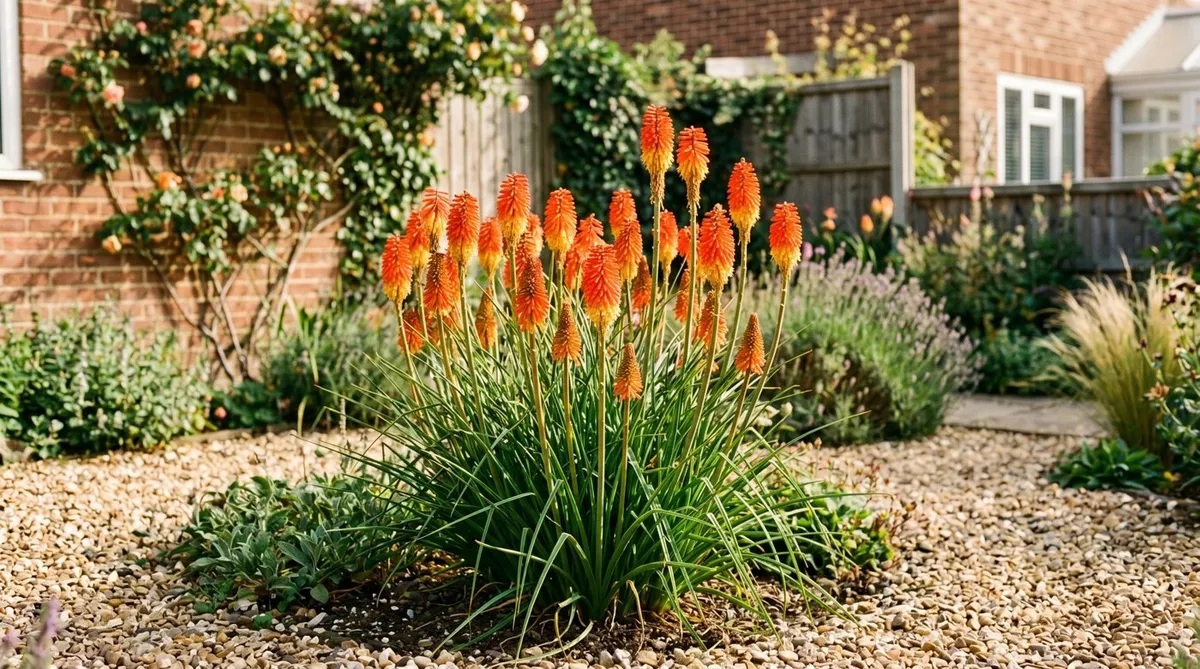
Kniphofia belongs to the asphodel family, Asphodelaceae, and there are around 70 species plus hundreds of garden cultivars. The common name red hot poker comes from the classic two-tone spike: scarlet buds at the top opening to yellow florets below, so the spike looks like an iron heating in a fire. Modern breeding has widened the palette to solid lemon, peach, coral and near-white.
Each flower spike is a dense cylinder of narrow tubular florets, typically 200-400 per spike, opening from the bottom upwards over two to three weeks. The strappy, grey-green or mid-green foliage forms an evergreen or semi-evergreen fountain 40-90cm across. That bold vertical form is why designers reach for them. They punctuate a flat border, echo the shape of ornamental grasses, and hold their structure long after the flowers fade.
They sit naturally alongside other low maintenance architectural plants and pair beautifully with the rounded heads of agapanthus. If you like that exotic look, kniphofia work well in the same schemes as hardy exotic and tropical plants.
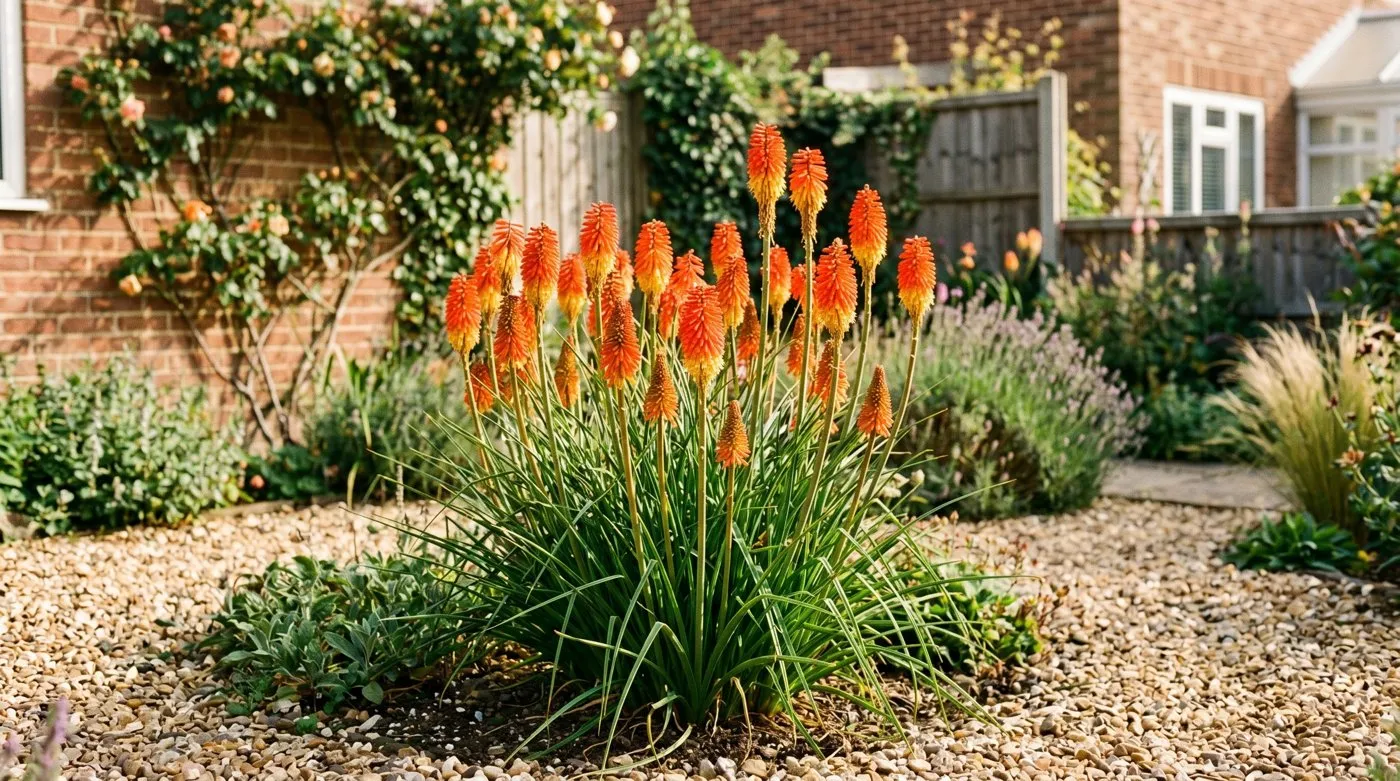 A mature kniphofia clump in full flower, the classic scarlet-to-yellow torch spikes that give the plant its name.
Choosing kniphofia varieties for a long flowering season
Early types start the season. Kniphofia ‘Bees’ Lemon’ opens clean lemon-yellow spikes from June. Mid-season brings the workhorses: ‘Royal Standard’, the classic red-and-yellow bicolour at 1.2m, and ‘Alcazar’, a strong flame-orange to 1.1m. For something different, ‘Tawny King’ carries smoky bronze buds opening to cream on dark stems, around 1.2m.
Late flowering extends the display into autumn. ‘Percy’s Pride’ throws greenish-yellow spikes to 1.5m well into October, a genuine late-nectar plant. For small gardens and pots, the dwarf ‘Nancy’s Red’ stays at 45-60cm and repeat-flowers from June to September if deadheaded. Where space allows, the giant Kniphofia uvaria ‘Royal Standard’ and tall species like K. caulescens add real drama at the back of a border.
Variety comparison table
| Cultivar | Height | Flower colour | Flowering months | Hardiness | RHS AGM |
|---|---|---|---|---|---|
| ’Bees’ Lemon’ | 1.2m | Lemon-yellow | Jun-Aug | -10C | Yes |
| ’Royal Standard’ | 1.2m | Scarlet to yellow | Jul-Sep | -12C | Yes |
| ’Alcazar’ | 1.1m | Flame orange | Jun-Aug | -10C | No |
| ’Tawny King’ | 1.2m | Bronze to cream | Jul-Sep | -10C | Yes |
| ’Percy’s Pride’ | 1.5m | Greenish-yellow | Aug-Oct | -12C | No |
| ’Nancy’s Red’ | 0.5m | Coral-red | Jun-Sep | -10C | Yes |
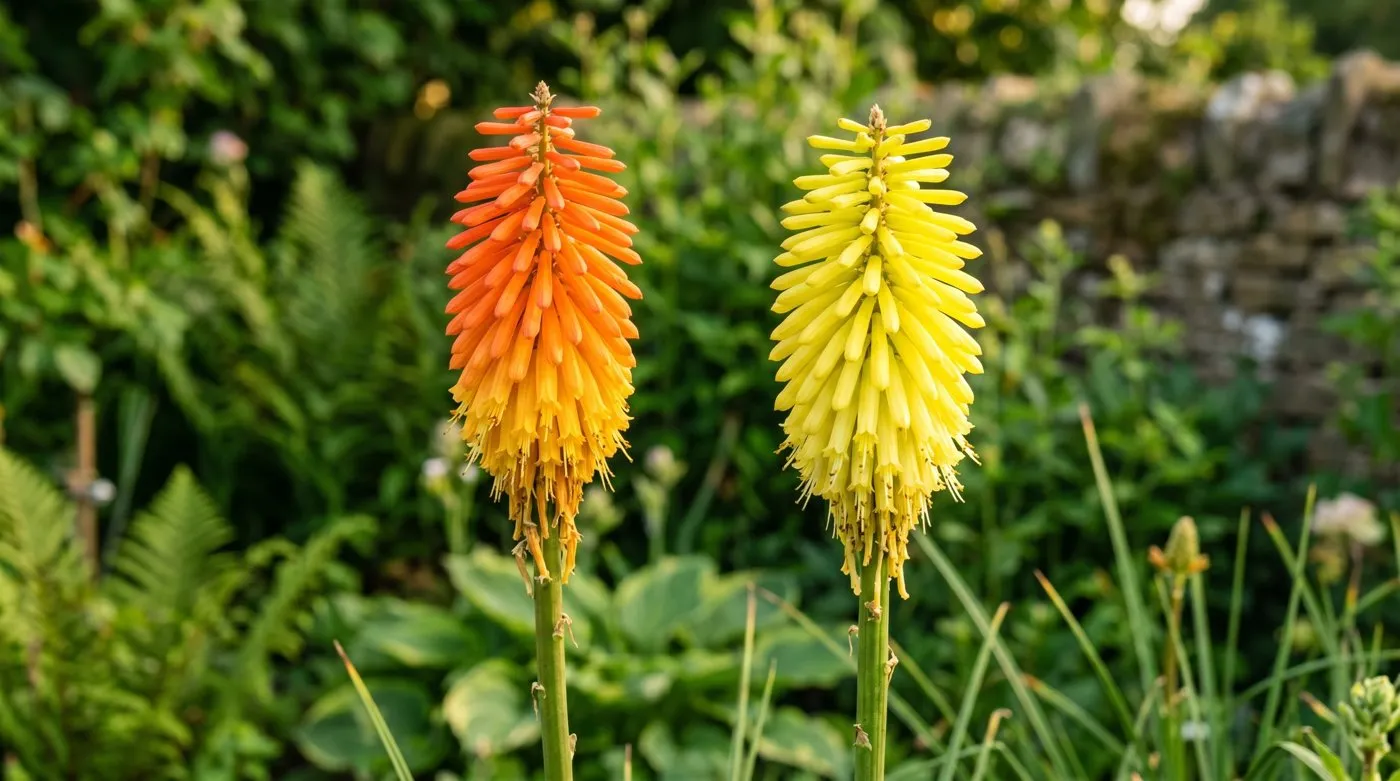 Two cultivars compared: the classic orange-to-yellow bicolour beside a single-colour lemon spike like ‘Bees’ Lemon’.
Soil and drainage: the make-or-break factor
Sharp drainage is the single most important thing you can give a kniphofia. In their native grassland habitat they grow on free-draining slopes with dry winters. UK winters are wet, and a crown sitting in cold, saturated soil from November to March is what kills them, far more often than cold alone.
A neutral to slightly acidic pH of 6.0-7.0 suits them, though they are not fussy. Avoid rich, heavily manured ground, which produces soft growth and few flowers. If your soil is solid clay, read our guide to improving clay soil before planting, or grow your pokers in raised beds and pots where you control the medium entirely. Their love of grit makes them a natural fit for a gravel garden.
How to plant kniphofia at the right depth and spacing
Spring planting, from April to early June, gives the best results in the UK. The soil is warming, and the plant has the whole growing season to root in before its first winter. Pot-grown plants can go in through summer if kept watered, but avoid autumn planting on cold or wet soil.
Dig a hole twice the width of the rootball. On clay, half-fill it with a 50:50 mix of grit and topsoil to lift the crown. Set the plant so the crown sits level with the soil surface, never buried. A buried crown traps moisture and rots. Tuck a fistful of coarse grit right under and around the crown as a drainage collar. Firm gently and water in.
Space plants 45-60cm apart for mid-height cultivars, up to 75cm for the giants. Good spacing keeps air moving around the crowns, which cuts rot and fungal problems. Crowding is one of the most common reasons clumps stop flowering, so resist planting too tight for instant effect.
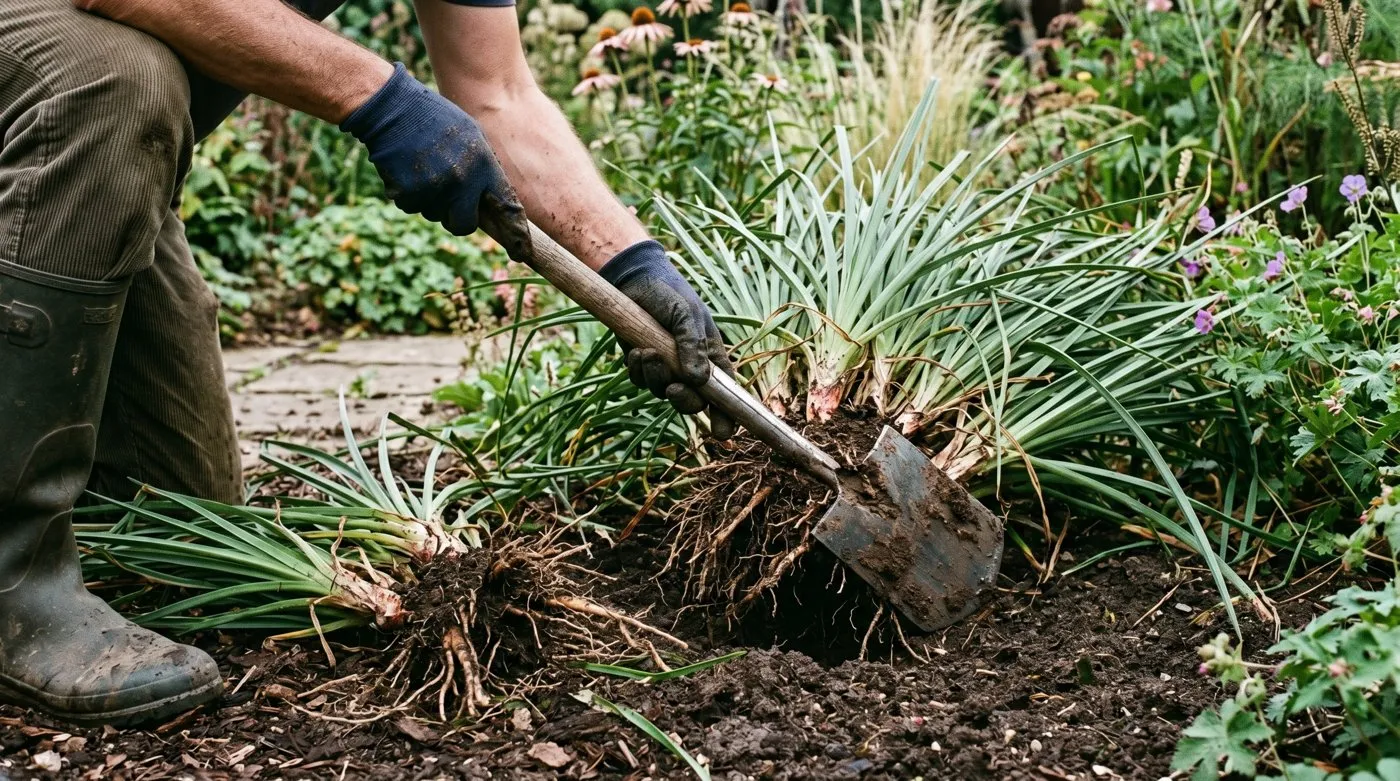 Lifting a congested clump in spring. Split it back to sections with three or more growing points each.
Watering, feeding and seasonal care through the year
Newly planted kniphofia need regular watering through their first summer, roughly twice a week in dry spells, until the roots establish. After the first year they are genuinely drought-tolerant and rarely need watering except in prolonged drought. Overwatering an established plant does more harm than good. They sit comfortably among other drought-tolerant plants in a low-water border.
Feed sparingly. A single dressing of general-purpose fertiliser in spring at 35g per square metre is plenty. High-nitrogen feeds push leafy growth and suppress flowering, the opposite of what you want. A spring mulch of composted bark or leaf mould, kept clear of the crown itself, conserves moisture and feeds the soil slowly. Never pile wet mulch against the crown.
Deadheading keeps repeat-flowering cultivars going. Snap or cut spent spikes off at the base as soon as they fade. This stops the plant setting seed and, on cultivars like ‘Nancy’s Red’, encourages a second flush. Leave a few late spikes on in autumn if you want seed for the birds, but deadheading the rest tidies the clump and channels energy back to the crown.
Month-by-month kniphofia care calendar
| Month | Task |
|---|---|
| January | Check ties are holding foliage upright over crowns; clear any pooling water |
| February | Leave foliage in place; resist the urge to cut back |
| March | Cut old foliage to 10cm as new growth appears; clear winter debris |
| April | Apply spring feed at 35g per sq m; divide congested clumps now |
| May | Plant new pot-grown stock; mulch with bark, keeping crowns clear |
| June | First spikes open on early cultivars; water new plants twice weekly |
| July | Peak flowering; deadhead spent spikes to encourage repeats |
| August | Continue deadheading; late cultivars like Percy’s Pride start |
| September | Enjoy late spikes; reduce watering as growth slows |
| October | Last flowers fade; leave foliage standing for winter cover |
| November | Tie strappy leaves loosely upright to shed water off the crown |
| December | No action needed; ensure crowns are not waterlogged |
Dividing kniphofia and propagating by offsets
Division is the simplest way to multiply kniphofia and rejuvenate a tired clump. Do it in mid-spring, April to May, as growth restarts. The plant has the full season to recover, and the cut crowns are not left to rot through a wet winter. Never divide in autumn.
Lift the whole clump with a fork. Mature kniphofia have thick, fleshy roots and a dense crown, so this is hard work on a big plant. Split the clump with a sharp spade, or push two garden forks back to back into the centre and lever them apart. Aim for divisions with three or more growing points each. Discard the woody, exhausted centre of a very old clump and replant the vigorous outer sections.
Replant divisions immediately at the same depth, crown level with the soil, on grit as before. Water in and keep them moist through their first few weeks while new roots form. Divided plants often skip flowering the following year while they settle, then come back stronger. Established clumps only need dividing every 4-5 years, when the centre dies out or flowering drops off. For more on lifting and resetting perennials, see our guide to perennials to divide in May.
Overwintering: why you should not cut the foliage hard
Winter care is where most kniphofia are won or lost, and the rule is counter-intuitive: leave the foliage on. The strappy leaves form a natural thatch over the central crown, shedding rain and insulating against frost. Cutting them hard in autumn, as many gardeners do out of tidiness, exposes the crown to exactly the cold wet conditions that cause crown rot.
In November, gather the leaves and tie them loosely upright into a topknot with soft twine. This funnels water off the crown rather than into it. The bundled foliage looks neat and does the protective job through the worst of the winter wet. Leave the tie in place until spring.
In March, once new growth shows at the base, cut the old foliage back to about 10cm and clear away the dead material. The plant pushes fresh leaves and the cycle begins again. In very cold inland gardens, a dry mulch of bracken or straw tucked around (not over) the crown adds extra insulation for borderline-hardy cultivars.
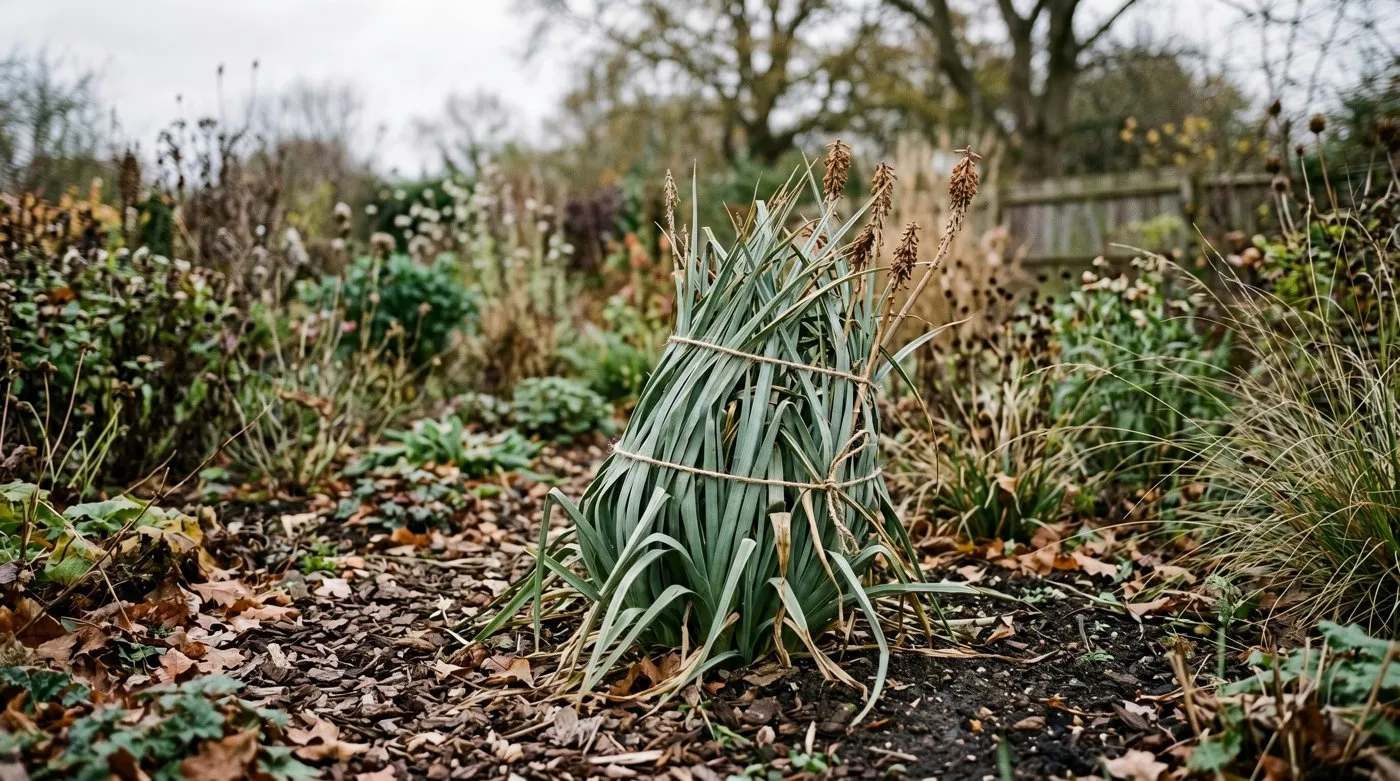 Foliage tied loosely upright in November. This sheds water off the crown and prevents winter rot.
The real cause of kniphofia failure in UK gardens
Most kniphofia that die in UK gardens are not killed by cold. They are killed by winter wet rotting the crown. The plant evolved on free-draining African grassland with dry winters. Our wet, mild winters keep the soil saturated for months, and a fleshy crown sitting in cold water simply rots from the centre out. The leaves yellow, the crown goes soft and brown, and by spring the plant collapses.
The mistake most people make is treating kniphofia as tender and reaching for a fleece or a sheltered, shady spot. That makes things worse: shade reduces flowering and a still, damp corner holds moisture. The real fix is drainage, not warmth. Plant in full sun, on grit, raised slightly, with the crown clear, and leave the foliage as winter cover.
Get this right and hardiness rarely becomes an issue. The cultivars in the table above all survive normal UK winters down to -10C or -12C in well-drained soil. The same plants will die at 0C if their crowns sit in saturated clay. Drainage is the variable you control, so it is the one to fix first.
Pests and problems to watch for
Kniphofia are largely trouble-free, but a few problems crop up. Crown rot is the big one, covered above, and the answer is always drainage. Slugs and snails chew the soft new growth in spring, especially on young plants and divisions. Protect emerging shoots with grit, wool pellets or beer traps until the leaves toughen.
Thrips occasionally rasp the flower spikes, leaving silvery, speckled florets in hot, dry spells. They rarely warrant treatment outdoors; a sharp jet of water knocks them back, and natural predators usually cope. Aphids sometimes cluster on flower stems and can be hosed off or left to ladybirds and hoverflies. Avoid spraying, as kniphofia are major pollinator plants.
The other common problem is simply no flowers, which traces back to shade, overcrowding or overfeeding. Move plants into full sun, divide congested clumps, and cut back on nitrogen. A clump that has not been split for six or seven years will throw plenty of leaf and few spikes until you divide it.
Kniphofia for pollinators and coastal gardens
Kniphofia are outstanding pollinator plants. Each spike holds 200-400 nectar-rich tubular florets, and they open in sequence over weeks, so a clump feeds insects for a long stretch. Bumblebees and honeybees work the spikes constantly, and late-flowering cultivars provide nectar in September and October when little else is open. They sit well with other autumn-flowering plants for bees in a wildlife border.
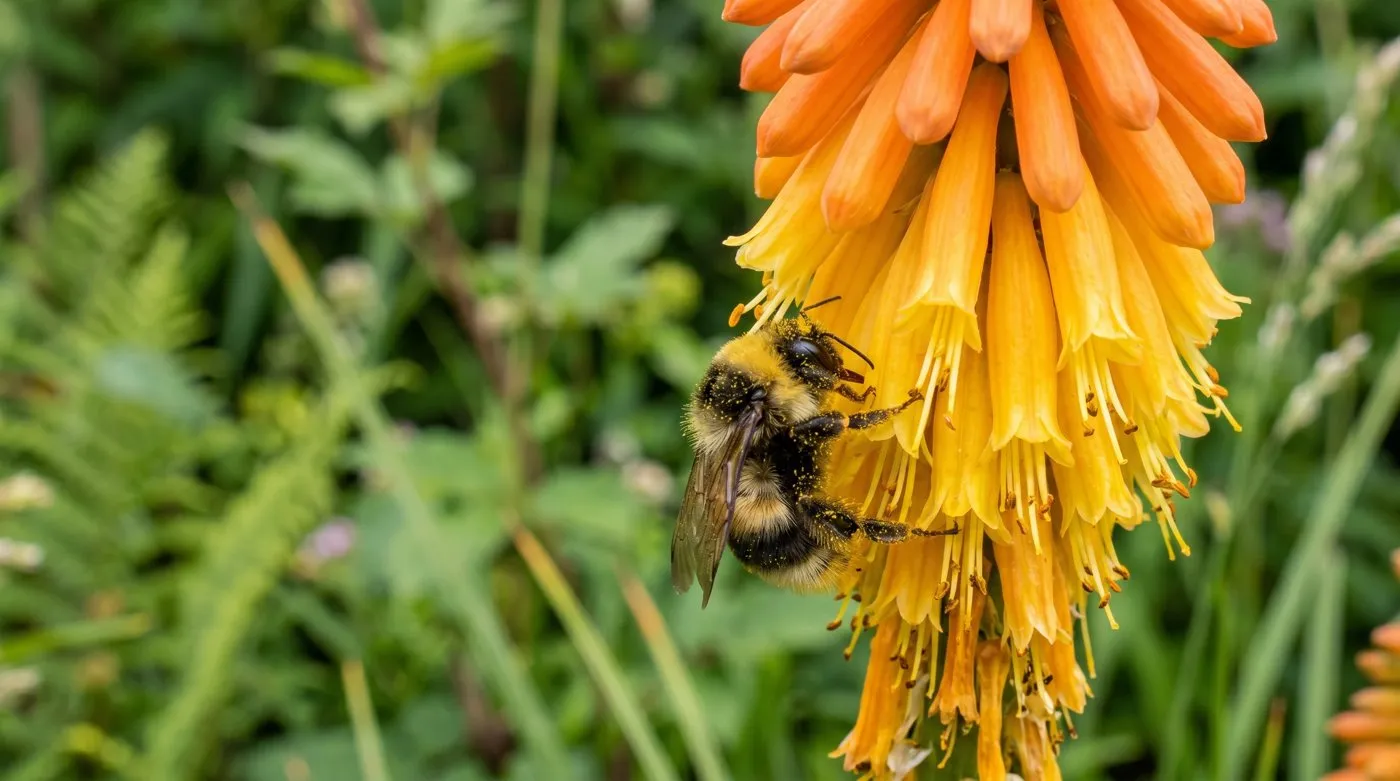 A bumblebee working the florets. Each spike opens from the base up, feeding pollinators over two to three weeks.
Growing kniphofia in pots and small gardens
Dwarf cultivars make kniphofia practical for pots, balconies and small borders. ‘Nancy’s Red’ at 45-60cm is the standout container choice, repeat-flowering coral-red from June to September. Use a pot at least 30cm wide with plenty of drainage holes.
The compost must drain freely. Mix two parts loam-based compost (John Innes No.2) to one part horticultural grit. This mimics the gritty, free-draining soil they love and stops the crown sitting wet, which is even more of a risk in a pot than in the ground. Raise the pot on feet so water runs straight through.
Water pots more often than border plants in summer, as they dry faster, but let the top few centimetres dry between waterings. Feed once in spring with a slow-release granular feed. In winter, move pots to a sheltered spot against a wall, lift them onto feet, and leave the foliage on for crown protection. The free-draining mix and overhead shelter together prevent the winter wet that catches out container-grown pokers.
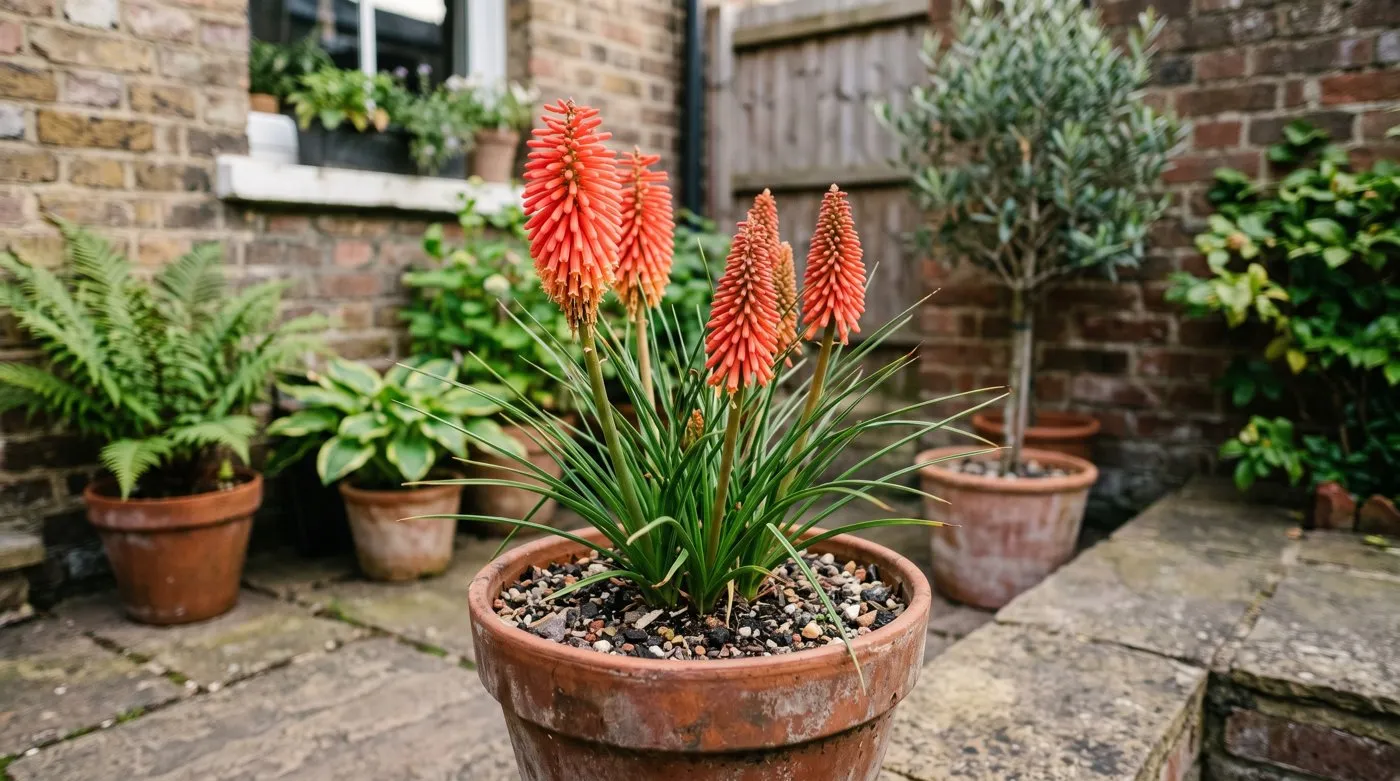 A dwarf cultivar like ‘Nancy’s Red’ in a gritty, free-draining pot, ideal for a small patio or balcony.
Common mistakes when growing red hot pokers
Avoiding these errors is the difference between a clump that thrives for a decade and one that rots in its first winter.
Planting in heavy wet clay without grit
This is the number one killer. Kniphofia set straight into unimproved clay sit in cold water all winter and rot at the crown. Always dig in 30% grit and plant on a slight mound. On the worst clay, grow them in raised beds or pots instead.
Cutting the foliage back hard before winter
Tidying the leaves off in autumn exposes the crown to rain and frost. Leave the foliage, tie it loosely upright in November, and only cut back in spring. This single habit saves more plants than any other.
Overcrowding and never dividing
A clump left undivided for six or seven years stops flowering and becomes a slug haven. Divide every 4-5 years in spring, space new plants 45-60cm apart, and keep air moving around the crowns.
Overfeeding for bigger plants
Rich soil and high-nitrogen feed give lush leaves and few flowers. Feed once in spring at 35g per sq m and no more. Lean, gritty conditions produce the most spikes.
Planting in shade to protect from cold
Shade reduces flowering and a damp, still corner holds moisture against the crown. Kniphofia need full sun and sharp drainage, not shelter. Warmth is not the issue; winter wet is.
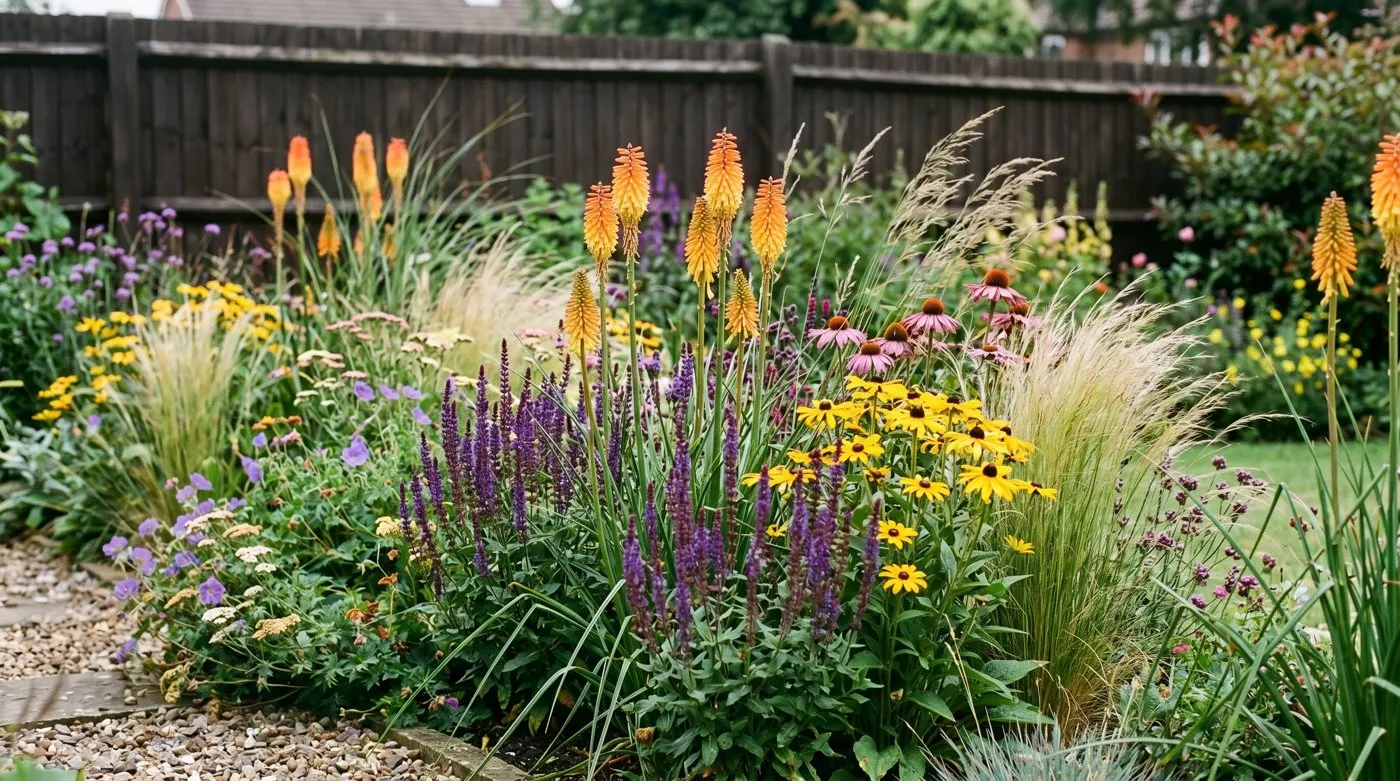 Kniphofia in a prairie-style scheme, their vertical spikes echoing grasses and contrasting with rounded salvia heads.
Designing with kniphofia in the border
The strong vertical form makes kniphofia a natural structural plant. Use them to break up flat, mounded planting and to draw the eye through a border. They look most at home in prairie and gravel schemes, rising among ornamental grasses like Stipa and Calamagrostis, with the rounded heads of agapanthus, echinops and alliums for contrast.
Colour-wise, the hot orange and red cultivars sing against blue and purple: salvias, perovskia and agapanthus. The cooler lemon and cream types, like ‘Bees’ Lemon’ and ‘Tawny King’, work in softer schemes with grasses and bronze fennel. If you love the bold, repeated shapes of agapanthus, our guide to growing agapanthus in the UK covers a plant that needs almost identical conditions, so the two thrive side by side.
Place tall cultivars like ‘Percy’s Pride’ and ‘Royal Standard’ mid-border or toward the back, where their 1.5m spikes carry. Use dwarf ‘Nancy’s Red’ at the front or in pots. Group the same cultivar in threes or fives for impact rather than dotting single plants, and a kniphofia planting reads as a confident, deliberate design.
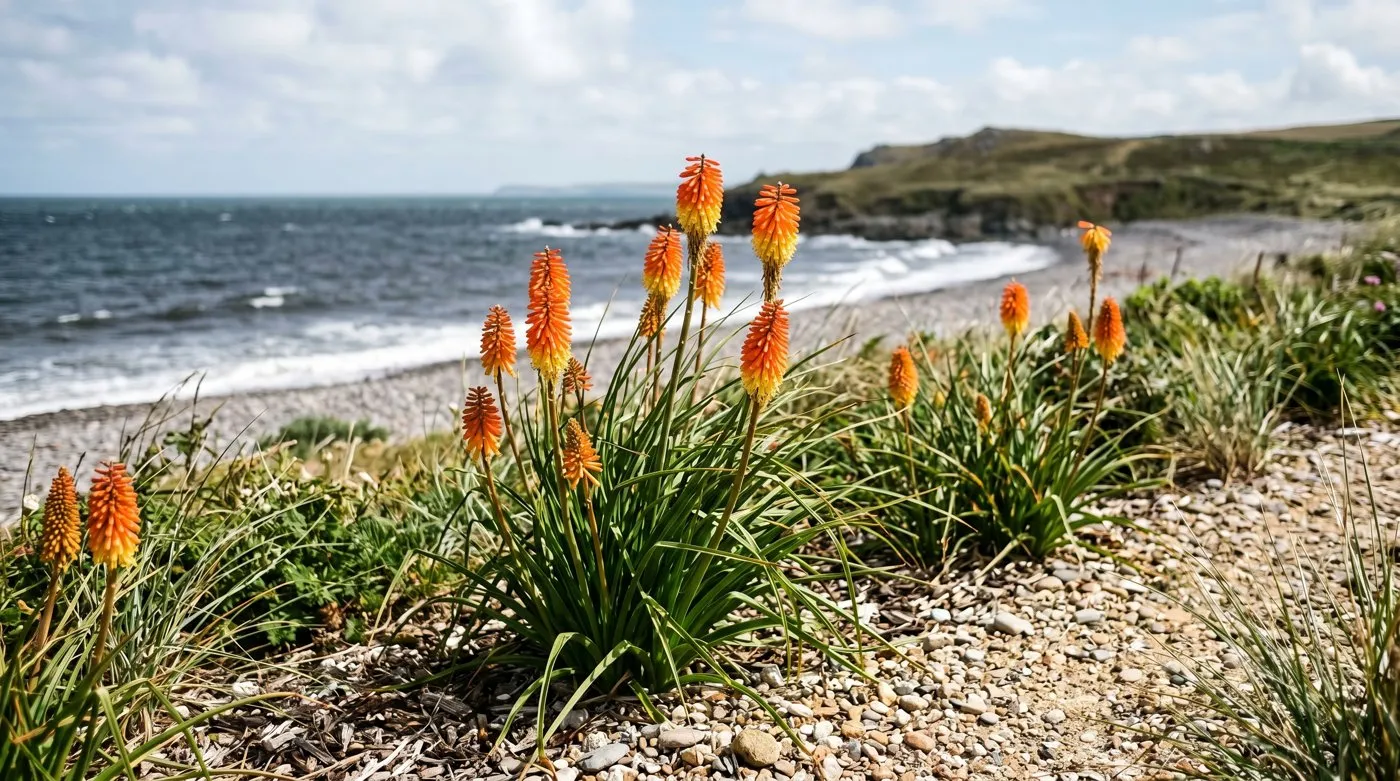 Kniphofia thrive in free-draining coastal gardens, where sandy soil and sea breezes suit them perfectly.
Frequently asked questions
Where is the best place to plant red hot pokers?
Full sun on free-draining soil. Kniphofia need at least 6 hours of direct sun and sharp drainage. They tolerate poor, sandy, gravelly and coastal soils well. Avoid shade, heavy wet clay, and any spot where water sits in winter, as a soggy crown is the main cause of death.
Should I cut back red hot pokers for winter?
No, leave the foliage on over winter. The strappy leaves protect the central crown from frost and wet. Tie them loosely upright in November to shed water away from the centre. Cut the old foliage back to 10cm in spring, once new growth shows. Cutting hard in autumn exposes the crown and risks losing the plant.
Why are my red hot pokers not flowering?
Too much shade, overcrowding, or a recent move. Kniphofia need full sun to flower well. A congested clump that has not been divided for years produces leaves but few spikes. Newly planted or recently divided plants often skip a year while they settle. Feed sparingly; rich soil and high nitrogen give lush leaves at the expense of flowers.
When should I divide kniphofia?
In mid-spring, April to May, as growth begins. Lift the clump and split it with a spade or two forks back to back. Replant divisions with three or more growing points each. Never divide in autumn; the cut crowns sit wet all winter and rot. Established clumps need dividing only every 4-5 years.
Are red hot pokers good for bees?
Yes, they are excellent for bees and late pollinators. Each spike holds 200-400 tubular florets full of nectar. Bumblebees, honeybees and late butterflies all feed on them. Late-flowering cultivars like Percy’s Pride bridge the autumn nectar gap when many other border plants have finished.
Do red hot pokers come back every year?
Yes, kniphofia are hardy herbaceous perennials. Most return reliably for 10-15 years or more in well-drained soil. The biggest threat is winter wet rotting the crown, not cold. Plant on grit, leave the foliage for winter cover, and a healthy clump will bulk up and flower more freely each season.
How tall do red hot pokers grow?
From 45cm to 1.8m, depending on the cultivar. Dwarf types like Nancy’s Red reach 45-60cm and suit pots and small borders. Mid-height cultivars sit around 90cm-1.2m. The tallest, such as Royal Standard and Percy’s Pride, throw spikes to 1.5-1.8m and may need staking on exposed sites.
Now you know how to grow kniphofia from planting to overwintering, keep your spikes coming with our guide to deadheading flowers the right way for a longer display.
Our team produces practical UK gardening guidance from source research, contributor records and established horticultural practice. Editorial standards are overseen by Matt W.