Key takeaways
- Tayberries fruit on second-year canes (floricanes); cut spent canes to the ground immediately after the August harvest
- Three horizontal wires at 0.6m, 1.0m and 1.5m on 2.5-3m posts is the standard UK training system
- Buckingham Tayberry is thornless and the sensible choice for family gardens; the original spiny clone yields 10-15% more
- Pick when fully purple-red, not red; red fruit is sour and the flavour swings sweet-sharp only at full ripeness
- Plant bare-root between November and March in fertile, moist, well-drained soil at pH 6.0-6.7 in full sun and shelter
The tayberry is the most interesting cane fruit you can grow in a UK garden. It crops bigger and more aromatic than a raspberry, more sweet than a loganberry, and produces a jam so good it has its own Scottish following. The plant is a 1979 cross from the Scottish Crop Research Institute (now the James Hutton Institute) and was named after the River Tay near Dundee. The downside is that it needs a proper training system and an annual prune-out, both of which scare off impatient growers. Get those two jobs right and a five-plant row gives 25-40kg of fruit a year from year three onwards.
What is a tayberry and why bother growing one
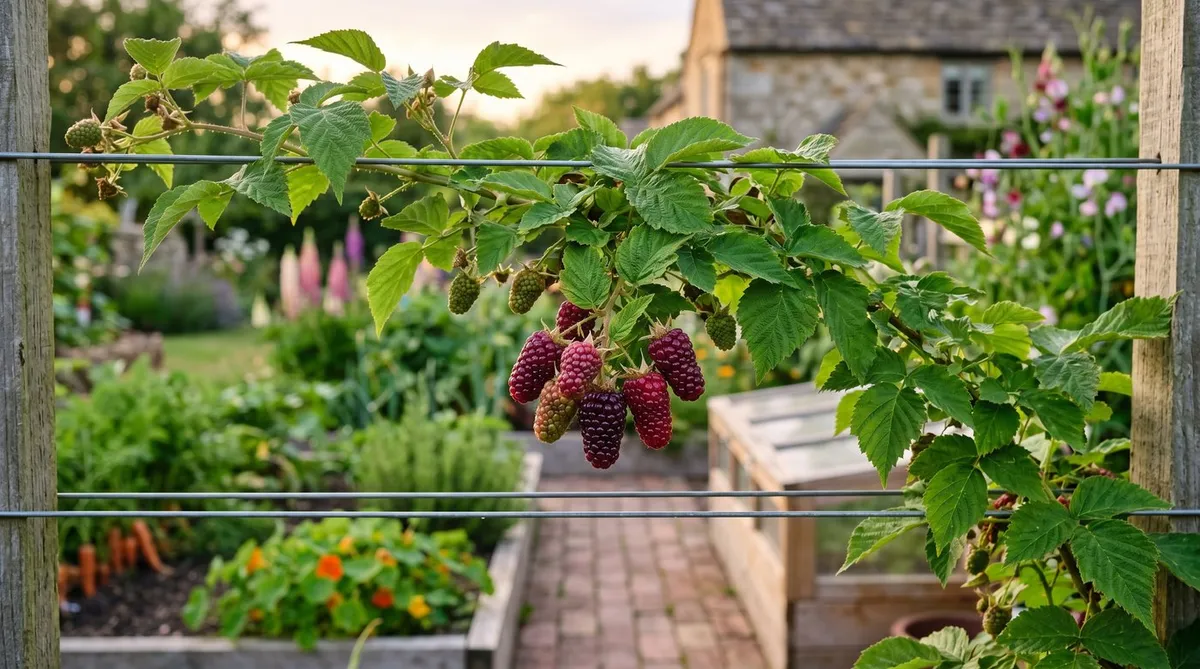
A tayberry is a hybrid between a red raspberry (Rubus idaeus) and a blackberry (Rubus fruticosus), bred deliberately at the Scottish Crop Research Institute outside Dundee in 1979 and released to UK growers in 1981. The aim was a larger, more aromatic fruit than a raspberry with the vigour of a blackberry, and it worked. The fruit is conical, 3-4cm long, wine-red ripening to deep purple-red, and the flavour is genuinely distinctive: sweeter than a loganberry, more aromatic than any raspberry, with a sweet-sharp finish that makes it the best UK soft fruit for jam, summer pudding and sorbet.
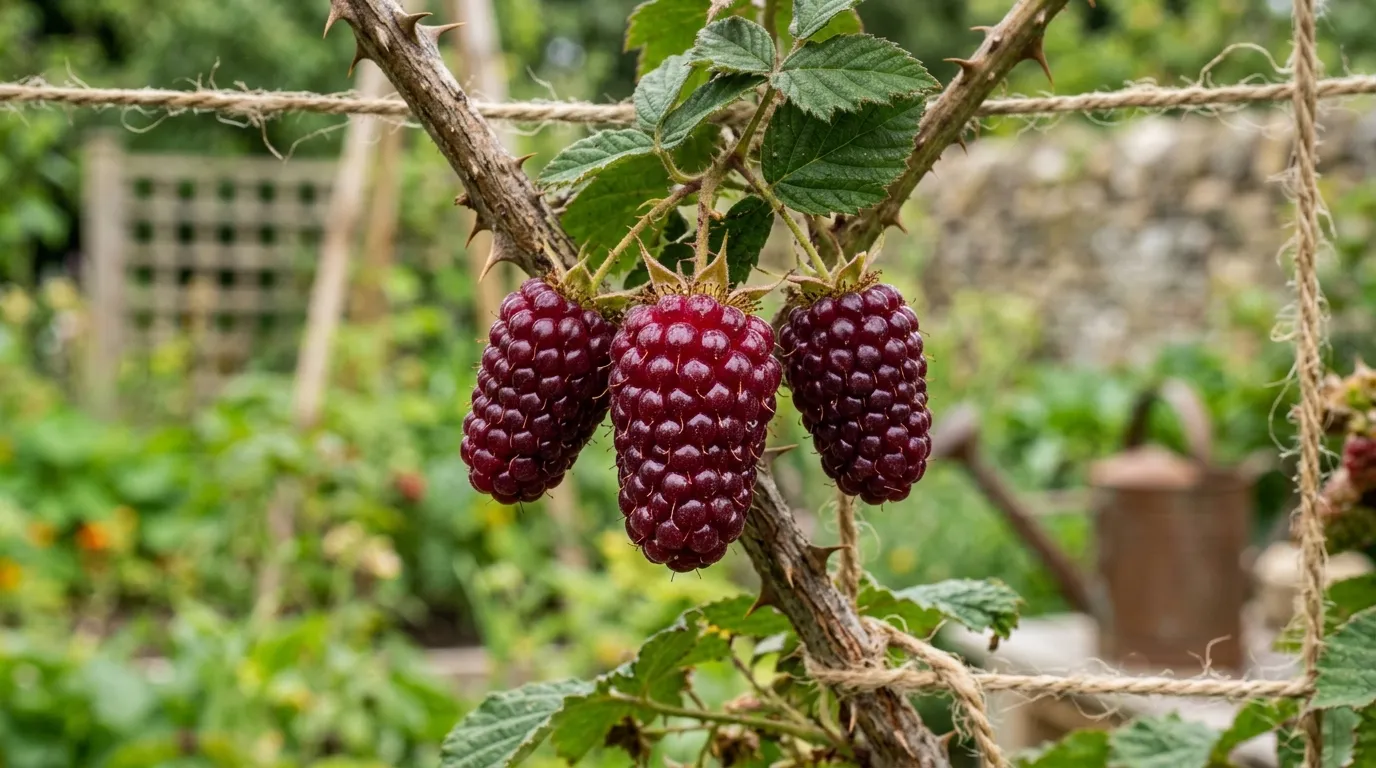
Compared with growing raspberries the tayberry needs more space, more wires and more annual training work. In return it gives you fruit that no supermarket stocks because the berries are too soft to ship. That alone makes it worth a 6m run in any kitchen garden.
Choosing the right tayberry cultivar
Three cultivars are sold in the UK and the choice matters more than people realise.
| Cultivar | Spines | Vigour | Yield per plant (year 3+) | UK availability | Best for |
|---|---|---|---|---|---|
| Tayberry (original spiny clone) | Sharp prickles on cane and leaf | Very vigorous, 3-4m canes | 4-5kg | RHS-registered nurseries | Maximum yield gardens, no children |
| Buckingham Tayberry | Thornless | Slightly less vigorous, 2.5-3.5m canes | 3.5-4.5kg | Pomona, Blackmoor, RV Roger | Family gardens, picking with children |
| Tayberry Medana | Sharp prickles, improved disease resistance | Vigorous, 3-4m canes | 4-5kg | Specialist nurseries | Sites with previous cane fruit pressure |
For most UK gardens the Buckingham Tayberry is the right call. The thornless habit means the picker can push a hand inside the fan to harvest from the inner canes without the daily punctures the spiny clone delivers from late June onwards. The 10-15% yield drop against the original is real but small in absolute terms, and any gardener with children will pay it back ten times in lower stress.
The original spiny clone is the better choice if maximum yield is the goal and the picker does not mind heavy gauntlets. Tayberry Medana is the disease-resistant choice for any site that has previously grown cane fruit, where cane spot and cane botrytis pressure may be higher. The James Hutton Institute holds the breeders’ rights on all three and the RHS soft fruit guidance lists each as suitable for UK cultivation.
Site selection: where tayberries thrive
Tayberries are not fussy about climate (they crop reliably from Cornwall to Inverness) but they are fussy about three things: sun, shelter and soil.
Sun and shelter
A tayberry needs at least six hours of direct summer sun a day for full ripening. Light shade slows ripening and gives soft fruit. A sheltered site matters more than it does for raspberries because the long canes (2.5-3.5m on a thornless plant, 3-4m on the original) catch the wind and snap at the wire if exposed. A south or west-facing fence line, the side of a kitchen garden away from prevailing wind, or a position behind a hedge or shed all work.
Soil
If your soil is heavy clay, build a raised bed 30cm above the surrounding level and backfill with topsoil plus 30% grit and 20% compost. If your soil is chalky or alkaline above pH 7.0, grow tayberries in containers (60L minimum) with ericaceous compost mixed 50:50 with John Innes No. 3.
Spacing and row direction
Plant 4-6 plants per family of four (a 5-plant row gives 25-40kg a year). Space plants 2.5-3m apart along the wire run. Run rows north-south where possible so both sides of the fan get sun through the day. Allow 1.5m between rows for picking access.
The wire training system
This is the single biggest difference between cane fruit that works and cane fruit that collapses by year three. Tayberries must be trained on a permanent wire system because the canes are too long and too heavy to free-stand.
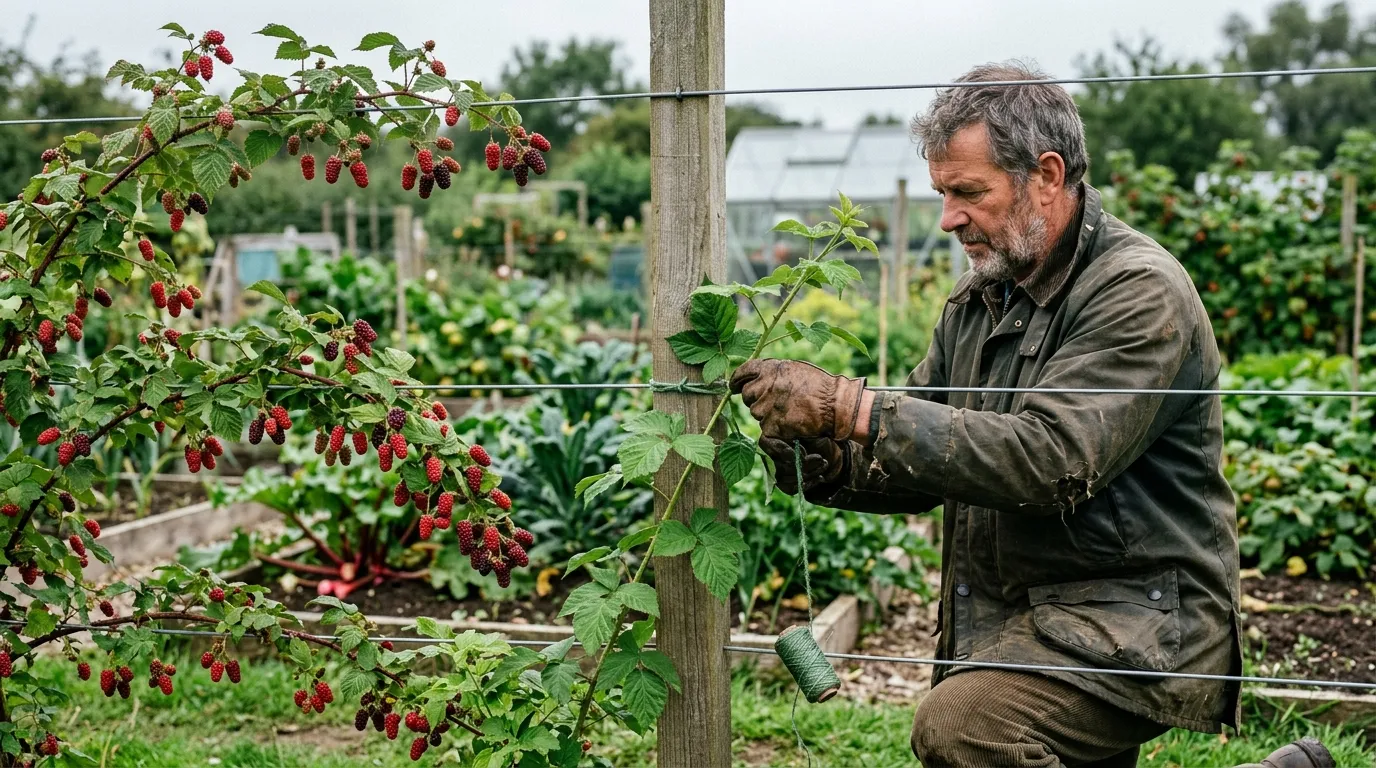
The standard three-wire system
Set 2.4m treated softwood posts (or galvanised steel) at each end of the row and at 4m intervals between. Sink the posts 60cm into the ground and brace the end posts at 45 degrees back along the row. Strain three horizontal galvanised wires (2.5mm or 3mm) between the posts at heights of 0.6m, 1.0m and 1.5m above ground. Use a tensioner at one end so the wires can be tightened each spring as they slacken.
A 7m row needs three intermediate posts plus two end posts. Materials cost in 2026: posts and bracing 80-110 pounds, wire and tensioners 35-50 pounds, soft jute twine for tying-in 6 pounds. Total around 130-160 pounds for a 5-plant run.
Fan training vs weaving
Two systems work for tayberries.
Fan training is the cleaner option. Each year’s new primocanes are tied to one side of the fan as they grow. The cropping floricanes (last year’s growth) are tied to the other side. After harvest the spent floricanes are cut to the ground and the new primocanes are unfurled, retied, and become next year’s cropping canes. The fan stays orderly through the season and the picker always knows which canes hold fruit.
Weaving trains the canes in figure-of-eight loops through the wires. It packs more cane into a shorter run but mixes new and old growth, which makes picking and pruning harder.
For UK gardens with 6m+ of run, fan training is the right answer. Use weaving only if space is very tight.
Planting and establishment
Bare-root tayberry plants are sold by specialist soft-fruit nurseries (Pomona, Blackmoor, RV Roger, Welsh Fruit Stocks) from November through to March. They are cheaper, establish faster and outperform container-grown stock in the first two years. Container plants are available year-round but cost twice as much for the same result.
How to plant
- Mark the planting positions along the wire run, 2.5-3m apart.
- Dig a trench 40cm wide and 25cm deep at each position.
- Mix the dug-out soil with 30% well-rotted manure or compost.
- Sit each plant with the crown at the original soil mark visible on the stem (usually a faint colour change). Do not bury the crown deeper.
- Spread the roots out flat in the trench, backfill, firm with the boot.
- Water in with 10 litres per plant.
- Cut all canes back to 25cm above ground level to force strong new growth from the crown.
That last step is the one that beginners skip and regret. The first-year canes that emerge from the cut-back crown are the canes that crop in year two. If you leave the original canes uncut the plant puts its energy into them and the new primocanes that emerge are weak.
Mulching and feeding
After planting, mulch the row with 7cm of well-rotted manure or garden compost. Keep it 5cm clear of the cane bases to prevent crown rot. Top-dress each March with 4-5cm of fresh manure and a handful of fish-blood-and-bone (around 60g per square metre) raked in lightly.
Do not feed with high-nitrogen lawn fertiliser. It pushes soft growth that snaps in the wind and attracts aphids.
The annual pruning cycle
Tayberries fruit on second-year canes called floricanes. New canes (primocanes) grow during summer, overwinter, then crop the following July to August before dying. The pruning cycle is shaped around that biology and is the single most important job in the tayberry year.
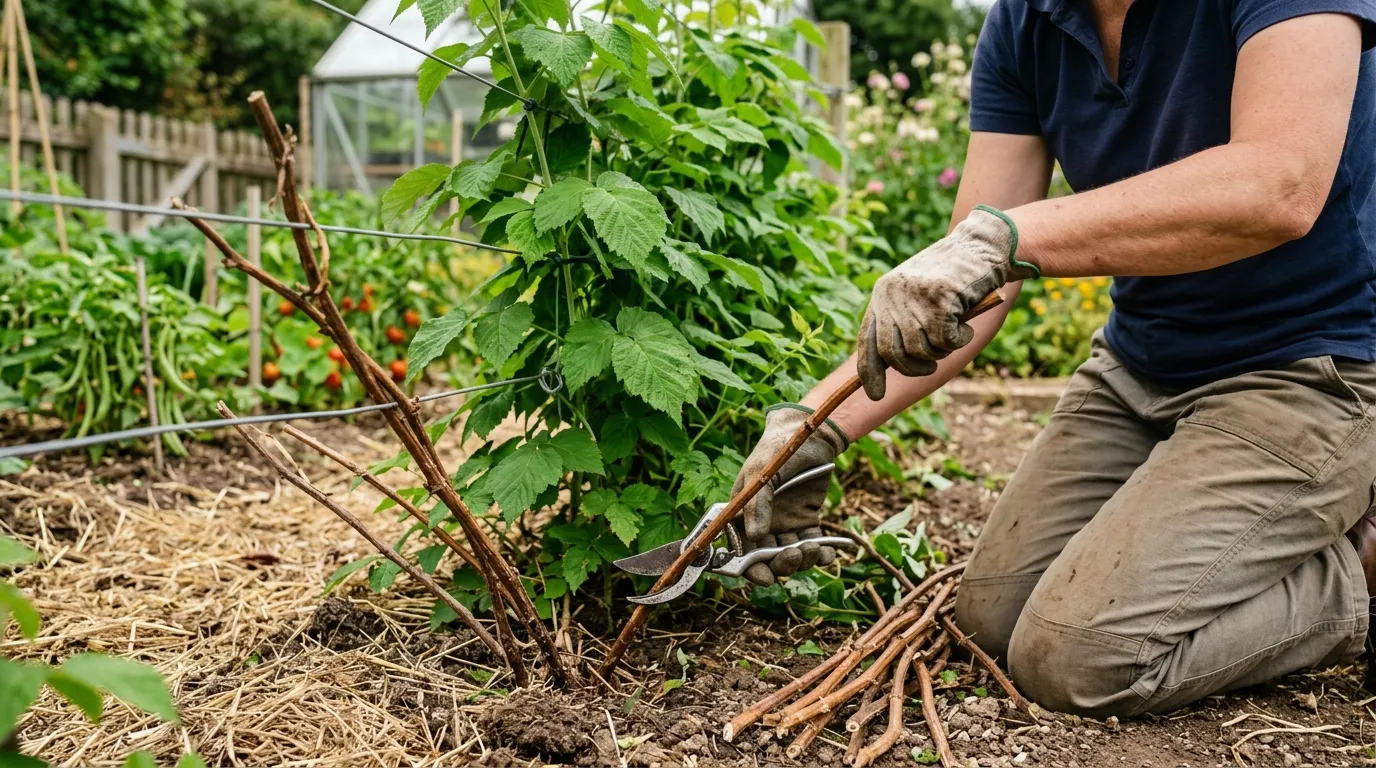
August prune-out (the main job)
Within two weeks of the last picking, cut every spent fruiting cane to the ground. Brown, dried-out flowering side-shoots are the giveaway. Make the cut at soil level with sharp bypass secateurs. Carry the cut canes away and burn or shred them (do not compost cane fruit prunings because virus and cane spot survive a cold compost heap).
Then untie the year’s new primocanes from the holding wire on the opposite side of the fan, fan them out across the empty side, and tie them in to the three horizontal wires with soft jute twine in a figure-of-eight loop. Aim for 6-8 strong primocanes per plant evenly spaced across the fan.
Spring tip-prune (optional)
In late February to early March, tip-prune the floricanes by removing the top 30cm of each cane. This stops the canes whipping in spring wind and encourages stronger flowering laterals. Most UK growers skip this step and the fruit is still fine; it is a marginal-gain job worth doing if you have time.
Summer primocane management
Pest and disease pressure
Tayberries share most pests with raspberries but escape some of the worst. The five UK problems worth knowing.
| Problem | Symptoms | When | Treatment |
|---|---|---|---|
| Raspberry beetle | Maggots inside fruit at harvest | June-July | Pheromone trap, derris alternative; pick clean and early |
| Cane spot | Purple-bordered spots on canes, fruit drop | Wet springs | Cut and burn affected canes; copper spray pre-blossom |
| Cane botrytis | Grey rot at cane base, fruit moulds | Wet summers | Improve airflow by reducing cane count to 6-8 per plant |
| Raspberry leaf and bud mite | Curled, bronze leaves | Mid-summer | Tolerate; rarely causes yield loss; avoid sulphur sprays |
| Vine weevil (containers only) | Notched leaves, sudden wilting | Year-round | Biological nematode drench in spring and autumn |
Birds are less of a problem on tayberries than on raspberries because the fruit is darker and harder to see. Even so, a fruit cage or netting over the row from early July onwards is worth the 60-90 pound build cost for a 5-plant row. For a wider take on UK soft-fruit pests see the gooseberry sawfly identification and control guide, where the same exclusion principles apply.
Yield expectations and harvest
- Year 1 (2019-2020): no fruit (canes cut back at planting).
- Year 2 (2020-2021): 6kg total, 1.5kg per plant from the canes that grew in year 1.
- Year 3 (2021-2022): 18kg total, 4.5kg per plant.
- Year 4 (2022-2023): 21kg total, 5.25kg per plant.
- Year 5 (2023-2024): 22kg total, 5.5kg per plant.
A well-managed 5-plant row of 7m can reasonably expect 25-40kg of fruit a year from year three onwards. That is enough for a family of four to eat fresh through August, make 12-15 jars of jam, freeze 3-4kg for winter sorbet and still have plenty to give away to neighbours.
When and how to pick
Pick every two days through late July and into August. Ripe fruit drops within 48 hours of full colour and the only fruit worth picking is fully deep purple-red. Red fruit is sharp and disappointing. A ripe tayberry pulls cleanly off the plug with a gentle tug; if it resists, leave it another day.
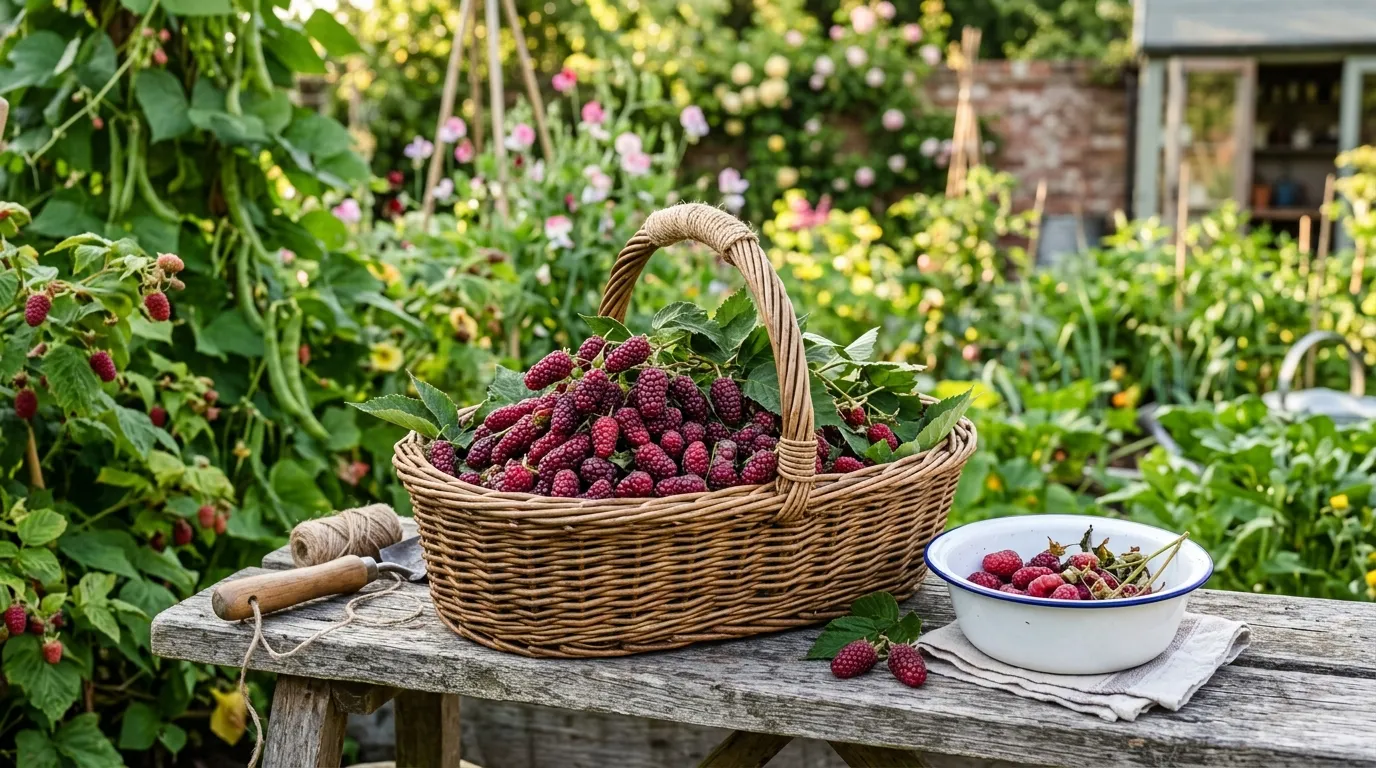
Tayberries do not keep. Fresh-picked fruit is good for 24 hours in the fridge before it begins to soften, then 48 hours at the outside. Plan to use, freeze or jam the harvest within two days of picking. Frozen tayberries hold their flavour for nine months on an open tray then bag system.
Growing tayberries in containers
Tayberries can be grown in containers where ground space is short, soil is alkaline, or a patio is the only sunny spot. They need a bigger pot than most people realise and the yields fall to 30-40% of an in-ground plant, but a single container plant on a south-facing patio still gives 1.5-2kg of fruit a year.
Container size and compost
Use a 60-litre minimum container, ideally a 75-litre half barrel or 80-litre trough. Anything smaller dries out by July and the canes go limp by the second week of warm weather. Drill or check for 6-8 drainage holes around the base, sit the pot on pot feet so water flows away, and fill with a 50:50 mix of John Innes No. 3 soil-based compost and a peat-free multipurpose compost. Add a 30% volume of horticultural grit at the base for drainage. Top with a 4cm bark mulch to slow surface evaporation.
A single Buckingham Tayberry trained on a 1.8m bamboo wigwam works in a container, or two plants on a free-standing 2.4m post-and-three-wire system. The wires can be anchored to the patio with rawl bolts or to a fence behind the container.
Watering and feeding
The container is the limiting factor. Water every 2-3 days from May to September, deep enough that water runs from the base. In hot spells (over 25C) water daily. A drip irrigation kit on a battery timer (40-60 pounds) saves the plant when you go on holiday.
Feed weekly from April to August with a tomato fertiliser at half-strength (the high potash supports fruiting). Top-dress the compost in March with 3cm of fresh garden compost plus a handful of pelleted poultry manure.
Container plants weaken after 4-5 years. Lift, divide the crown in two, refresh the compost, and replant one half back into the pot. The other half goes into the ground or a friend’s garden.
Propagation: making more plants for free
Tayberries propagate from tip-layering more easily than any other soft fruit. The new canes bend over naturally in late summer and root where they touch the ground. A single mature plant can give 4-6 new plants a year at no cost.
Tip layering method (August to October)
- Choose a strong, flexible primocane on the outside of the fan.
- Bend the cane down to the ground without snapping it.
- Bury the growing tip 5cm deep in moist soil at the point it naturally reaches the ground.
- Pin it down with a length of bent wire or a heavy stone.
- Water in and leave through winter.
- By March the buried tip will have rooted into a new crown.
- Sever the connection to the parent plant with secateurs at the soil surface.
- Lift the new rooted plant in November of the same year and transplant.
Division of mature plants
After 7-8 years the crown spreads to a 50-60cm clump. Lift the whole plant in November, slice the crown vertically with a sharp spade into 2-3 pieces, and replant each piece on fresh ground. Each division returns to full crop in its second year.
Hardwood cuttings
Less reliable than tip layering but worth a try. Take 25cm hardwood cuttings from one-year-old canes in late November, push two-thirds of each cutting into a trench of gritty compost, and leave through winter. Strike rate is around 30-40% for tayberries, compared with 80%+ from tip layering.
Companion planting and integration with the kitchen garden
A tayberry row is not just a fruit producer. It earns its keep in the wider kitchen garden if you plan around it.
What to plant nearby
- Comfrey (Bocking 14): plant a clump 1m away from the end of the row. The deep roots draw up potassium and the chopped leaves make an excellent liquid feed for the tayberries in July.
- Garlic and chives: alliums planted along the base of the row deter aphids and rabbit browsing. They also crop early enough not to compete with the main fruiting window.
- Calendula and nasturtium: annual flowers in the row drag in pollinators and trap aphids away from the cane tips.
- Strawberries (perpetual fruiting): a low row of strawberries 1m in front of the tayberry row uses the same wire posts for low strawberry netting and crops on the same picking schedule.
What to keep clear
- Other cane fruit (raspberries, blackberries, loganberries): within 5m the virus and cane spot pressure builds across the whole soft-fruit area. Separate the cane families.
- Potatoes: share verticillium wilt, which kills tayberries fast.
- Brassicas: heavy feeders that strip the soil before the tayberries can use it.
- Trees and shrubs casting shade: anything within 3m on the south side shades the wire run.
For a wider kitchen-garden plan that places tayberries alongside other soft fruit and vegetables, the soft-fruit picking calendar runs gooseberries (mid-July), redcurrants (mid-July to early August), tayberries (late July to mid-August), blackcurrants (late July to mid-August), summer raspberries (early to mid-August), and autumn raspberries (September to October). A 7m tayberry run fits perfectly into a 4m x 8m fruit cage shared with two blackcurrant bushes and a red and white currant.
What to do with the fruit
Tayberries make the best jam of any UK soft fruit. The flavour holds through cooking better than a raspberry and the natural pectin level is high enough that the jam sets at 40% sugar without added pectin. A 4kg pick gives 12-15 standard 340g jars.
Beyond jam:
- Summer pudding: the classic. A 1.5kg pick of mixed tayberries, raspberries and redcurrants makes a six-portion pudding.
- Sorbet and ice cream: the sweet-sharp flavour suits both. The fruit blends smooth without the seedy texture of raspberry.
- Tayberry pie: mix with a tart apple at 70:30 to balance the sweetness.
- Fresh, simply served: with creme fraiche or thick Greek yoghurt and a sprinkle of demerara.
- Wine and cordial: a 5kg pick makes 5 litres of cordial or 7 litres of fruit wine.
For tree-fruit pruning that pairs well with the soft-fruit calendar see the fruit tree pruning guide, which covers apples, pears, plums and cherries.
Tayberry jam: the working recipe
- Weigh the fruit. Use equal weights of fruit and granulated sugar (1kg fruit to 1kg sugar). Tayberries set well at 40% sugar by total mass once water boils off.
- Tip the fruit into a heavy preserving pan with 50ml of lemon juice per kg of fruit. The lemon adds the small extra pectin needed for a soft set and brightens the colour.
- Warm gently over a low heat to draw the juices for 15 minutes. Crush the fruit lightly with a potato masher; do not blend it because the drupelet seeds break and turn bitter.
- Add the sugar and stir until fully dissolved. Bring to a rolling boil.
- Boil hard for 8-10 minutes. Test on a cold saucer from the freezer: a wrinkle on the surface when pushed with a fingertip means a set.
- Skim the foam off the top. Pour into warm sterilised jars, seal and label.
A 4kg pick gives 12-15 standard 340g jars and the jam holds in the cupboard for 18 months. Once opened keep refrigerated and use within 4 weeks.
Freezing tayberries for winter
Spread the fresh-picked fruit in a single layer on a baking tray and open-freeze for 4 hours. Once solid, tip into a labelled freezer bag. The open-freeze step stops the berries clumping into a frozen brick, so you can scoop a handful at a time straight from the bag. Frozen tayberries hold their flavour for 9 months and work in smoothies, sorbets, crumbles and jam straight from frozen.
Long-term row management
A tayberry row is productive for 12-15 years if managed properly. After that the stool weakens, virus pressure builds, and yields halve. The signs of a row past its best:
- Yield drops below 60% of the year-3 peak.
- New primocanes grow shorter and thinner each season.
- Leaves develop persistent yellow mottling not explained by feeding.
- Cane spot lesions appear earlier each spring.
- Fruit size drops below 3cm at full ripeness.
When two or more of those signs show up, plan a replant. Order fresh certified bare-root stock for the following November, choose a new site at least 3m from the old row, and start the cycle again. The old row can be removed, the wires reused, and the ground replanted with brassicas, beans or potatoes for 2-3 years before any cane fruit goes back in.
For wider soft-fruit planning, the white currant guide pairs well with a tayberry row. A balanced UK soft-fruit garden runs tayberries on a wire run for July-August, blackcurrants in a bush row for late July, and redcurrants and whitecurrants for fresh eating from mid-July, with the best blackcurrant varieties rounding out the season.
Related guides
For other cane and hybrid berries see raspberries and blackberries. For currant bushes that crop alongside tayberries the redcurrant and blackcurrant guide covers the practical detail. For pest pressure that affects most UK soft fruit see gooseberry sawfly identification and control, and for tree fruit beyond canes the fruit tree pruning guide covers apples, pears, plums and cherries.
Our team produces practical UK gardening guidance from source research, contributor records and established horticultural practice. Editorial standards are overseen by Matt W.