Key takeaways
- Landcress tastes almost identical to watercress but grows in normal garden soil
- Hardy to -10C without protection - the only true outdoor winter UK salad
- Sows August to March; harvests October to April from successional sowings
- Cut-and-come-again from 30 days; 5-6 cuts before bolting in spring
- Yields 800-1,200g per 1-metre row of cut leaves across the winter
- Self-seeds readily once established - one good year gives several volunteer crops
Landcress is the UK winter salad nobody talks about. Watercress gets all the attention but needs flowing water. Lambs lettuce gets the seed sales but turns slimy under January frost. Rocket bolts as soon as the weather warms. Landcress (Barbarea verna) crops outdoors from October to April with no greenhouse, no fleece, and no fuss. It tastes almost identical to watercress.
This guide gives the sowing dates, varieties, harvest method, and bolting calendar for landcress in a UK plot. You will find the 21-day succession sowing schedule, the frost-flavour effect that turns mild leaves into peppery ones overnight, and the cut-and-come-again technique that delivers 5-6 cuts per plant. Pair this with our winter salad harvesting guide and our how to grow lettuce for the wider salad cluster.
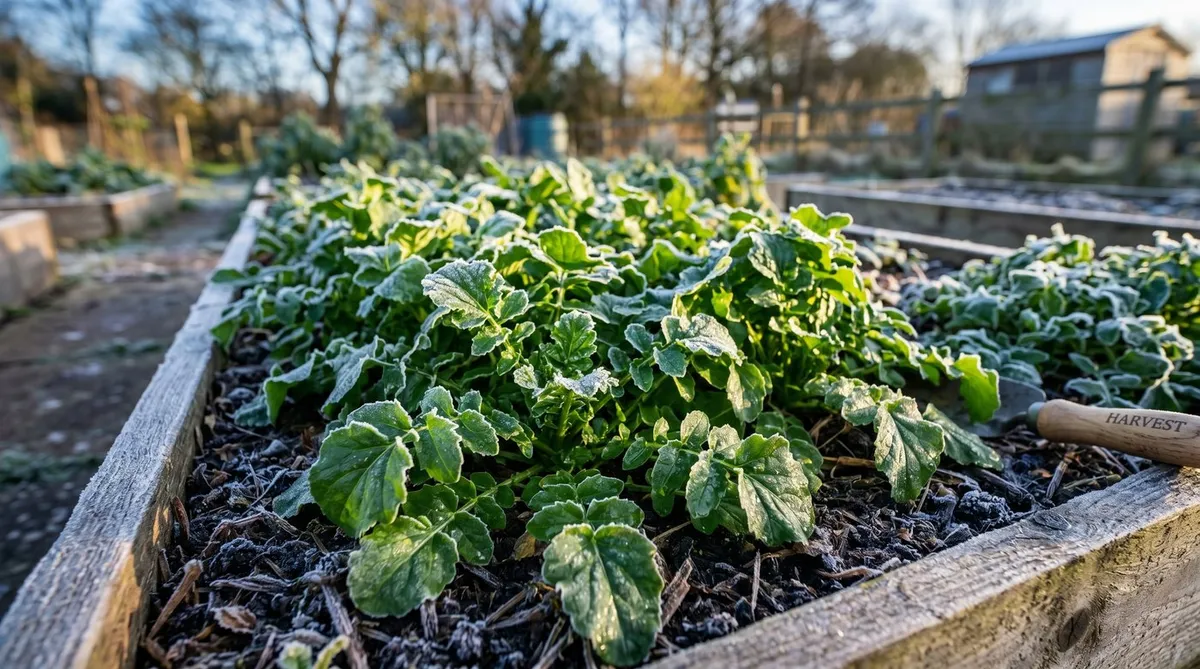
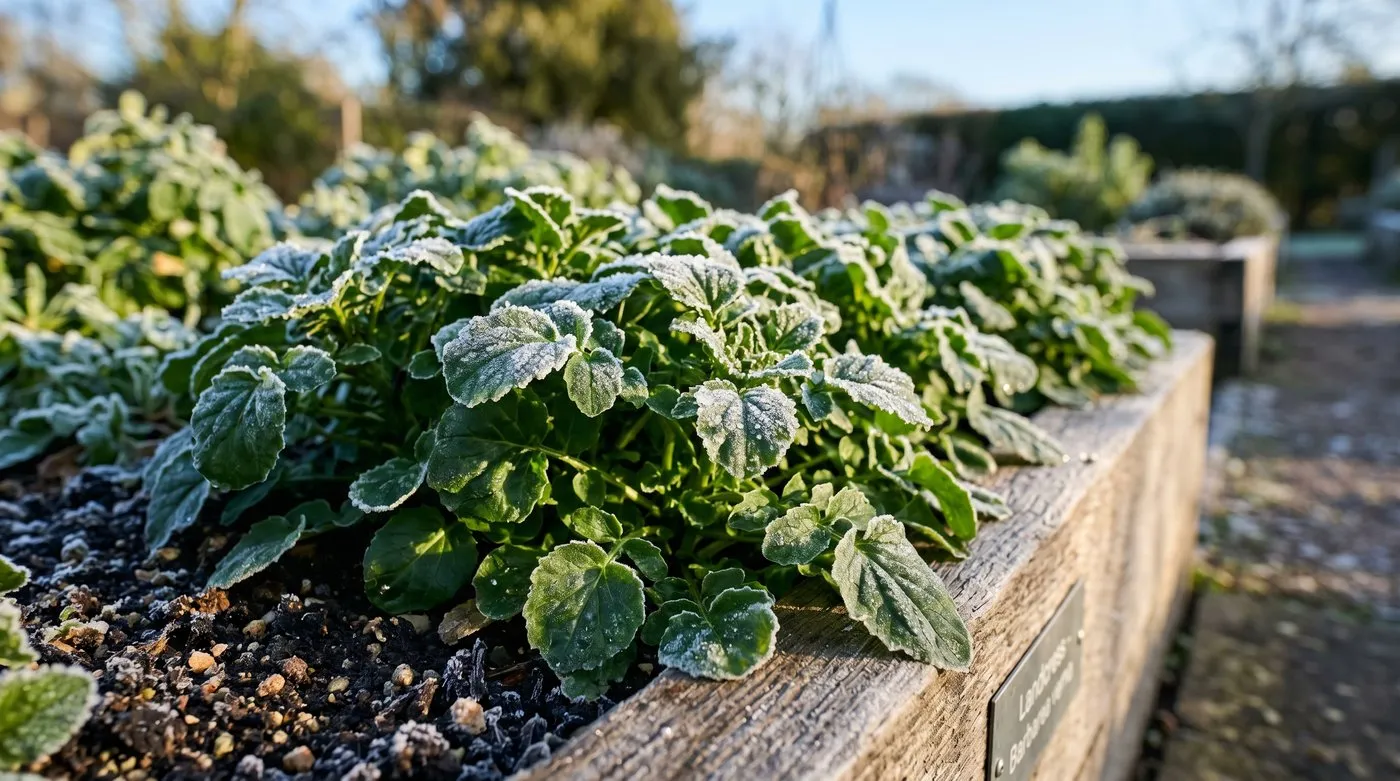 Landcress under hard frost in early January, the cold intensifies the peppery flavour and leaves stay crisp and edible at -8C
What landcress is and why nobody grows it
Landcress (Barbarea verna) is a hardy biennial in the cabbage family. Also called American cress, upland cress, Belle Isle cress, and early winter cress. The plant forms a flat rosette of dark green pinnate leaves 15-25cm across. Each leaf has a strong peppery flavour almost identical to watercress.
The taste is the surprise. Most UK gardeners who try landcress report it tastes more like watercress than watercress does in the shop. The pepperiness is sharp on first bite, mellow on chewing, with no bitter aftertaste in well-grown leaves.
Landcress is not a substitute. It is the original UK winter cress. Records of landcress in British market gardens predate watercress cultivation by 100 years. The name “early winter cress” first appears in Gerard’s Herball of 1597. Watercress only became commercial in the 19th century with the spread of artificial watercress beds.
The plant is hardy to -10C unprotected. Leaves may droop and turn purple under hard frost but recover fully within 24 hours of the thaw. No other commonly grown UK salad survives this. Lambs lettuce gets slimy, mizuna freezes, lettuce dies entirely.
Self-seeds easily once established. Plants left to flower in late spring drop seed that germinates in autumn. One good year on a plot gives several years of volunteer landcress in unexpected corners.
| Plant | Hardiness | Texture in winter | Flavour |
|---|---|---|---|
| Landcress | -10C | Crisp, intact | Peppery, watercress-like |
| Watercress | -3C (in water) | Soft, water-bound | Peppery, mild |
| Lambs lettuce | -5C | Soft, slimy under frost | Mild, nutty |
| Mizuna | -3C | Limp under frost | Mild, mustard |
| Land claytonia | -8C | Crisp | Bland, neutral |
| Winter lettuce | -2C | Dies under frost | Mild |
Sowing dates: the 21-day succession plan
Sow landcress August to March for UK autumn-winter harvests. Avoid summer sowings: heat triggers bolting and bitter flavour. The optimal three sowing windows are late August/early September, late October/early November, and February/March.
Late August to early September gives plants that reach cutting size by mid-October and crop continuously through to January.
Late October to early November gives smaller autumn rosettes that hold through winter and produce a heavier cut in February-March.
February to March gives a final spring sowing that crops in April before the bolting trigger of May warmth.
21-day stagger within each window. Within the late summer window, sow on day 1, day 22, and day 43. This avoids a single peak harvest and spreads cuts across 8-10 weeks.
Direct sow or modules, both work. Direct sow 0.5cm deep, thin to 15-20cm. Modules in 6-cell trays at 18-20C germinate in 5-8 days. Transplant at 4 true leaves. Module-sown plants establish faster but direct-sown plants root deeper and stand frost better.
| Sowing date | Transplant date (modules) | First harvest | Notes |
|---|---|---|---|
| Late August | Mid-September | Mid-October | Earliest crop, heaviest yield |
| Mid-September | Early October | Late October | Standard timing |
| Late October | Mid-November | December under fleece | Smaller rosettes |
| Mid-November | Early December | February | Smallest rosettes, frost slows |
| February | Early March | Mid-April | Final crop before bolting |
| Mid-March | Early April | Late April | Risk of bolting in warm year |
Soil, spacing and position
Landcress prefers cool, moisture-retentive soil in partial shade. South-facing beds work in winter when sun is low. North-facing or east-facing positions extend the cropping window because soil stays cool longer in spring.
Soil pH 6.5-7.5 is ideal. Acid soils give weak plants and shorter cropping. Add lime in autumn to plots below pH 6.0.
Spacing 15-20cm in the row, 25-30cm between rows. Closer than 15cm gives smaller rosettes with thinner stems. Wider spacing increases yield per plant but reduces yield per square metre.
Soil enriched with compost or composted manure. Brassicas need feeding. Apply 3-5kg per square metre of compost before sowing. Top-dress with seaweed feed monthly during winter to keep growth steady.
Drainage matters in winter. Waterlogged ground rots crowns. Raised beds help on clay sites. On heavy clay, mix in coarse grit or composted bark before sowing.
Cool position prevents summer bolting. Plants in full summer sun bolt within 4-6 weeks. Plants in partial shade extend to 8-12 weeks before flowering. For year-round harvest, use a shaded position adjacent to taller crops or trellised peas.
 Cool-morning harvest in late November. Cut whole rosettes 2cm above the crown to trigger re-growth for the next cut in 14-21 days
Hardiness and the frost-flavour effect
Landcress survives -10C in UK plots without protection. This is the single feature that separates it from every other commonly grown salad. Leaves flatten under hard frost, turn purple at the edges, and look dead. Within 24 hours of the thaw they stand back up.
Flavour intensifies after the first hard frost. Cold accumulates pungent compounds called isothiocyanates in the leaves. Pre-frost landcress tastes mildly peppery. Post-frost landcress tastes like sharp watercress. Many UK gardeners only learn this after the first November freeze.
The mechanism is similar to brassica frost-sweetening. Cold temperatures slow respiration but maintain compound synthesis. The plant accumulates protective chemicals (including the mustard oils that give the bite) faster than it uses them.
Cold frames or fleece are optional, not essential. A cold frame keeps harvest continuous through hard winters by raising leaf temperature 3-5C above ambient. Fleece adds 1-2C. Use protection only if you want to cut in deep frost without waiting for thaw.
Snow cover is beneficial. A 5-10cm snow layer insulates plants from wind chill. Leaves under snow stay crisp and harvestable. Brush snow off only if you want to cut that day.
Wind chill is the real threat, not air temperature. Exposed sites with -3C and 25mph wind damage leaves more than sheltered sites at -8C still air. Plant landcress in the shelter of brassica cages, hedges, or taller crops.
Harvesting: cut-and-come-again
Cut whole rosettes 2cm above the crown to trigger re-growth. Use kitchen scissors or a sharp knife. Cut at the base of the leaves, leaving the central growing point untouched.
Re-growth takes 14-21 days. New leaves emerge from the crown within a week and reach cutting size in two to three weeks. Each plant gives 5-6 cuts before bolting in spring.
Pick outer leaves only for slower harvest. Outer leaves at 8-12cm length are harvestable while the plant continues growing. This method gives smaller cuts but extends the productive life of each plant.
Yield averages 150-200g per cut per metre of row. 5-6 cuts give 800-1,200g per metre across the season. A 4-metre row supplies a household with cut salad weekly from October to April.
Cut in the cool of the morning. Leaves are crisp and full of water. Cut after midday in winter sun and the leaves wilt faster after picking.
Store in a damp tea towel in the fridge for 5-7 days. Wash only at the point of eating. Wet leaves deteriorate fast.
| Cut number | Days after previous | Cut weight | Notes |
|---|---|---|---|
| First cut | 50-60 days from sowing | 200g per metre | Heaviest cut |
| Second cut | 14-21 days | 180g per metre | Slight slow in mid-winter |
| Third cut | 14-21 days | 160g per metre | Late January |
| Fourth cut | 14-21 days | 150g per metre | February |
| Fifth cut | 14-21 days | 140g per metre | March, slower growth |
| Sixth cut | 14-21 days | 130g per metre | Final cut before bolt |
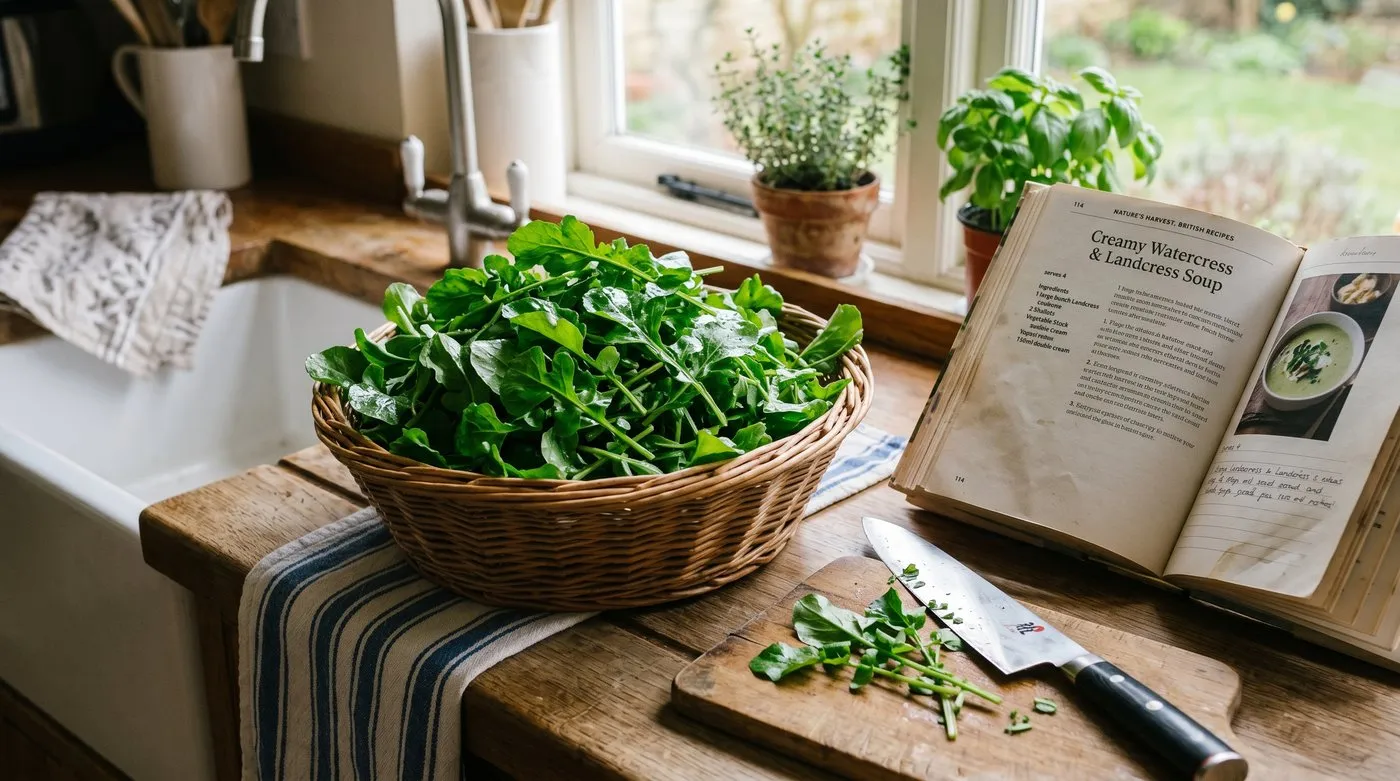 Fresh landcress leaves ready for the kitchen. The peppery flavour matches watercress almost exactly and works in every watercress recipe
Pest and disease pressure
Landcress pest pressure is low in winter. The plant is most exposed to flea beetle and cabbage white in late summer and early autumn. Winter pests are minimal.
Flea beetle bites pinholes in young leaves September-October. Cover seedlings with fleece for the first 4-6 weeks. By late October temperatures drop too low for flea beetle activity. See our flea beetle protection guide for the full method.
Cabbage white caterpillars eat leaves August to early October. Inspect twice weekly and hand-pick eggs from leaf undersides. Insect mesh stops the problem entirely.
Slugs and snails take young rosettes in damp weather. Pellets, beer traps, or copper rings around plants. Worse in October when ground is damp but not yet cold.
Powdery mildew can develop in March under cloches. Ventilate cold frames on mild days. Remove affected leaves promptly. The crop is usually nearly over when mildew shows.
Pigeons strip plants in deep winter when other food is scarce. Use bird netting on hoops over the row from December onwards if pigeons are active locally.
Step-by-step: sowing a landcress row
Step 1: prepare a 1m row in a partially shaded bed. Dig over to 15cm, work in 3-5kg per square metre of garden compost, rake level.
Step 2: water the row the day before sowing. Moist soil grips small seeds and gives even germination.
Step 3: draw a shallow drill 0.5cm deep. Use a length of string or bamboo cane to mark the line.
Step 4: sprinkle seed thinly along the drill. Aim for one seed every 3cm. Landcress seed is small but visible on dark soil.
Step 5: cover with 0.5cm of fine soil or compost. Press lightly to ensure soil-to-seed contact.
Step 6: water in with a fine rose. Keep soil damp but not waterlogged for the first 10 days.
Step 7: thin to 15-20cm at the 4-leaf stage. Use the thinnings as the first cut salad. Composted plants give vigorous mature rosettes.
Step 8: water during dry autumn weather. Once frost arrives, watering is rarely needed. Snow and rain supply enough.
Step 9: protect from flea beetle with fleece for 4-6 weeks. Remove once temperatures drop below 10C.
Step 10: first harvest at 50-60 days from sowing. Cut whole rosettes 2cm above the crown.
 Module-sown landcress at the 4-leaf stage ready for transplanting in early September. Module raising avoids slug damage and gives a 10-day head start
Common mistakes to avoid
Sowing in summer heat. Landcress bolts within 4-6 weeks above 20C soil. Restrict sowings to August through March.
Full sun exposure in late spring. Even March sowings bolt in May warmth if planted in full sun. Use partial shade or interplant with taller crops.
Cutting below the crown. Cuts below the central growing point kill the plant. Always leave 2cm of stem above the soil surface.
Letting plants bolt. Once flower stems appear, leaves turn bitter. Cut bolting plants for the compost heap and fresh-sow the next batch.
Overwatering in winter. Damp cold soil rots crowns. Water sparingly from November to February. Spring growth needs more water.
Treating landcress like lettuce. Lettuce wants warmth and even moisture. Landcress wants cool, frost, and steady not lush growth. The two crops complement each other across the year.
Gardener’s tip: Save seed from one or two plants left to flower in late spring. Landcress self-pollinates and produces hundreds of seeds per plant. Catch seed in a paper bag tied around the seed head, store dry, sow the next August. Free seed for life.
The standard Barbarea verna is the only widely available variety. Sold under names like ‘American Cress’, ‘Upland Cress’, ‘Belle Isle’ or simply ‘Landcress’. All are the same species; minor strain differences exist but performance is broadly equivalent.
Realseeds ‘Landcress’ is the artisan choice. Slightly larger leaves, deeper green colour, marginally stronger flavour. £3-£4 per packet. Best from Realseeds direct.
Suttons and Thompson and Morgan both stock the same standard line. Comparable performance.
There is no F1 hybrid landcress. All seed is open-pollinated. Save your own from year two; the seed comes true.
| Source | Common name | Packet size | Cost | Notes |
|---|---|---|---|---|
| Mr Fothergill’s | American Cress | 250 seeds | £2.50 | Most reliable in trial |
| Realseeds | Landcress | 200 seeds | £3.50 | Slightly larger leaves |
| Suttons | American Cress | 200 seeds | £2.95 | Standard performance |
| Thompson and Morgan | Land Cress | 200 seeds | £3.25 | Standard performance |
Frequently asked questions
Is landcress the same as watercress?
No, but they taste similar. Landcress (Barbarea verna) is a hardy land plant in the mustard family. Watercress (Nasturtium officinale) is an aquatic plant that needs flowing water. Landcress has the same peppery flavour and similar appearance but grows in any garden soil and survives -10C frost. Most UK gardeners cannot tell them apart in a soup or sandwich.
When should I sow landcress in the UK?
Sow landcress August to March for autumn-winter harvests. Late August and September sowings give November-January cuts. November sowings give February cuts. February and March sowings give April cuts before bolting. Avoid summer sowings; plants bolt and turn bitter in the heat. Stagger sowings every 21 days within each window for continuous harvest.
How cold can landcress survive?
Landcress survives temperatures down to -10C without protection in UK plots. Leaves may turn purple and lay flat under hard frost but recover fully when the frost lifts. A cold frame or fleece cover keeps cropping continuous through hard winters but is not essential for plant survival. Snow cover insulates plants and helps them through prolonged cold spells.
Why has my landcress turned bitter?
Landcress turns bitter when the plant prepares to flower (bolts) in late spring, or when stressed by heat or drought. The first sign is taller central stems and rounder upper leaves. Cut bolting plants for the compost heap; the season is over. Fresh sowings give clean flavour again from October. Mild bitterness in summer-sown plants can sometimes be reduced by partial shade and steady watering.
Can landcress be used like watercress in recipes?
Yes, landcress works in every watercress recipe including watercress soup, sandwiches, salads and garnish. The flavour is almost identical with a slightly sharper edge. Some chefs prefer landcress to watercress because the texture holds up to a brief saute, which collapses watercress entirely. Use cut weight for cut weight as a direct swap.
Now you have a true winter salad, see our winter salad harvesting guide for the wider cool-season cropping plan and our how to grow corn salad (lambs lettuce) for the complementary mild salad. The Royal Horticultural Society winter salad guide covers the broader UK cool-season vegetable range.
Our team produces practical UK gardening guidance from source research, contributor records and established horticultural practice. Editorial standards are overseen by Matt W.