Key takeaways
- Bore tubes 1.0 to 1.2m deep give the depth needed for a 900mm-plus exhibition carrot
- St Valery, New Red Intermediate and James Scarlet Intermediate are the three benchmark show varieties
- Filling mix is 70% riddled peat-free compost, 20% sharp sand, 10% leaf-mould plus 30g of slow-release feed per tube
- Single-seed each tube and thin to one seedling at the 4-true-leaf stage
- Sow in late March under a tile, lift in September, wash for the show bench under cool running water only
- Forking is caused by fresh manure, stones or splitting tap roots, not poor variety
- Judges score out of 20 against the NVS handbook for condition, uniformity, size and colour
How to Bore Tubes for Long Show Carrots
The bore is the foundation of the whole job. Get this wrong and the carrot has nowhere to go. The standard method on UK exhibition plots is a steel crowbar with a welded T-handle on the top and a tapered point on the bottom. The bar should be 1.2m to 1.4m long and at least 25mm in diameter. A cheaper alternative is a length of scaffold tube fitted with a steel cone, but the crowbar gives the truest hole.
Mark out the tube positions in a single row at 250mm spacing. This gives the foliage room to breathe and keeps the bed easy to weed. Drive the crowbar vertically into the prepared ground using your full body weight, lifting and dropping the bar in short strokes. A hole 1.0 to 1.2m deep takes 6 to 8 minutes per tube on heavy clay, less on lighter soil. Twist the bar half a turn at the bottom of each stroke to widen the hole. The finished hole should be 60mm to 80mm in diameter to take a standard 75mm PVC bore liner.
Bore Liner Mix Recipe for Show Carrots
Lower each liner into a bored hole and tamp the soil gently around the top so the liner sits flush with the bed surface. The liner is not removed at lifting. It stays in the hole for the whole season.
Pass every ingredient through a 6mm garden riddle before mixing. One stone bigger than 6mm will fork the carrot. Mix the ingredients in a wheelbarrow until the colour is uniform. Fill each tube in 100mm layers, watering each layer with a fine rose before adding the next. This is the single mistake new growers make: filling in one pour, then watching the mix settle 100mm in three weeks and finishing with a carrot shoulder 90mm below soil level.
 A welded T-handle crowbar is the standard tool for boring 1m vertical holes on UK exhibition plots. Bore in February when the ground is still wet from winter for the easiest job.
Best Long Carrot Varieties for UK Showing
St Valery is an open-pollinated French variety that consistently throws the longest, straightest roots in clay-based tubes. Skin colour is mid-orange and finishes matt under cool washing. New Red Intermediate is shorter on average but holds shoulder size better and is the variety most NVS branch champions grow. James Scarlet Intermediate is the easiest of the three for a first-season grower because it is forgiving of small mix errors.
For a first attempt at exhibition carrots, start with James Scarlet Intermediate or Sweet Candle F1. Move to St Valery and New Red Intermediate in your second and third seasons once your bore and mix routine is settled.
How to Single-Seed and Cover Bore Tubes for Long Carrots
Single-seeding is what separates exhibition growers from kitchen growers. Each tube gets one seed. If it fails, you re-sow. If it succeeds, you have a single root with no competition.
Sow in the last week of March in central England. Adjust by a week earlier for the South-West and a week later for Scotland and Northern Ireland. Push the seed 3mm into the surface of the mix using a clean pencil end. Cover with 4mm of riddled compost. Water with a fine rose until the top 30mm is dark with moisture.
Place a clay roof tile or upturned 100mm plant pot over the top of each tube. The cover does three jobs. It keeps carrot fly off the emerging seedling. It stops heavy rain washing the seed sideways out of the tube top. It evens out temperature swings during early April night frosts. Lift the cover daily once the first true leaf shows and remove it fully at the 3-true-leaf stage.
If a tube fails to germinate within 18 days, sow a second seed. Long carrot seed germination averages 65% to 75% on packet, but drops to 40% on year-old seed. Use fresh seed every season.
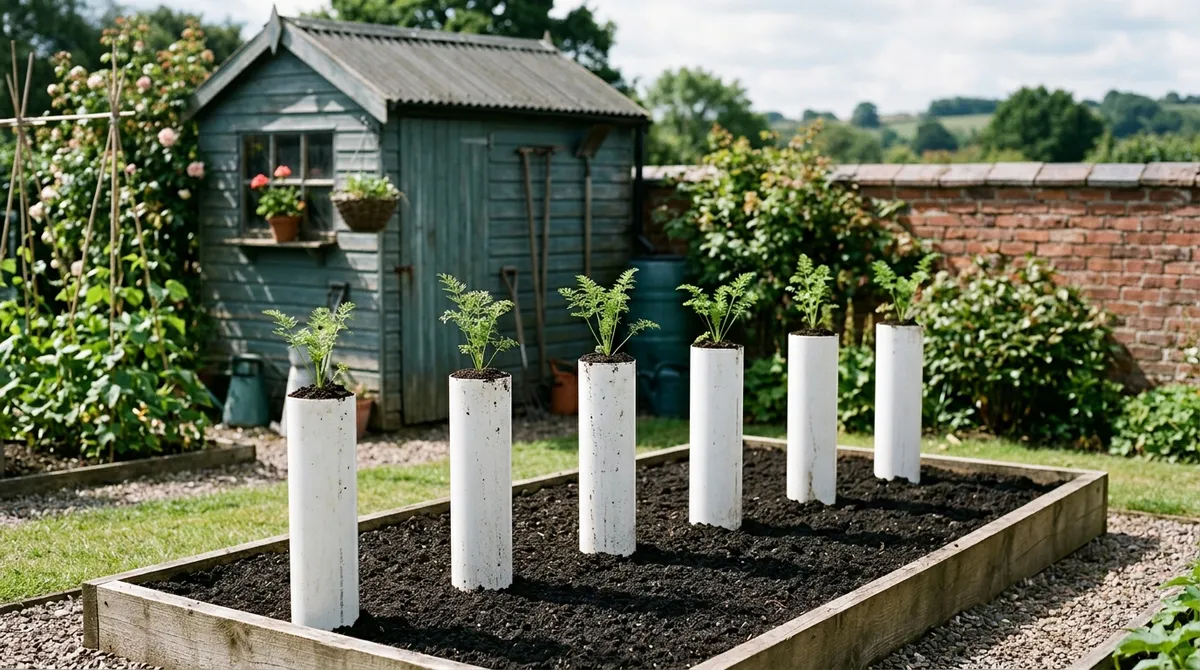
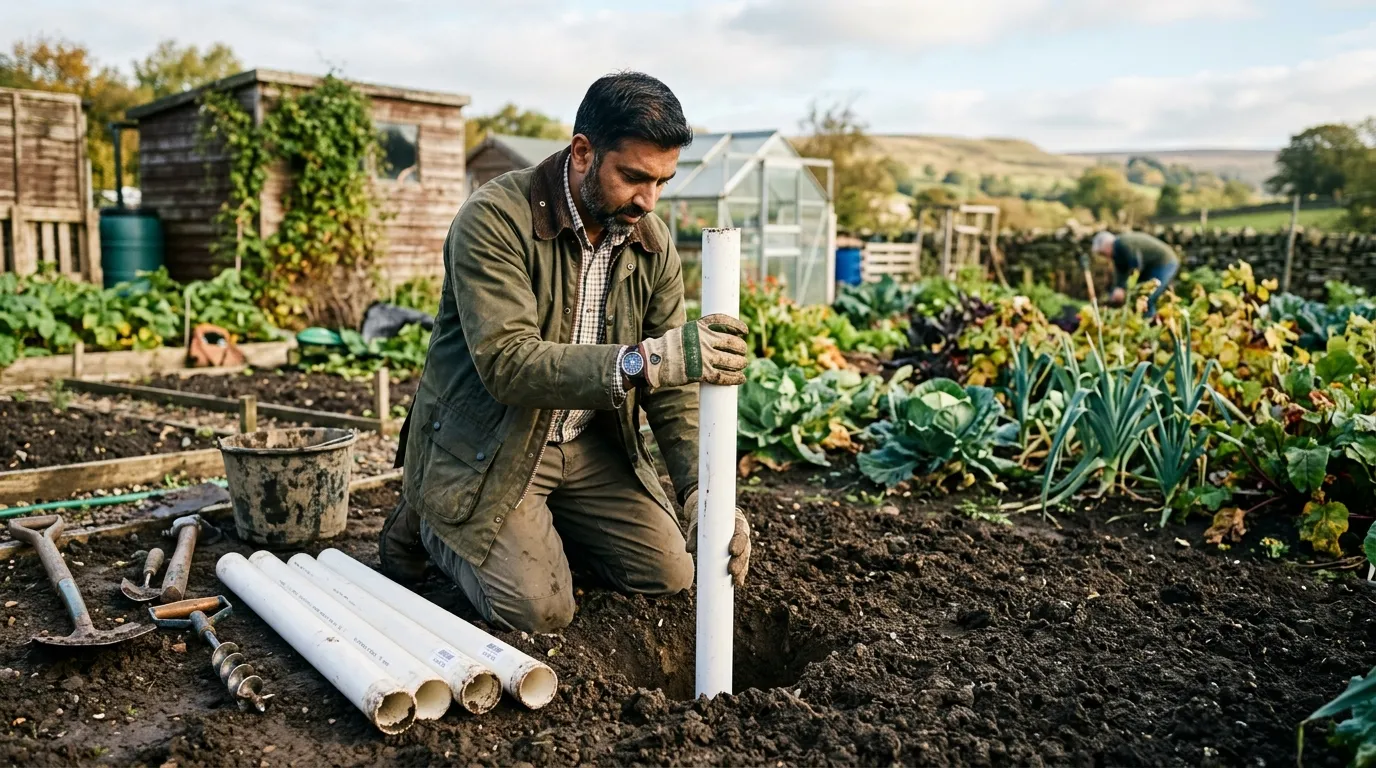 White PVC waste pipe at 75mm diameter cut to 1m lengths is the standard bore liner. The liner stays in the hole for the full 22 to 24 week growing season.
Daily Care for Long Carrots in Bore Tubes
The 22 weeks between sowing and lifting need 4 minutes of attention per tube per week. Water, weed, watch for carrot fly, and feed lightly. Carrots are not greedy. Most exhibition failures come from too much care, not too little.
Watering is the single biggest variable. Keep the top 100mm of the tube moist for the first 6 weeks. Once the tap root is past 150mm down, ease back to a deep soak every 4 to 5 days. The mix below 200mm holds moisture all season once charged. A tube watered to drips out of the bottom every day produces a swollen shoulder, a stunted taper and a fork rate above 60%.
Carrot fly is the biggest pest. Female flies lay eggs in May, July and September. The maggots tunnel into the shoulder. Surround the tubes with a 600mm tall fleece barrier on canes from late April. Carrot fly fly low and cannot clear a 600mm barrier. Companion-planting onions or chives between tubes also helps but is not enough alone.
Feeding is two liquid feeds over the season. Apply diluted liquid seaweed at 5ml per litre in late May and again in late July. Do not add high-nitrogen feed. Nitrogen pushes foliage at the expense of root length.
Warning: Never apply fresh manure to a long carrot bed or inside a tube. Fresh manure is the most common cause of forking in UK show carrots. Even well-rotted manure should be used only on the surrounding ground, never in the tube mix itself.
Lifting Long Show Carrots Without Breaking the Taper
The lift is the most stressful 30 minutes of the season. Lift on a damp morning 5 to 7 days before the show. Carrots lifted too far in advance dehydrate at the shoulder. Carrots lifted on the show morning rarely wash well in time.
The technique is simple but slow. Soak the tube with 5 litres of water 24 hours before the lift. Cut the foliage to 75mm with sharp scissors. Slide the PVC liner straight up out of the hole. Lay it carefully on its side. Slide the entire column of mix and carrot out of the liner onto a sheet of polythene. Brush the mix away from the carrot with your fingers, working from the shoulder down to the taper. Never pull. Never twist. The taper below 800mm is thinner than a pencil lead and will snap with any sideways force.
A 1m carrot weighs 320g to 450g and is surprisingly heavy. Support the carrot horizontally with both hands as soon as it is free. Wrap immediately in a damp clean tea towel for the journey to the wash area.
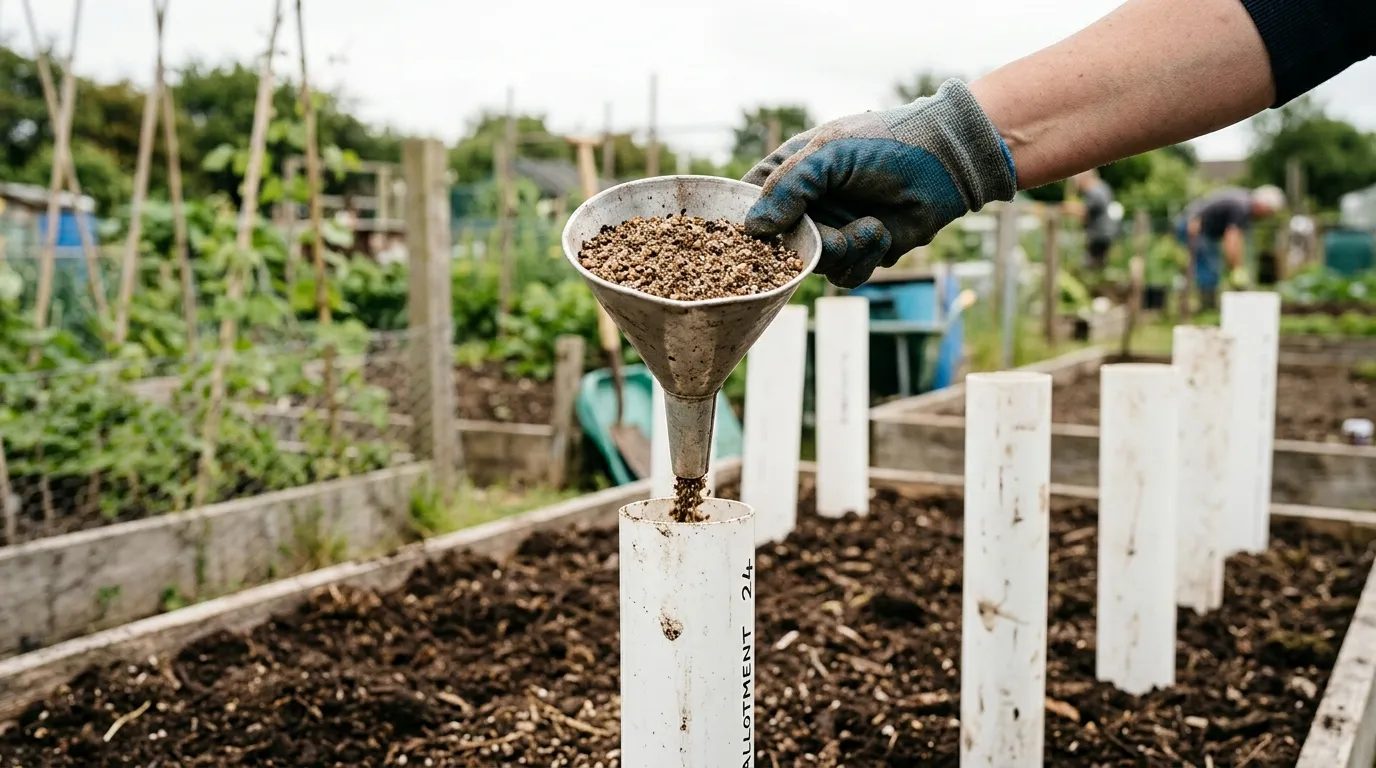 Layered filling is the rule. Pour the riddled mix in 100mm layers and water each layer in before the next. A tube filled in one pour settles by 80 to 120mm in three weeks.
Washing Long Carrots for the Show Bench
Washing is judged. Polish, scrub marks or skin damage are all point deductions under the NVS handbook. Use cool slow-running tap water, a clean soft natural sponge, and your fingers. No brush, no detergent, no scrubbing. Lay the carrot horizontally across a smooth shallow tray. Sponge the shoulder, then work down the root. Rotate the carrot 90 degrees and repeat. Total wash time should be 6 to 8 minutes per root. The skin must finish matt, intact and the original mid-orange.
Trim the foliage to a final length of 75mm with sharp scissors at the show, not at home. Long carrots are staged in sets of three or singles on green show felt or polished elder leaves, depending on the show schedule. Check the schedule before staging. Penkridge stages on green felt. Stafford stages on dark green velvet. The NVS National Show stages on white show cloths. Stafford Horticultural Show offers a Long Carrot class with prize money of £8, £5 and £3 and is one of the better-attended shows in the West Midlands.
Show Calendar: Sowing to Staging Across the UK Season
A month-by-month calendar for the long carrot exhibitor in the UK.
| Month | Task |
|---|---|
| January | Order seed from Medwyns of Anglesey, Robinsons Mammoth or Kings Seeds. Buy fresh every year. |
| February | Bore the holes when the ground is still wet. Install PVC liners. |
| March | Mix and riddle the bore mix. Fill tubes in 100mm layers. Sow single seed under tile last week of March. |
| April | Cover with tile. Check germination at day 14 and day 18. Re-sow any failures. |
| May | Erect 600mm fleece barriers against carrot fly. First liquid seaweed feed at 5ml per litre. |
| June | Light daily watering at the shoulder. Watch for carrot fly second generation. |
| July | Second liquid seaweed feed. Thin foliage to no more than 5 leaves per plant for show quality. |
| August | Reduce watering frequency. Stop all feeding. Begin checking shoulder size at week 18. |
| September | Lift 5 to 7 days before the show. Penkridge Horticultural Show first Saturday, Stafford Show third Saturday. |
| October | Harrogate Autumn Flower Show stages NVS long carrot classes. Final regional shows in Wales and Scotland. |
| November | Empty tubes, refresh mix for next season, store PVC liners flat under cover. |
The major UK shows for long carrots are the NVS National Championships (rotating venue, second weekend of September), the Harrogate Autumn Flower Show (third weekend of September, organised by the North of England Horticultural Society), and the Malvern Autumn Show (last weekend of September). Local NVS branch shows run from late August through to mid-October.
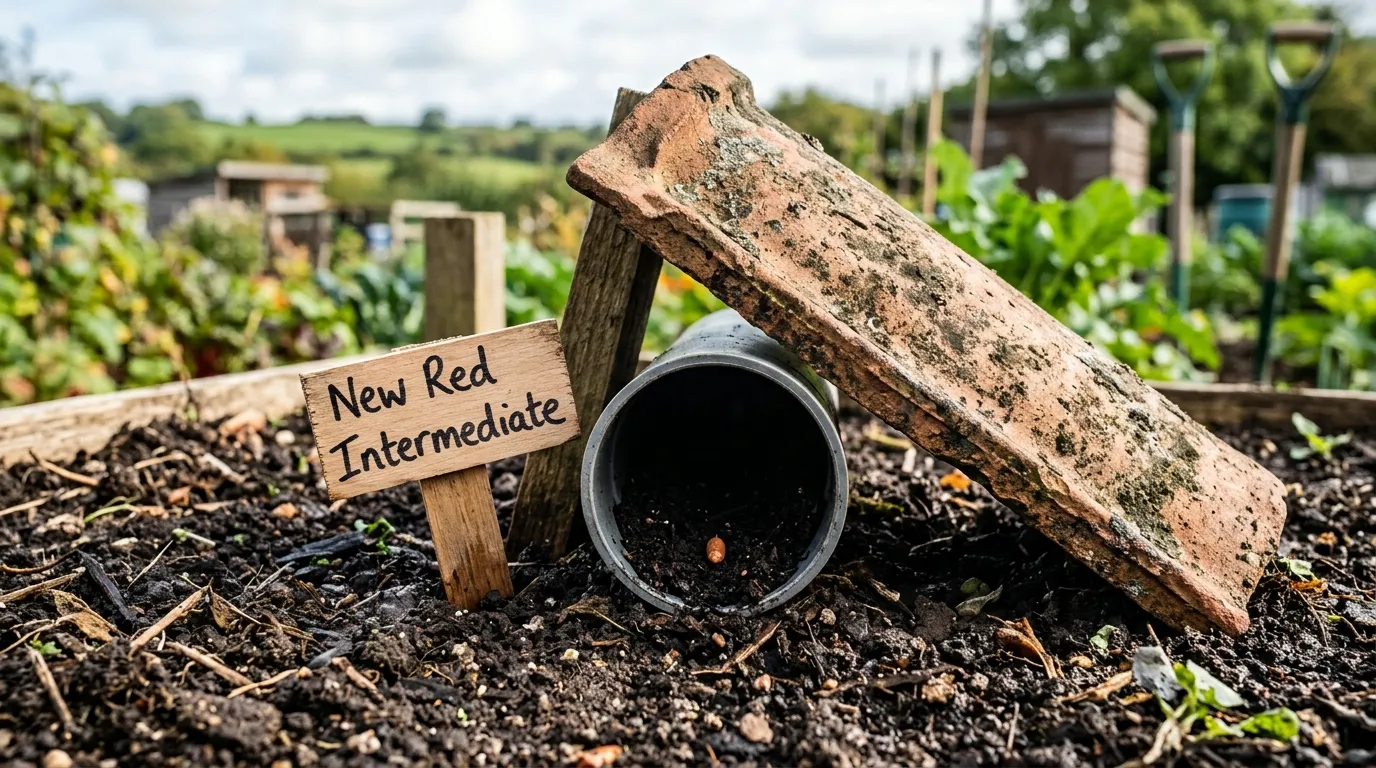 Each tube is sown with a single seed and covered with a clay tile or upturned pot. The cover stops carrot fly, evens out temperature swings, and keeps heavy April rain from washing the seed sideways.
Why Long Carrots Fork: Root Cause Analysis
Forking is the most common failure mode in long carrot growing. A forked carrot is unstageable. The root cause is rarely variety. It is almost always one of four things.
Stones in the mix. Any stone, twig or lump bigger than 6mm in the bore tube will deflect the tap root sideways. The root then splits to grow around the obstacle and you have two thin tapers instead of one fat one. Riddle every ingredient through a 6mm mesh before mixing. Riddle the compost twice if it is fresh from the bag.
Fresh or undecomposed manure. Nitrogen-rich material burns the growing tip of the tap root. The tip stops growing. Lateral roots fire instead. The result is a multi-pronged carrot. Never use manure in the tube. Apply manure to the surrounding ground at least 12 weeks before sowing.
Drying out at the 3-true-leaf stage. The tap root is most vulnerable in the first 4 weeks after germination. A single dry-down kills the tip. New tips fire from the side. Keep the top 100mm of mix moist for 6 weeks after germination, without drowning it.
Multiple seeds germinating in the same tube. Two seedlings in one tube compete. The dominant root cannot grow straight because the secondary root is pushing against it. Single-seed every tube. Thin to one seedling at the 4-true-leaf stage if two come up.
Permanent prevention is simple. Riddle. Layer-fill. Single-seed. Even water for the first 6 weeks. Apply those four and the fork rate drops below 8%. Without them, expect 35% to 50% forks.
 The taper below 800mm is thinner than a pencil lead. Support the lifted carrot horizontally with both hands and wrap immediately in a damp tea towel for the journey to the wash area.
How Long Carrots Are Judged at UK Shows
Long carrots are scored out of 20 under the NVS handbook, which is used by every NVS-affiliated branch show and the major autumn flower shows. The 20 points split as below.
| Criterion | Points | What judges look for |
|---|---|---|
| Condition | 5 | Skin intact and matt, no damage, no splits, no fly damage |
| Uniformity | 5 | All three roots in a set matched in length, taper and colour |
| Size | 5 | Length, shoulder diameter in proportion, no swollen tops |
| Colour and finish | 5 | Mid-orange uniform colour, no green shoulder, no polish |
A class-winning set of three long carrots scores 17 to 19. Anything under 13 is rarely placed. The biggest single-point losses are uniformity (mismatched lengths across the three) and condition (a single small split or fly mark). Stage four roots, then choose your best three at the bench before judging closes.
Common Mistakes in Long Carrot Showing
Mistake 1: filling the tube in one pour
The mix settles by 80 to 120mm in the first three weeks. The carrot starts in a depression, the shoulder finishes below soil level, and you lose 200mm of usable length. Layer-fill in 100mm increments, watering each layer before adding the next.
Mistake 2: multiple seeds per tube
Two seedlings in one tube produce two compromised carrots. Single-seed every tube. Re-sow failures rather than thin from multiple. Thinning a 4-leaf seedling disturbs the dominant root.
Mistake 3: feeding too much
High-nitrogen liquid feed pushes foliage. Foliage is shading the next tube and wasting energy that should be in the root. Two seaweed feeds over the whole 22 weeks is enough. Vitax Q4 in the tube mix provides the rest.
Mistake 4: scrubbing at the wash
The skin must finish matt. Brushing, scrubbing or any abrasive lifts the skin and shows on the bench. Sponge only. Slow water. No detergent.
Mistake 5: lifting on the show morning
There is not enough time to wash, trim, transport and stage a long carrot in the same morning. Lift on the Tuesday for a Saturday show. Store wrapped horizontally in damp tea towels in a cool dark shed. Wash on the Friday evening.
Cost of Setting Up Long Carrot Tubes
After year one, the running cost per tube drops to £4 to £6 because the crowbar, liners, riddle and feed bottle are all re-used. New compost and fresh seed are the only annual costs.
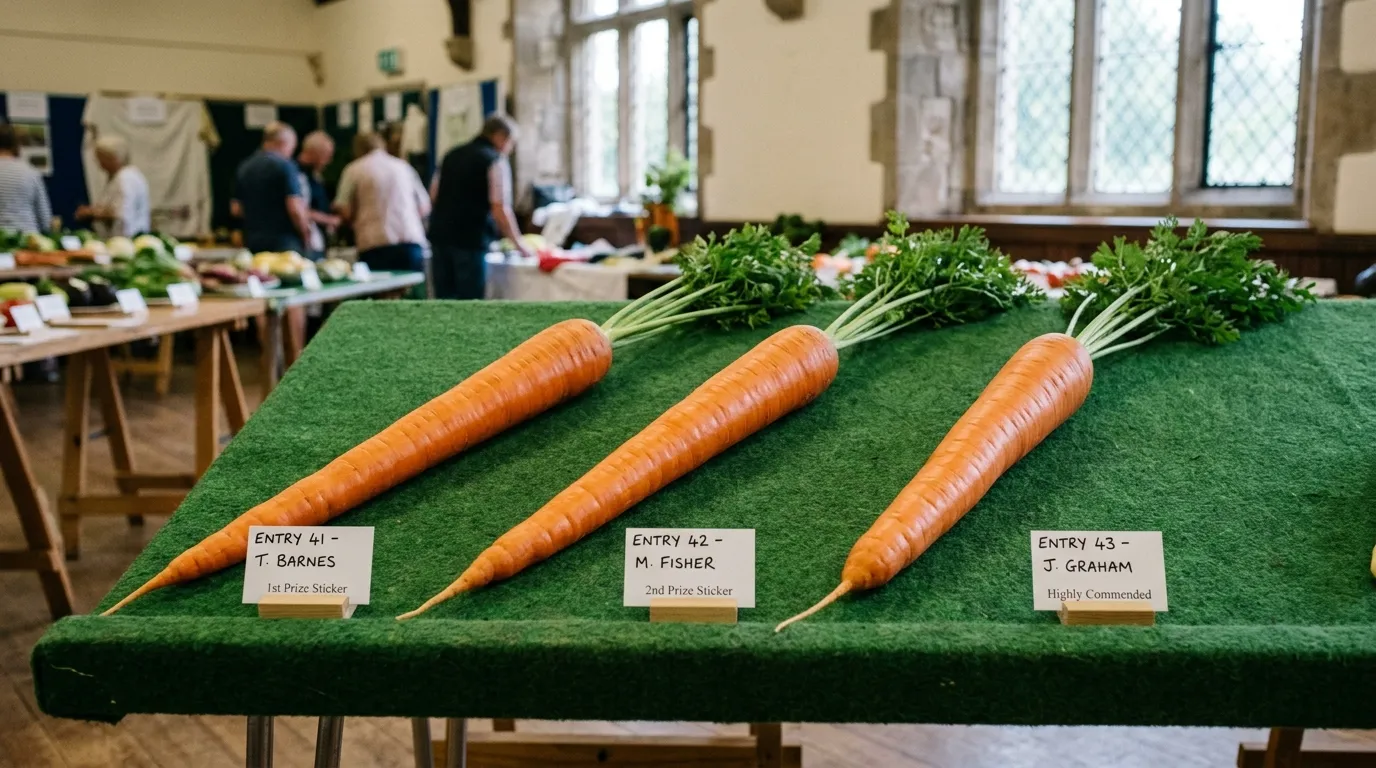 A matched set of three long carrots staged on green show felt at a village hall vegetable show. Judges score out of 20 across condition, uniformity, size and colour.
Where to Read More on UK Showing
The National Vegetable Society publishes the standard UK judging handbook and runs branch shows across all six NVS regions. Membership at around £20 a year includes a quarterly journal with technical articles on long roots and other show classes. The Harrogate Autumn Flower Show (organised by the North of England Horticultural Society) hosts the largest open vegetable show in the country in late September.
Frequently asked questions
How deep do bore tubes need to be for long show carrots?
Bore tubes need to be 1.0 to 1.2m deep. A standard long carrot class on the UK show bench expects a root of 900mm or more to a clean pencil point. The tube must give the taper 100 to 200mm of clear soil below the finished point of the carrot.
What is the best variety of long carrot for showing in the UK?
St Valery is the most reliable long carrot for UK showing. New Red Intermediate runs it close on length and is the standard for NVS branch shows. James Scarlet Intermediate is the third benchmark. All three regularly produce roots over 900mm in well-managed bore tubes.
What mix do you fill bore tubes with for long carrots?
Use 70% riddled peat-free compost, 20% sharp sand and 10% leaf-mould, with 30g of slow-release fertiliser per tube. The mix must pass through a 6mm riddle to remove every stone, twig and lump that could fork the taper.
Why do my show carrots fork or split?
Forking is caused by stones in the mix, fresh manure, or the tap root being checked by drying out at the 3-true-leaf stage. Riddle the mix to 6mm. Never use manure of any age inside a bore tube. Keep the top 100mm of the tube moist for the first six weeks.
When do you sow long carrots for show?
Sow in the last week of March in central England. Cover each sown tube with a clay tile or upturned pot until the first true leaves show through. This protects the seed from carrot fly, late frost and heavy rain washing it sideways out of the tube top.
How do you wash a show carrot without damaging it?
Wash a show carrot under cool slow-running tap water only, using a clean soft natural sponge. Never scrub. Never use a brush. The skin must stay intact and matt. Polishing or scrubbing is a points deduction at all NVS-affiliated shows.
What is the judging criteria for long carrots at UK shows?
Long carrots are scored out of 20 under the NVS handbook. Points cover condition (5), uniformity across the dish (5), size (5), and colour and finish (5). A set of three matched 1m roots with no forking, no splits and an even pencil taper will score 17 to 19.
Now stage your first long carrot
Bore the tubes in February. Riddle the mix to 6mm. Layer-fill in 100mm increments. Single-seed in the last week of March. Two seaweed feeds. Lift on the Tuesday for the Saturday show. Wash with sponge and cool water only. Stage on green felt. The 9-season method that gave me a 1.18m root at Stafford in 2023 is the same method that gives a first-year grower a 900mm root that scores 16 out of 20 on a village hall bench.
Our team produces practical UK gardening guidance from source research, contributor records and established horticultural practice. Editorial standards are overseen by Matt W.