Key takeaways
- Climbing beans, tall peas, cucumbers, cordon tomatoes, squash and melons all need support in UK gardens
- Add the trellis at sowing or planting, before roots establish, never after the plant flops over
- A runner bean wigwam reaches 2 to 2.5m and each cane carries 8 to 12kg of growth and pods
- Heavy fruit over 0.5kg needs a fabric sling tied to the frame, or the stem snaps under the weight
- Vertical growing lifts yield per square metre by 20 to 30 percent and cuts slug and mildew damage
- Dwarf beans, bush peas and bush tomatoes need no trellis, so check the variety before you build
Knowing which vegetables need a trellis saves a summer of flopping stems and curled, slug-grazed pods. Climbing beans, tall peas, cucumbers, cordon tomatoes and many squash all need vertical support to crop well in UK gardens. The trick is not just choosing the right support. It is adding it at the right time, before the plant grows, and matching its strength to the weight it must carry.
Which vegetables need support and which do not
Some vegetables climb by nature, others carry fruit too heavy for the stem, and a few simply crop better off the ground. Those three reasons cover almost every crop that needs a trellis. Climbing and runner beans twine up anything vertical. Tall peas grip with tendrils. Cucumbers, squash and melons ramble and produce heavy fruit. Cordon tomatoes grow as a single tall stem that cannot stand alone.
The opposite group needs nothing. Dwarf French beans grow as 45cm bushes. Bush peas like ‘Kelvedon Wonder’ rarely top 60cm and lean on each other. Bush tomatoes, also called determinate types, stop at a fixed height and sprawl by design. Root crops, brassicas and most leafy greens never climb at all.
The deciding factor is always the variety, not the vegetable. A packet labelled “climbing”, “pole”, “runner”, “cordon”, “indeterminate” or “tall” needs a trellis. A packet labelled “dwarf”, “bush”, “patio” or “determinate” does not. Read it before you build anything. For the full range of crops worth growing, see our guide to vegetables to grow at home.
Ranked: vegetables by how essential a trellis is
The table below ranks crops from most to least essential for support. It covers climbing habit, the support type that suits each one, mature height, the moment to add the trellis, and the weight load the frame must carry. Use it to plan before you sow.
| Vegetable | Climbing habit | Support type needed | Mature height | When to add support | Weight load |
|---|---|---|---|---|---|
| Climbing & runner beans | Strong twiner, self-clinging | Wigwam, A-frame, tall netting | 2 to 2.5m | At sowing or planting | 8 to 12kg per cane |
| Cordon (indeterminate) tomatoes | None, needs tying | Cordon string or single stake | 1.8 to 2.2m | At planting out | 4 to 6kg per plant |
| Cucumbers (outdoor & greenhouse) | Tendril climber | Netting, mesh, vertical string | 1.5 to 2m | At planting out | 3 to 5kg per plant |
| Tall & mangetout peas | Tendril climber | Pea netting, twiggy sticks | 1.2 to 1.8m | At sowing | 2 to 4kg per row metre |
| Melons & small winter squash | Rambler, heavy fruit | Sturdy A-frame plus fruit slings | 1.5 to 2m | At planting out | 6 to 10kg plus slings |
| Climbing courgettes & gourds | Rambler, semi-twiner | Obelisk, sturdy trellis | 1.2 to 2m | At planting out | 4 to 8kg per plant |
| Malabar spinach | Twiner | Light wigwam or string | 1.8 to 2.5m | At planting out | 1 to 2kg per plant |
| Dwarf beans, bush peas, bush tomatoes | None | None or twiggy sticks only | 0.4 to 0.6m | Not needed | Self-supporting |
Beans top the list because they cannot crop without a frame. Bush varieties sit at the bottom because they need nothing. Everything between needs the right support at the right time, which the next sections explain in detail.
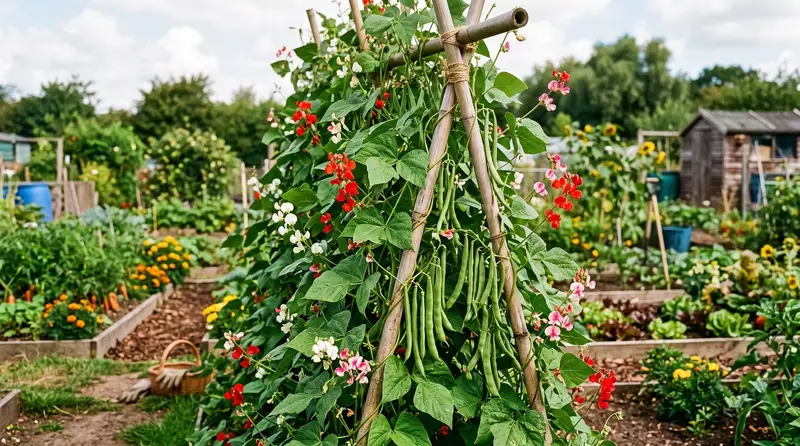
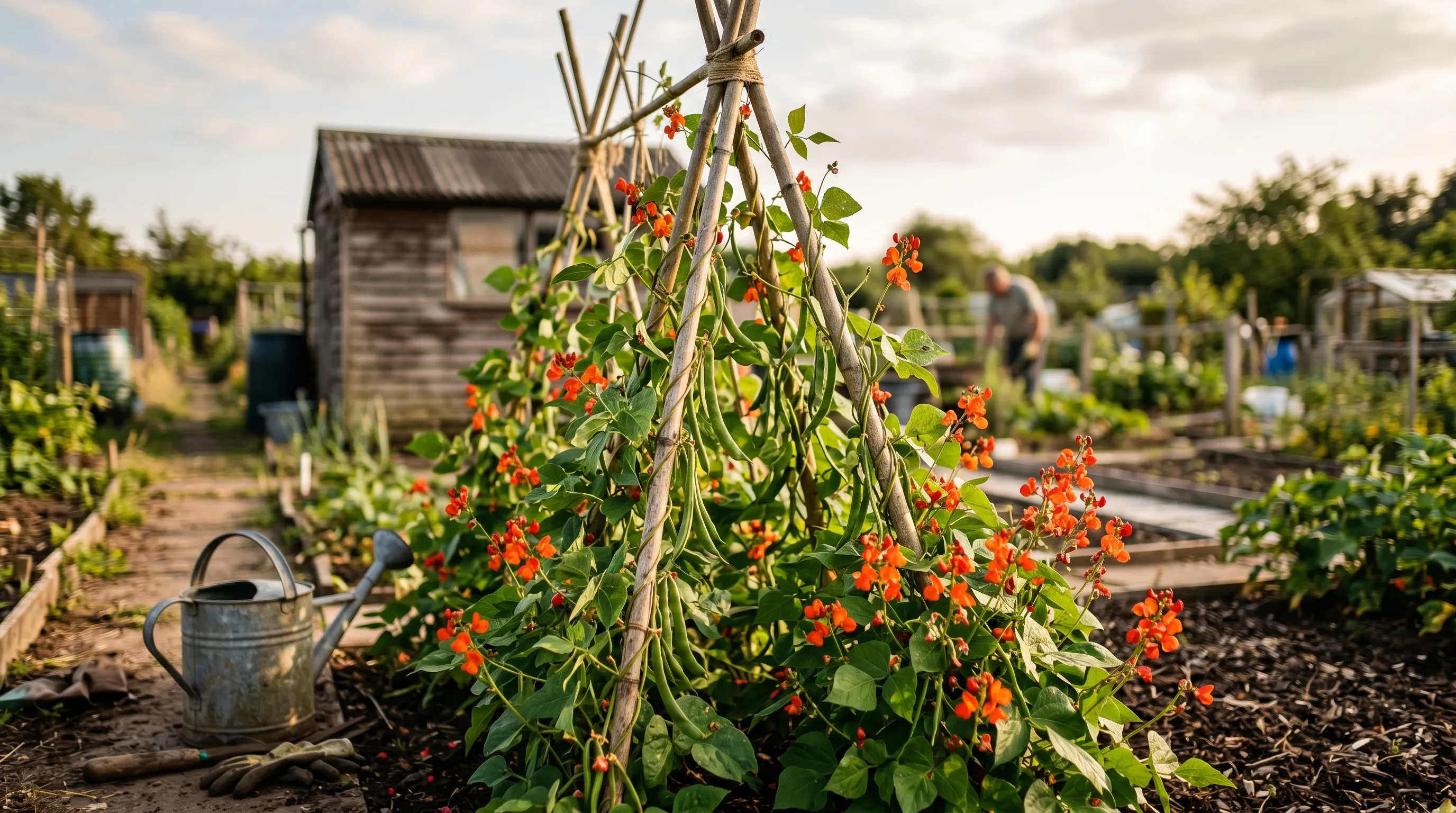 Scarlet runner beans climbing a bamboo wigwam. Each cane carries 8 to 12kg of vine and pods by August.
Climbing beans, runner beans and pole beans
Climbing and runner beans are the crops that most need a trellis, because they cannot crop without one. Their stems twine anticlockwise around any vertical support and reach 2 to 2.5m. Without a frame they sprawl into a tangled mat, the pods rot on damp soil, and slugs strip them overnight.
Build the frame before you sow. A wigwam of six to eight bamboo canes tied at the top is the classic. Space canes 25 to 30cm apart in a circle 90cm across, push each one 30cm into firm soil, and lash the apex tightly. An A-frame of two angled rows suits a long bed and holds more plants. Use 12 to 16mm canes or hazel rods, never thin 8mm split canes, which snap under a wet August crop.
Sow two beans at the base of each cane in late May, then thin to the strongest. The seedling finds the cane and climbs without help. For the full sowing and harvest detail, read our guide to growing runner beans. Pinch out the growing tip when it reaches the top of the frame, which pushes energy into pods rather than more stem.
Peas: tall, mangetout and dwarf
Most peas climb with tendrils and need netting or twiggy support, but height varies hugely by type. Tall and mangetout peas reach 1.2 to 1.8m and grip a vertical surface with delicate tendrils. They cannot twine like beans, so they need something to grab. Dwarf and bush peas like ‘Kelvedon Wonder’ stay under 60cm and lean on twiggy pea sticks or each other.
For tall and mangetout peas, stretch pea netting with a 10 to 15cm mesh between two stout posts, or push a row of birch twiggy sticks into the soil along the drill. Do this at sowing, not after germination. Pea seedlings reach for support within two weeks, and a seedling that finds nothing flops and never recovers its grip.
Support tall peas like ‘Alderman’, which can hit 1.8m, with a frame the same height. Mangetout types such as ‘Carouby de Maussane’ climb to 1.5m and produce flat edible pods. Sugar snap peas sit around 1.2 to 1.5m. Our guide to growing peas covers variety choice and sowing times for each. Match the frame to the variety height and add it before the first tendril appears.
Cucumbers: outdoor ridge and greenhouse cordon
Cucumbers crop far better up a trellis than trailing on the ground, both outdoors and under glass. Outdoor ridge cucumbers and greenhouse cordon types both climb with tendrils once they find a 5 to 10cm mesh or a vertical string. Vertical fruit hangs straight, stays clean and is simple to pick. Trailing fruit curls, rots where it touches damp soil and feeds slugs.
For greenhouse cucumbers, train a single cordon up a vertical jute string tied to the roof. Twist the growing tip round the string every few days and tie loosely. Pinch side shoots back to two leaves to keep the plant manageable. The string carries 3 to 5kg of vine and fruit by midsummer.
Outdoor cucumbers climb netting or an obelisk. Plant them out in early June after the last frost, at the base of the support already in place. A wandering tendril grips within days. For full crop care, see our guide to growing cucumbers. Never wait until the plant sprawls before adding the trellis, because lifting a tangled vine onto a frame snaps the brittle stems.
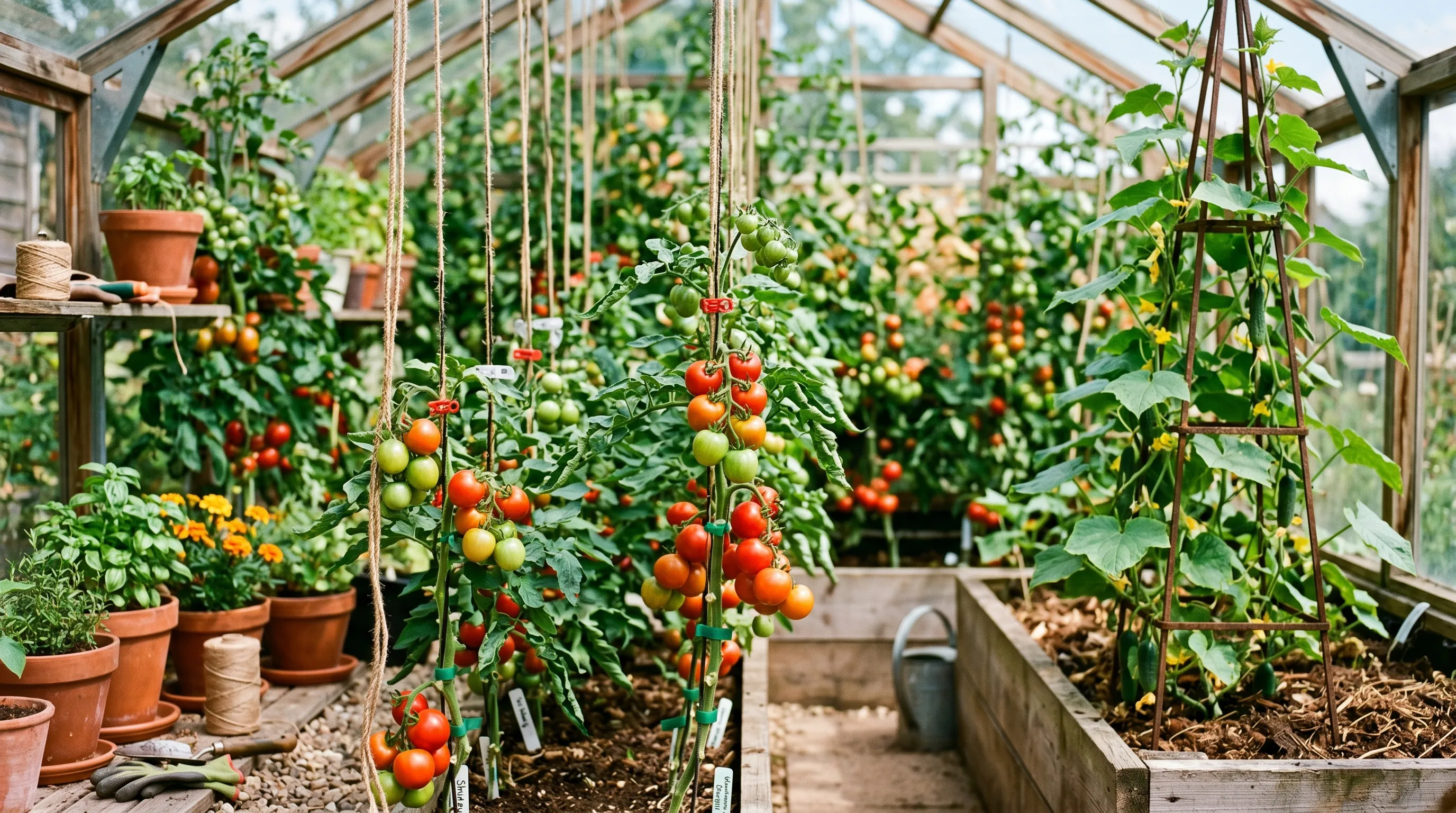 Cordon tomatoes up jute string, with a cucumber on an obelisk alongside. Vertical training keeps both clean and easy to pick.
Cordon tomatoes versus bush tomatoes
Cordon tomatoes need a stake or string from planting, while bush tomatoes need no support at all. This is the single most confused point in vegetable growing. Cordon, or indeterminate, varieties grow as one tall stem to 1.8 to 2.2m and carry 4 to 6kg of fruit. The stem cannot stand alone. Bush, or determinate, varieties stop at a fixed height of 45 to 75cm and sprawl naturally.
For cordon tomatoes, drive a 2.4m stake beside each plant at planting out, or tie a jute string from an overhead wire down to the rootball. Train the single main stem up the support and tie it every 20cm with soft twine. Pinch out every side shoot that forms in the leaf joints, which keeps the plant to one productive stem.
Get the support in on planting day. A tomato planted without a stake leans within a week, and the kinked stem never grows straight. Train the leader up the string and keep tying as it climbs. Bush types like ‘Tumbling Tom’ suit hanging baskets and need nothing but a container.
Squash, pumpkins and melons need slings for heavy fruit
Small squash and melons climb well, but the heavy fruit needs a fabric sling once it passes 0.5kg. This is where many growers fail. A climbing squash or melon sends a strong vine up an A-frame, then the swelling fruit tears free under its own weight and drops. A sling spreads the load and holds the fruit until it ripens.
Make a sling from an old pair of tights, a net bag or a square of soft cloth. Cradle each fruit and tie both ends to a horizontal frame bar. The stretch in tights moves with the growing fruit and never cuts in. Add the sling when the fruit reaches tennis-ball size, around 0.5kg, and check the knots weekly as it swells.
Small winter squash like ‘Uchiki Kuri’ and Charentais melons suit this method. Large pumpkins do not. A 5kg pumpkin is too heavy for any vertical frame, so let those trail on the ground with a tile or plank under each fruit to keep it off the wet soil. For full crop detail, see our guide to growing pumpkins and squash.
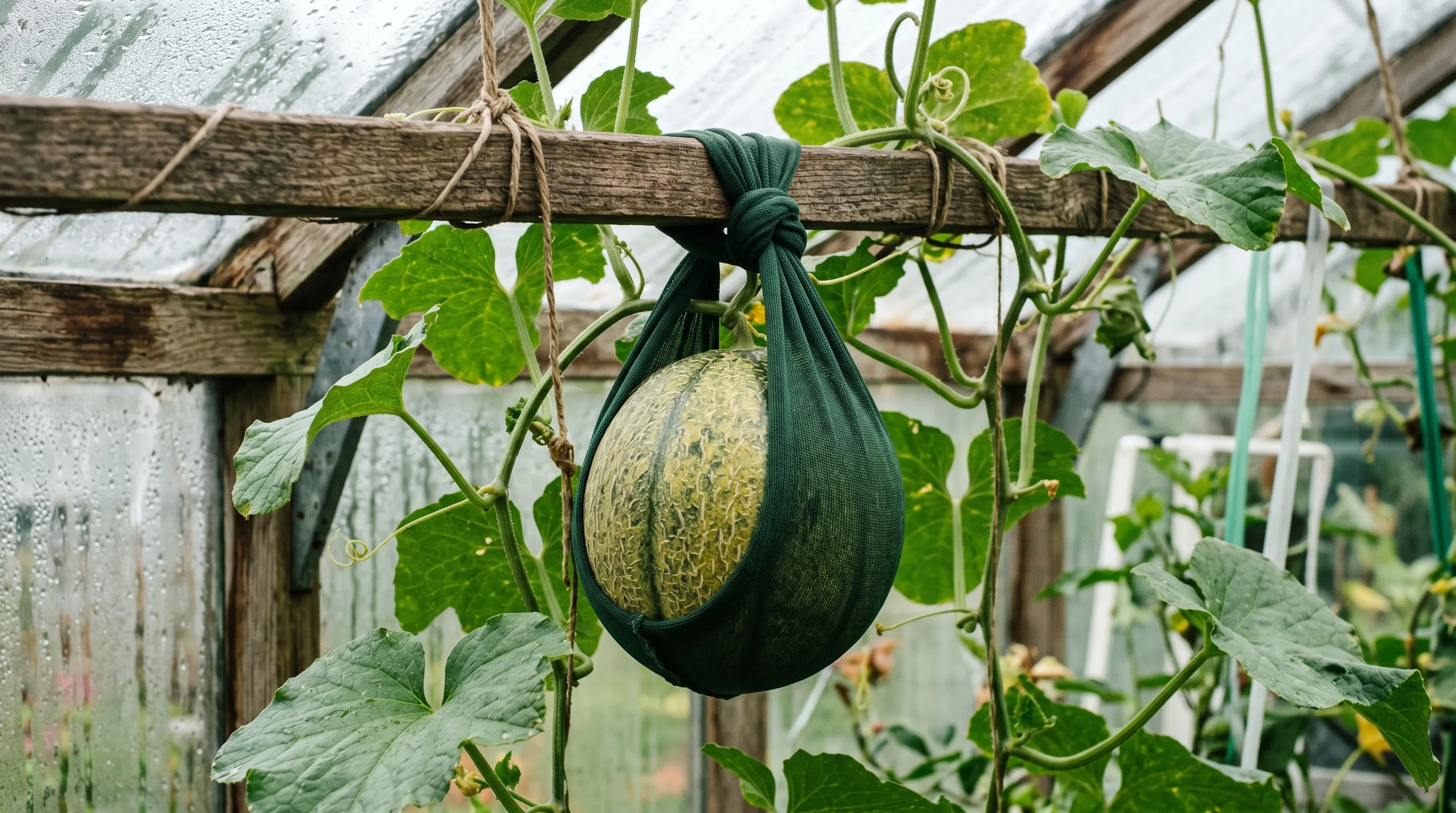 A melon held in a tights sling. Tie the support on at tennis-ball size, before the fruit can tear from the vine.
Climbing courgettes, gourds and Malabar spinach
A few less common crops also climb, including climbing courgettes, ornamental gourds and Malabar spinach. Most courgettes are bush plants, but climbing types such as ‘Black Forest’ grow as a 1.5 to 2m vine on an obelisk or sturdy trellis. Vertical growing keeps the fruit clean and the plant compact in a small bed, freeing ground space below.
Ornamental and edible gourds ramble vigorously and produce heavy fruit, so they need a strong frame plus slings, exactly like squash. Bottle gourds and loofahs can reach 3 to 4m and need a tall arch or pergola. Their fruit hangs down and shapes best in the air, which is why they suit an overhead structure.
Malabar spinach is a twining summer leaf crop that climbs a light wigwam or string to 1.8 to 2.5m. It is not true spinach but a heat-loving climber that crops through a warm UK summer when ordinary spinach bolts. For a courgette-growing refresher, read our guide to growing courgettes. Each of these crops needs its support in place at planting, before the vine starts to wander.
When to add the trellis: timing that decides the crop
Add the trellis at sowing or planting, before roots establish, never after the plant has flopped. This is the rule that separates a clean vertical crop from a tangled mess. A support put in early gives the seedling something to find the moment it reaches upward. A support pushed in later disturbs the root plate and risks snapping the stem.
Follow this timing order for each crop:
- Build the frame first. Put the wigwam, A-frame or netting in place on the empty bed.
- Sow or plant at the base. Place the seed or seedling within 5cm of the support.
- Guide the first growth. Once a tendril or twining tip appears, tuck it onto the support by hand if it misses.
- Tie and train weekly. For tomatoes and cucumbers, tie the stem every 20cm as it grows.
- Pinch the top. When the plant reaches the frame top, pinch the growing tip to push energy into fruit.
A plant that flops first develops a kink in the stem that never straightens. It also roots into the soil where it touches, which makes lifting it onto a frame later almost impossible without breakage. Get the support in before the plant needs it, every time.
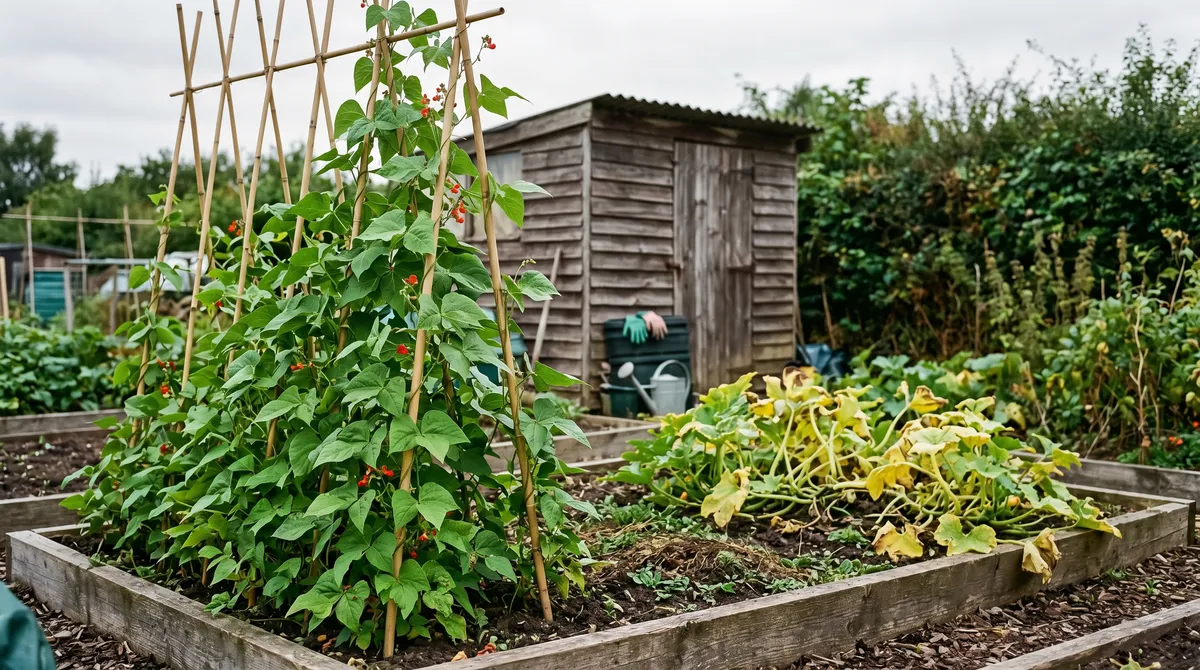
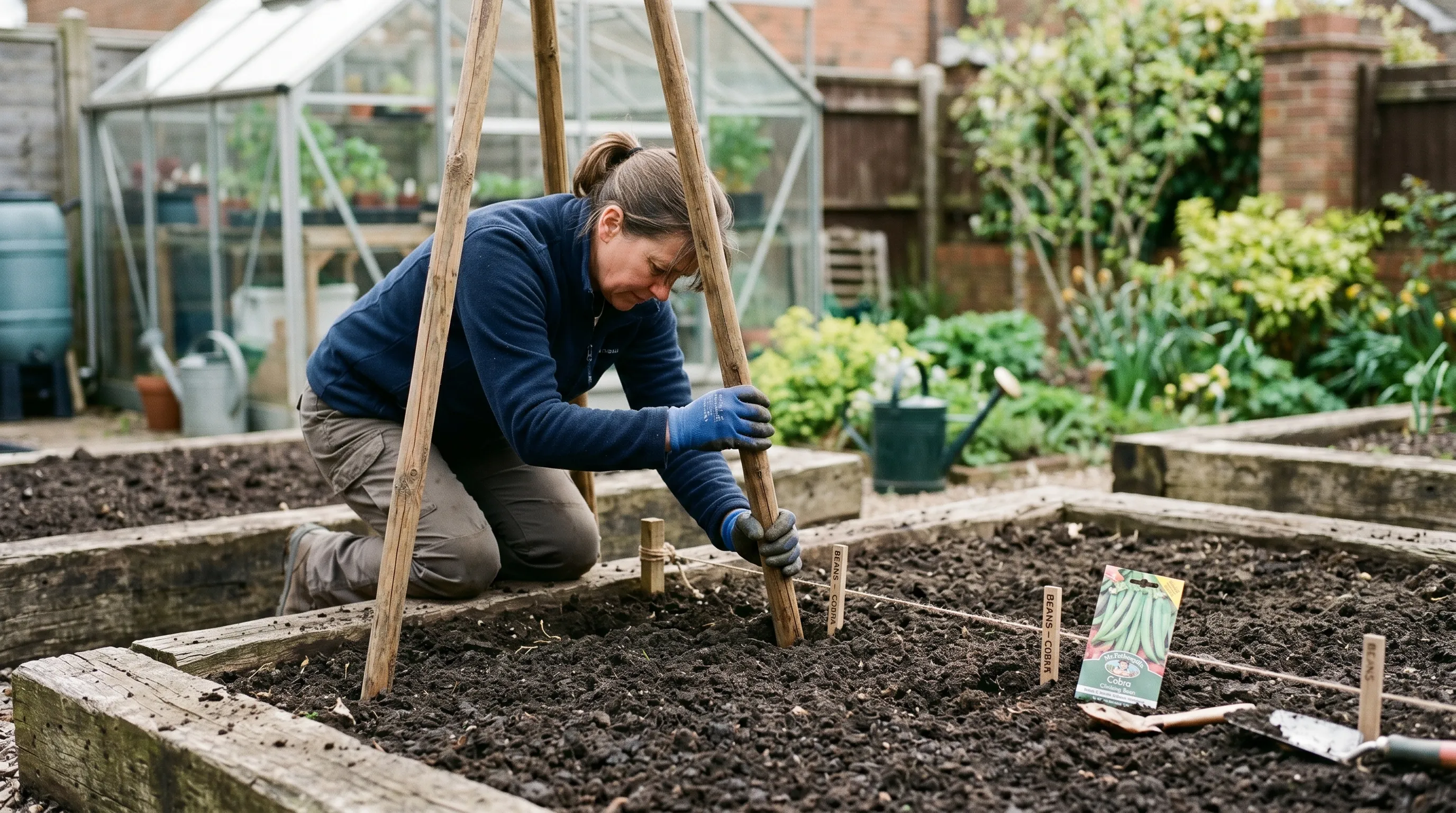 The frame goes in at sowing, into bare soil. Wait until the seedlings flop and you have already lost the straight crop.
Support types and how to anchor them
The right support depends on the crop, the bed shape and the weight load, from a light pea net to a heavy squash A-frame. Each type suits a different job. Match the structure to the crop in the ranked table above, then anchor it so a summer storm cannot rack it.
| Support type | Best for | Height | Anchoring method |
|---|---|---|---|
| Wigwam | Runner beans, climbing beans | 2 to 2.5m | Six canes 30cm deep, apex lashed tight |
| A-frame | Beans, squash, melons in long beds | 2 to 2.4m | Two angled rows, ridge pole, legs 30cm deep |
| Pea netting | Tall peas, mangetout, cucumbers | 1.2 to 1.8m | Stretched between two stout end posts |
| Cordon string | Greenhouse tomatoes, cucumbers | To roof | Tied to overhead wire, base round rootball |
| Obelisk | Climbing courgettes, ornamental crops | 1.5 to 2m | Feet pushed 20cm into firm soil or pot |
| Arch or pergola | Gourds, loofahs, trailing squash | 2 to 2.5m | Posts concreted or driven 45cm deep |
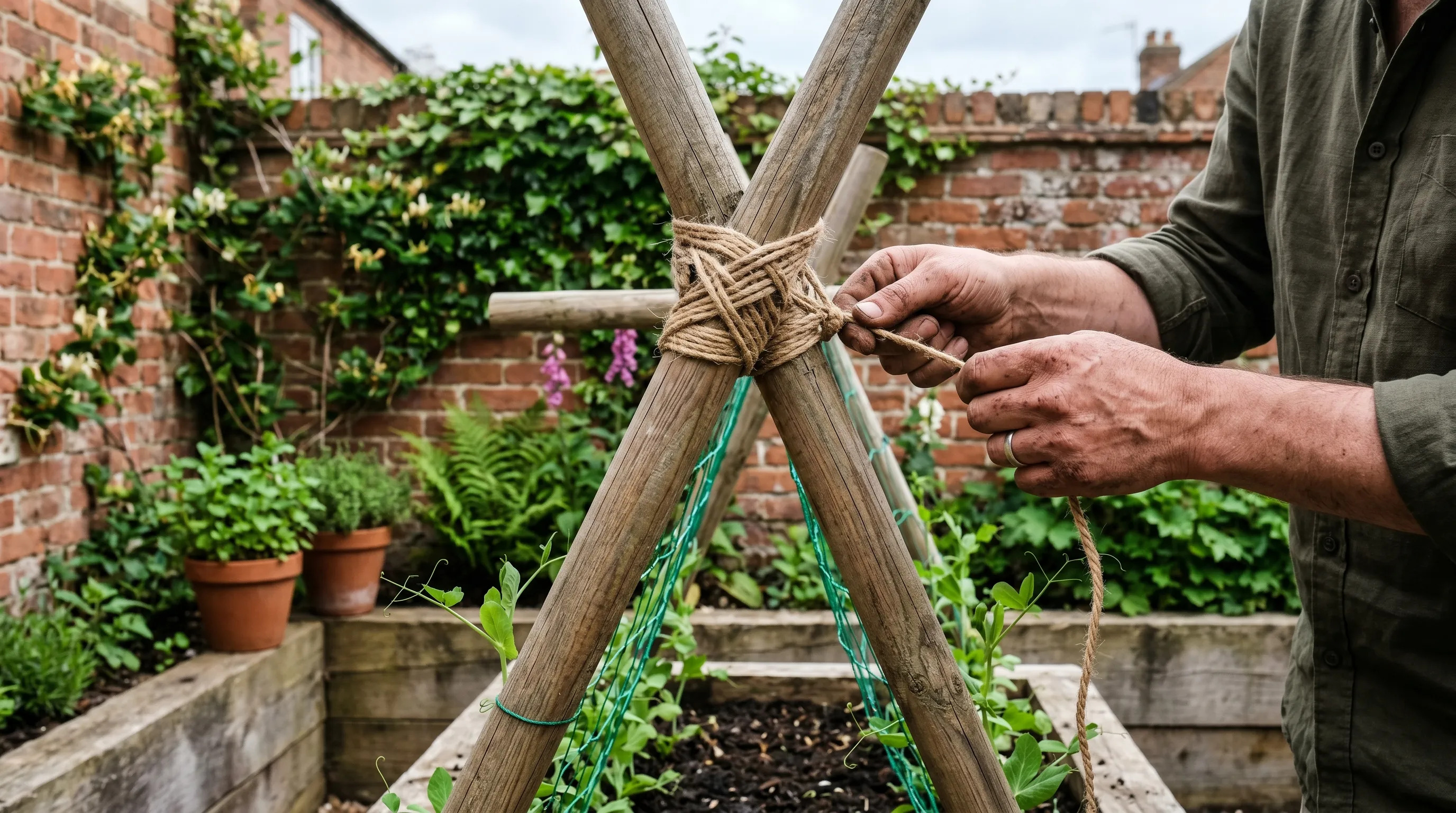 An A-frame lashed at the apex with twine and clad in pea netting. Build the structure before a single seed goes in.
Month-by-month vegetable support calendar
Timing the support matters as much as the crop. This calendar shows when to build frames and add slings through a UK growing year.
| Month | Support task |
|---|---|
| March | Order canes, netting and hazel rods. Repair frames stored over winter. |
| April | Build pea netting and twiggy supports. Sow early peas at the base. |
| May | Erect bean wigwams and A-frames before sowing. Stake cordon tomatoes at planting. |
| June | Plant cucumbers, squash and melons at the base of supports already in place. |
| July | Tie and train weekly. Add first fruit slings as melons and squash reach 0.5kg. |
| August | Check all anchors before storms. Pinch growing tips at frame tops. Renew slings. |
| September | Harvest. Leave frames standing while late pods and fruit finish. |
| October | Dismantle, clean and dry canes and netting. Store under cover to last longer. |
Common mistakes when supporting vegetables
A few repeated errors cause most support failures. Avoid these and the crop usually holds up all summer.
Adding the support too late. This is the biggest error. A plant left to flop develops a kinked stem and roots into the soil where it touches. Lifting it onto a frame then snaps the stem. Always build the frame before sowing or planting.
Using flimsy canes. Thin 8mm split canes snap under a wet August crop. A full runner bean wigwam holds 50 to 70kg of soaked growth in a downpour. Use 12 to 16mm bamboo or hazel and drive it 30cm deep.
No slings for heavy fruit. Melons and squash tear from the vine once the fruit passes 0.5kg. A tights sling tied to the frame at tennis-ball size saves every fruit. Skip it and the fruit drops and rots.
Spacing plants too close. Crowded climbers compete for light and trap damp air, which spreads powdery mildew. Space bean canes 25 to 30cm apart and cucumbers 45cm apart so air moves through the frame.
Mismatching frame and variety. Building a 1m frame for a 2.4m bean wastes the crop. Check the variety height on the packet and match the support to it before you build.
Gardener’s tip: Tie soft jute twine, not wire or thin string, when training stems onto a support. Wire and nylon cut into swelling stems and strangle the plant by midsummer. A loose figure-of-eight loop of jute gives the stem room to thicken and rots away naturally at the end of the season, so there is nothing to unpick.
Warning: Never push bamboo canes in at eye height without a cane topper or upturned pot on each tip. A bare cane is a serious eye-injury risk when you bend over a bed to weed or pick. Fit a topper to every vertical cane the moment the frame goes up, especially where children share the plot.
Frequently asked questions
Which vegetables need a trellis in the UK?
Climbing beans, tall peas, cucumbers, cordon tomatoes, squash and melons all need support. These crops climb, twine or carry heavy fruit the stem cannot hold. Dwarf and bush varieties of the same vegetables need no trellis. Always check the variety name on the packet, because the deciding factor is the type, not the vegetable.
When should I put up a vegetable trellis?
Add the trellis at sowing or planting time, before roots establish. Pushing canes in later disturbs the root plate and risks snapping stems. A plant that has flopped rarely climbs straight again. Put the frame in first, then sow or plant at its base so the seedling finds support the instant it reaches upward.
How much weight does a runner bean trellis hold?
Each 2.4m cane carries 8 to 12kg of vine and pods at peak. A full wigwam of six canes holds 50 to 70kg of wet growth in a downpour. Use 12 to 16mm bamboo or hazel, push canes 30cm into firm soil, and lash the top tightly so wind cannot rack the frame.
Do cucumbers need a trellis or can they trail?
Cucumbers crop better up a trellis or netting. Vertical fruit stays straight, clean and easy to pick. Trailing cucumbers curl, rot where they touch damp soil and attract slugs. Both outdoor ridge types and greenhouse cordon types climb readily once their tendrils find a 5 to 10cm mesh or a vertical string.
Do squash and pumpkins need support for the fruit?
Yes, heavy fruit needs a fabric sling once it passes 0.5kg. Small winter squash and melons climb well, but the swelling fruit tears from the vine without a net or old tights tied to the frame. Large pumpkins are too heavy to grow vertically, so let those trail on the ground with a tile under each fruit.
Ready to build your supports?
Now you know which vegetables need a trellis and when to add it, plan the frames before you sow a single seed. Get the structure in early, match its strength to the crop, and add slings for heavy fruit in good time. For the next step, read our full guide to growing mangetout and sugar snap peas, or browse all our growing guides for crop-by-crop advice.
Our team produces practical UK gardening guidance from source research, contributor records and established horticultural practice. Editorial standards are overseen by Matt W.