Key takeaways
- Bocking 14 is sterile and triploid, so seed labelled 'comfrey' is never Bocking 14 (it is officinale or russian comfrey)
- Root cuttings (October or March) are the easiest method with a 90 percent or higher take rate
- Crown division in late February gives 100 percent take but slower bulk-up per parent plant
- Always cut the top end of a root section flat and the bottom end angled, to avoid planting upside down
- Plant root cuttings 50mm deep, 60 to 90cm apart, water in once and mulch lightly
- One parent plant gives 12 root cuttings in year two and around 60 plants by year three
Bocking 14 is the most useful comfrey for a UK garden, full stop. It builds deep biomass, makes a high-potash liquid feed, and importantly produces no seed at all, so it stays where it is planted. The drawback is that you cannot grow it from seed. Every Bocking 14 plant in every UK allotment, organic garden and community plot started life as a root cutting, a crown division or a basal offset taken from another Bocking 14 plant. The original parents trace back to the trial ground at Bocking in Essex where Lawrence D. Hills selected the cultivar between 1953 and 1955 for Garden Organic (then the Henry Doubleday Research Association).
This guide covers the three propagation methods, their UK take rates, the timing windows that work, and the small details that make the difference between a row of healthy shoots in spring and a row of unmoved soil six months on. The companion piece on how to feed crops with comfrey, making comfrey and nettle liquid feed, explains what to do with the leaves once your patch is established.
Why Bocking 14 is different from any other comfrey
Common comfrey (Symphytum officinale) and Russian comfrey (Symphytum x uplandicum) both flower freely, set seed by the thousand, and behave like a perennial weed. Once they arrive on an allotment site they spread by seed into paths, hedge bases and neighbouring plots, and the only way to get them out is to dig every fragment of root from the soil.
Bocking 14 is different in three useful ways.
First, it is a named cultivar of Symphytum x uplandicum, not a wild form. Lawrence D. Hills tested 21 numbered selections at the Bocking trial ground in Essex through the early 1950s. Of those, Bocking 14 came top for leaf yield, mineral content and growth speed.
Third, the triploid genetics also give it deeper roots and faster regrowth than common comfrey. A mature Bocking 14 plant sends a taproot 1.5 to 2m deep into UK clay loam, mining potassium and other minerals from the subsoil and concentrating them in the leaves above. Four to five cuts per season per plant is the typical UK yield.
The combination of sterility plus high yield is the reason Bocking 14 is the only comfrey worth planting near vegetable beds. It will not seed into the brassica patch and it will not seed into the path. It stays exactly where you put the root cutting.
You cannot grow Bocking 14 from seed: where to actually source it
Every gardener new to Bocking 14 makes the same wrong move. They search online for “comfrey seed”, find a packet at three to four pounds, plant it, and end up with a row of Symphytum officinale that flowers, seeds and spreads exactly the things they were trying to avoid.
There is no Bocking 14 seed. Anywhere. The cultivar is sterile.
In the UK the practical sources for genuine Bocking 14 are:
- Garden Organic Heritage Seed Library and member exchanges: Garden Organic was Henry Doubleday Research Association, the home of the original Bocking selections. They sell root cuttings and supply plants through member exchange schemes. The single most reliable UK source.
- Organic Plants (Rosie Stewart, Tavistock): mail-order organic plant nursery that regularly carries Bocking 14 plug plants in spring.
- RHS member plant exchange events: Bocking 14 turns up at these regularly, sold by knowledgeable members. Ask before buying that the plant is named Bocking 14 not “russian comfrey”.
- Allotment associations: the cheapest and often the best route. Many UK sites have a long-established Bocking 14 row that the secretary will let you take cuttings from in autumn or early spring.
- Local organic gardening groups and seed swaps: Permaculture Association local groups and similar networks distribute Bocking 14 cuttings frequently.
What you should avoid:
- Packets of seed labelled “comfrey” (any variety). These are always officinale or uplandicum, never Bocking 14.
- Plants sold as “russian comfrey” or “wild comfrey” without the Bocking 14 designation. These are seeding types.
- Online listings without a named source. If the seller cannot point to the original Bocking 14 parent stock, treat with caution.
Expect to pay around 3 to 5 pounds per root cutting from a commercial supplier, or zero from a generous allotment neighbour.
The three propagation methods compared
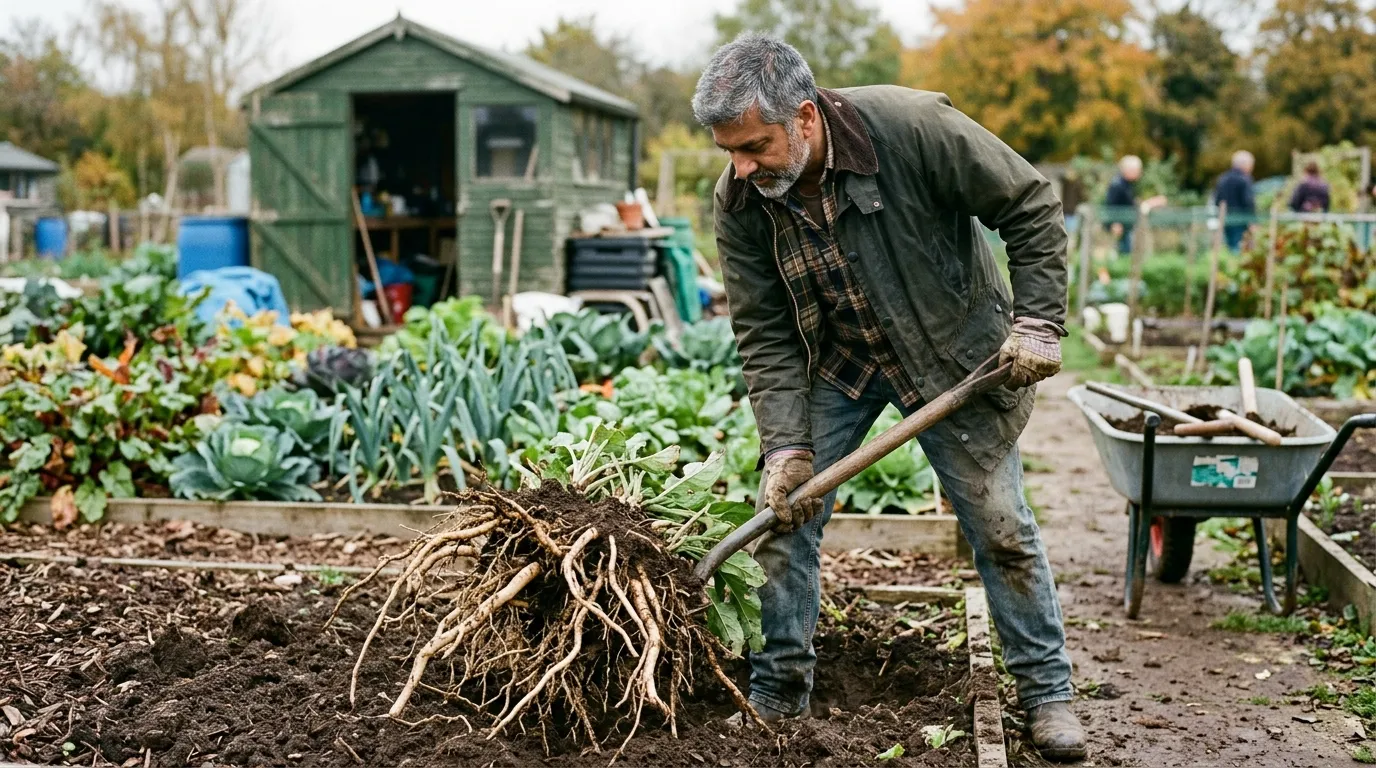
There are three working methods to propagate Bocking 14, all of them vegetative. The choice depends on whether you want maximum number of new plants from a single parent (root cuttings), fastest established plants (crown division), or simply a few extra free plants from existing ones (stem-base offsets).
| Method | Best UK Timing | Take Rate | Yield per Parent | Difficulty |
|---|---|---|---|---|
| Root cuttings | October-November or March | 90-95 percent | 8-12 cuttings per mature plant per year | Easy |
| Crown division | Late February before active growth | 100 percent | 2-4 divisions per plant | Easy |
| Stem-base offsets | May to early June | 70-80 percent | 2-3 offsets per plant per year | Moderate |
Root cutting method, the standard UK approach
Root cuttings are the workhorse method, the one Garden Organic taught from the 1950s onwards, and the one that lets you multiply a single parent plant into an allotment-association supply over three or four years.
Timing
Two windows work in the UK:
- October to early November (best, around 95 percent take). The parent plant has died back, energy reserves are stored in the roots, and the cuttings sit dormant through winter and push up shoots in March or April.
- March, after the last hard frost (around 88 percent take). The parent is still dormant, but soil is starting to warm, so emergence is faster (4 to 6 weeks instead of 12 to 16 weeks).
Avoid summer cuttings. The parent is in active leaf, root reserves are depleted, and cuttings struggle to root before the autumn frosts arrive.
The take-rate gap between the two windows is small enough that the choice often comes down to scheduling rather than success rate. October works best for gardeners who want to mulch the bed straight after planting and leave it alone until spring. March works best when the soil has been compacted by winter rain and needs forking through before cuttings go in, or when the autumn window was missed entirely. Either way, get the cuttings into the ground within a fortnight of taking them. Cuttings left lying around at room temperature dry out at the cut surfaces and lose their bud potential before they are planted.
Lifting the parent
If you have an established mature plant (year three or older), you can lift the whole rootball with a sharp spade, take the cuttings you need, and replant the parent in the same hole. The parent regrows from any small piece of root left behind.
If the parent is younger or you would rather not disturb it, slice down beside the plant with a sharp spade, lift the side roots only, and leave the central crown undisturbed. This gives fewer cuttings per session but no setback to the parent.
Wash the lifted roots under a hose or in a bucket so you can see what you are working with. Mud hides the diameter and the root forks.
Selecting roots
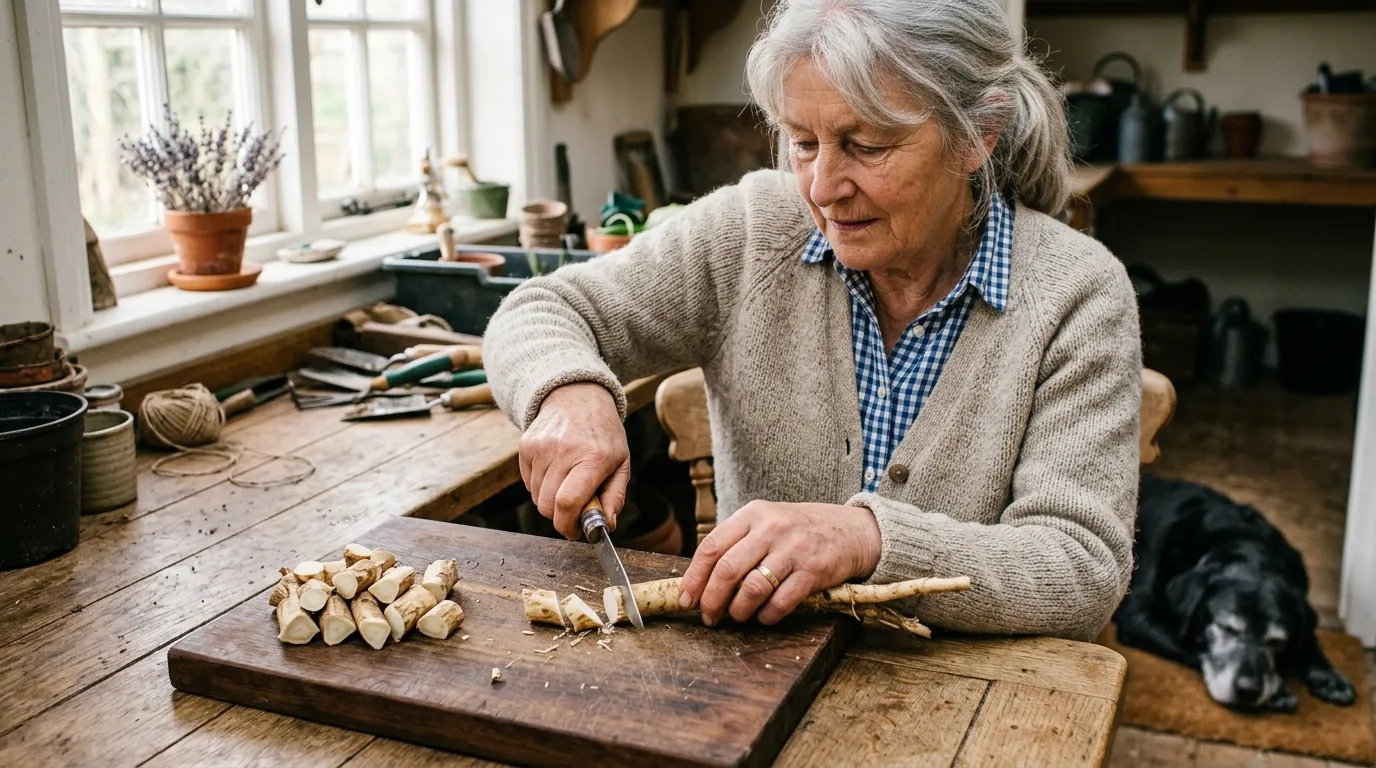
You are looking for “thumb-thick” sections of root: roughly 8 to 15mm in diameter. Thinner roots (pencil-thick or less) will root but produce a weaker first-year plant. Thicker roots (over 20mm, near the crown) are slow to break dormancy and not worth the effort.
A mature Bocking 14 plant typically gives 8 to 12 usable thumb-thick root sections per autumn lift.
Cutting
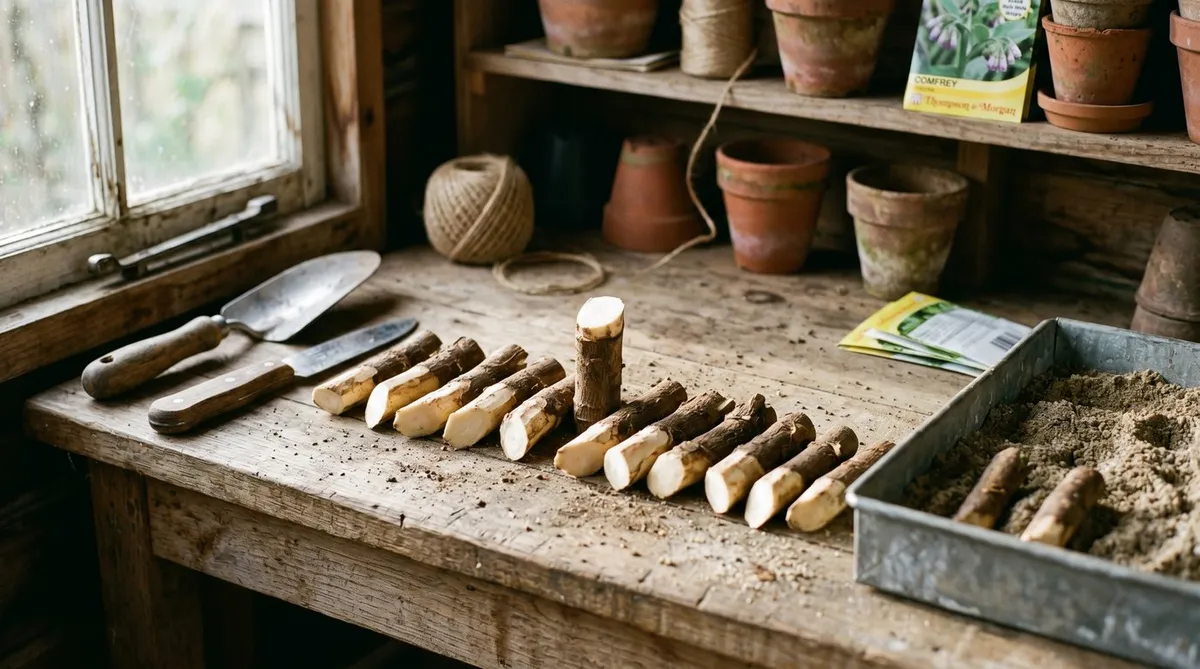
Cut the roots into 75 to 100mm sections with a sharp horticultural knife or secateurs. The single most important rule:
- Top end (the end nearest the crown when growing): flat cut.
- Bottom end (the end further from the crown): angled cut, around 45 degrees.
This is the traditional UK convention, going back to the original Garden Organic propagation notes from 1955, and it solves the single most common Bocking 14 failure: planting upside down. A root cutting planted upside down produces no shoots because the bud zone is at the top end only. The flat-cut top tells you which way is up at planting time, even if the cutting has been stored for weeks.
Storage (optional)
Cut root sections can be stored in damp builders sand in a frost-free shed or unheated garage for 4 to 6 weeks before planting. Layer the cuttings flat in a wooden tray with damp (not wet) sand between them and check weekly that the sand has not dried out.
Long-term storage is not advised. Plant within 6 weeks of cutting for best take.
Planting
Prepare the bed with a fork. Bocking 14 likes a deep open soil, will tolerate clay, and prefers a sunny or part-shaded spot. Avoid waterlogged ground.
Plant each cutting:
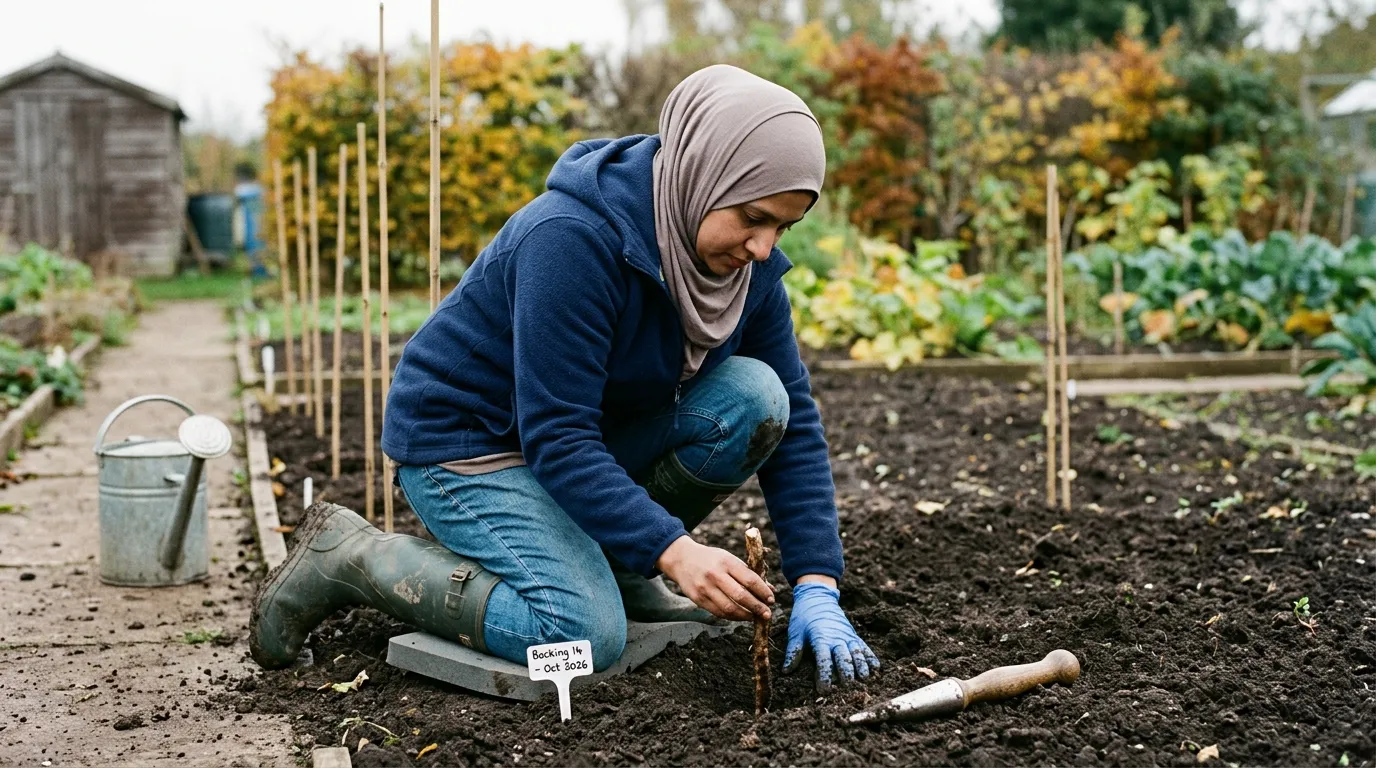
- Depth: 50mm deep, with the flat-cut top end 50mm below the soil surface.
- Spacing: 60 to 90cm apart in each direction. Closer than 60cm gives overcrowding by year three.
- Orientation: flat end up, angled end down. This is the rule that prevents the upside-down planting failure.
Firm the soil around each cutting, water in once, and mulch lightly with compost or leaf mould.
For UK gardens on heavy clay, follow the bed-preparation advice in no-dig gardening on heavy clay soil, then plant Bocking 14 root cuttings into the mulched surface in October once the bed has had its first autumn topping of compost.
What happens next
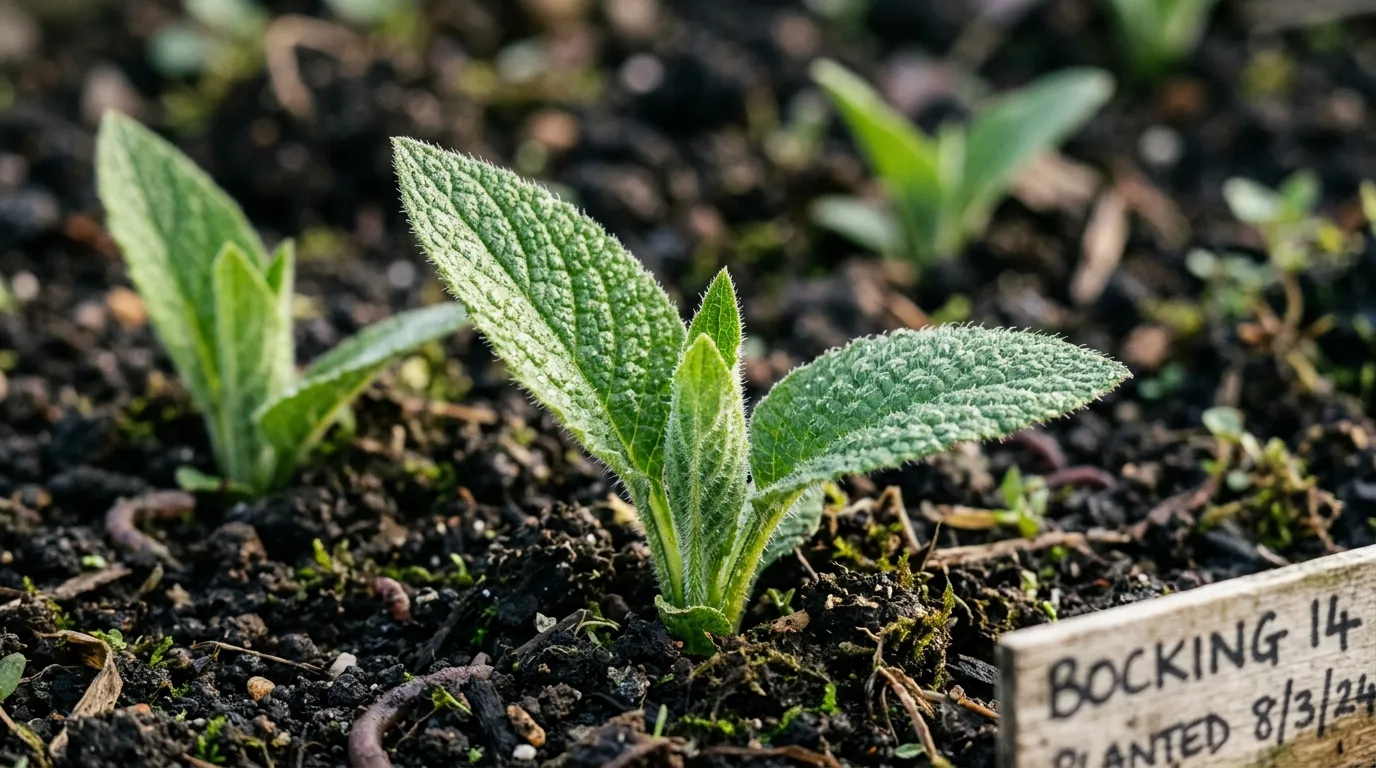
Autumn cuttings: stay dormant through winter, push up first shoots in March or April. By June of the first year each cutting carries 4 to 6 leaves and is around 30cm tall. By September of year two the plant is 60cm across and ready to crop for liquid feed.
March cuttings: emerge in 4 to 6 weeks, slower autumn growth, but generally caught up with autumn-planted cuttings by year two.
Do not crop leaves from a first-year cutting. The plant needs the leaves to build root reserves. From year two onwards you can take 3 to 5 leaf cuts per season.
Crown division, the fastest route to a few extra plants
Crown division splits a mature Bocking 14 plant into 2 to 4 chunks, each carrying a growing point and a piece of rootstock. The advantage is speed: every division is effectively already established and will crop in year one. The disadvantage is yield: you only get 2 to 4 new plants per parent (compared to 8 to 12 root cuttings).
Timing
Late February, before the parent plant breaks dormancy. The crown is fully formed (so divisions are obvious to the eye) but active growth has not started, so the parent and the divisions both transplant with minimal setback.
Method
- Lift the parent plant with a sharp spade, ideally on a dull, cool day so the roots do not dry out.
- Wash or knock the soil off so you can see the crown clearly.
- Insert two garden forks back to back through the centre of the crown and lever them apart. Larger plants may need 3 to 4 fork-passes to fully separate.
- Aim for 2 to 4 divisions per parent. Each division must carry at least one visible growing point (a bud or dormant shoot) and a substantial piece of rootstock (around 100mm long).
- Replant each division immediately at 60 to 90cm spacing, 50mm deeper than it was previously, and water in.
This method is the right choice when you want to refresh an old established plant (a mature Bocking 14 starts to lose vigour at year 8 to 10) and gain a few extra plants at the same time. Crown division every 8 years keeps a row in peak production.
Stem-base offsets are basal shoots taken from the parent plant in late spring. They root reasonably but the yield per parent is low and the take rate is poorer than the other two methods.
Method (briefly)
In May to early June, identify basal shoots 50 to 80mm tall growing at the edge of the parent plant. With a sharp knife, slice each shoot away from the parent with a small piece of stem base and root attached. Plant immediately in moist soil in half-shade, water daily for the first 14 days, and shelter from strong sun and wind for the first 4 weeks.
Use this method only when you cannot lift the parent (an established and treasured specimen, for instance) or when you need a few extra plants in late spring after the autumn cutting window has closed.
Multiplying a single plant into a row, a bed, an allotment
The maths of Bocking 14 propagation is the reason the cultivar has spread so far across UK allotments since 1955.
| Year | Action | Number of plants |
|---|---|---|
| Year 1 | Plant 1 purchased root cutting | 1 |
| Year 2 (autumn) | Take 8-12 root cuttings from the year-1 parent | 9-13 |
| Year 3 (autumn) | Take 8-12 cuttings from each year-2 plant | 60-80 |
| Year 4 (autumn) | Distribute or plant out | Whole-allotment supply |
For an allotment association running a shared row for liquid feed production, this pattern means a single plot holder’s purchase of one or two parent cuttings can fund the whole site within four years. Bocking 14 is the right cultivar for collective propagation precisely because it does not seed: every new plant is a deliberate act, traceable to a named donor.
For the wider context of how Bocking 14 fits into a beginner’s allotment, it sits in the same long-term planting decision category as fruit canes and asparagus crowns: plant once, propagate forwards, crop for decades.
Keeping the patch pure
The single risk with Bocking 14 over time is contamination by other comfreys. Bocking 14 is sterile and produces no seed, but the parent plants can still be cross-pollinated by airborne pollen from nearby Symphytum officinale or Symphytum x uplandicum. Cross-pollination does not change the Bocking 14 plant itself, but it can produce occasional seeds (very rarely, in a triploid) which would germinate as a non-sterile seedling.
If you take crown divisions or root cuttings from a Bocking 14 plant that has been cross-pollinated, the new plants are still genetically Bocking 14 and still sterile. The risk is the rare seed that drops to the ground beside the parent and germinates the following year. That seedling, if not weeded out, would be a non-Bocking 14 plant carrying common comfrey traits.
- Keep common comfrey and russian comfrey out of the same plot.
- Weed any unexpected comfrey seedling that appears near a Bocking 14 row.
- Take cuttings only from named, verified parent plants.
For an allotment site with a known wild comfrey population in the hedge or path verges, position the Bocking 14 row at the opposite end of the plot if possible.
One further safeguard worth adopting on a collective allotment site: label every Bocking 14 plant with a permanent metal or slate marker giving the cultivar name and the date of the original cutting. A row that loses its labels over the years drifts into anonymous “comfrey” status, and after two or three plot turnovers nobody remembers whether the planting was sterile Bocking 14 or seeding russian comfrey. A small label saves the row from doubt later.
After mentoring a dozen new plot holders through their first Bocking 14 row, the same six errors come up again and again.
- Buying “comfrey seed”. The single commonest mistake. The buyer thinks they have Bocking 14 and ends up with common comfrey that seeds across the plot for the next decade. Only buy named root cuttings or established plants.
- Planting root cuttings upside down. The flat-top, angled-bottom convention exists for this reason. Mark every cutting at the cutting stage, not the planting stage.
- Planting too shallow. A cutting at 25mm dries out before the bud breaks. 50mm is the right depth in UK soils, deeper (75mm) on light sandy soils.
- Overcrowding. Bocking 14 spreads 60cm wide once established. Plant any closer than 60cm and by year three the row is a tangled mass that yields less per plant than wider spacing.
- Cropping in year one. Leaves stripped in year one starve the developing root. Wait until year two before taking any leaves.
- Letting the patch get to year 10 without division. Vigour drops noticeably from year 8. A late-February crown division at year 7 or 8 refreshes the row and gives a few extra plants in the process.
Avoid these and a Bocking 14 row pays for itself many times over. The mineral profile of the leaves makes the liquid feed worth the propagation effort: high potash, useful phosphorus, and a deep root that has mined nutrients from below the topsoil layer.
What to do with the leaves once you have a row
A row of six mature Bocking 14 plants gives roughly 30 to 40kg of leaf material per season across 4 to 5 cuts. The traditional UK use is liquid feed, made by steeping leaves in water for 4 to 6 weeks until they decompose into a dark, strong-smelling concentrate that dilutes 1:15 for foliar feeding and 1:10 for root drench on tomatoes, courgettes, runner beans and any heavy feeder.
The step-by-step process is covered in how to make comfrey and nettle liquid feed, with the dilution ratios, the brewing time, and the safe-storage instructions for the finished concentrate.
Comfrey leaves are also useful as a mulch layer under fruit trees (decompose in 4 to 6 weeks, releasing potassium directly to the root zone), as an accelerator for cold compost heaps (10 percent comfrey leaves by volume noticeably speeds breakdown), and as a green manure incorporated into a vegetable bed before sowing a cover crop over winter. Tomatoes mulched with a 20mm layer of chopped comfrey leaves in June give measurable yield gains compared to unmulched controls.
For wider use of comfrey alongside other natural fertilisers, best fertilisers for UK gardens covers how the home-made comfrey feed compares to bagged organic alternatives like seaweed meal, blood-fish-bone and chicken pellets.
The economic case for a Bocking 14 row is hard to beat. A bottle of bought tomato feed costs around 6 to 8 pounds for 1 litre of concentrate, enough to dose roughly 15 watering cans over the season. A row of six mature Bocking 14 plants gives 4 to 5 litres of comparable concentrate per cut, with 4 to 5 cuts per season. That works out at around 80 to 100 watering cans of diluted feed per row per year, replacing roughly five bottles of bought feed and saving 30 to 40 pounds per year on tomato and courgette nutrition alone. Across a 20-year row life, that is 600 to 800 pounds of saved feed from one row of six plants, all bulked up from one original Garden Organic root cutting.
Related guides
For making compost that pairs well with a Bocking 14 mulch, how to make compost covers the basics of the hot heap and the cold heap. For the wider propagation toolkit (cuttings, division and layering across other garden plants), plant propagation: cuttings, division and layering explains the techniques that apply across most UK perennials. And for the recipe side of comfrey use, how to make comfrey and nettle liquid feed walks through the brewing process step by step.
Sister deep dives in the comfrey cluster: the growing and using comfrey UK pillar is the master reference covering species, site, harvest cycle and all 10 uses. The comfrey liquid feed recipe has the strength, dilution and crop-by-crop application tables. The medicinal uses of comfrey UK covers the topical-only knitbone salve route with full safety positioning.
Our team produces practical UK gardening guidance from source research, contributor records and established horticultural practice. Editorial standards are overseen by Matt W.