Key takeaways
- Day length controls bulbing, bolting and flowering in many UK vegetables
- Long-day onion varieties suit the UK - short-day varieties never bulb here
- UK summer day length reaches 16-17 hours south, 18-19 hours north Scotland
- Lettuce and spinach bolt above 14-hour days combined with 22C+ temperatures
- Brassica heading is triggered by shortening days in autumn
- Grow lights can override natural day length for indoor starts and winter crops
Day length is one of the three primary growth signals every UK plant responds to (the others are temperature and water). Plants measure day length through specialised proteins in their leaves and use the signal to trigger flowering, bulbing, dormancy and seed-setting. Understanding photoperiod is the difference between a successful UK onion crop and a row of green leaves that never bulb up.
This guide covers what photoperiod is, how UK plants respond to it, which crops are photoperiodic (and which are not), and how to manage day-length-driven problems like onion failure, lettuce bolting, and brassica timing.
For the related seasonal context, see our crop rotation planner UK guide for botanical groupings and our polytunnel calendar UK for year-round protected cropping that can override natural day length.
What is photoperiod?
Photoperiod is the daily duration of light exposure. Plants measure not the day length directly but the uninterrupted dark period between sunset and sunrise. A light-sensitive protein called phytochrome in plant leaves switches between two forms - Pr (active in red light) and Pfr (active in far-red light) - and the ratio at dawn tells the plant how long the night was.
Three plant categories respond to day length differently:
Long-day plants flower or bulb when day length exceeds a critical threshold (usually 14-16 hours). Includes most UK onions, spinach, lettuce, dill, radish. They sit dormant or grow vegetatively until day length triggers the change.
Short-day plants flower or bulb when day length falls below a critical threshold (usually 10-12 hours). Includes chrysanthemums, poinsettias, sweet potato, some bean varieties. Rare in UK vegetable growing - the UK summer day length is too long for most short-day crops to ever trigger.
Day-neutral plants are insensitive to day length and respond mainly to temperature. Includes tomatoes, peppers, most beans, cucumbers, carrots. The bulk of UK vegetable crops fall into this category.
The single biggest day-length problem for UK gardeners is mistakenly planting short-day varieties (especially onion sets) bred for southern US or Mediterranean conditions. These never trigger in UK summer.
UK day length by latitude and date
UK day length varies significantly by latitude. Here are the key reference points:
| Date | London (51.5°N) | Manchester (53.5°N) | Edinburgh (55.9°N) | Inverness (57.5°N) |
|---|---|---|---|---|
| 21 March (equinox) | 12h 11min | 12h 12min | 12h 14min | 12h 15min |
| 21 May | 15h 35min | 15h 56min | 16h 25min | 16h 51min |
| 21 June (solstice) | 16h 38min | 17h 5min | 17h 36min | 18h 7min |
| 21 July | 16h 0min | 16h 22min | 16h 47min | 17h 9min |
| 21 August | 14h 24min | 14h 35min | 14h 50min | 15h 3min |
| 21 September (equinox) | 12h 22min | 12h 23min | 12h 25min | 12h 26min |
| 21 October | 10h 22min | 10h 12min | 10h 1min | 9h 51min |
| 21 December (solstice) | 7h 50min | 7h 24min | 6h 56min | 6h 33min |
The practical implications:
- April-September is the long-day window where photoperiod triggers are reachable
- May-July is the peak long-day period - onion bulbing, brassica bolting, lettuce stress
- October-March is the short-day window where overwintering crops establish
Long-day onions - the biggest UK photoperiod story
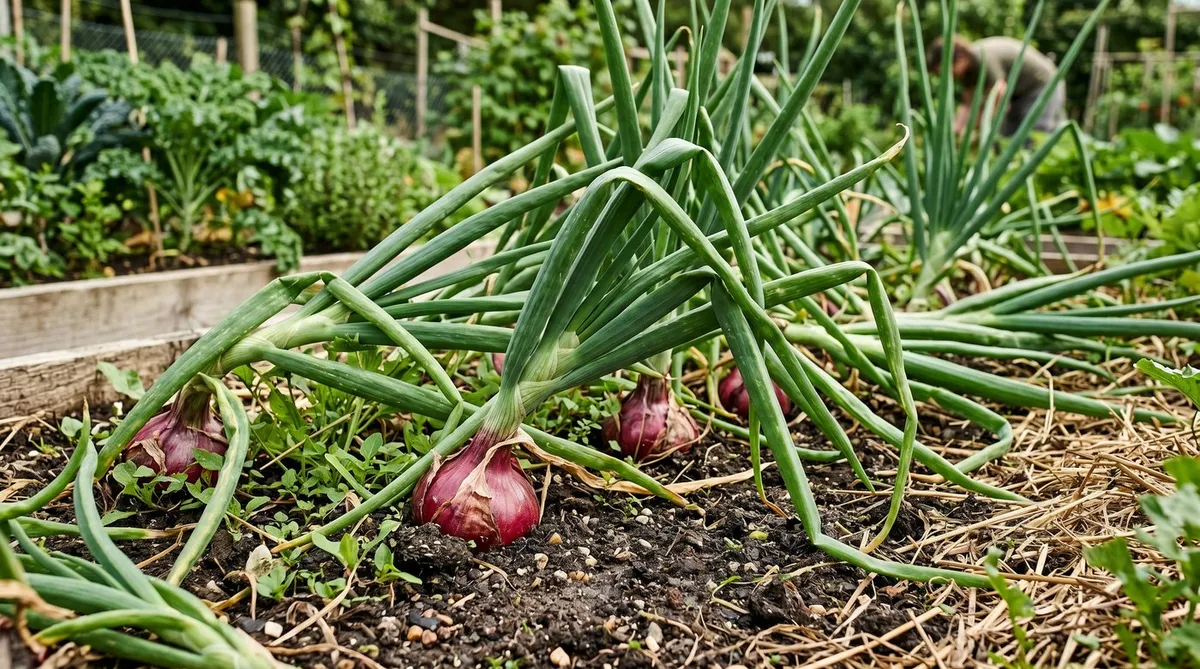
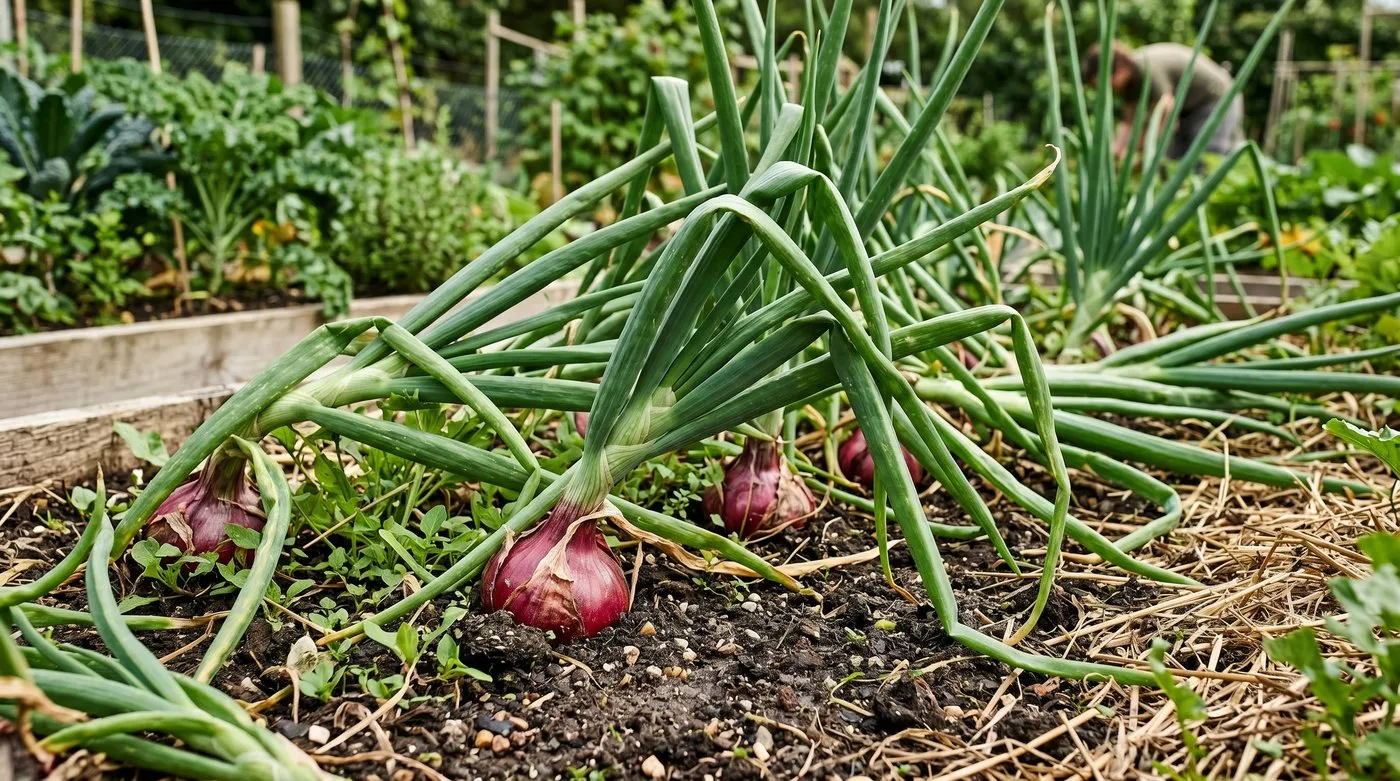 The flop-over moment. Long-day onions trigger bulbing when day length exceeds 14-16 hours - typically mid-June in the UK. The leaves then fall over as the bulb finishes swelling.
Onions are the textbook photoperiodic UK crop. The plant grows leaves through spring while day length increases. When day length crosses the variety’s critical threshold (typically 14-16 hours for long-day varieties), the plant switches from leaf production to bulb formation. The leaves stop growing, energy moves down to the bulb, the bulb swells, and after 4-6 weeks the leaves flop over to signal harvest.
Long-day varieties (suitable for UK)
Critical threshold: 14-16 hours of daylight. Triggers in mid-June through early July in the UK.
- Sturon - the standard UK long-day onion. Brown skin, firm flesh, good keeper.
- Stuttgarter - flat-shaped brown onion, traditional UK variety, very reliable.
- Setton - improved Sturon, slightly larger bulbs.
- Hercules F1 - hybrid long-day, large brown bulbs.
- Centurion F1 - bolt-resistant, high-yield hybrid.
- Red Baron - the standard UK red long-day onion.
- Hi Keeper - exceptional storage, lasts to following March.
- Bedfordshire Champion - heritage long-day, large bulbs.
Day-neutral varieties (also OK for UK)
Trigger by temperature rather than day length. Worth knowing because some “long-day” sets are actually day-neutral and can be planted later in the season.
- Walla Walla - sweet, large bulbs, day-neutral
- Candy - sweet onion, day-neutral
- Patterson - day-neutral hybrid
Short-day varieties (FAIL in UK)
Critical threshold: 10-12 hours of daylight. Never triggers in UK summer. Avoid these on UK labels:
- Texas Early Grano (and any “Texas” variety)
- Granex
- Yellow Granex
- Vidalia (the original short-day sweet onion)
- Crystal Wax
- Southern Belle
- Any onion labelled “short-day” or “warm-climate”
The label “short-day” sometimes appears on imported US sets sold cheaply in UK garden centres. Read the variety name before buying rather than just “yellow onion”.
Brassica heading - the reverse of bulbing
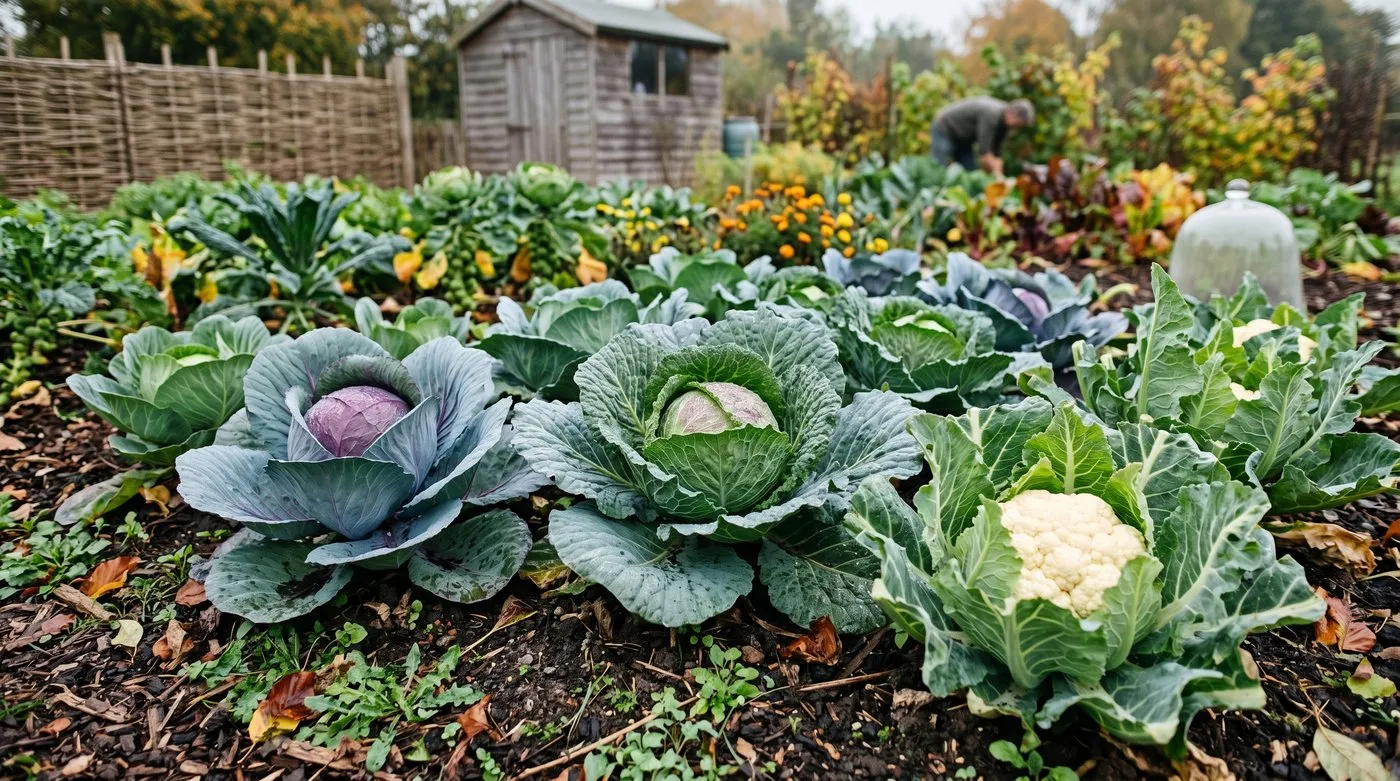 Brassicas head (cabbages) or curd (cauliflowers) as autumn day length shortens. The plant detects the shorter day, switches from leaf production to head formation, and packs the energy into a tight central structure.
Brassicas (cabbage, broccoli, cauliflower, sprouts) respond to shortening autumn day length by forming heads or curds. The process:
- Spring-summer (April-July): plant grows large leaves while days are long
- Late summer (August): day length starts to decrease past 14 hours
- Early autumn (September): plant detects shorter days, slows leaf growth
- Autumn (October-November): central leaves wrap inward, heart or curd forms
- Late autumn-winter: head matures, ready for harvest
The mistake UK gardeners make is sowing brassicas too late - if the plant hasn’t grown enough leaf mass by August, it heads up small. The right schedule is to start brassicas in March-May indoors, plant out by June, let them grow large leaves through July-August, and let the September day-shortening trigger heading.
Varieties that head at different day lengths:
- Spring cabbages (Pixie, April) head at very long days in late spring after overwintering as small plants. Sow August, head May.
- Summer cabbages (Hispi, Greyhound) head at the longest days. Sow February-March, head June-August.
- Autumn cabbages (Marner, Stonehead) head as days start shortening. Sow April-May, head September-November.
- Winter cabbages (Savoy, January King) head in short days. Sow May-June, head December-March.
Lettuce bolting - photoperiod plus temperature
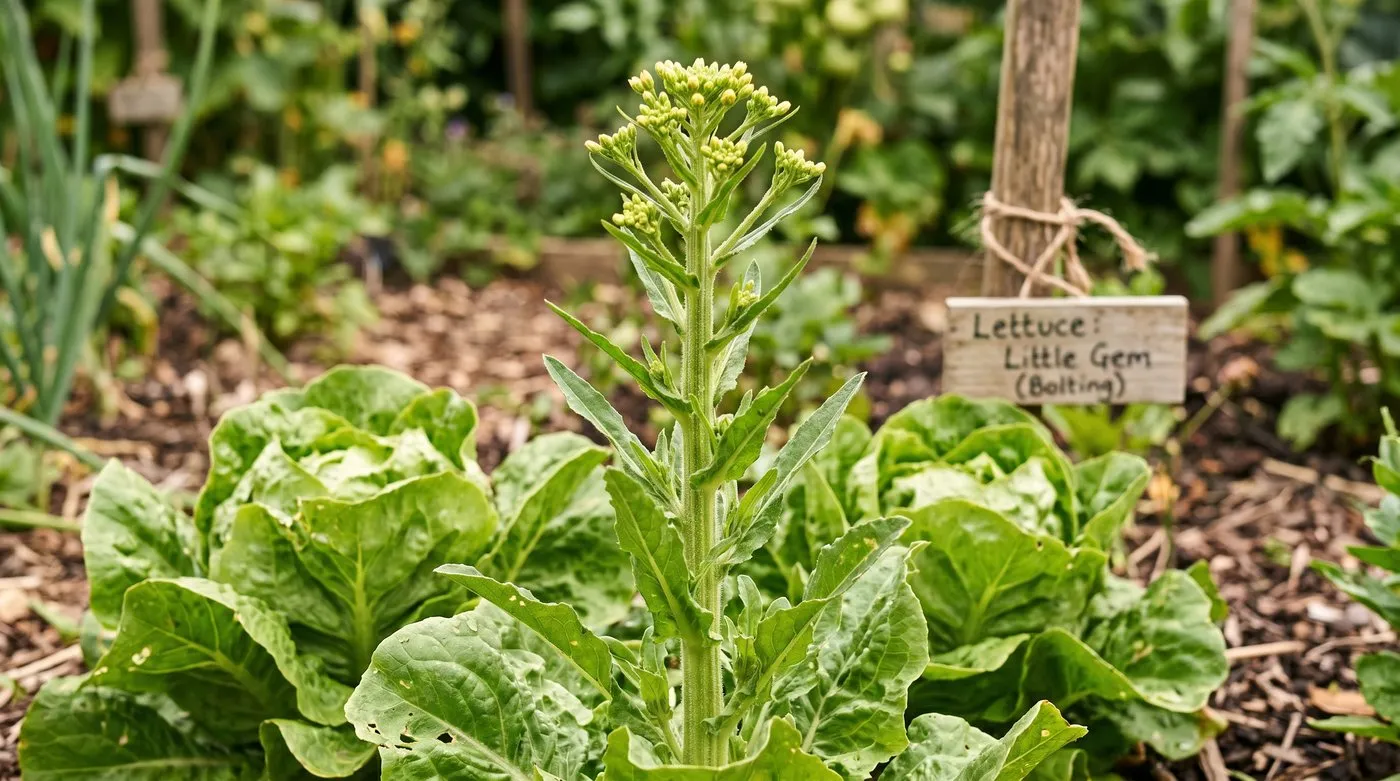 Bolting lettuce. The central stem rockets upward as long days plus heat tell the plant to switch from leaf production to seed setting.
Lettuce bolts (sends up a flower stem and goes bitter) when two conditions combine:
- Day length above 14 hours - UK summer from late May to early August
- Soil temperature consistently above 22C - UK summer from mid-June to late August
Both conditions need to be met. Long days alone do not bolt lettuce (you can grow it under glass through the longest days if you keep the temperature low). Hot days alone do not bolt lettuce until day length is also long (October temperatures of 28C cause less bolting than June temperatures of 25C).
Bolt-resistant varieties
For UK summer growing, choose varieties bred for late-bolting:
- Little Gem - small cos, very bolt-resistant
- Lobjoit’s Green Cos - heritage cos, resistant to summer heat
- Salad Bowl (red and green) - loose-leaf, bolt-tolerant
- Lollo Rosso / Lollo Bionda - loose-leaf, slow to bolt
- Buttercrunch - butterhead, bolt-resistant
- Webb’s Wonderful - heritage iceberg, slow-bolt
- Black Seeded Simpson - oldest American variety, surprisingly bolt-tolerant in UK
Other bolting crops
Same photoperiod + temperature combination triggers bolting in:
- Spinach - bolt threshold: 12-14 hour days + 18C temperature. Earlier than lettuce.
- Coriander - bolts almost as soon as it grows in summer. Plant in shade or in spring/autumn.
- Rocket - bolts within 4-6 weeks in summer heat. Continuous sowing required.
- Pak choi - bolts at 14h days + 20C. Best as autumn crop.
- Chinese cabbage - bolts at long days. Best as autumn crop.
The general rule: salad crops are spring (March-May) and autumn (August-October) crops in the UK. Mid-summer is the bolt zone.
Summer solstice - the photoperiod peak
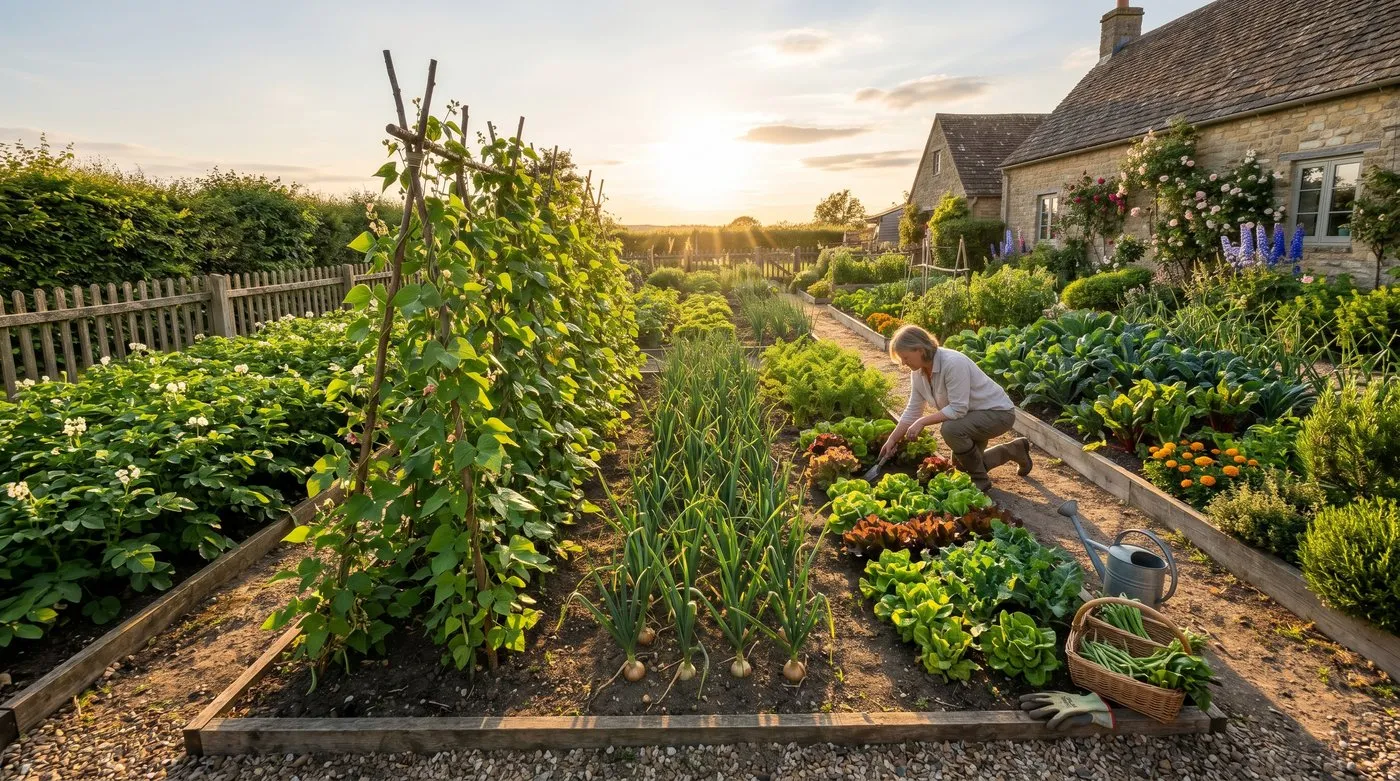 The summer solstice (around 21 June) is the photoperiod peak. From this date day length starts decreasing and many photoperiod triggers reverse.
The summer solstice (around 21 June) marks the longest day of the year and the peak of long-day photoperiod effects:
- Onion bulbing has just triggered or is about to
- Lettuce bolting is at maximum risk
- Long-day flowering is at peak (sweet peas, foxgloves, delphiniums all peak around now)
- Strawberry day-neutral cropping continues at maximum
- Brassica heading has not yet started
After the solstice, day length decreases by roughly 4-5 minutes per day in southern England, slightly more further north. By mid-August, day length is back to around 14 hours - the threshold below which most autumn crops start triggering.
The solstice is therefore a natural inflection point in the UK growing year - and one of the few days where the same hour of light arrives at the same time across the entire country.
Extending day length with grow lights
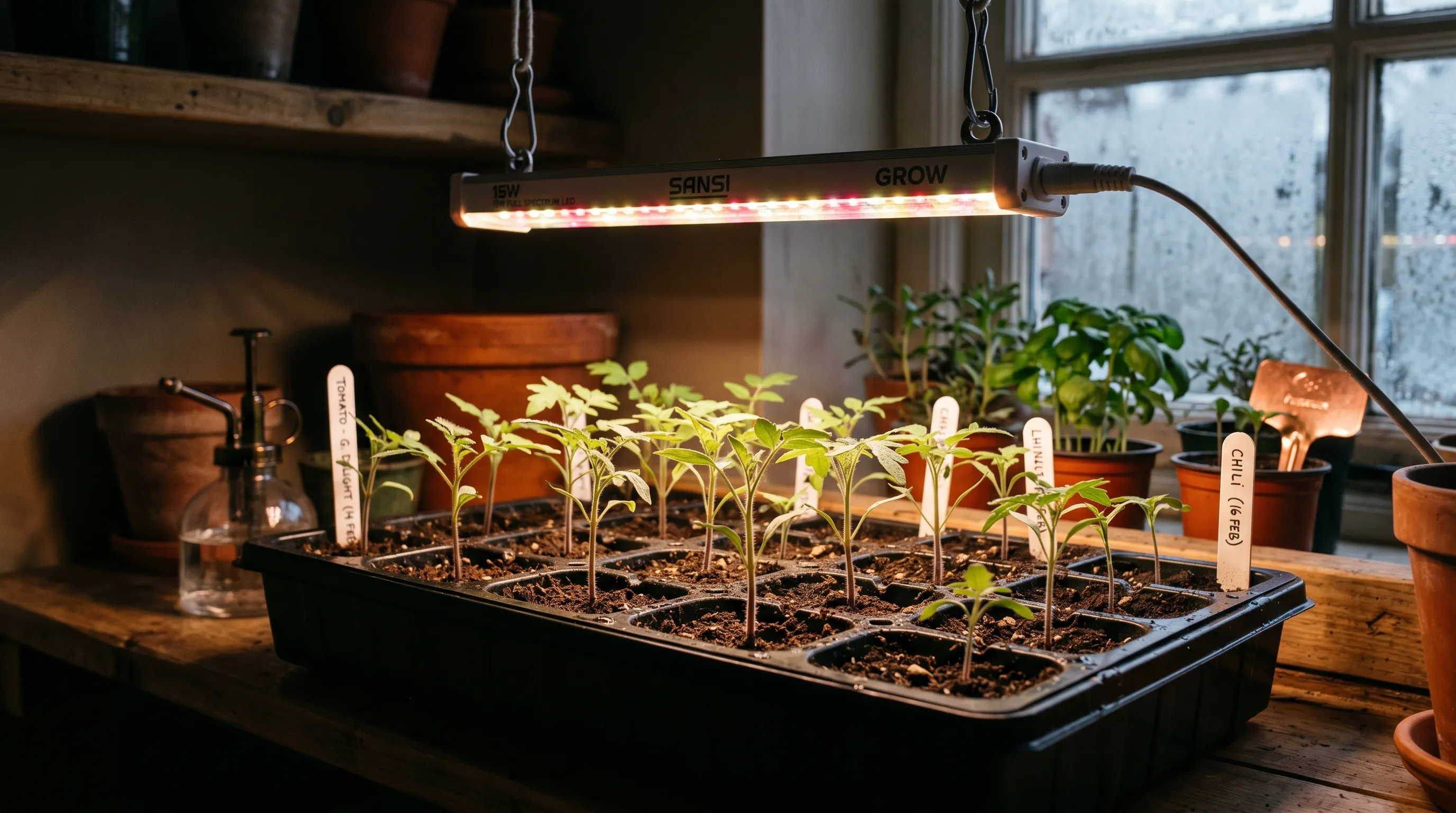 LED grow lights extend the photoperiod for indoor seedlings and winter crops. Standard 80-120W per square metre full-spectrum panels match summer day-length effects.
LED grow lights override natural day length for indoor or polytunnel growing. Two common UK applications:
Application 1: Winter seedling raising
Tomato, pepper, chilli and aubergine seedlings sown in February need long days to grow well, but UK February day length is only 9-10 hours. Without supplementation, seedlings become leggy and weak.
Setup: 60-80W LED panel over a single seed tray, running 14-16 hours per day. Switch on at 5am, off at 8pm or 9pm. Total daily energy use: 1-1.5 kWh.
Cost: 80-120W full-spectrum LED panel costs £40-£100. Electricity at 27p per kWh = 27-40p per day, £4-£6 per month.
Benefit: seedlings grow stocky and dark green rather than leggy and pale. Saves 3-4 weeks of seedling development time.
Application 2: Winter polytunnel salad growing
Cut-and-come-again salad crops slow dramatically in the short days of November-February. Even unheated supplementary lighting extends the cropping season by 6-8 weeks.
Setup: 200-400W LED panel suspended 1m above a polytunnel salad bed (1.5m² coverage). Run 4-6 hours of supplementary light morning and evening to bring total to 14 hours.
Cost: Higher capital outlay (£150-£350 for a serious panel). Running cost approximately £15-£30 per month through midwinter.
Benefit: continuous winter salad production rather than 8 weeks of dormancy.
For the wider context of grow light use in seed starting, see our grow lights for seed starting UK guide.
Photoperiod-sensitive flowers
Day length also affects ornamental flowering:
Long-day flowering (peak in midsummer):
- Sweet peas (Lathyrus odoratus)
- Foxgloves (Digitalis)
- Delphiniums
- Hollyhocks (Alcea)
- Cornflowers (Centaurea cyanus)
- Larkspur (Consolida)
Short-day flowering (peak in autumn):
- Chrysanthemums (commercial growers manipulate day length to time flowering)
- Asters (autumn-flowering varieties)
- Dahlias (technically day-neutral but flower more strongly in shortening days)
- Poinsettias (need 12-14 hours of complete darkness to flower)
Day-neutral flowering (most cottage garden flowers):
- Roses
- Geraniums (Pelargonium)
- Begonias
- Pansies
- Petunias
Most UK gardeners do not need to think about flower photoperiod because the standard varieties bred for UK conditions are already matched to UK day length. The exceptions are exhibition growers who manipulate day length to time peak bloom for shows.
Common UK photoperiod mistakes
Mistake 1: Buying short-day onion sets. The most common single mistake. Always check the variety name against UK-suited long-day list before planting.
Mistake 2: Sowing salads in mid-summer. Spring (March-May) and autumn (August-October) windows produce far better salads than mid-summer attempts that bolt.
Mistake 3: Late brassica sowing. Brassicas need 8-12 weeks of long-day growth before autumn heading triggers. Sow by mid-May at latest for autumn crops.
Mistake 4: Trying to grow winter salads outdoors without protection. Day length below 10 hours combined with cold temperatures stops growth completely. Salad needs polytunnel, glasshouse or grow lights to crop in midwinter.
Mistake 5: Storing seeds wrong way round. Many seed packets list “long-day” or “short-day” if relevant. Read the packet rather than assuming.
Decision framework for UK gardeners
For each crop you plan to grow, ask:
Five seconds of variety-check at the garden centre prevents the entire-season failures that day-length mismatches cause.
Field note: The RHS holds UK-specific data on photoperiodic crops and recommended varieties. Their plant finder filters by photoperiod requirements for serious growers.
Quick reference: which UK vegetables are photoperiodic?
| Crop | Photoperiod | UK practical implication |
|---|---|---|
| Onion | Long-day | Use long-day varieties only |
| Garlic | Long-day | Plant Oct-Nov for next summer |
| Shallot | Long-day | Plant Feb-Mar for summer bulb |
| Leek | Day-neutral | No photoperiod concern |
| Spinach | Long-day | Bolts in summer - sow March/Sept |
| Lettuce | Long-day + heat | Bolts in summer - bolt-resistant varieties |
| Brassicas (heading) | Day-shortening | Plant by mid-May for autumn heads |
| Carrot | Day-neutral | No concern |
| Parsnip | Day-neutral | No concern |
| Tomato | Day-neutral | Temperature-driven |
| Pepper / chilli | Day-neutral | Temperature-driven |
| Bean (most) | Day-neutral | No concern |
| Sweet potato | Short-day | Almost never bulbs in UK |
| Strawberry (June-bearing) | Day-neutral | Fruits regardless |
| Strawberry (everbearing) | Day-neutral | Fruits regardless |
| Chrysanthemum | Short-day | Flowers autumn |
Now you’ve understood photoperiod
For the related topic of variety choice for UK soil and climate, read our seed germination temperatures UK reference table which covers the temperature side of the variety-selection puzzle.
Our team produces practical UK gardening guidance from source research, contributor records and established horticultural practice. Editorial standards are overseen by Matt W.