Key takeaways
- A well-run 3m by 6m UK polytunnel yields 250-450kg of produce a year, four times the outdoor equivalent on the same footprint
- Four distinct crop windows per square metre per year is the single biggest productivity lever (most growers use only one or two)
- Tomatoes hit 12-18 kg per square metre under cover versus 4 kg outdoors; cucumbers and aubergines need a polytunnel to crop reliably in the UK
- Vertical planting to 2.5m plus ground-level underplanting can double the effective growing area without adding any floor space
- Bed layout matters: a 4-bed deep system uses 60% of floor area, a perimeter-and-island layout pushes that to 70%
- Annual cost of a hobby polytunnel pays back in produce value within one to three years at Tesco organic retail equivalent
A productive UK polytunnel is a maths problem before it is a growing problem. The cover and the soil are fixed. The light is roughly fixed. The variables that you control are how many crops you grow per square metre per year, how high you grow vertically, and how quickly you replace a finished crop with the next one. Get those three right and an 18 square metre tunnel routinely produces 250-450kg of fresh food a year. Get them wrong and the same tunnel struggles to hit 100kg.
What productivity actually means in a UK polytunnel
Productivity is yield per unit area per unit time. In a polytunnel context the most useful figure is kilograms of edible produce per square metre per year. The all-UK average for outdoor allotment growing sits around 3-5 kg per square metre per year across a mixed bed. The same square metre under polytunnel cover hits 14-25 kg, with strong growers pushing past 25 kg on intensively cropped sections.
The four levers that move yield are:
- Light: a polytunnel transmits 85-92% of the available daylight versus 65-75% inside a typical glasshouse, so the light side already favours the tunnel. Side height and door size affect this on cloudy days.
- Soil: tunnel soil dries out faster and uses up nutrients faster than outdoor beds, so the productivity question turns into a soil-feeding question by year two.
- Water: under cover, rain never reaches the soil. Watering becomes a deliberate decision rather than a default supply, and consistency matters more for fruit-set than absolute volume.
- Ventilation and temperature: airflow keeps fungal disease down and stops summer overheating from shutting off pollination. The UK polytunnel productivity ceiling is set as much by ventilation as by anything else.
The fifth lever, and the one most growers neglect, is succession. A bed that holds one crop per year produces a quarter of what the same bed can produce when it holds four.
Yield per square metre: polytunnel versus outdoor
A few patterns stand out. Cucumbers and aubergines are the crops where the polytunnel makes the biggest difference because both struggle to crop reliably outdoors in the UK. Tomatoes give the highest absolute weight per square metre. And salads have the best multi-crop potential because the short growing time lets you fit four to eight harvests into a single year on the same bed.
The four crop windows per square metre per year
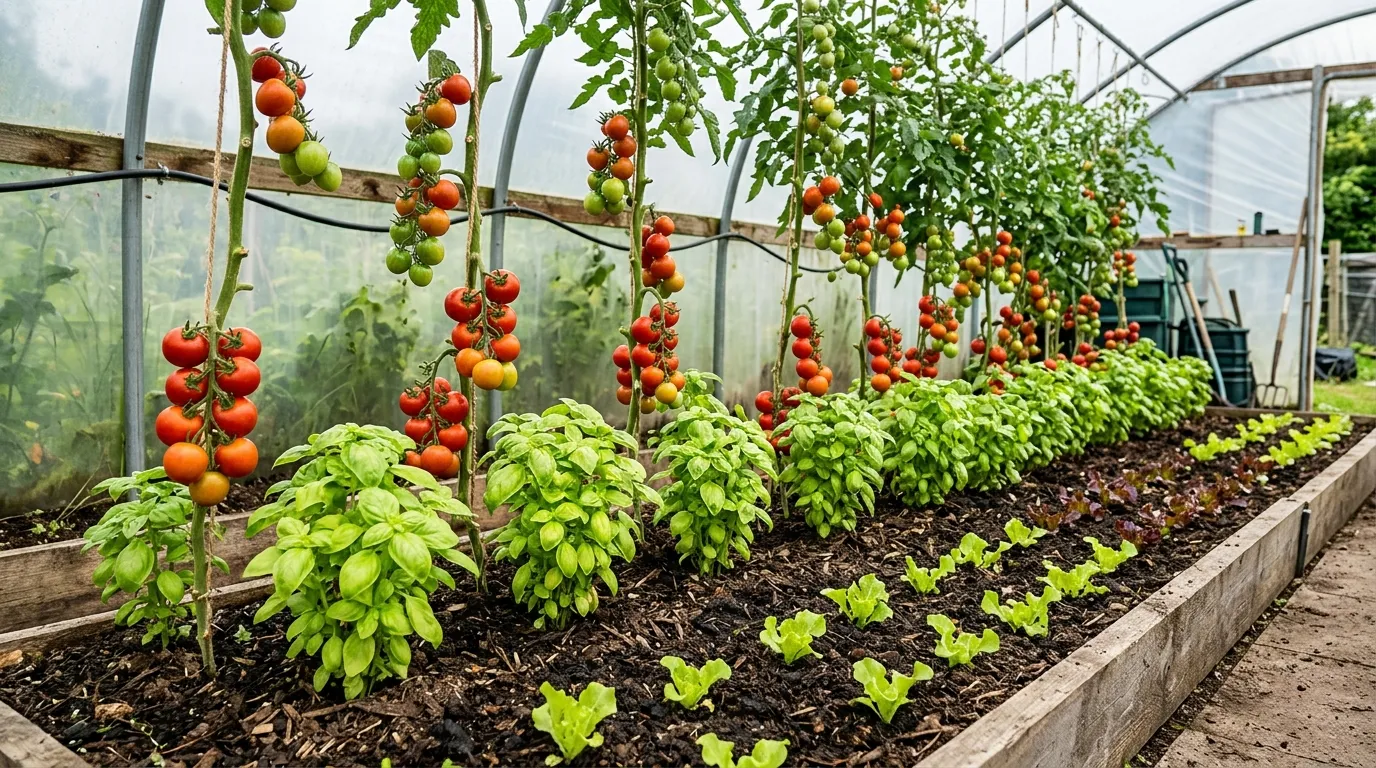
This is the single biggest productivity lever and the one most UK growers skip. Treat each square metre of bed as a property with four rental tenancies per year rather than one or two. Each tenancy is a crop window:
Window 1: early March to mid-May (cool-season). Lettuce, mizuna, radish, spring onions, pak choi, rocket. All fast crops that finish before the tomatoes need the soil warm. Sow direct or transplant from cell trays. Pick at baby-leaf or full-head stage.
Window 2: late May to mid-October (warm-season fruiting). Tomatoes, cucumbers, peppers, aubergines, melons, French beans, basil, sweet corn. The window every grower already uses. The trick is keeping it productive right to the end of October rather than letting it tail off in September.
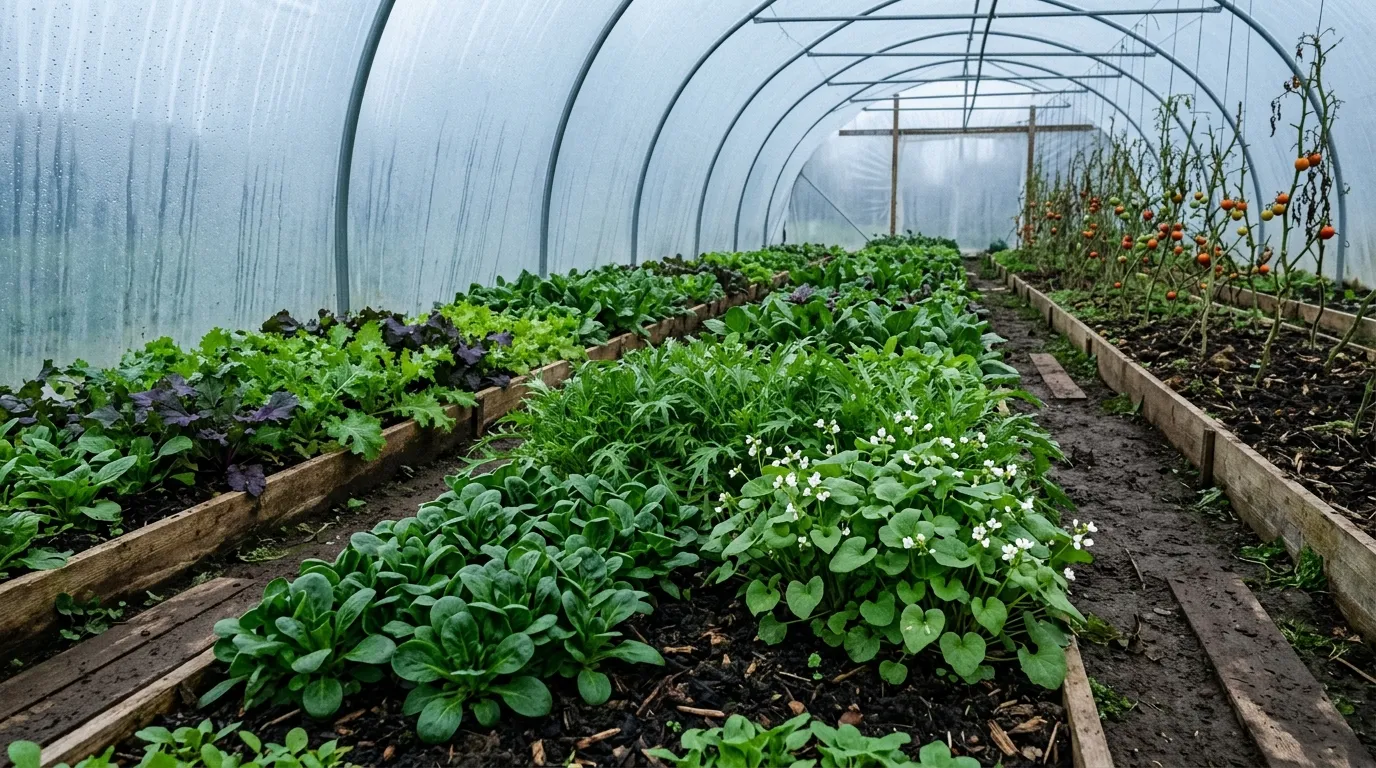
Window 3: mid-October to mid-December (winter salads, first push). Pak choi, leaf radish, mizuna, mustard greens, winter lettuce (‘Winter Density’, ‘Arctic King’). Sown into the bed in mid-September while the tomatoes are still finishing, then revealed when the summer crops come out in early October. Picks from November to mid-December.
Window 4: mid-December to end February (hardy winter). Corn salad (lamb’s lettuce), claytonia (miner’s lettuce), mustard greens, leeks, leaf chicory. The hardiest crops in the polytunnel growing system. Picks slowly through the coldest months, then ramps up in February as the light returns.
The trick to overlapping these is to sow the next crop into gaps before the previous one finishes. The tomatoes do not have to all come out before the pak choi goes in. Plant pak choi modules between tomato stems in early September and they will be 100mm tall by the time you pull the tomatoes in October.
Three polytunnel layout strategies
Layout decides what percentage of your floor area is actually growing crops versus paths. A 3m by 6m tunnel has 18 square metres of floor. The growable percentage varies from 55% to 75% depending on layout.
Strategy 1: four deep beds, 60% growing area
Four beds running across the width of the tunnel, each 750mm wide, with 600mm paths between them. This is the layout most new growers default to and is forgiving for first-time tunnel users.
Growing area: 10.8 square metres of 18 (60%). Pros: every bed accessible from both sides without stepping on the soil; easy to rotate crops; tidy. Cons: the 600mm paths eat 40% of the floor area.
Strategy 2: two deep beds with central path, 65% growing area
Two beds running the length of the tunnel, each 1m wide, separated by a 600mm central path. This layout suits taller crops because the longer bed run gives you continuous trellis lines for tomatoes and cucumbers.
Growing area: 11.7 square metres of 18 (65%). Pros: continuous lines for cordon training; fewer ends meaning fewer wasted corners; easier irrigation runs. Cons: the centre of each 1m bed is 500mm from the path, which is at the edge of comfortable reach for most growers.
Strategy 3: perimeter beds plus island bed, 70% growing area
Growing area: 12.6 square metres of 18 (70%). Pros: highest growing percentage of any standard layout; full perimeter is reachable from outside the bed; island bed catches the best light through the day. Cons: awkward to wheelbarrow compost into the back corners; not ideal for tall cordons against the side walls because the cover slopes inward.
Vertical multi-storey planting
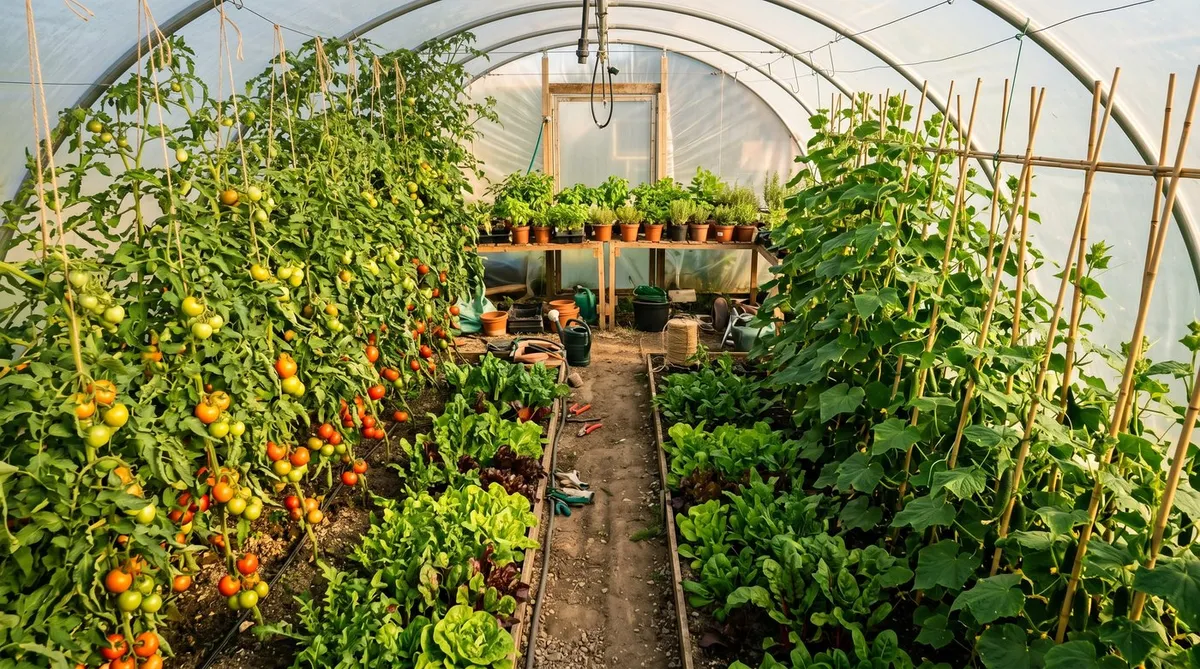
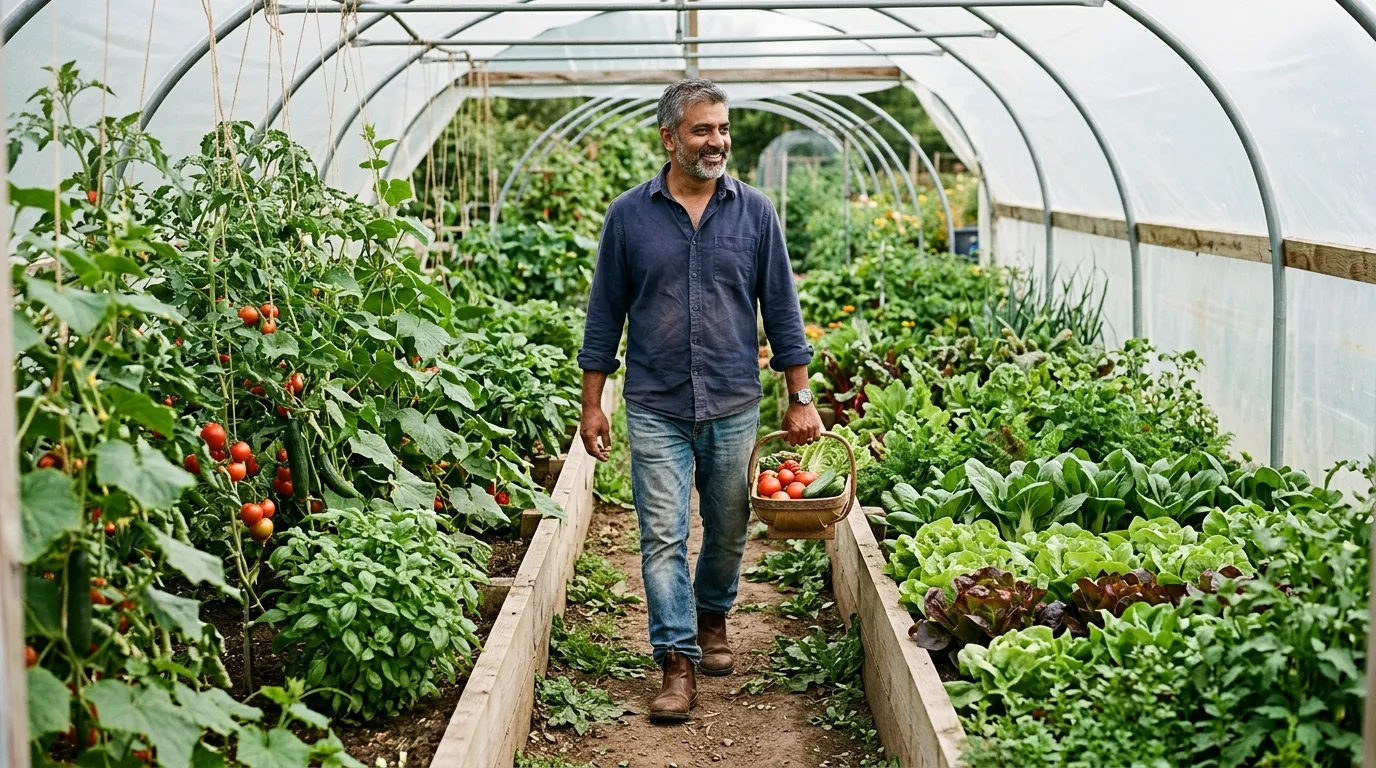
The floor area of a UK polytunnel is fixed but the air space is not. A 2.5m ridge gives you roughly 1.6m of usable vertical growing room above ground level. Used well, this can effectively double the productive area of the tunnel.
Top layer (1.5-2.5m high): cordon tomatoes trained up vertical strings or canes; greenhouse cucumbers trained the same way; trailing tumbler tomatoes and strawberries in hanging baskets attached to the cross-purlins.
Middle layer (0.5-1.5m): sweet peppers, chillies, aubergines, bush French beans, basil. These crops fill the space between the cordon stems and use light that the tomato canopy lets through.
Ground layer (0-0.5m): lettuce, pak choi, rocket, mizuna, parsley, coriander, radish. Once the tomato canopy fills out in June and the floor becomes shaded, these shade-tolerant crops do better than they would in full sun anyway.
A common ground-layer mistake is to keep the soil under cordon tomatoes bare. That square metre is producing nothing for four months. Plant lettuce or pak choi instead and you get a 200-300g crop of leaves from the same patch with no extra space cost.
Companion planting for productivity
Companion planting in a polytunnel is partly about pest deterrent and partly about not wasting space. Three pairings that work well across UK tunnel data:
Basil with tomatoes. Both like warmth, the basil is finished and harvested before it would shade the tomatoes meaningfully, and the smell deters whitefly. Plant basil 200mm from each tomato cordon at the same time you set out the tomatoes.
Marigolds (Tagetes patula or Calendula officinalis) at row ends and bed corners. Whitefly bridge in via the doors. A 300mm clump of marigolds in the bed end nearest the door catches the first wave. Pick the flowers regularly to keep the plant producing.
Nasturtiums under the staging or in pots at the door. Aphids prefer nasturtium leaves to nearly anything else, so they act as a sacrificial trap crop. Pull the heavily-infested leaves and bin them once a week.
These pairings sit on top of the standard rule against growing tomatoes in the same bed two years running. Polytunnel soil builds up tomato root knot eelworm if cropped repeatedly. Rotate the cordon crop on a three-year cycle: tomatoes year one, cucumbers or peppers year two, French beans or aubergines year three.
Succession sowing calendar
Lettuce: sow every 10-14 days from early March to mid-September. Twelve sowings across the year. Use cell modules and transplant at the four-true-leaf stage so a new lettuce goes in within hours of the previous one being picked.
Pak choi: four sowings in March, late June, late July and early September. Each sowing crops in 35-45 days. The September sowing carries on through into November.
Radish: sow every 14 days from March to September. Twenty sowings possible. Hot summer radishes (July-August) bolt fast so sow smaller batches and pick young.
Spring onions: two sowings, early March and early August. The August sowing overwinters and picks from February.
Coriander: sow every 21 days from March to September. The summer sowings bolt fast in heat so move them to the shadiest corner of the tunnel from June to August.
Mizuna and mustard greens: sow every 28 days from August to March. Stop in April when the leaves turn hot and bolt.
A standing rule: sow modules a week before you expect to need them. The newly-vacated bed is then planted within an hour of the previous crop coming out, with no wasted growing time.
Soil and feeding for intensive cropping
Polytunnel soil works harder than outdoor soil. Four crops per square metre per year extract roughly four times the nutrients of a single crop, and the cover keeps rain off, so winter rain does not flush salts and reset the soil chemistry. By year three an under-managed tunnel bed starts producing visibly weaker plants.
Annual compost top-dressing: spread 75-100mm of well-rotted compost or composted manure over every bed in February or early March. Do not dig it in. Worms and root activity will pull it down through the season. This single act is the most important productivity habit of all.
Winter cover crop on any empty beds: phacelia or mustard sown in October on any bed not carrying a winter crop. Mow it down in February and leave the residue on the surface. Adds biomass and protects the soil from compaction.
Rotation: never grow tomatoes in the same bed two years running. Root knot eelworm builds up in the soil and starts to depress yields by year three. A simple three-year rotation around the tunnel keeps the eelworm population in check without intervention.
For tunnels on heavy clay subsoil, the no-dig approach on heavy clay is the most reliable way to build a productive bed in the first two years. The 100mm annual compost layer sits on top and the worms do the bed-forming work.
Watering systems for productivity
Inconsistent watering is the second biggest UK productivity killer after empty beds (the first is failure to side-shoot cordon tomatoes). Four systems ranked by effectiveness:
Drip line with timer. A 4mm or 16mm drip line laid along each bed, fed from a tap timer. Most efficient. Delivers water at the soil surface, not on the leaves (so no fungal disease). Cost: 80-150 pounds for a 3m by 6m tunnel kit. Pays for itself in saved watering time within one season.
Capillary matting on staging. Suits propagation and salad trays. Lay matting on the bench, soak it once a day, the pots wick water up from below. Roots stay evenly moist. Cost: 25-40 pounds for a 1.5m run of bench matting.
Soaker hose under mulch. Cheap and reliable. Run the soaker along each bed, mulch over it with 50mm of compost or grass clippings. Less precise than drip but very forgiving. Cost: 40-60 pounds for a 3m by 6m tunnel.
Hand watering with a rose. The highest time cost and the lowest precision. Watering 18 square metres of intensively cropped beds by hand takes 25-30 minutes a day from May to September. The same garden on drip takes 30 seconds to check the timer. Hand watering is fine for the first season while you learn the tunnel; switch to drip in year two.
For tunnels without a piped supply, the allotment water supply solutions guide covers rainwater capture and gravity-fed systems that pair well with tunnel drip irrigation.
Returns per square metre in pounds
The retail equivalent of polytunnel produce in 2026 (priced against Tesco Organic UK ranges) is a useful sanity check on whether the tunnel is paying for itself.
| Crop | Polytunnel yield | UK retail equivalent | Value per m² |
|---|---|---|---|
| Cordon tomatoes | 12 kg/m² | 3-4 pounds per kg | 36-48 pounds |
| Cucumbers | 20 kg/m² | 1.50-2 pounds per kg | 30-40 pounds |
| Aubergines | 8 kg/m² | 4 pounds per kg | 32 pounds |
| Sweet peppers | 5 kg/m² | 6 pounds per kg | 30 pounds |
| Cut-and-come-again salads | 8 kg/m² (full year) | 3-4 pounds per kg | 24-32 pounds |
| Pak choi (4 sowings) | 8 kg/m² | 4-5 pounds per kg | 32-40 pounds |
| Strawberries | 1.2 kg/m² | 8-12 pounds per kg | 10-15 pounds plus earlier picking |
A 3m by 6m polytunnel with 11-12 square metres of growing area, cropped well across all four windows, returns 450-900 pounds of retail-equivalent value a year. The hobby tunnels at the smaller end of the market (First Tunnels 3x6m model, Premier 3x6m, Northern Polytunnels Garden range) sit at 750-1,200 pounds depending on door spec and frame gauge. The payback period at retail equivalent is one to three growing seasons.
The polytunnel versus greenhouse comparison goes into the structure costs in detail. The short answer: polytunnel produce-per-pound-of-build-cost beats glass for the first ten years, then glass starts to catch up as the polytunnel cover needs replacing.

Specific crop productivity notes
A quick walk through the high-yield UK polytunnel crops with productivity-focused detail.
Tomatoes. The single most productive crop by weight. Cordon varieties (also called indeterminate) outyield bush varieties by 2-3x in tunnel conditions because they keep producing trusses up the cane. ‘Sungold’, ‘Shirley’, ‘Brandywine’ and ‘Gardener’s Delight’ are reliable UK tunnel performers. Sideshoot every week without fail and feed twice weekly. The companion guide on growing tomatoes for UK beginners covers variety choice, sideshooting and tying technique.
Cucumbers. Greenhouse cucumber varieties (‘Carmen’, ‘La Diva’) outyield ridge varieties by 3-4x in a tunnel. Train one main stem up a string, pinch out side shoots above the second leaf. Pick fruit at 200mm length, before they go bitter. Two plants supply a family of four. The UK cucumber growing guide has variety and pollination detail.
Sweet peppers and chillies. Slow to start, productive from August to October. Allow three plants per square metre, prune to four main stems each. Sweet pepper varieties ‘Diablo’, ‘Mohawk’ and ‘Lipstick’ suit UK tunnel conditions. The UK sweet pepper growing guide covers the propagation timing that catches most new growers out.
Aubergines. Unreliable outdoors in the UK, productive in a polytunnel. Allow two plants per square metre. Pinch the growing tip at 600mm to encourage branching. Pick at 150-200mm before the seeds darken. Variety ‘Moneymaker’ is the safest UK choice.
Cut-and-come-again salads. The workhorses of multi-cropping. Pick from each plant 4-6 times across its lifespan. Mizuna, rocket, mustard greens, chard, lettuce ‘Salad Bowl’. Sow density: 100 seeds per square metre, thin to 50 plants per square metre at the four-leaf stage.
For low-cover season extension on the outdoor side of the garden, the cloches and low tunnels guide pairs well with the polytunnel approach.
Realistic versus aspirational yields
The numbers in this guide assume average UK growing skill with two or three seasons under your belt, a south-facing site with no major light blockage, and 25-30 minutes a day of attention from April to October. First-year tunnel yields are typically 60-70% of these figures because the soil biology is still developing and the grower is still calibrating timing. The fourth and fifth seasons usually outperform the figures shown.
A few caveats worth flagging:
- Pollination. Tomatoes self-pollinate but benefit from gentle vibration. Walk the canes and tap them lightly each morning, or run a small fan on a timer. Cucumbers, peppers and aubergines need insect access through open doors.
- Pollinator access. Keep the doors open whenever the temperature is above 10C. Bumblebees are the main UK tunnel pollinator and they range up to 50m to find a tunnel door.
- Summer ventilation. A closed polytunnel hits 38-42C in midday sun in July, which shuts off pollen viability. Doors fully open by 9am, closed at 6pm.
- Winter dormancy. Winter productivity is slow growth, not zero growth. A pak choi planted in September will not get bigger in December; it will just hold its size until the light returns in February.
Common UK productivity killers
After six years of records and a fair amount of conversation with neighbouring tunnel growers on local allotment sites, the same five mistakes show up over and over:
- Not side-shooting cordon tomatoes. A cordon left unpruned puts energy into vegetation instead of fruit and drops yield by 30-40%. Weekly side-shoot rounds are non-negotiable.
- One crop per bed per year. The biggest single yield killer. Four crop windows per bed should be the baseline target, not the stretch goal.
- Summer overheating. Doors closed on hot days, no shade paint, no ridge vents. The tunnel hits 40C and pollen sterilises. Apply shade paint in mid-June, remove it in mid-September.
- Drying out in heat waves. A drip line and a tap timer remove this risk almost entirely. Hand watering on a 32C day cannot keep up.
- No winter crop. Beds bare from October to March waste half the year. Sow winter salads into gaps in September and the productivity figure doubles.
The fixes are all cheap and all habit-based. None of them require equipment beyond what comes with a standard hobby tunnel kit.
Frequently asked questions
How much produce can a 3m by 6m polytunnel realistically grow in a year?
A 3m by 6m UK polytunnel covers 18 square metres of floor area and typically produces 250-450kg of fresh food a year once it is on its second or third season. First-year tunnels often manage 180-220kg because the soil biology is still developing and timing is being learned. Skilled growers running four crop windows and vertical planting routinely push past 400kg.
What is the highest-value crop to grow in a UK polytunnel?
Cordon tomatoes give the best yield per square metre and the best retail-equivalent return at 36-48 pounds of value per square metre over the season. Cucumbers are similar on weight but slightly cheaper at retail. Aubergines, peppers and melons all carry a higher unit price but produce less weight per square metre, so the per-metre value is similar.
Can I really grow four crops a year in the same square metre of polytunnel soil?
Yes, by overlapping rather than waiting for a clean changeover. Window 1 runs March to mid-May with cool-season salads and radish. Window 2 from late May to October with warm-season fruiting crops. Window 3 from October to mid-December with winter salads sown into gaps in September. Window 4 from mid-December to February with corn salad, claytonia and leeks.
Do I need a heated polytunnel to grow productively in winter?
No. Most productive UK polytunnels are unheated. Winter productivity comes from cold-hardy crop choice (corn salad, claytonia, mizuna, leeks, mustard greens) rather than added heat. A polytunnel without heat keeps overnight temperatures roughly 2-4C above outdoors, which is enough for these crops. Heating only makes sense for early seedling propagation in February.
What is the single biggest mistake new polytunnel growers make on productivity?
Leaving beds empty after the summer fruiting crops finish. Most new growers clear the tomatoes in October, dig over the bed and leave it bare until next April. That single decision halves the annual yield from those beds. Winter salads sown into the same bed in late September pick from November to March and use the residual fertility from the tomato crop.
Related guides
Pair this productivity-focused piece with the polytunnel growing calendar for sowing-to-harvest dates and the polytunnel versus greenhouse comparison for choosing the right covered structure. For the highest-yielding individual crops, see growing tomatoes for UK beginners, how to grow cucumbers in the UK and how to grow sweet peppers in the UK. For tunnels built on difficult ground, the no-dig method on heavy clay is the most reliable way to build a productive bed.
For tunnel upkeep across the seasons see polytunnel maintenance and repair UK. Once the high-volume tunnel harvests come in, the storing garden produce pillar, the freezing vegetables guide with the blanching times table, and the comfrey liquid feed recipe for the weekly fruiting-crop feed are the practical companions.
Our team produces practical UK gardening guidance from source research, contributor records and established horticultural practice. Editorial standards are overseen by Matt W.