Key takeaways
- Blanching deactivates enzymes that destroy vitamins, colour and flavour. Skipping it costs 30 to 50 percent of vitamin C in 3 months
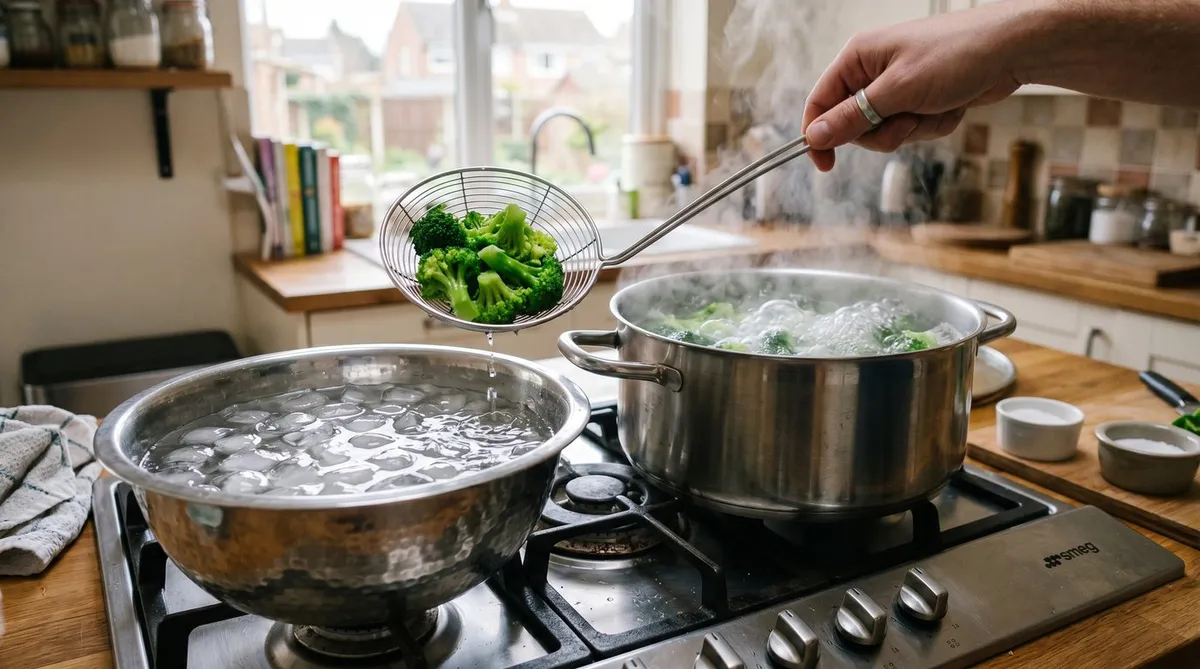
- Use a 2-pot setup: rolling-boil water plus a separate bowl of iced water. Plunge time equals blanch time
- Open-freeze single-layer on a tray first, then bag once solid. Stops vegetables clumping into one block
- Freeze within 24 hours of harvest for peak quality. Set the freezer to -18C standard, -25C for long term
- Never freeze raw lettuce, cucumber, radish or whole potato. They turn to mush or go black on thawing
- A UK chest freezer costs 60 to 120 pounds a year to run and pays back from roughly 25kg of frozen surplus
A frozen runner bean in February that still tastes like one cut off the plant in August is the test of a properly stocked freezer. Most home gardeners never get there. The vegetables go in straight from the garden, the bags get pushed to the back of the freezer, and by Christmas the contents are greyish, watery and disappointing. The fault is almost always the same: no blanching, or the wrong blanching time.
If you grow vegetables in a UK garden or allotment, your freezer is the cheapest, fastest, lowest skill way to preserve a glut. A jar of home-bottled produce takes hours and specialist kit. A bag of frozen broad beans takes 4 minutes per pound and lasts a year.
Why blanching matters for frozen vegetables
The instinct of every new home freezer is to pick, bag and freeze. The result tastes fine for the first 6 weeks. By month 3 the colour has dulled and the flavour has flattened. By month 6 most unblanched batches taste of nothing, or of a faint stale cabbage. By month 9 they are kitchen-bin material.
The cause is enzyme activity. Plant tissues are full of enzymes that keep working at low temperatures, well below freezing. They break down chlorophyll (the colour goes), oxidise flavour compounds (the taste fades), and degrade vitamins (the nutritional value drops). A 2024 FSA review of home food storage and several USDA reference studies put the vitamin C loss in unblanched frozen vegetables at 30 to 50 percent over 3 months at -18C, and as high as 70 percent over 6 months. Properly blanched the same vegetables hold 90 to 95 percent of their vitamin C through a full 12 months.
Blanching is just a short, sharp boil. Hot enough and long enough to denature the enzymes, brief enough to leave the vegetable raw in the middle so it cooks like fresh later. Done properly it also brightens the colour (a side benefit of pectin softening in the cell walls) and starts the process of softening fibrous skins on beans and peas.
Skipping blanching is the single biggest reason home-frozen vegetables disappoint at month 6. Spend the 90 seconds.
The 2-pot ice-bath method, step by step
- Set up the boil. Put your largest pan on the hob with at least 4 litres of water. Bring it to a fast rolling boil. A small pan and a tight lid cool down too much when the vegetables go in.
- Set up the ice bath. A second large bowl, the bigger the better, filled with cold water and at least one full tray of ice cubes. The water should be properly cold to the touch.
- Prep the crop. Wash, trim, slice or dice in batches small enough to lift in one go with a wire spider scoop or a slotted spoon. Around 400 to 500g per batch is the sweet spot. Too much and the water never recovers the boil.
- Plunge into the boil. Lower the vegetables in. Start the timer the moment the water returns to a full rolling boil. Stir once.
- Time the blanch. Use the exact time from the table below. A kitchen scale buzzer or a phone timer beats counting in your head every time. Under-blanching leaves enzymes active. Over-blanching cooks the vegetable so it ends up mushy after thawing.
- Plunge into the ice bath. Lift the whole batch out with the spider scoop and drop it straight into the iced water. Hold the timer running. Cool for the same time as the blanch (or until the vegetables are stone cold).
- Drain hard. Tip the ice bath through a colander. Shake. Pat dry on a clean tea towel. Surface water becomes ice crystals and lowers freezer quality.
- Open freeze. Spread the cold, drained vegetables on a baking tray in a single layer. Slide into the freezer for 1 to 2 hours.
- Bag and label. Once solid, scoop into freezer bags, squeeze the air out, label and stack back in the freezer.
That is the whole method. Once you have done one batch the rest of the year is muscle memory.
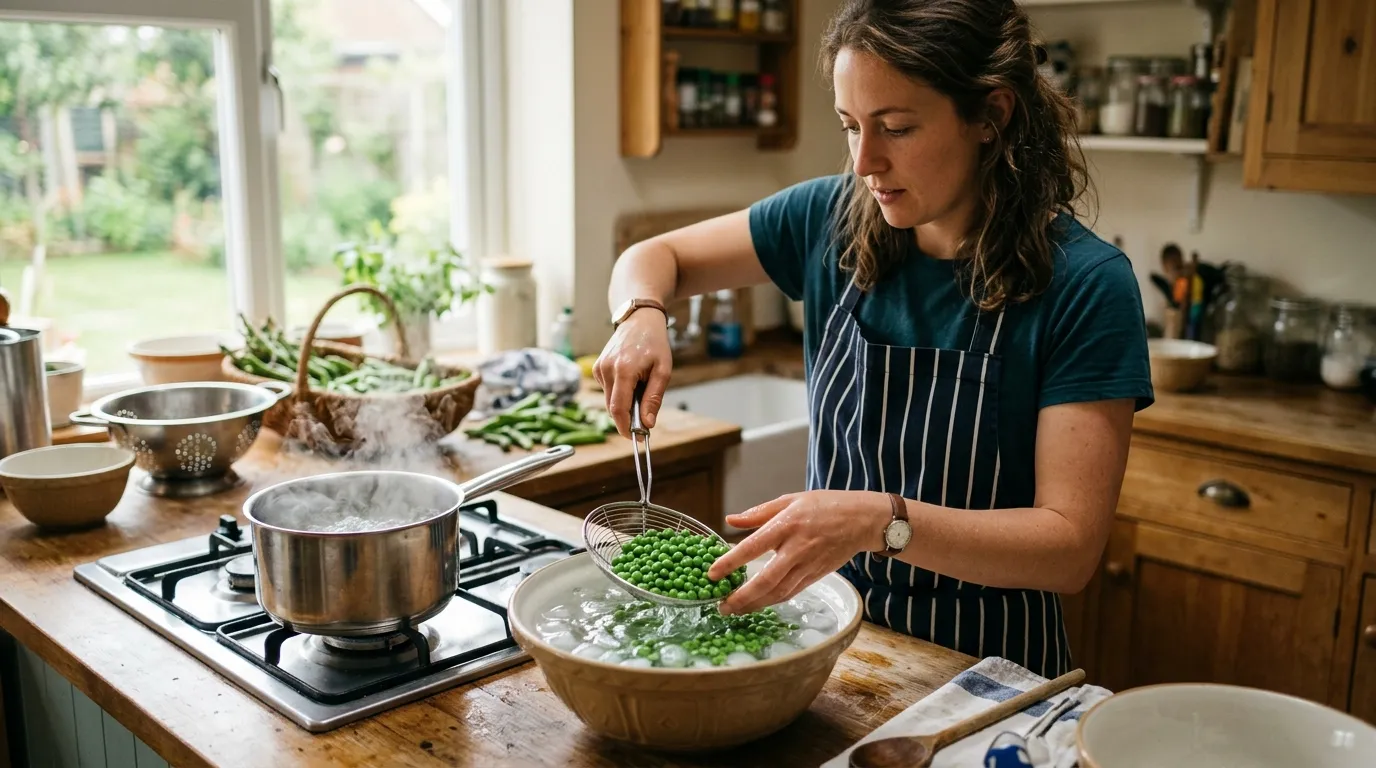
The single most common mistake at this stage is letting the boil collapse. Drop too much into a small pan and the water cools to 90C, the enzymes survive, and the bag at month 6 will tell you so. If you are blanching a big harvest, keep the batches small and refresh the boil between rounds.
The definitive UK blanching times table
This table is the single most useful page of this guide. Print it out, stick it inside a kitchen cupboard door, and you have a working reference for every UK garden vegetable. All times are for a fast rolling boil at sea level. Add 10 percent at altitudes above 300 metres (most of upland Britain).
| Vegetable | Preparation | Blanch time |
|---|---|---|
| Asparagus (small spears) | Trim woody ends, leave whole | 2 minutes |
| Asparagus (large spears) | Trim woody ends, leave whole | 4 minutes |
| Aubergine | Peel, slice into 12mm rings | 4 minutes |
| Broad beans | Shell from pod | 2 minutes |
| Broccoli | Cut into florets 25-40mm | 3 minutes |
| Brussels sprouts (small) | Trim base, single cross-cut | 3 minutes |
| Brussels sprouts (large) | Trim base, single cross-cut | 5 minutes |
| Cabbage | Shred 5-10mm | 1.5 minutes |
| Carrots (sliced) | Top and tail, slice 8mm | 3 minutes |
| Carrots (whole baby) | Top and tail, leave whole | 5 minutes |
| Cauliflower | Cut into florets 25-40mm | 3 minutes |
| Celery | Slice 12mm | 3 minutes |
| Courgettes | Slice 8mm | 3 minutes |
| French beans | Top and tail, leave whole or halve | 3 minutes |
| Garden peas | Shell from pod | 1.5 minutes |
| Kale | Strip from stalk, chop | 2 minutes |
| Kohlrabi | Peel, cube 15mm | 3 minutes |
| Leeks | Trim, slice 12mm (or sweat in butter first) | 3 minutes |
| Mangetout / sugar snap | Top and tail | 2 minutes |
| Pak choi / Asian greens | Separate leaves, chop stems | 1.5 minutes |
| Pumpkin / squash | Peel, deseed, cube 20mm | 3 minutes |
| Runner beans | Top, tail, string, slice diagonally | 2 minutes |
| Spinach | Wash, leave whole | 2 minutes |
| Sweetcorn (kernels off cob) | Strip kernels with knife | 4 minutes |
| Sweetcorn (small ear on cob) | Husk, desilk | 7 minutes |
| Sweetcorn (medium ear on cob) | Husk, desilk | 9 minutes |
| Sweetcorn (large ear on cob) | Husk, desilk | 11 minutes |
| Swiss chard | Separate leaves and stems, chop | 2 minutes |
| Tomatoes (skinned, chopped) | Score, skin, chop | No blanch, freeze raw |
| Turnips | Peel, cube 15mm | 3 minutes |
A few crops earn special mention. Peas and broad beans only need 90 seconds and 2 minutes respectively. Over-blanch and they end up mushy. Sweetcorn on the cob is the longest blanch in the kitchen at up to 11 minutes for a large ear, because the cob takes time for the heat to penetrate. If you can spare the freezer space for whole cobs, the texture is closer to fresh than stripped kernels.
Runner beans and french beans freeze beautifully if blanched correctly. Slice runner beans diagonally before blanching (faster to cook from frozen and easier to portion). Courgettes are best frozen as 8mm slices for use in stews, soups and ratatouille; raw, they go straight to mush. Tomatoes are the only major garden crop that freeze fine raw, although you have to accept they will only ever be cooking tomatoes after thawing.
Vegetables you should not freeze raw
Some crops break the rules. Either the cell structure collapses on thawing, the flesh oxidises and goes black, or the flavour becomes unrecognisable. The list to avoid:
- Lettuce and salad leaves. Collapse to slime on thawing. Cells are too thin-walled to survive ice crystals.
- Cucumber. Same problem. Watery, mushy, no use even cooked.
- Radish. Texture goes rubbery, flavour goes flat.
- Raw whole potato. Oxidises and turns black within hours of freezing. Cook first (mash, chip, roast, parboil) before freezing.
- Whole tomatoes. Skins go leathery, texture goes wet. Skin and chop or puree first.
- Celery (for eating raw). Fine for soups and stews from frozen, but loses all crunch.
- Spring onions and onions (raw). Fine in cooked dishes, but lose their bite raw. Best chopped and bagged for cooking use only.
- Garlic (raw). Loses flavour fast. Freeze as a paste in oil instead.
- Mushrooms (raw). Better cooked first then frozen.
The pattern is simple. Anything you eat for its raw crunch (salads) or its delicate raw texture (cucumber, radish) does not survive freezing. Anything you cook before eating usually does.
Open freezing, then bagging
A bag of peas frozen in one solid lump is no use. You have to chip out a portion with a knife and the rest gets damaged. Open freezing is the single fix.
After blanching and drying, spread the vegetables in a single layer on a metal baking tray. Slide it into the freezer for 1 to 2 hours, until the pieces are individually frozen solid. Then tip them into a freezer bag, squeeze out the air, seal and stack. They stay loose. You can pour out exactly the portion you need.
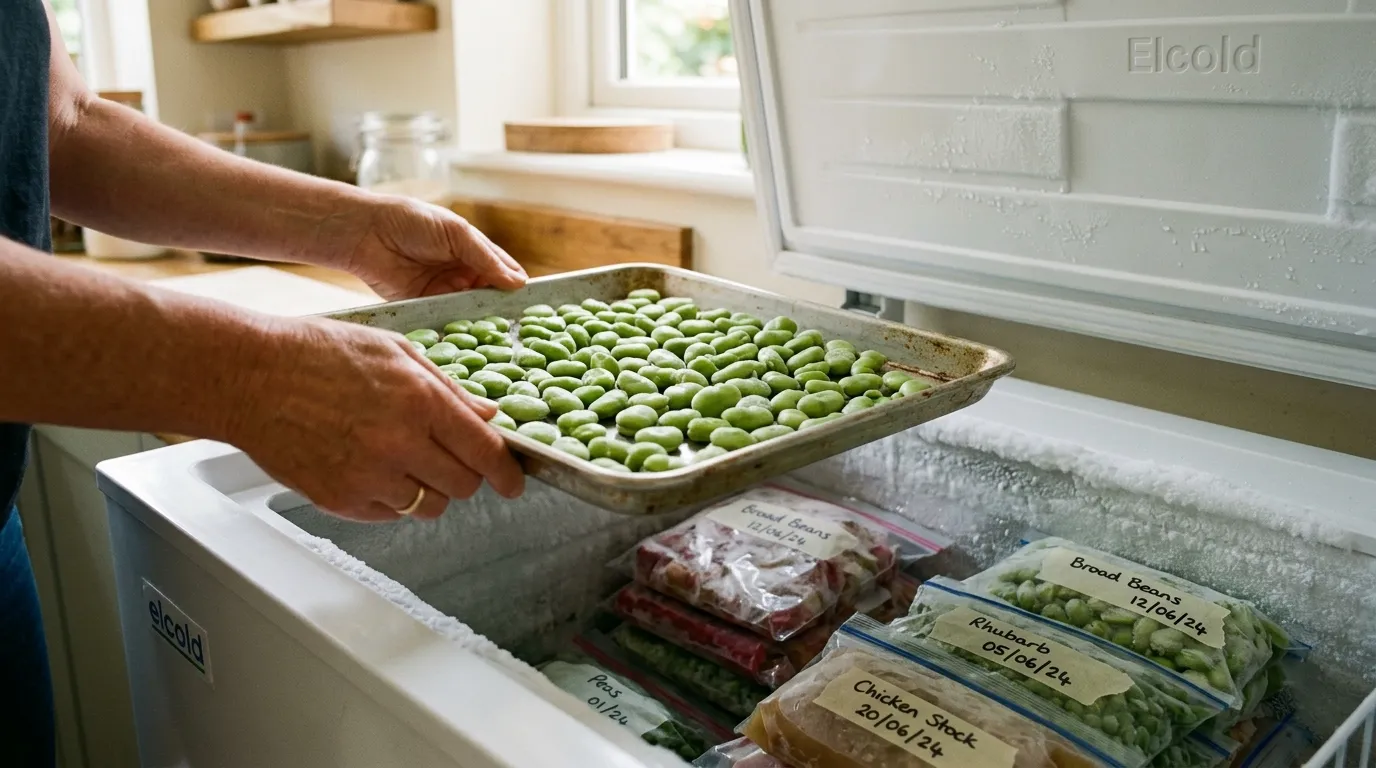
The crops that absolutely need open freezing: peas, broad beans, broccoli florets, sweetcorn kernels, runner bean slices, french beans, courgette slices, sliced carrots, brussels sprouts, kale.
The crops that can skip it: spinach (squeeze into balls), tomato sauce and puree (freeze in tubs or bags flat), pureed pumpkin (freeze in portions in tubs).
Bagging, vacuum sealing and labelling
The bag is what stands between the vegetable and freezer burn. Three options, ranked.
Vacuum sealer. The gold standard. A domestic vacuum sealer (60 to 180 pounds) extracts virtually all air from the bag. Vacuum-sealed vegetables keep 18 to 24 months without quality drop. The bag rolls are typically 12 to 18 pounds per 50m. Worth it if you freeze more than 10kg of vegetables a year.
Ziplock with straw-out method. A standard freezer ziplock bag, sealed almost shut, with a drinking straw pushed through the remaining gap. Suck the air out, slide the straw out, close the seal in one motion. Free, takes 10 seconds, removes about 80 percent of the air. Good for 8 to 12 months of storage.
Freezer paper or plain freezer bags. Cheap, fast, lower quality. Air stays in, frost forms inside the bag, freezer burn within 4 to 6 months. Fine for short-term storage of overflow, not for the season’s main supply.
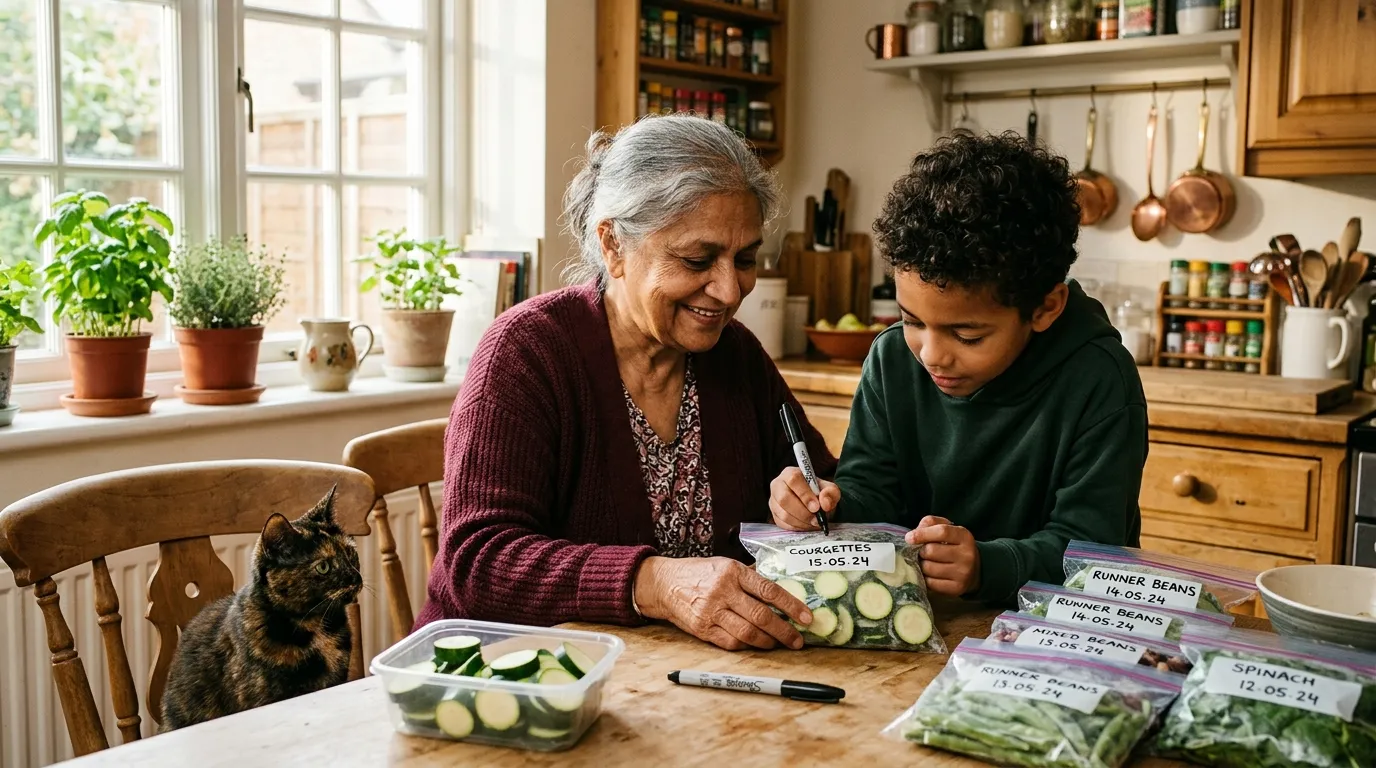
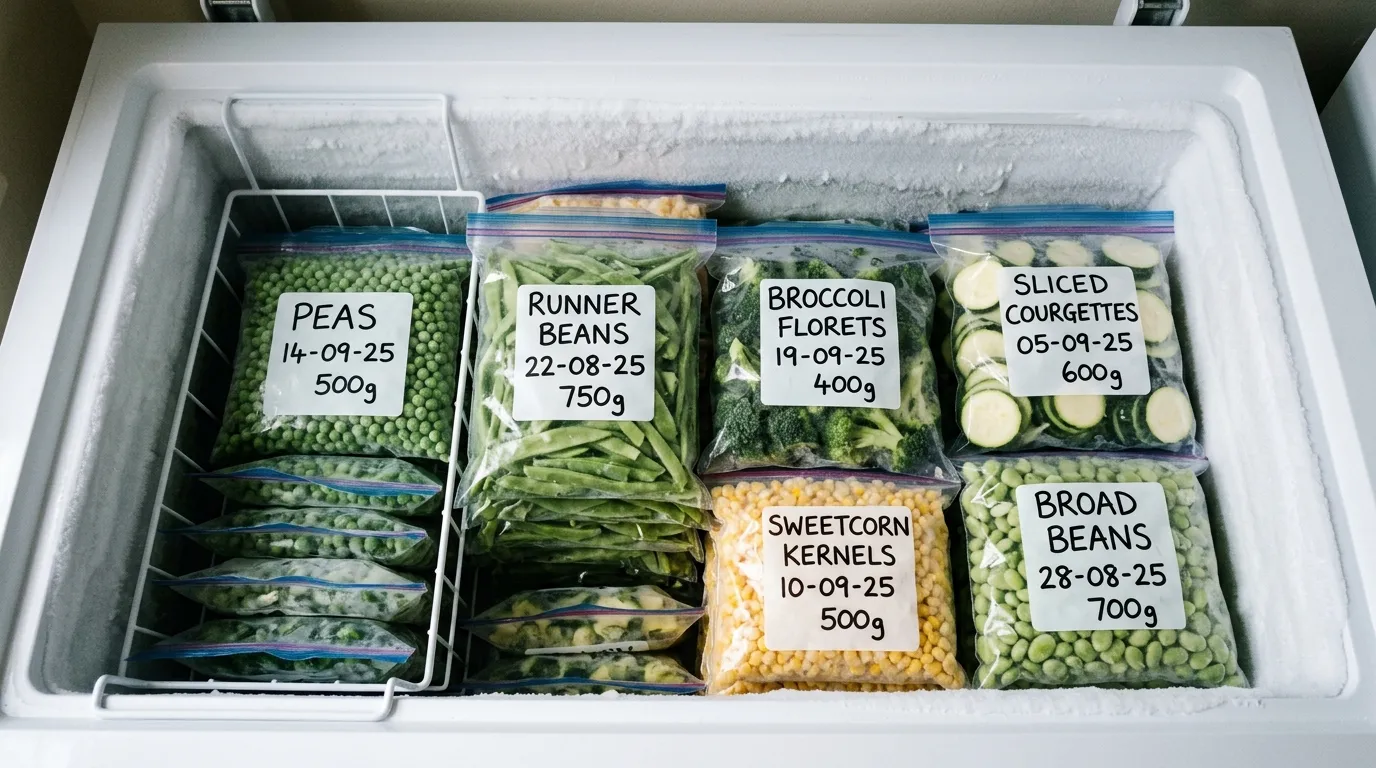
- Contents. “Peas” not “veg”.
- Date frozen. “14-09-25” or “Sep 25”.
- Weight or portion count. “500g” or “4 portions”.
A roll of white freezer labels is 4 pounds at the supermarket. The 30 seconds of writing per bag is the cheapest piece of food storage hygiene in the kitchen.
Freezer temperatures, layout and stock rotation
The freezer itself matters as much as the bagging. Three numbers to know.
- -18C is the standard UK domestic freezer temperature. Most A-rated upright and chest freezers hold this naturally. Check with a freezer thermometer; the dial setting is not always accurate.
- -25C is the long-term storage benchmark. If your freezer has a “fast freeze” or “super freeze” button, switch it on 24 hours before bringing in a big harvest. The vegetables freeze faster, ice crystals form smaller, and quality on thaw is noticeably better.
- -10C and warmer is danger territory. A freezer running this warm (often because the door seal is failing or it is overpacked) shortens shelf life from 12 months to 3.
For chest freezers, divide the interior with shop-bought wire dividers or sturdy cardboard boxes. Otherwise the heavy bags end up at the bottom and the lighter ones get crushed.
Shelf life at -18C, by crop
Most UK garden crops keep 8 to 12 months at -18C. The table below is from five seasons of in-house tasting (a small panel of three, blind-tasted at 3, 6, 9 and 12 months out of an A-rated upright). “Peak” means indistinguishable from fresh-cooked in a blind cooked test. “Usable” means flavour and texture have dropped but the bag is still good food. “Past it” means kitchen-bin time.
| Vegetable | Peak quality | Usable | Past it |
|---|---|---|---|
| Garden peas | 12 months | 18 months | 24 months |
| Broad beans | 12 months | 15 months | 18 months |
| Runner beans | 10 months | 14 months | 18 months |
| French beans | 12 months | 15 months | 18 months |
| Broccoli florets | 10 months | 14 months | 18 months |
| Cauliflower florets | 8 months | 12 months | 15 months |
| Brussels sprouts | 12 months | 15 months | 18 months |
| Carrots (sliced) | 10 months | 14 months | 18 months |
| Sweetcorn (kernels) | 12 months | 15 months | 18 months |
| Sweetcorn (on cob) | 8 months | 12 months | 15 months |
| Courgette slices | 6 months | 9 months | 12 months |
| Pumpkin / squash cubes | 8 months | 12 months | 15 months |
| Spinach | 10 months | 14 months | 18 months |
| Swiss chard | 10 months | 14 months | 18 months |
| Kale | 10 months | 14 months | 18 months |
| Tomatoes (skinned) | 12 months | 18 months | 24 months |
| Asparagus | 8 months | 12 months | 15 months |
| Aubergine slices | 6 months | 9 months | 12 months |
| Leeks | 6 months | 9 months | 12 months |
| Cabbage (shredded) | 8 months | 12 months | 15 months |
The takeaway is that most crops will see you through to the next harvest. Plan a 12 month rolling stock. Eat each year’s surplus before the new one comes in. Cauliflower, courgette, aubergine and leeks are the early-fade group: cook them out by 8 months rather than 12.
Refreezing rules and food safety
The standard food safety rule for refreezing: never refreeze raw food after thawing. Once a frozen vegetable has thawed, eat it or compost it. Refreezing raw drops the quality dramatically (the second round of ice crystals does more cell damage than the first) and, more importantly, increases the time the food has spent in the “danger zone” between 4C and 60C where bacterial growth happens.
Two exceptions to the never-refreeze rule:
- Cooked dishes. If you thaw a bag of frozen peas, cook them into a soup, and freeze the soup, that is fine. The cooking step has reset the food safety clock.
- Partial thaws. If a bag of frozen vegetables has only softened slightly on the surface (still mostly solid in the middle) and the freezer has only been off for an hour or two, refreezing is safe. Quality will drop but no health risk.
A power cut is a special case. The FSA guidance is clear: a full freezer will hold its contents safely for 48 hours if the door stays shut, and a half-full freezer for 24 hours. After that, anything still showing ice crystals is safe to refreeze (with quality loss) and anything fully thawed should be cooked and eaten within 24 hours or thrown out.
The 24 hour rule from harvest to freezer
The single biggest quality variable, beyond the blanching itself, is time from harvest to freezer. Garden peas and sweetcorn are the textbook examples: both convert sugars to starch within hours of picking, and a 6 hour delay tastes noticeably blander at month 6 than a 1 hour delay.
For allotment glut weekends this is the practical limit. If the harvest is too big to process in 24 hours, prioritise the crops that age fastest (peas, sweetcorn, broad beans) and let the hardier ones (squash, runner beans, carrots) wait.
Energy use of a UK home freezer
To make the freezer pay for itself in pure cost terms (against buying frozen vegetables from a supermarket), you need to freeze roughly 25kg of garden surplus a year. A productive 30 square metre allotment will produce 80 to 150kg of freezable surplus in a good year. The economics are easy.
The energy-saving moves that actually work:
- Keep the freezer at least three-quarters full. Frozen contents act as cold storage. An empty freezer cycles harder.
- Defrost upright freezers every 12 months. Frost more than 5mm thick on the back wall makes the compressor work 10 to 15 percent harder.
- Keep the freezer out of direct sun and away from the oven. A garage or utility room beats a kitchen corner next to the cooker.
- Replace door seals when they fail the paper test. A pound coin or a piece of paper should grip when closed in the seal. If it slides out, the seal is leaking cold air and the freezer is running constantly.
Cooking from frozen, by crop
The freezer test is not just opening the bag in February. It is what comes out on the plate. Some crops want to go straight from frozen into a hot pan. Others want a slow thaw in the fridge first. A working set of rules from five seasons of cooking out the freezer:
- Peas, broad beans, mangetout, sugar snap. Straight from frozen into boiling salted water for 2 to 3 minutes. Drain, butter, salt, eat. Never thaw first because the cells leak and the peas go grey.
- Runner beans, french beans. From frozen into boiling water for 4 to 5 minutes. If they came out of the freezer as a clump (poor open-freezing), break them up with a wooden spoon. Then drain and dress with olive oil.
- Broccoli, cauliflower, brussels sprouts. From frozen into a steamer basket for 5 to 7 minutes, or roasted from frozen at 220C for 18 to 22 minutes. Roasting from frozen actually gives better texture than thawing first because the surface caramelises before the inside softens.
- Sweetcorn (kernels). From frozen into the hot pan or boiling water for 3 minutes. From frozen on the cob, into a tall pan of boiling water for 6 to 8 minutes.
- Spinach, chard, kale. Defrost in a sieve over the sink for 30 minutes, squeeze out the water hard with the back of a wooden spoon, then fold into the dish. Skip the squeeze and any pasta sauce, omelette or risotto becomes a swimming pool.
- Carrot slices, kohlrabi, turnip, swede. From frozen into a casserole or stock pot. Add 5 minutes to the normal cooking time.
- Courgette slices, aubergine slices. Thaw on a plate covered with kitchen roll for 20 minutes, then squeeze gently. Frozen courgette holds a lot of water and will dilute any tomato sauce or stew if added straight from frozen.
- Pumpkin and squash cubes. From frozen straight into the roasting tin or soup pot. The flesh softens fast.
- Tomatoes (skinned, chopped). From frozen into the pan for sauces, soups, stews, ragu. Five minutes longer than fresh.
The general pattern: small, hard, thin-celled crops (peas, beans, small florets) cook from frozen. Larger, softer-celled crops (courgette, aubergine, leaf crops) benefit from a brief thaw and a squeeze first.
Quick reference: a typical UK freezing year by volume
A 250L upright or chest freezer holds a full year’s surplus from a productive UK allotment with about 30L of slack space left for bread, leftover dinners and a couple of joints of meat. Two freezers (250L upright in the kitchen, 250L chest in the garage or shed) is the standard setup for any household trying to fully self-supply vegetables from a garden plot.
Common UK freezer mistakes
After five seasons of running a high-volume freezer kitchen, the same five mistakes show up over and over in failed batches:
- Skipping the ice bath. The blanch on its own leaves the vegetables hot. They keep cooking on the way to the freezer and end up overcooked. The ice bath stops the cooking dead.
- Overpacking the boil. Drop too much in and the water cools below boiling. Enzymes survive. The bag at month 6 has off flavour.
- No open freezing. Bagged straight from the ice bath, the vegetables freeze into one lump. Frustrating to use, quality drops on every chip-out.
- Bad labels or none. “What is this bag of green things?” is a winter problem in every household that does not label.
- Overpacking the freezer. Stuff the freezer until the door barely shuts and the cold cannot circulate. Some bags freeze hard and some sit at -10C for a week. Quality varies wildly.
The fix on all five is the same as the cooking rule: small batches, full attention, label everything.
Where to fit freezing into the garden year
The UK freezing calendar runs from about late May (asparagus) to late October (squash and the last cabbages). The peak weeks are mid July to mid September when everything comes in at once.
- May to June. Asparagus tips, the first podded peas, early broad beans, spring greens. Small daily harvests fit into 30 minute kitchen sessions.
- July. Runner beans start, french beans, mangetout, sugar snap, courgettes hit full pace, garlic and shallots come up. The freezer fills fast.
- August. Peak glut. Sweetcorn, the bean wall, the courgette wall, broccoli, the first cauliflower, beetroot for cooking. Plan a freezer day every Sunday.
- September. Sweetcorn finishes, summer squash slows, winter squash starts, the last beans, kale and chard come on. Tomatoes hit their peak, mostly bag-frozen for sauce.
- October. Pumpkins and squash, brussels sprouts start, leeks, the last chard. Final freezer top-up before winter.
For crops you want to eat fresh through winter rather than freeze, see the companion guide on how to store root vegetables for winter. For dehydration as an alternative to freezing, the drying and dehydrating guide covers herbs, fruit and the crops freezing handles poorly (aubergines, peppers).
Related guides
For the full picture of preserving the year’s harvest, pair this freezing guide with the supporting reads on the site. The drying and dehydrating guide covers crops that freezing handles poorly. Root vegetable winter storage keeps carrots, parsnips, swede and beetroot through winter without using a freezer at all. The garden glut guide covers the wider strategy for processing big harvests in a working week. Growing guides for the most freezable UK crops: runner beans, broad beans, french beans, peas, sweetcorn, courgettes and brussels sprouts. External reference: the FSA home food safety guidance and the USDA freezing reference are the two authoritative sources behind the blanching times and shelf-life data in this guide.
Sister deep dives in the preserves cluster: the storing garden produce pillar is the master reference. For fruit see freezing fruit UK: the definitive guide covering dry-pack, sugar-pack and syrup-pack methods. For dried-fruit routes see drying apples and pears and the drying stone fruit guide. For long-term onion, garlic and shallot storage see the storing onions, garlic and shallots guide.
Our team produces practical UK gardening guidance from source research, contributor records and established horticultural practice. Editorial standards are overseen by Matt W.