Key takeaways
- Three species grown in the UK: Chaenomeles japonica, C. speciosa, and the hybrid C. x superba
- Hardy to minus 15 Celsius in RHS hardiness band H6, suitable for every UK region
- Flowers January to April, providing nectar when little else is open
- Prune immediately after flowering in late May to preserve next year's flower buds
- Fruit harvested in October makes outstanding quince jelly at around 600g sugar per kilo of fruit
- Crimson and Gold, Geisha Girl, and Nivalis are the most reliable named varieties for British gardens
Chaenomeles, the Japanese flowering quince, opens its first scarlet buds while the rest of the garden is still asleep. Flowers appear from mid-January in mild seasons through to mid-April, often before the leaves emerge. The shrubs are tough, fully hardy to minus 15 Celsius, and unfussy about soil. They tolerate clay, sand, chalk, partial shade, and exposed positions. Three species are grown: Chaenomeles japonica from Japan, C. speciosa from China, and the garden hybrid C. x superba. Between them they cover red, pink, white, orange, salmon, and bicoloured flowers on plants from 60cm to 3m tall.
The genus is often still called japonica, the old gardening name. Vita Sackville-West planted it at Sissinghurst in the 1930s, and the variety Knaphill Scarlet was bred by John Waterer’s nursery in Surrey in 1959. The shrubs earn their place three times over: winter flowers, summer foliage and structure, and an autumn crop of fragrant golden quince fruit that makes the finest jelly on the British preserves shelf. This guide covers the species and best varieties, planting, wall training, pruning timing, fruit harvest, and the few pest and disease issues worth knowing.
The three Chaenomeles species grown in UK gardens
The three species differ in height, habit, and flower form. Choosing the right species matters more than choosing a specific cultivar.
Chaenomeles japonica (Maule’s quince)
The smallest species at 60cm to 1m tall. Orange-red flowers around 3cm across. Stems are spiny. C. japonica is the parent of many compact garden cultivars. It is excellent for low informal hedging and the front of mixed borders.
Chaenomeles speciosa
The tallest species at 2 to 3m. Flowers up to 4.5cm across in red, pink, white, or bicoloured. C. speciosa is the species traditionally trained against walls. Variety ‘Moerloosei’ (also called ‘Apple Blossom’) has pale pink-and-white flowers, while ‘Nivalis’ is pure white.
Chaenomeles x superba
A garden hybrid between C. japonica and C. speciosa. Reaches 1 to 1.5m. Combines the compact habit of C. japonica with the larger flowers of C. speciosa. Most modern named cultivars belong to this group: Crimson and Gold, Pink Lady, Knaphill Scarlet, Cameo, and Texas Scarlet.
The best Chaenomeles varieties for UK gardens
Crimson and Gold
Geisha Girl
C. x superba with double semi-double pale apricot-peach flowers. The double form means the flowers last longer in cold weather. Height 1.2 to 1.5m. The most child-friendly chaenomeles because the spines are fewer and shorter.
Pink Lady
Bright rose-pink saucer-shaped flowers in March. C. x superba. Height 1.5m, spreads to 2m. Good for a north or east wall where the pink reads strongly against grey stone or brick.
Nivalis
Pure white flowers up to 4cm across. C. speciosa. Height 2 to 2.5m. The white form pairs well with stronger reds and pinks in a mixed planting. Heavy flowering in March and April.
Cameo
Knaphill Scarlet
Bright orange-scarlet flowers on a slightly spreading 1.5m plant. C. x superba. Bred at the Knaphill Nursery in Surrey in 1959 and still one of the strongest flowering varieties for general garden use.
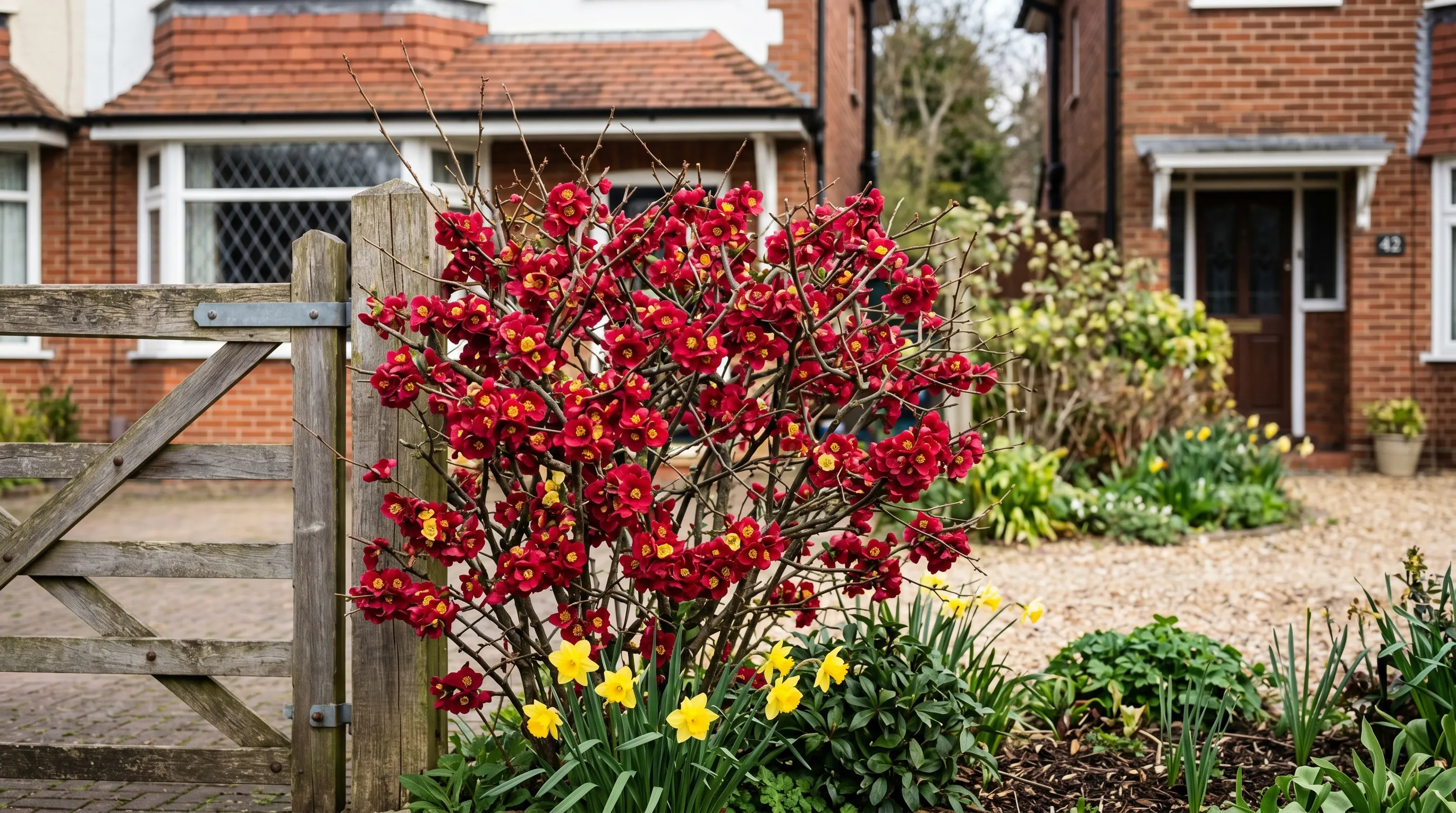 Crimson and Gold in late February. The combination of deep red petals with golden stamens is unmatched at this time of year.
Variety comparison
| Variety | Species | Flower colour | Height | Flowering window | Spines |
|---|---|---|---|---|---|
| Crimson and Gold | C. x superba | Crimson with gold stamens | 1-1.2m | Jan-Mar | Moderate |
| Geisha Girl | C. x superba | Apricot-peach, double | 1.2-1.5m | Feb-Apr | Few |
| Pink Lady | C. x superba | Rose-pink | 1.5m | Feb-Apr | Moderate |
| Nivalis | C. speciosa | Pure white | 2-2.5m | Mar-Apr | Many |
| Cameo | C. x superba | Peach-pink, double | 0.9-1.2m | Mar-Apr | None |
| Knaphill Scarlet | C. x superba | Orange-scarlet | 1.5m | Feb-Apr | Moderate |
Where and when to plant Chaenomeles
The best planting season is November to March in mild weather while plants are dormant. Container-grown stock can go in at any time of year if watered carefully. Bare-root plants from specialist nurseries are cheaper (£12 to £18) and establish quickly when planted in autumn or late winter.
Site preferences
Chaenomeles tolerates almost any UK garden soil except permanently waterlogged ground. It grows on clay, sand, chalk, and acidic loam without complaint. The plant performs in full sun, partial shade, or against a cold north or east-facing wall. Sun gives heaviest flowering. A north wall delays flowering by two to three weeks but the cold actually preserves the open flowers longer.
Planting steps
- Dig a hole twice as wide as the rootball and the same depth as the pot.
- Fork over the base of the hole. On clay, add a 5cm layer of grit for drainage.
- Mix one part well-rotted compost with two parts excavated soil for the backfill.
- Set the plant at the same depth it sat in the pot.
- Firm the soil with the heel and water in with at least 10 litres.
- Mulch with 5cm of bark or compost, keeping it 5cm clear of the stem.
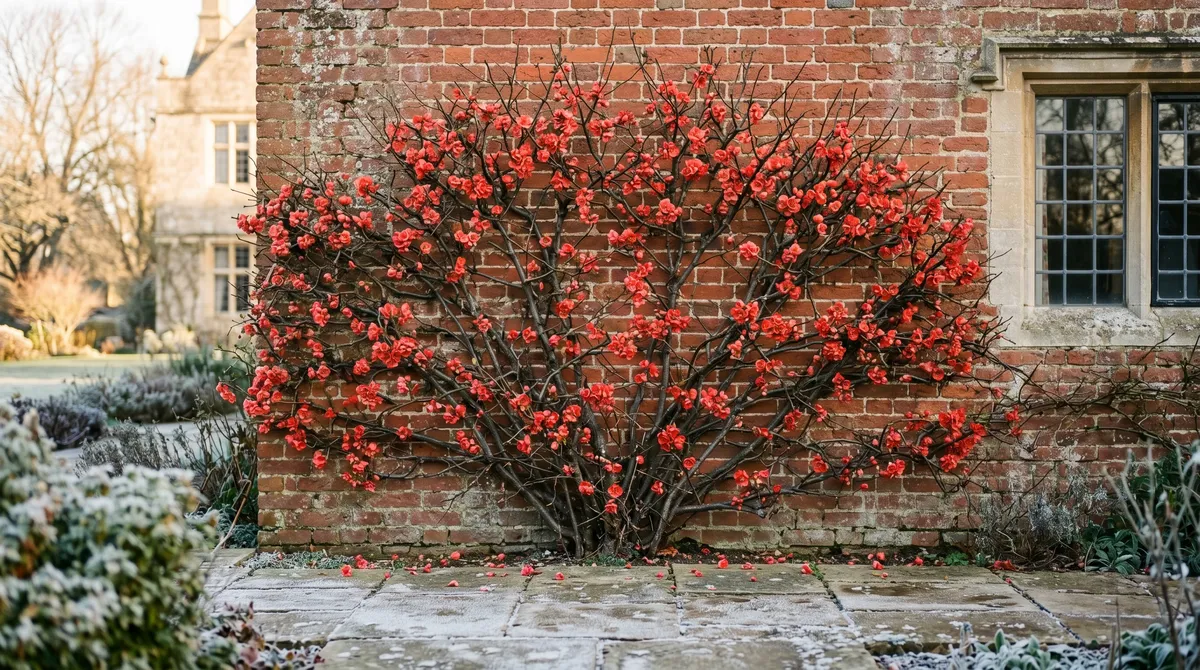
For wall-trained plants, set the root ball 25 to 30cm out from the wall. The wall itself dries out the soil immediately beneath, so the slight outward placement gives roots a better moisture reservoir.
Wall training a Chaenomeles step by step
Chaenomeles is one of the easiest fruiting shrubs to wall-train. The plants accept hard pruning and naturally produce flat sprays of growth that suit two-dimensional shapes. The same principles used to fan-train a fruit tree apply to Chaenomeles, with shorter timescales and more forgiving wood.
Setting up the supports
Fix horizontal galvanised wires to the wall using vine eyes. Set wires 30cm apart, starting 30cm above ground and running up to the height you want the plant to cover. A 2m x 2m panel needs six horizontal wires. Use 16-gauge wire and tension it with straining bolts so it sits 5cm proud of the wall surface.
First year tying-in
Plant in November. Cut the leader back to a strong outward bud 30cm above the ground. Through the first growing season, tie new shoots to the wires fanning out left and right. Aim for five to seven main branches arranged like the ribs of a fan.
Annual pruning cycle
After flowering each May, cut every side shoot back to two or three buds from the main framework. This concentrates next year’s flowers close to the structural branches and keeps the plant tight against the wall. Remove any forward-pointing shoots completely. The pruned plant looks bare but produces a heavy flush of flowers the following winter.
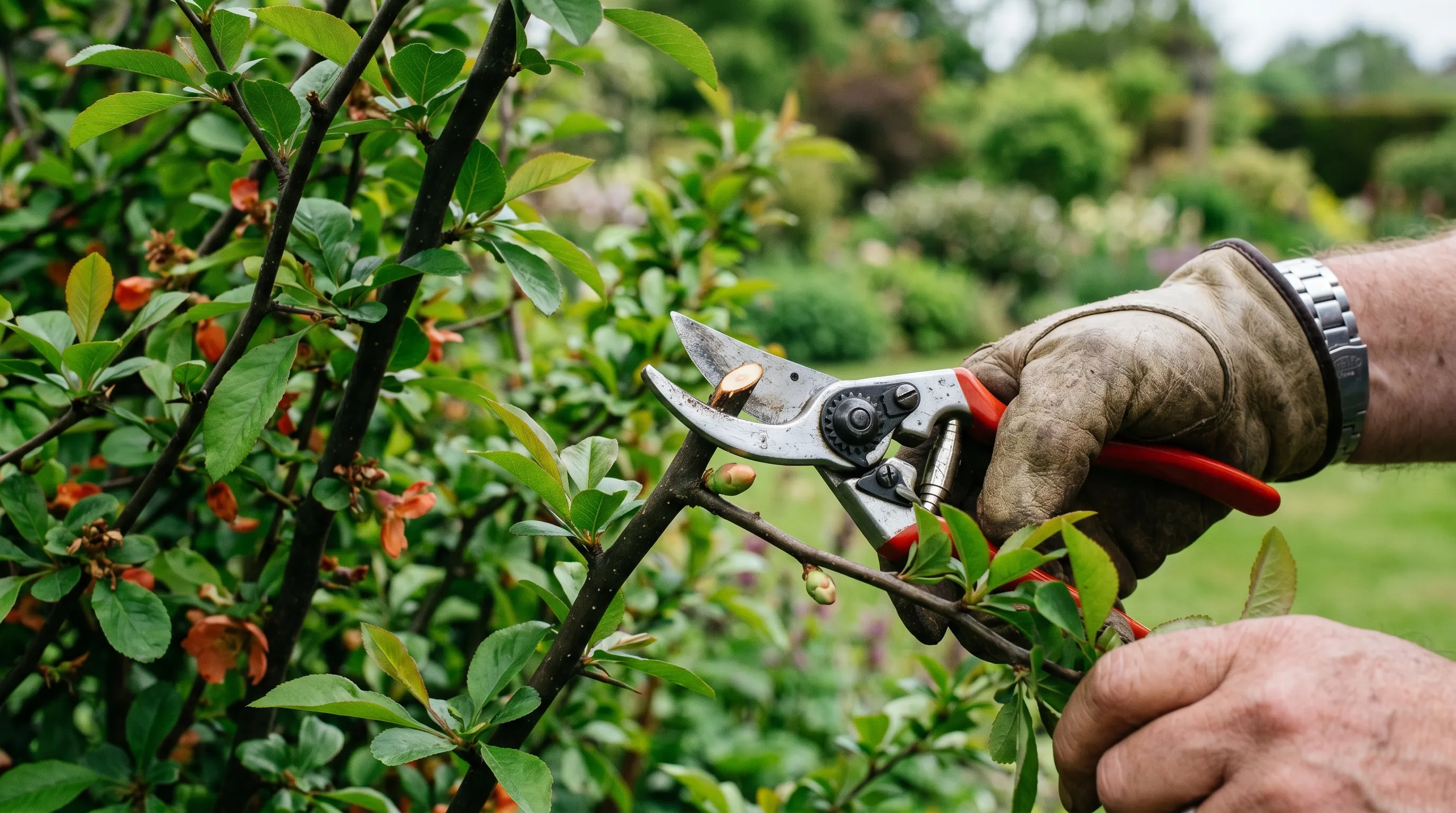 The post-flowering pruning cut. Each side shoot is cut back to two or three buds from the main framework in late May.
Pruning Chaenomeles for flowers and fruit
The pruning timing is the single most important detail for getting good flowers year after year.
Why timing matters
Chaenomeles flowers on wood made the previous summer. Cut in winter and you cut off the flower buds. Cut immediately after flowering and the plant has all summer to build new flowering wood for next year.
Free-standing shrubs
Prune any time from mid-May to mid-June, immediately after the last flowers fade. Cut the previous year’s growth back by half. Remove any dead, damaged, or crossing stems. On older plants (more than seven years), remove one in five of the oldest stems at ground level each year to keep the plant young.
Wall-trained plants
Prune harder than free-standing shrubs. Cut all new side shoots back to two or three buds from the main framework. Pin any new long shoots growing parallel to the wall into the framework. Cut any shoots growing straight out from the wall flush with the parent stem.
Renovating an old neglected plant
If a Chaenomeles has become a tangled mass, cut a third of the oldest stems right back to the ground in three successive Mays. The remaining stems flower while the new growth builds up. After three years you have a fully renewed plant flowering on young wood.
Harvesting fruit and making quince jelly
The autumn fruit is the second great gift of Chaenomeles. Plants typically start fruiting in their third or fourth year and produce 2 to 4kg of fruit annually from a mature 1.5m shrub.
When to harvest
Pick the fruit in October, once the skin turns from green to a clear yellow with a bronze blush. Ripe fruit is fragrant: hold one in your hand for a minute and you should smell pineapple, apple, and citrus. Unripe fruit can be picked before the first hard frost and ripened indoors in a cool larder for two to three weeks.
Storage
The fruit stores well in a cool dry place for six to eight weeks. Lay fruit in single layers in cardboard trays. Check weekly and remove any that have bruised. Wash and process before any sign of brown soft patches appears.
Making quince jelly
Chaenomeles fruit is rich in pectin, so jelly sets without added pectin. The classic recipe uses 600g of sugar for every 1kg of strained juice and yields about 1.2kg of jelly per 2kg of fruit.
- Chop the fruit roughly, including skin and cores. The pips contain extra pectin.
- Simmer with water to barely cover (about 600ml per kg of fruit) for 45 minutes until pulp is soft.
- Strain overnight through a scalded jelly bag. Do not press the pulp or the jelly will be cloudy.
- Measure the juice into a heavy pan. Add 600g of granulated sugar per 1kg of juice.
- Boil hard for 8 to 12 minutes until setting point (104.5 Celsius on a jam thermometer or a wrinkle on a cold saucer).
- Pour into sterilised jars and seal while hot.
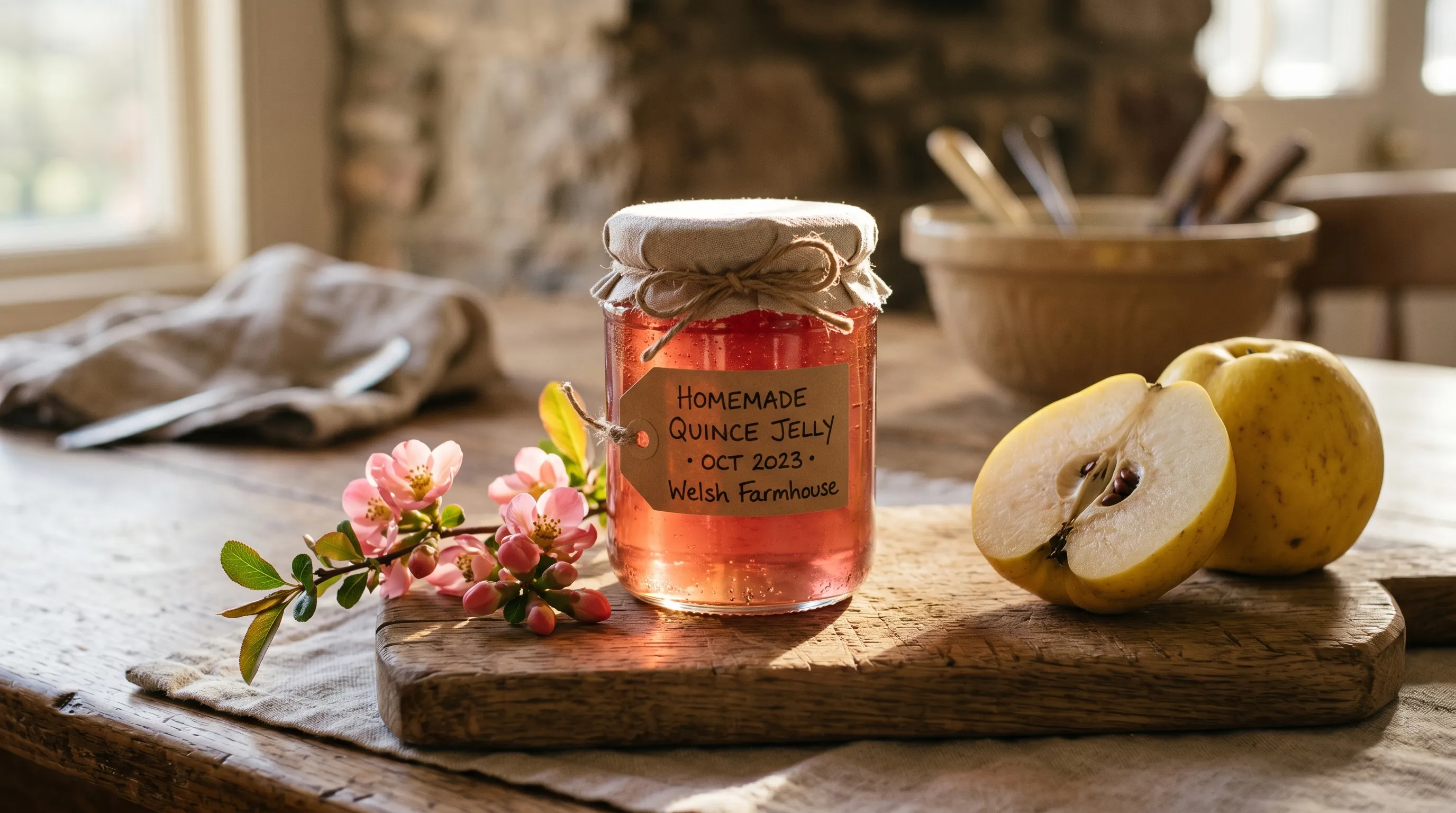 Chaenomeles jelly setting in jars. The natural pectin in the fruit gives a clean jewel-bright set without added sugar pectin.
Bumper crop tips
A fruit-set partner improves yields. Two different cultivars planted within 5m of each other cross-pollinate and produce more fruit than a single specimen. The Bumblebee Conservation Trust notes that early-flowering shrubs like Chaenomeles are an important nectar source for emerging queen bumblebees in January and February, which in turn improves pollination across the whole garden.
Using Chaenomeles for hedging and ground cover
The compact C. x superba cultivars make excellent low informal hedges, particularly in front gardens, allotment perimeters, and along driveways where their spiny stems also serve as a deterrent.
Planting a Chaenomeles hedge
Plant three to four plants per metre of bare-root stock in autumn. Space larger varieties (Pink Lady, Knaphill Scarlet) at 40cm and compact varieties (Crimson and Gold, Cameo) at 30cm. Cut all stems back to 25cm after planting to encourage low branching. Trim lightly after flowering each May to keep the hedge tight. The mature hedge reaches 90cm to 1.2m and stays evergreen-effect with bare twigs in winter.
For other choices of low informal hedging, our hedge planting guide covers spacing and soil preparation for a range of shrubs.
 A 90cm informal Chaenomeles hedge mixing orange Knaphill Scarlet and pink Pink Lady. The hedge softens a hard boundary while keeping a secure thorny barrier.
Pests and diseases of Chaenomeles in the UK
The genus is largely trouble-free, but three issues are worth knowing.
Scale insects
The most common pest. Brown soft scale (Coccus hesperidum) appears as raised oval brown bumps 3 to 5mm across on stems and the undersides of leaves. Sticky honeydew below the affected stems and a black sooty mould on lower leaves are the giveaways. Light infestations can be scrubbed off with a soft brush and soapy water. Heavy infestations are best treated by pruning out the worst-affected stems and burning them (do not compost).
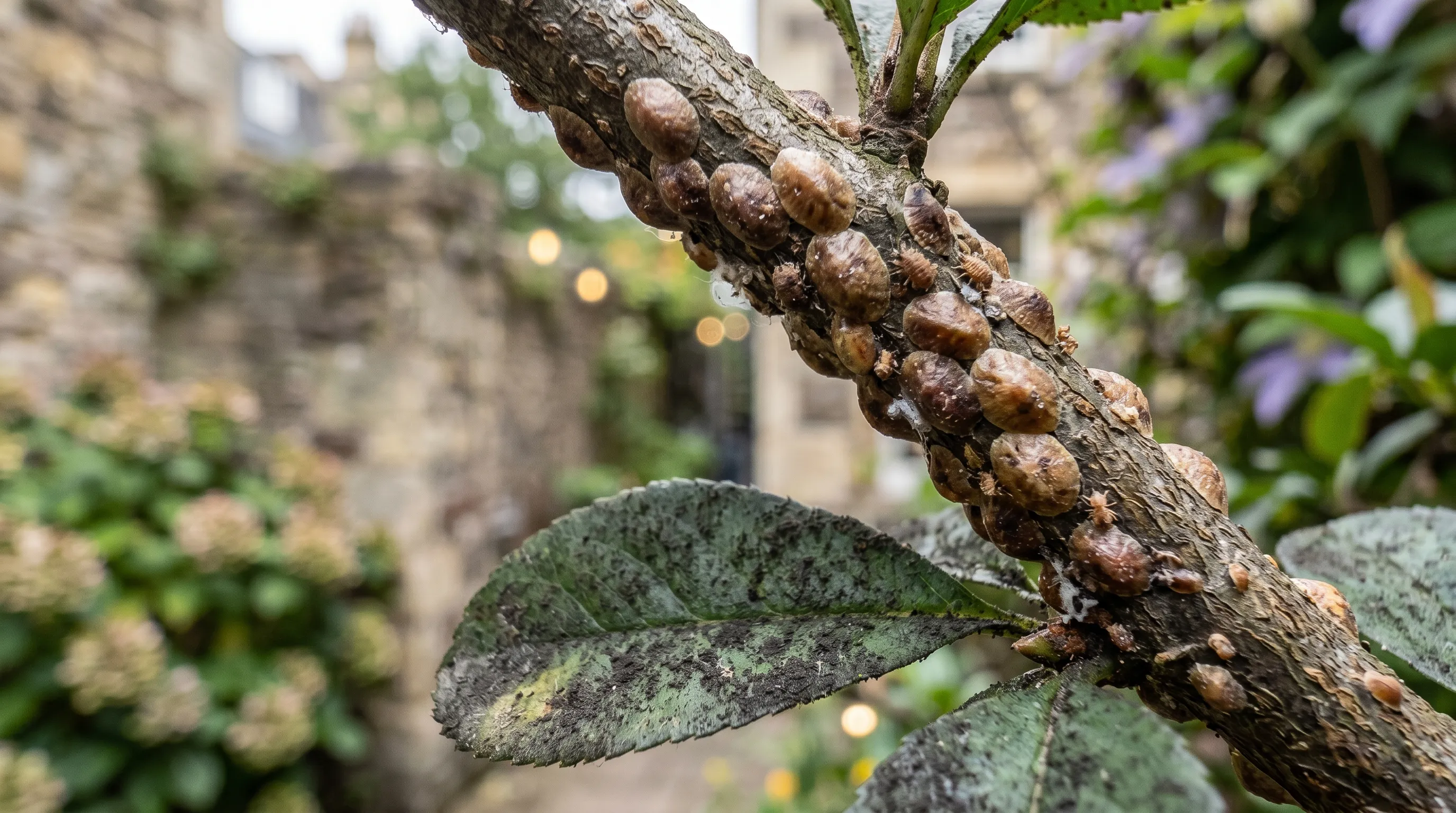 Brown soft scale insects on a Chaenomeles stem. The raised brown shells are about 4mm across and accompanied by sticky honeydew and sooty mould.
Fireblight (Erwinia amylovora)
Chaenomeles is a member of the rose family (Rosaceae), sub-family Maloideae, which includes pears, apples, hawthorn, and cotoneaster. All of these can carry fireblight, a bacterial disease that causes shoots to suddenly blacken and wither as if scorched by fire. Cut out affected stems 30cm below visible damage and sterilise tools between cuts with neat alcohol or a 10% bleach solution. Burn the prunings.
Aphids
Light aphid colonies appear on the soft new shoots in spring. They rarely cause significant damage and are usually cleared up by ladybirds and lacewings within two to three weeks. A jet of water from the hose dislodges the worst clusters.
Common mistakes to avoid
These are the five mistakes that account for most disappointment with Chaenomeles in UK gardens.
Pruning at the wrong time. Cutting in winter removes the flower buds. The only safe pruning window is the four to six weeks immediately after flowering in May and June.
Choosing a deep shade position. Chaenomeles tolerates partial shade but produces few flowers in deep shade under tree canopies. Aim for at least four hours of direct sun, even if that is only winter sun while neighbouring deciduous trees are bare.
Planting too close to a wall. Plants set right against a wall struggle to get water to the rootball because the wall and overhanging eaves keep the soil dry. Plant 25 to 30cm out and tie back to the wires.
Letting the plant get away from you. Free-standing Chaenomeles becomes a tangled mass within five years if never pruned. The annual May cut keeps the plant productive and flowering on young wood.
Skipping the wires on a wall plant. Tying directly to the wall with masonry nails damages mortar and gives nowhere for new shoots to attach. Galvanised wires set 5cm proud of the wall surface make training quick and tidy.
Month-by-month Chaenomeles calendar
| Month | Task |
|---|---|
| January | First flowers open on early varieties from mid-month in mild seasons. Enjoy. No pruning. |
| February | Peak early-flowering period. Top up mulch if needed. |
| March | Main flowering month for mid-season varieties. Watch for early pollinators on the open flowers. |
| April | Late varieties (Cameo) finish flowering. Plant container-grown stock before active growth begins. |
| May | Prune all plants immediately after flowering. Tie in new growth on wall-trained specimens. |
| June | Apply a balanced general fertiliser at 70g per square metre. Mulch with 5cm of compost. |
| July | Water young plants weekly through dry spells. Monitor for scale insects on stems. |
| August | Watch for fireblight. Cut out any blackened shoots with sterilised secateurs. |
| September | Fruit begins to swell and yellow. Stop feeding. |
| October | Harvest fruit when yellow and fragrant. Make jelly within two weeks of picking. |
| November | Bare-root planting season opens. Plant new specimens while soil is still warm. |
| December | Order bare-root plants from specialist nurseries. Tie in wall-trained stems blown loose by winter wind. |
Burncoose is based in Cornwall and offers a strong mail-order service across the UK. Standard varieties cost £18 to £22, rare and double cultivars £28 to £35. Bare-root plants from specialist hedging suppliers like Hopes Grove cost £12 to £15 each in autumn.
Pair Chaenomeles with the right partners
Chaenomeles peaks when little else is in bloom, so partner plants need to do their work in different seasons.
- Spring pairing: hellebores, snowdrops, dwarf narcissi, primroses, pulmonarias
- Wall companions: clematis (summer-flowering Group 3 types pruned hard in February), trained pear, climbing hydrangea
- Foliage contrast: black-leaved Sambucus Black Lace, golden Choisya Sundance, evergreen Ceanothus
For a fuller selection of early spring flowers for UK gardens, see our seasonal guide.
Gardener’s tip: Cut a few Chaenomeles branches in early January and bring indoors. Stand them in a vase of warm water in a bright room. Buds open within five to seven days and last two weeks. This forced-branch trick gives a free indoor flower display from any garden plant from mid-January onward.
Now you have mastered Chaenomeles
Chaenomeles delivers the same wall-trained shape and autumn fruit as a true quince tree, in a fraction of the space. For the next step in your fruiting wall-shrub knowledge, read our guide on growing quince trees in the UK which covers the larger true quince (Cydonia oblonga) for orchards and the back of borders. For more winter flower options, our best flowering shrubs UK guide covers the wider range of compact and wall shrubs that pair well with early-flowering japonica.
Our team produces practical UK gardening guidance from source research, contributor records and established horticultural practice. Editorial standards are overseen by Matt W.