Key takeaways
- UK last frost spans mid-April on the south coast to late May in Scotland
- Hardening off takes 7 to 14 days, from 2 hours to a full night outdoors
- Stake perennials at 30cm of growth, not after they flop in June
- Earth up potatoes as soon as 10cm of shoot shows above the soil
- Newly planted trees need 20 to 30 litres a week from April onwards
- Greenhouse shading pays from mid-April once internal temperatures pass 30C
Knowing what to do in the garden in April is mostly a question of ranking, not listing. April is the busiest month in the British gardening year, and it is the month most people lose control of. Every job arrives at once, the weather turns usable, and the list outgrows the available weekends. The gardens that come through well are not the ones where everything got done. They are the ones where the right three things got done first.
The other April trap is frost. One warm week in the middle of the month convinces people the season has turned, and out go the courgettes. In the UK the last air frost runs from mid-April on the south coast to late May inland and in Scotland. This guide ranks the month’s jobs, gives the regional frost dates and sets out a two-weekend plan for anyone short of time.
The April jobs that actually cannot wait
Not all April jobs carry the same cost if you skip them. Three have hard biological deadlines. The rest tolerate slippage.
Hardening off cannot be compressed. A plant that goes straight from a 20C greenhouse to an exposed April border suffers leaf scorch and a growth check of two to three weeks. There is no way to make up that time later, and the plant often never fully recovers its early vigour.
Earthing up potatoes has a window of days. Once shoots exceed 15cm they lean, and drawing soil up over a leaning stem breaks it. Miss it entirely and you lose both frost protection and a measurable share of the yield.
Staking perennials must happen while the plant is short enough to grow up through the support. Do it at 30cm and the foliage hides the frame by June. Do it at 90cm and you are tying a flopped plant into an obvious cage, badly.
Everything else has give. Sowing slips a fortnight with almost no penalty, and often catches up. Mulching, lawn feeding, pond work, dividing evergreens and tying in climbers can all move to early May without real loss. Rank accordingly.
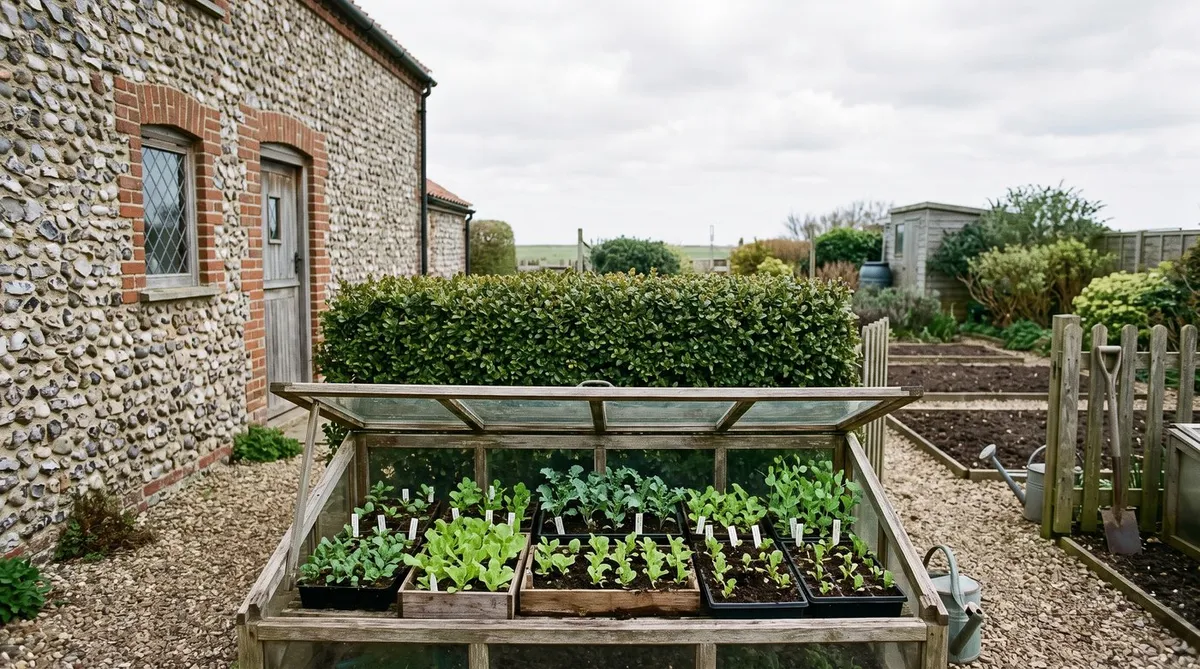
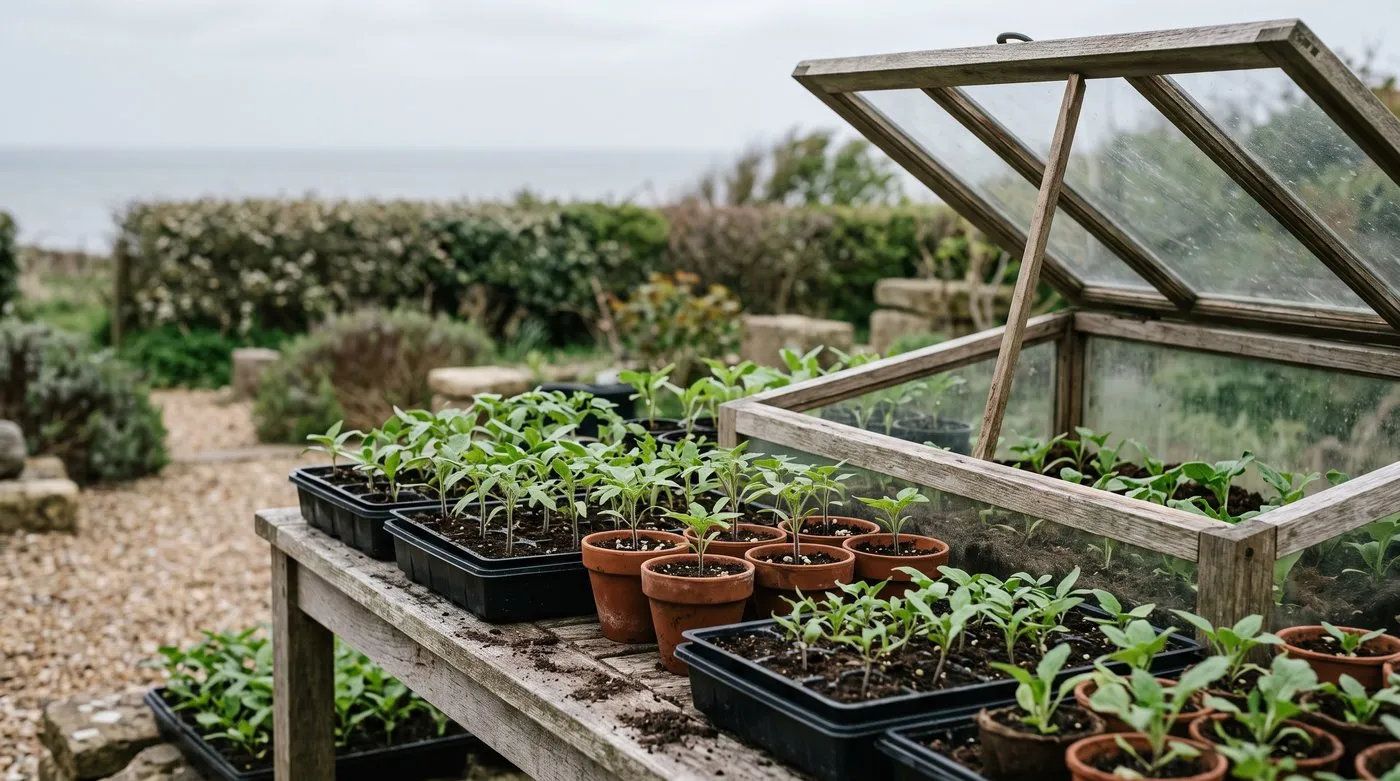 Trays staged beside an open cold frame in a Norfolk coastal garden. Hardening off is the one April job with no way to catch up later.
UK last frost dates by region
The last frost date is the number that governs half of April. These are average last air frost dates, with the practical planting-out date allowing a safety margin.
| Region | Average last air frost | Safe to plant tender crops | Ground frost persists to |
|---|---|---|---|
| Cornwall and the Isles of Scilly | 15 April | Early May | Late April |
| South coast and Norfolk coast | 22 April | Mid-May | Early May |
| London and the south east | 20 April | Mid-May | Early May |
| Bristol and the south west inland | 28 April | Mid-May | Mid-May |
| Midlands | 5 May | Late May | Late May |
| North west and Yorkshire | 12 May | Late May | Late May |
| Wales, upland | 20 May | Early June | Early June |
| Scotland, lowland | 18 May | Late May | Early June |
| Scotland, upland and the Pennines | 28 May | Mid-June | Mid-June |
Coastal Norfolk sits earlier than its latitude suggests because the sea holds heat, but it pays for that with wind. A seaside garden that never frosts after 22 April can still shred tender growth in an easterly gust. Salt-laden wind scorches new foliage as effectively as frost does.
Note the gap between air frost and ground frost. Ground frost typically continues for two more weeks after the last air frost in every region. That matters for anything at soil level, which includes newly planted-out bedding and potato shoots. Our guide to protecting plants from frost covers fleece weights and cloche options in detail.
How to harden off properly in April
Hardening off is the process of thickening a plant’s cuticle and adjusting its stomatal control so it can survive outdoors. It is a physiological change, not a habit, and it takes time.
The plant responds to three stresses: lower temperature, higher light intensity and moving air. Ultraviolet light is the one people forget. Greenhouse glass filters most UV, so a seedling raised under glass has effectively never seen full sunlight. Put it straight out on a bright April day and the leaves bleach within hours.
Run the process across 7 to 14 days:
- Days 1 to 2. Two hours outside, in shade, sheltered from wind. Bring in before mid-afternoon.
- Days 3 to 4. Four hours, with an hour of morning sun. Still sheltered.
- Days 5 to 6. Six to eight hours, in a more open position.
- Day 7. A full day outside, brought in at dusk.
- Days 8 to 9. Left out overnight in a cold frame with the lid propped, or under two layers of 30gsm fleece.
- Days 10 to 14. Full nights unprotected, provided no frost is forecast.
The critical mistake is treating the process as a countdown rather than a response to weather. A frost or a gale on day six means you repeat day five, not skip to day seven. Half-hardy bedding and tender crops both follow this schedule, and the detail for each plant group is in our guide to hardening off bedding plants and half-hardies.
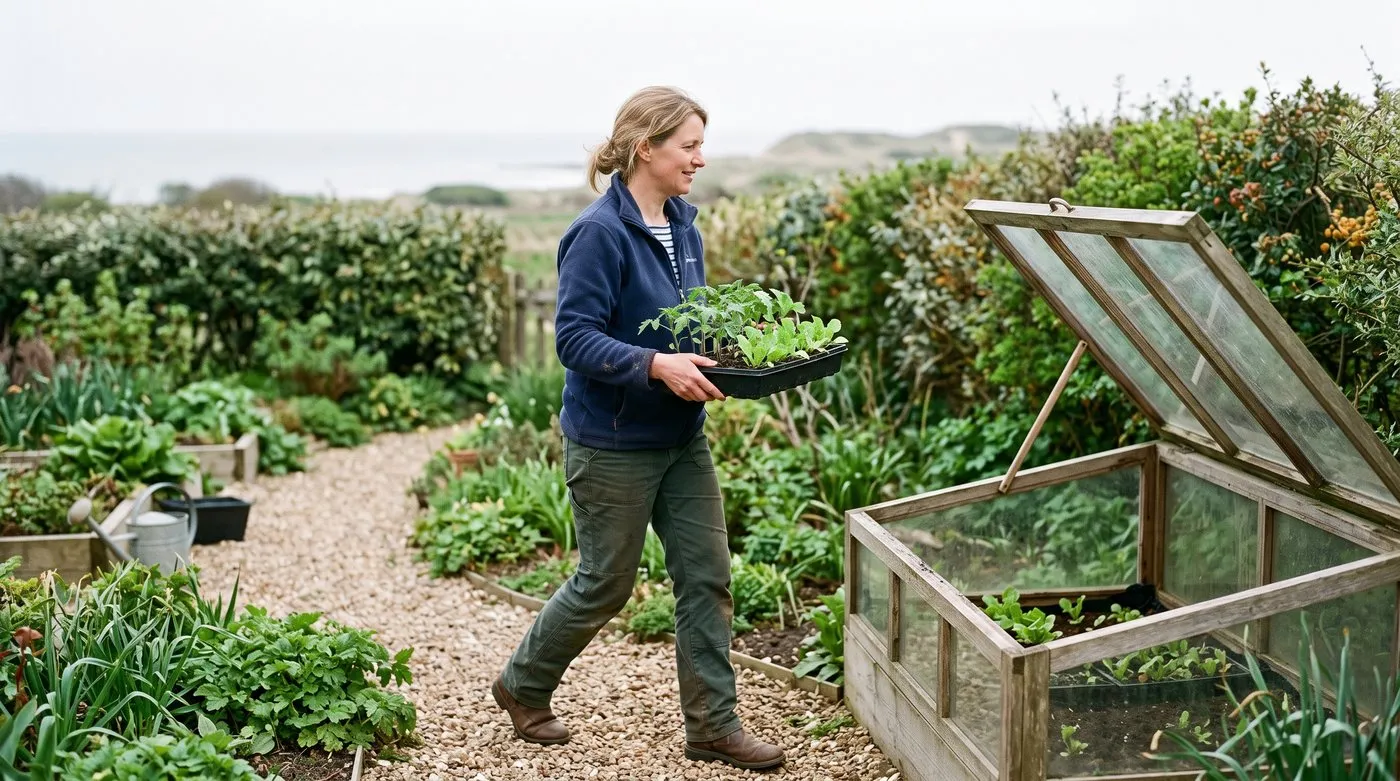 Day four of hardening off in a Norfolk garden. The tray goes out mid-morning and comes back in before the temperature drops in the afternoon.
Sowing under cover and direct in April
April splits into three sowing streams, and mixing them up is where the frost losses come from.
Tender crops under cover are sown now for planting out in late May. Courgettes, squash, sweetcorn, French and runner beans all germinate at 18 to 21C and grow fast. Sow them too early and you get a leggy 60cm plant stuck in a pot in a cold May. Mid-April is the right window for most of England; sow in the last week of April in Scotland.
Hardy vegetables direct go straight into the ground once soil holds 8C or above at 5cm. Beetroot, carrots, parsnips, peas, spinach, radish, salad onions and chard all qualify. Sow in short successional batches every two to three weeks rather than one long row.
Hardy annual flowers direct is the cheapest colour in gardening. Calendula, nigella, cornflower, poppy and larkspur sown in April flower from late June until the first frosts. A GBP 2.50 packet covers three square metres and gives a display that would cost GBP 40 in bedding plants.
Sow into a fine, firmed tilth and water the drill before sowing, not the surface afterwards. Watering a dry drill from a can washes seed sideways into clumps. Fill the drill, let it drain, sow, then cover dry.
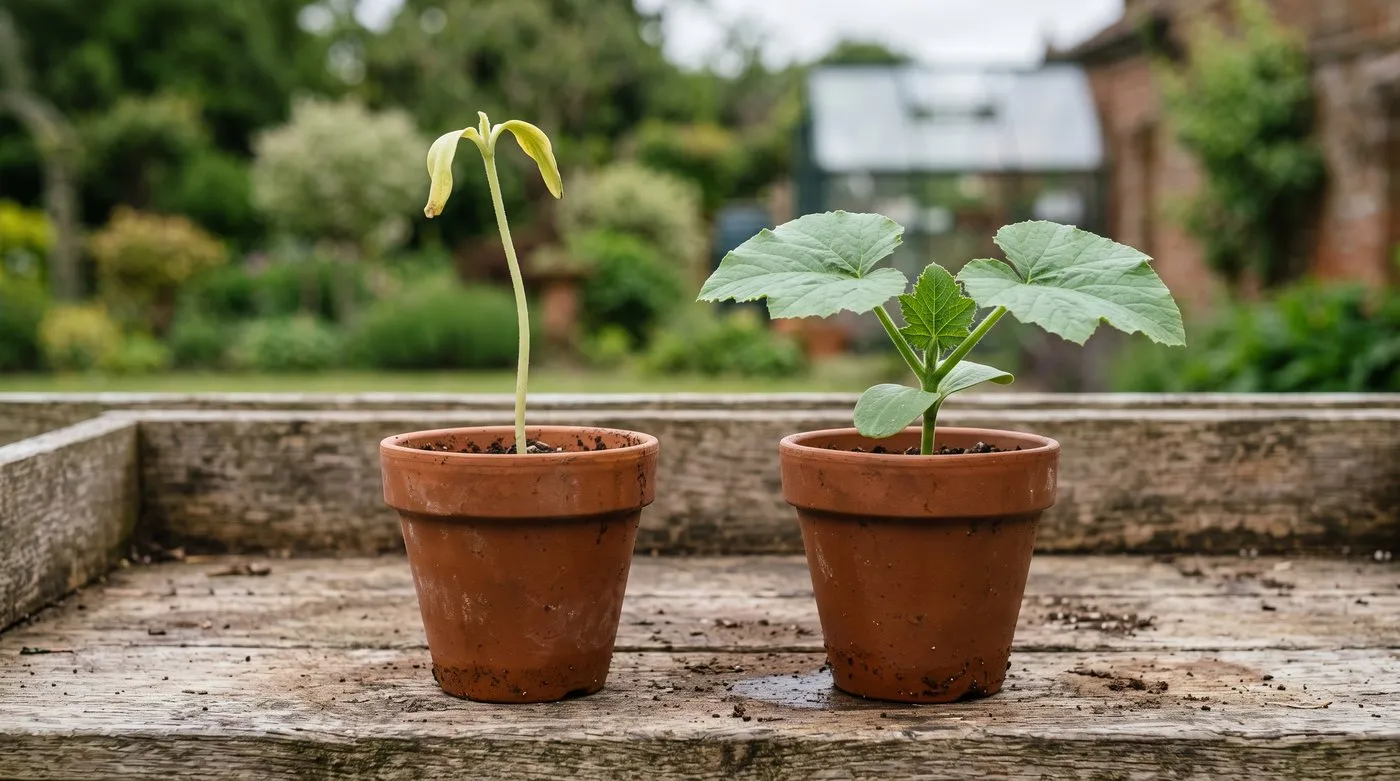 The cost of sowing tender crops too early. The pale, stretched seedling on the left was sown in mid-March, the compact one on the right in mid-April.
Potatoes, climbers and staking before it is needed
Three structural jobs define the middle of April, and all three reward being early.
Earthing up potatoes starts when shoots reach 10cm. Draw soil from between the rows up over the stems, leaving about 5cm of shoot showing. Repeat at two to three week intervals until the ridge is 20 to 25cm high. Earthing up does three jobs: it protects shoots from frost, stops light reaching developing tubers, and adds stem length for tubers to form on. Skipping it can cut yield by around a fifth and leaves green, inedible tubers at the surface. Our potato earthing up guide covers ridge shape and container-growing differences.
Tying in climbers is an April job because the new growth is still soft and steerable. Clematis, honeysuckle, climbing roses and sweet peas all put on extensive growth from mid-April. Tie in weekly with soft twine, spreading shoots horizontally where you can: horizontal stems flower along their whole length, vertical ones flower only at the tip.
Staking perennials is the job everyone does too late. Delphinium, lupin, peony, aster, helenium and phlox all need support in a British summer. Put grow-through supports or hazel pea sticks in at 30cm of growth, which is mid to late April for most species. The plant then grows through the frame and hides it. Our guide to staking tall perennials sets out the support types by plant.
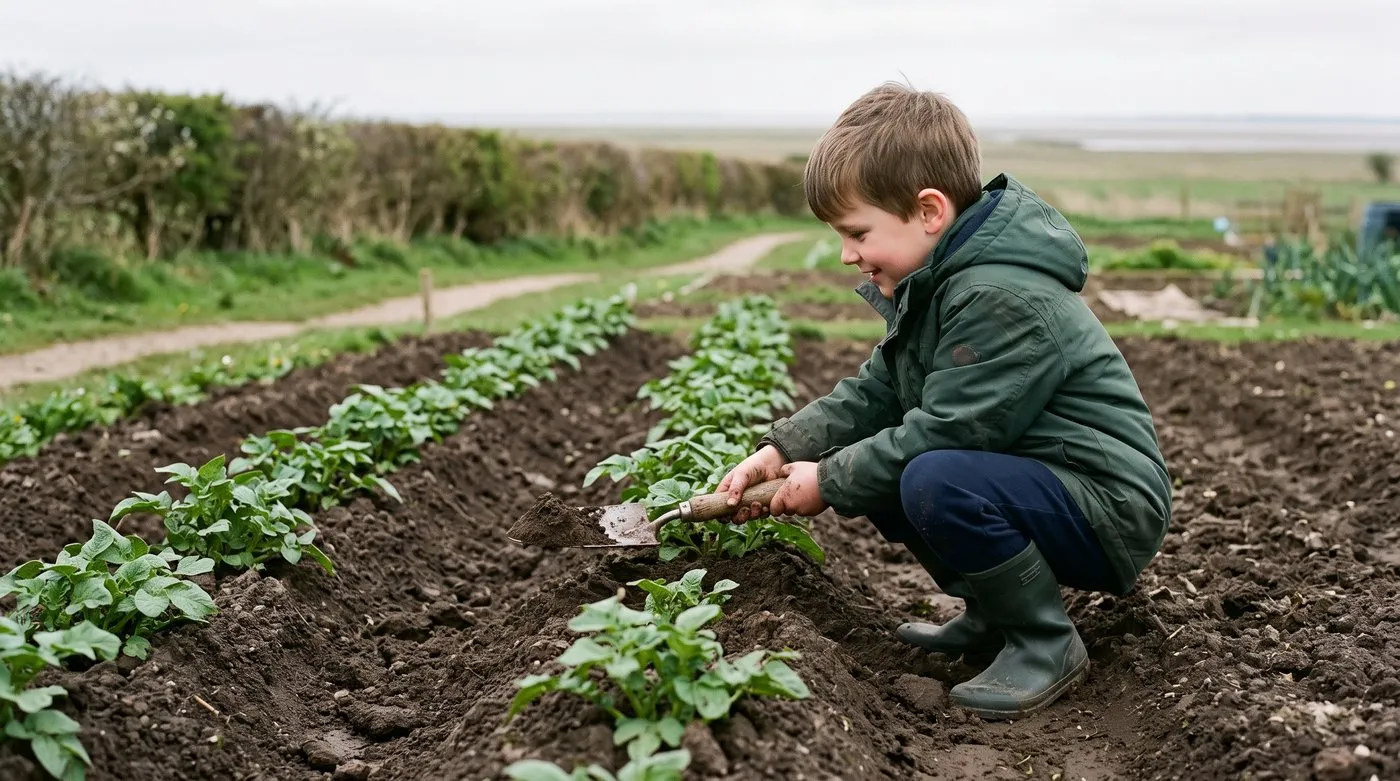 Earthing up first earlies in a Norfolk plot. The shoots were 12cm before soil was drawn up, leaving about 5cm showing above the new ridge.
Lawn care and the weed and feed question
April is the main growing month for UK turf, and the month lawn care goes wrong most often.
Establish the mowing rhythm now: weekly from mid-April, dropping the blade height by about 5mm a week from the 40mm first-cut setting down to a summer height of 25 to 30mm. Cutting weekly means removing a third of the leaf each time, which is what the grass is adapted to. Cutting fortnightly means removing two thirds, which starves the roots and thins the sward.
Weed and feed products need three conditions met at once: grass actively growing, weeds in full leaf, and soil moist. All three usually align in the second half of April in England and early May further north. Apply at the stated rate, typically 35g per square metre, and never eyeball it. Doubling the rate scorches the lawn and does not kill the weeds any faster.
Do not apply weed and feed within four weeks of laying turf or sowing seed, and keep clippings out of the compost heap for the first three cuts afterwards. The selective herbicide persists and will damage tomatoes and beans. Our guide to feeding a UK lawn covers the nitrogen rates and timings by season.
Watering new plantings and April pond work
April is the month when watering starts to matter and almost nobody starts it.
Newly planted trees and shrubs need 20 to 30 litres a week in their first season, delivered in one or two soakings rather than daily sprinkles. A light daily watering keeps roots in the top 5cm, exactly where the soil dries first. April rainfall in East Anglia averages around 45mm, which sounds adequate but is often front-loaded into two wet days.
Water into the planting pit, not the surrounding soil. A ring of soil built into a low 10cm bank around the trunk holds a full can while it soaks in. Mulch after watering, keeping the layer 5cm clear of the trunk.
Pond work starts as the water warms. Once water passes 10C, oxygenating plants resume growth and any fish start feeding. Divide and thin marginal plants now, before they are in full growth. Remove no more than a third of the plant material in one go, and leave what you remove on the pond edge overnight so invertebrates can crawl back in.
Blanketweed responds to rising light and warmth from April. Twist it out with a cane rather than a net, which lifts less of the water column with it. Barley straw pads, at about GBP 6 each and one per 4,500 litres, work as a preventive if they go in during April rather than in July when the problem is visible.
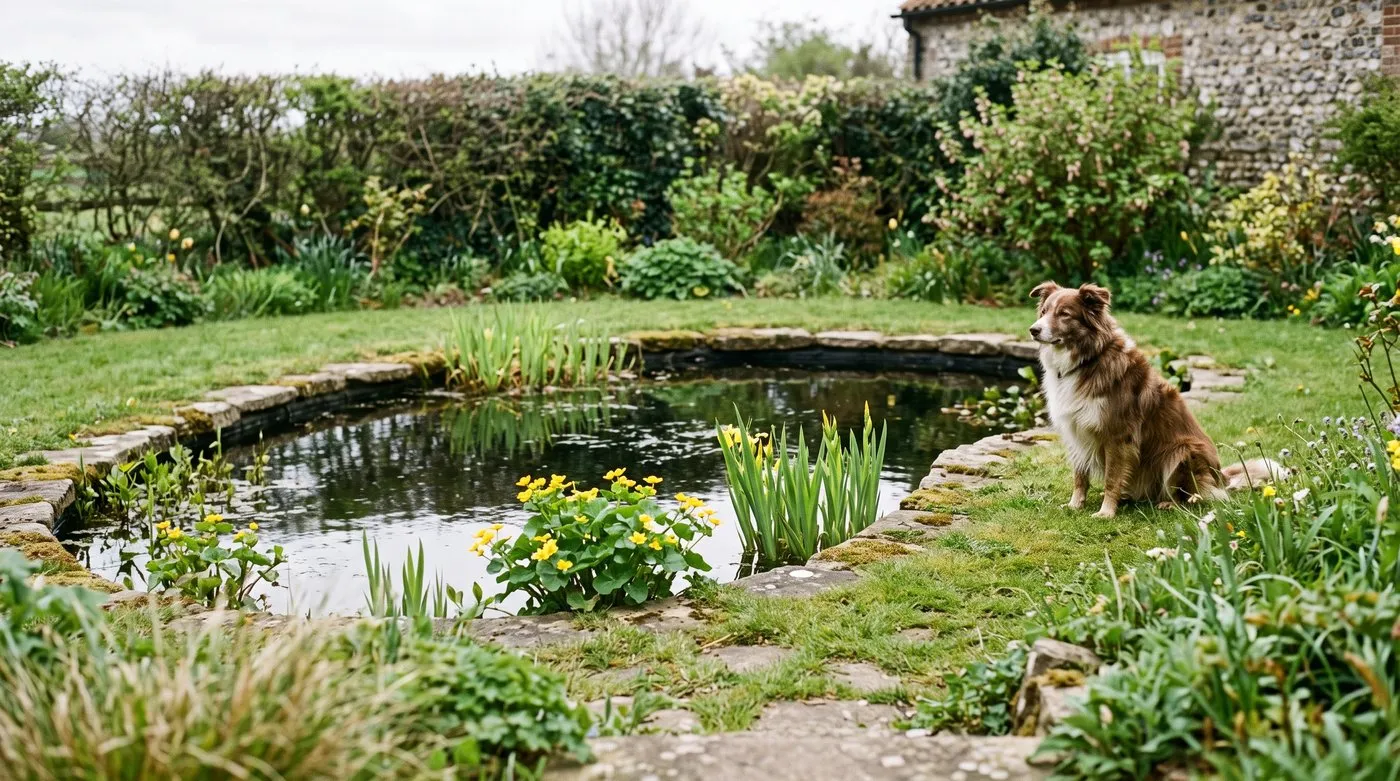 Marginals coming back into growth in a Norfolk garden pond in mid-April. Dividing them now is far easier than waiting until they are in full leaf.
Greenhouse shading, damping down and pest watch
Sun strength in the UK on 20 April is close to that of 20 August, while air temperatures are 10C lower. That mismatch is what catches greenhouse growers out.
Shading pays from mid-April in most of the country. A closed greenhouse on a clear 15C April day reaches 35 to 40C internally by early afternoon. Shade paint costs about GBP 12 a tin and covers a 6ft by 8ft house; woven shade netting at 40% runs GBP 15 to 25. Either brings internal temperatures down by 6 to 10C.
Damping down means wetting the floor and staging once or twice on hot days. Evaporation raises humidity and cools the air by 3 to 5C. It also suppresses red spider mite, which thrives below 50% humidity. Do it in the morning, never late in the day, so the house dries before nightfall.
The April pest watch list is short and specific. Lily beetle adults emerge from the soil in April, are 8mm long and bright scarlet, and are easiest to hand-pick before they lay. Viburnum beetle larvae hatch in April and skeletonise leaves within a fortnight. Aphids build on soft new shoots from mid-April, doubling roughly every seven days in warm weather. Slugs move onto everything newly planted out.
Twice-weekly inspection through April removes more damage than any spray applied in June. Full identification detail is in our lily beetle guide.
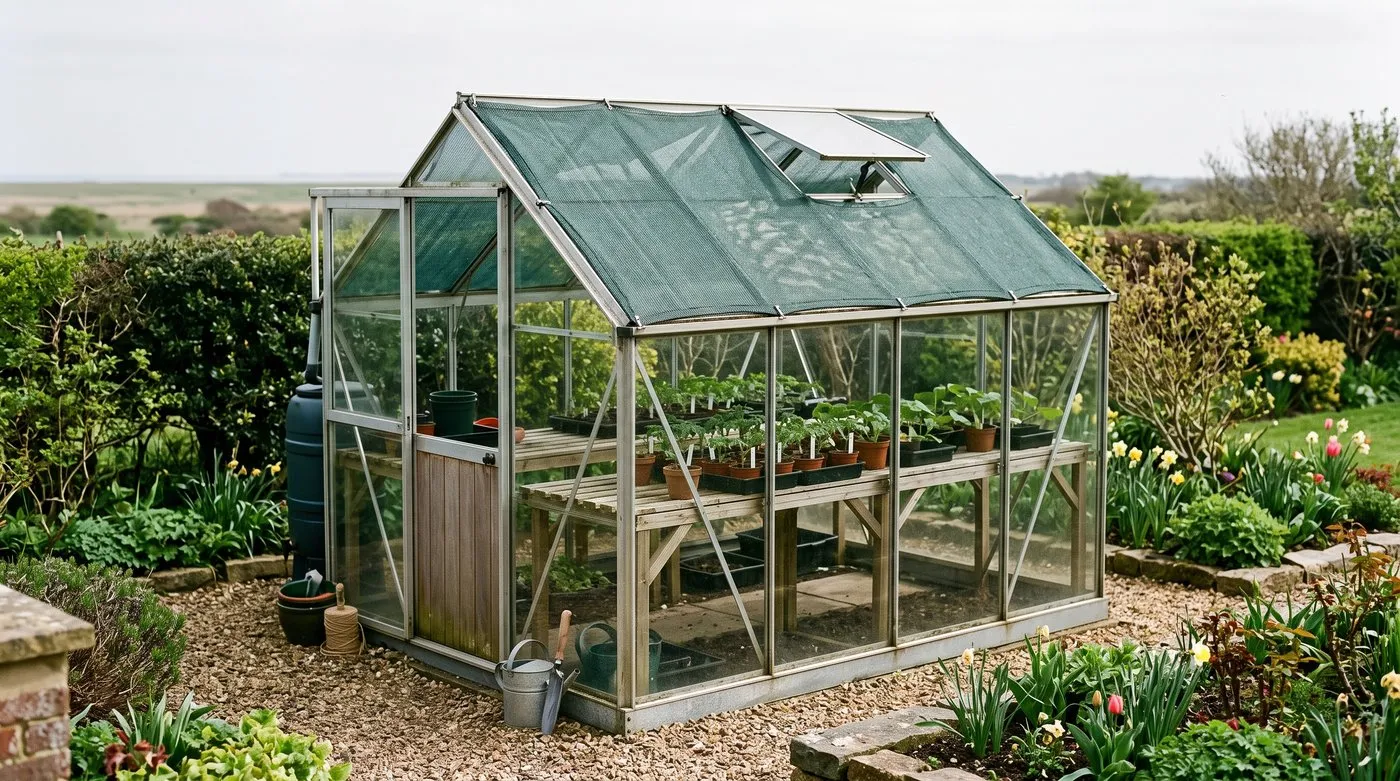 Shade netting and open roof vents on a Norfolk greenhouse from mid-April. Internal temperatures drop 6 to 10C, which is the difference between growth and scorch.
Why April gardens run out of control
The root cause of April overwhelm is that the jobs are not sequenced, they are listed. Every magazine, seed catalogue and website publishes April as a flat list of twenty tasks. A flat list gives no way to decide what to drop when the weather takes a weekend away from you.
The reason this goes unnoticed is that the cost of getting it wrong appears in June and July, not April. A perennial that flops in July looks like a windy summer. A leggy courgette that never crops looks like poor seed. Neither gets traced back to an unsequenced April.
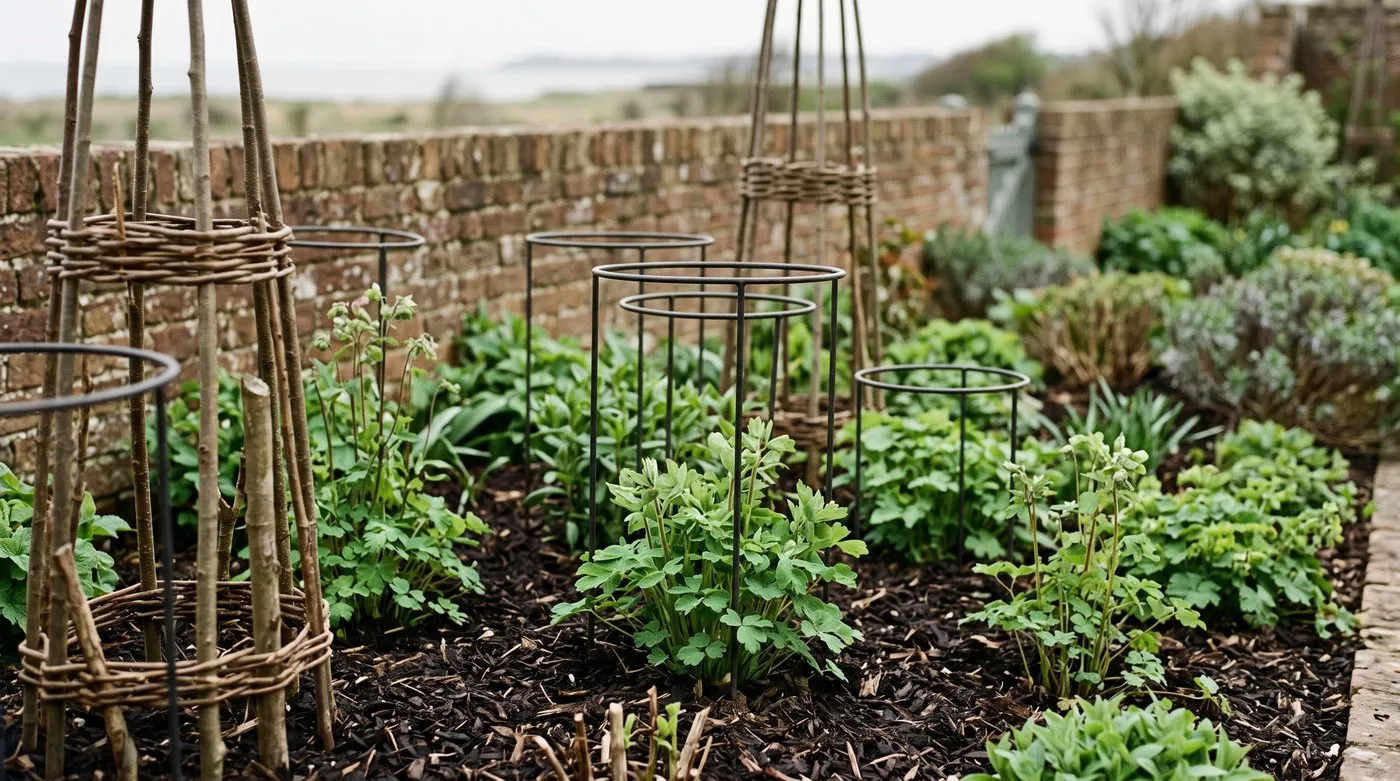 Supports installed at 30cm of growth in a Norfolk coastal border. By late June the foliage hides the frame completely and nothing has flopped.
The two-weekend April plan
| Priority | Job | Weekend | Time needed | Cost of doing it late |
|---|---|---|---|---|
| 1 | Start hardening off | First | 20 min a day for 2 weeks | 2 to 3 week growth check, unrecoverable |
| 2 | Earth up potatoes | First | 45 min per 10m row | Green tubers, roughly 20% yield loss |
| 3 | Stake perennials | First | 8 min per plant | Up to 83% storm losses on tall species |
| 4 | Sow tender crops under cover | First | 1 hour | Late crop, or leggy plants held too long |
| 5 | Establish weekly mowing | Both | 30 min a week | Thin sward, moss and weed ingress |
| 6 | Tie in climbers | Second | 30 min | Tangled growth, tip-only flowering |
| 7 | Direct sow hardy veg and annuals | Second | 1 hour | Minimal, catches up within a fortnight |
| 8 | Weed and feed the lawn | Second | 30 min | Minimal, works fine in early May |
| 9 | Pond thinning and shading up | Second | 1 hour | Minimal, though algae builds |
The gold standard is finishing the first four before the second weekend arrives. Those four carry every deadline that cannot be recovered. Everything from row five down can slip into May with no meaningful cost to the season.
Common April mistakes
- Planting tender crops out after one warm week. Mid-April often delivers three days at 18C, and the courgettes go in. A single 0C night kills them outright. Check your regional last frost date and add a fortnight before planting anything tender.
- Staking after the plant needs it. Support goes in when the flop has already happened, usually in June. The stems are then bent and the frame is visible all summer. Stake at 30cm of growth in April, before it looks necessary.
- Hardening off in four days because the forecast looks good. People compress the schedule to hit a planting date. The result is bleached leaves and a checked plant. The cuticle change takes 7 to 14 days regardless of how keen you are.
- Applying weed and feed to a dry lawn. The granules sit undissolved and scorch in patches once rain finally arrives. Apply to moist soil with rain forecast within 48 hours, at the stated 35g per square metre.
- Watering new trees a little every day. Daily sprinkling keeps roots shallow and the tree fails in its first dry August. Give 20 to 30 litres once a week and let the water reach depth.
Warning: Do not compost lawn clippings for the first three cuts after applying any weed and feed containing a selective herbicide. Residues persist through composting and cause twisted, cupped growth on tomatoes, beans and potatoes the following year. Bin those clippings or leave them on the lawn.
For regional frost records and current warnings, the Met Office publishes station data going back decades, and the Wildlife Trusts set out the case for the uncut spring lawn strip described above.
Now you have April ranked by deadline, work out exactly what goes in the ground with our guide to what to plant in April in the UK, or browse the full set of practical how-to guides for the detail behind each job here.
Frequently asked questions
When is the last frost date in the UK?
It runs from mid-April on the south coast to late May in upland Scotland. Cornwall averages its last air frost around 15 April, the Midlands around 5 May and inland Aberdeenshire around 28 May. Ground frost lingers roughly two weeks beyond the air frost date in every region.
What should I do first in April if I only have two weekends?
Harden off seedlings, earth up potatoes and stake perennials. Those three jobs have hard deadlines that cannot be recovered later. Sowing, mulching and lawn feeding all tolerate a fortnight of slippage without any real cost to the season.
How long does hardening off take in April?
Between 7 and 14 days, depending on the plant and the weather. Start with two hours outside in a sheltered, shaded spot, then add roughly two hours a day. By day seven the plant should manage a full day, and by day ten a full night under fleece.
When should I earth up potatoes?
As soon as shoots reach 10cm above the soil surface. Draw soil up to leave about 5cm of shoot showing. Earthing up protects against frost, stops tubers greening and increases yield by giving the stem more length to produce from.
Can I plant tender crops out in April?
No, tender crops should not go out until after your local last frost. Courgettes, runner beans, sweetcorn and tomatoes are all killed outright at 0C. One warm April week convinces thousands of gardeners otherwise every year, and May frosts then wipe out the lot.
When do I start shading and damping down the greenhouse?
Shading pays from mid-April once internal temperatures regularly pass 30C. Damping down the floor once or twice on hot days raises humidity and cools the air by 3 to 5C. Both matter more in April than most people expect, because sun strength climbs faster than air temperature.
Which pests should I watch for in the garden in April?
Lily beetle, viburnum beetle, aphids and slugs are the April four. Lily beetle adults emerge from the soil in April and are easiest to hand-pick then. Checking twice a week in April removes more damage than any spray applied in June.
Our team produces practical UK gardening guidance from source research, contributor records and established horticultural practice. Editorial standards are overseen by Matt W.