Key takeaways
- Perennial climber to 3-4m, scrambling through hedges and shrubs with twining leaf stalks
- Vivid scarlet trumpet-shaped flowers July to September, fed by long curving spur
- Needs acidic soil at pH 4.5-6.0, cool root run, and a damp west or north UK climate
- Plant rhizomes horizontally 75-100mm deep with the growing tip pointing toward the support
- Takes 2-3 years from planting to first reliable flowering, then long-lived for 15-20 years
- Best UK regions: Scotland, Lake District, North Wales, Cornwall. Fails in dry southern English gardens
Tropaeolum speciosum is the plant that turns Scottish and Cumbrian gardens scarlet every August. The Royal Botanic Garden Edinburgh has it pouring through yews in the Woodland Garden. National Trust gardens at Powis Castle and Hidcote use it as a defining late-summer plant. Yet most southern English gardeners try it once, watch it die, and never try again.
What is Tropaeolum speciosum and why is it called the Scottish Flame Flower?
Tropaeolum speciosum, also known as the Chilean Flame Flower, Scottish Flame Flower, or perennial nasturtium, is a herbaceous climbing plant native to the temperate rainforests of southern Chile. It belongs to the same genus as the annual nasturtium but behaves completely differently.
The plant produces six-lobed leaves on twining stalks and scarlet trumpet-shaped flowers with five rounded petals and a long curving spur. Mature plants reach 3-4 metres, scrambling through host shrubs and hedges using their leaf petioles to grip. Flowers appear from July to September. After flowering, distinctive blue berries form in red-tinted calyces.
The plant earned its UK common name because it flourishes in the cool damp climate of Scotland in a way it struggles to match further south. Royal Botanic Garden Edinburgh, Inverewe in Wester Ross, and Crarae Gardens on Loch Fyne all hold it as a signature plant. South of Manchester, success rates drop sharply. South of London, it borders on impossible without artificial cooling and irrigation.
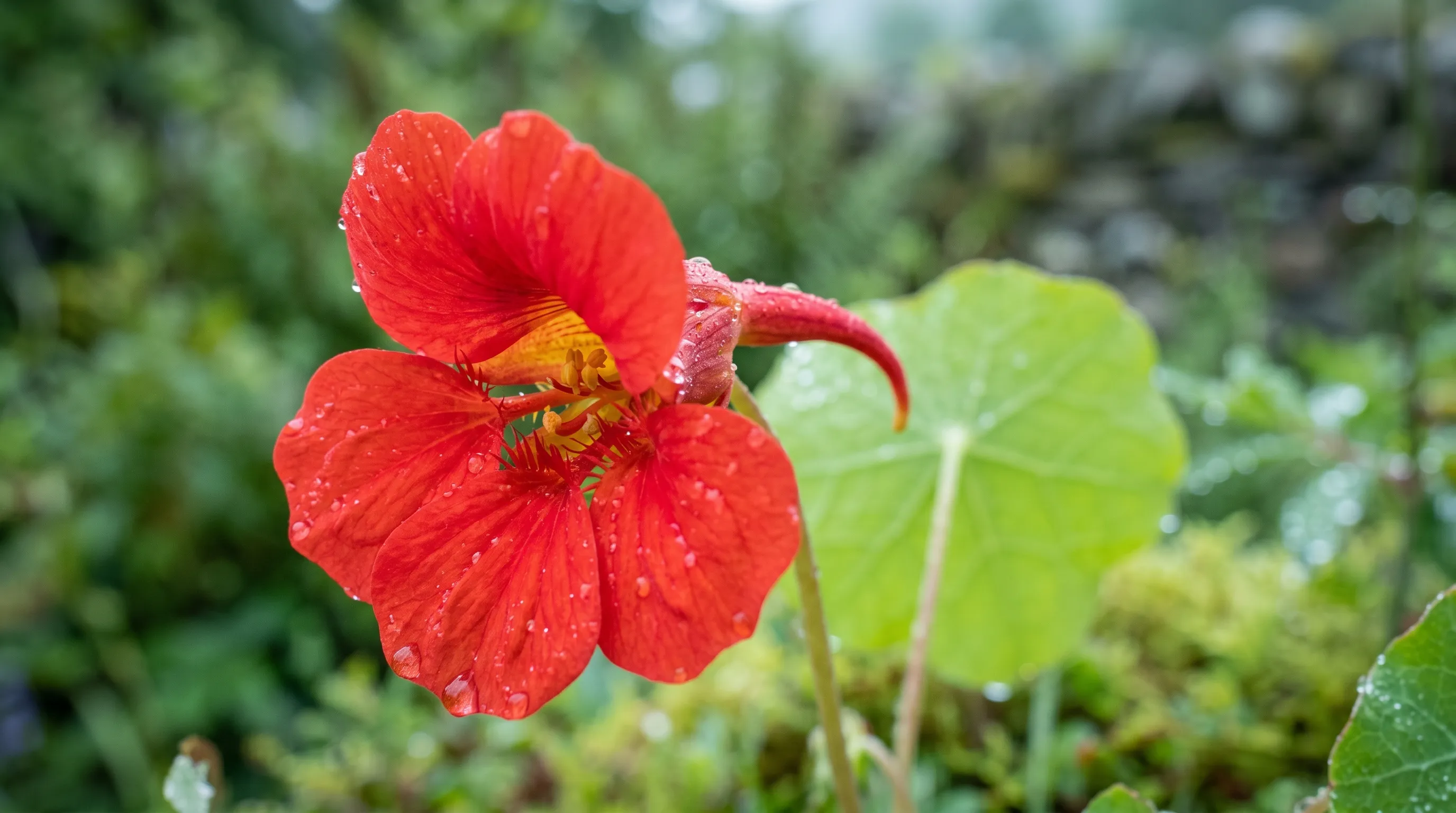 The diagnostic trumpet flower shape of Tropaeolum speciosum: five rounded petals, dark central throat, and a long curving spur for nectar.
Why southern English gardens struggle with Tropaeolum speciosum
The plant needs four conditions to thrive. Most southern English gardens fail at least two of them.
| Requirement | Detail | Why southern UK often fails |
|---|---|---|
| Acidic soil | pH 4.5-6.0, ideally 5.0-5.5 | Limestone, chalk, and clay soils across the south are pH 7.0-8.0 |
| Cool root run | Summer soil temperature below 20C | Southern soils regularly hit 25-28C in heatwaves |
| Consistent moisture | Annual rainfall over 1,000mm | South-east UK averages 600-750mm with summer droughts |
| Mild summers | July average max temperature below 22C | London and the south-east average 23-26C in July |
The Royal Horticultural Society plant database confirms hardiness as H5 (minus 15C). Cold is not the issue. Heat and dry soil are the killers. A west-facing chalk border in Surrey will fry the rhizome in its first summer. A north-facing acidic clay border in Argyll will host it for 20 years.
For an honest assessment of your conditions, see our guide to acidic soil plants and check the climbing options that suit your region.
How to plant Tropaeolum speciosum rhizomes
The rhizome is a pale, finger-like rootstock typically 50-150mm long and 8-15mm wide. Buying from a specialist nursery in early spring gives the best results. Avoid dried-out rhizomes that have lost their plumpness.
Planting depth and orientation
Plant rhizomes horizontally at 75-100mm deep. Orient the growing tip (slightly fatter end) toward the host plant the climber should scramble through. The growing point sits 60-90mm below the soil surface, deep enough to stay cool but shallow enough to emerge in spring.
Soil preparation
Dig a planting pocket 400mm wide and 300mm deep. Fork in:
- 2 buckets of leaf mould (preferred over compost)
- 1 bucket of ericaceous compost to lower pH
- 0.5 bucket of horticultural grit for drainage
- A handful of pine needles or composted bracken for additional acidity
Backfill so the rhizome sits 75-100mm below the final soil level. Firm gently. Water in with rainwater (tap water in hard-water areas is too alkaline). Mulch with 50mm of bracken, pine needles, or ericaceous compost. Maintain this mulch every spring.
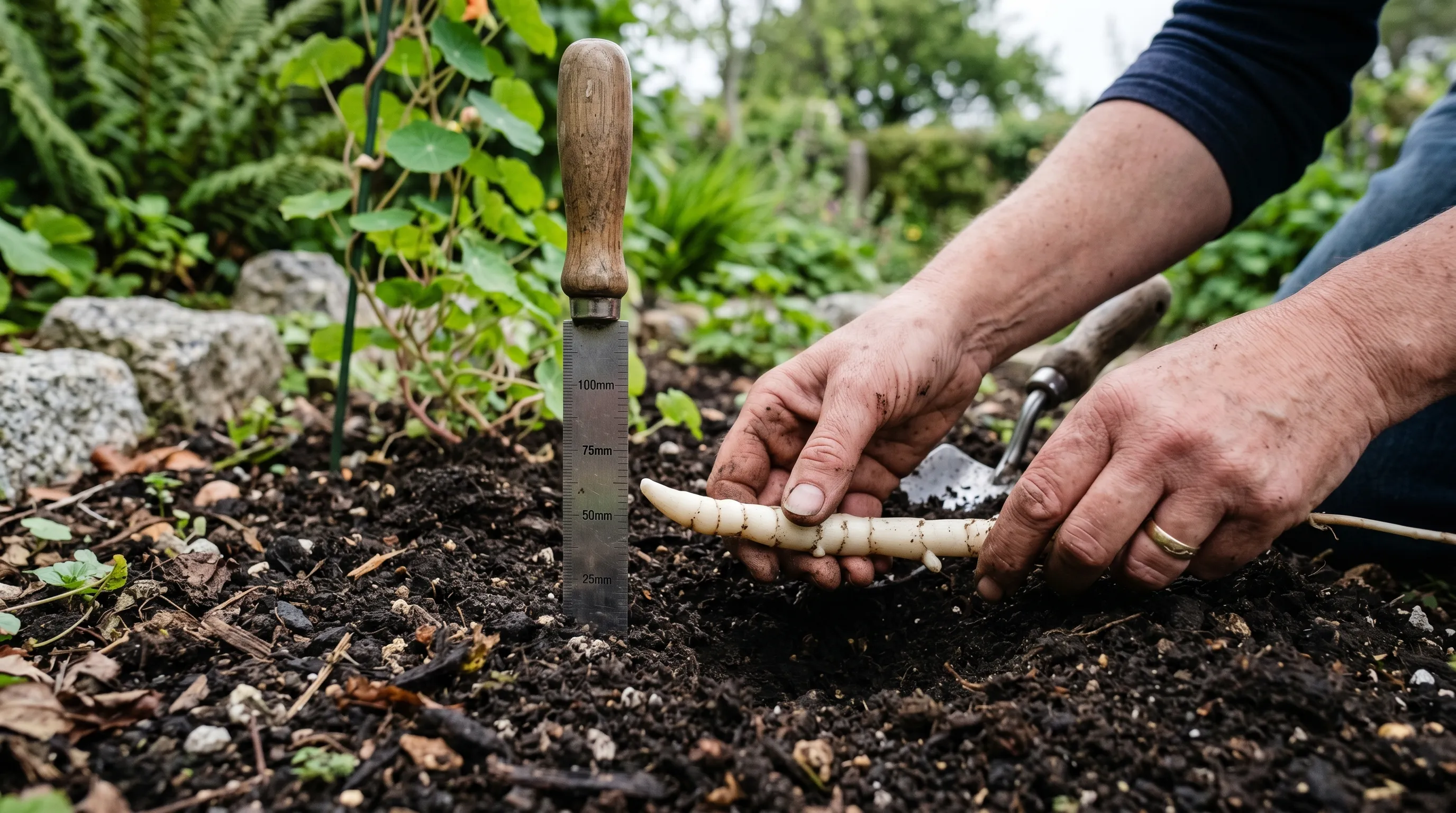 Planting a Tropaeolum speciosum rhizome horizontally at 75mm depth in a Cornish garden. Note the leaf mould, ericaceous compost, and pine needle mulch.
Aspect and position
The ideal position is:
- East or north aspect (cool morning sun, shaded afternoons)
- At the base of a hedge or large shrub where roots stay shaded
- 300-600mm out from the host plant so the rhizome avoids root competition but the climber can reach up
- Protected from prevailing wind in exposed Scottish or Cumbrian sites
For wider context on planting climbers near established shrubs, see fast-growing climbers for fences and walls.
Best UK regions for Tropaeolum speciosum
The pattern is clear. Above the line from Bristol to Hull is the territory where Tropaeolum speciosum has a fair chance. Below it, even keen gardeners with prepared acidic beds rarely keep plants alive longer than 3-5 years. The Royal Horticultural Society notes the same regional pattern in its plant entries.
If you live in southern England and refuse to give up, your best chances are:
- North-facing position behind a tall yew or holly hedge
- Imported ericaceous bed of at least 1m³
- Buried drip irrigation set to run during dry spells from May to September
- Mulch refreshed twice yearly with pine needles or composted bracken
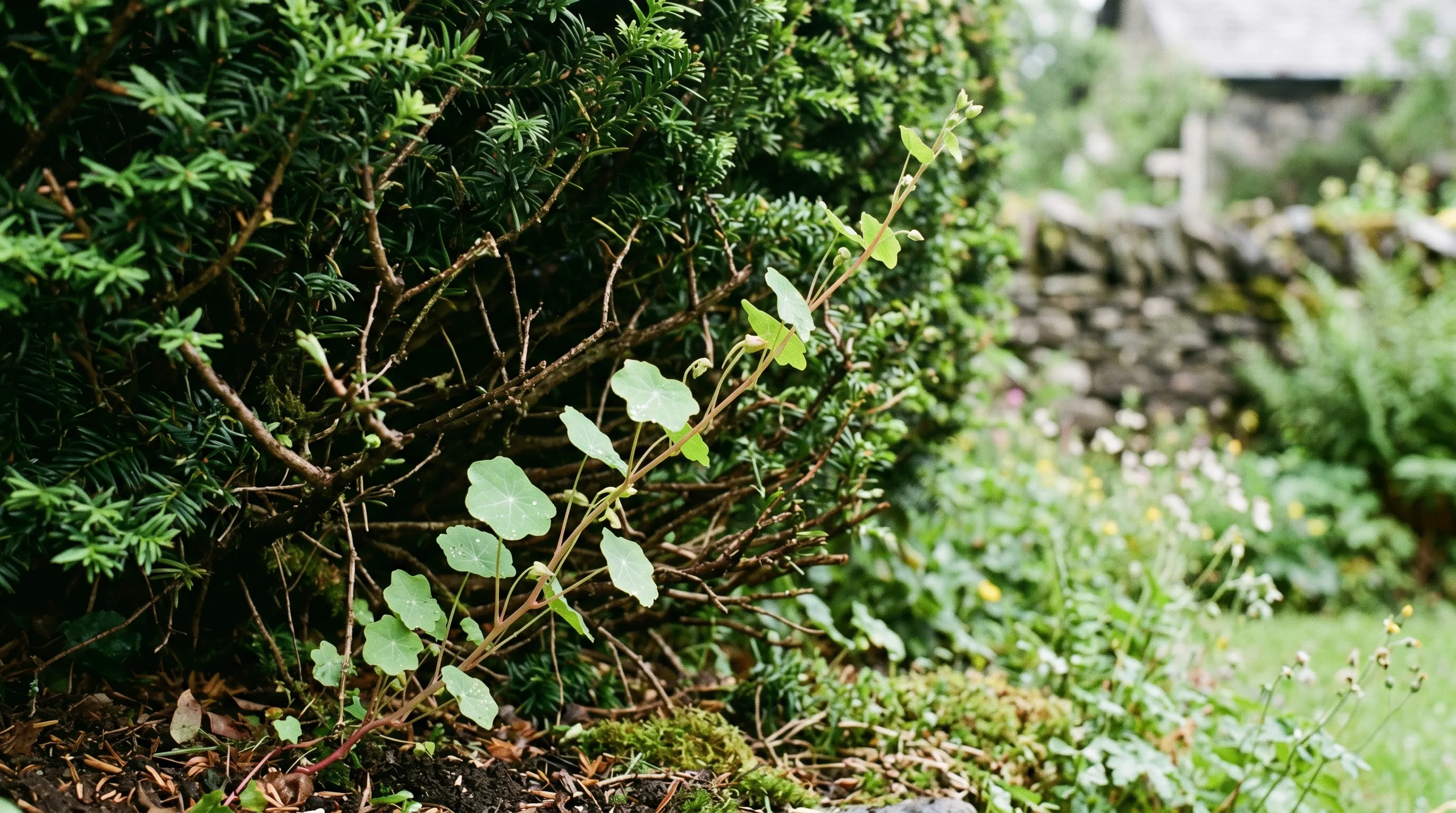 A young Tropaeolum speciosum shoot in early June at a Lake District garden. The leaf petioles twine around host shrub stems to climb.
The summer dormancy quirk
Tropaeolum speciosum has an unusual habit of disappearing briefly in midsummer, particularly in warmer southern UK conditions. The plant sends up shoots in late spring, grows to 1-2 metres, then dies back to soil level in July if temperatures spike. New growth often resumes in August once cooler weather returns.
In cooler regions this dormancy rarely happens. Scottish gardens see continuous growth from May to October. Cornwall and parts of west Wales sit between the two patterns. If your plant disappears in July, do not panic and dig it up. Mulch the area, water with cool rainwater, and wait until late August.
Companion planting: why yew is the classic UK choice
The traditional UK partnership is Tropaeolum speciosum scrambling through clipped yew. This pairing works for three reasons:
- Yew (Taxus baccata) tolerates the climber’s twining stems without damage
- The dense yew canopy keeps soil cool and shaded at the root zone
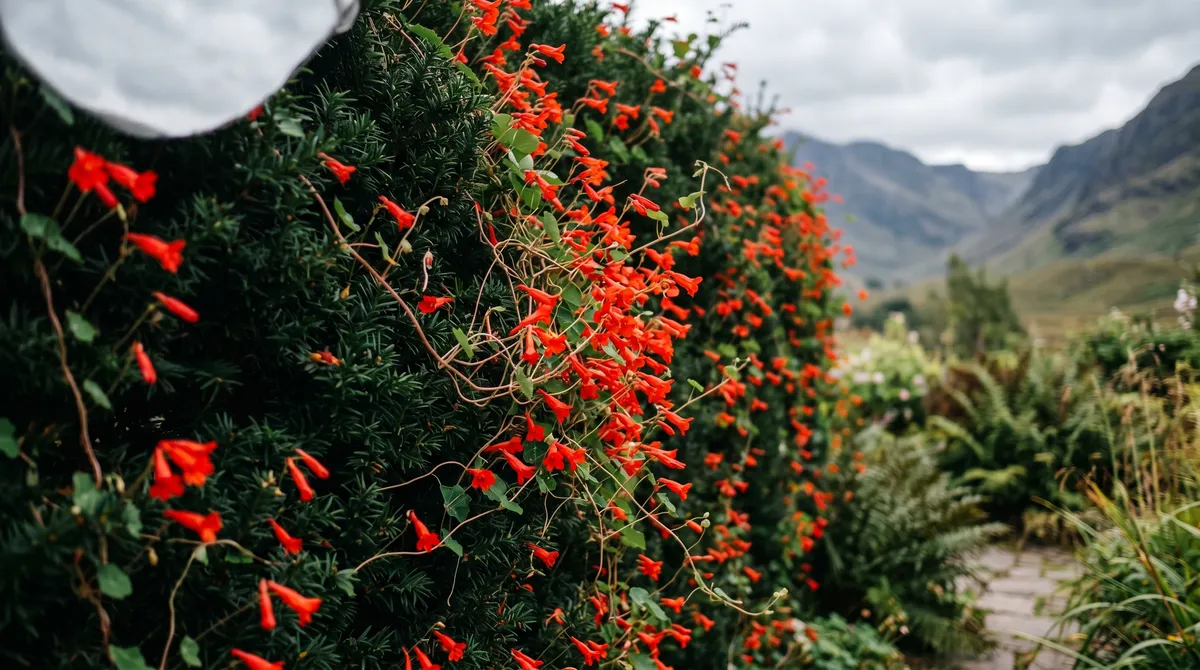
- Dark green yew foliage makes scarlet flowers visibly pop in a way pale or variegated shrubs cannot
Other proven UK partners include:
- Holly (Ilex aquifolium): similar shade and dark foliage
- Common rhododendron and large hybrids: matched acid soil preferences
- Evergreen viburnums (Viburnum tinus, V. davidii): cool root run
- Mature heathers (Erica arborea): shared acid soil, smaller scale
Avoid sun-loving silver-leaved shrubs like olive, lavender, and Mediterranean plants. The soil and aspect requirements are opposite.
For more on planting climbers through hedges, see our hedge planting guide for the UK.
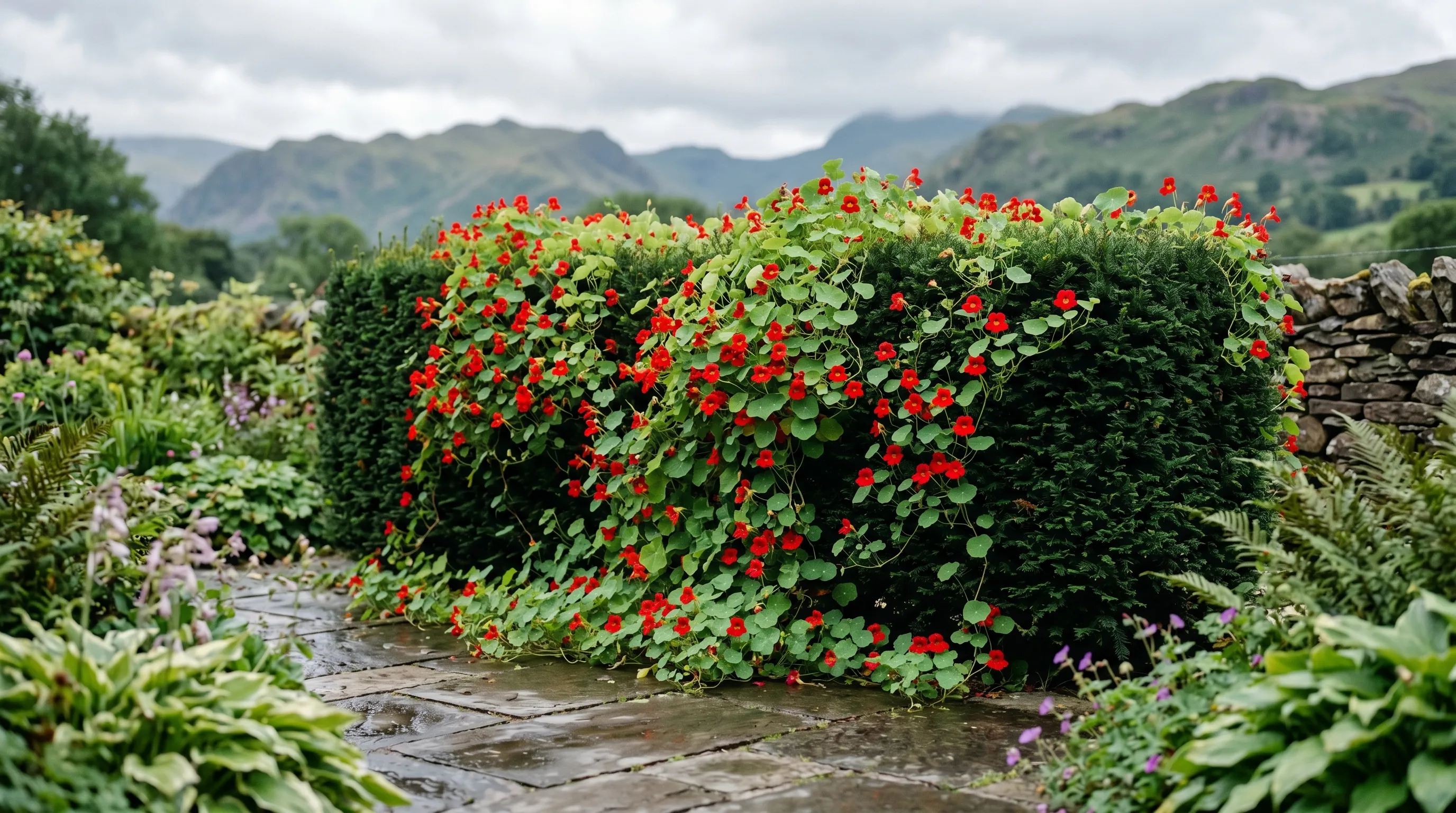 Mature Tropaeolum speciosum covering 2 metres of clipped yew hedge in a Lake District garden in late August. The dark yew foliage intensifies the scarlet flower colour.
Gardener’s tip: Plant Tropaeolum speciosum 450-600mm out from the base of the host shrub, not directly against it. This avoids competition for moisture during the climber’s establishment years and lets you mulch the rhizome zone without damaging the host’s root flare.
How Tropaeolum speciosum differs from related Tropaeolum species
The genus contains around 80 species, several of which are grown in UK gardens. Knowing which is which prevents the wrong plant for the wrong site.
| Species | Common name | Habit | Hardiness | Best UK use |
|---|---|---|---|---|
| Tropaeolum speciosum | Scottish Flame Flower | Perennial climber 3-4m | H5 (-15C) | Cool wet acidic gardens, hedges |
| Tropaeolum majus | Common nasturtium | Annual trailer/climber to 2m | Half-hardy annual | All UK, edible flowers and leaves |
| Tropaeolum tuberosum | Mashua, anu | Perennial tuber climber 2-3m | H3 (-5C) | Mild south-west, edible tubers |
| Tropaeolum tricolor | Three-coloured nasturtium | Tuberous climber 1-2m | H2 (frost tender) | Cool greenhouse only |
| Tropaeolum polyphyllum | Greyleaf nasturtium | Trailing perennial 30cm | H4 (-10C) | Sunny scree and rock gardens |
For the annual species, see our how to grow nasturtiums in the UK guide. The annual is the polar opposite of speciosum: it likes sun, dry soil, neutral pH, and warmth.
Common mistakes
Planting on alkaline soil without amendment
Tropaeolum speciosum simply cannot establish on chalk or limestone soils above pH 7.0. Adding a single bag of ericaceous compost is not enough. Either dig a 1m³ pit and replace the soil with a custom acidic mix, or accept that this is not a plant for your garden.
Planting in full sun
Even in Scotland, full sun bakes the rhizome zone. The classic image of scarlet flowers in sunshine misleads gardeners. The plant grows in shade or part shade. The flowers reach the sun by scrambling up through the host shrub, but the roots stay buried in cool shadow.
Disturbing during summer dormancy
Plants that vanish in July are not dead. Digging up the rhizome to check kills it. Mark the position with a cane in spring so you know where it sits. Leave the soil undisturbed.
Watering with tap water in hard-water areas
Tap water in chalk and limestone regions has a pH of 7.5-8.2 and gradually raises soil pH around the rhizome. Use rainwater from a butt where possible, especially during the establishment years.
Expecting flowers in year one
Even in ideal Scottish conditions, first flowers usually appear in year two or three. In trickier sites it can take five years. Patience is non-negotiable. The plant is establishing a substantial underground rhizome system in years one and two.
Month-by-month Tropaeolum speciosum calendar
| Month | Task |
|---|---|
| January | Source named rhizomes from specialist UK nurseries. Crocus and Crug Farm are reliable |
| February | Prepare planting pocket on a north or east aspect near a yew or holly hedge |
| March | Plant rhizomes once soil temperature reaches 6C. Cornwall first, Scotland mid-April |
| April | Main planting month for most UK regions. Mulch with 50mm bracken or pine needles |
| May | First shoots emerge from established plants. Water with rainwater if dry |
| June | Climbing growth phase. New plants reach 0.5-1m, established plants 1.5-2.5m |
| July | First flowers in cool wet regions. Watch for summer dormancy in warmer sites |
| August | Peak flowering in most UK regions. Photograph for plant association reference |
| September | Late flowering. Blue berries forming. Stop deadheading to let berries develop |
| October | Top growth dies back to soil level. Apply autumn mulch of leaf mould |
| November | Plant fully dormant. Mark position with cane to avoid disturbing rhizome |
| December | Rest. Ericaceous mulch protects rhizome through winter |
Cost breakdown for a Tropaeolum speciosum yew hedge planting
| Item | Cost (UK 2026) | Notes |
|---|---|---|
| Named rhizome (Crocus or Crug Farm) | £14-£20 | Plant 1-2 for a 3m hedge run |
| Ericaceous compost (60 litres) | £12 | Two bags for soil amendment |
| Leaf mould (homemade or sourced) | £0-£8 | Best free, or buy by the bag |
| Bracken or pine needle mulch | £5-£10 | Annual refresh |
| Rainwater butt 200L if you don’t have one | £35-£60 | Essential in hard-water areas |
| Total first year | £66-£110 | One plant for 3m of hedge |
| Annual maintenance | £8-£15 | Mulch refresh only |
A mature Tropaeolum speciosum costs nothing once established and runs reliably for 15-20 years on a suitable site. Compared to annual climbers that need replanting every spring, it is excellent value if your climate suits it.
Where to see Tropaeolum speciosum in the UK
Several public gardens hold outstanding specimens that justify a visit if you are uncertain whether to attempt it at home.
- Royal Botanic Garden Edinburgh (Woodland Garden, late August)
- Inverewe Garden, Wester Ross (scrambling through native rhododendrons)
- Crarae Garden, Loch Fyne (Argyll’s classic Tropaeolum collection)
- Bodnant Garden, North Wales (Dell, late summer)
- Hidcote Manor Garden, Cotswolds (one of the few successful southern sites, north-facing aspect)
Visit in late August for peak flowering across most sites. The Plantlife conservation charity features Tropaeolum speciosum as an exemplar of how regional climate dictates which non-native plants thrive in UK gardens.
 Inspecting a thriving Tropaeolum speciosum on the west coast of Scotland in late August. The cool, damp climate is ideal for the species.
Pairing Tropaeolum speciosum with passionflower and other climbers
In larger Scottish and Cumbrian gardens, several climbers can share a wall or hedge if the conditions overlap. Pair with Clematis viticella types that also enjoy cool root runs and acid-tolerant soils. Avoid pairing with passionflower, which prefers warm, well-drained, alkaline-to-neutral conditions and demands a sunny wall.
The scarlet of Tropaeolum speciosum sits well alongside the deep purples of late-flowering Clematis viticella ‘Etoile Violette’ and the pale yellow of Eccremocarpus scaber if your climate supports it. The combination flowers from late July to October.
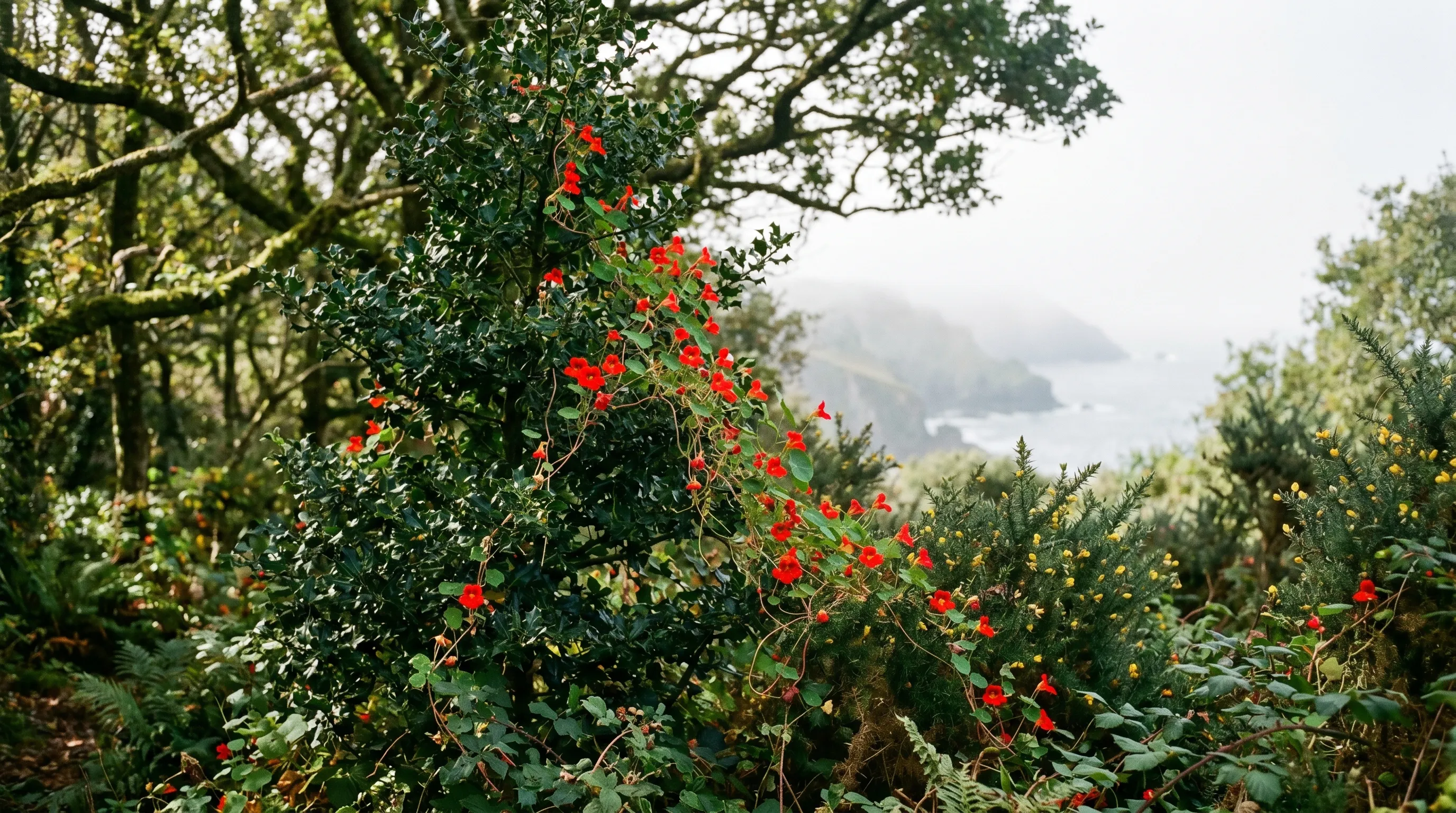 Tropaeolum speciosum scrambling at the woodland edge of a Cornish coastal garden. The Atlantic mist and acidic soils suit the species perfectly.
Frequently asked questions
Why won’t my Tropaeolum speciosum flower?
Tropaeolum speciosum needs 2-3 years from planting before reliable flowering, and may fail to flower at all in soil over pH 6.5 or in hot dry positions. Check soil pH first using a £5 test kit. If above 6.5, mulch annually with ericaceous compost and pine needles. The plant needs cool moist roots and an acid soil to flower. Hot, dry, alkaline conditions cause leaf growth without flowers.
Where in the UK does Tropaeolum speciosum grow best?
Tropaeolum speciosum thrives in cool, wet, acidic regions: western Scotland, the Lake District, Snowdonia, and Cornwall. These areas have summer temperatures below 22C, annual rainfall above 1,200mm, and naturally acidic soils. Southern English gardens with limestone soils and hot dry summers usually fail. The Highlands and Argyll have the best UK success rates.
How deep do I plant Tropaeolum speciosum rhizomes?
Plant Tropaeolum speciosum rhizomes horizontally at 75-100mm deep in moist, acidic soil with the growing tip pointing toward the support plant. Cover with leaf mould and water in. Mulch with 50mm of bracken or pine needles to keep roots cool. Plant in spring once soil temperature reaches 8C. Autumn planting is unreliable on heavy soils that waterlog.
Does Tropaeolum speciosum die back in winter?
Yes, Tropaeolum speciosum is fully herbaceous and dies back to the rhizome each autumn, regrowing from soil level in late spring. New shoots appear in May or June and grow rapidly through summer. Some plants also disappear briefly in midsummer if conditions are dry, returning in late summer. This summer dormancy is normal in southern UK and is not a sign of plant death.
What plants pair well with Tropaeolum speciosum?
Yew, holly, dark conifers, and red-flowered rhododendrons are the classic UK partners for Tropaeolum speciosum. The scarlet flowers stand out best against dense, dark green foliage. Yew is the traditional pairing, particularly in Scottish and Cumbrian gardens. The plant also scrambles successfully through hollies, evergreen viburnums, and large mature heathers. Avoid pale-leaved or variegated shrubs which dilute the colour impact.
Next steps
Now you’ve mastered Tropaeolum speciosum, read our best climbing plants for UK gardens guide for the next step in choosing climbers that suit your soil and aspect.
Our team produces practical UK gardening guidance from source research, contributor records and established horticultural practice. Editorial standards are overseen by Matt W.