Key takeaways
- Cold compost takes 12-18 months but needs zero work after building - the lazy gardener's method
- Fast compost takes 6-9 months at 30-45C with monthly turning - realistic for most UK gardens
- Hot compost takes 8-12 weeks at 55-65C - kills weed seeds and pathogens but needs 1m cubed minimum
- Brown to green ratio: 3:1 by volume for fast and hot piles, 4:1 for cold piles
- Pile size drives temperature - 1m cubed minimum to reach hot composting temperatures
- Moisture stays at wrung-out-sponge dampness throughout - too wet smells, too dry stalls
Composting turns kitchen waste, grass clippings and autumn leaves into the single most valuable soil amendment a UK garden can have. Three methods produce finished compost over very different timescales: a cold pile takes 12-18 months and needs zero work, a fast pile takes 6-9 months with occasional turning, and a hot pile takes 8-12 weeks but demands serious volume and weekly attention.
For the general principles of composting (bin choice, layering basics, what to add and avoid), our how to make compost at home guide is the companion piece. This article goes deeper on the three-method comparison.
The three composting methods at a glance
Each method sits at a different point on the time-effort tradeoff curve:
| Method | Time to finish | Pile temperature | Effort | Pile size |
|---|---|---|---|---|
| Cold | 12-18 months | Ambient | None after building | Any |
| Fast | 6-9 months | 30-45C | Monthly turning | 0.5m cubed minimum |
| Hot | 8-12 weeks | 55-65C | Weekly turning, moisture checks | 1m cubed minimum |
The right method for any UK gardener depends on three variables:
- How much material you generate - a small back garden producing two bins of kitchen waste a month can only run cold composting. A productive allotment generating two wheelbarrows of green waste a week can sustain a hot pile.
- How much time you can give it - hot composting needs a real weekly 15-30 minute commitment. Cold composting needs zero ongoing time.
- What you want the compost for - weed seeds and disease pathogens survive cold and fast composting. Only hot composting kills them. If you compost perennial weed roots or diseased plant material, you need hot.
Cold composting - the lazy gardener’s method
Cold composting is the default approach for most UK back gardens. You build a pile (or open bin) at whatever pace your garden generates material, add things as they come, and ignore the pile for a year and a half until the bottom layer has turned into compost.
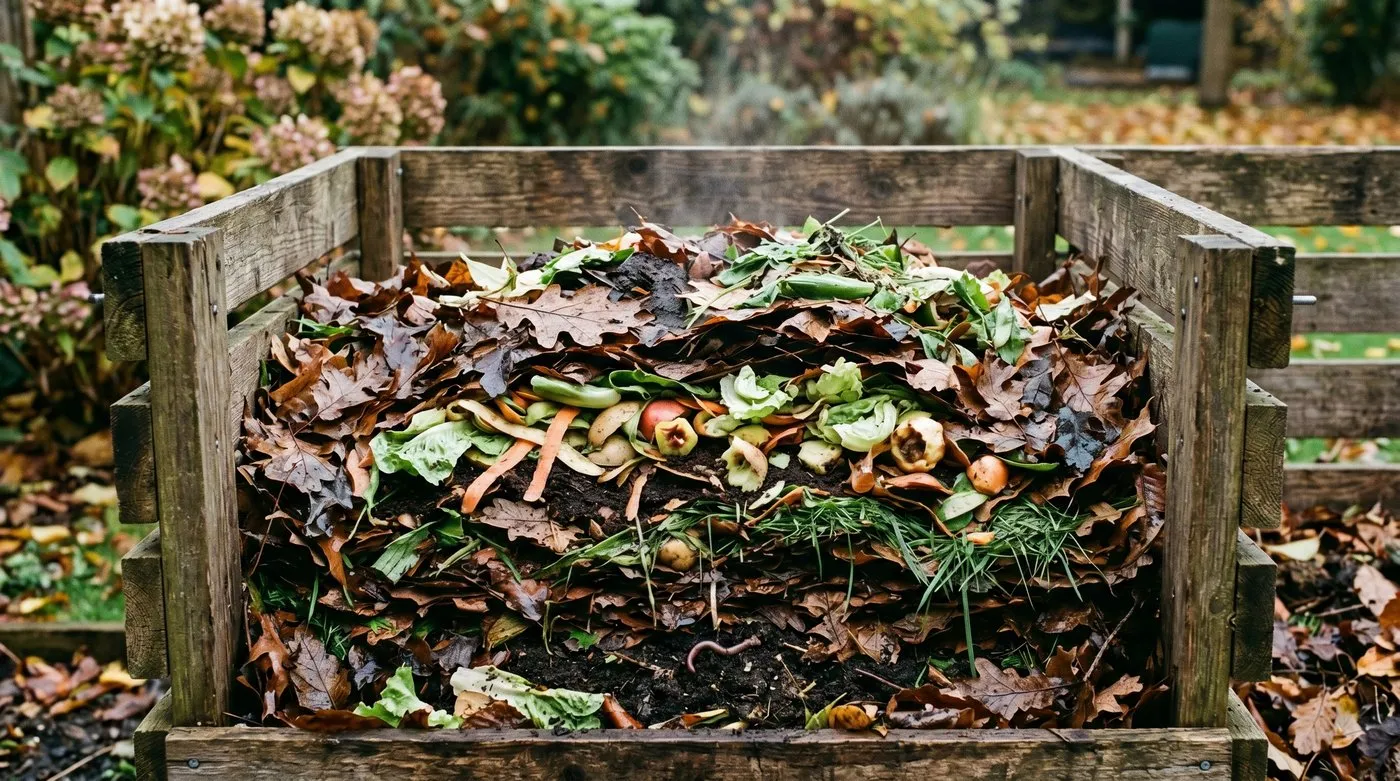 Cold compost works on layering rather than mixing. Autumn leaves and grass clippings stratify naturally as the pile builds.
How it works
The pile runs at ambient garden temperature - 15-25C in summer, 0-10C in winter. Decomposition happens through fungi and earthworms rather than the bacteria that drive hot composting. Worms and woodlice colonise the lower layers within 4-6 weeks. The bottom 20-30cm finishes first; the top is still half-recognisable a year in.
Best for
- Small UK gardens generating less than 100 litres of waste per month
- Renters or short-term tenants who do not want long-term installations
- Gardeners who want zero ongoing labour
- People who do not care about killing weed seeds (no problem weeds in their garden)
Setup
Three options work for cold composting in UK conditions:
- Dalek-style plastic bin (200-300L capacity, council-supplied or £25-£45 from garden centres). Sits anywhere, includes lid to keep rain off, opens at the base to extract finished compost.
- Wooden pallet bay (free if you can source 3-4 pallets, lash with wire). Holds up to 1m cubed. Open front for easy access.
- Open heap on bare soil (no container at all). Decomposes slowly but allows worm migration from the soil below.
Brown to green ratio
4:1 by volume - more browns than for active composting. The excess browns prevent compaction and keep enough air pockets for the slower decomposition.
Common UK browns: shredded cardboard, autumn leaves, dried grass clippings, straw, sawdust, used tea bags (paper varieties only).
Common UK greens: fresh grass clippings, vegetable peelings, coffee grounds, soft prunings, annual weeds without seed.
Finishing time
12-18 months from the date of the last addition to the date the bottom layer becomes usable compost. Pile the next year’s material on top of the still-finishing previous year’s material - the system runs continuously.
Limits
Does not kill weed seeds. Does not destroy plant pathogens. Slows almost to a stop from December to February. Bulk reduction is roughly 60-70%, meaning a metre of input becomes 30-40cm of compost.
Hot composting - the fast intensive method
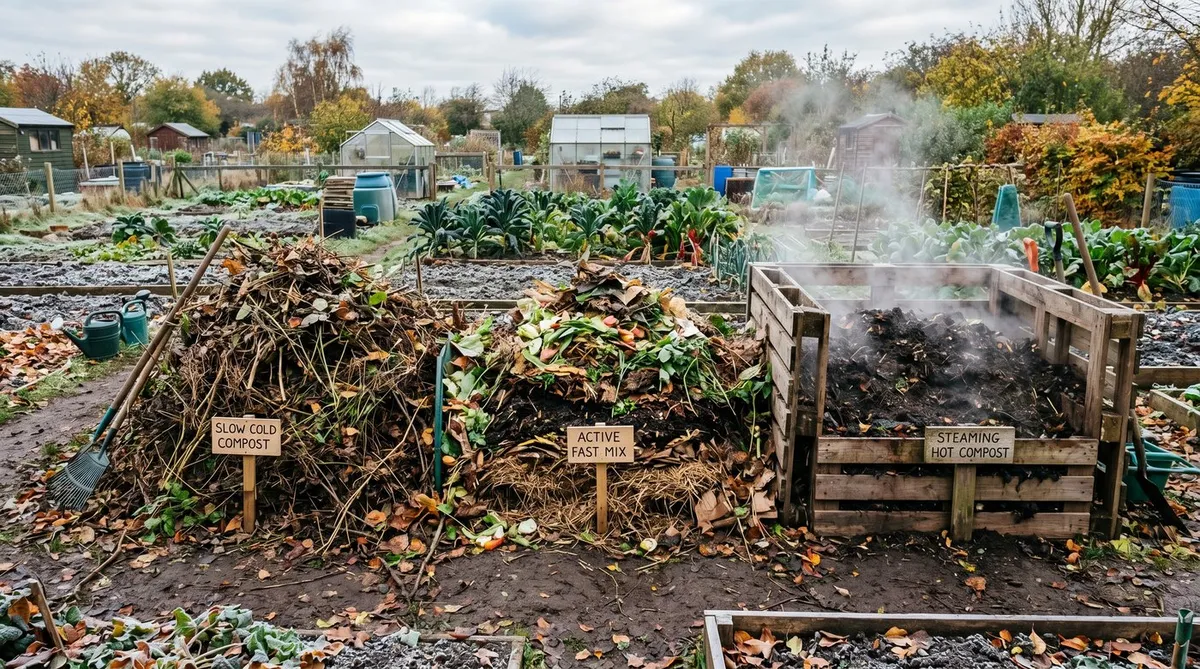
Hot composting is the opposite of cold. The pile is built in a single event (not added to over time), reaches 55-65C within 5-7 days, and produces finished compost within 8-12 weeks. Heat is generated by thermophilic bacteria breaking down the carbon and nitrogen materials.
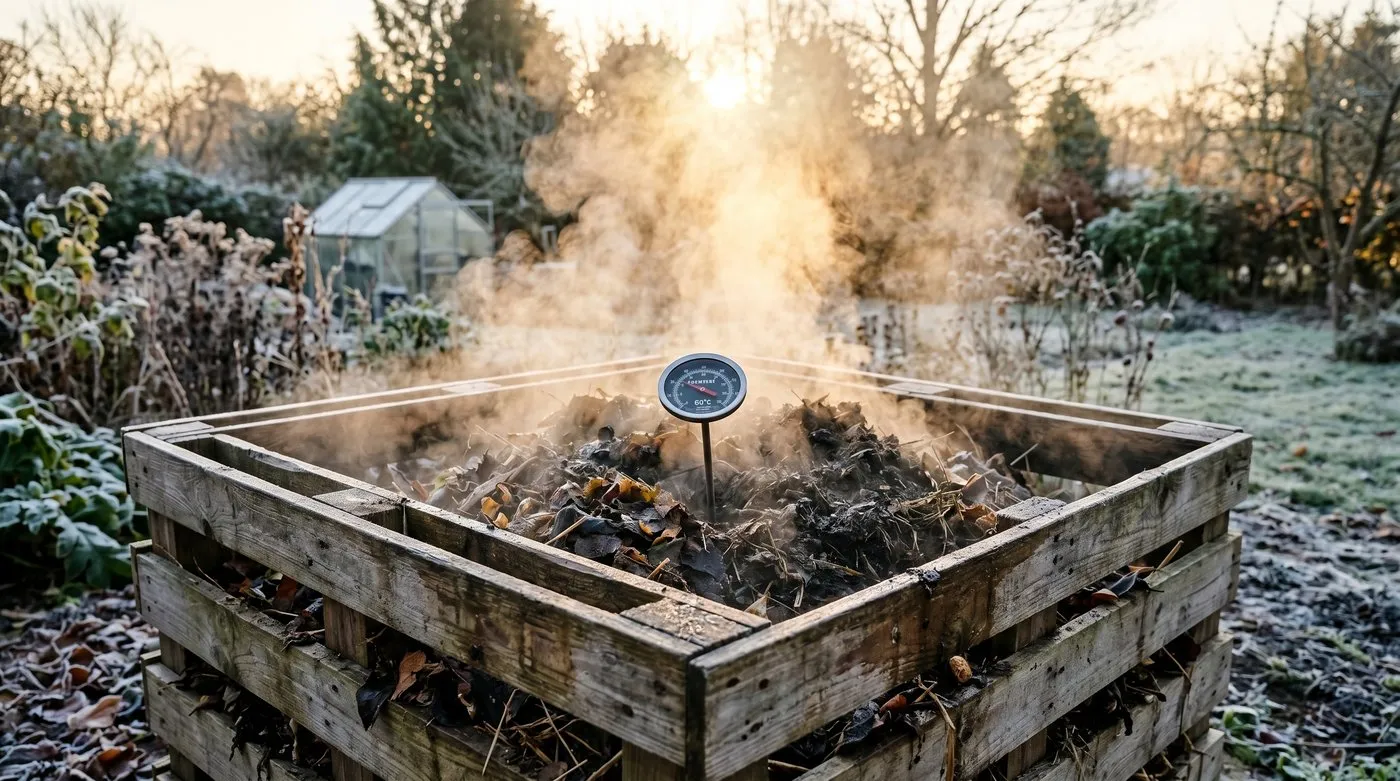 A hot pile in active phase. Visible steam on cold mornings is the giveaway sign that the core has reached the 55-65C target.
How it works
A pile of 1 cubic metre or more, built in a single building event with the right C:N ratio, reaches a core temperature of 55-65C within 5-7 days through bacterial activity. The high temperature kills weed seeds, plant pathogens and most soil-borne pests. Turning every 3-5 days reintroduces oxygen and brings outer material into the hot core.
Best for
- Allotment growers and serious UK kitchen gardens
- Anyone composting perennial weed roots (bindweed, couch grass, ground elder)
- Anyone composting diseased plant material (tomato blight foliage, club-root brassicas)
- Households with high green waste volumes (multiple wheelbarrows per week in growing season)
- Gardeners who want finished compost on a predictable timeline
Setup requirements
- Volume. 1 cubic metre is the absolute minimum. Smaller piles cannot retain enough heat to reach 55C in UK ambient conditions. 1.2x1.2x1.2m gives consistent results.
- Build the pile in a single event. Stockpile materials for 2-4 weeks first, then build the full pile in one afternoon. Adding fresh material later disrupts the heating cycle.
- 3:1 brown to green ratio by volume. Hot composting demands more nitrogen than cold composting. Fresh grass clippings, kitchen waste and chicken manure are the high-nitrogen options.
- Moisture at 50-60%. A handful squeezed should feel like a wrung-out sponge - damp but no water dripping out. Hose down dry browns as you build.
- Open or air-vented container. A solid wooden box overheats and cooks the contents. Pallets with gaps work perfectly.
Building method
- Site on bare soil (allows worms to migrate in once it cools) or paving slab (cleaner finish, no soil-pest entry).
- Layer browns and greens alternately, 100mm browns then 50mm greens, repeating until the pile reaches 1m+ tall.
- Water each browns layer as you build - the dry leaves and cardboard need wetting through.
- Top with a thick browns layer to insulate.
- Cover with old carpet, hessian sack, or breathable tarpaulin to retain moisture and heat.
Day-by-day timeline
| Day | What is happening | What to do |
|---|---|---|
| 0 | Pile built, ambient temperature | Check moisture |
| 1-3 | Mesophilic bacteria active, temperature climbing | Monitor core temp |
| 4-7 | Thermophilic phase begins, 55-65C in core | Verify 55C+ reached |
| 8 | First turn - move outer material to centre | Re-check moisture |
| 12-15 | Second turn | Add water if temp drops below 55C |
| 18-25 | Third turn, temperature begins falling | Stop turning |
| 28-50 | Cooling phase, fungi and actinomycetes active | Leave alone |
| 50-90 | Maturation, worms colonise from underneath | Leave alone |
| 60-90 | Compost finished, dark crumbly texture | Use or store |
Probe thermometer is essential. A long stem thermometer (40-60cm probe) costs £15-£25 and lets you confirm the pile actually reached the hot phase. Without one, you are guessing.
For finished-compost integration into heavy ground, see our no-dig heavy clay soil guide.
Fast composting - the middle ground
Fast composting sits between cold and hot. The pile reaches 30-45C (warm to the touch but not steaming), produces compost in 6-9 months, and requires monthly turning. It is the method most UK allotment holders run because it works without the volume and effort of hot composting but produces a better-quality finished product than cold.
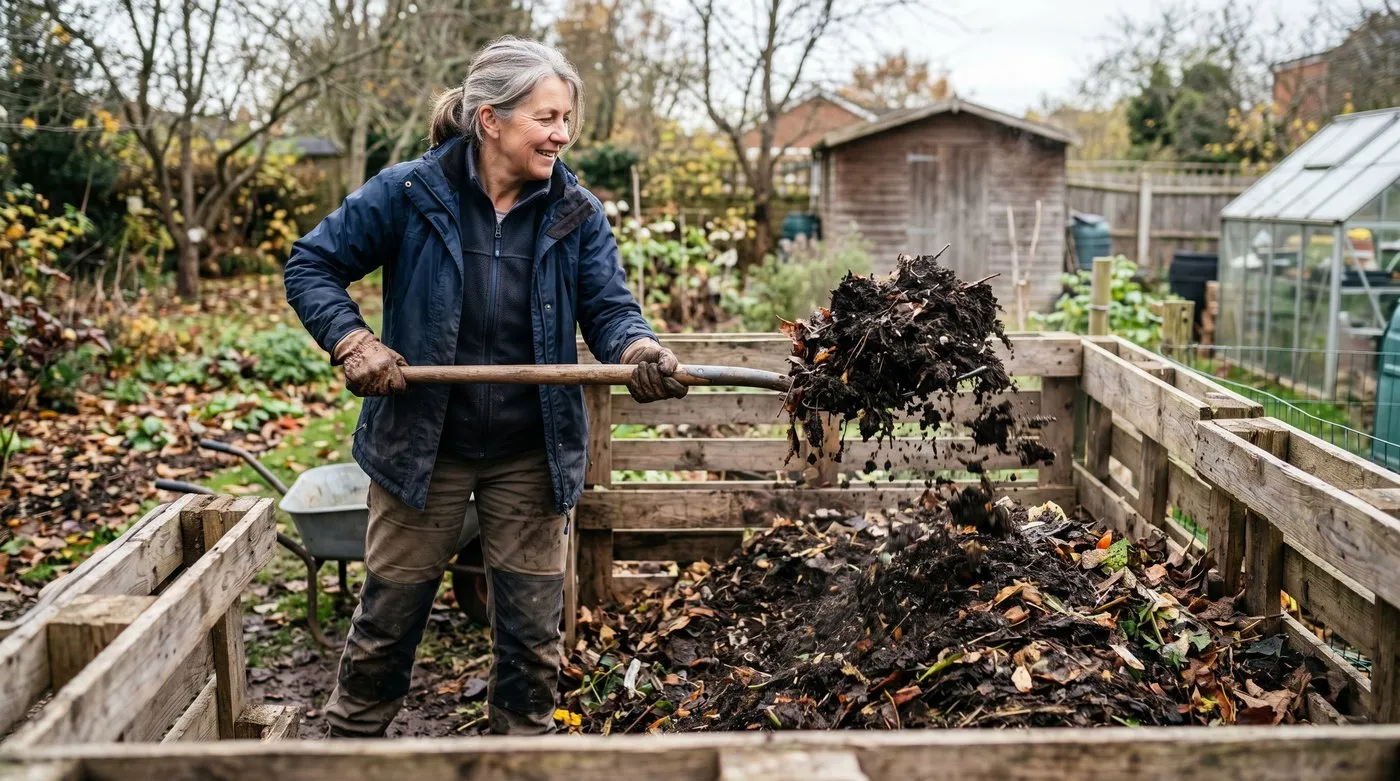 Turning fast compost monthly is the only effort required. The fork lifts the top to the bottom and the dry edges to the centre.
How it works
A pile of 0.5-1.0 cubic metres, built over 2-4 weeks of garden activity and turned once a month, reaches 30-45C in the core. The temperature kills some weed seeds (especially annual weeds like chickweed) but not perennial roots. Decomposition runs about twice as fast as cold composting because the warm-bacteria phase is active.
Best for
- Most UK allotment plots and back gardens with regular garden waste
- Gardeners willing to spend 15 minutes a month turning the pile
- Households with moderate green waste (a wheelbarrow per week in season)
- Anyone who wants finished compost in time for the next spring’s beds
Setup
Pallet bay or large compost bin, 0.5-1.0 cubic metre capacity. Add materials as they come from the garden for 2-4 weeks. When the pile reaches 0.5m+ tall, turn it for the first time and stop adding new material. Continue turning monthly until finished.
Brown to green ratio
3:1 by volume - same as hot composting. The lower volume cannot sustain the bacterial activity needed for high heat, but the same chemistry applies.
Finishing time
6-9 months in UK conditions. A pile built in April finishes in October. A pile built in August finishes the following April-May.
Limits
Will not kill perennial weed roots or persistent pathogens. Quality of finished compost is excellent - typically better-looking than hot compost because the slower maturation produces more complete decomposition.
Brown and green materials - the UK list
The carbon-to-nitrogen ratio is the single most important variable in any compost method. Here is the UK garden materials list with rough C:N ratios:
| Material | Category | C:N ratio | Notes |
|---|---|---|---|
| Browns (carbon-rich) | |||
| Autumn leaves | Brown | 60:1 | Free, plentiful Oct-Nov |
| Cardboard (uncoloured) | Brown | 350:1 | Shred for faster breakdown |
| Newspaper (black ink only) | Brown | 175:1 | Use sparingly, compacts |
| Straw | Brown | 80:1 | From hay merchants, allotment stores |
| Dried grass clippings | Brown | 30:1 | If left to dry first |
| Wood chip | Brown | 400:1 | Very slow, use in small amounts |
| Sawdust (untreated) | Brown | 500:1 | Tiny amounts only - hydrophobic |
| Coffee filter papers | Brown | 175:1 | With the grounds |
| Greens (nitrogen-rich) | |||
| Fresh grass clippings | Green | 17:1 | Mix with browns or compacts |
| Vegetable kitchen peelings | Green | 25:1 | Avoid cooked food |
| Coffee grounds | Green | 20:1 | Acidic but harmless in mix |
| Chicken manure (with bedding) | Green | 12:1 | The fastest activator |
| Comfrey leaves | Green | 10:1 | Quickest natural activator |
| Soft pruning trimmings | Green | 25:1 | Chop into 10cm pieces |
| Annual weeds (no seeds) | Green | 30:1 | Fine in any method |
The target overall mix ratio for a working pile is 25-30:1 carbon to nitrogen. Browns and greens combined at the right volume ratio (3:1 or 4:1 by volume) hit this naturally.
Moisture - the variable that catches people out
Moisture management is the most common failure point in UK composting. Three rules:
Wrung-out sponge dampness throughout. A handful squeezed should release one or two drops of water. Drier than that and decomposition stalls. Wetter than that and the pile goes anaerobic, smells terrible, and produces a slimy mess.
Check weekly during dry summers. A south-facing pile in a heatwave can dry out completely in 7-10 days. Water with a 10-20 litre can if the top 20cm feels dry.
Cover during wet winters. UK rainfall can waterlog open piles. A breathable cover (carpet, hessian, sack-cloth) lets vapour escape but sheds rain.
If the pile is too wet, mix in 100mm of dry browns (shredded cardboard, autumn leaves) across the surface and turn. Repeat until the moisture is right. If the pile is too dry, water through every 100mm layer as you turn.
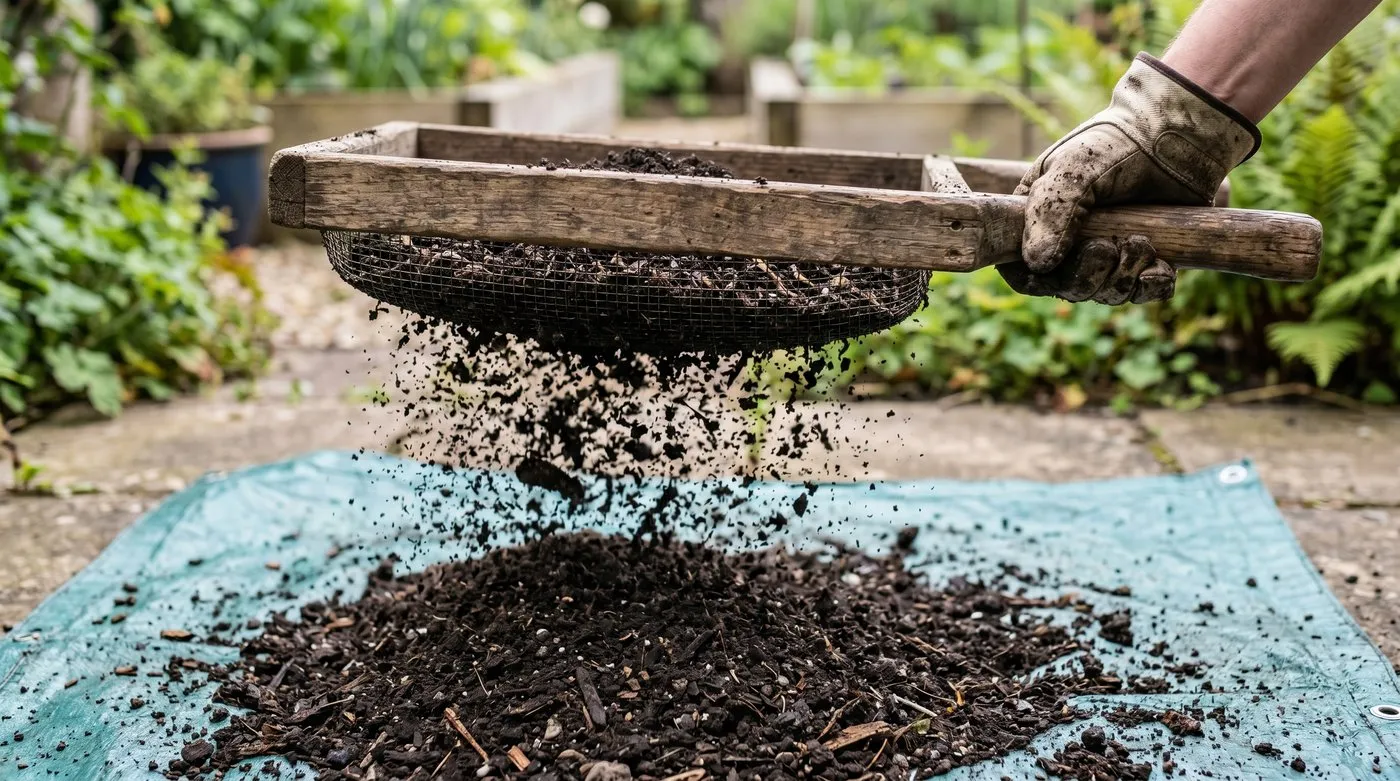 Finished compost should be dark, crumbly, and smell of woodland soil. Sieving through a 10mm riddle separates the usable fines from undecomposed sticks and stones for return to the next pile.
What goes in - and what to keep out
Most UK garden and kitchen waste composts safely. A few categories cause real problems:
Always avoid:
- Cooked food (attracts rats, slow decomposition)
- Meat and fish (attracts rats and foxes, smell)
- Dairy products (attracts rats, smell)
- Cooking oil and fat (water-shedding, slows decomposition)
- Cat or dog faeces (pathogen risk)
- Diseased plants (cold/fast piles only - hot can handle)
- Persistent weed roots (cold/fast piles only)
- Coloured or glossy paper (printing chemicals)
- Coal or barbecue ash (heavy metals)
Safe in any method:
- Fruit and vegetable peelings
- Coffee grounds (with paper filters)
- Tea bags (paper type only - some contain plastic)
- Eggshells (crushed for faster breakdown)
- Hair, feathers, wool (slow but fine)
- Wood ash from untreated timber (small amounts, raises pH)
- Annual weeds without seedheads
- Soft pruning trimmings under 1cm thick
- Spent compost from containers
Hot method only (60C+ to be safe):
- Perennial weed roots (bindweed, couch grass, ground elder)
- Diseased plant foliage (blight, club-root, rust)
- Weed seedheads
For wildlife implications of where you site your compost heap, see our composting for wildlife guide.
Common problems and fixes
Pile not heating up. Too small (under 1 cubic metre for hot), too dry, or not enough green nitrogen. Add 50mm of fresh grass clippings or vegetable waste, water in, turn. Should heat within 48 hours.
Pile smells of ammonia. Too much nitrogen. Add 50-100mm of dry browns (cardboard, leaves), turn. Smell clears in 2-3 days.
Pile smells rotten or like rotten eggs. Too wet, going anaerobic. Tip out, add dry browns, rebuild with better drainage.
Compost finished but full of undecomposed sticks. Normal for any method. Sieve through a 10mm garden riddle - return the larger fragments to the next pile.
Rats in the heap. Caused by including cooked food, meat or dairy. Stop adding these immediately. Cover with a layer of fresh greens (rats dislike fresh decomposition). Place a paving slab on top to discourage tunnelling.
Slugs at the heap. Normal and beneficial - slugs at compost heaps eat decaying material rather than living plants. Welcome them. They cycle the material faster than the bacteria alone.
Pile too wet from rain. Cover with breathable tarpaulin or carpet. If saturated, tip out, mix in 30% browns by volume, rebuild on a slope so excess drains.
How to use finished compost
Finished compost has three main uses in a UK garden:
Soil improvement. Spread 50mm on bare beds in autumn and dig in over winter (or leave on top under the no-dig method). Improves clay drainage, sandy water retention and provides slow-release nutrients across the next growing season.
Top dressing. Spread 25-50mm around established perennials, shrubs and fruit bushes in spring. Mulch effect plus slow nutrient feed. Hungry annuals respond well to the same treatment: a compost-enriched bed gives tall feeders like cleome (spider flower) the steady moisture and nutrients they need to flower all summer.
Potting mix component. Sieved finished compost works as 25-40% of a homemade potting mix (blended with topsoil, leaf mould and a little grit). Pure compost is too rich for seedlings - use it as an ingredient, not the base.
For specific clay soil rescue using finished compost, see our no-dig heavy clay soil guide.
Bokashi, leaf mould and wormeries - alternative methods
Three alternative composting systems suit UK gardeners with specific needs:
Bokashi composting ferments kitchen waste in a sealed bucket using bran inoculated with effective microorganisms. Takes 4-6 weeks to ferment, then needs burying in soil to complete decomposition. Handles cooked food, meat and dairy that cannot go in standard compost. See our bokashi composting UK guide for the full setup.
Leaf mould is the autumn-leaves-only method. Bag the leaves wet and forget for 18-24 months. The result is a crumbly, fungal-decomposed soil improver that is the best of all UK compost types for seedling and houseplant mixes.
Compost tea - liquid feed from finished compost
If you want a fast-acting liquid feed from finished compost, brew compost tea by steeping 1kg of finished compost in 10 litres of rainwater for 24-48 hours, then diluting 1:10 before applying as a foliar or root drench. See our how to make compost tea UK guide for the full brewing method.
Decision tree - which method should you use?
Answer four questions:
- Do you generate more than a wheelbarrow of green waste per week in season? No → cold composting. Yes → continue.
- Do you have space for a 1m cubed bay? No → fast composting in a smaller bay. Yes → continue.
- Are you willing to spend 30 minutes a week on the compost heap? No → fast composting. Yes → continue.
- Do you need to kill weed seeds or compost diseased material? No → fast composting still fine. Yes → hot composting.
Most UK gardeners end up running fast composting. It is the realistic method for the typical allotment-or-suburban-garden waste volume and time budget. Cold suits the smallest gardens. Hot suits the most committed growers.
Field note: The RHS and Garden Organic both publish detailed UK composting research. Garden Organic’s home composting research is the longest-running UK trial dataset and remains the standard reference for amateur composting.
Month-by-month UK composting calendar
| Month | Cold pile | Fast pile | Hot pile |
|---|---|---|---|
| Jan | Dormant | Final turn before winter | Insulate or rebuild |
| Feb | Dormant | Dormant | Build first pile of year |
| Mar | First worms returning | Monthly turn resumes | Active, turn twice |
| Apr | Add spring weeds | Build second pile | Turn twice |
| May | Continue adding | Active turning | First pile finishes |
| Jun | Active decomposition | Active turning | Build second |
| Jul | Water if dry | Watch moisture | Watch moisture closely |
| Aug | Continue adding | Active | Second pile finishes |
| Sep | Add cleared annuals | Active | Build third |
| Oct | Add autumn leaves | Add leaves | Third pile finishes |
| Nov | Final additions | Insulate | Rebuild for winter |
| Dec | Dormant | Dormant | Wrap with carpet |
Now you’ve understood the methods
For the general principles of building a working compost system from scratch including bin selection, layering technique and the wider material list, read our how to make compost at home which is the foundational guide that complements this methods-focused article.
Our team produces practical UK gardening guidance from source research, contributor records and established horticultural practice. Editorial standards are overseen by Matt W.