Key takeaways
- Crown lift lower branches to 2-3m to flood light underneath while keeping the screen above eye level
- Never thin more than 10-30 percent of the canopy in one year or you trigger water-shoot regrowth
- Crown reduction shortens height and spread by up to a third, cut back to a growth point at least a third of the stem's width
- Prune most deciduous trees in winter dormancy, but prune Prunus (cherry, plum) only June to August to dodge silver leaf
- Check for a Tree Preservation Order or Conservation Area before any cut; unauthorised work fines reach into the thousands
- Avoid the bird nesting season, March to August, protected under the Wildlife and Countryside Act 1981
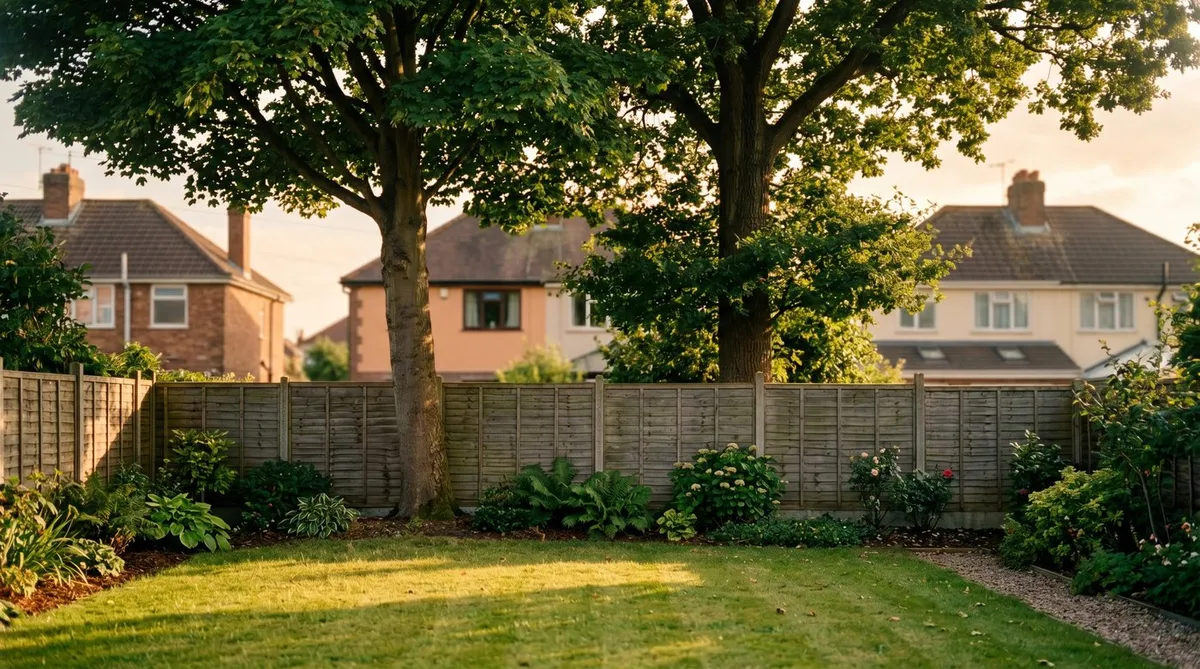
Pruning trees for privacy and light is a balancing act. You want the screen that hides the neighbours, but not at the cost of a dark, sunless garden. The good news is that the right cuts do both at once. Pruning trees for privacy and light works by keeping the screen at eye level while opening the canopy so daylight returns to the lawn and the house behind it.
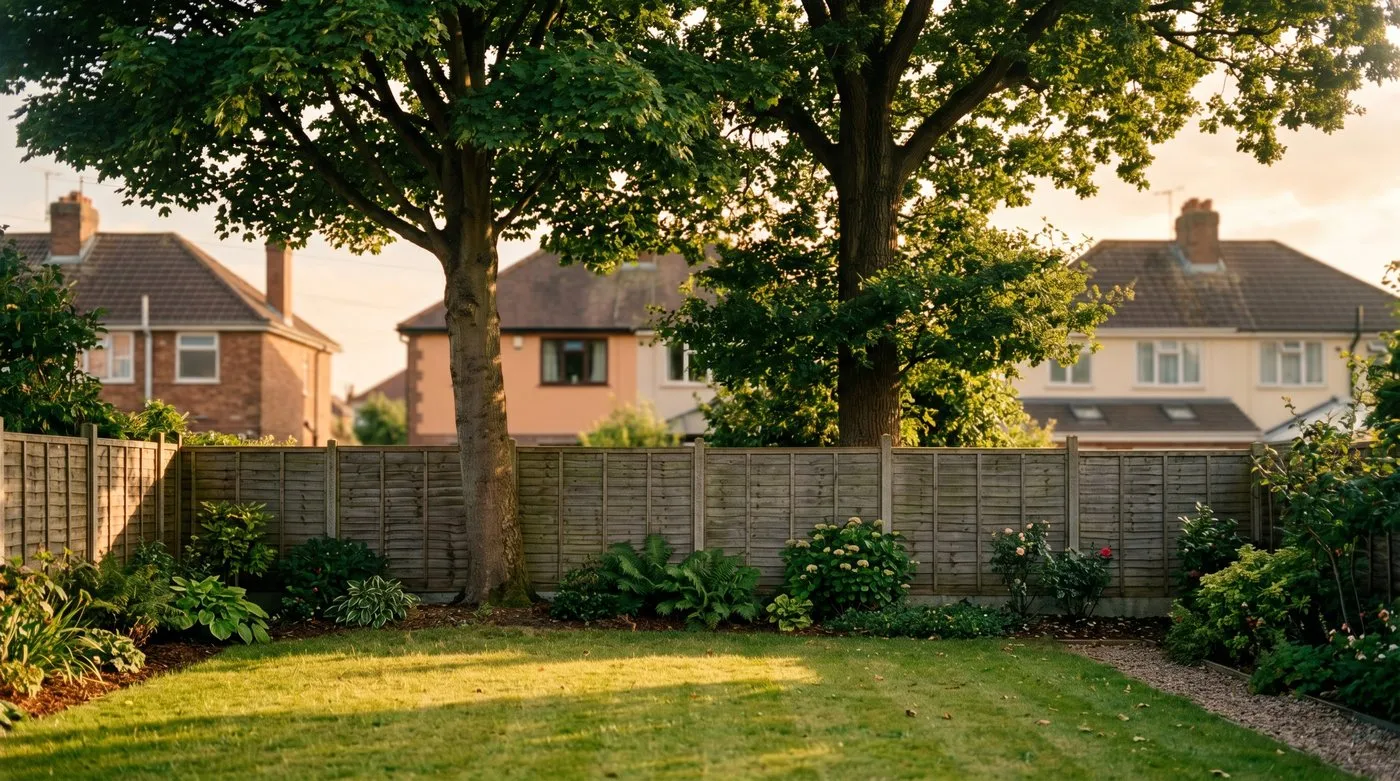
How to keep privacy and still get light back
The trick is to screen at eye level and above, while clearing the canopy lower down and inside. Privacy works from roughly 1.7m upward, the height of a standing adult looking over a fence. Light is lost mostly from a dense lower skirt of branches and an overcrowded inner canopy. So you remove the parts that block light without touching the parts that screen.
Three core techniques do the job, used alone or together. Crown lifting raises the bottom of the canopy. Crown thinning opens the inside. Crown reduction brings down an over-tall or wide tree. Each one keeps the outer screen intact while letting more daylight through. None of them means topping the tree, which is the destructive shortcut that ruins both the screen and the tree.
Before any saw comes out, learn the parts of the tree. The branch collar is the swollen ring where a branch meets the trunk or a larger limb. Every good cut respects it. This same eye-level logic shapes a privacy screening planting plan from the day the trees go in.
Crown lifting to let light under the canopy
Crown lifting means removing the lowest branches to raise the bottom edge of the canopy. This is the single most effective cut for getting light back into a garden. The low branches cast the heaviest shade on a lawn or patio, yet do little for privacy, since the screen you actually need sits higher up.
Remove whole branches back to the branch collar, never leaving stubs. Take no more than the bottom third of the total canopy height as clear trunk. A tree that is 9m tall should keep at least 6m of leafy crown. Lift too far and you destabilise the tree and lose the screen.
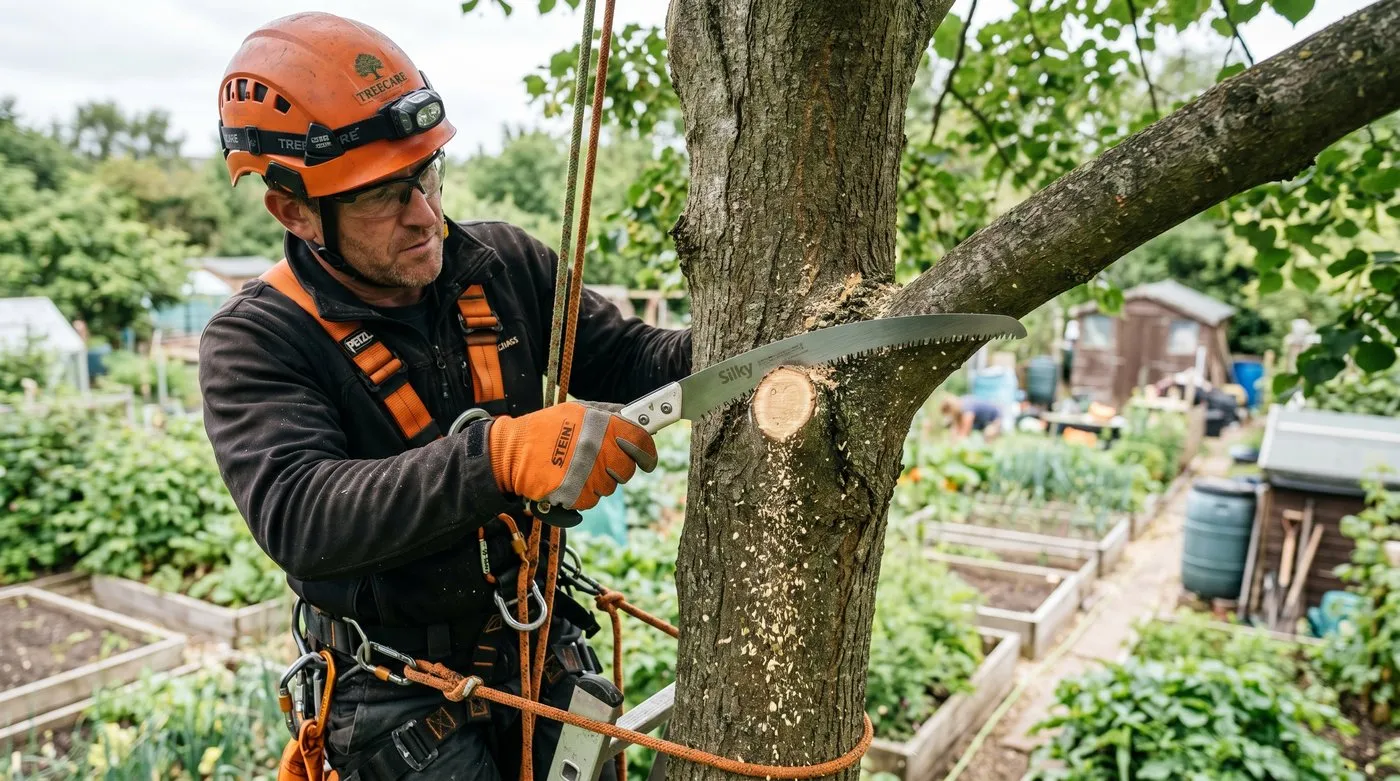 Crown lifting removes the lowest branches at the collar, raising canopy clearance to 2-3m so light reaches the garden floor.
Crown thinning for dappled light through the screen
Crown thinning removes a portion of the inner and crossing branches evenly, so dappled light passes through while the screen outline stays. Unlike crown lifting, which changes the canopy’s lower edge, thinning reduces its density without changing its shape. The tree still reads as a solid green screen from the road, but light filters through it onto the garden.
The golden rule is restraint. Remove no more than 10 to 30 percent of the live canopy in a single year. Take out crossing branches, weak inner growth, and any limb rubbing against another. Thin evenly across the whole crown so the tree keeps its natural balance. Never strip the inside bare and leave only an outer shell, a mistake called lion-tailing that weakens branches and invites breakage.
Crown reduction for an over-tall or wide tree
Crown reduction shortens the height or spread of a tree by cutting branches back to suitable lower growth points. Use it when a tree has simply outgrown its space and shades the house, rather than when you only want more light underneath. It keeps a smaller, denser screen rather than a tall thin one.
Reduce by up to a third at most in one go. Cut each branch back to a side branch or bud that is at least a third of the diameter of the limb being removed. That side branch then takes over as the new leader, so the cut heals and growth stays controlled. Cutting back to a thin twig or leaving a bare stub causes rot and a forest of water shoots.
Reduction is skilled work and the riskiest of the three on a large tree. For anything above head height on a major limb, hire a qualified arborist. The same careful, cut-to-a-growth-point principle applies when you prune garden shrubs and when you shape fruit trees for a heavier crop.
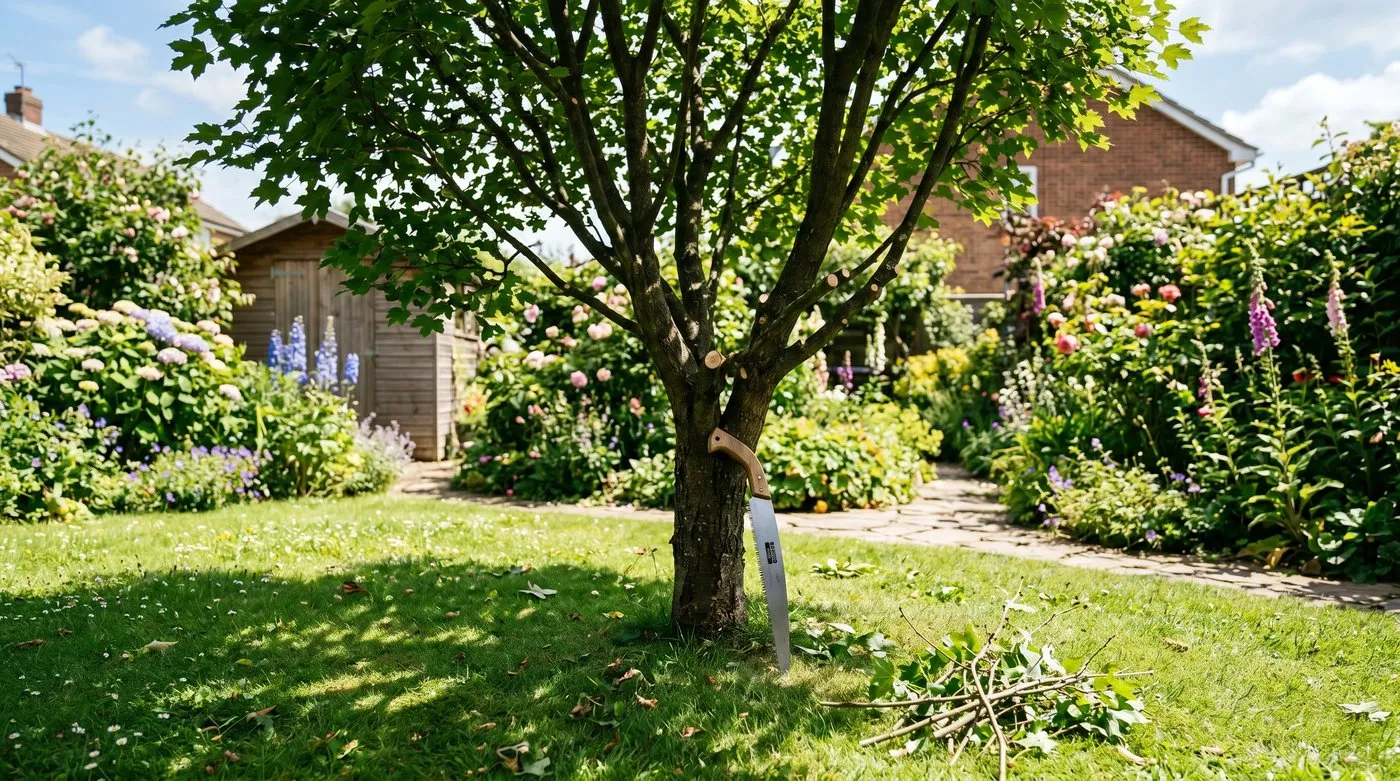 The three core cuts: crown lifting raises the base, thinning opens the inside, reduction lowers the whole frame.
The three-cut method and cutting to the collar
Every branch thicker than your wrist comes off in three cuts, ending at the branch collar. This stops the falling limb from tearing a strip of bark down the trunk, a wound that lets in decay and can kill the tree. The method takes seconds longer and saves the tree.
Make the first cut on the underside of the branch, about 30cm out from the trunk, sawing a third of the way up. Make the second cut from the top, a few centimetres further out, until the branch drops cleanly. You are left with a short stub. Make the third and final cut just outside the branch collar, the swollen ring at the base, never flush to the trunk.
Cutting flush removes the collar and the tree cannot seal the wound. Leaving a long stub leaves dead wood that rots back into the trunk. The collar contains the cells that grow over the cut, so a clean cut just outside it heals fastest. Use sharp, clean tools and disinfect blades between trees to avoid spreading disease.
Warning: Never cut a branch flush against the trunk and never leave a protruding stub. Both let decay into the heartwood. Always finish the cut just outside the raised branch collar.
When to prune trees in the UK without harming them
Prune most deciduous trees in winter dormancy, between November and February, when the bare framework is easiest to read. With the leaves gone you can see the structure clearly and the tree loses no working foliage. Sap pressure is low, so most species bleed little. Winter pruning also avoids the bird nesting season entirely.
There is one critical exception. Never prune Prunus species in winter. That means cherry, plum, ornamental flowering cherry, almond and damson. These trees are highly vulnerable to silver leaf disease, a fungus whose spores are most active in the cool, damp months. Prune Prunus only between June and August, when the wounds seal fast and spore numbers are low.
A few other trees have quirks. Walnut, birch and maple bleed heavily if cut in late winter, so prune them in mid-summer after the leaves harden. For everything else, the dormant-season window is safest. Plan light corrective work alongside your wider spring pruning jobs once the worst frosts pass.
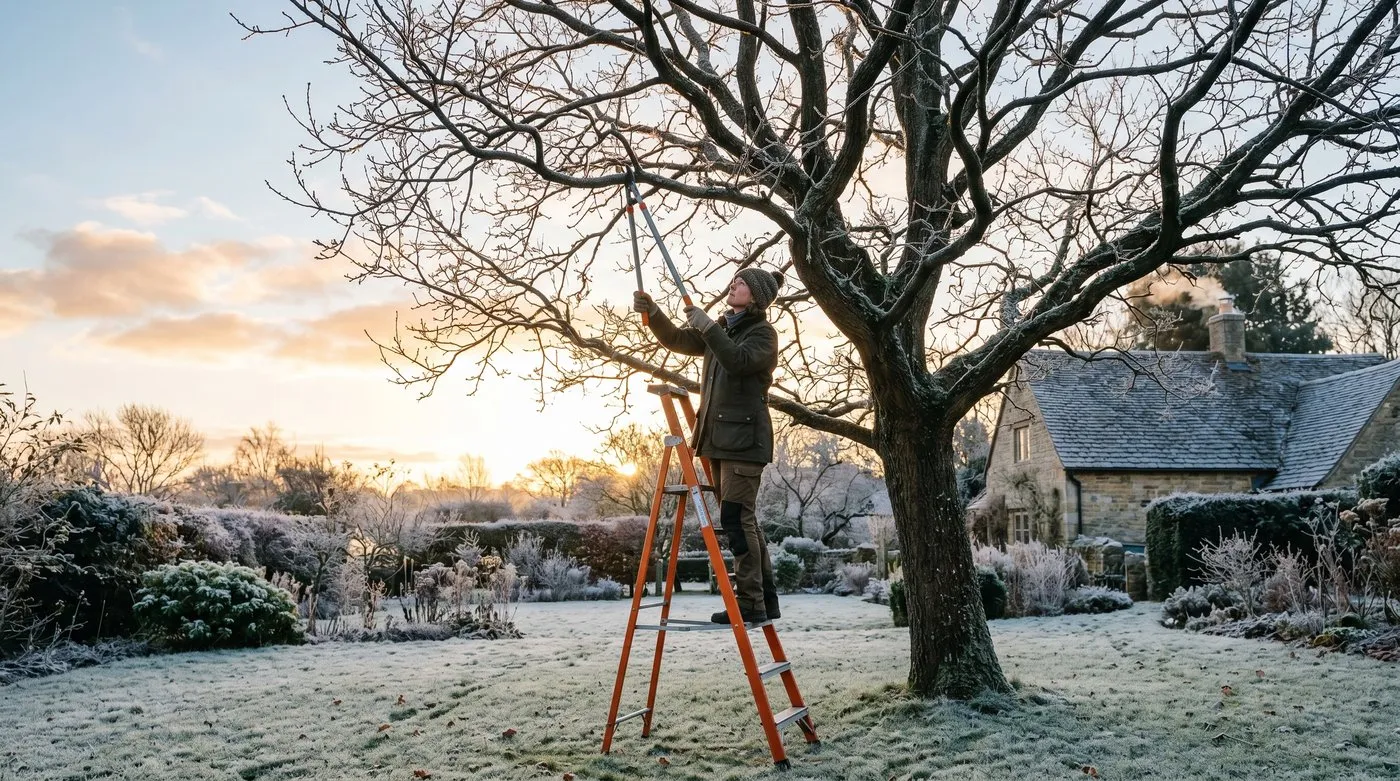 Winter dormancy is the safest window for most deciduous trees, but never for Prunus, which needs a summer cut.
Tree Preservation Orders, Conservation Areas and the law
Before any cut, check whether the tree has a Tree Preservation Order or sits in a Conservation Area. This is the step most gardeners skip, and it is the one that costs the most. A Tree Preservation Order, or TPO, makes it a criminal offence to cut, top or fell the tree without the council’s written consent. Fines run into thousands of pounds per tree.
Your local council holds the TPO register. A quick call or a search on the council website tells you the tree’s status. If you live in a Conservation Area, you must give the council six weeks’ written notice before pruning any tree over a set trunk size, even without a specific order. They can place a TPO on it within that window.
For overhanging branches from a neighbour’s tree, the rule is precise. You may cut branches back to the boundary line, but no further, and only if the tree carries no TPO. The cuttings legally belong to the tree owner, so you must offer them back rather than keeping or dumping them. There is no automatic legal right to light for a private garden. For boundary and high-hedge disputes, read the government’s high hedges guidance before you act.
Warning: The High Hedges part of the Anti-social Behaviour Act 2003 covers evergreen or semi-evergreen hedges over 2 metres tall. A neighbour can ask the council to order a reduction. It does not cover single deciduous trees, so do not rely on it for those.
Best trees for privacy and light in UK gardens
The best screening trees give height and cover without casting heavy, year-round shade. Deciduous trees like hornbeam and amelanchier drop their leaves in winter, returning low-angle sun to the garden exactly when you want it most. Evergreens hold the screen all year but block winter light, so use them sparingly and away from the house.
Pleached trees are the gardener’s secret for tight spaces. A pleached lime or hornbeam trains the canopy into a flat, raised panel on a clear stem, screening at first-floor height while leaving the ground open and light. It is privacy on stilts. For a free-standing tree, hornbeam and holly take hard pruning well and respond predictably to thinning.
| Tree | Type | Screening height | Light it lets through | Best use |
|---|---|---|---|---|
| Hornbeam | Deciduous | 4-8m | High in winter, dappled in summer | Pleached panels, formal screens |
| Holly | Evergreen | 3-6m | Low, year-round shade | Dense year-round screen, slow |
| Portugal laurel | Evergreen | 3-5m | Low to moderate | Neat evergreen screen, clips well |
| Amelanchier | Deciduous | 3-5m | High, open airy canopy | Small gardens, blossom and berries |
| Crab apple | Deciduous | 4-6m | Moderate, light canopy | Wildlife, blossom, light screen |
| Photinia | Semi-evergreen | 3-4m | Low to moderate | Fast evergreen screen, red shoots |
| Pleached lime | Deciduous | 3-5m on stem | High below the panel | Tight boundaries, eye-level screen |
For a fuller shortlist matched to garden size, see our guide to the best trees for privacy in UK gardens, and for narrow plots the best trees for small gardens.
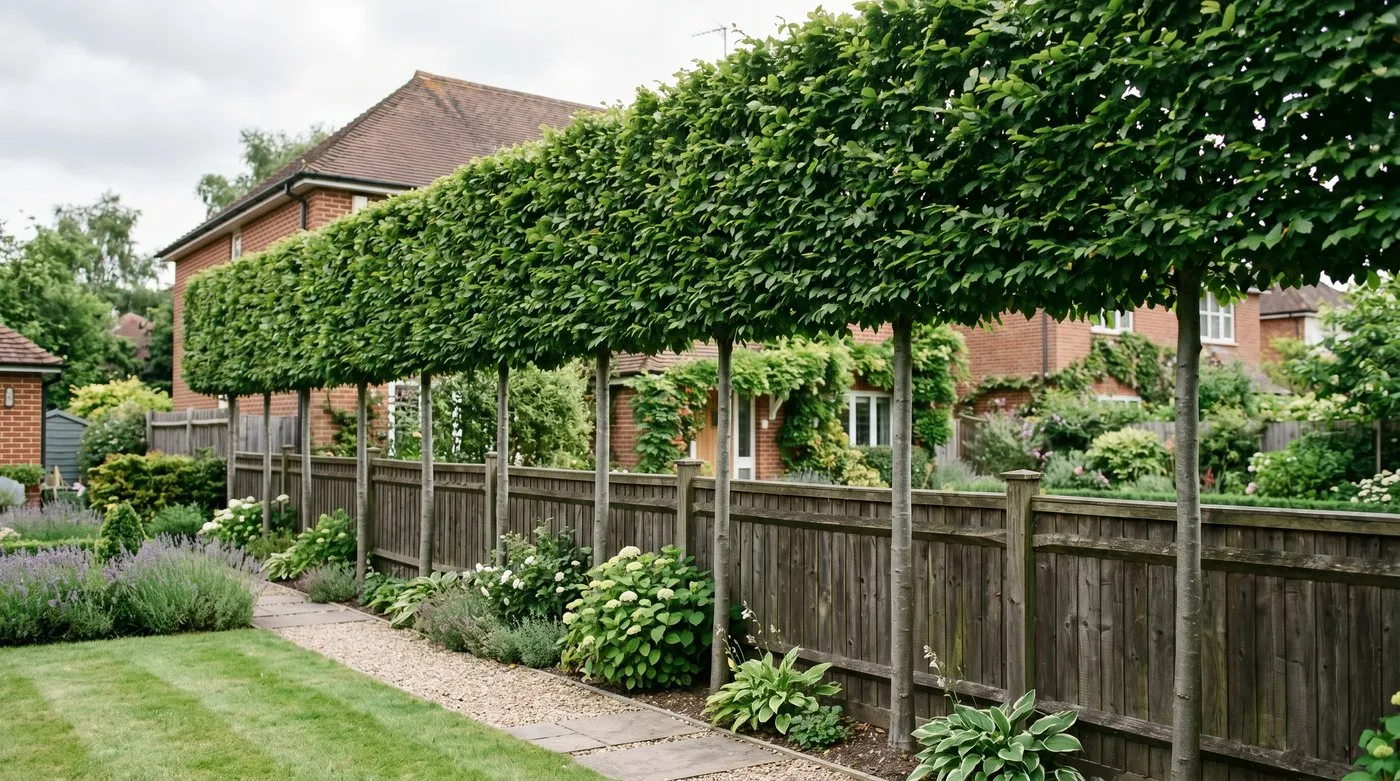 Pleached hornbeam screens at eye level while leaving the ground clear, ideal for tight urban boundaries.
Which technique to use and how well it works
No two pruning techniques do the same job, so match the cut to the problem. Crown lifting is the gold standard for getting light back into a garden while keeping a full screen above. Thinning suits a dense tree that needs softening. Reduction is the last resort for a tree that is simply too big.
Formative pruning is the cheapest insurance of all. Shaping a young tree in its first three to five years builds a strong, well-spaced frame that needs little corrective work later. Pollarding and coppicing are renewal cuts for an old, overgrown screen, cutting hard back to a framework or to the base so the tree resprouts fresh.
Renewing an overgrown screen with pollarding
Pollarding cuts an overgrown tree back to a permanent framework of main limbs, forcing dense new growth from the cut points. It is how you rescue a screen that has grown leggy, gappy or far too tall. Done at the right age and repeated regularly, a pollarded tree lives for centuries: London’s old planes are proof.
Make the first pollard cut on a young to middle-aged tree, never an old one, and always in winter dormancy on deciduous species. Cut the main limbs back to your chosen framework height, leaving a knuckle that will sprout. The tree responds with a thicket of straight new shoots, which rebuild a denser, lower screen within two or three seasons. Repeat the cut every two to five years to the same points.
Coppicing takes this further, cutting the whole tree to near ground level so it resprouts as a multi-stemmed shrub. It suits hazel, hornbeam and willow used as a low boundary screen. The same principle of cutting to renew works whether you are managing a screen or planting a new bare-root tree to replace one that is past saving.
The month-by-month tree pruning calendar
Time each pruning job to the right month and you avoid disease, bird nests and bleeding wounds. The calendar below covers the main UK pruning windows for boundary and screening trees. The two hard rules sit at either end of the year: dormant deciduous work in winter, Prunus work in summer.
| Month | Pruning task |
|---|---|
| January | Crown lift, thin and reduce most deciduous trees in full dormancy. Best month for shaping bare frameworks |
| February | Continue dormant deciduous pruning. Finish before sap rises and before birds begin nesting |
| March | Stop major work. Bird nesting season begins; check every tree for active nests before any cut |
| April | No pruning of nesting trees. Light tidying only, with a careful check for nests first |
| May | Prune spring-flowering trees just after the blooms fade. Avoid disturbing nesting birds |
| June | Begin pruning Prunus: cherry, plum, ornamental cherry, to dodge silver leaf. Summer-prune trained forms |
| July | Continue Prunus and summer pruning. Reduce vigorous regrowth and water shoots on previously cut trees |
| August | Finish Prunus pruning. Nesting season ends late August; confirm before resuming general work |
| September | Light formative pruning of young trees. Avoid heavy cuts before winter |
| October | Tidy and inspect. Plan winter work. Plant new bare-root screening trees from late this month |
| November | Resume dormant-season pruning as leaves fall. Begin crown lifting and thinning of deciduous trees |
| December | Full dormant pruning window. Ideal for major crown lifting and reduction on bare deciduous trees |
How to stop a pruned tree growing back thicker
The root cause of a tree growing back thicker is over-pruning, not the act of pruning itself. Cut too hard or too often and the tree reads it as an emergency. It floods the cut area with fast, weak, upright water shoots to replace lost canopy as quickly as possible. Within two summers the screen is denser and darker than before you started, and the new growth is brittle.
The permanent fix is restraint and good technique, not more cutting. Keep thinning at or below 30 percent of the canopy in any single year. Always cut back to a viable growth point, a side branch at least a third the width of the limb removed, never to a bare stub. A stub has no leaves to draw energy upward, so the tree responds with a brush of shoots around it.
If a tree has already been topped or over-thinned and is throwing water shoots, do not panic-cut them all off, as that restarts the cycle. Thin them gradually over two or three winters, selecting one or two to become permanent replacement branches and removing the rest cleanly at the collar. Patience, not the saw, restores a stable screen.
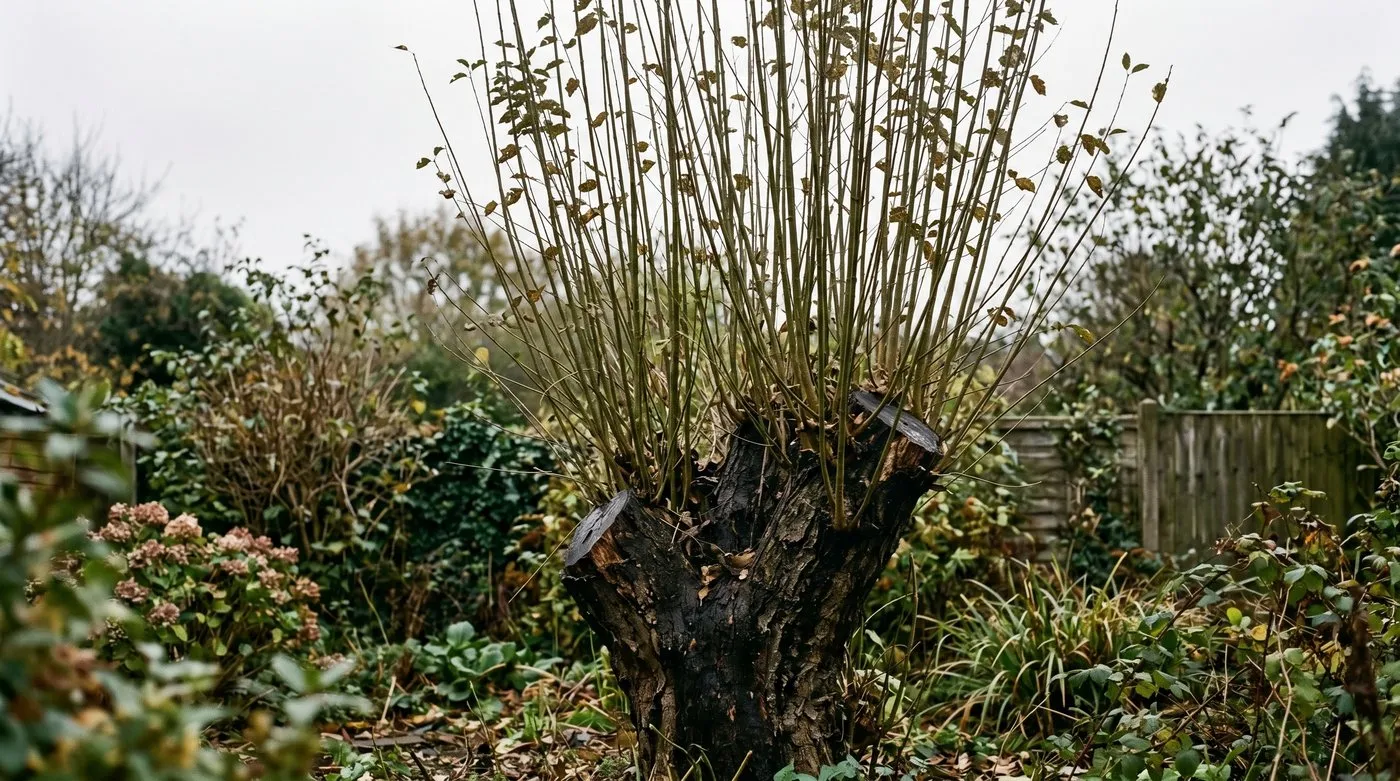 Water shoots are the tree’s response to over-pruning, a thicket of weak vertical growth that darkens the screen again.
Common mistakes when pruning trees for privacy and light
Topping the tree instead of reducing it
Topping means lopping the main stems off at a uniform height, leaving stubs. It is the worst thing you can do. The tree responds with a dense crowd of weak water shoots, the wounds rot, and the screen comes back thicker and uglier. Always reduce to growth points, never top.
Cutting too much in one year
Removing more than 30 percent of the live canopy starves the tree and triggers stress regrowth. A garden left brighter for one summer turns darker the next as water shoots fill the gaps. Spread heavy work across two or three winters.
Pruning Prunus at the wrong time
Cutting cherry, plum or ornamental cherry in winter invites silver leaf disease, which can kill the tree. The spores thrive in cool damp air. Always prune Prunus between June and August, when wounds seal quickly and spore numbers are low.
Ignoring the law before you cut
Pruning a protected tree without consent is a criminal offence with fines into the thousands. People assume a tree on their own land is theirs to cut. Always check for a Tree Preservation Order or Conservation Area with the council first.
Leaving stubs or cutting flush
A flush cut removes the branch collar so the wound never heals. A long stub rots back into the trunk. Both let decay into the heartwood. Finish every cut just outside the swollen collar, no more and no less.
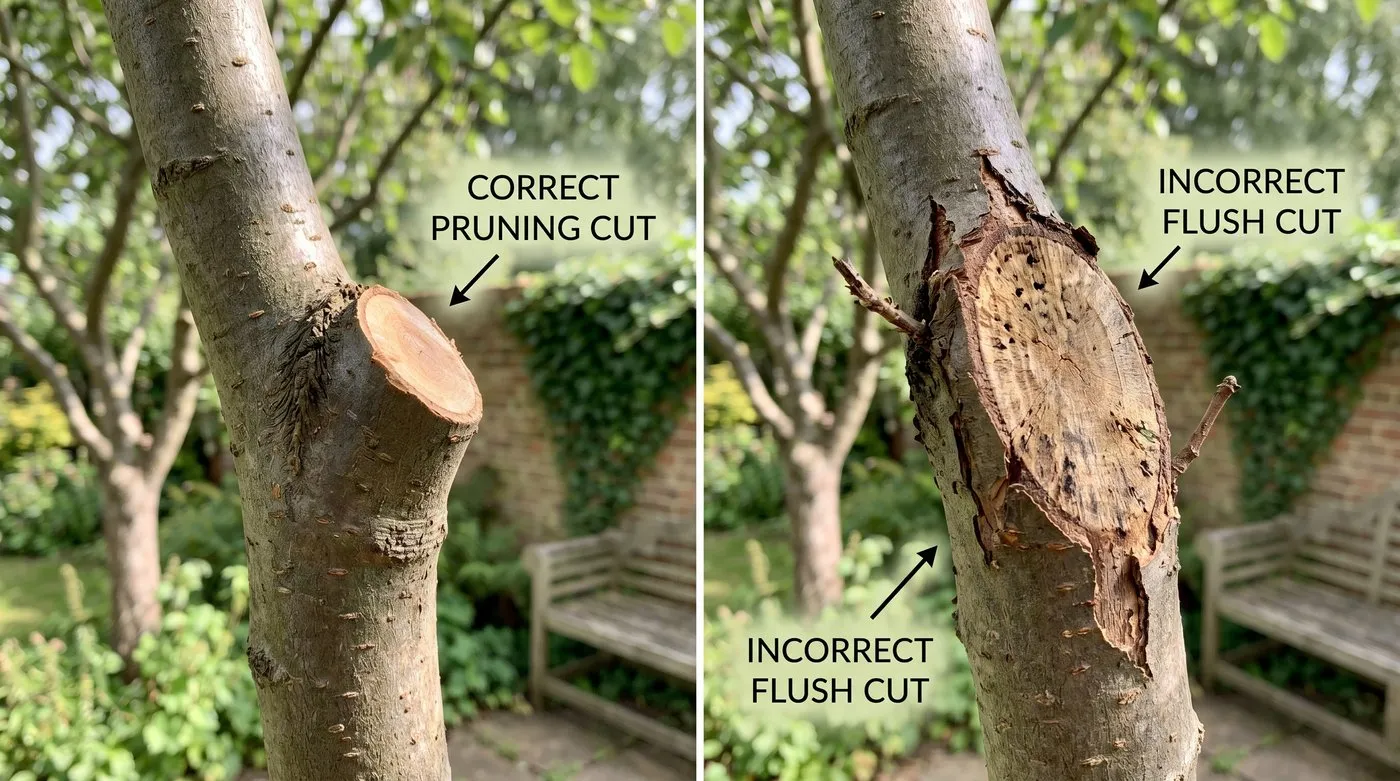 The correct cut sits just outside the collar; flush cuts and stubs both let decay into the trunk.
Related reading: Coppicing keeps a fast grower in bounds, as we explain in our guide to eucalyptus for UK gardens.
Frequently asked questions
Can I cut tree branches that overhang my garden?
Yes, you can cut overhanging branches back to the boundary line. You may only cut up to your property line, not beyond. The cuttings legally belong to the tree owner, so offer them back. The tree must not be covered by a Tree Preservation Order. Check with your council before you start.
When is the best time to prune trees in the UK?
Prune most deciduous trees in winter dormancy, between November and February. The bare framework makes shaping easier and the tree loses no leaves. Never prune Prunus species like cherry and plum in winter, as they catch silver leaf. Prune those between June and August instead. Avoid the bird nesting season, March to August.
How much of a tree can I prune without harming it?
Remove no more than 10-30 percent of the live canopy in a single year. Cutting more starves the tree of energy and triggers a flush of weak water shoots. A crown reduction should shorten height or spread by up to a third at most. Spread heavy work over two or three winters to let the tree recover.
Do I need permission to prune a tree in my own garden?
Yes, if the tree has a Tree Preservation Order or sits in a Conservation Area. You must apply to the council and wait for consent before any cut. Unauthorised work on a protected tree can bring fines into the thousands of pounds. Trees without protection on your own land need no permission, but check first.
Will pruning a tree for light make it grow back thicker?
Over-pruning makes trees grow back thicker with weak water shoots. Cutting too hard or too often triggers dense, upright regrowth as the tree replaces lost canopy fast. Keep thinning under 30 percent a year and cut to a growth point, not a flush stub. Light, regular pruning keeps the screen open and stable.
What trees give privacy without blocking too much light?
Hornbeam, holly, amelanchier and pleached lime give screening with light. Deciduous screens like hornbeam and amelanchier drop their leaves in winter, returning low-angle light when you need it most. Pleached and crown-lifted trees screen at eye level while leaving a clear trunk below. Avoid dense evergreen conifers like Leyland cypress near boundaries.
How high can a hedge or tree be before my neighbour can complain?
Evergreen hedges over 2m can be reported under the High Hedges law. The Anti-social Behaviour Act 2003 lets neighbours complain to the council about evergreen hedges blocking light. The council can order a reduction. There is no automatic right to light for a garden, and the rule covers hedges, not individual deciduous trees.
Now you can prune your boundary trees for both privacy and light, plant the right screen from the start by reading our guide on the best evergreen trees for UK gardens for the next step. For more pruning detail, the RHS tree pruning advice is a useful companion reference.
Our team produces practical UK gardening guidance from source research, contributor records and established horticultural practice. Editorial standards are overseen by Matt W.