Key takeaways
- Spent compost retains 60-80% of its useful properties after one season
- Mix 50/50 with fresh peat-free compost plus slow-release fertiliser
- Reuse for salads, herbs, hardy perennials, bulbs
- Don't reuse for tomatoes, courgettes or hungry feeders
- Discard if vine weevil, root rot or clubroot was present
- Refreshed compost equals new compost for 90% of UK garden uses
Reusing spent compost is one of the easiest sustainability wins in UK gardening. The average UK home gardener disposes of 30-100 litres of container compost annually after one growing season - all of it still useful. Spent compost loses some nutrients but retains soil structure, organic matter, beneficial microbes and water-holding capacity. With annual refreshing it grows next year’s crops as well as fresh-from-the-bag compost.
For wider organic-gardening context, see our feed the soil not the plants UK, peat-free compost guide UK and how to make compost UK guides.
Why most UK gardeners bin perfectly good compost
The annual ritual: empty last year’s pots, throw the spent compost on the heap or in the bin, fill with new bagged compost. About 500,000 tonnes of spent compost goes to UK garden-bin or landfill each year - more than 60% of total bagged-compost sales.
The reasoning: “the compost is exhausted; the plant took all the nutrients out”. Partly true - the nitrogen, phosphorus and potassium content drops significantly over a growing season. But the rest of what makes compost work remains.
What spent compost still has after one season:
- Organic matter content - largely intact (only 5-10% of the organic matter actually breaks down in one season)
- Soil structure - the crumb structure that gives drainage and air space
- Water-holding capacity - largely retained
- Beneficial microbes - active soil biology, actually enhanced after a season of root activity
- Trace elements - most still present (only the major NPK drops significantly)
- Mycorrhizal fungi - if the original plant had them, they’re still in the spent compost ready for next year
What it doesn’t have:
- N, P, K - significantly reduced
- Trace mineral balance - somewhat reduced
- Freshness for sterile uses (seed sowing, propagation)
The fix is straightforward: add back what’s missing, leave what’s still there.
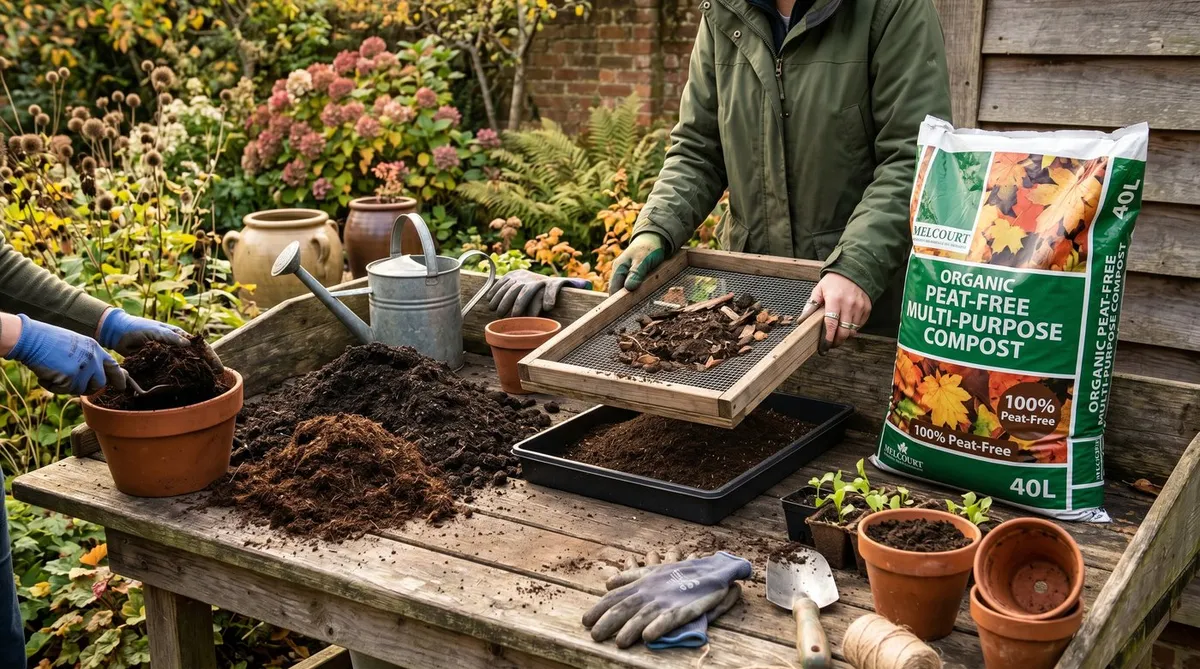
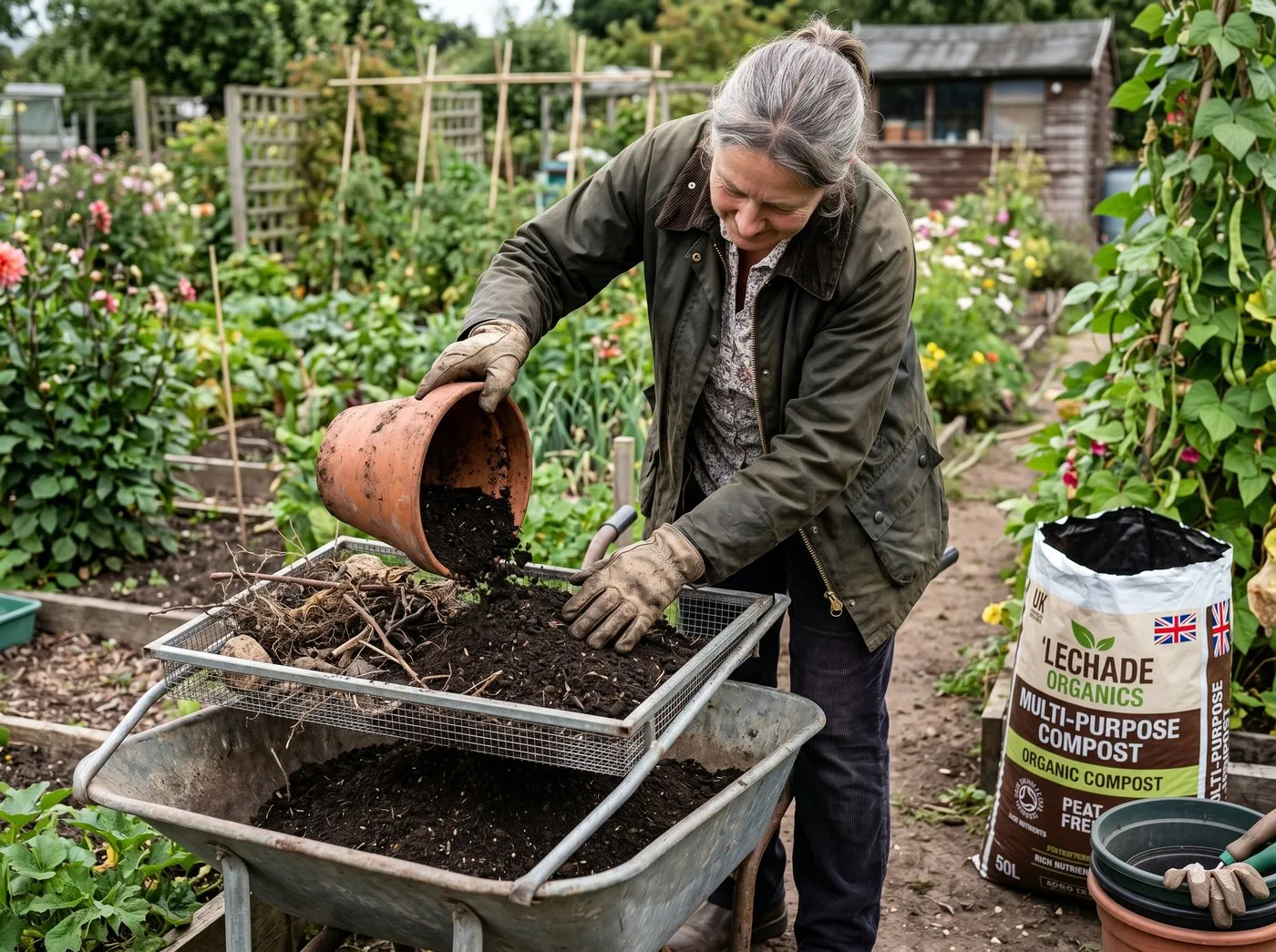 Sieving spent compost through a 10mm riddle - removes old roots and stones, leaves the still-useful organic matter and crumb structure intact.
The refresh method
Standard recipe:
- Tip out the pot into a wheelbarrow or large tray
- Pull out the root ball of the previous plant
- Sieve through a 10mm garden riddle - removes old roots, any stones, larger debris
- Inspect - smell test (good compost smells earthy; bad smells sour or rotten), check for visible mould, vine weevil grubs, or root pieces still showing rot signs
- Mix with fresh peat-free compost at 50/50 ratio - so 25 litres of spent + 25 litres of new = 50 litres of refreshed mix
- Add fertiliser - 50-100g of slow-release organic pellets (Vitax Q4 or chicken manure pellets) per 25 litres of mix
- Optional bonus - a handful of leafmould or mature compost for trace elements and microbe diversity
- Mix thoroughly with a garden fork
- Refill the pot ready for next season’s planting
The whole process takes about 10 minutes per medium pot. For 8-10 pots, allow an hour.
Slow-release fertiliser options
| Product | Rate per 25L | UK cost |
|---|---|---|
| Chicken manure pellets | 100g | £0.50 |
| Vitax Q4 | 80g | £1.00 |
| Fish blood and bone | 100g | £0.60 |
| Bone meal (slow N) | 60g | £0.80 |
| Garden compost + kelp meal | 200g + 30g | £0.30 |
Pick one. Don’t combine multiple chemical fertilisers - over-fertilisation burns roots in containers.
What to grow in refreshed compost
The match between crop and compost quality matters. Some crops do well in refreshed compost; some demand fresh.
Excellent in refreshed compost
- Salads (lettuce, mizuna, rocket, spinach, chard)
- Herbs (parsley, basil, chives, thyme, sage, mint, oregano)
- Hardy perennials (heuchera, ferns, hostas, sedums)
- Bulbs (daffodil, tulip, allium, spring bulbs)
- Strawberries in year 2 or later
- Annual flowers (cosmos, calendula, nigella, sunflowers)
- Container shrubs in maintenance years
Acceptable in refreshed compost
- Beans (dwarf French, runner) with extra slow-release feed
- Peas with slow-release feed
- Beetroot, carrots (short-rooted varieties)
- Onions, garlic, spring onions
- Hardy vegetables generally
Requires fresh compost
- Tomatoes (cordon and bush both)
- Peppers and chillies
- Aubergines
- Courgettes
- Cucumbers
- Brassicas if in containers
- Newly potted-up perennials (first year)
- Seed sowing and propagation (use sterile fresh seed compost)
The pattern: heavy feeders and fast-growing crops need fresh compost. Salads, herbs and slow-growing perennials reuse beautifully.
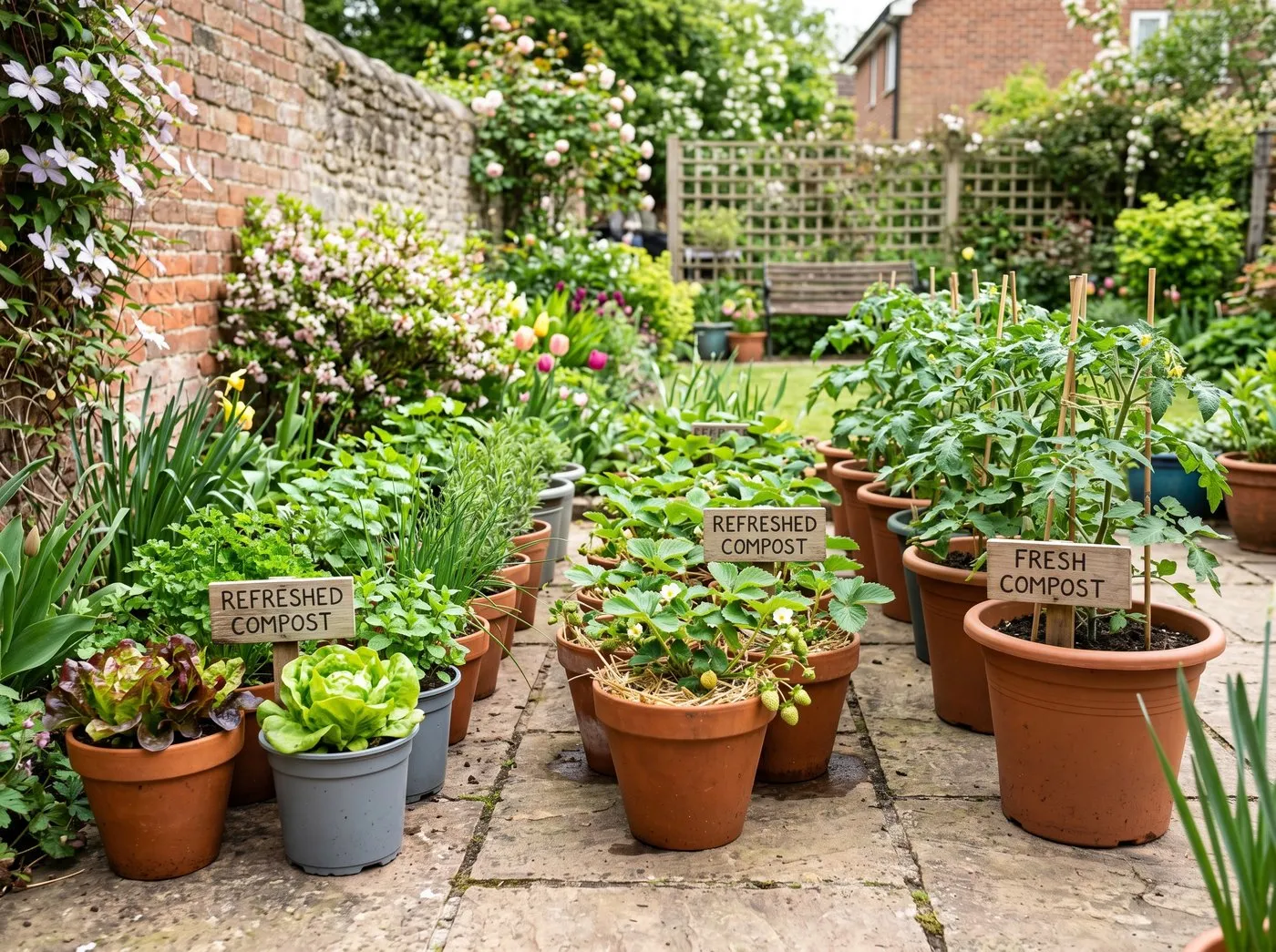 Right plant in right compost - lettuce and strawberries in refreshed mix; tomatoes in fresh compost. The match determines whether refreshed compost succeeds.
When to discard - the deal-breakers
Three situations where you must discard spent compost:
Vine weevil grubs in the previous plant
The C-shaped white grubs eat roots silently and lay 500-1,500 eggs in the compost. Refreshed compost from an infested pot will reinfest the next plant. Discard - either deep-bury in a separate corner of the garden away from beds, or bag for council green waste.
Root rot or fungal disease
If the previous plant died of root rot, fusarium wilt, clubroot, or another soil-borne disease, the compost carries spores. Discard. Don’t put on the compost heap (most home compost heaps don’t get hot enough to kill these pathogens).
Sour or anaerobic smell
If spent compost smells sour, vinegary or like rotting eggs, it’s gone anaerobic from waterlogging. The biology is wrong. Spread thinly on lawn (the air exposure helps) or compost-heap-bury.
What about compost from short-lived plants?
The shorter the time a plant was in a pot, the better the compost reuses. Bedding plants that only spent April-October in a pot leave compost in better shape than perennials that grew there for 3 years.
The 5-year compost lifecycle
Many UK gardeners running this system follow a multi-year compost lifecycle:
Year 1: Fresh peat-free compost from the bag. Used for tomatoes or heavy feeders.
Year 2: That same compost, refreshed 50/50, used for hungry annuals like beans or chard.
Year 3: Refreshed again 50/50 (now mostly mixed), used for salads, herbs.
Year 4: Refreshed again, used for hardy ornamentals, perennials, bulbs.
Year 5: Spread as a mulch on garden beds or used for pot crocking / drainage.
By year 5 the original compost is mostly digested and dispersed; the soil and beds have benefited.
This pattern uses each kilogram of fresh peat-free compost about 4-5x before it reaches end of useful container life. Compared to single-use-and-bin, the carbon footprint and cost drop by 75-80%.
The 2026 UK peat-free market
Since the UK retail peat ban (effective 2024), all bagged compost sold to UK consumers is peat-free. Quality varies widely:
- Premium peat-free (£8-£12 per 50l) - typically composted bark, coir, wood fibre, biochar. Good performance.
- Mid-range peat-free (£5-£8 per 50l) - typically green waste compost with bark and wood fibre. Variable quality.
- Budget peat-free (£3-£5 per 50l) - mostly green waste compost. Dries fast, depletes fast.
Refreshed compost actually outperforms budget peat-free in most cases because the biological activity is intact. A refreshed mix of last year’s premium peat-free + fresh budget compost often performs better than the budget compost alone.
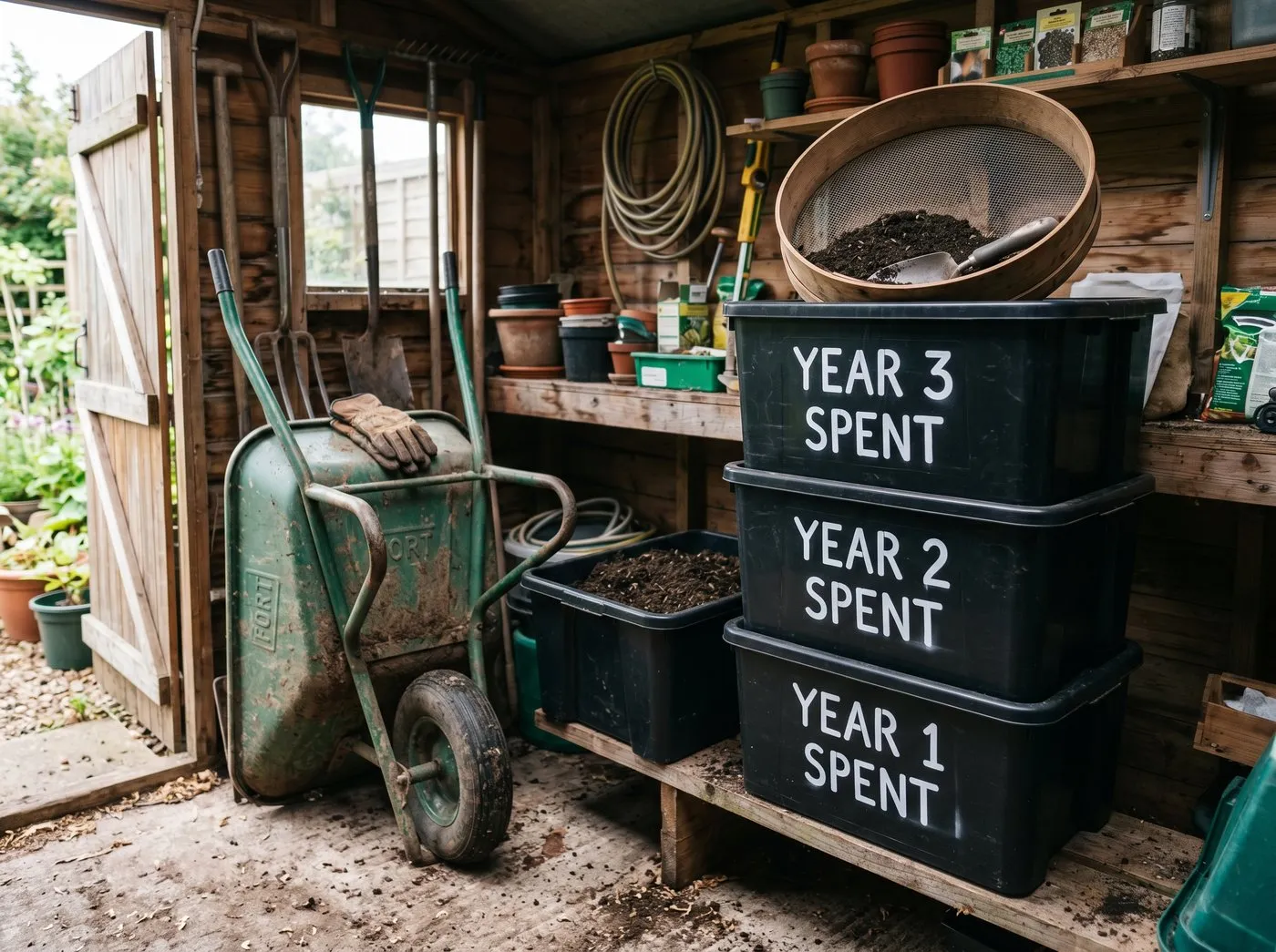 Storage system for spent compost - 3 year-stages kept separate, each used for different next-year crops. The year-1 spent goes to bean and pea pots; year-3 spent goes to bulb tubs.
What to do with the inevitable surplus
Some spent compost is best NOT used in containers. Productive end-of-life uses:
Surface mulch on beds
Spread 50mm thick on flower or vegetable beds. Worms incorporate over winter. Adds organic matter to ground soil.
Drainage layer in deeper pots
The bottom 5cm of large pots can use spent compost instead of crocks or stones. Better drainage than crocks, plus the bonus of organic matter at root depth.
Path-edge filler
Soft path edges where you want some growth (creeping thyme, low alpines). Spent compost mixed with grit works well.
Lawn top-dressing
Mix 50/50 with sharp sand and apply 5-10mm thick over patches of thin lawn in autumn. Improves soil over a season.
Compost heap addition
If you have an active compost heap, spent compost adds organic matter and biological activity. Don’t add diseased compost.
Common questions
Yes - bake in oven at 80C for 1 hour, or pour boiling water through. Both methods kill most disease organisms. However, you also kill beneficial microbes, so you lose much of the value of reusing. Better to discard suspect compost than sterilise it.
What about compost worms in spent compost?
Bonus - they’re beneficial. Leave them in the refreshed mix. They’ll move to the new pot and continue improving compost structure.
Refreshed ericaceous compost stays acidic, but the pH drifts up over time. Add a small amount of sulphur chips (10g per 25l) to maintain pH below 5.5 for rhododendrons, blueberries, camellias.
Discard. Cat urine in particular concentrates ammonia which damages roots. Spread thinly on lawn or compost-heap-bury.
Field note: The RHS guide on reusing compost covers UK-specific recommendations and the Garden Organic compost research at Ryton has run multi-year compost-reuse trials showing performance equivalence with refreshed compost.
The simple sustainability win
Most UK gardeners running 20-30 patio containers throw away 60-150 litres of spent compost annually. Refreshing instead:
- Saves £30-£60 per year in fresh-compost costs
- Reduces plastic-bag waste from bagged compost
- Cuts the carbon footprint of compost manufacture and transport
- Builds long-term soil biology
- Produces growing media equal to or better than budget bagged peat-free
The cost: 30-60 minutes of refreshing time each autumn or spring. The result: a year of growing on largely free, locally-cycled compost.
Now you’ve got the refresh framework
For the wider organic-gardening context, our feed the soil not the plants UK, peat-free compost guide UK and how to make compost UK guides cover the rest of the soil-cycling system that works alongside compost reuse.
If you would rather blend your own, see our guide to mixing your own peat-free potting compost.
Our team produces practical UK gardening guidance from source research, contributor records and established horticultural practice. Editorial standards are overseen by Matt W.