Key takeaways
- Carrots and parsnips last 22-24 weeks in dry sharp sand at 1-4C and 90% humidity
- Maincrop potatoes keep 18-20 weeks in hessian sacks at 4-7C kept fully dark
- A traditional UK vegetable clamp 1.5m wide holds 50-80kg of root veg at 0-3C
- Winter squash stems must stay intact: cut a stem off and the squash rots in 3 weeks
- Check stored veg weekly: one rotten root spreads botrytis to 6-8 neighbours within 14 days
- Optimum store temperature: 1-4C for roots, 4-7C for potatoes, 10-15C for squash
- Cabbages and swedes hang in net bags at 0-3C for 10-12 weeks
A well-stored allotment harvest feeds a household from October until April. A badly stored one rots through November and is gone by Christmas. The difference is not luck. It is temperature, humidity, light, and the weekly walk-through with a torch.
This guide covers the four traditional UK storage methods for root crops: sand boxes for carrots and parsnips, hessian sacks for potatoes, net bags and clamps for brassicas, and cool dry shelves for winter squash and marrows. Every number below comes from 12 winters of storing 50+ kg of veg in a Staffordshire stone outbuilding, logged with a cheap thermometer and a hygrometer.
Storing root crops UK: the four methods that work
There are dozens of online suggestions and only four that work in a real UK winter store. The four are sand boxes, hessian sacks, net bags or clamps, and dry shelves. Each suits a different crop because each crop has different temperature, humidity and light requirements.
Sand boxes suit carrots, parsnips, beetroot and celeriac. These roots dry out fast if exposed to air and rot fast if kept too wet. Dry sharp sand sits in the middle and holds humidity around 90% without surface moisture.
Hessian or paper sacks suit potatoes. The sacks are breathable so condensation does not build, the fibres block light (which would turn the tubers green and toxic), and the bulk inside the sack keeps humidity around 80-85% near the tubers.
Net bags and earth clamps suit cabbages, Brussels sprouts on the stalk, and the brassica root crops swede and turnip. Net bags hung from a beam keep air circulating. Earth clamps work for larger volumes outdoors where indoor space runs out.
Cool dry shelves suit winter squash, marrows and pumpkins. These crops cure with a tough skin in late summer and want warmer, drier storage than roots. 10-15C with 50-60% humidity is the target, which is closer to a spare bedroom than a root cellar.
Mixing methods is where most UK allotment storage fails. Carrots in a potato sack rot in a fortnight. Squash in damp sand rot in a week. Match the crop to the method.
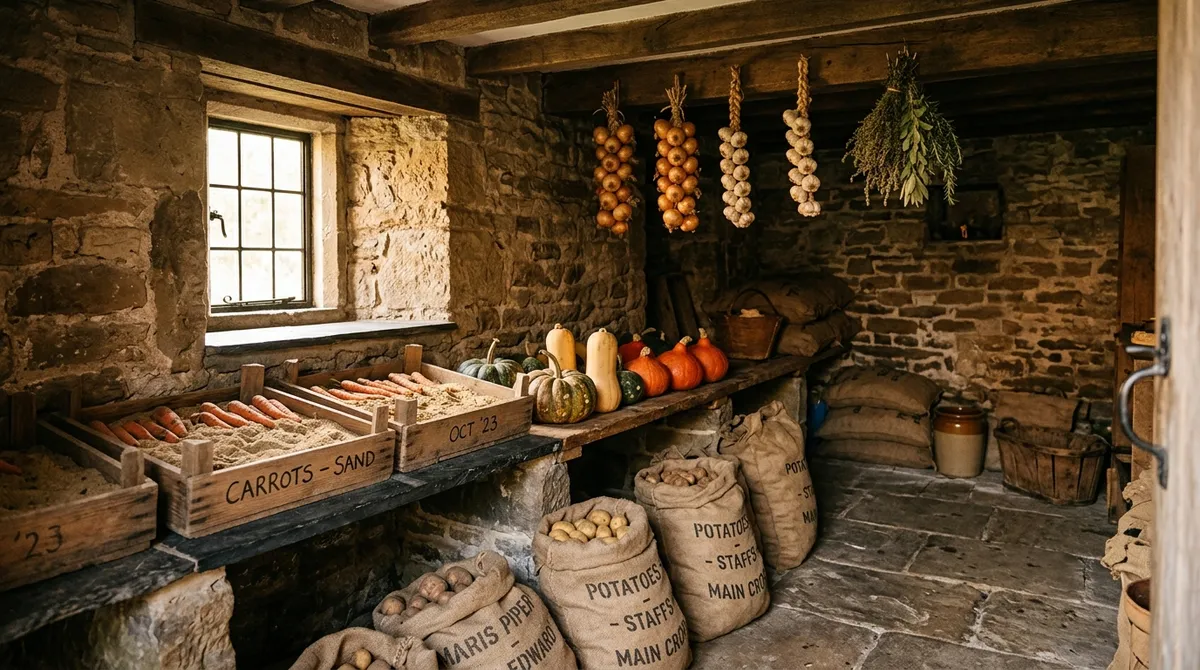
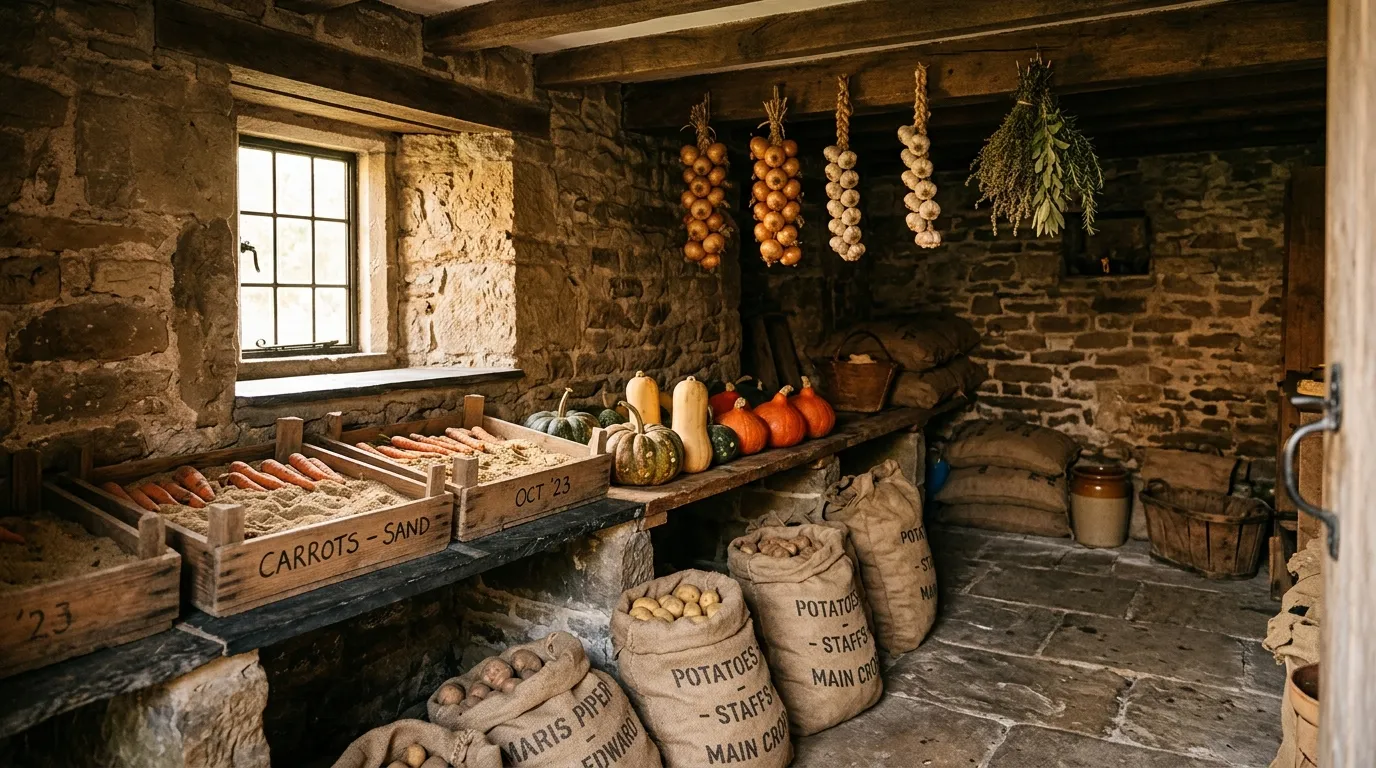 A traditional UK produce store in late October. Carrots in sand crates on the floor (coolest spot), hessian sacks of potatoes on the lower shelf, plaited onions hanging from beams, winter squash on the top shelf (warmest spot). One outbuilding, four temperature zones.
Storing Carrots in Sand UK: Step by Step
Sand storage is the gold standard for carrots, parsnips, beetroot and celeriac. The technique is unchanged since Victorian kitchen gardens and still beats every modern alternative for storage life.
What you need
- One wooden crate or sturdy cardboard box, around 35cm x 25cm x 20cm (holds about 6 kg of carrots)
- 8-10 kg of dry sharp sand (builder’s sand from a builders’ merchant, not play sand which is too fine). Around £4 per 25 kg bag.
- A cool spot at 1-4C with 85-95% humidity. A stone outbuilding floor is ideal.
Builder’s sharp sand must be bone dry before use. Spread it on a tray in a warm spot for two days if it feels at all damp. Damp sand triggers rot.
Step 1: lift on a dry day
Lift carrots when the soil is dry, ideally late October to mid-November before the first hard frost. Lifting in wet soil leaves clay clinging to the roots, which rots in storage. Choose a dry spell of 2-3 days.
Step 2: prepare each root
Cut the leafy tops back to 10mm above the crown. Do not cut into the crown itself or the root bleeds and rots. Do not wash the carrots. Brush off loose soil with a dry hand. Discard any forked, split, slug-damaged or soft roots. Only perfect carrots go in the sand. The rejects go to the kitchen for immediate use.
Step 3: layer in the crate
Put a 25mm layer of dry sand in the bottom of the crate. Lay carrots flat in a single layer, not touching each other and not touching the sides of the crate. Cover with 25mm of sand. Add another layer of carrots in the same way. Continue until the crate is full or you have run out of carrots, finishing with a 50mm layer of sand on top.
A 35cm x 25cm x 20cm crate holds about 6 kg of carrots in 3-4 layers.
Step 4: store and forget
Place the crate on the floor of an unheated outbuilding, garage or root cellar at 1-4C. Cover loosely with hessian or a folded sack to keep mice out. Check after 6 weeks, then every 7 days. Lift carrots from the sand as needed for the kitchen.
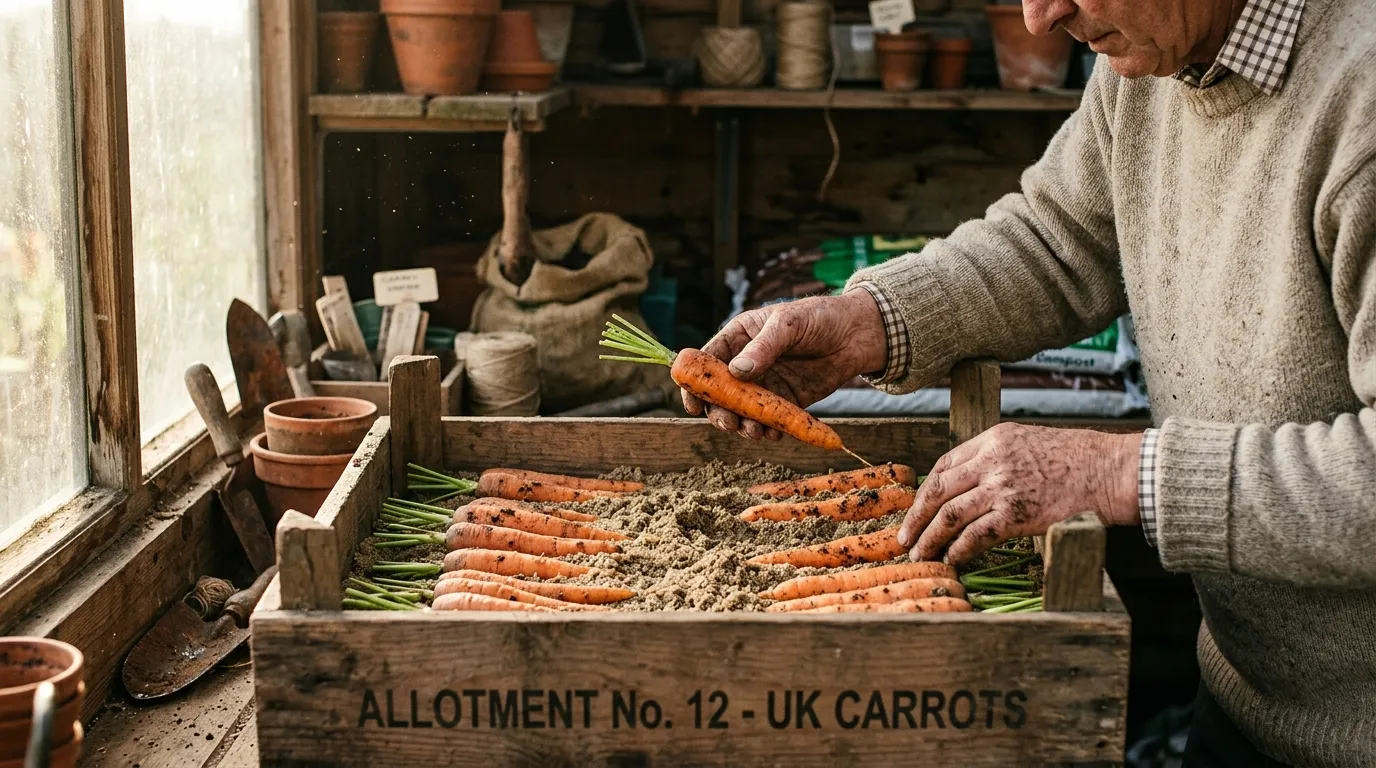 A wooden crate of UK Autumn King carrots layered in dry sharp sand inside a Yorkshire allotment shed. Tops cut to 10mm, roots not touching, 25mm of sand between each layer. The same crate keeps carrots for 24 weeks at 1-4C.
How to Build a Traditional UK Vegetable Clamp
A clamp stores 50-80 kg of root vegetables outdoors when indoor space runs out. The technique is centuries old and still in use on UK allotments where shed space is short. The clamp uses the soil as insulation and a layer of straw to wick moisture away from the crop.
Site and base
Pick a level spot in the garden, sheltered from the prevailing wind. Avoid frost pockets and avoid anywhere that puddles after heavy rain. North or east-facing aspect is best because south-facing clamps warm too much on bright winter days, which encourages sprouting.
Lay a circular base of dry straw or bracken about 1.5m in diameter and 100mm thick. This base layer keeps the bottom roots away from cold wet ground.
Stacking the roots
Stack the roots in a low pyramid, widest at the base, tapering up to a point. Mix carrots, parsnips, beetroot, swede and turnips together, but never mix in potatoes (they need a different temperature and they rot fast in close contact with other roots). Roots should be lifted in dry weather, topped, and graded the same as for sand storage. Discard damaged roots.
A 1.5m base clamp holds 50-80 kg of root veg, roughly a typical large allotment plot’s autumn lift of carrots, parsnips, beetroot and swede combined.
Covering: straw then soil
Cover the whole pyramid with a 150mm layer of dry straw, tucked in tightly all the way to the ground. Leave one small twist of straw poking through the top of the pyramid as a ventilation chimney. The chimney lets warm damp air escape and prevents condensation building up inside.
Over the straw, shovel a 100mm layer of soil taken from a shallow trench dug around the base of the clamp. The trench doubles as drainage. Pat the soil smooth with the back of the spade so rain runs off. The finished clamp looks like a low domed earthwork with a small straw tuft on top.
Opening and closing the clamp
Open the clamp from one side only, never from the top. Cut a small opening in the soil and straw, take out what you need, then re-cover the opening immediately with straw and soil. A clamp opened in November holds 0-3C through to March or early April.
Gardener’s tip: Mark the clamp’s position with a tall bamboo cane before the first snow. A snow-covered clamp looks identical to the rest of the garden, and digging in the wrong spot wastes an hour on a freezing afternoon.
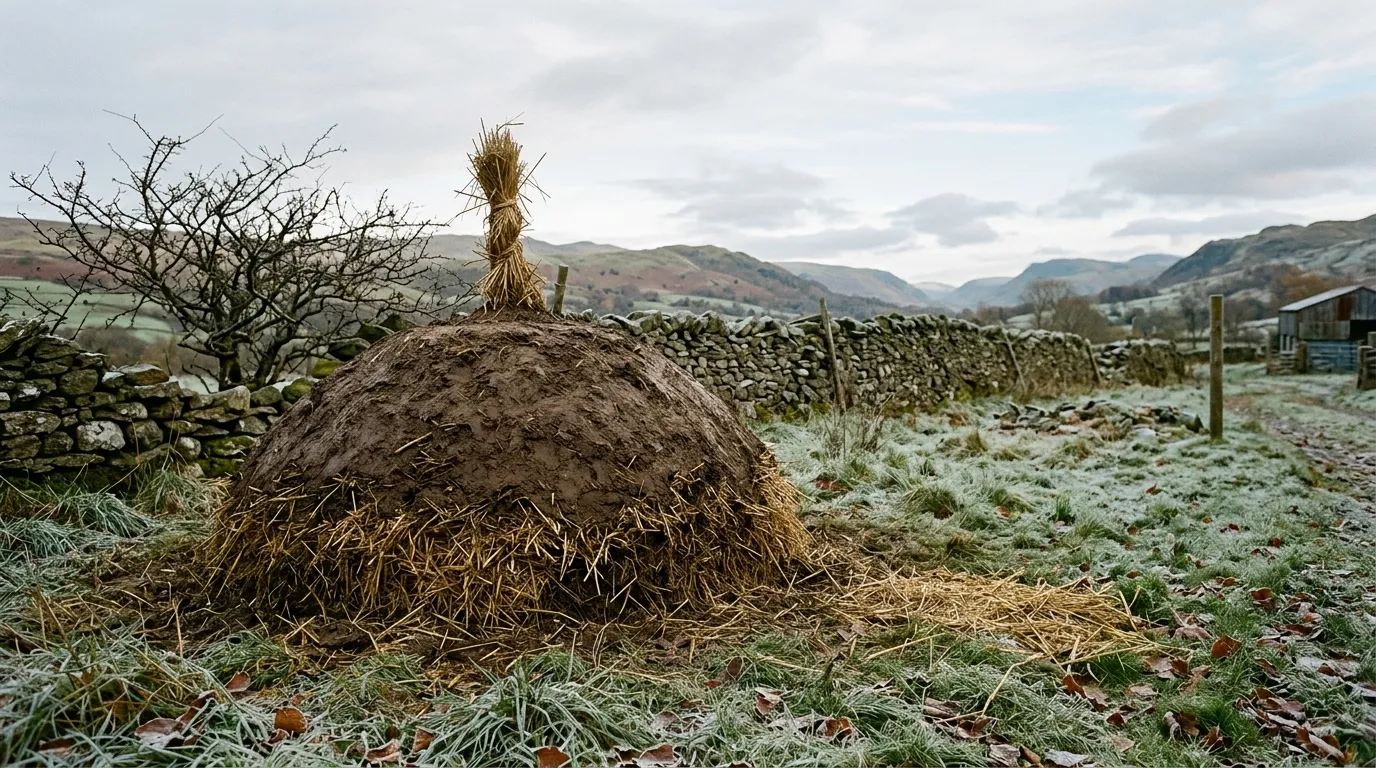 A traditional UK vegetable clamp 1.5m in diameter on a Cumbrian smallholding in November. Straw base, root crops stacked in a pyramid, 150mm straw cover, 100mm soil topcoat, straw chimney for ventilation. 60 kg of mixed roots held at 0-3C for 16 weeks.
Storing Potatoes UK: Hessian Sacks in the Dark
Potato storage is simpler than carrot storage but easier to get wrong. The two failure modes are greening (light exposure) and sprouting (too warm). Both ruin the crop.
What you need
- Hessian or paper sacks, not plastic. Plastic traps moisture and the tubers rot. A 25 kg hessian sack costs around £3 from an agricultural merchant.
- A cool dark spot at 4-7C and 80-85% humidity. A stone outbuilding lower shelf or an unheated garage cupboard usually fits.
- A wooden tray or rack to keep sacks off a cold concrete floor.
Cure first, then store
Newly lifted maincrop potatoes need 7-14 days to cure before going into storage. Curing thickens the skin and seals minor lift damage. Spread the potatoes in a single layer on a wooden tray in a cool dry place out of direct sun. After 10 days the skins should be firm enough not to rub off under thumb pressure.
Curing also reveals any tubers with hidden slug damage or eelworm tunnels, which spoil fast in storage and must be discarded before sacking up.
Sack and store
Fill hessian sacks loosely (around 12-15 kg per sack so they remain liftable). Tie the sack at the neck. Stack sacks on a wooden tray or rack to keep them off the cold floor. Cover the entire stack with a folded sack or a piece of hessian to block all light.
Test the darkness: shut the door, wait 5 minutes for your eyes to adjust, then check whether you can see the outline of your hand against the sacks. If you can, more light is reaching them than you want, and the potatoes will green within 4-6 weeks.
Storage life by variety
| Variety | Type | Best storage life |
|---|---|---|
| Maris Piper | Maincrop | 18-20 weeks |
| King Edward | Maincrop | 18-20 weeks |
| Pink Fir Apple | Salad maincrop | 16-18 weeks |
| Cara | Maincrop | 20-22 weeks |
| Charlotte | Second early | 10-12 weeks |
| Wilja | Maincrop | 14-16 weeks |
Second earlies like Charlotte do not store well. Eat them through October to December and switch to maincrops for January to April. Our growing potatoes UK guide covers variety choice in detail, and best potato varieties UK ranks them by storage as well as taste.
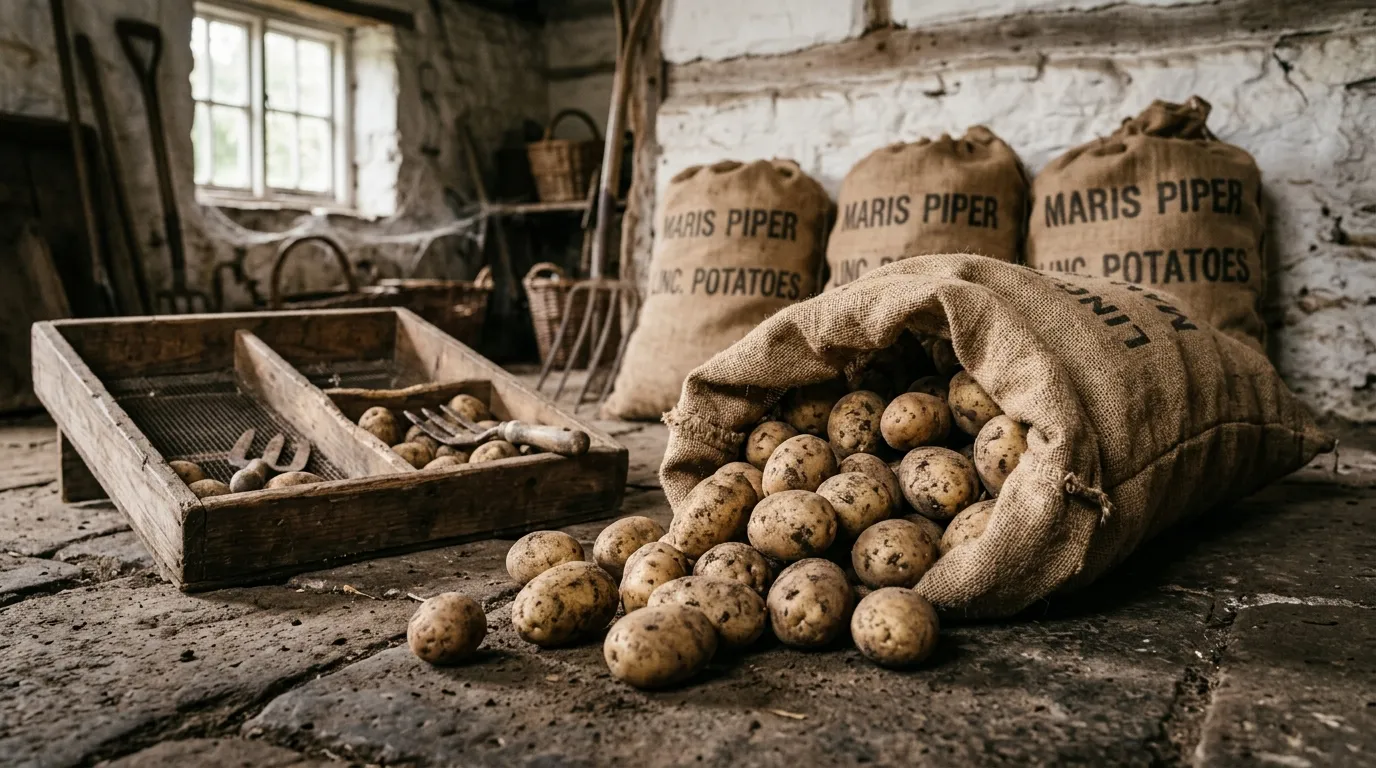 A coarse hessian sack of cured Maris Piper potatoes spilling onto the flagstone floor of a Lincolnshire kitchen garden store. Skins firm, no green patches, soil still lightly clinging. Hessian breathes, blocks light when stacked and covered, and holds humidity at 80-85%.
Storing Brassicas for Winter UK
Brassicas are the trickier group. Cabbages, swedes, turnips and Brussels sprout stalks all need cool moist storage at 0-3C, but each has a slightly different best practice.
Cabbages in net bags
Savoy and January King cabbages store best hung in net bags from a beam at 0-3C. Lift the whole plant with as long a stalk as possible, trim off any damaged outer leaves, and hang upside down in a net bag (an old onion sack works). The cabbage keeps for 10-12 weeks.
Red cabbages last longer than green: 14-16 weeks in the same conditions. The dense head and waxy outer leaves resist water loss better.
Brussels sprouts on the stalk
Brussels sprouts keep best on the cut stalk. Lift the whole plant, trim the roots and the top, and stand the stalk in a bucket with 50mm of damp sand in the bottom inside a cool outbuilding. The sprouts hold for 4-6 weeks, far longer than picked sprouts in a fridge.
Swedes and turnips
Both store well in a clamp (see above) or in damp sand crates in an unheated shed. Cut tops to 10mm, brush off soil, layer in damp (not wet) sand at 0-3C. Storage life: swedes 12-16 weeks, turnips 8-10 weeks.
Cauliflower
Cauliflower does not store well. Curds turn yellow and the texture goes mealy within 2 weeks. The only practical option is to lift the whole plant with roots intact, hang upside down in a frost-free shed, and use within 14 days. For longer storage, blanch and freeze.
Warning: Brassica storage smells. Cabbages release sulphur compounds as they age. Store brassicas in a different shed or outbuilding from apples, pears and potatoes, all of which take on the flavour quickly. One affected Maris Piper tastes of cabbage for days.
Storing Marrows and Winter Squash UK
Squash and marrow storage breaks every rule for root crop storage. The squash family wants warm, dry, light storage, the opposite of carrots and potatoes. Get the conditions right and a Crown Prince keeps for 28 weeks. Get them wrong and the same squash rots in 6 weeks.
Cure properly first
After lifting in October, cure the squash for 10-14 days in a warm dry spot at 15-25C. A south-facing greenhouse bench, conservatory windowsill or sunny porch all work. Curing toughens the skin and dries the stem, both essential for long storage.
A squash that has cured properly should sound hollow when tapped and the skin should not dent under thumb pressure. Cut into one that fails the thumb test and you usually find soft flesh inside.
Leave the stem intact
This is the rule that catches out most UK gardeners. The stem (peduncle) is the seal that keeps the squash sterile inside. Cut the stem off and the squash rots in 3 weeks. Always lift squash by cutting the vine 50mm above where the stem joins the fruit, leaving a clean T-shaped handle. Never carry a squash by its stem either: if it snaps off, storage life drops to 2-4 weeks.
Store on dry shelves
Place each squash on a wooden shelf in a cool dry room at 10-15C with 50-60% humidity. A spare bedroom, a hallway, or the warmest shelf of an outbuilding all work. Space the squash so they do not touch each other. Air circulation prevents the small dark spots on the skin from spreading.
Storage life by variety
| Variety | Type | Best storage life |
|---|---|---|
| Crown Prince | Blue-grey winter squash | 24-28 weeks |
| Butternut | Winter squash | 16-20 weeks |
| Uchiki Kuri | Onion squash | 12-16 weeks |
| Hubbard | Winter squash | 24-28 weeks |
| Turk’s Turban | Ornamental edible | 16-20 weeks |
| Marrow (any) | Summer marrow stored | 8-12 weeks |
| Pumpkin (carving type) | Field pumpkin | 8-10 weeks |
Crown Prince and Hubbard are the storage champions. A Crown Prince lifted in late September still cooks well in March. For variety choice and growing, see our how to grow pumpkins and squash UK guide.
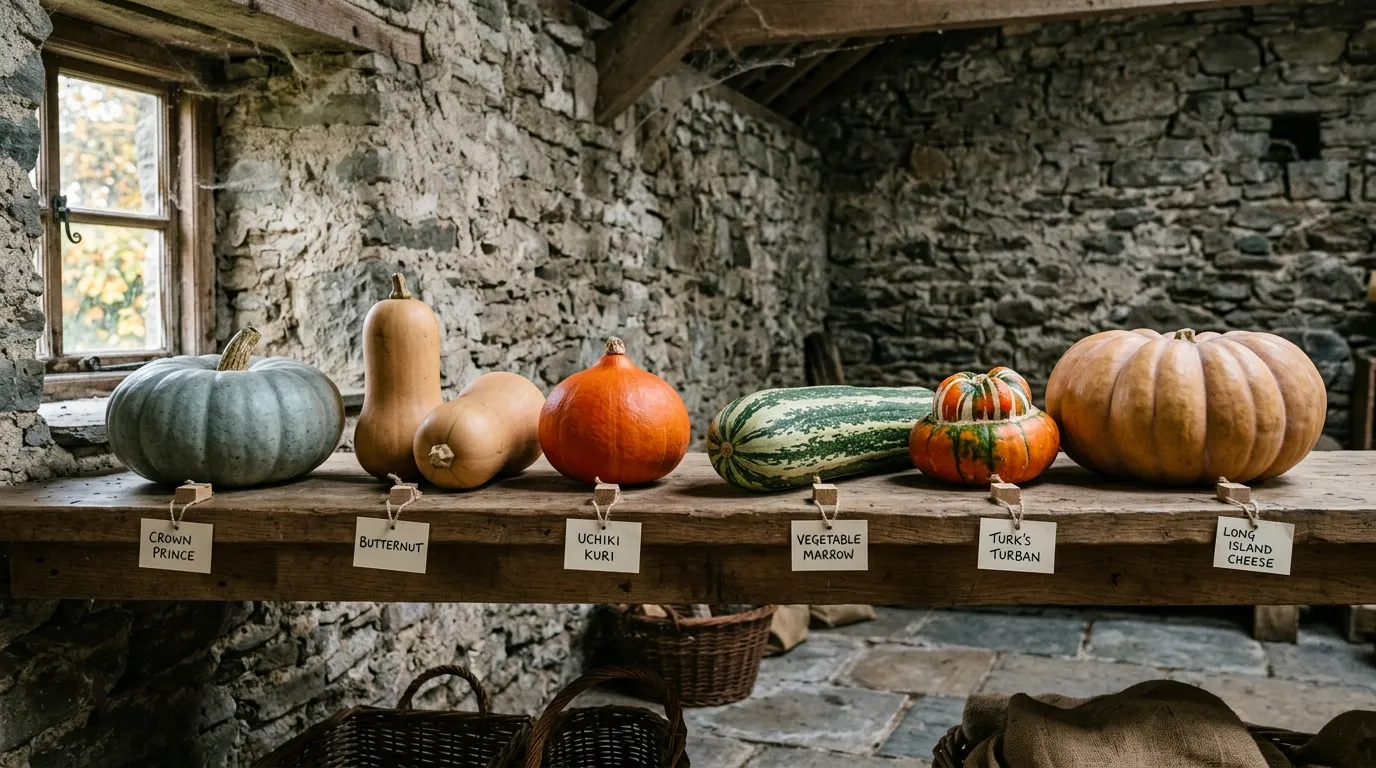 A wooden shelf of UK winter squash inside a Welsh stone barn. Crown Prince, two Butternut, Uchiki Kuri, a striped marrow, a small Turk’s Turban and a Long Island Cheese pumpkin. Every fruit has its T-shaped stem intact. Labelled, spaced apart, kept at 10-15C with 50-60% humidity.
Best Temperature for Storing Root Crops UK
There is no single best temperature for everything. Each crop group wants a different climate, and a working UK produce store has 2-3 temperature zones rather than one.
Comparison table: crop × method × temperature × storage life
| Crop | Best method | Ideal temp (C) | Humidity (%) | Storage life (weeks) | Failure signs |
|---|---|---|---|---|---|
| Carrots | Sand crate | 1-4 | 85-95 | 22-24 | Soft tip, grey mould, sprouting tops |
| Parsnips | Sand crate or in-ground | 1-4 | 85-95 | 16-20 | Brown core, soft skin |
| Beetroot | Sand crate | 1-4 | 85-95 | 14-18 | Wrinkled skin, soft flesh |
| Celeriac | Sand crate | 1-4 | 85-95 | 14-16 | Sunken brown spots |
| Maris Piper potato | Hessian sack, dark | 4-7 | 80-85 | 18-20 | Green skin, sprouts, soft rot |
| Pink Fir Apple | Hessian sack, dark | 4-7 | 80-85 | 16-18 | Soft rot at eyes |
| Savoy cabbage | Net bag hanging | 0-3 | 80-90 | 10-12 | Slimy outer leaves, grey mould |
| Red cabbage | Net bag hanging | 0-3 | 80-90 | 14-16 | Wilted, mouldy stalk |
| Swede | Clamp or sand | 0-3 | 85-95 | 12-16 | Soft pulpy flesh |
| Brussels sprouts | Whole stalk in sand bucket | 0-3 | 80-90 | 4-6 | Yellow leaves, loose buttons |
| Crown Prince squash | Dry shelf | 10-15 | 50-60 | 24-28 | Soft patch at stem end |
| Butternut squash | Dry shelf | 10-15 | 50-60 | 16-20 | Wrinkled skin, soft spots |
| Marrow | Dry shelf | 10-15 | 50-60 | 8-12 | Stem dry-rot, soft flesh |
| Onions | Plaited or net, dry shelf | 5-10 | 60-70 | 24-32 | Soft neck, sprouting from base |
For storing the alliums alongside your roots, see our storing onions garlic shallots UK guide.
Three temperature zones in one outbuilding
A typical UK stone outbuilding or unheated garage has natural temperature stratification. The floor sits 2-4C cooler than the top shelf, and you can use this to your advantage.
- Floor (coolest, 1-4C): carrots, parsnips, beetroot, celeriac in sand crates
- Lower shelf (4-7C): hessian sacks of potatoes, swedes in sand
- Mid shelf (6-9C): plaited onions, garlic
- Top shelf (8-12C): winter squash on dry timber
Month-by-Month Storage Calendar: Lift to Eat-By
UK storage runs roughly October to April, with each crop having a window for lifting and a separate window for finishing in the kitchen.
| Month | Storage tasks |
|---|---|
| September | Lift onions and shallots. Cure 14 days on a wire rack. Lift the first maincrop potatoes. Cure in the dark. |
| October | Lift Crown Prince and Hubbard squash before first frost. Cure 14 days warm. Lift carrots, parsnips, beetroot in dry spells. Build sand crates. Lift remaining maincrop potatoes. |
| November | Build vegetable clamps for swede, turnip, surplus carrots. Hang cabbages in net bags. Apply 100mm straw mulch over swedes left in ground. Start weekly check of all stores. |
| December | Eat through second earlies (Charlotte). Use first-picked squash (Uchiki Kuri). Cabbages from the net bags. Carrots from sand. |
| January | Eat maincrop potatoes (now at their best). Swedes from the clamp. Onions from the plait. Inspect every store thoroughly mid-month: discard any soft roots, re-cover clamps. |
| February | Lift any remaining in-ground swedes before they sprout. Start using stored Crown Prince. Re-check potato sacks for sprouting (rub off sprouts by hand). |
| March | Use up parsnips before they go woody. Last of the carrots. First spring greens replacing stored cabbages. |
| April | Eat any final Crown Prince squash (28-week limit). Empty clamps as they will warm above 5C. Wash and dry sand crates ready for re-use in autumn. |
The autumn gardening jobs UK guide covers lift timing in detail, and the what to harvest this month UK calendar tracks what is ready week by week.
Why Stored Root Crops Rot: Botrytis, Fusarium and Frost
Most UK allotment storage failures are not bad luck. They have specific named causes, and once you identify the cause you can prevent the next failure. The three big agents of storage loss are botrytis grey mould, fusarium dry rot, and frost damage.
Botrytis (grey mould)
Botrytis cinerea is the airborne grey fuzzy mould you see on a soft strawberry left out overnight. In storage it appears as a grey-brown fuzzy patch on a soft spot of a root, and it spreads outwards into healthy tissue at about 6-10mm per day at 5C. One affected carrot infects 6-8 neighbours within 14 days at typical store humidity.
Botrytis enters through bruises and cuts. The defences are: lift carefully, never wash, cure properly, store in single layers separated by sand, and check weekly so you catch the first spot before it spreads.
Fusarium dry rot
Fusarium fungi cause the chalky brown dry rot you see on stored potatoes and swedes. Unlike botrytis it does not spread by air, only by direct contact and shared bruising. A single affected potato in a sack typically infects 2-4 neighbours over 6 weeks.
Fusarium enters through wounds at lifting. Fork damage is the single biggest cause. Lift with a fork carefully under the row, never through it. Discard wounded tubers before sacking.
Frost damage
Most root crops tolerate occasional dips to 0C but not sustained sub-zero. A 24-hour spell at minus 3C ruptures cell walls in carrots and potatoes, and the damage shows up days later as soft watery patches. Beetroot is more frost-tolerant (handles minus 5C briefly). Squash is the least frost-tolerant: a single night below 4C in storage shortens the storage life by half.
Sustained frost is rare inside a sound stone outbuilding, but uninsulated metal sheds and timber sheds with single-skin walls regularly hit minus 4C in a cold UK January. If your shed is single-skin, line the storage area with 50mm polystyrene boards or move the most frost-sensitive crops (squash, potatoes) into the house porch for the coldest nights.
Permanent prevention
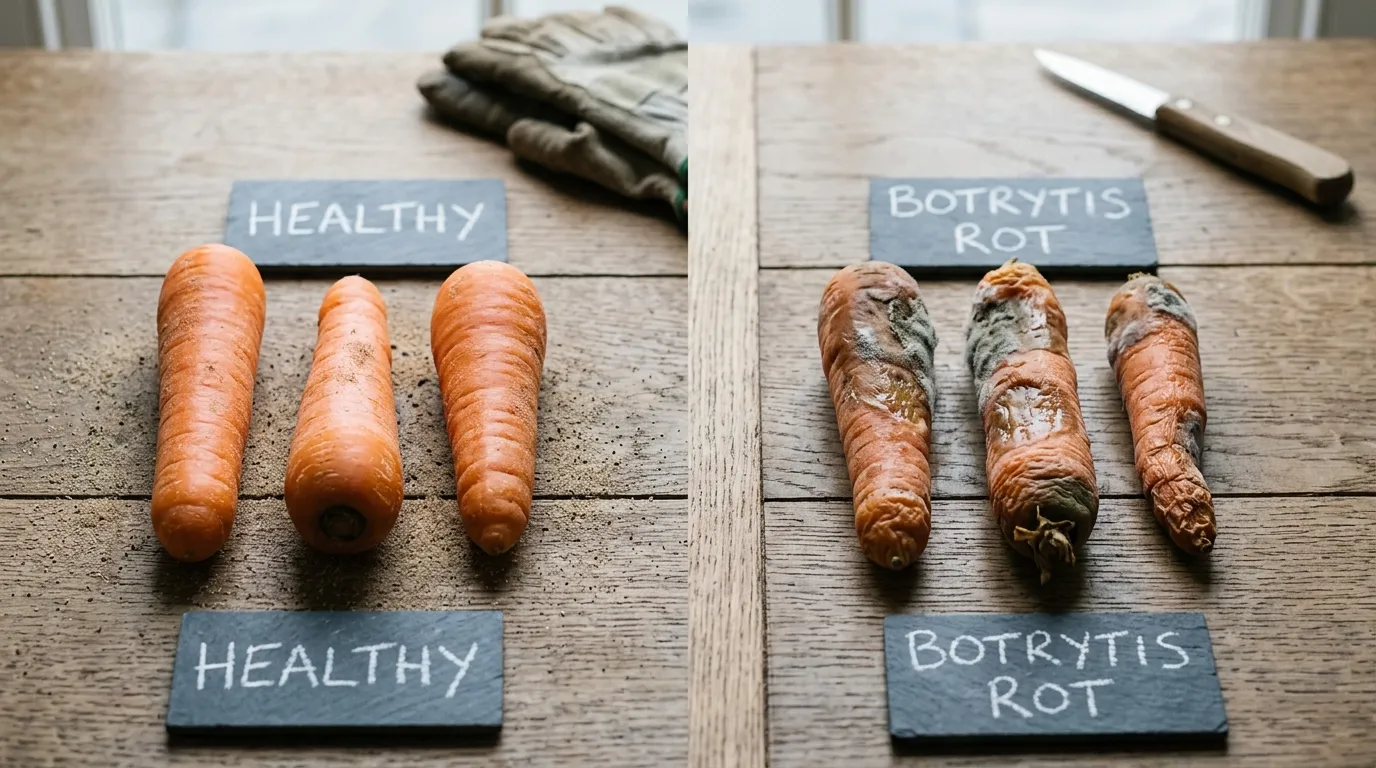 Diagnostic comparison on a UK workbench. Left: three healthy stored carrots after 16 weeks in sand at 2C. Right: three carrots with botrytis grey mould and brown soft spots from the same crate, identified at the weekly check. The rotten roots came out before they infected the rest.
5 common mistakes when storing root crops UK
Mistake 1: washing the roots before storage
Washed carrots and beetroot rot within 4-6 weeks. The thin skin loses its natural protective film, and any cuts or grazes are immediately colonised by botrytis. Always store roots dirty. Brush off loose soil with a dry hand. Wash only when you bring them in for the kitchen.
Mistake 2: storing potatoes and apples together
Apples release ethylene gas as they ripen. Ethylene triggers sprouting in stored potatoes within 2-3 weeks. The two crops must live in different rooms or different outbuildings. Onions also affect potatoes (the smell and the gases shorten storage life by 4-6 weeks).
Mistake 3: skipping the weekly check
One rotten root infects 6-8 neighbours within 14 days. A monthly check misses the spread window. Walk the store every 7 days with a head torch and remove every soft, mouldy or sprouting item. The 10-minute weekly walk is the single most effective storage technique you can practise. It is also the most-skipped.
Mistake 4: cutting squash stems off
A squash without an intact stem rots in 3-4 weeks no matter how good your storage. The stem seal is what keeps the fruit sterile. Lift squash with the vine cut 50mm above the stem, and never carry by the stem itself. If a stem snaps off, eat that squash within the month.
Mistake 5: storing one crop at one temperature
Carrots at 6C sprout by January. Potatoes at 1C convert starch to sugar and taste sweet and watery. Squash at 3C develops chill injury and rots from the inside. The single most common storage failure is sending the whole harvest into one shed at one temperature. Set up multiple zones, even within one small outbuilding, and place each crop at its correct temperature.
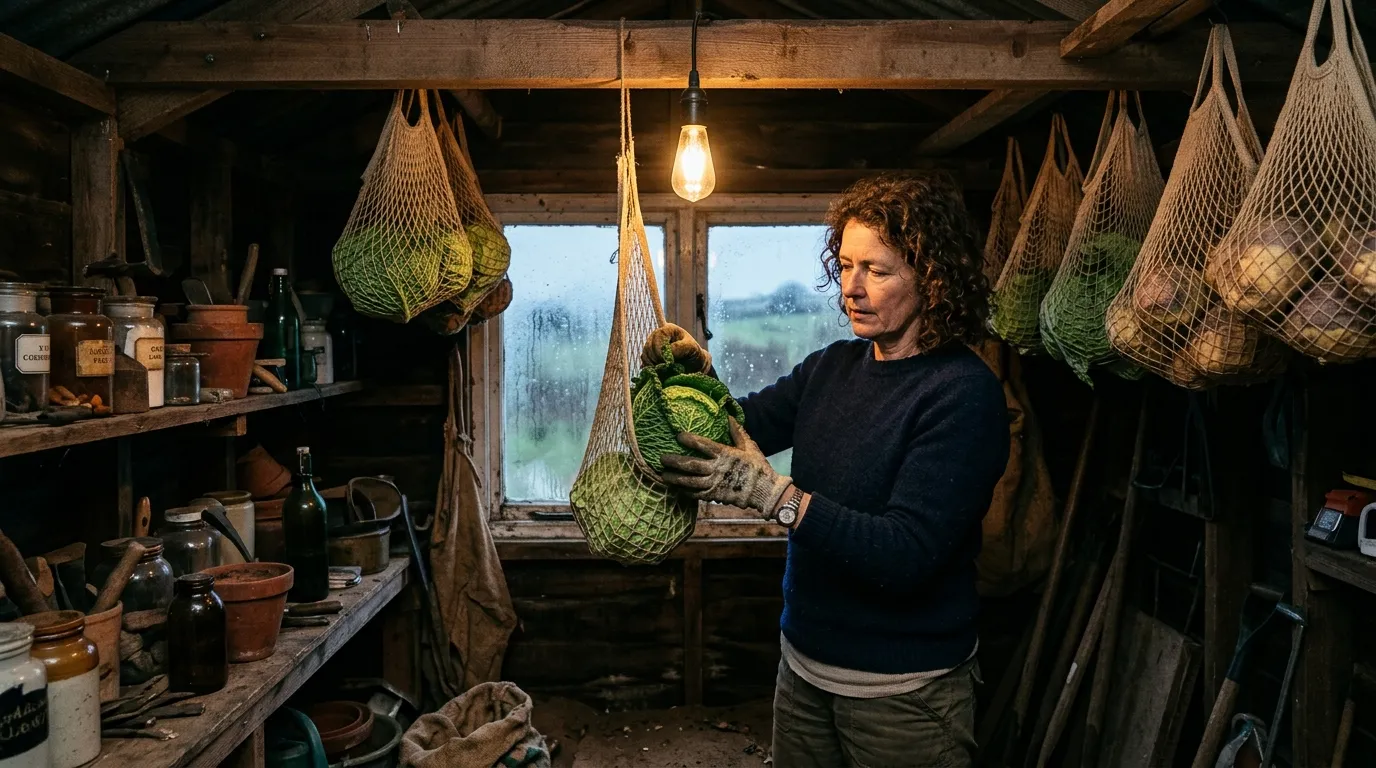 The weekly inspection in a Cornish smallholding storage shed in December. A Savoy cabbage lifted from its hanging net bag and checked for soft outer leaves, grey mould and slug damage. Catching one affected head stops the rot before it spreads to the six others on the same beam.
Setting Up a UK Root Cellar or Storage Shed
A dedicated storage area pays for itself in one winter of saved harvest. The setup does not need to be elaborate.
The space
Any small outbuilding, garage corner, or shed of 2m x 2m and upwards. Stone walls are best (mass insulation, stable temperature). Brick is good. Timber single-skin is poor unless lined with insulation boards. The space wants:
- No daylight reaching the storage area (cover any windows with hessian or a board)
- A solid floor (concrete or flagged), not bare earth which holds damp
- Air circulation (a small grille at low level and another at high level on opposite walls)
- A door that closes tight enough to keep mice out
The kit list
| Item | Purpose | Approx UK cost |
|---|---|---|
| Wooden crates (10) | Sand storage for roots | £30-£50 secondhand |
| Sharp builder’s sand (50 kg) | Layering medium | £8-£12 |
| Hessian sacks (5) | Potato storage | £15 |
| Onion or potato net bags (5) | Cabbages, brassicas | £8 |
| Min-max thermometer | Track temperature zones | £14 |
| Digital hygrometer | Track humidity | £6-£12 |
| Head torch | Weekly inspection | £12 |
| Shelving (timber) | Stratified storage | £40-£80 |
Rotation, Crop Planning and Storage
Storage capacity should drive crop planning, not the other way around. A 2m x 2m store comfortably holds about 60-80 kg of mixed root crops, which is roughly:
- 25 kg carrots and parsnips (4-5 crates)
- 25 kg potatoes (2 sacks)
- 10 kg winter squash (4-6 fruits)
- 10 kg brassicas (cabbages, swedes)
- 5 kg onions and garlic
Beyond that capacity, the harvest goes to waste or you build a clamp. Plan your allotment beds with this capacity in mind. Our four year crop rotation UK guide and the crop rotation planner UK cover bed-by-bed planning so you grow the volumes that match your storage. The Garden Organic guide to organic vegetable storage covers the chemistry of curing and storage in detail.
Frequently asked questions
How long do root crops last in storage UK?
What is a traditional vegetable clamp?
A clamp is an outdoor mound of root vegetables covered with straw then earth. Build a 1.5m base of straw, stack roots in a pyramid, cover with 150mm of straw and 100mm of soil with a ventilation chimney through the top. A 1.5m clamp holds 50-80 kg of mixed root crops at 0-3C for 16 weeks. Open only from one side and re-cover immediately.
How do you store carrots in sand UK?
Cut tops to 10mm, do not wash, lay roots in a wooden crate between 25mm layers of dry sharp builder’s sand. Keep at 1-4C and 85-95% humidity. Roots must not touch each other. A 35cm x 25cm crate holds 6 kg in 3-4 layers. Carrots last 22-24 weeks in sand, longer than any other home storage method.
What temperature should a root cellar be UK?
A root cellar should sit at 1-4C with 85-95% humidity for carrots, parsnips, beetroot and celeriac. Potatoes want a separate 4-7C zone in the dark. Squash and marrows want 10-15C with 50-60% humidity. One temperature for everything almost always fails. Use shelving stratification to create multiple zones in one space.
Why do my stored potatoes go green?
Light exposure causes greening, even brief indirect light. Store in hessian or paper sacks inside a fully dark cupboard or under a heavy cover. Green skin contains solanine, a toxic alkaloid. Discard any tuber with green patches. Test darkness by sitting in the store with the door closed for 5 minutes: if you can see your hand against the sacks, the area needs better light blocking.
Now you have your storage sorted
Twelve years of winter storage in a Staffordshire stone outbuilding boils down to four methods, three temperature zones and one weekly inspection. Lift on dry days, cure where needed, never wash, match each crop to its temperature, walk through the store every 7 days. Done well, an allotment-grown harvest feeds a household from October to April with carrots, parsnips, potatoes, swedes, cabbages and squash still on the kitchen table.
Now you have storage sorted, read our how to store apples and pears UK guide for the same level of detail on top fruit. For planning next year’s beds around your storage capacity, the four year crop rotation UK guide is the next step.
Our team produces practical UK gardening guidance from source research, contributor records and established horticultural practice. Editorial standards are overseen by Matt W.