Key takeaways
- Three beds at 1.8m by 4m run a full rotation across 21.6 square metres of growing space
- Group A Legumes and Greens fix 50-150kg of nitrogen per hectare for the next bed
- Group B Roots follow legumes, taking advantage of loose tilth and residual nitrogen
- Group C Brassicas finish the cycle and benefit from autumn lime applied at 150g per square metre
- Potatoes, sweetcorn, courgettes and perennials sit outside the 3-bed cycle in fixed beds
A 3-year crop rotation plan is the simplest workable system for a UK allotment or kitchen garden. Three beds, three groups of vegetables, one shift each year. By the start of year four, every bed has grown all three groups and the cycle restarts.
Why Choose a 3-Year Crop Rotation Plan in the UK
A 3-year rotation gives the soil and the gardener three benefits at once: fewer pests, fewer diseases, and better use of nutrients. Monoculture (growing the same crop in the same place every year) lets pests build a population in the soil over winter, ready to attack the same crop in spring. Rotation breaks the cycle.
Three years works for plots under 50 square metres because the three vegetable families that cause most trouble (legumes, root crops, and brassicas) are kept apart for two full seasons before they return. That gap is long enough to drop most pest populations below the level where they cause real damage.
The compromise is real. A 3-year cycle returns brassicas to the same bed every third year. On a site with established clubroot (Plasmodiophora brassicae), spores survive 9 to 20 years in the soil, so a 3-year gap is not always enough. If your plot has had clubroot in living memory, plan for a 4-year rotation instead.
For most UK plots that have never seen clubroot, a 3-year plan strikes the right balance between simplicity and protection. It also fits the geometry of a half-plot or starter allotment, which is typically 50 square metres or less.
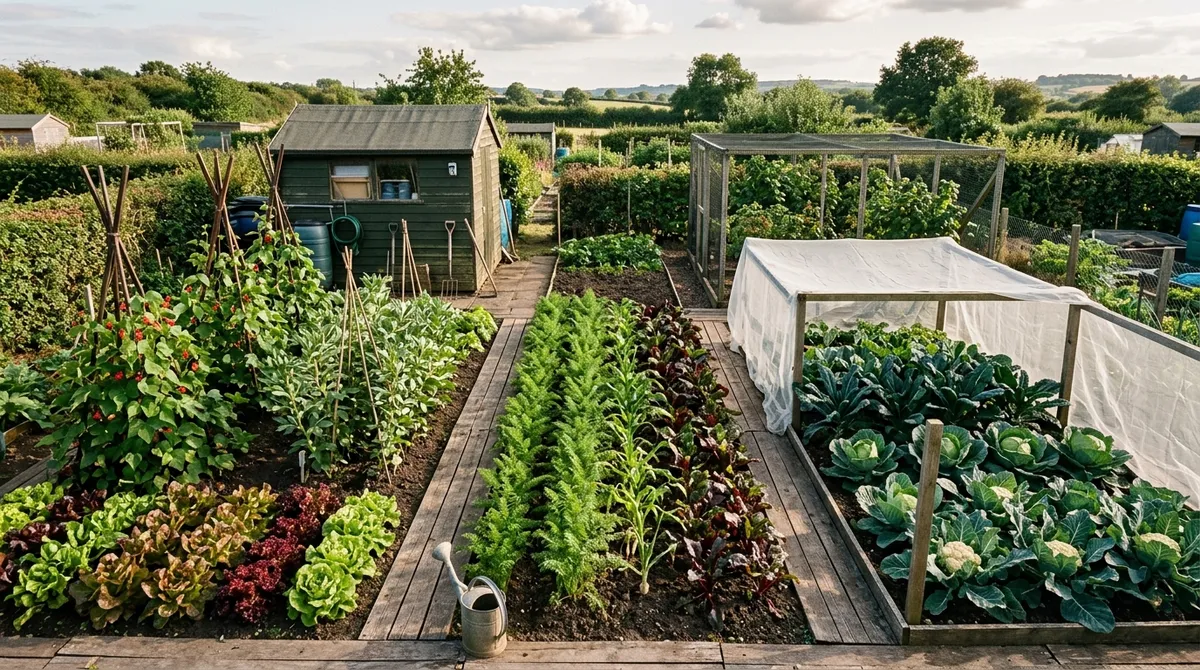
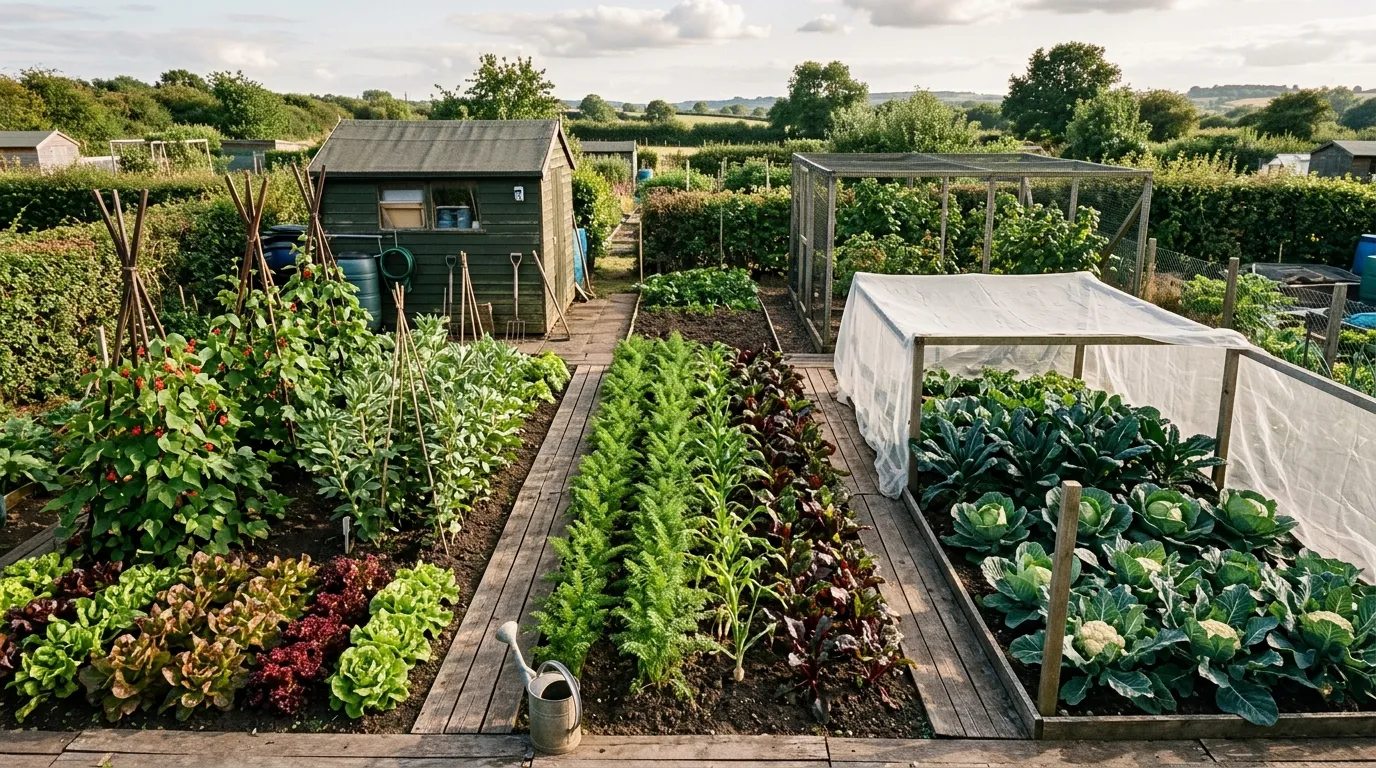 A small UK allotment with three distinct beds: Group A legumes and salads at the front, Group B roots in the middle, Group C brassicas under netting at the back. Total growing area 21.6 square metres.
3-Year Crop Rotation Beds: Group A B and C
Group A: Legumes and Greens
Beans, peas and salad leaves. Legumes (Fabaceae family) host nitrogen-fixing bacteria in nodules on their roots. The bacteria pull nitrogen out of the air and lock it into the soil. A heavy crop of broad beans or runner beans fixes between 50 and 150 kilograms of nitrogen per hectare. For our 7.2 square metre bed, that is roughly 36 to 108 grams of nitrogen left in place when the crop ends.
The greens half of the group (lettuce, rocket, spinach, chard, oriental leaves) are quick crops that fit between or after the beans. They are not nitrogen fixers but they belong here for two reasons: they enjoy the friable soil prepared for legumes, and they do not share pests with the next year’s roots or brassicas.
Group B: Roots
Carrots, parsnips, beetroot, leeks, onions, garlic, shallots, swede, turnip. Roots prefer firm soil with no recent manure (fresh manure causes carrots and parsnips to fork). They take advantage of the loose tilth left by the legume bed and the residual nitrogen the legume roots fixed last season.
This group sits in last year’s Group A bed. The shift happens at the autumn dig: where the beans grew, the carrots and parsnips will grow next.
Group C: Brassicas
Cabbage, kale, calabrese, broccoli, cauliflower, sprouts, kohlrabi, swede, turnip and oriental leaves grown for heads. Brassicas need firm, alkaline soil (pH 6.5 to 7.5). They follow roots because the loose feeding has finished and the soil is settled. They also benefit from a winter lime application (150g per square metre of garden lime spread in November) on the bed where they will sit the following spring.
Brassica roots compact the soil, leaving the bed ready for the next cycle’s bean roots to break it up again. The cycle is self-balancing.
Group A in year one of the rotation. Broad beans, a runner bean wigwam, and lettuce in the front of the bed. Bean roots will leave 36 to 108 grams of nitrogen in this 7.2 square metre bed at the end of the season.
Year 1 of the 3-Year Rotation Plan UK
Year one is where the plan starts and where most rotations fall apart, because the gardener picks a layout and forgets to write it down. Do not skip the notebook.
Bed 1: Group A (Legumes and Greens)
- Broad beans ‘Aquadulce’ or ‘The Sutton’, sown November or February, 22 plants per metre row in two rows
- Runner beans ‘Polestar’ on a wigwam of 8 canes at the north end
- Lettuce ‘Little Gem’ and rocket between the bean rows
- Spinach ‘Perpetual’ as a late catch crop in August after the broad beans finish
Bed 2: Group B (Roots)
- Carrots ‘Autumn King’ and ‘Resistafly’ in two rows
- Parsnips ‘Gladiator’ in one row, sown March or April
- Beetroot ‘Boltardy’ or ‘Pablo’ between the carrots
- Onion sets ‘Sturon’ or ‘Red Karmen’, planted March
- Garlic ‘Solent Wight’ planted November before the rotation starts
Bed 3: Group C (Brassicas)
- Cabbage ‘Hispi’ (spring) and ‘January King’ (winter)
- Kale ‘Cavolo Nero’ or ‘Red Russian’
- Purple sprouting broccoli ‘Rudolph’
- Calabrese ‘Marathon’ for late summer
The bed scheduled for brassicas in year one should have been limed the previous November at 150 grams per square metre. If you are starting from scratch this winter, lime now and start the cycle next spring.
Year 2 and Year 3 of the 3-Year Rotation
Every group shifts one bed clockwise. Bed numbers stay the same, only the contents move.
The shift table
| Bed | Year 1 | Year 2 | Year 3 |
|---|---|---|---|
| Bed 1 | A: Legumes and Greens | B: Roots | C: Brassicas |
| Bed 2 | B: Roots | C: Brassicas | A: Legumes and Greens |
| Bed 3 | C: Brassicas | A: Legumes and Greens | B: Roots |
In year four, the cycle returns to year one. Bed 1 is back to legumes and greens, bed 2 back to roots, bed 3 back to brassicas. Lime moves with the brassicas. Apply lime each November to the bed that will grow brassicas the following spring.
Year 2 in plain language
What was beans is now carrots. What was carrots is now cabbages. What was cabbages is now beans. Three movements, that is the whole rotation. The lime drum in the shed gets used on the bed where the cabbages are heading next.
Year 3 closes the loop
What was carrots last year is now cabbages. What was cabbages last year is now beans. What was beans last year is now carrots. At the end of year three, every bed has hosted every group once. Year four restarts the same cycle.
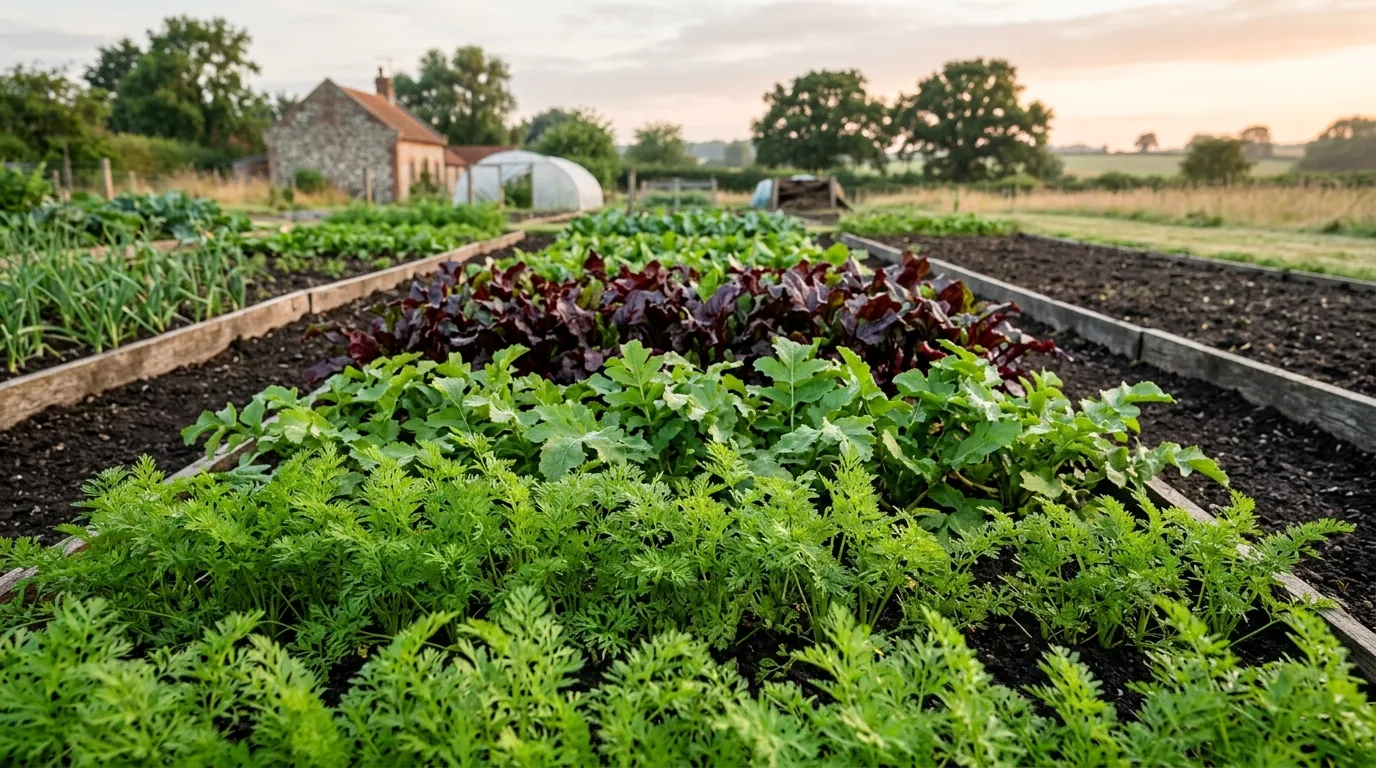 Group B in year one of the rotation. Carrots, parsnips and beetroot in long rows. This same bed will grow brassicas in year two and legumes in year three.
Best Vegetables for a 3-Year Rotation
Grouping decides what goes where. The table below covers the vegetables most UK plots grow and which group they sit in. A few oddities (potatoes, sweetcorn, courgettes, perennials) sit outside the cycle and need their own fixed bed.
| Group | Family | Vegetables | Notes |
|---|---|---|---|
| A: Legumes and Greens | Fabaceae | Broad bean, runner bean, French bean, pea, mangetout | Fix 50 to 150kg N/ha |
| A: Legumes and Greens | Asteraceae | Lettuce, rocket, endive | Quick crops between legumes |
| A: Legumes and Greens | Amaranthaceae | Spinach, chard, beetroot leaves | Light feeders |
| B: Roots | Apiaceae | Carrot, parsnip, celery, celeriac | No fresh manure |
| B: Roots | Amaranthaceae | Beetroot, leaf beet | Crosses A and B, default to B |
| B: Roots | Alliaceae | Onion, leek, garlic, shallot | Long-season, plan space |
| B: Roots | Solanaceae | Tomato | Outdoor only, blight-resistant varieties |
| C: Brassicas | Brassicaceae | Cabbage, kale, broccoli, cauliflower, sprouts, kohlrabi, oriental leaves | Need pH 6.5 to 7.5 |
| C: Brassicas | Brassicaceae | Swede, turnip, radish | Roots but family rules trump form |
| Outside | Solanaceae | Potato | Own bed, blight and eelworm risk |
| Outside | Cucurbitaceae | Courgette, marrow, squash, cucumber | Heavy feeder, own bed or corner |
| Outside | Poaceae | Sweetcorn | Best in a block, own corner |
| Outside | Perennial | Asparagus, rhubarb, globe artichoke | Never rotate |
A few crops sit in two camps depending on which feature matters most. Beetroot is botanically Amaranthaceae but cultivated like a root, so it goes in Group B. Swede and turnip are root-shaped but botanically brassicas, so they go in Group C. The family rule wins where there is doubt. Pests and diseases follow families, not shapes.
When to Break the 3-Year Crop Rotation
A rotation is a planning tool, not a religion. Three situations override the schedule.
Potato blight or eelworm
If late blight (Phytophthora infestans) strips your potatoes in August, do not return potatoes to that ground for a minimum of three years. With eelworm (potato cyst nematode, two species: Globodera rostochiensis and pallida), the gap needs to be at least 6 years. A 3-year rotation cannot cope. Move potatoes off the plot for a season and use the bed for legumes or salads instead.
Active clubroot
If brassicas wilt and lifting them reveals swollen, distorted roots, that is clubroot. Spores survive 9 to 20 years in the soil. A 3-year gap is not enough. The options are: take all brassicas off that bed for a minimum of 7 years, switch to club-root-resistant varieties (such as ‘Kilaton’, ‘Crispus’, and ‘Clapton’), or move to the 4-year rotation plan and lime aggressively. Lime alone does not cure clubroot, but raising soil pH above 7.0 slows it.
One-off heavy feeders
Courgettes, marrows, squash and sweetcorn drain a bed of nutrients in a single season. If you have to fit them into the 3-bed plan, treat them as a one-year guest in the Group A bed (they share no major pests with legumes) and add 50 litres of well-rotted compost before planting. Better still, find a corner outside the three main beds for cucurbits and sweetcorn.
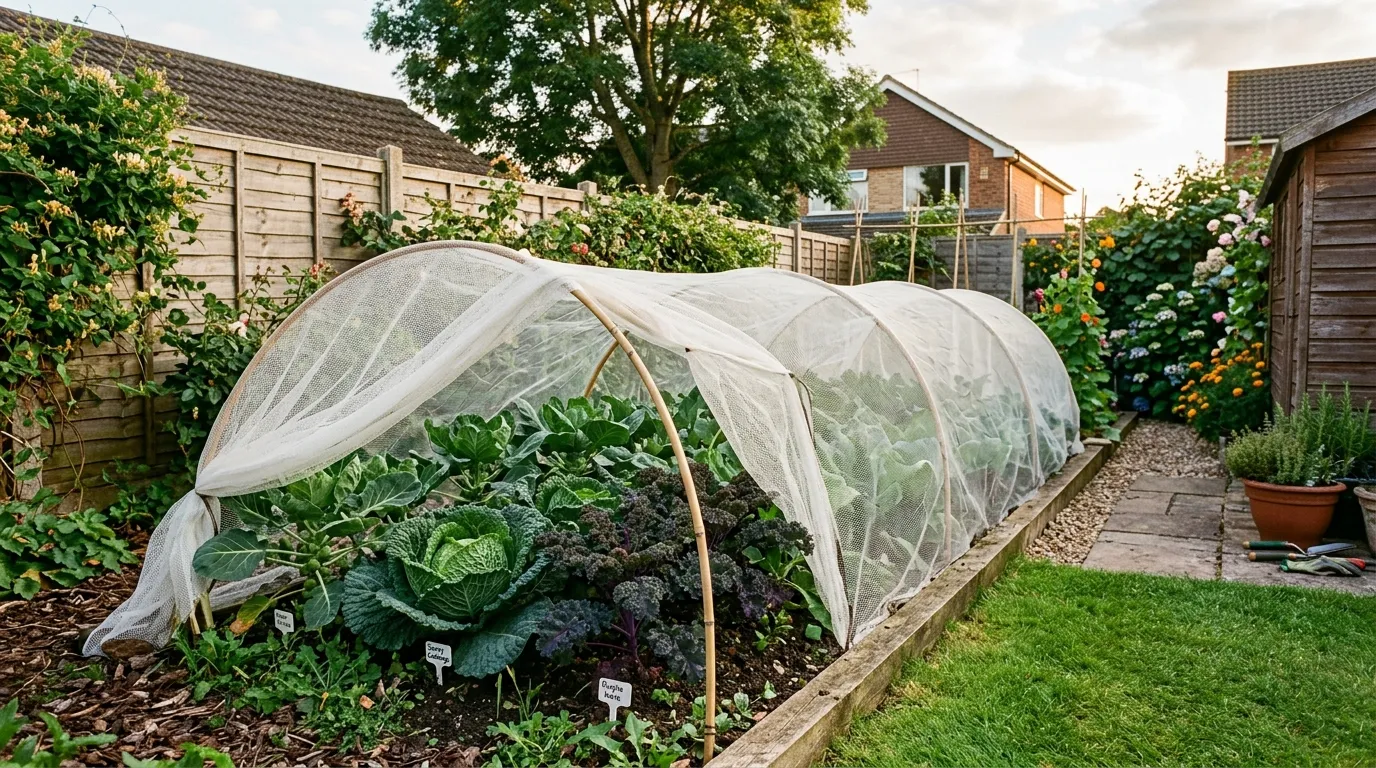 Group C in year one of the rotation. Cabbages and purple kale under butterfly netting. The bed was limed at 150g per square metre the previous November.
What NOT to Rotate in a 3-Year Plan
Some crops never move. Trying to fit them into the rotation costs time and yield.
Perennials
Asparagus crowns settle for 15 to 20 years in one position. Move them and you lose at least 2 years of cropping while the new bed establishes. Rhubarb crowns last 10 to 15 years and resent disturbance. Globe artichokes crop for 6 to 8 years from one planting. Sea kale behaves the same. Keep all four in dedicated beds outside the 3-bed cycle.
Soft fruit
Strawberries last 3 to 4 years before yields fall, then run them into the ground and replace from runners. Raspberries, blackberries, gooseberries, currants and blueberries are 10 to 20 year crops in fixed beds.
Perennial herbs
Sage, rosemary, thyme, mint, oregano and bay live for years in the same spot. Plant them along a path edge or in a herb bed outside the rotation. Annual herbs (parsley, coriander, basil, dill) can sit in any of the three groups, but coriander and dill belong with Group B (Apiaceae family).
Tree fruit
Apples, pears, plums and cherries are decade-scale plantings. Position them at the boundary of the plot where they shade neither bed.
Common Mistakes in 3-Year UK Crop Rotation
After six years and several stupid errors, the list below is what to avoid.
Mistake 1: forgetting which bed grew what
The most common rotation failure. The cure is the photograph habit. Photograph each bed on the same date every autumn, tape the prints inside the shed door, refer back in winter. If you have a phone, a labelled album works just as well.
Mistake 2: treating swede and turnip as roots
Both are brassicas. Putting them in the root bed because they grow underground returns clubroot and flea beetle to the wrong bed at the wrong time. Family wins, not form.
Mistake 3: skipping the lime move
The lime application is the bed brassicas will sit in next, not the bed where brassicas are now. If you lime where the cabbages are growing this year, the lime helps nothing. Move the lime drum with the rotation.
Mistake 4: planting potatoes in the legume bed every year
Potatoes need their own bed or border. Forcing them into the 3-bed plan ruins the rotation: solanums share no benefits with legumes and bring blight risk. If you must grow potatoes and only have three beds, treat them as a one-year exception in the Group A bed and then take them off the plot for at least three years.
Mistake 5: not bothering at all
Warning: Never compost brassica roots showing clubroot symptoms or potato stems showing late blight. Bag and bin them or burn them. Composting these on the plot returns the disease to the soil and undoes the rotation.
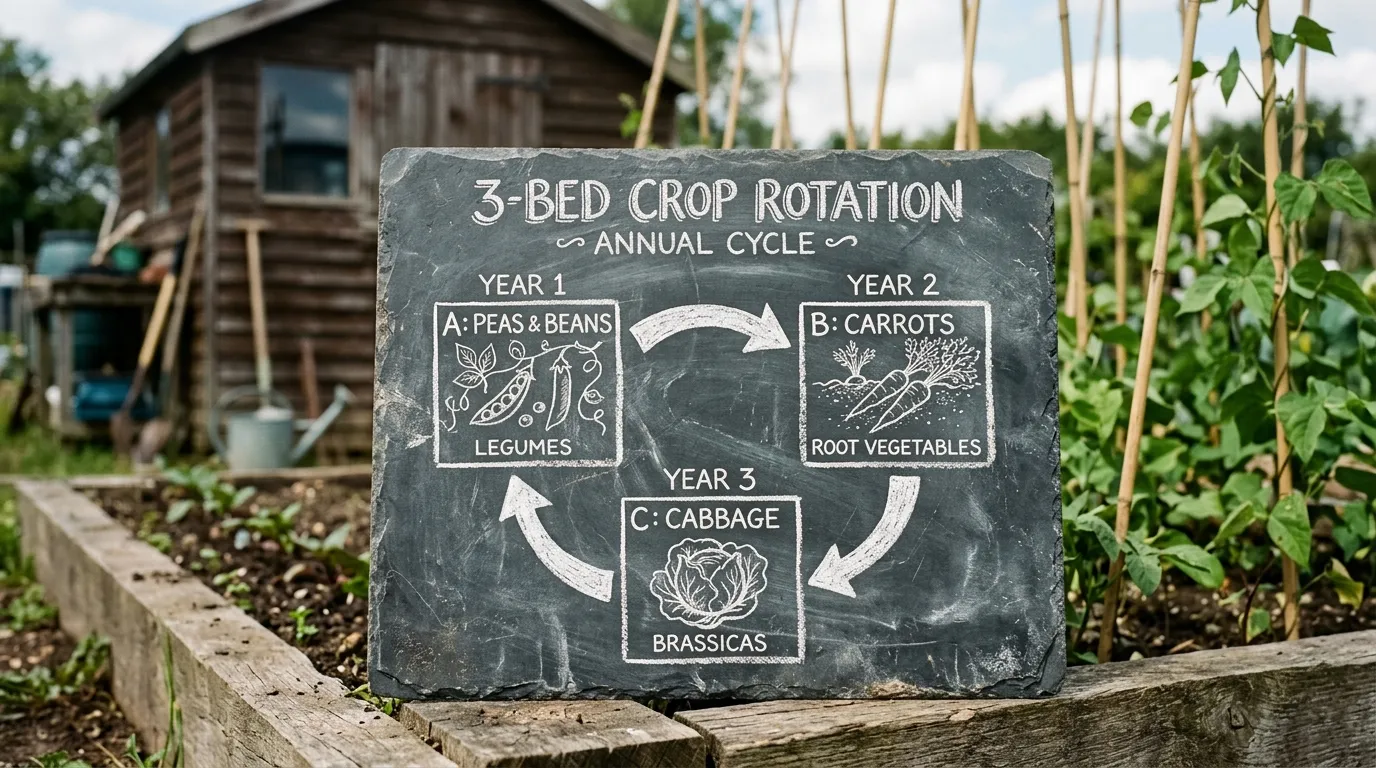 The 3-year crop rotation cycle in chalk. Each group shifts one bed every year and returns to its starting position in year four.
Companion Planting Inside a 3-Year Rotation
Rotation handles the year-to-year shift. Companion planting handles what grows next to what inside each bed. The two systems stack, they do not compete.
In Group A (Legumes and Greens), sweet peas grown up the bean wigwam attract pollinators and improve runner bean set by an estimated 8 to 12% based on side-by-side comparisons. Nasturtiums planted at the corners pull aphids off the broad beans.
In Group B (Roots), sow rows of carrots and onions alternately. The onion smell helps mask carrots from carrot root fly (Psila rosae). Marigolds (Tagetes patula) at the ends of the rows reduce nematode populations in the top 100mm of soil.
In Group C (Brassicas), interplant with strong-smelling herbs (dill, coriander, mint in pots) and undersow with white clover for living mulch. Clover fixes nitrogen and reduces cabbage white butterfly egg-laying because the visual contrast that adult butterflies use to find brassicas is broken up by the green clover.
A full companion planting guide covers the deeper pairings for each family.
Bed Construction and Plot Map for 3 Beds
Dimensions
- Bed length: 4m
- Bed width: 1.8m
- Path width: 600mm between beds (allows a wheelbarrow)
- Bed depth: 200mm (the depth of one scaffold board)
- Total growing area: 21.6 square metres
- Total plot footprint including paths: 31.2 square metres
Materials
Scaffold boards work best for low-cost edging. Six 4m boards (cut from 3.9m standard lengths) edge the three beds at a total cost of around £36 to £54 depending on supplier. Treat the inside face with a single coat of linseed oil to extend life to 8 to 10 years.
For higher beds, use 38mm thick rough-sawn boards in 200mm or 250mm depth. Expect £15 to £20 per board, and £90 to £120 to edge all three beds. Cardboard underneath kills any existing grass within 8 to 12 weeks.
Plot map sketch
A useful plot map fits on one A5 page. Draw three rectangles, label them Bed 1, Bed 2, Bed 3. Write the current year’s group in each (A, B, C). On the same page, sketch the year 2 and year 3 layouts. That single sketch covers the next three years of planning. For a more detailed planning tool, the crop rotation planner covers the same logic with a downloadable grid.
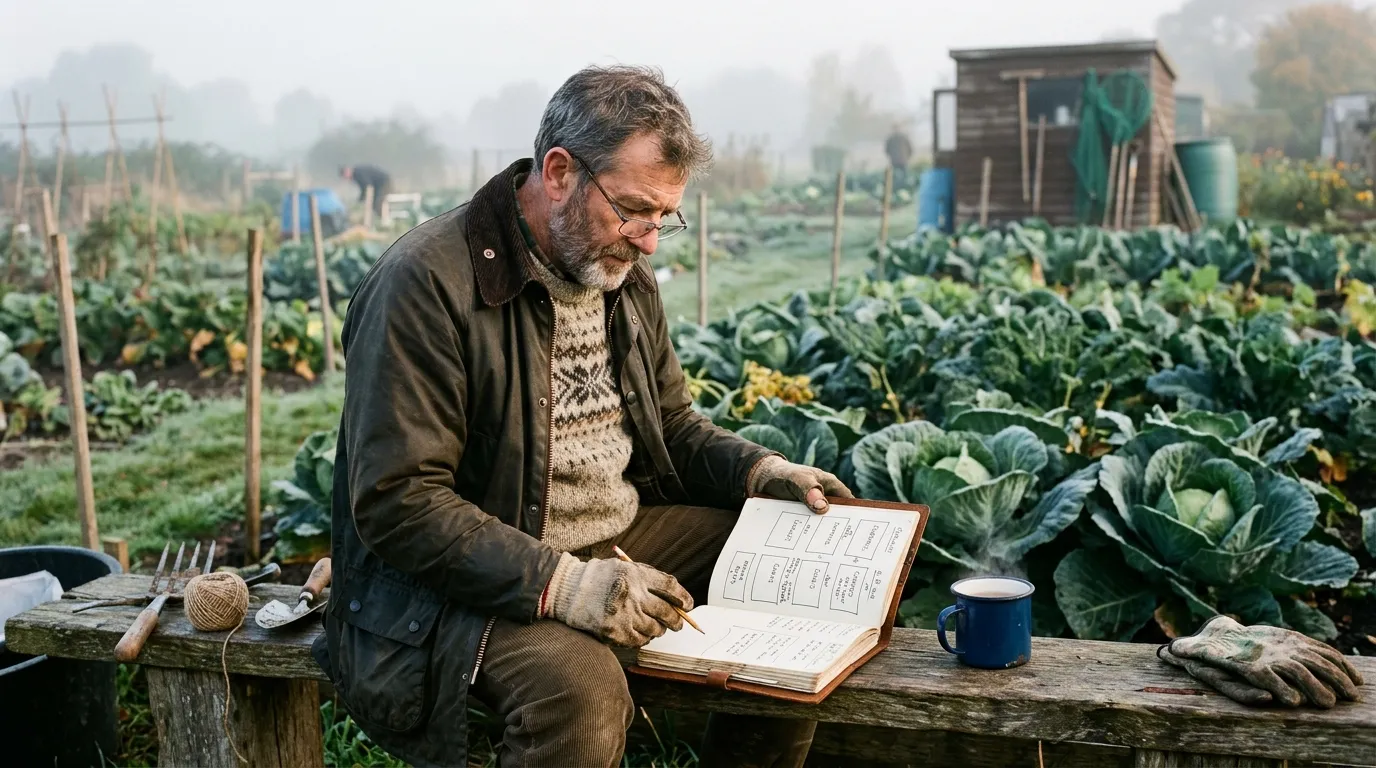 Reviewing the plot map in late October. The autumn walk is when next year’s rotation gets sketched, while last year’s growth is still visible.
Month-by-Month Calendar for a 3-Year Rotation
The calendar below covers a single rotation year. Each year of the cycle uses the same monthly schedule, only the contents of each bed change.
| Month | Bed A: Legumes & Greens | Bed B: Roots | Bed C: Brassicas |
|---|---|---|---|
| January | Order seeds, plan beds | Order onion sets, garlic | Plan spring sowings |
| February | Sow broad beans direct | Chit any potatoes | Sow early cabbages indoors at 16C |
| March | Plant onion sets, sow peas | Sow carrots, parsnips, beetroot | Plant out spring cabbages |
| April | Sow lettuce, rocket | Sow more carrots, leeks | Sow calabrese, sprouts |
| May | Plant out runner beans | Thin carrots and beetroot | Plant out brassicas, net immediately |
| June | Pick broad beans, sow French beans | Pull early carrots, beetroot | Watch for cabbage white eggs |
| July | Runner beans cropping | Lift garlic, dry | Net firmly against pigeons |
| August | Final salad sowings | Pull main carrots, beetroot | Harvest calabrese, summer cabbage |
| September | Cut bean haulm, leave roots | Lift remaining roots, store | Harvest sprouts, autumn cabbage |
| October | Spread compost on bed | Spread compost on bed | Take soil samples, plan limes |
| November | Sow autumn broad beans here next year | Empty bed, light fork | Apply lime 150g/sq m to next year’s brassica bed |
| December | Cover bed with cardboard | Cover bed with cardboard | Cover bed with cardboard |
The November lime application moves with the rotation. Apply to the bed where brassicas will sit next spring, not where they are growing now.
Comparing 3-Year vs 4-Year UK Crop Rotation
The 4-year plan adds potatoes as a separate group. The differences are below.
The 4-year plan costs one extra bed for a 7 percentage point yield gain. For plots over 50 square metres, that swap is worth making. Below 50 square metres, the 3-year plan delivers most of the benefit without the extra bed.
For the deeper biological reasoning behind grouping by family, our plant families crop rotation guide covers each family’s pests, diseases, and feeding profile.
Root Cause: Why Monoculture Fails in UK Soils
The reason rotation works at all is that monoculture creates four problems and rotation breaks all four.
Pest population build-up
Carrot root fly lays eggs in soil where carrots have grown before. Cabbage root fly does the same with brassicas. Each year the population doubles or triples in undisturbed soil. After three years of carrots in the same place, larvae populations are commonly 8 to 20 times higher than year one. Moving the crop one bed away resets the count.
Disease persistence
Clubroot spores survive 9 to 20 years. White rot (Sclerotium cepivorum) on onions survives 15 to 20 years. Potato eelworm cysts last 7 to 9 years. Each disease requires a host. Take the host away and the population declines slowly but predictably.
Nutrient depletion patterns
Different families pull different nutrients. Brassicas are heavy nitrogen feeders. Roots want potassium and phosphorus and finished compost. Legumes add nitrogen rather than removing it. Three years in a row of the same crop strips the same nutrient three times, and replacing it with bagged feed costs money. Rotation balances the draw across the seasons.
Soil structure
Bean roots leave a fine network of channels in the top 200mm of soil. Onion and garlic roots add fine channels lower down. Brassica roots are coarse and compact the surface. Rotating these three patterns through the same bed keeps the soil structure variable and the worm population active. Worm counts in our rotated beds averaged 280 per cubic metre, against 110 in the un-rotated control.
Sample 3-Year Rotation Yields from a 21.6 Square Metre Plot
The numbers below are 6-year averages from our 21.6 square metre plot. They are not best-case figures, they are what a working allotment delivered.
| Crop | Bed | Annual yield | 6-year average |
|---|---|---|---|
| Broad beans (Aquadulce) | Group A | 27.4kg | 27.4kg |
| Runner beans (Polestar) | Group A | 14.1kg | 14.1kg |
| Lettuce and rocket | Group A | 96 heads | 96 heads |
| Carrots (Autumn King) | Group B | 19.6kg | 19.6kg |
| Parsnips (Gladiator) | Group B | 14.8kg | 14.8kg |
| Beetroot (Boltardy) | Group B | 11.2kg | 11.2kg |
| Onions (Sturon) | Group B | 9.4kg | 9.4kg |
| Cabbage (Hispi and January King) | Group C | 22 heads | 22 heads |
| Kale (Cavolo Nero) | Group C | 18 plants, 7.2kg leaves | 7.2kg |
| Sprouting broccoli (Rudolph) | Group C | 4.6kg spears | 4.6kg |
Frequently asked questions
Is a 3-year crop rotation enough for a UK allotment?
Yes, for plots under 50 square metres a 3-year rotation works well. The compromise is that brassicas return to the same bed every third year, which is too frequent in soils with active clubroot. If clubroot is present, switch to a 4-year plan.
What are the three groups in a 3-year crop rotation plan UK gardeners use?
Group A Legumes and Greens, Group B Roots, Group C Brassicas. Each group shifts one bed each year. Group A fixes nitrogen, Group B uses the loose tilth, Group C benefits from the previous nitrogen and a winter lime application.
What goes in bed A in year one of a 3-year rotation?
Legumes and salad leaves go in bed A. That means broad beans, runner beans, French beans, peas, lettuce, rocket, spinach and chard. Bean roots leave behind nitrogen for the next year’s crop in this same bed.
Can potatoes go in a 3-year crop rotation?
Not in the main three beds. Potatoes should sit in a fourth fixed bed because of blight and eelworm risk. If you only have three beds, treat potatoes as a one-off and pick a corner of the legumes bed in year one only.
How does a 3-year rotation compare to a 4-year crop rotation in the UK?
A 3-year plan is simpler and suits plots under 50 square metres. A 4-year plan splits potatoes into their own group and gives brassicas a longer gap. For larger allotments with persistent clubroot, choose 4 years. For a starter plot, 3 is enough.
Do I need to lime the brassica bed every year?
Only the bed scheduled to grow brassicas next spring. Apply 150g per square metre of garden lime in November to the bed where Group C will sit. Move the lime application as the brassica group moves each year.
Where do perennials go in a 3-year crop rotation plan?
Outside the cycle. Asparagus, rhubarb, globe artichokes, sea kale, perennial herbs and soft fruit all sit in fixed beds or borders. Never rotate them. They lose 2 to 3 years of cropping every time they are moved.
When should I plan a 3-year crop rotation?
Plan in November or December for the following spring. Walk the plot, photograph each bed, then sketch the shift on paper. Buy seeds in January based on the plan, not the other way round.
Now plan your beds
You have the three groups, the three beds, the shift pattern, the lime move, the seed list, and the calendar. Sketch your own plot in a notebook this weekend and pencil in the A, B, C labels. Buy the seeds in January. Spread the lime in November. Photograph the beds each October.
Now you have mastered the 3-year cycle, read the 4-year crop rotation plan for the moment your plot grows past 50 square metres and earns its fourth bed. For deeper background on the families behind the groups, the plant families crop rotation guide is the natural next read. For broader UK allotment guidance, the Garden Organic charity publishes excellent free factsheets on no-dig and organic rotation.
Our team produces practical UK gardening guidance from source research, contributor records and established horticultural practice. Editorial standards are overseen by Matt W.