Key takeaways
- 8 fast-result projects from 3 days (cress) to 3 months (pineapple top)
- All projects work on a sunny UK windowsill with at least 4 hours of daylight
- Starter cost under £5 per project, most reuse kitchen waste (carrot tops, sweet potato, pineapple)
- Suitable ages: 3+ with help, 5+ with supervision, 8+ independent
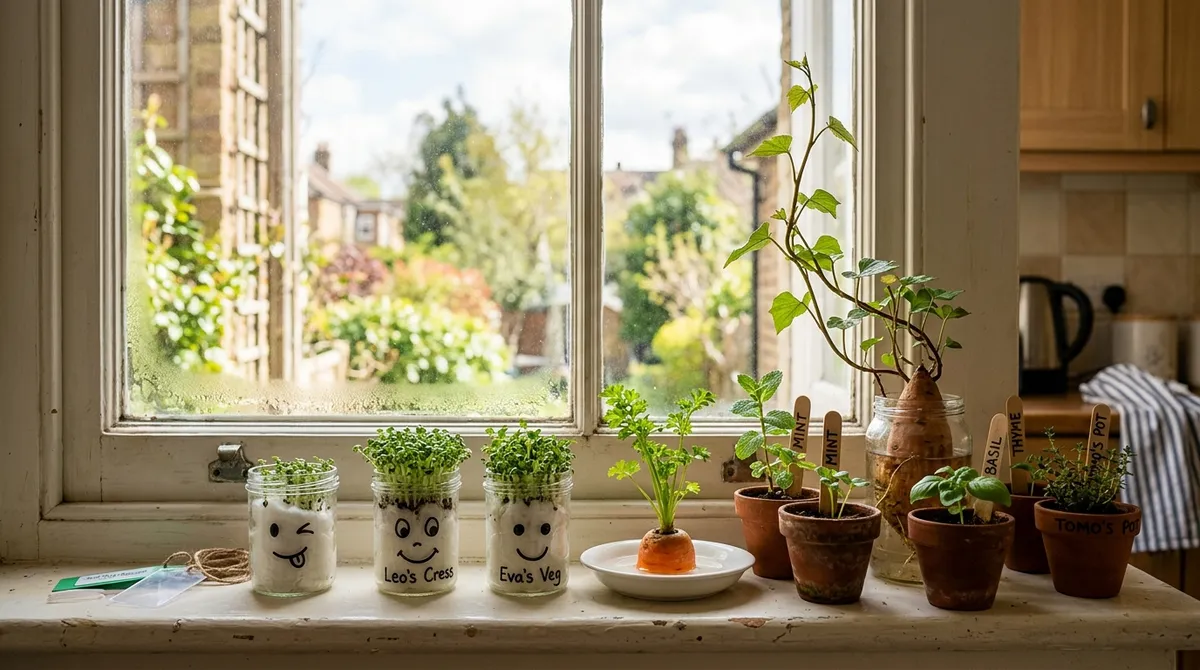
- Pollinator windowsill: lavender pot, marigold pot, butterfly feeder for summer wildlife visits
- Best learning outcomes: daily observation journal with sketches and measurements
A windowsill is the ideal first garden for a child. It is at eye level, the light is consistent, the watering routine is short, and the results are visible within days. Eight UK projects covered here run from a 3-day cress head to a 3-month pineapple top, with a pollinator-friendly extension that brings bees and butterflies to the window through summer. Each one is built for children to do most of the work, with adult help for sharp tools and watering large pots.
For more family gardening content see easy vegetables kids can grow UK and gardening projects for kids UK.
How to choose the right project for the child
The single biggest predictor of success is matching the project’s time-to-result to the child’s attention span:
| Age | Attention span | Best projects | Avoid |
|---|---|---|---|
| 3-4 | 3-5 days max | Cress heads, bean shoots | Anything over 2 weeks |
| 5-7 | 1-2 weeks | Cress, microgreens, carrot tops, herbs | Long-term tuber projects |
| 8-10 | 2-8 weeks | Sweet potato vine, microgreens harvest cycles, herb garden | None |
| 11-12 | 2-3 months | Pineapple top, full pollinator windowsill build | None |
The other variable is the result. Edible projects (cress, microgreens, herbs, sprouts) tend to outperform purely ornamental ones because the reward is tangible: the child grew something and now eats it. Pair an edible project with an observational one (sweet potato vine growth chart) for the strongest engagement.
A 4-year old finishing a cress project in 5 days will typically come back asking for the next one. A 9-year old finishing a pineapple project across 12 weeks usually wants to expand the windowsill into a proper indoor garden by the end.
Project 1: Cress heads (3 days, ages 3+)
The classic starter project. Total cost: 50p for a sachet of cress seeds. Suitable from age 3 with adult help, independent from age 5.
What you need: An empty eggshell (top half cut off cleanly), kitchen roll or cotton wool, cress seeds (Mr Fothergill’s or Suttons, £0.99 a packet), a felt-tip pen, a small dish or egg cup.
Steps:
- Draw a face on the front of the eggshell with the felt-tip.
- Dampen the kitchen roll and pack it into the eggshell.
- Sprinkle cress seeds thickly across the surface (don’t cover with more compost or paper).
- Sit the eggshell in an egg cup on a sunny windowsill.
- Mist with water from a spray bottle once a day.
What to observe:
- Day 1: Seeds visible on damp surface
- Day 2: Tiny white roots appear
- Day 3: Green shoots 10-15mm tall (“hair”)
- Day 5: Cress 50-60mm tall, ready to cut with scissors
Harvest by cutting the “hair” at 5mm above the eggshell. Eat in a salad sandwich or on buttered toast. One eggshell typically gives one good cut, then the plant exhausts itself.
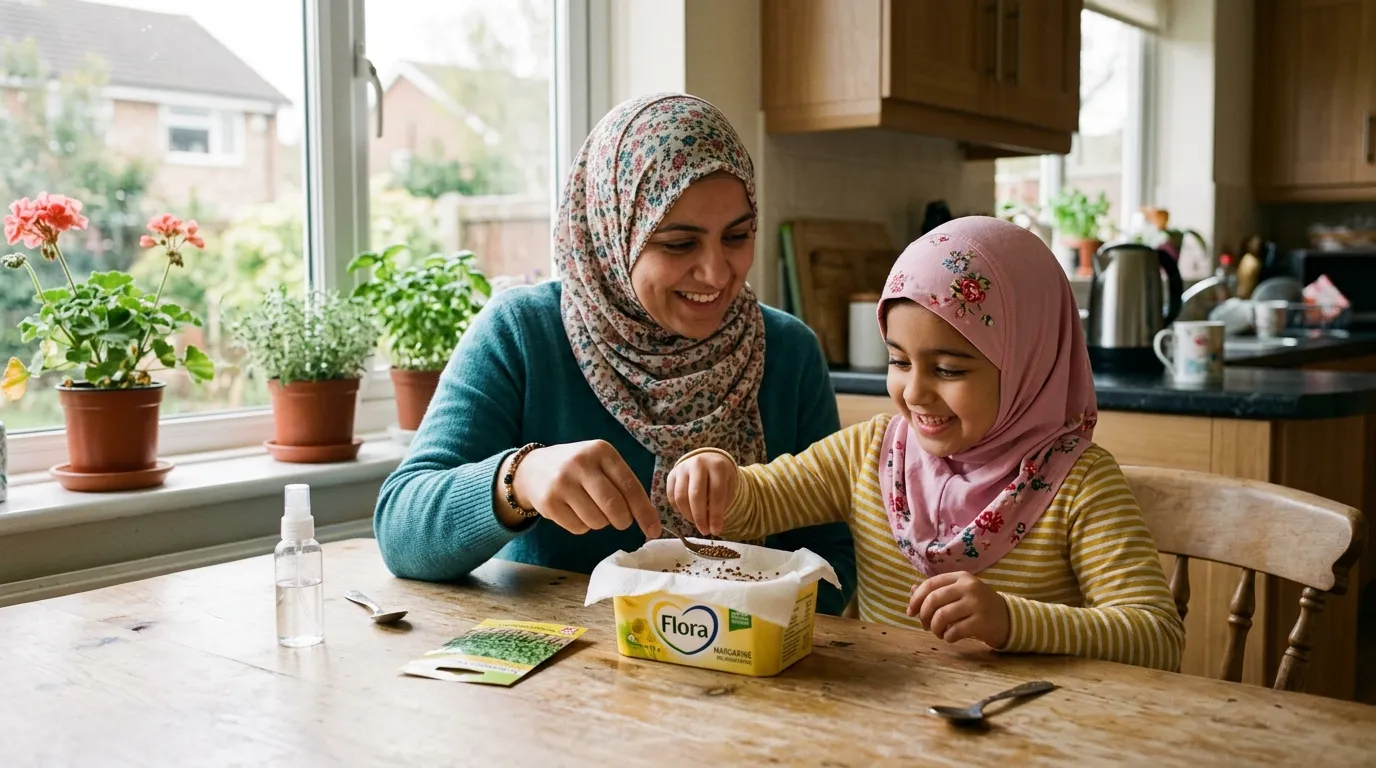 Cress is the gateway project. A child can see the result within 5 days and the harvest is small enough to eat in one sandwich
Project 2: Bean shoots in a jar (5 days, ages 4+)
A classic sprouting project. Total cost: 50p for a bag of dried mung beans or haricot beans from any UK supermarket. Suitable from age 4 with supervision.
What you need: A clean jam jar, a square of muslin or clean tights, a rubber band, 2 tablespoons of dried mung beans.
Steps:
- Pour the beans into the jar and cover with 200ml cold water. Soak overnight.
- Drain through the muslin (secured with the rubber band over the jar).
- Lay the jar on its side in a sunny windowsill.
- Rinse with cold water and drain twice a day (morning and evening).
- Within 5 days the jar will be full of crisp 30-50mm sprouts.
What to observe: Children can see growth every 12 hours. Sketching the sprouts twice a day in a notebook teaches both observation and measurement.
Use the sprouts in stir-fries, sandwiches or salads. The jar yields roughly 200g of fresh sprouts from 2 tablespoons of dried beans, a tangible multiplication that surprises most children.
Project 3: Microgreens tray (10-14 days, ages 5+)
A more structured project that produces a usable salad crop. Total cost: £3-4 for a seed packet and tray. Suitable from age 5 with help, independent from age 8.
What you need: A shallow tray with drainage holes (or a takeaway container with holes punched in the base), peat-free seed compost, a packet of microgreen seeds (pea shoots, sunflower, broccoli, radish - all available from Mr Fothergill’s or Sutton’s at £2-3 a packet), a spray bottle.
Steps:
- Fill the tray with 30mm of damp seed compost. Smooth the surface flat.
- Scatter seeds thickly across the surface, almost touching each other.
- Press the seeds gently into the compost with the back of a spoon.
- Cover with a layer of damp kitchen roll for 3-4 days.
- Once seedlings push up, remove the kitchen roll and move to a sunny windowsill.
- Mist twice daily to keep the compost damp.
- Harvest with scissors at 50mm tall (day 10-14).
The full tray gives 80-100g of microgreens, enough for two family salads. Pea shoots are the easiest starter; broccoli microgreens have the strongest flavour. For more detail see how to grow microgreens UK and the related windowsill sprouts and microgreens UK guide.
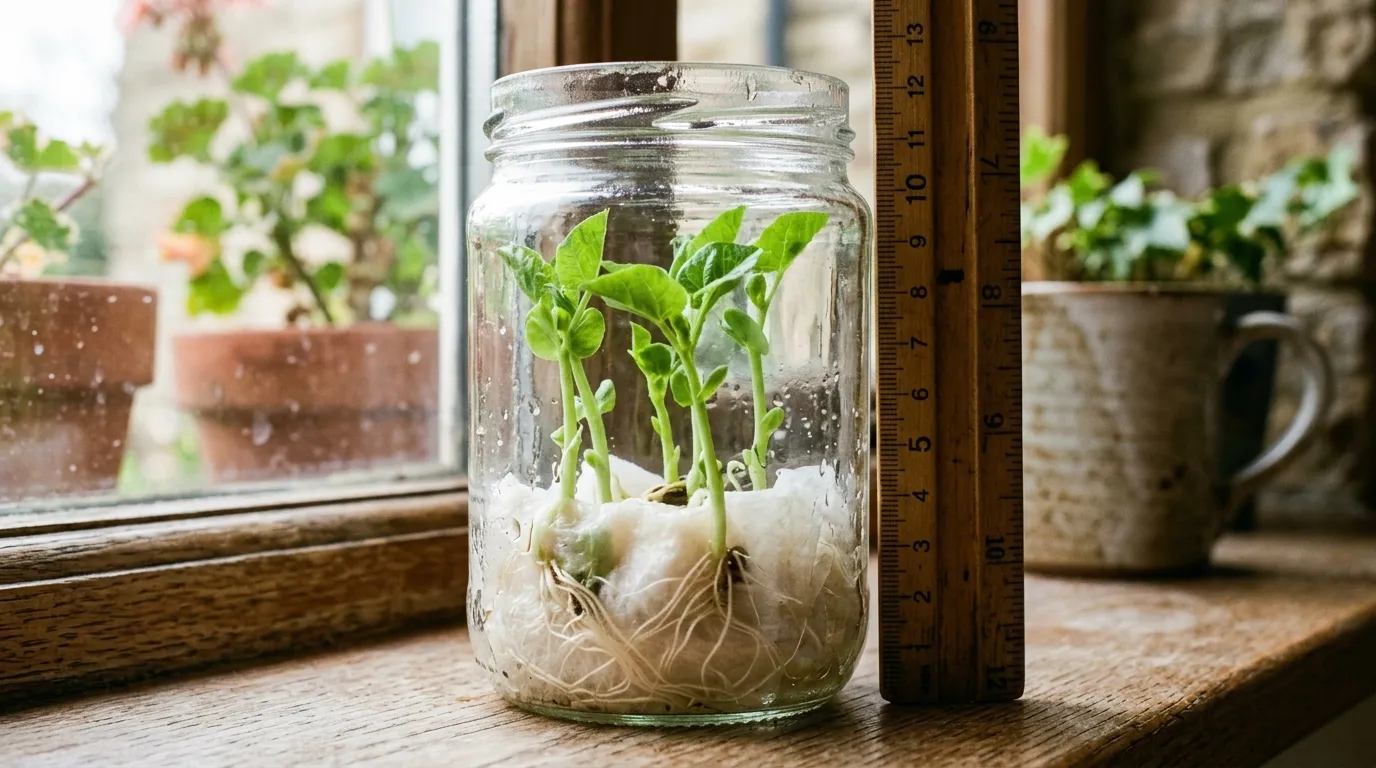 Sprouts and microgreens are the fastest jar-to-plate window crops. Pea shoots add a pea-pod sweetness to salads and grow reliably indoors year-round
Project 4: Carrot tops (14 days, ages 4+)
A free, kitchen-scrap project that demonstrates plant biology. Total cost: nothing - uses the tops of carrots that would otherwise go in the compost.
What you need: The cut tops of 3-4 carrots (with about 20mm of orange flesh still attached), a shallow saucer, water.
Steps:
- Slice 20mm off the top end of an orange carrot. Keep the green-leaf end.
- Sit the carrot top in a saucer with 5mm of water - just enough to wet the bottom of the carrot.
- Place on a sunny windowsill.
- Top up the water every 2-3 days.
What to observe: New green feathery leaves emerge from the top within 7 days. By day 14 the carrot top has a tuft of green 100-150mm tall. The carrot itself does not grow back - this is leaf regeneration only, not a new carrot.
The leaves are edible (taste similar to parsley) but can be slightly bitter; chop into salads or use as a garnish. The project demonstrates that some plants store food in their root for later leaf growth, which is the science behind biennials like carrots.
Project 5: Sweet potato vine (8 weeks, ages 6+)
A long-term observational project with a stunning visual result. Total cost: 80p for one sweet potato from any UK supermarket.
What you need: One firm sweet potato (the orange-fleshed type), a glass jar slightly narrower than the potato’s diameter, 4 toothpicks, water.
Steps:
- Push 4 toothpicks evenly around the middle of the sweet potato to support it.
- Sit the potato in the jar with the bottom half submerged in water.
- Place on a sunny windowsill.
- Refresh the water weekly.
- Within 2 weeks roots appear at the bottom. Within 4 weeks green shoots appear at the top.
- By week 8 the vine is 600-1000mm long with heart-shaped leaves.
The vine can be encouraged to climb a window frame or trail down the kitchen cabinets. Some children make it into a competition with siblings. The full vine can live for 6 months on a kitchen windowsill before needing potting on into compost.
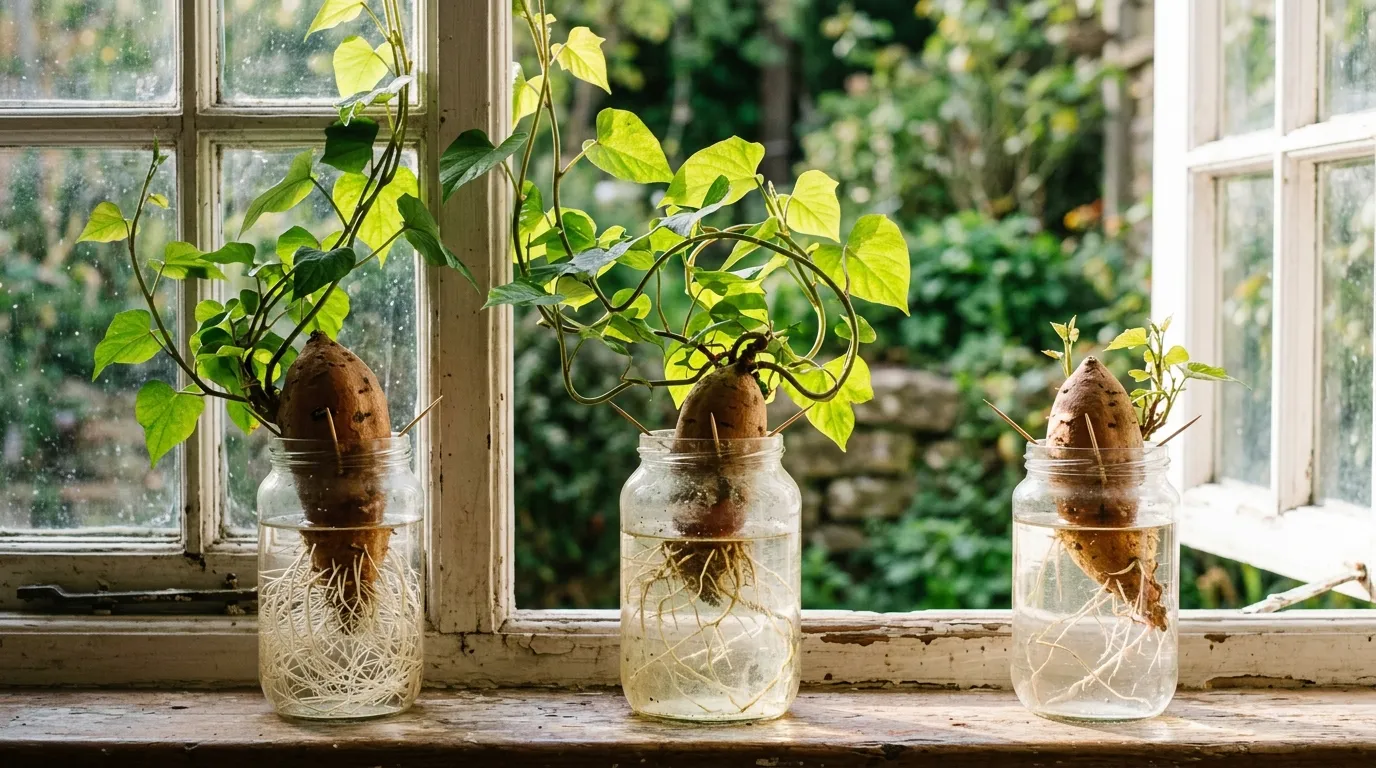 A sweet potato vine grows a metre of trailing leaves over 8 weeks from one supermarket tuber. Children can train it up a window frame with string for an indoor jungle
Project 6: Pineapple top (3 months, ages 8+)
The most ambitious project. Total cost: free if you eat a pineapple anyway. The pineapple top can grow into a recognisable houseplant over 6 to 12 months and may even fruit in a UK conservatory after 2-3 years.
What you need: The leafy top of a fresh pineapple (cut 30mm below the leaves), a glass of water, a 15cm pot, peat-free compost.
Steps:
- Cut the leafy top off a fresh pineapple. Strip off the bottom 4-5 small leaves to expose a 20mm stem.
- Leave the cut top to dry on a windowsill for 2 days (this prevents rot).
- Suspend the top in a glass with the cut stem submerged in 30mm of water.
- Place on a sunny windowsill.
- After 3-4 weeks white roots appear from the cut stem.
- When roots reach 50mm long, pot up into peat-free compost in a 15cm pot.
- Keep on a warm, sunny windowsill (minimum 18C).
This is a 3-month observation project for the rooting phase, then an open-ended houseplant for the long-term. The leaves grow vertical, swordlike and spiky. Pineapples will only fruit after 2-3 years and need a warm conservatory or heated greenhouse, but the rosette plant is a striking object even without fruit.
Project 7: Windowsill herb garden (year-round, ages 5+)
A practical project that produces a year of fresh herbs for cooking. Total cost: £6-10 for three herb plants and pots.
What you need: Three 15cm pots with drainage, peat-free compost, three supermarket herb plants (basil, chives, parsley are the easiest UK starters), labels.
Steps:
- Move each supermarket herb plant into a slightly larger 15cm pot with fresh compost. The supermarket pots are too small to support long-term growth.
- Label each pot with the herb name and planting date.
- Place on a sunny windowsill (south or west-facing).
- Water when the top 10mm of compost is dry to the touch.
- Pick leaves as needed, taking no more than a third of the plant at any one time.
Children can be given charge of one herb each. The supermarket-herb-to-windowsill-herb conversion is detailed in supermarket herbs indoors UK, and indoor herbs from seed UK covers the longer-term seed-grown route.
 A windowsill herb garden teaches children both gardening and cooking. Letting them choose which herb to add to dinner makes the link between growing and eating concrete
Project 8: Butterfly feeder (summer, ages 5+)
A pollinator-attracting project that turns the windowsill into a wildlife observation point. Best run from late June to early September when butterflies are most active.
What you need: A shallow saucer (10cm diameter), a kitchen sponge, overripe fruit (banana, apple, plum, watermelon), a small jar of sugar water (1 teaspoon sugar dissolved in 100ml warm water).
Steps:
- Place the saucer on an outdoor windowsill or hang from a bracket outside a window.
- Soak the sponge in the sugar water and place in the saucer.
- Surround the sponge with chunks of overripe fruit.
- Refresh every 2 days. Watch from inside the window.
UK butterflies that visit windowsill feeders include red admirals (most common feeder visitor), painted ladies, small tortoiseshells, peacocks and commas. Wasps will also visit; this is a feature not a bug, as wasps eat aphids and pollinate.
For more on bringing pollinators to the window or balcony, see best plants for butterflies UK and bee-friendly garden plants. The Butterfly Conservation Trust is the best UK reference on attracting butterflies.
Pollinator pots for the windowsill
A windowsill pollinator garden gives children a year of bee and butterfly visits in addition to the indoor projects. Three pots, all in 20cm containers, cover the main UK pollinator groups.
| Pot | Plant | Best for | UK flowering window |
|---|---|---|---|
| 1 | English lavender ‘Hidcote’ | Bumblebees | June to August |
| 2 | Pot marigold (Calendula officinalis) | Hoverflies, small butterflies | June to October |
| 3 | Chives or fennel | Bees, hoverflies | May to July |
The pots sit outside the window in summer, then come in for winter (lavender and chives are hardy; calendula is half-hardy). Children can keep a tally chart of which insects visit which pot.
The full guide to attracting wildlife to a small garden is in wildlife activities for kids in UK gardens and the broader attracting birds to garden reference.
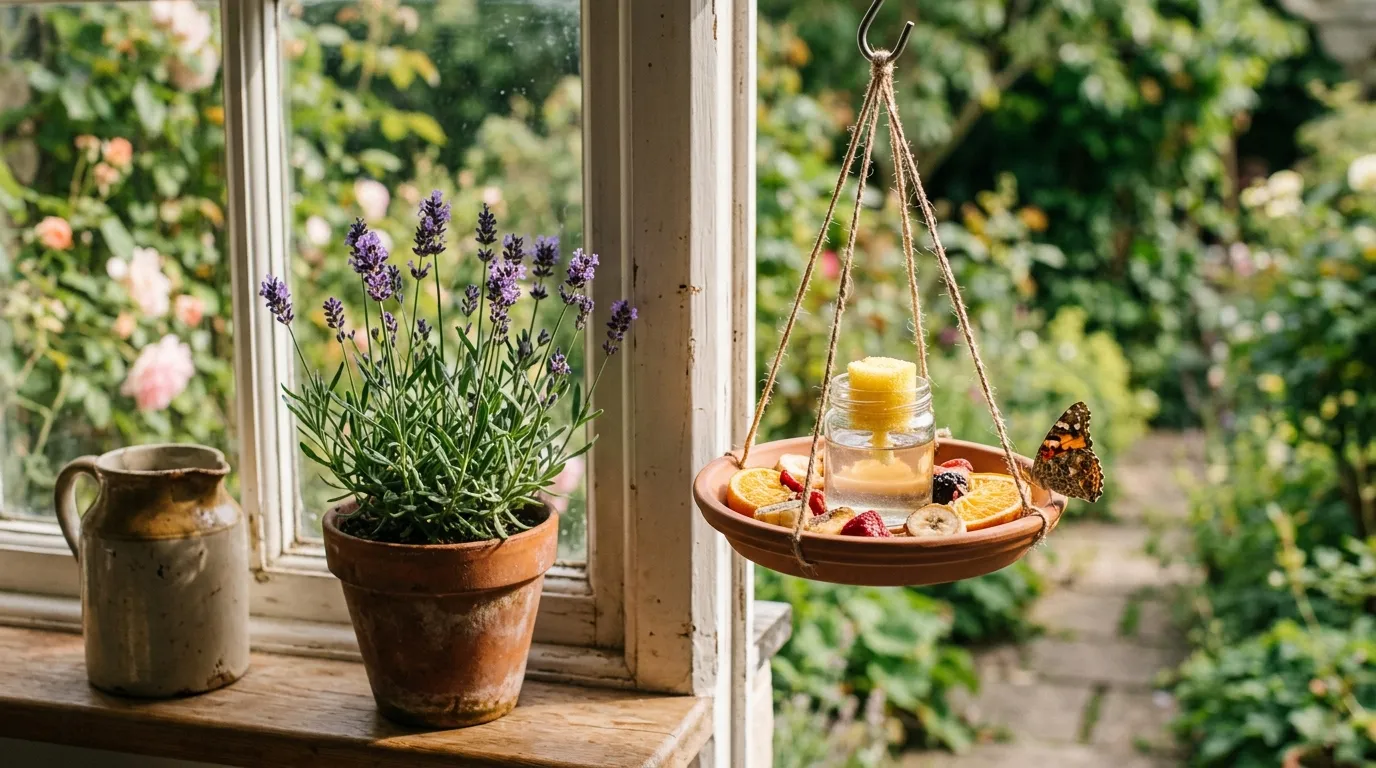 A combined pollinator station: lavender for bees, overripe fruit and sugar water for butterflies. Red admirals are the most common UK visitor
What to observe and record
The educational value of these projects scales with the observation effort. A child who looks at their cress once a day for 5 days learns roughly half of what they would learn writing a daily journal entry.
The simplest observation framework, suitable from age 5:
Stick the journal in a sleeve on the kitchen fridge. The combination of measurement and feeling links the science to the personal experience and produces the strongest long-term engagement.
Common mistakes to avoid
The five most common reasons windowsill projects fail with children:
-
Forgetting to water for 4+ days. The single biggest cause of failure. Set a daily reminder on a parent’s phone for the first week of each project. After 7 days the child usually takes over independently.
-
Putting the project on a cold windowsill. Anything below 15C average slows germination dramatically. Avoid windowsills behind a radiator (too hot, dries fast) and avoid north-facing rooms in winter (too cold). South or east-facing kitchen windowsill is the gold standard.
-
Starting too many projects at once. One project per child at a time. Two children means two projects. Six projects across the kitchen window confuses the routine and several get forgotten.
-
Using compost on a sprouting project. Sprouts and bean shoots grow in water alone, no compost. Adding compost introduces fungus and ruins the harvest.
-
Letting one project run to seed before starting the next. Cress harvested on day 5 should be followed by a new sowing on day 6. The continuous cycle keeps the engagement up. Empty windowsills break the routine.
For more family-focused growing content see easy vegetables kids grow UK and the seasonal Easter garden activities for kids guide.
Frequently asked questions
What is the best indoor plant project for kids?
Cress heads in eggshells. Children see green growth within 3 days, can harvest and eat the crop within 5 days, and the project costs under £1. Suitable from age 3 with help. The combination of fast result, tangible reward, and edible outcome makes it the most reliable starter project for UK families.
How long does it take to grow cress on a windowsill?
Five days from seed to harvest. Sow on damp kitchen roll or cotton wool in a small dish, keep on a sunny windowsill, and mist daily. Seeds germinate within 24 hours, reach 30mm tall by day 3, and are ready to cut at 50-60mm tall on day 5. One sachet of cress seeds (£1) grows roughly 8 batches.
What can children grow from kitchen scraps?
Carrot tops (green leaves regrow from the cut top in 7-14 days), sweet potato vines (the whole vine grows from one tuber over 8 weeks), pineapple tops (a new plant rooted from the cut crown over 3 months), and spring onion bases (regrow on a windowsill in 7-10 days). All free from kitchen waste.
Are microgreens safe for kids to grow and eat?
Yes, when grown in clean compost on a sunny windowsill. Pea shoots, sunflower greens and broccoli microgreens are the safest UK starters. Use a clean tray with drainage, peat-free seed compost, and sow thickly across the surface. Harvest with scissors at 50mm tall (10-14 days). Wash before eating.
How can I attract bees and butterflies to a windowsill?
Plant a 20cm pot with English lavender (‘Hidcote’ is the most compact UK variety), a 15cm pot of pot marigold (Calendula officinalis), and place a saucer of overripe fruit as a butterfly feeder. Position on a south or west-facing sill from June to September. Bees usually find lavender within 7-10 days of placement.
What is the easiest plant for a 5 year old to grow indoors?
Bean shoots in a jar. Soak haricot or mung beans overnight, transfer to a clean jar with a muslin lid, rinse twice daily, and harvest sprouts within 5 days. No compost or watering schedule, visible growth every day, and a usable harvest at the end. Suitable from age 4 with supervision for the rinsing.
Next step
Now you have the windowsill set, scale up to the patio or garden. Our guide on easy vegetables kids can grow UK covers radishes, lettuce and cherry tomatoes - the obvious next step for a child who has mastered the windowsill cress cycle.
Our team produces practical UK gardening guidance from source research, contributor records and established horticultural practice. Editorial standards are overseen by Matt W.