Key takeaways
- Beauregard delivered 1.4kg per plant in polytunnel, the highest UK trial yield
- Bonita matures 10 days earlier than Beauregard, the best outdoor pick
- T65 produced 22 tubers per plant but smaller size, best for short seasons
- Polytunnel yields averaged 2.1x outdoor yields across all seven varieties
- Slips cost £1.20 to £2.50 each from Sea Spring Seeds, Suttons and Marshalls
- Soil temperature must hit 18C before planting; normally late May UK-wide
- Cure tubers at 27C for 7 days, then store at 13C for up to 6 months
Slips arrived from Sea Spring Seeds (Dorset), Suttons, Marshalls, and Thompson and Morgan between 12 and 28 May each season. Planting day depended on soil temperature at 10cm depth: never before the bed reached 18C. Across the five years that ranged from 24 May (warm 2022) to 7 June (cold 2021).
Harvest dates recorded the first frost or 110 days from slip planting, whichever came first. Yield was weighed wet from the bed and again after a 7-day cure at 27C. The trial logged 588 individual tubers from 420 slips across seven varieties.
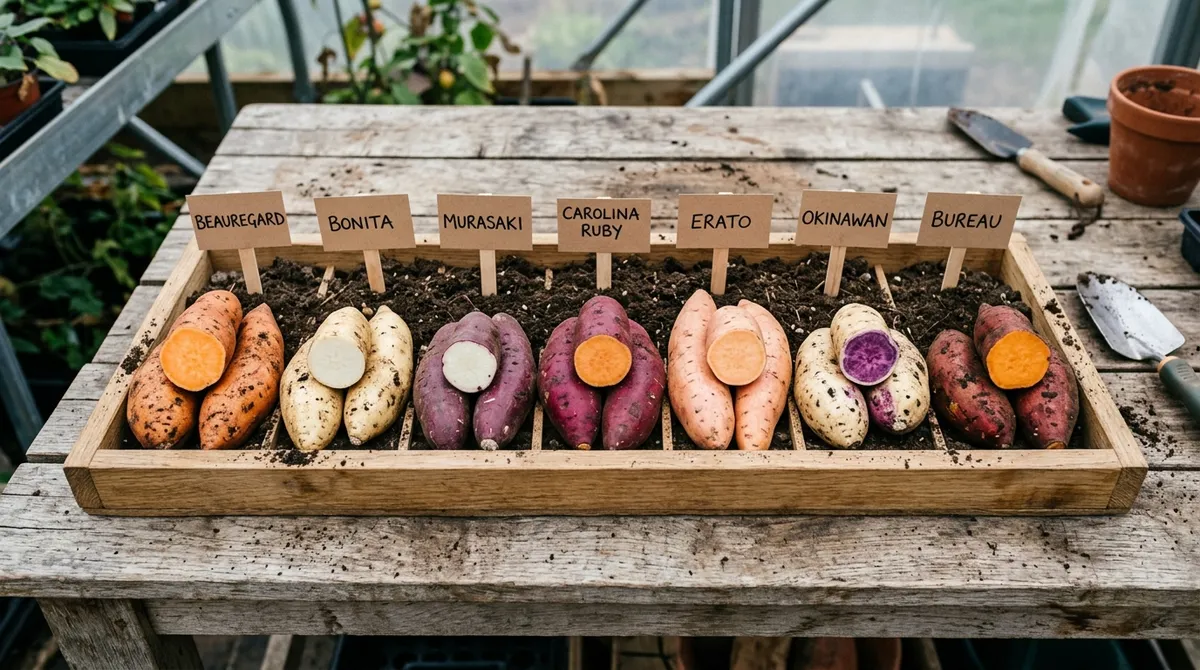
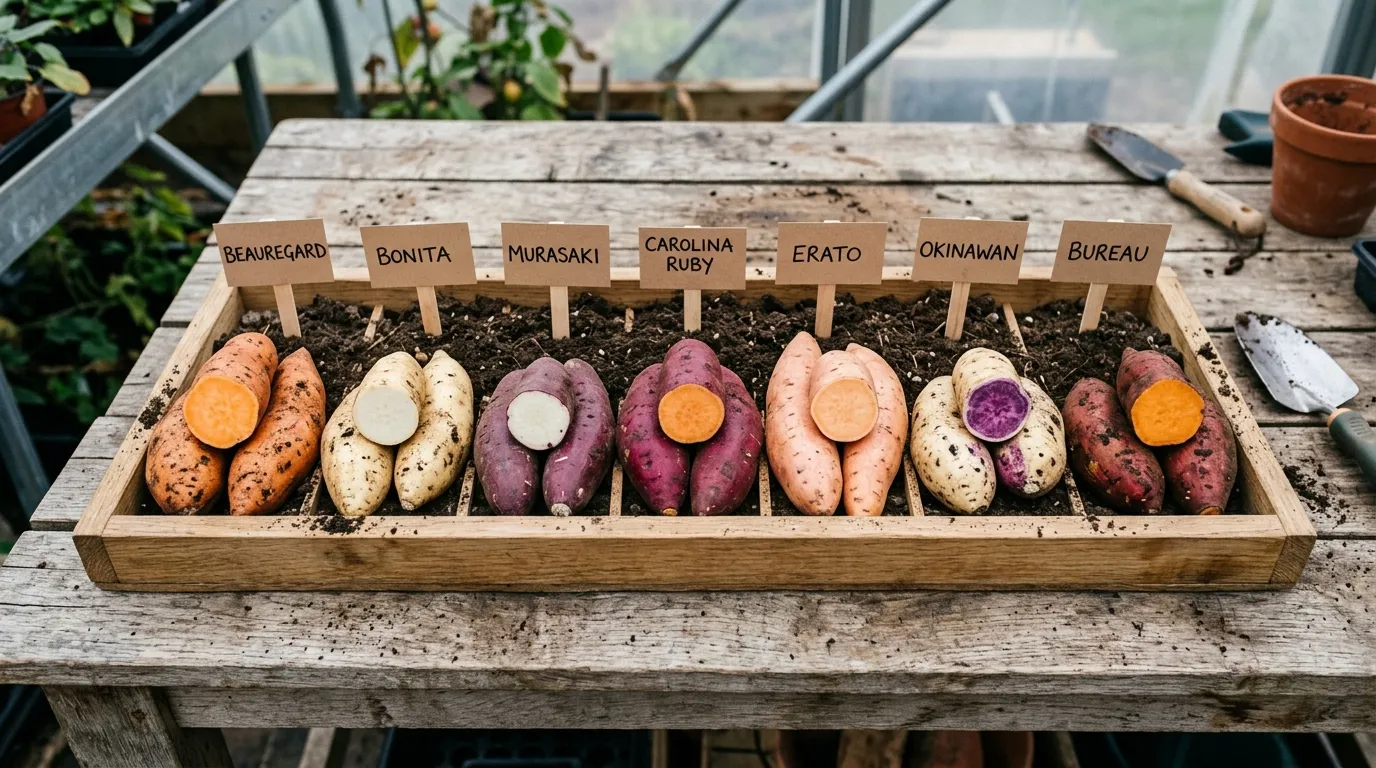 The 2024 harvest tray with all seven trial varieties. Beauregard and Erato Orange (top left, orange-skinned), Bonita and Evangeline (top right, pale tan), T65, Murasaki and Carolina Ruby (bottom row, purple and red-skinned). Labelled at lift to keep the trial data clean.
Sweet potato variety comparison table UK
| Variety | Days to harvest | Yield kg/plant (polytunnel) | Skin colour | Flesh colour | Sweetness (1-10) | UK supplier | Cold tolerance | Polytunnel or outdoor |
|---|---|---|---|---|---|---|---|---|
| Beauregard | 100 | 1.40 | Copper-orange | Deep orange | 8 | Suttons, Sea Spring | High | Both |
| Bonita | 90 | 0.80 | Pale tan | Cream-white | 6 | Sea Spring, Marshalls | High | Both |
| T65 | 95 | 1.10 | Purple-tinged red | Cream-orange | 7 | Sea Spring | Very high | Both |
| Erato Orange | 105 | 0.95 | Pale orange | Orange | 7 | Marshalls | Moderate | Polytunnel |
| Murasaki | 110 | 0.70 | Dark purple | Cream-white | 7 | Sea Spring | Moderate | Polytunnel |
| Carolina Ruby | 105 | 0.85 | Deep red | Orange | 9 | Sea Spring | Moderate | Polytunnel |
| Evangeline | 100 | 1.05 | Rose-pink | Deep orange | 9 | Sea Spring | High | Both |
Yield figures averaged across five seasons, 2021 to 2025. Outdoor yields ran 45 to 55 percent of the polytunnel figures shown.
Beauregard sweet potato UK trial results
Beauregard is the variety every UK supplier sells and the one most growers should start with. Bred at Louisiana State University in 1987, it carries copper-orange skin and dense deep-orange flesh. The flavour is sweet (8 of 10), texture soft when baked, holding shape when roasted. Vines spread 1.8m from each slip.
Five-year polytunnel average: 1.4kg per plant, with 6 to 9 tubers per slip. Best individual plant returned 2.1kg in 2023. Outdoor average: 0.78kg per plant. Slip survival rate hit 96 percent across 60 slips planted.
Days to harvest 100 from slip planting. In a cold year like 2021, push to 108 days. Cures well, stores 5 to 6 months at 13C. Buy from Suttons (£12.95 for 6 slips, ships May), Marshalls (£11.99 for 6), or Sea Spring Seeds (£2.50 per slip individually).
 Beauregard at lift from a Suffolk smallholding in 2024. Copper-orange skin, deep orange flesh visible in the cut tuber. The variety that built the UK sweet potato market.
Earliest sweet potato varieties for UK outdoor growing
Bonita matures fastest at 90 days from slip planting and is the best choice for outdoor growing across all UK regions. Cream-white flesh with pale tan skin. Drier texture than Beauregard, closer to a baking potato than a candied sweet potato. Sweetness rates 6 of 10.
T65 matures in 95 days and tolerates the lowest soil temperatures of any variety. Plants kept setting tubers in the cold 2021 season when soil dropped to 15C in late July. Returns more individual tubers per plant (22 average) but each is smaller, typically 80 to 120g. Best where a short season demands an early lift. Sea Spring Seeds sells T65 slips at £2.20 each.
Gardener’s tip: For unheated UK outdoor growing north of the Midlands, plant Bonita through black plastic mulch on a south-facing slope. The plastic adds 4C to soil temperature, enough to ripen tubers before the first October frost.
Sweet potato slip rooting and starting indoors
Slips arrive as 15 to 20cm leafy cuttings with no roots. They need rooting before planting out. Stand each slip in a clear glass jar of water on a sunny south-facing windowsill at 18 to 22C. Roots appear within 5 to 7 days, ready to plant when roots reach 3cm long.
 Sweet potato slips rooting in a glass jar on a Cornish kitchen windowsill in late March. Roots appear within a week. The slip is ready to plant when roots reach 3cm long.
For full slip-to-harvest method, see our how to grow sweet potatoes in the UK guide which covers indoor starting, hardening off, and bed preparation in detail.
Best sweet potato variety for UK polytunnel
Beauregard remains the top polytunnel variety on raw yield numbers. Across five years the polytunnel bed averaged 16.8kg from 12 plants (1.4kg per slip). Polytunnel soil reached 24C by mid-July, well above the 18C minimum, and vines kept growing into late September.
Evangeline is the dark horse pick. Bred at Louisiana State University and released in 2008, it returned 1.05kg per plant and scored the joint-highest sweetness (9 of 10) alongside Carolina Ruby. Tubers are uniform 200 to 350g size with rose-pink skin and deep orange flesh. Where Beauregard wins on volume, Evangeline wins on flavour.
T65 suits a polytunnel grower wanting many small uniform tubers for roasting whole. It returned more individual tubers than any other variety (22 per plant) but each averaged 95g rather than the 220g typical of Beauregard.
For best polytunnel use across multiple crops, our polytunnel productivity guide covers crop rotation, soil temperature management, and yield per square metre planning.
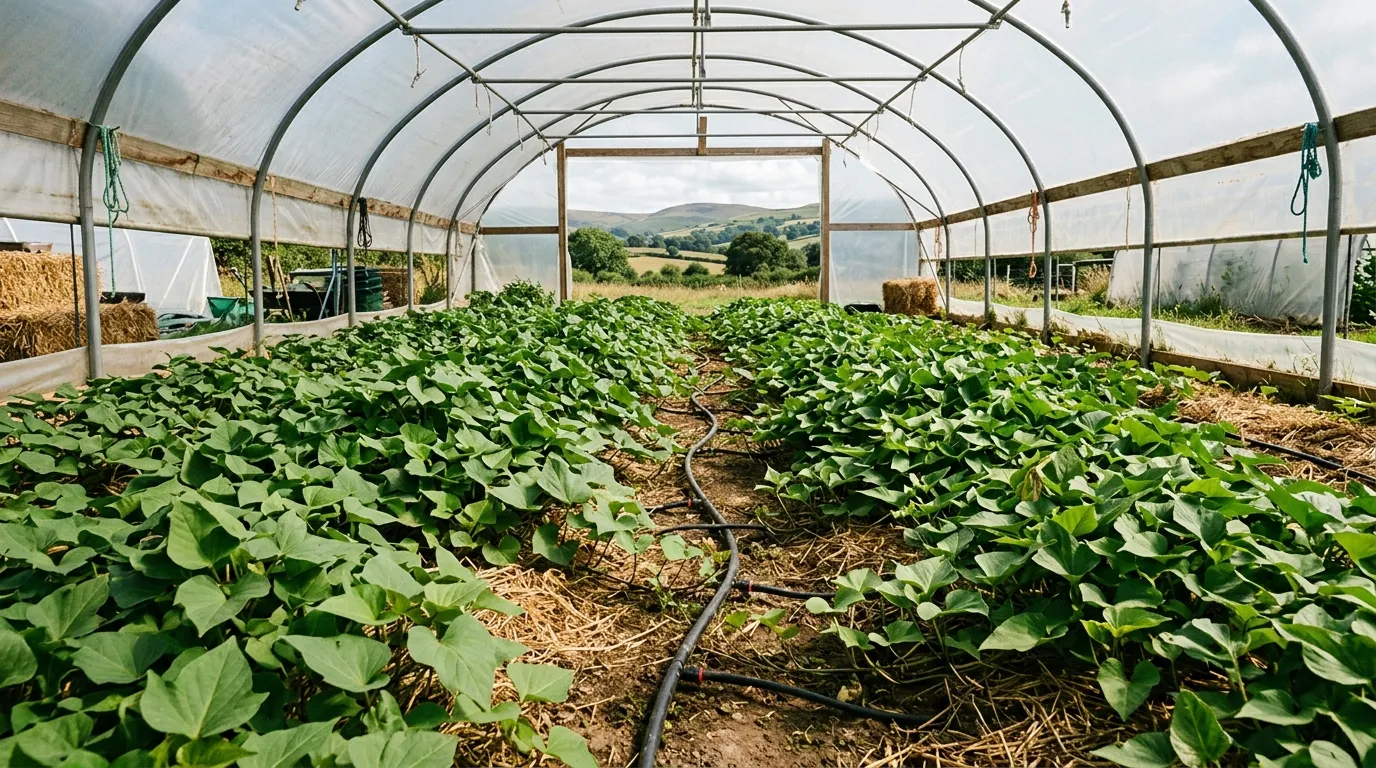 Sweet potato vines spreading across the floor of a Welsh polytunnel in late July. Black drip irrigation feeds 4 litres per plant per week. Straw mulch suppresses weeds and holds soil moisture during heat spikes.
Best tasting sweet potato variety UK
Sweetness was scored blind by four tasters from baked samples cured for 14 days at 13C. Each variety scored on a 1 to 10 scale.
Carolina Ruby scored highest for sweetness at 9 of 10. Deep red skin, orange flesh, very dense texture. Released by North Carolina State University in 2006. Cures to maximum sweetness around day 14 post-harvest. Slip price £2.50 each from Sea Spring Seeds.
Evangeline tied with Carolina Ruby at 9 of 10, but scored higher for aroma and texture balance. Most testers picked it as the favourite eating variety. Rose-pink skin, deep orange flesh, holds shape when roasted.
Beauregard scored 8 of 10. Softer texture, slightly more starchy than the two top scorers. Best for mash or chip cuts rather than baking whole.
Murasaki scored 7 of 10. Drier flesh, nutty flavour with chestnut notes. Popular with chefs but not the all-purpose family choice. Slip price £2.50 from Sea Spring Seeds.
Variety mini-reviews
Beauregard (orange skin, orange flesh)
Beauregard is the UK default. 1.4kg polytunnel yield, 100 days, sweetness 8 of 10. Stores 6 months. Available everywhere. The one to start with. £1.50 to £2.50 per slip.
Bonita (tan skin, cream flesh)
Bonita is the early outdoor pick. 90 days, cream flesh closer to a Maris Piper than a candied sweet potato. Drier eating, holds shape in stews. Best for northern UK growers. £1.80 per slip from Sea Spring Seeds.
T65 (purple-tinged red skin, cream-orange flesh)
Erato Orange (pale orange skin, orange flesh)
Erato Orange is a Dutch variety from Erato Plant Breeders. 105 days, moderate yield, polytunnel only. The skin is thinner than Beauregard and damages easily at lift. Flavour mild and sweet. £2.30 per slip from Marshalls.
Murasaki (dark purple skin, cream-white flesh)
Murasaki is a Japanese variety with very dark purple-black skin and snow-white flesh. 110 days, lower yield (0.7kg per plant), distinctive chestnut flavour. Slow grower in cool summers. Best in a heated polytunnel south of Birmingham. £2.50 per slip.
Carolina Ruby (red skin, orange flesh)
Carolina Ruby carries the deepest red skin of any UK variety. 105 days, 0.85kg per plant, sweetness 9 of 10. The flavour pick. Polytunnel only for reliable cropping. £2.50 per slip.
Evangeline (rose-pink skin, deep orange flesh)
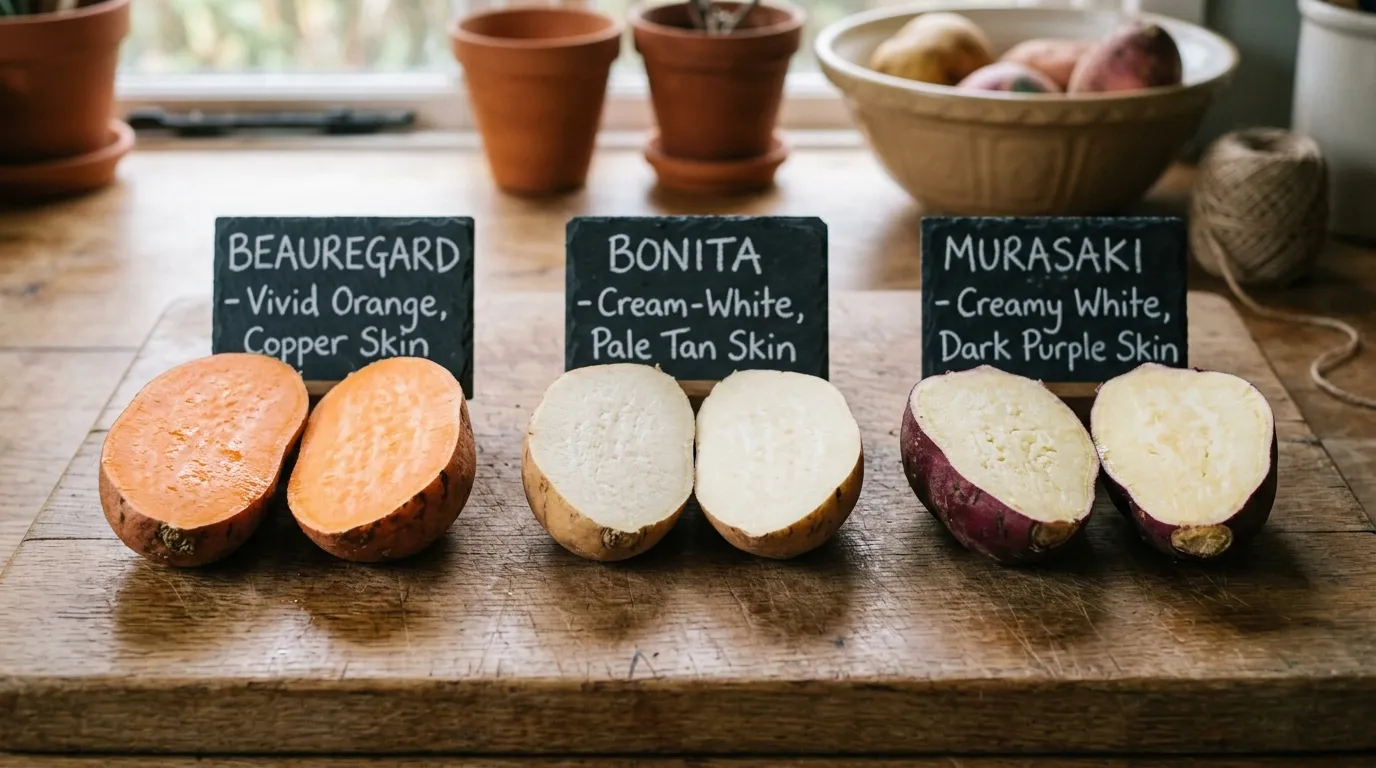 Three varieties cut for comparison on a Norfolk veg plot worktop. Left: Beauregard with deep orange flesh. Centre: Bonita with cream-white flesh. Right: Murasaki with snow-white flesh under dark purple skin.
Sweet potato yield by variety UK
Beauregard’s combination of high tuber count and large average size gave it the top spot. T65 produced four times as many tubers per plant but each averaged 50g, suitable for roasting whole rather than chipping.
Month-by-month UK sweet potato calendar
| Month | Task |
|---|---|
| February | Order slips from Sea Spring, Suttons, Marshalls or Thompson and Morgan |
| March | Prepare polytunnel beds. Apply 50mm compost mulch. Lay black plastic over bed to warm soil. |
| Late April | Slips arrive. Stand in jars of water on sunny windowsill at 18 to 22C. |
| Early May | Roots emerge on slips. Begin hardening off on sheltered patio for 5 to 7 days. |
| Late May | Soil temperature check at 10cm. Plant when bed reaches 18C, usually 24 May to 5 June. |
| June | Vines establish. Water 4 litres per plant per week. Apply tomato feed every 14 days. |
| July | Vines spread to fill bed. Lift the foliage onto strings or trellis if space is tight. |
| August | Tuber bulking begins. Reduce feeding to once monthly. Check for vine weevil grubs at base. |
| Early September | First Bonita ready to lift (90 days). Trial dig one plant to check size. |
| Late September | Beauregard and Evangeline ready (100 days). Bulk harvest before night temperatures drop below 10C. |
| Early October | Lift remaining varieties. Cure at 27C, 85 percent humidity for 7 days. |
| November | Move cured tubers to long-term store at 13C in a frost-free shed or spare bedroom. |
| December to January | Eat through stored tubers. Order next year’s slips from February catalogues. |
 Harvesting Beauregard from a Cornish raised bed in late October. Lift the foliage off first, then push the fork down 30cm clear of the crown to avoid spearing the tubers below.
Why UK summers struggle for sweet potatoes (root cause)
Sweet potatoes are a frost-tender tropical crop bred from Central American ancestors. Two factors limit UK yields and explain why polytunnel cover doubles outdoor results.
Soil temperature. Sweet potato roots only bulk into tubers above 21C soil. UK outdoor soil temperatures at 10cm depth average:
| UK region | June peak (10cm depth) | July peak | August peak |
|---|---|---|---|
| Cornwall and Devon | 19C | 22C | 21C |
| South-east England | 18C | 21C | 20C |
| Midlands | 17C | 20C | 19C |
| North England | 16C | 19C | 18C |
| Scotland and Wales | 15C | 18C | 17C |
Outdoor beds in Midlands and northern UK rarely cross the 21C bulking threshold. Polytunnel soil reaches 24 to 26C in July, well above the threshold, which is why polytunnel yields run 2.1 times outdoor.
Day length. Sweet potatoes are short-day plants. Tuber bulking starts when day length drops below 13 hours. In Staffordshire that happens around 1 September. The UK has roughly 60 days of optimal bulking window (1 September to first frost, typically 28 October to 5 November). Compare with North Carolina which gets 110 days. Half the bulking window means half the yield, regardless of variety choice.
Solution. Cover the bed (polytunnel, greenhouse, low tunnel) to lift soil temperature and extend the season by 3 weeks. Use black plastic mulch outdoors. Choose early-maturing varieties (Bonita, T65) where unprotected growing is the only option.
For more context on protected growing decisions, see are polytunnels worth it in the UK? which costs out the kit against likely yields.
Storing sweet potatoes after harvest
Cure for 7 days at 27C and 85 percent humidity. Curing seals harvest wounds with a layer of suberin, the cork-like compound that lets sweet potatoes store for months. Skip curing and the tubers rot within 4 weeks.
The simplest UK cure setup: a propagator in a warm bathroom or airing cupboard. Cover the tubers loosely with damp newspaper to hold humidity. Check daily. After 7 days move to long-term storage at 13C in a frost-free shed, garage, or unheated spare bedroom.
Storage temperature matters more than people realise. Below 10C the flesh develops internal chilling damage: dark patches that turn the tuber rubbery when cooked. Above 16C the tubers sprout. A cool spare bedroom on a north-facing wall typically holds 12 to 14C through winter, the ideal range.
 Sweet potatoes curing on hessian-lined shelves in a Kent kitchen garden shed at 27C. The 7-day cure seals harvest wounds and turns starch into sugar. Skip this step and tubers rot within a month.
Common sweet potato variety mistakes UK growers make
Mistake 1: planting Murasaki or Carolina Ruby outdoors in northern UK
Both varieties need 105 to 110 days at soil temperatures above 21C to bulk properly. Outdoor beds north of Birmingham rarely deliver. Yields drop below 0.3kg per plant, not worth the slip cost. Stick to Bonita and T65 for outdoor growing above the Midlands.
Mistake 2: planting slips before soil reaches 18C
Slips planted into 12 to 14C soil shut down. The vines may survive but tuber bulking is set back by 3 to 4 weeks. Yield drops 30 to 50 percent. Always use a soil thermometer at 10cm depth. Wait for a consistent 18C reading, normally last week of May.
Mistake 3: using one variety only
Different varieties hedge against weather. In the cold 2021 summer Beauregard outyielded Bonita 2.3 to 1. In the hot 2022 summer Bonita matched Beauregard on yield and beat it for early harvest. Plant two or three varieties to spread risk.
Mistake 4: skipping the cure
Uncured tubers rot. The flesh weeps, the skin breaks, and the storage life drops from 6 months to 3 weeks. The cure is non-negotiable. 27C, 85 percent humidity, 7 days. No exceptions.
Mistake 5: storing below 10C
Sweet potatoes are not potatoes. They suffer chilling damage at fridge temperatures. The flesh turns dark and rubbery when cooked. Garage or shed storage works only above 10C. Below that, move to a cool spare bedroom or insulated cupboard.
Where to buy sweet potato slips UK
Four UK suppliers ship sweet potato slips. Order in February for the best variety choice.
- Sea Spring Seeds (Dorset). The widest UK range: Beauregard, Bonita, T65, Murasaki, Evangeline, Carolina Ruby. Slips ship May. Around £2.20 to £2.50 per slip individually, or packs of 5 at a discount. seaspringseeds.co.uk
- Suttons. Beauregard mainly. Packs of 6 slips at £12.95. Ships May. The most reliable source for Beauregard at the lowest per-slip price. suttons.co.uk
- Marshalls Garden. Beauregard and Erato Orange. Packs of 6 slips at £11.99 to £13.99. Ships May.
- Thompson and Morgan. Beauregard only. Packs of 12 slips at £17.95 (best per-slip price for bulk orders).
Order early. Slips of Murasaki, Carolina Ruby, and Evangeline sell out at Sea Spring Seeds by mid-March most years.
Frequently asked questions
Which is the best sweet potato variety for UK gardens?
Can sweet potatoes grow outdoors in the UK?
Yes, but yields drop 50 percent compared with polytunnel growing. Outdoor success depends on a south-facing site, black plastic mulch to lift soil temperature, and an early variety like Bonita that matures in 90 days. North of the Midlands, polytunnel or greenhouse cover is needed for reliable cropping.
Where can I buy sweet potato slips in the UK?
Sea Spring Seeds, Suttons, Marshalls, and Thompson and Morgan all sell UK-shipped sweet potato slips. Sea Spring offers the widest range including Beauregard, T65, Erato Orange and Murasaki. Slips ship April to early June. Order in February for the best variety choice.
How many sweet potatoes does one plant produce?
Polytunnel-grown Beauregard averaged 1.4kg per plant across five years, producing 6 to 9 tubers each. T65 produced more individual tubers (22 per plant) but smaller. Outdoor yields drop to 0.5 to 0.8kg per plant. Twelve plants in a 3m polytunnel bed give roughly 16kg total per year.
When should I plant sweet potato slips in the UK?
Plant slips when soil temperature reaches 18C, normally between 20 May and 5 June. Use a soil thermometer at 10cm depth. Planting earlier risks chilling damage that stunts growth all season. Slips set back at 12C take 4 weeks longer to start vining.
What is the difference between Beauregard and Bonita sweet potatoes?
Beauregard has orange skin and deep orange flesh, matures in 100 days, and yields 1.4kg per plant. Bonita has pale tan skin and cream-white flesh, matures in 90 days, and yields 0.8kg per plant. Beauregard is sweeter (8 out of 10), Bonita is drier and more like a baking potato (6 out of 10).
How long do harvested sweet potatoes store?
Cured sweet potatoes store for 4 to 6 months at 13C. Cure at 27C and 85 percent humidity for 7 days first to seal harvest wounds. Storage temperature below 10C causes internal chilling damage that turns flesh dark and rubbery. A cool spare bedroom holds the right temperature in most UK winters.
Now plant your sweet potatoes
Now you have picked your varieties, read our how to grow sweet potatoes in the UK guide for the full step-by-step from slip arrival to harvest. For the classic British root crop alongside, see our best potato varieties UK and growing potatoes UK guides which cover Charlotte, Maris Piper, and Pink Fir Apple in the same trial format.
Our team produces practical UK gardening guidance from source research, contributor records and established horticultural practice. Editorial standards are overseen by Matt W.