Key takeaways
- Guelder rose is Viburnum opulus, a native British shrub, not a true rose
- White lacecap flowers appear May to June: an outer ring of showy sterile florets around a fertile centre
- Translucent red berries ripen August to November and feed mistle thrushes, bullfinches and waxwings
- One of very few natives happy on wet heavy clay; also grows on chalk, sun or partial shade
- Rated RHS H6 and fully hardy to about -20C; reaches 4m by 4m but takes hard pruning
- Plant bare-root November to March at £1.50-£3 a whip, or potted year-round at £12-£20
- Trim hedges in February after berries drop, never in late summer, or you lose next year's display
Guelder rose is one of the most useful native shrubs you can plant, and its name confuses almost everyone who meets it. It is not a rose. It is Viburnum opulus, a British native in the moschatel family, and the “rose” tag comes only from its flat, rose-like flower heads. Get past the name and you have a genuine three-season shrub: white lacecap blossom in early summer, glowing red berries in autumn, and foliage that turns the colour of red wine before it falls.
Is a guelder rose actually a rose?
No, guelder rose is not a rose. It is Viburnum opulus, a deciduous native shrub found in hedgerows, damp woodland and ditch sides across Britain. The Woodland Trust lists it as a native British tree and shrub, and it has grown here since the last ice age.
Its flowers form flat white heads that look, at a glance, like a wild rose. The “guelder” part comes from Gueldersland in the Netherlands, where the ornamental snowball form was first grown and traded into Britain centuries ago.
The leaves settle the argument. Guelder rose has three-lobed, maple-like leaves, nothing like the divided leaflets of a true rose. It carries no thorns either.
It sits in the same genus as the shrubs in our guide to growing viburnum in the UK, but guelder rose is the native member of the family and the best of them for wildlife.
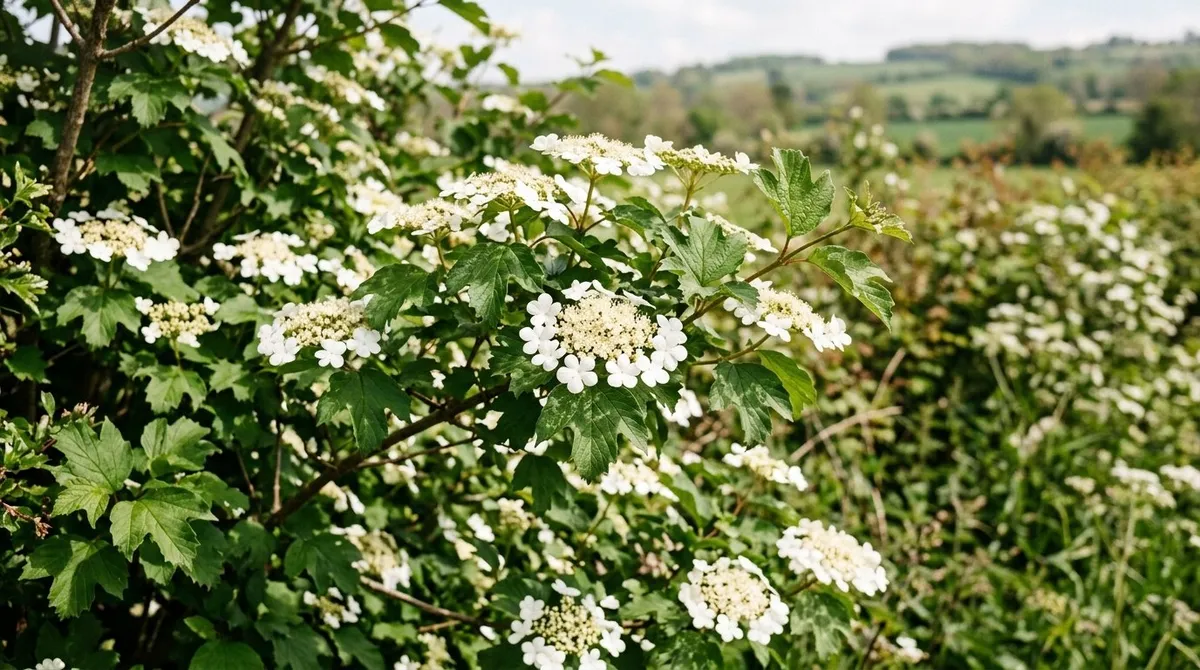
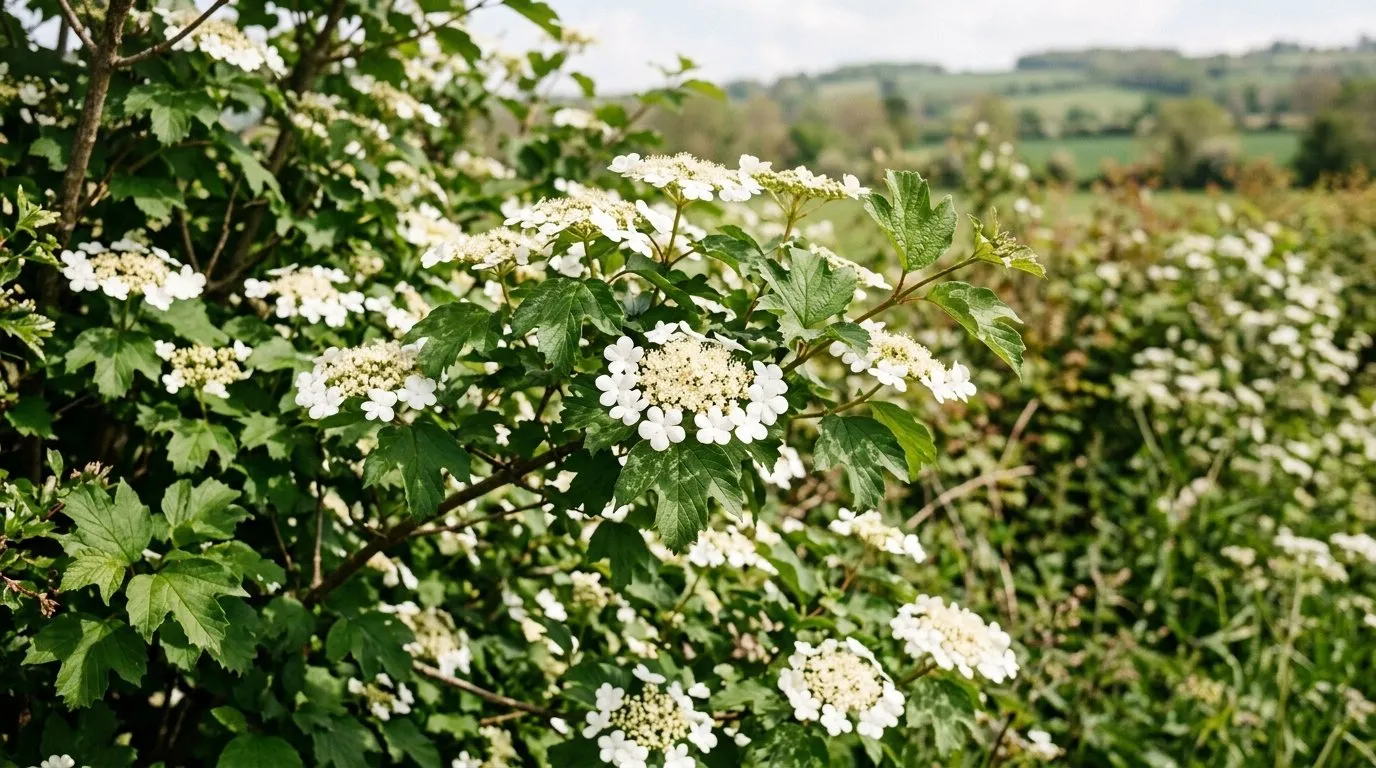 Guelder rose in full flower in a rural hedgerow in May. The flat white lacecaps are what earn it the rose in its name.
What does guelder rose look like through the year?
Guelder rose gives you three distinct displays across the seasons, which is rare in a single native shrub.
Flowers, May to June. The blossom is a flat, white lacecap. A ring of large, showy, sterile florets surrounds a dense centre of small, fertile flowers. The outer ring is pure advertising; the fertile centre is where hoverflies and bees feed. Each head is 5cm to 10cm across.
Berries, August to November. After the fertile flowers are pollinated, they swell into drooping clusters of round, translucent red berries. Backlit by low autumn sun they glow like redcurrants.
Autumn colour. The maple-shaped leaves turn a deep wine-red to burgundy in October, often on the same day the berries are at their brightest. For a fortnight the whole shrub burns red, then the leaves drop and the bare berries feed birds into winter.
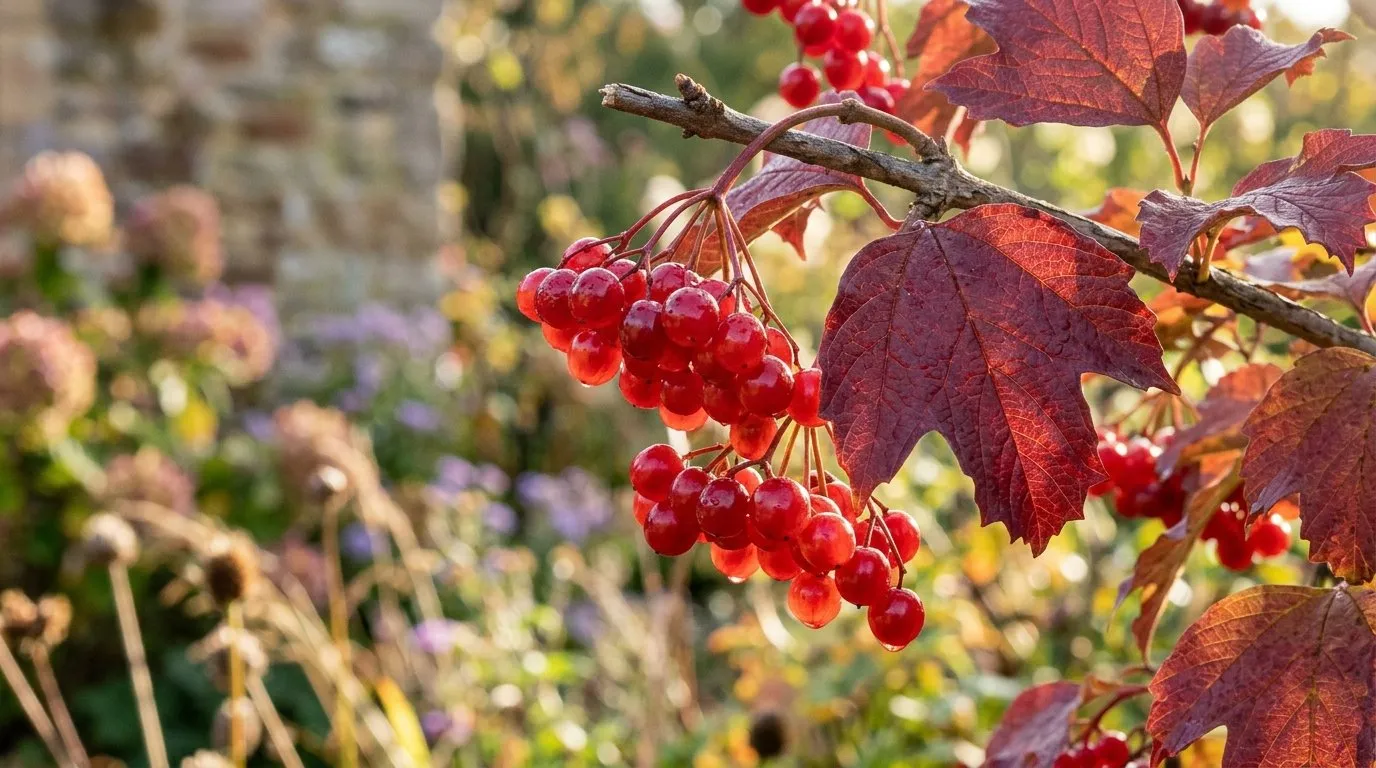 Translucent red berries and burgundy autumn leaves arrive together in October. The berries hang on into November unless birds strip them first.
Where does guelder rose grow best in the UK?
Guelder rose grows best on moist soil in sun or partial shade, and it is one of the few native shrubs that positively thrives on heavy, wet clay. Where most shrubs rot in waterlogged ground, guelder rose grows away happily.
It handles the full range of British soils. Heavy clay, chalk, loam and damp sand all suit it, provided the ground never bakes bone-dry in summer. In the wild you find it on ditch banks and pond margins. Copy those conditions and it needs nothing else.
If your garden is the sticky, boggy sort, guelder rose belongs near the top of your list alongside the other picks in our guide to the best plants for clay soil. It is one plant you do not need to improve the ground for first.
For light, moisture matters more than position. Full sun gives the heaviest flowering and strongest autumn colour. Partial shade is fine and suits a woodland-edge planting, but deep shade thins the flowering and dulls the leaf colour.
When and how do you plant guelder rose?
Plant bare-root guelder rose between November and March while the shrub is dormant, or plant potted stock at any time of year. Bare-root is far cheaper and establishes just as well.
Bare-root whips cost £1.50 to £3 each in mixed native hedging packs. They arrive as leafless sticks 40cm to 90cm tall, and you plant them the day they come. Potted plants cost £12 to £20 for a two or three-litre pot and let you plant in leaf during the growing season, which suits a one-off specimen.
To plant, dig a hole no deeper than the roots but half as wide again. Set the plant at the depth it grew before, spread the roots out and backfill with the soil you dug out. Firm it in with your heel and water well, even in winter. Bush-form guelder rose needs no staking unless you are training a single-stem standard.
Space plants 45cm to 60cm apart in a hedge, or give a specimen the full 4m width it will eventually fill. Water through the first summer if it turns dry, then leave it to fend for itself. The routine is the same as any native, set out in our hedge planting guide.
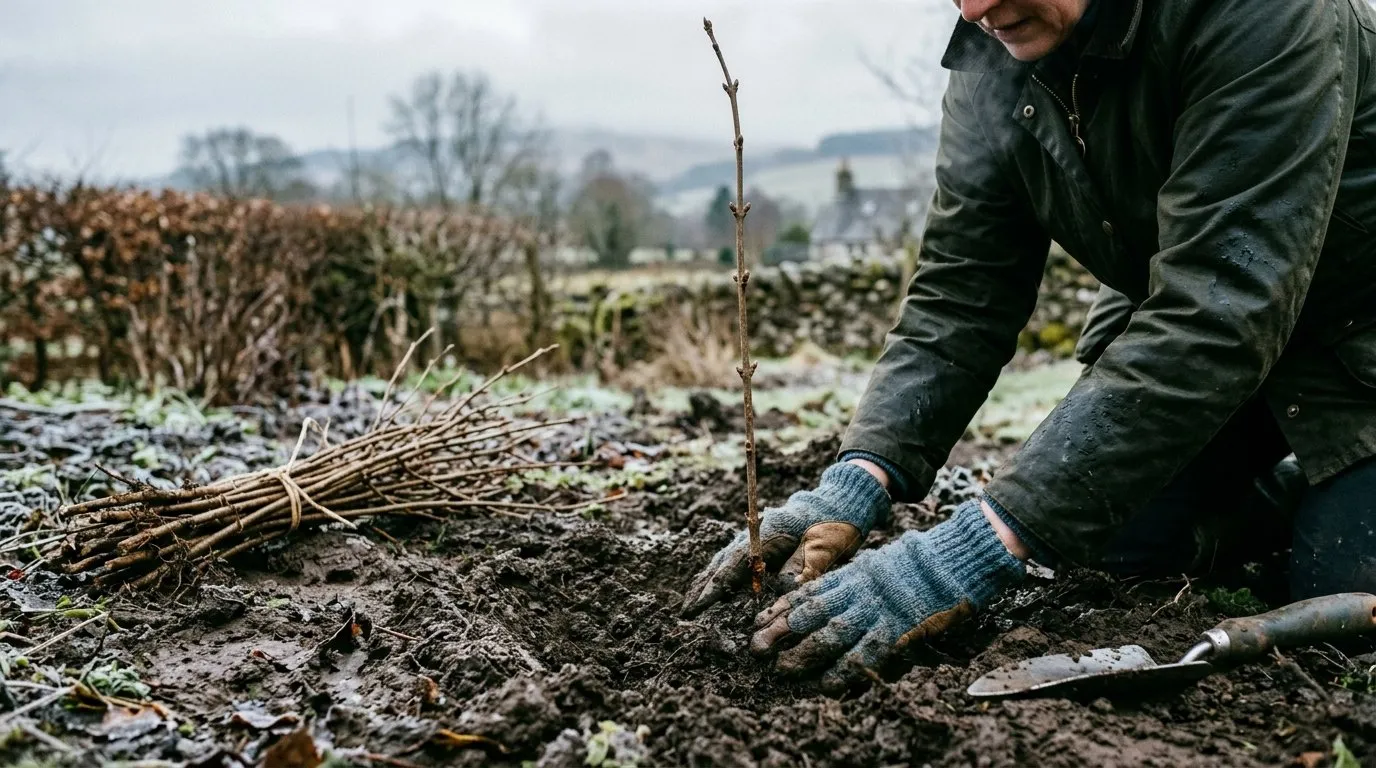 Bare-root whips go in from November to March at £1.50 to £3 each. Firm them in well and skip the stake: bush guelder rose stands on its own.
Is guelder rose good in a native hedge?
Guelder rose is a classic component of a mixed native hedge, and it earns its place for both wildlife and autumn colour. It is not a hedge on its own, but a partner. Plant it as roughly one in ten plants through a hedge of hawthorn, blackthorn and hazel.
Guelder rose is looser and less thorny than hawthorn or blackthorn, so it cannot carry the structure of a hedge alone. Woven through the thorny bulk of the other natives, it adds flower, berry and colour without weakening the barrier.
The timing rule is the one thing people get wrong. Trim a guelder rose hedge in February, after the berries have dropped or been eaten, and never in late summer. Guelder rose flowers and fruits on old wood. Cut it in August and you remove next spring’s blossom and next autumn’s berries in one pass. Late-winter trimming also keeps you the right side of the nesting-bird rules explained in our guide to when to cut hedges and the legal dates.
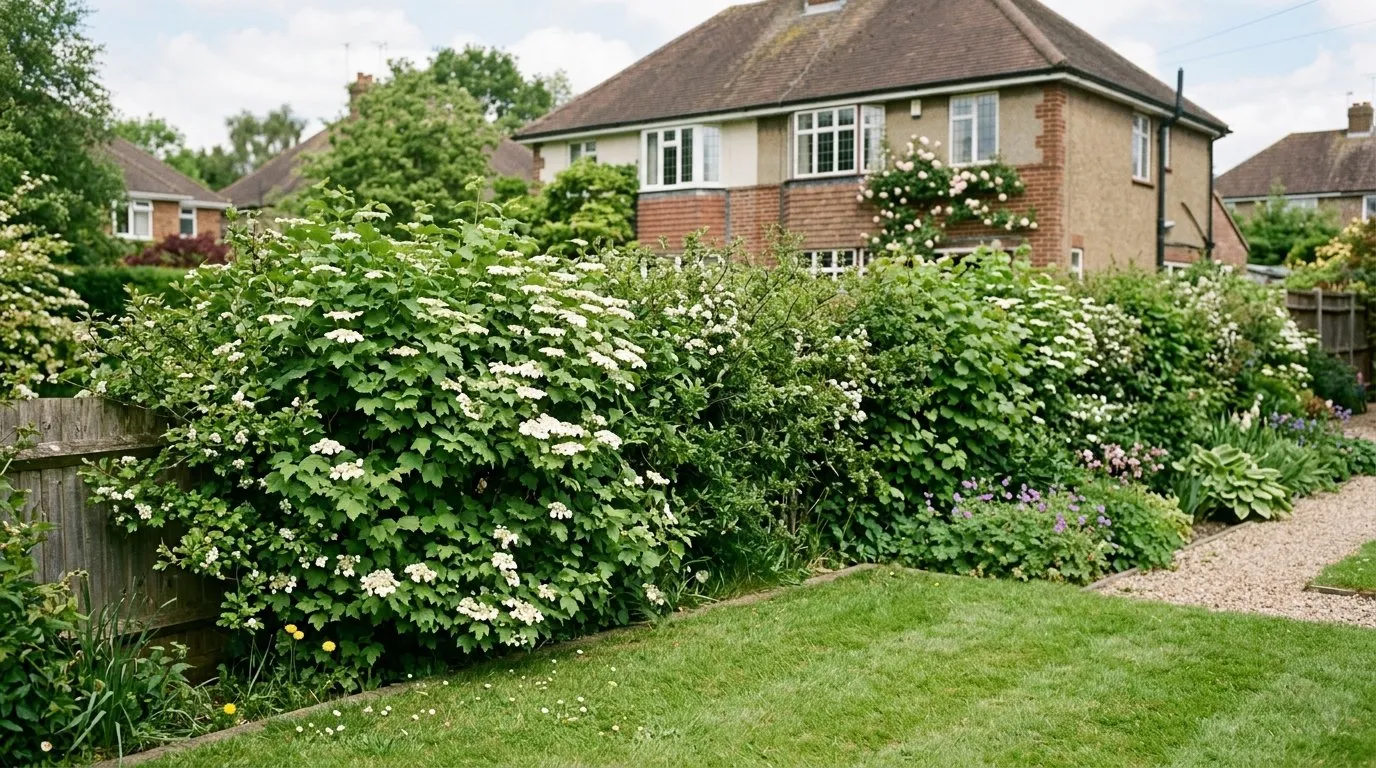 Guelder rose woven through a mixed native hedge on a suburban boundary. Plant it as about one in ten alongside hawthorn, blackthorn and hazel.
Which guelder rose should you plant?
Choose your guelder rose by what you want from it, because the forms differ sharply. The wild species is best for wildlife. The showy snowball form gives no berries and no nectar at all. That trade-off is the key decision.
The straight species, Viburnum opulus, is the one to plant for wildlife, berries and autumn colour. The cultivars below suit particular jobs, and two hold the RHS Award of Garden Merit (AGM).
| Type | Flowers | Berries | Size | Best for |
|---|---|---|---|---|
| Species (V. opulus) | White lacecaps | Heavy, red, reliable | 4m x 4m | Wildlife, hedging, autumn colour |
| ’Roseum’ (snowball tree) | Round white sterile pompoms | None (sterile) | 4m x 4m | Pure show; no wildlife value |
| ’Compactum’ (AGM) | White lacecaps | Good, red | 1.5m x 1.5m | Small gardens, low hedges |
| ’Xanthocarpum’ (AGM) | White lacecaps | Golden-yellow | 2.5m x 2.5m | Yellow-berry contrast |
The snowball trade-off is worth stating plainly. ‘Roseum’, sold as the snowball tree, turns the whole flower head into a ball of sterile florets. But sterile flowers make no pollen, no nectar and no berries, so it offers nothing to bees, hoverflies or birds. If wildlife is your aim, skip it.
‘Compactum’ is the pick for a small city garden or a low native hedge. It keeps every good trait of the species, flowers, berries and autumn colour, in a plant that stays around 1.5m.
‘Xanthocarpum’ swaps red berries for glowing golden-yellow ones and also holds an AGM.
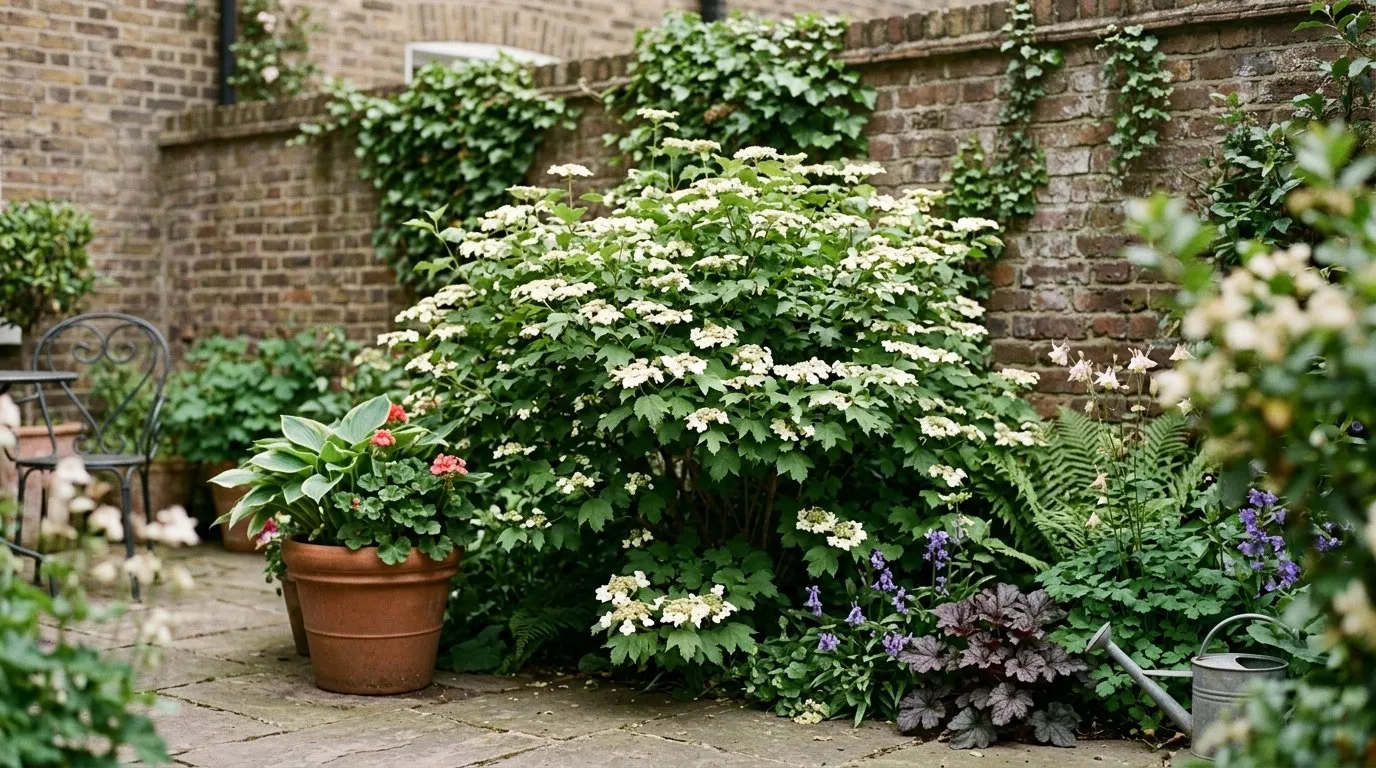 ‘Compactum’ keeps the flowers, berries and autumn colour of the wild species at around 1.5m, ideal for a small city garden.
What wildlife does guelder rose support?
Guelder rose supports wildlife across three seasons, from early-summer pollinators to autumn and winter berry-eaters.
In May and June, hoverflies, bees and other small insects work the fertile flowers at the centre of each lacecap. That early-summer nectar matters more than it looks, because the showy outer ring of florets produces nothing at all.
The dense twiggy growth shelters nesting birds in spring too, which is another reason a mixed native hedge is worth building.
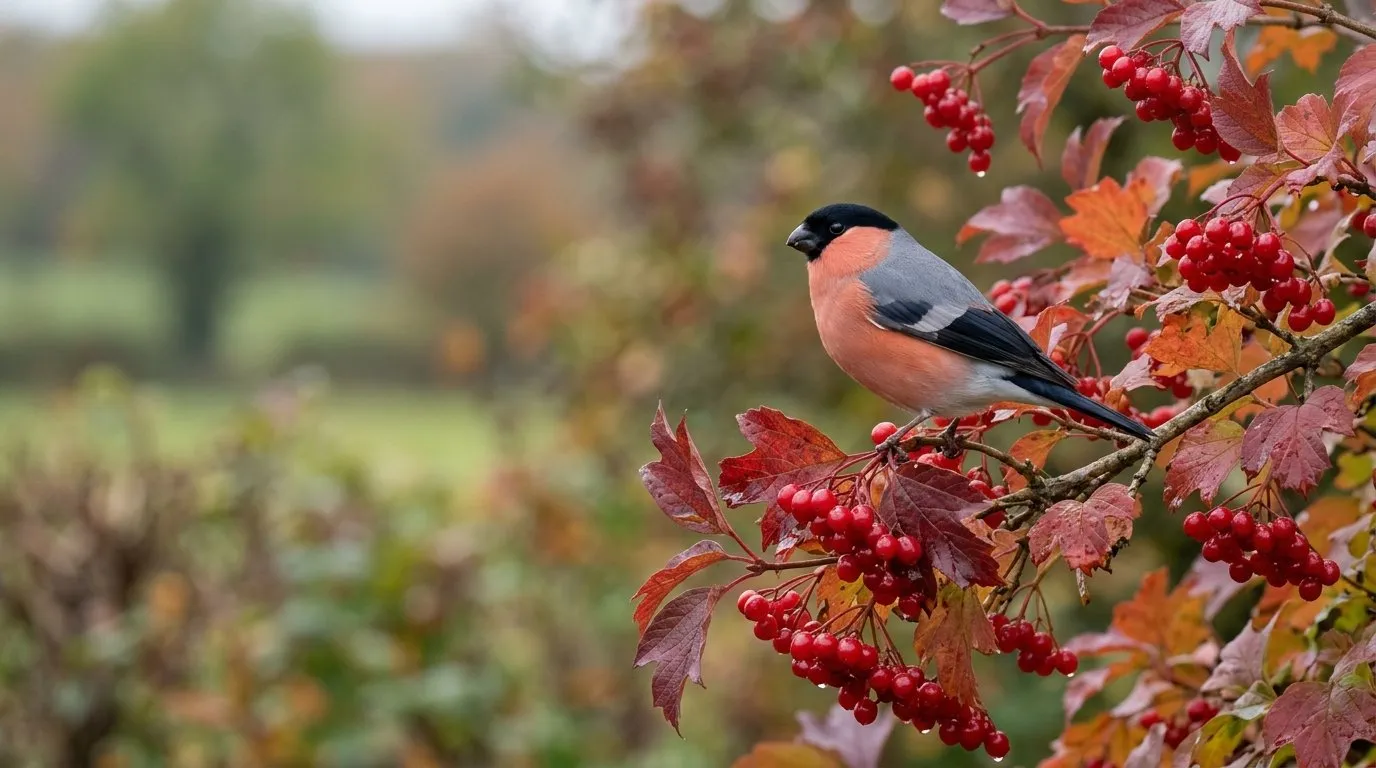 Bullfinches strip guelder rose berries in days, and winter waxwings can clear a shrub in an afternoon. The berries feed birds from August into winter.
What problems affect guelder rose?
Guelder rose is a tough, near trouble-free shrub, but one pest is worth knowing. Viburnum beetle is the main issue, and aphids are a minor spring nuisance. Neither is usually fatal.
Viburnum beetle is the one to watch. The RHS ranks it among Britain’s most reported garden pests, topping their pest surveys in several recent years. The greyish-yellow larvae hatch in April and chew the leaves into lace, leaving them skeletonised by May and June. A heavy attack can strip a shrub, though established plants recover and re-leaf.
Check the undersides of the leaves in April and squash the larvae by hand while they are small and clustered. Healthy, well-established guelder rose shrugs off most attacks and grows back. Avoid reaching for sprays, which also kill the beneficial insects the flowers are there to feed.
Aphids sometimes curl the soft new shoot tips in spring. They rarely do lasting harm. Ladybirds, hoverfly larvae and blue tits deal with most colonies, so encourage those predators and leave the aphids to feed them.
Are guelder rose berries poisonous?
Guelder rose berries are mildly toxic to people when eaten raw and can cause stomach upset, but they are not dangerously poisonous. It is not a reason to avoid the plant.
Eaten raw in quantity, the berries can cause nausea and an upset stomach. They taste bitter and sour, which puts most people off after one, and the toxicity is low rather than serious.
Cooking changes everything. In Scandinavia and eastern Europe the berries are traditionally cooked into a tart jelly and used to flavour drinks, once the heat has broken down the bitter compounds. They are high in vitamin C. Do not try this without a reliable recipe, and never confuse the raw berries with those of a truly edible native such as elderberry, which is a different plant entirely.
For a family garden, plant it freely, enjoy the berries as bird food and autumn colour, and teach children not to eat wild berries raw.
How do you propagate guelder rose?
Guelder rose is easy and free to propagate from hardwood cuttings taken in late autumn. This is the cheapest way to build a whole native hedge from one parent plant.
Take hardwood cuttings in November, once the leaves have dropped and the shrub is dormant. Cut pencil-thick lengths of the current year’s growth, about 20cm to 25cm long, with a straight cut below a bud at the base and a sloping cut above a bud at the top.
Push the cuttings two-thirds deep into a slit trench of gritty soil, or into deep pots. Firm them in and leave them alone. They root over winter with no heat and no propagator.
By the following autumn most will have rooted. Lift them the next dormant season and plant them out. From one established shrub you can raise dozens of plants, enough to thread through a whole native hedge.
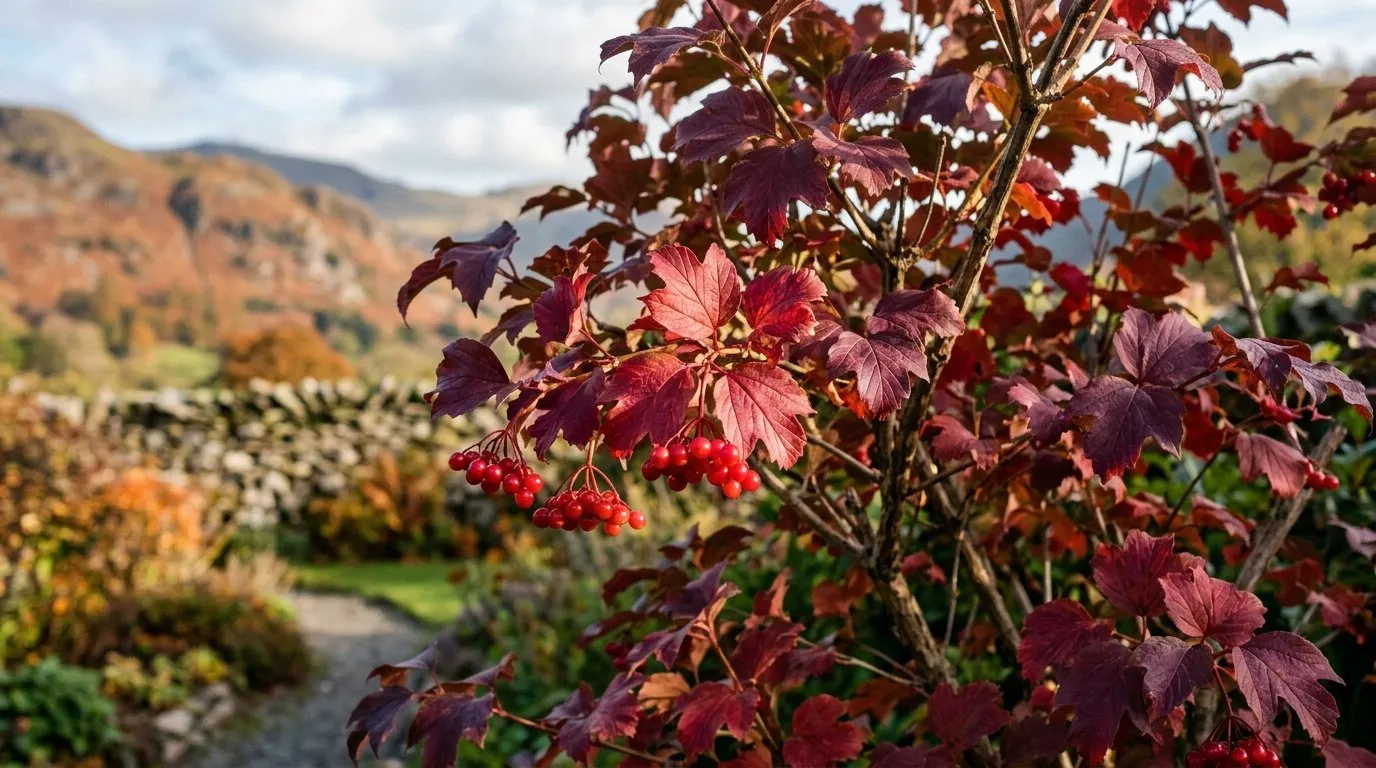 The maple-shaped leaves turn deep wine-red in October, often as the berries peak. This Lake District shrub burns red for a fortnight before the leaves fall.
Frequently asked questions
Is a guelder rose actually a rose?
No, guelder rose is not a rose at all. It is Viburnum opulus, a native shrub in the moschatel family. The name comes from its flat, rose-like lacecap flowers and from Gueldersland in the Netherlands, where the snowball form was first cultivated. True roses belong to a completely different plant family, the Rosaceae.
Where does guelder rose grow best?
Guelder rose grows best on moist soil in sun or partial shade. It is one of few native shrubs that thrives on heavy wet clay, and it also handles chalk. Give it a spot that never bakes dry. Damp ditch sides, pond margins and boggy corners suit it perfectly, which is where you find it wild.
Are guelder rose berries poisonous?
Guelder rose berries are mildly toxic to people when raw and can cause stomach upset. They are not dangerously poisonous, and cooking removes the problem. In Scandinavia the berries are cooked into jelly and used to flavour drinks. Keep young children from eating them raw, but the shrub is safe to plant in family gardens.
When should I cut a guelder rose hedge?
Trim guelder rose in February, after the berries have dropped or been eaten. Cutting in late summer removes the flowering wood and destroys next year’s berries and blossom. Guelder rose flowers on old wood, so one badly timed trim costs you a whole season of display and a whole winter of bird food.
Does guelder rose have berries every year?
The straight species berries reliably every year once established. The ornamental snowball form, ‘Roseum’, never berries at all because its flowers are sterile pompoms with no fertile centre. If you want berries for birds and autumn colour, plant the wild species or a berrying cultivar, not the snowball tree.
How big does a guelder rose get?
Guelder rose reaches about 4m tall and 4m wide when left unpruned. It grows fast, adding 30cm to 60cm a year on good soil. It responds well to hard pruning, so you can keep it to 1.5m in a hedge or a small garden. The compact cultivar ‘Compactum’ tops out at around 1.5m naturally.
Is guelder rose good for wildlife?
Guelder rose is one of the best native shrubs for wildlife. Hoverflies and bees work the fertile flowers in early summer, the red berries feed mistle thrushes, bullfinches and autumn waxwings, and the dense growth shelters nesting birds. It supports the full chain from pollinators to berry-eaters across three seasons.
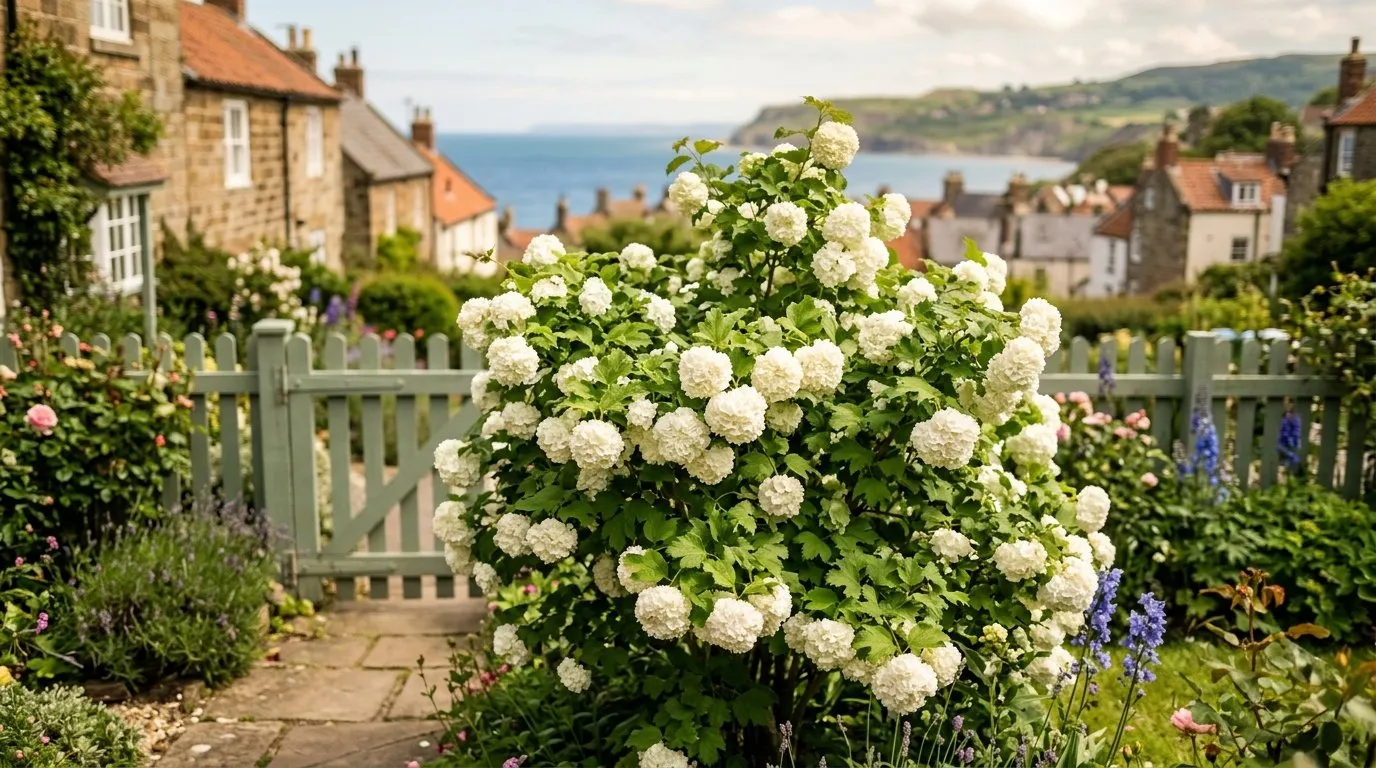 The sterile ‘Roseum’ snowball form is pure show: no nectar, no berries. Plant it for looks, but choose the wild species if you want wildlife.
For more native shrubs and trees that carry a garden through every season, see our guide to UK native plants for gardens.
Our team produces practical UK gardening guidance from source research, contributor records and established horticultural practice. Editorial standards are overseen by Matt W.