Key takeaways
- The pink appears on new growth only: hard prune in March to force fresh coloured shoots
- Most flamingo trees are top-grafted standards; remove every sucker sprouting below the graft
- Rated RHS H5 and hardy to -15C, though a late frost can nip the first pink flush
- Left unpruned it becomes a 2.5m by 2.5m shrub; a pruned standard stays at 1.5-1.8m
- Underwatering is the number one killer in pots: water daily through summer
- Expect to pay £12-15 for a supermarket standard and £40-60 for a nursery specimen
- A light trim in early July forces a second pink flush that lasts into September
The flamingo tree has become the most impulse-bought plant in Britain. Salix integra ‘Hakuro-nishiki’, to give it its full name, sits by supermarket entrances every spring as a £15 lollipop standard with shrimp-pink shoot tips. Thousands go home in trolleys. By August, most new owners are typing the same two questions: why has it gone green, and what are these shoots sprouting from the trunk?
Both have short answers, and both trace back to what this plant really is: a variegated dappled willow grafted onto the top of a plainer willow’s stem. Understand the graft and the way the colour works, and the salix flamingo becomes one of the easiest small trees in the country. This guide covers the March hard prune that brings the pink back, sucker removal, pot growing, brown-leaf diagnosis and the two willows people mix it up with.
What is a flamingo tree?
A flamingo tree is Salix integra ‘Hakuro-nishiki’, a variegated dappled willow, almost always sold grafted on top of a clear stem. The species grows wild in Japan, Korea and far-eastern Russia. ‘Hakuro-nishiki’ is the Japanese-raised variegated form, and it holds the RHS Award of Garden Merit. The RHS rates it H5, hardy to -15C, which covers every garden in the UK.
The pink is foliage, not flower. New leaves emerge shrimp-pink and cream-white from April, held on slender red-tinged shoots. Small yellow catkins appear on the bare stems in March. Each leaf then matures through marbled pink-white-green to a settled green flecked with white.
On its own roots it makes an arching shrub of 1.5-2.5m. What supermarkets sell is a top-grafted standard: a head of ‘Hakuro-nishiki’ budded onto a 1.1-1.2m stem of a stronger, plainer willow rootstock. That knuckle at the top of the trunk, the graft union, drives half the problems this article solves.
On price, the spread is wide. Supermarkets and discounters sell young standards for £12-15 each spring. Garden centres charge £25-35 for the same grade. A nursery specimen with a three or four year old head runs £40-60. You pay for head size and stem thickness, nothing more. If you want the wider family context first, our guide to growing willow in the UK covers the vigorous species this little tree is grafted onto.
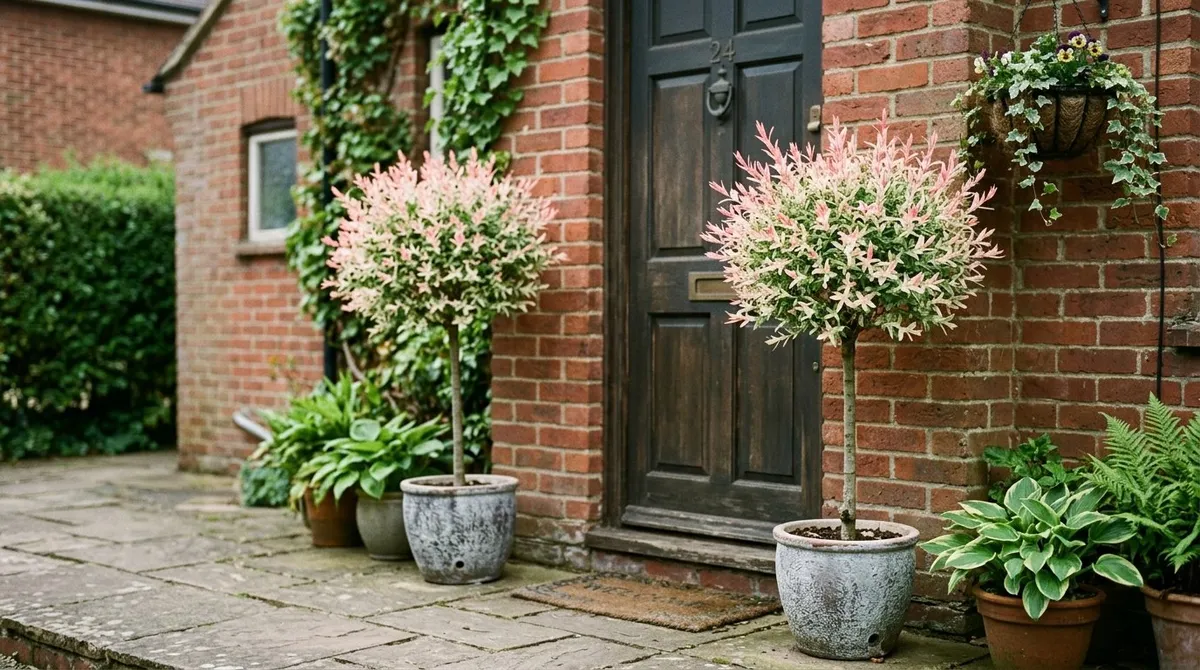
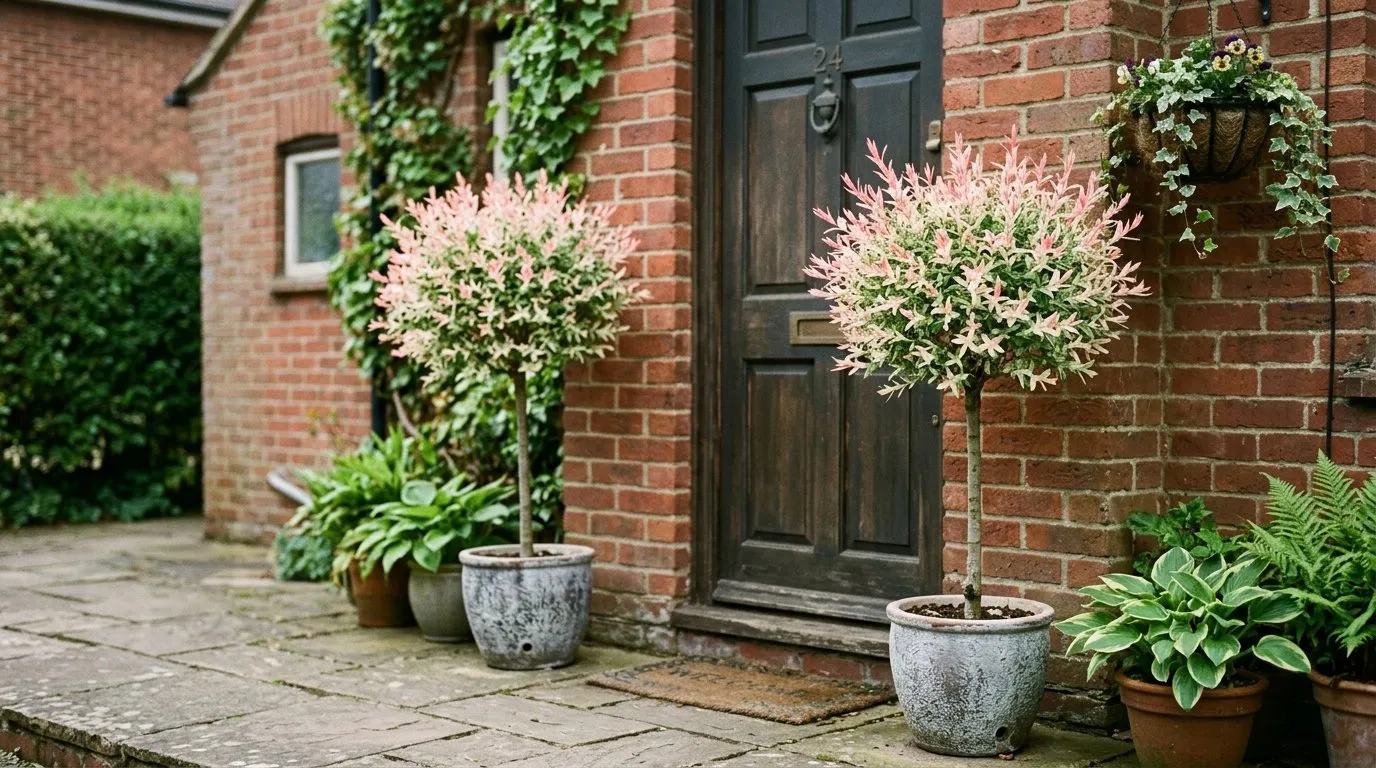 A pair of grafted standards doing what sells them: the April-to-June pink flush either side of a front door.
Why is my flamingo tree losing its pink colour?
The pink appears on new growth only, and every leaf fades towards green-white as it matures. Nothing is wrong with your plant. The spring flush, April to June, is the peak of the display. By mid-July an unpruned head reads mostly green and white, and by September it is plain green with pale flecks. Light matters too. In full sun, six hours or more, the new growth colours strongly and holds longer. In shade the flush arrives washed-out and brief. If your tree sits against a north-facing wall and has never really gone pink, the site is the reason.
The lasting fix is simple: colour follows the knife. Every cut forces new shoots, and only new shoots carry pink. A hard March prune gives the big spring flush. A light July trim buys a second, smaller flush through late summer. Water and a feed after each cut speed the regrowth. Skip the pruning entirely and within three seasons you own a shaggy, greenish mop on a stick.
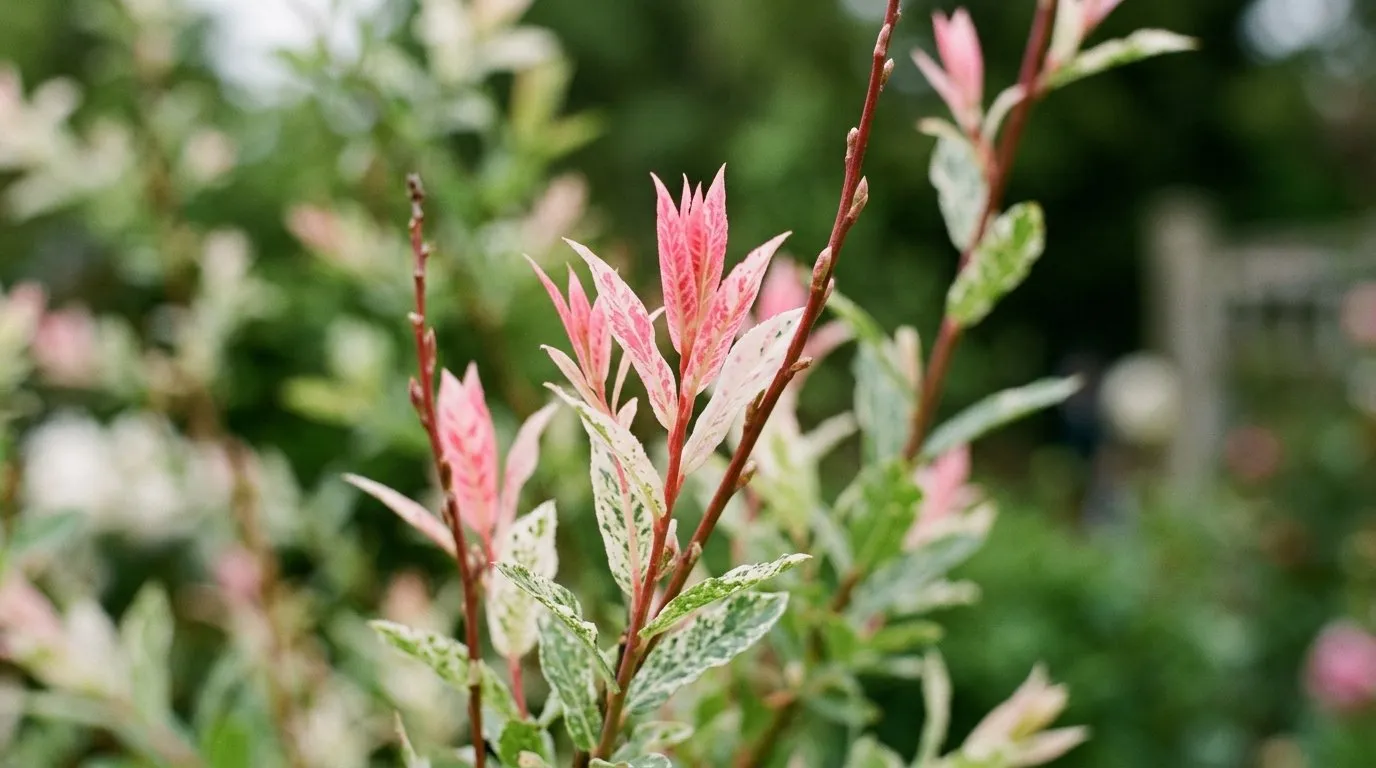 The money shot, close up. Shrimp-pink and cream on the newest leaves, fading to green-white further down the shoot.
When and how should you prune a flamingo tree?
Hard prune in March, cutting every stem on the head back to two or three buds, then trim lightly again in early July. The RHS lists this willow as needing minimal pruning, and as a border shrub that is true. A grafted standard is different. Leave the head uncut and it grows lopsided, green and heavy; treat it like a dogwood, cut hard annually, and it stays a tight ball of colour.
The March job takes ten minutes. In the first week of the month, before leaf-out, cut each stem back to 5-8cm from the framework, just above an outward-facing bud. Take dead and crossing twigs out completely. Use sharp bypass secateurs, a decent pair costs £12-25, and make clean cuts. The finished head looks like a fist of twigs. Hold your nerve: it releafs in three to four weeks. The technique is the same renovation logic covered in our guide to pruning shrubs, compressed onto a lollipop.
The July trim is lighter. In the first week of the month, shorten the new shoots by a third to a half. That triggers a second pink flush from late July into September. Stop cutting by mid-August: anything later pushes soft growth that the first frosts blacken.
| Month | Flamingo tree job |
|---|---|
| Early March | Hard prune: every stem to 2-3 buds, remove dead wood |
| April-June | Enjoy the main pink flush; rub off trunk suckers monthly |
| Early July | Trim new shoots by a third to half for a second flush |
| Mid-August | Last safe date for any cutting |
| November-February | No pruning needed; orange-red young stems earn their keep |
If you like working to a fixed rota, the March and July slots drop straight into our year-round pruning calendar alongside the dogwoods and buddleja.
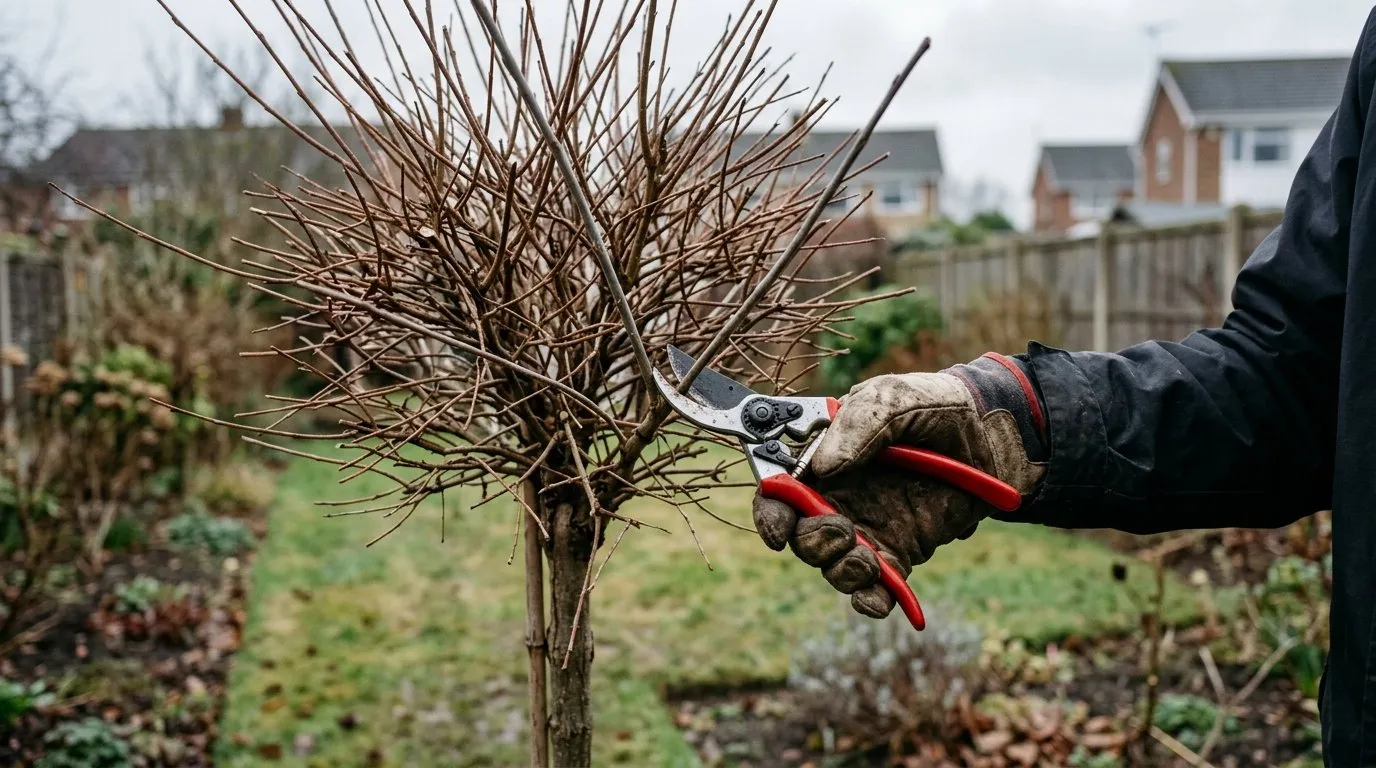 The March cut: every stem back to two or three buds. The head releafs in three to four weeks.
What are the shoots growing from the trunk below the head?
They are suckers from the rootstock, and every one must come off. Anything sprouting below the graft union belongs to the plain willow the stem was grown from, not to ‘Hakuro-nishiki’. Rootstock shoots are easy to spot: plain green leaves with no variegation, noticeably faster growth, usually bolt upright from the trunk or straight out of the soil.
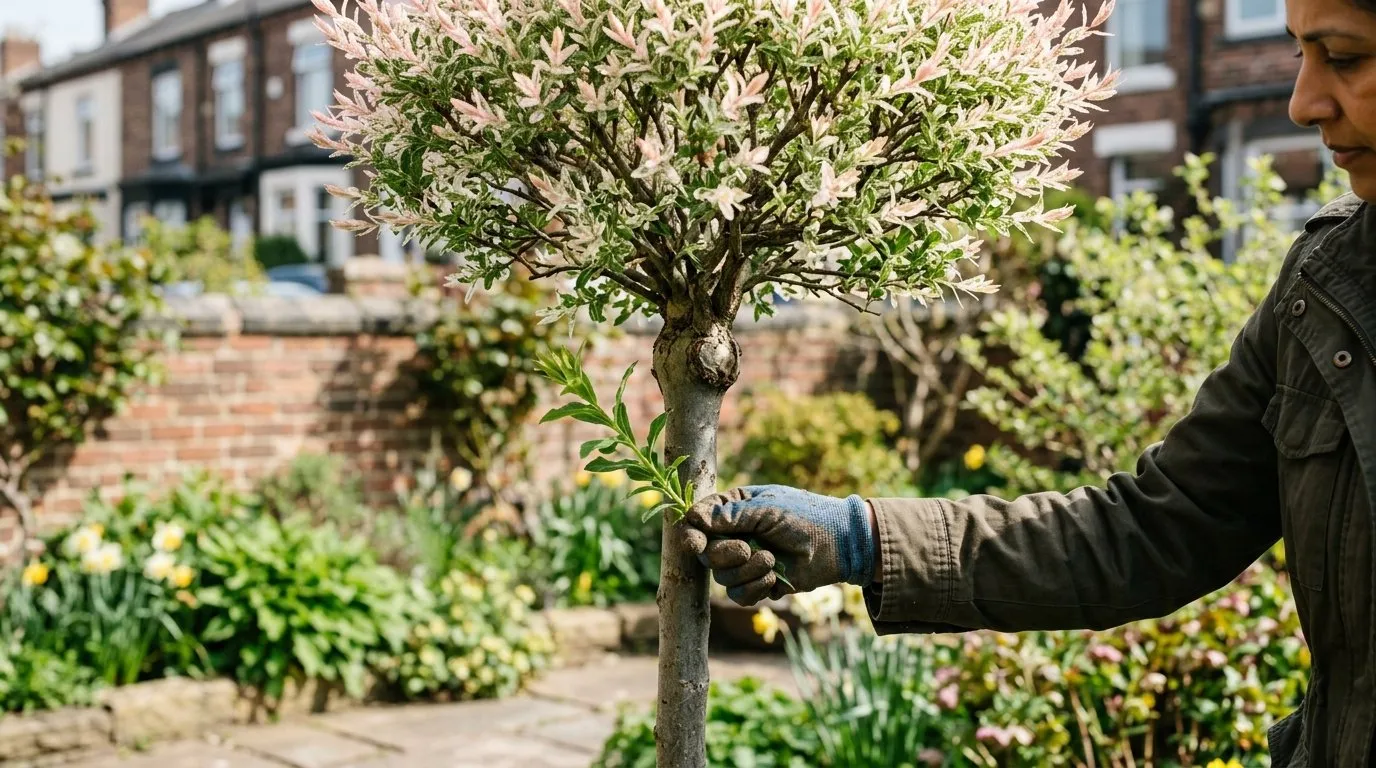 Plain green, fast and upright: a rootstock sucker below the graft. Rub or pull it off before it thickens.
Why are the leaves brown and crispy?
Drought is the most common cause of crispy flamingo tree leaves, followed by wind scorch and willow rust. The three look different if you know what to check.
Drought. Willows are riverbank plants and this one wilts fast. A dried-out pot crisps the entire head within days, and a border plant browns from the shoot tips inward during a dry fortnight. The rescue: soak thoroughly, an hour with the pot standing in water, then snip off the scorched shoots. A drought-crisped tree usually releafs within two to three weeks. It looks dead; it almost never is.
Wind scorch. Cold or drying wind in spring browns the margins and tips on the exposed side only, while the sheltered side stays clean. The thin, half-hardened April leaves are the most vulnerable. The pattern is identical to the scorch that hits Japanese maples, and the diagnosis walkthrough in our acer leaf scorch guide applies here directly. The fix is siting: a spot shielded from easterly winds, which matters most in open new-build gardens where fences are the only shelter.
Willow rust. From July, look under the leaves for orange pustules; the upper surface shows yellow speckling before leaves brown and drop early. Rust disfigures but rarely kills. Rake up and bin fallen leaves in autumn, keep the head open with the annual prune, and the cycle weakens. No fungicide available to home gardeners is worth the bother on this plant.
Anthracnose turns up in soggy summers as small dark leaf spots with twig dieback. Prune out affected shoots and let the annual hard cut renew the head.
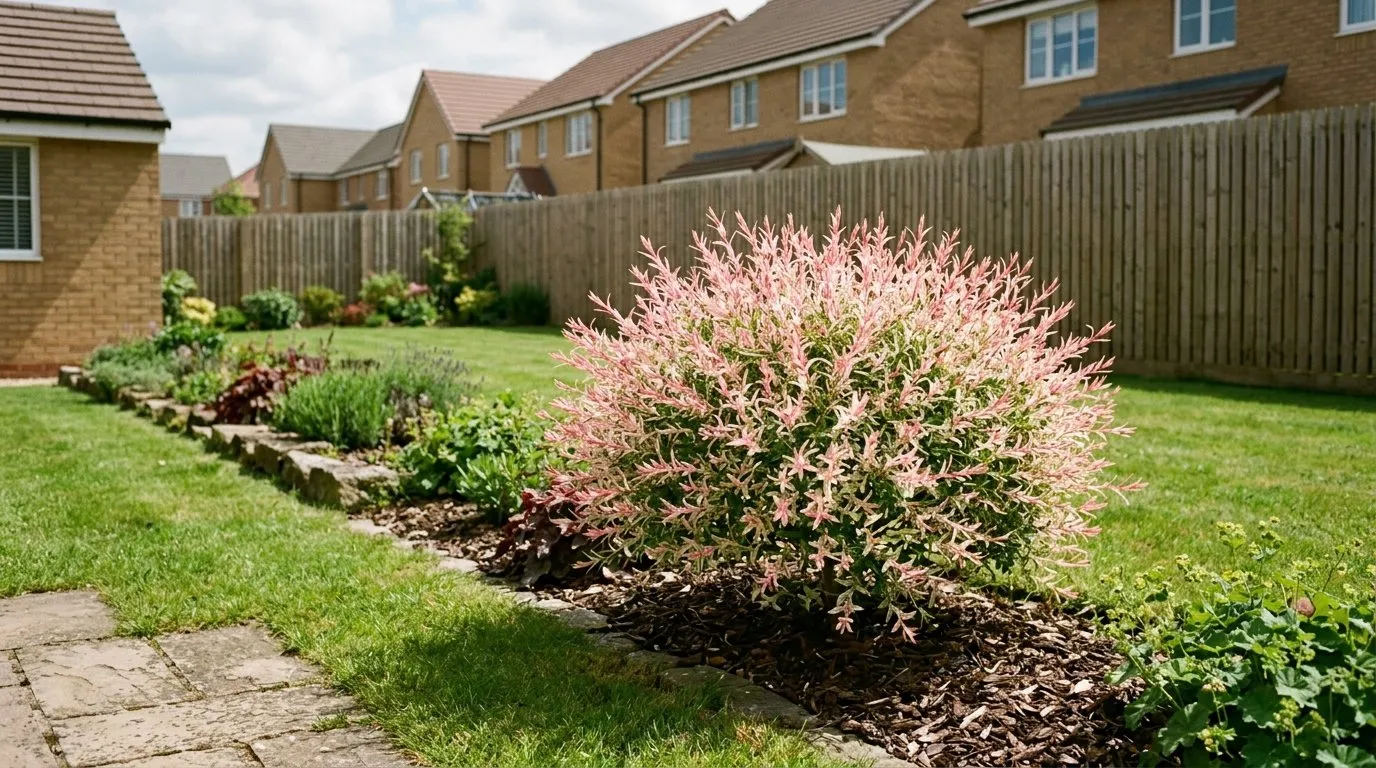 Shelter decides leaf quality. In exposed new-build plots, plant where fences break the east wind.
Can you grow a flamingo tree in a pot?
Yes, a flamingo tree lives happily for years in a 40-45cm pot, provided you never let it dry out. Underwatering kills more potted specimens than frost, pests and disease combined. In June, July and August a potted standard drinks 3-5 litres a day in warm weather. Daily watering is the deal you accept at the till.
Get the compost right and the rest is routine. Use a loam-based mix, John Innes No 3, which holds moisture and anchors a top-heavy standard against wind-rock. A 5cm mulch of bark or gravel on the surface slows evaporation. Feed monthly with liquid seaweed from April to August. Stop feeding in August so late growth hardens before frost.
Every two to three years the roots fill the pot and watering stops keeping up. Either pot on one size, or take the tree out in early spring and shave the rootball back, the method in our root pruning guide for pots. The pot can stay outdoors all winter in most of the UK; wrap it in bubble wrap only if a spell below -8C is forecast, to protect the confined roots rather than the top. For partner planting around the base through the seasons, our pick of the best plants for pots year-round has candidates that cope with the daily watering regime.
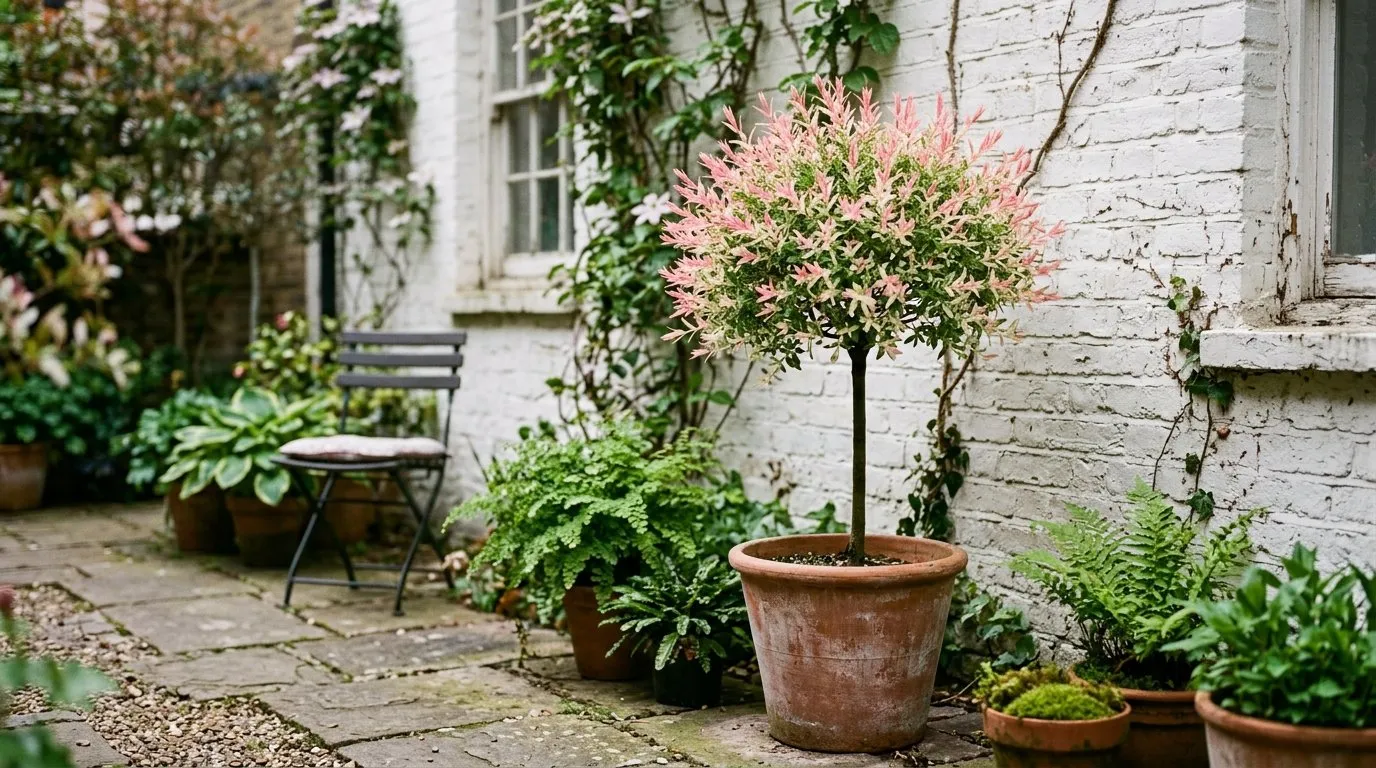 One pot, one tree, one rule: never let it dry out. A 40-45cm pot and John Innes No 3 carry a standard for years.
How big does a flamingo tree get, and is it hardy?
Left unpruned, a flamingo tree reaches about 2.5m tall and 2.5m wide within ten years; a hard-pruned standard holds at 1.5-1.8m indefinitely. The grafted stem never gains height. Only the head grows, throwing 30-45cm of new shoot a season after a hard prune. As an own-root border shrub it makes a soft, arching mound and takes the same annual treatment.
Hardiness is the least of your worries. RHS H5 means the plant shrugs off -15C, colder than almost any UK winter delivers. The one catch is timing, not depth, of cold. The April flush is soft, and a late frost below about -2C browns the fresh pink tips overnight. It looks alarming and means little: the head regrows within weeks. If a hard frost is forecast after leaf-out, a fleece sheet thrown over the head for the night saves the display.
Winter is quietly good value. The young stems ripen orange-red, the catkins arrive on bare wood in March, and a pruned standard reads as sculpture in a frosted border. Root behaviour stays polite too: 2-3m from walls and drains is plenty, unlike the full-sized willows whose roots genuinely hunt water.
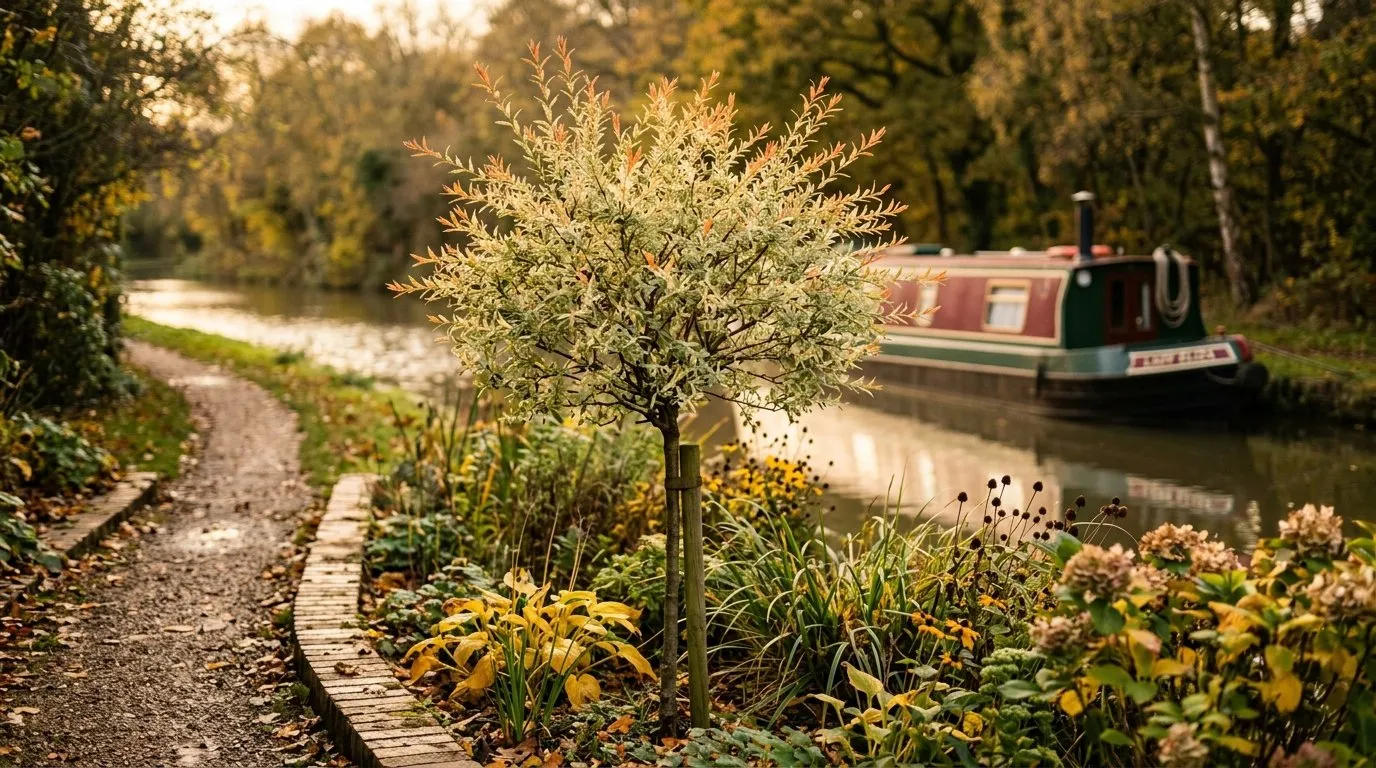 October honesty: the variegation fades to soft green and yellow, and the orange-red young stems take over the display.
Flamingo tree, pussy willow or Kilmarnock willow?
These three get confused constantly, because all three are sold as small lollipop standards on the same spring displays. The flamingo tree is grown for pink foliage; the other two are forms of Salix caprea grown for catkins.
| Flamingo tree | Pussy willow | Kilmarnock willow | |
|---|---|---|---|
| Botanical name | Salix integra ‘Hakuro-nishiki’ | Salix caprea | Salix caprea ‘Kilmarnock’ |
| The show | Pink-white spring foliage | Silver catkins, Feb-March | Silver catkins on weeping stems |
| Usual form sold | Top-grafted standard or shrub | Shrub or hedgerow tree | Grafted weeping standard |
| Size if left | 2.5m as a shrub | Up to 10m as a tree | 1.5-2m, weeps to the ground |
| Main prune | Hard cut in March | After catkins finish | Thin congested head after flowering |
The Kilmarnock, often misheard and mislabelled as the “Killarney willow”, is the one most often bought by mistake. It weeps stiffly to the ground, never goes pink, and is pruned by thinning rather than hard cutting. The wild goat willow is a different scale of plant altogether, a 10m hedgerow tree with the earliest and best catkins for wildlife; our pussy willow guide covers it properly. The RHS willow hub is a useful map of just how wide this family runs, from 2cm alpines to 25m riverside trees.
Frequently asked questions
Why has my flamingo tree turned green?
The pink only forms on new spring growth, and it fades as leaves mature. By late July most of the head settles to green and white, which is normal. Hard prune in March and trim again in early July to force fresh coloured shoots. Full sun deepens the pink; in shade the flush is weak from the start.
When should you prune a flamingo tree?
Hard prune in March, then give the head a lighter trim in early July. In March cut every stem back to two or three buds, roughly 5-8cm. In July shorten the new shoots by a third to half. Stop cutting by mid-August so late growth hardens before the first frosts.
Why are my flamingo tree’s leaves brown and crispy?
Drought, wind scorch or willow rust are the usual causes. A dried-out pot crisps the whole head within days. Wind scorch browns the tips and margins on the exposed side in spring. Rust shows as orange pustules under the leaves from July. Soak dry plants, improve shelter, and rake up rust-infected leaves in autumn.
How big does a flamingo tree get?
Left unpruned, it reaches about 2.5m tall and wide within ten years. That is the shrub form on its own roots. A top-grafted standard pruned hard each March holds at 1.5-1.8m with a head about 60-90cm across. The stem never gets taller; only the head grows.
Is a flamingo tree the same as a Kilmarnock willow?
No, the Kilmarnock willow is a weeping form of Salix caprea grown for catkins. Both are sold as small grafted standards, which is why they get confused. The flamingo tree earns its place with pink and white spring foliage, while the Kilmarnock covers its stiffly weeping stems with silver catkins in February and March.
Can a flamingo tree stay in a pot permanently?
Yes, in a 40-45cm pot with daily summer watering it lives for many years. Use a loam-based compost such as John Innes No 3, feed monthly from April to August, and root prune or pot on every two to three years. Underwatering kills more potted flamingo trees than every other cause combined.
Do flamingo trees have invasive roots?
No, a grafted standard has a modest, fibrous root system. It is nothing like the water-hunting roots of a full-sized weeping or crack willow. Planting 2-3m from walls and drains is ample caution. In heavy clay it actually appreciates the moisture other small trees resent.
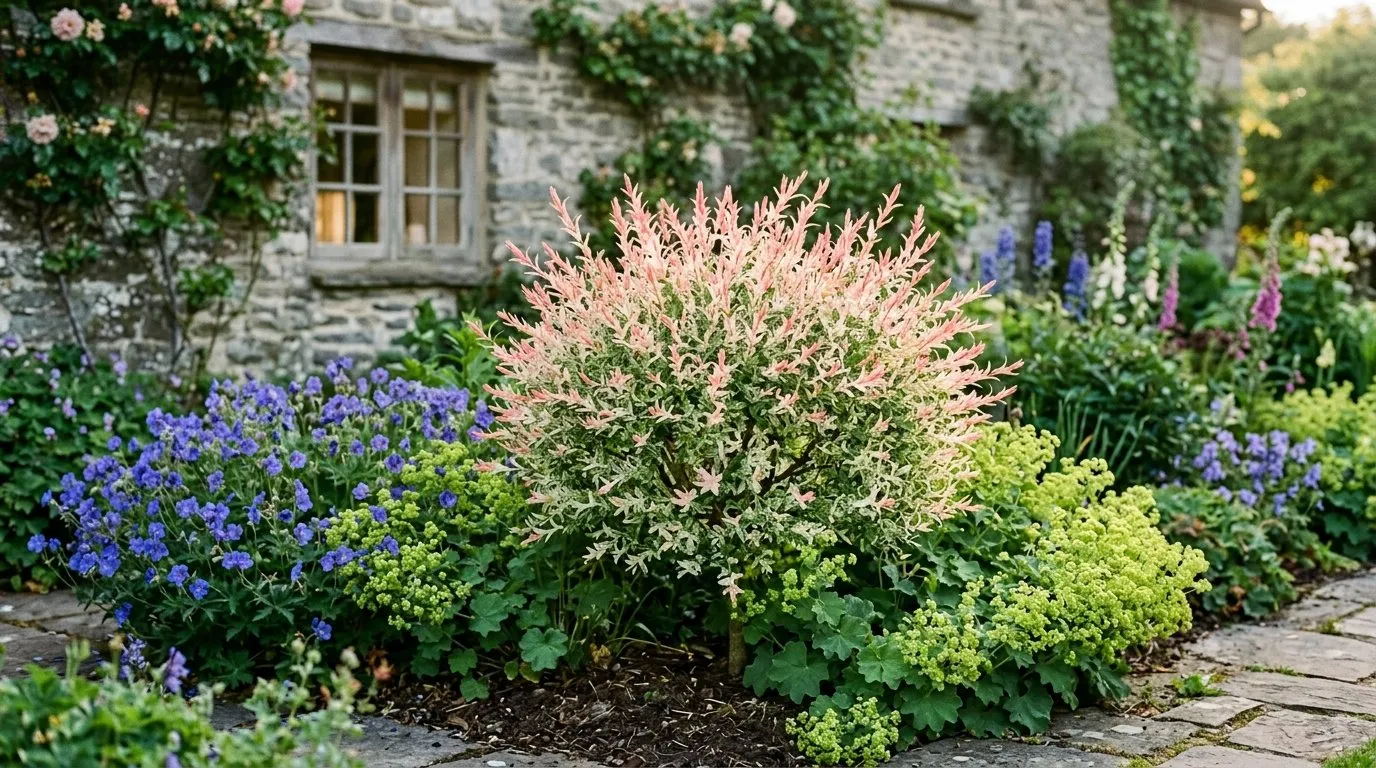 The other way to grow it: on its own roots as a border shrub, hard pruned in March exactly like the standard.
That £15 impulse buy asks for one thing: a hard cut every March. Give it that, daily water in the pot and a clean trunk, and the supermarket lollipop outlives plants that cost four times as much.
Our team produces practical UK gardening guidance from source research, contributor records and established horticultural practice. Editorial standards are overseen by Matt W.