Key takeaways
- The red flower is a spathe, a modified leaf; the true flowers are the tiny bumps on the central spadix
- Each bloom lasts 6-8 weeks and plants flower in flushes, with rests of up to 3 months between them
- A non-flowering anthurium is nearly always short of light; an east or west windowsill fixes most of them
- Water by weight, not by schedule: lift the pot and water only once it feels light
- Keep it above 15C all year; 40-50% humidity is enough in most UK rooms
- Repot every 2-3 years into a chunky mix: 2 parts peat-free ericaceous compost, 1 part bark, 1 part perlite
- All parts are toxic to cats and dogs; expect £8-12 for a supermarket plant, £25-40 for a specimen
Is the anthurium flower really a flower?
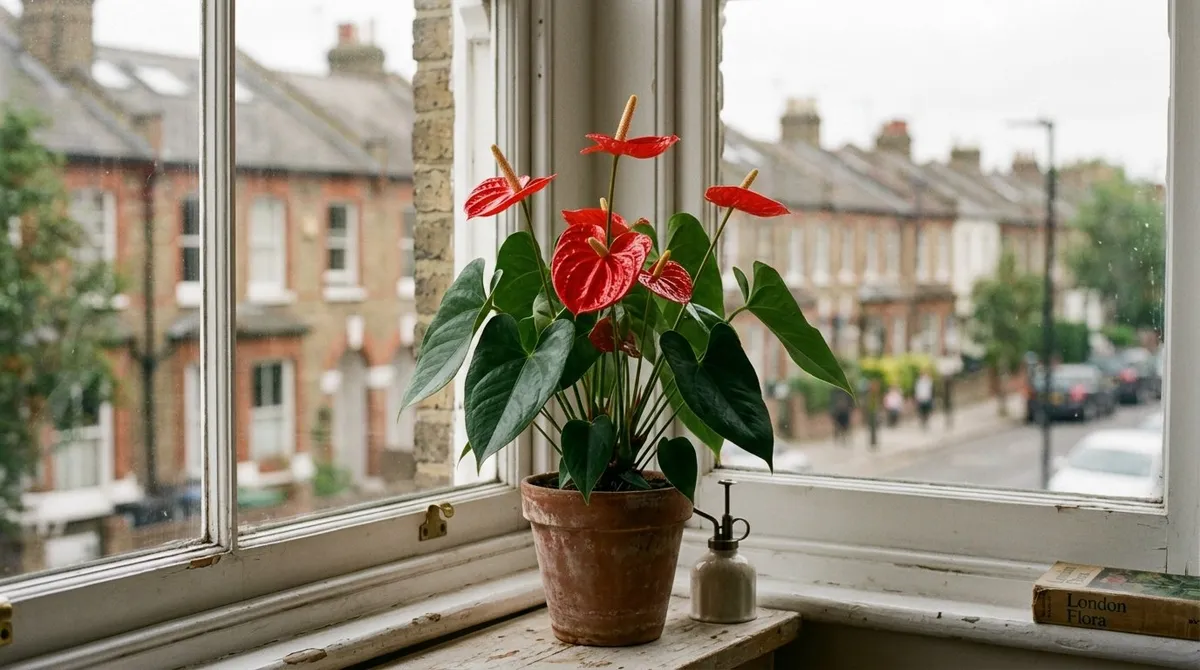
No. The coloured heart is a spathe, a modified leaf that has evolved to work as an advertising hoarding. The true flowers are the hundreds of tiny bumps packed onto the central spike, which botanists call the spadix. In the wild the spathe signals to pollinators from a distance; the cream or yellow spadix does the actual reproducing.
This matters for care because a spathe is built like a leaf, not a petal. That is why each bloom lasts 6-8 weeks, while a rose manages days. Anthuriums flower in flushes, then rest, and a rest of up to 3 months between flushes is completely normal. A mature plant in good light manages two or three flushes a year, often with four to six spathes open at the peak.
Anthurium andraeanum comes from the rainforests of Colombia and Ecuador, where it grows as an epiphyte, perched on tree branches rather than rooted in soil. It belongs to the aroid family alongside the monstera, and the two share the same dislikes: soggy compost and cold. The genus holds around 1,000 species, and the RHS profile for Anthurium andraeanum rates it a straightforward houseplant given warmth and bright, indirect light.
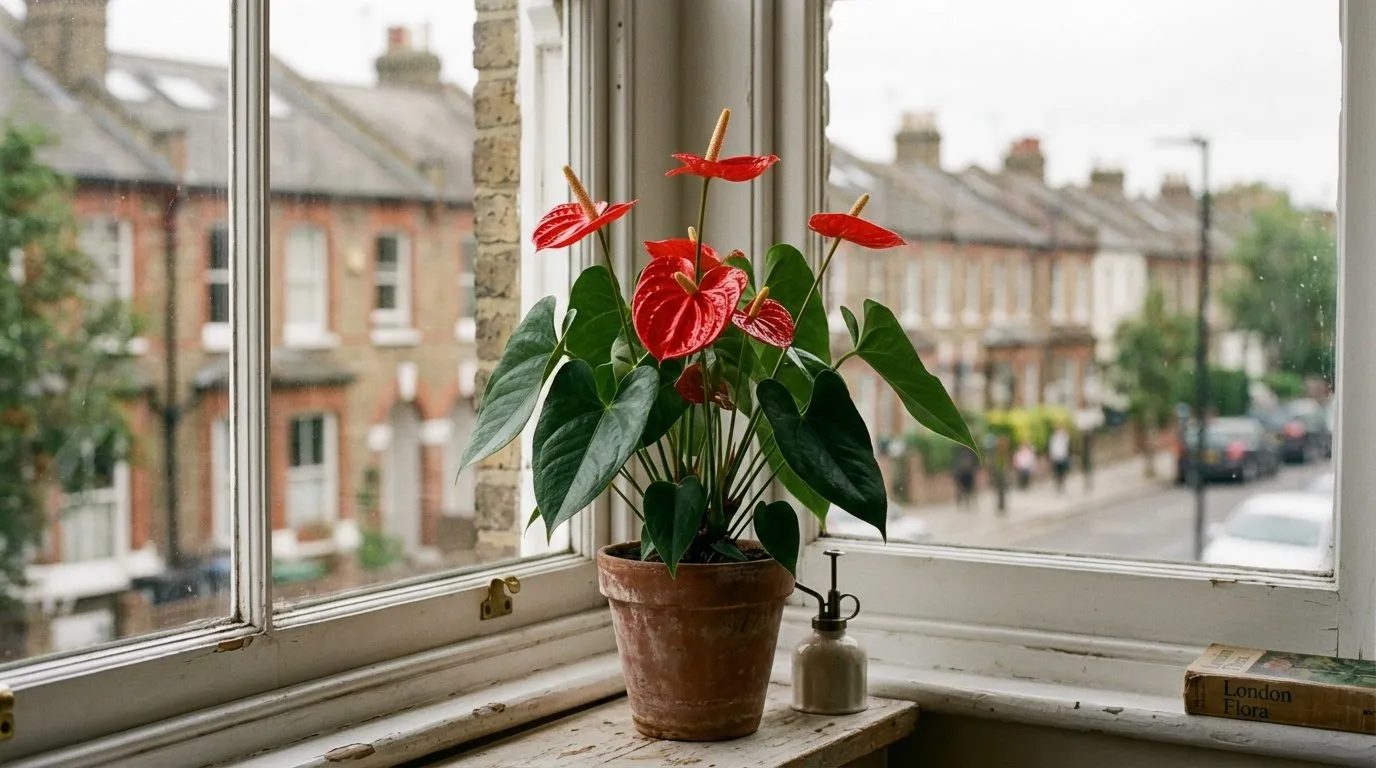 A flamingo flower earning its keep on a London windowsill. Each red spathe will hold its colour for six to eight weeks.
Where should an anthurium go in a UK home?
An east or west windowsill is the best spot in almost every UK home. Anthuriums want bright light with no midday sun. An east window gives gentle morning sun that does no harm. A west window gives late sun that is usually fine outside high summer. A south window works only if the plant sits 1-2 metres back from the glass or behind a net curtain, because direct summer sun bleaches and scorches the leaves.
North-facing rooms are the common failure. The plant survives there for years, but it will barely flower. If a dim room is all you have, pick something from our guide to the best low-light houseplants instead and give the anthurium the brighter sill.
Temperature is simple: 18-25C suits it, and 15C is the floor. The traps are elsewhere. Avoid sills trapped behind curtains on winter nights, where air against the glass can drop below 10C. Avoid spots within about 50cm of a radiator, which cook the leaf tips brown. And avoid draughty hallways, because cold moving air marks the foliage faster than still cold air does.
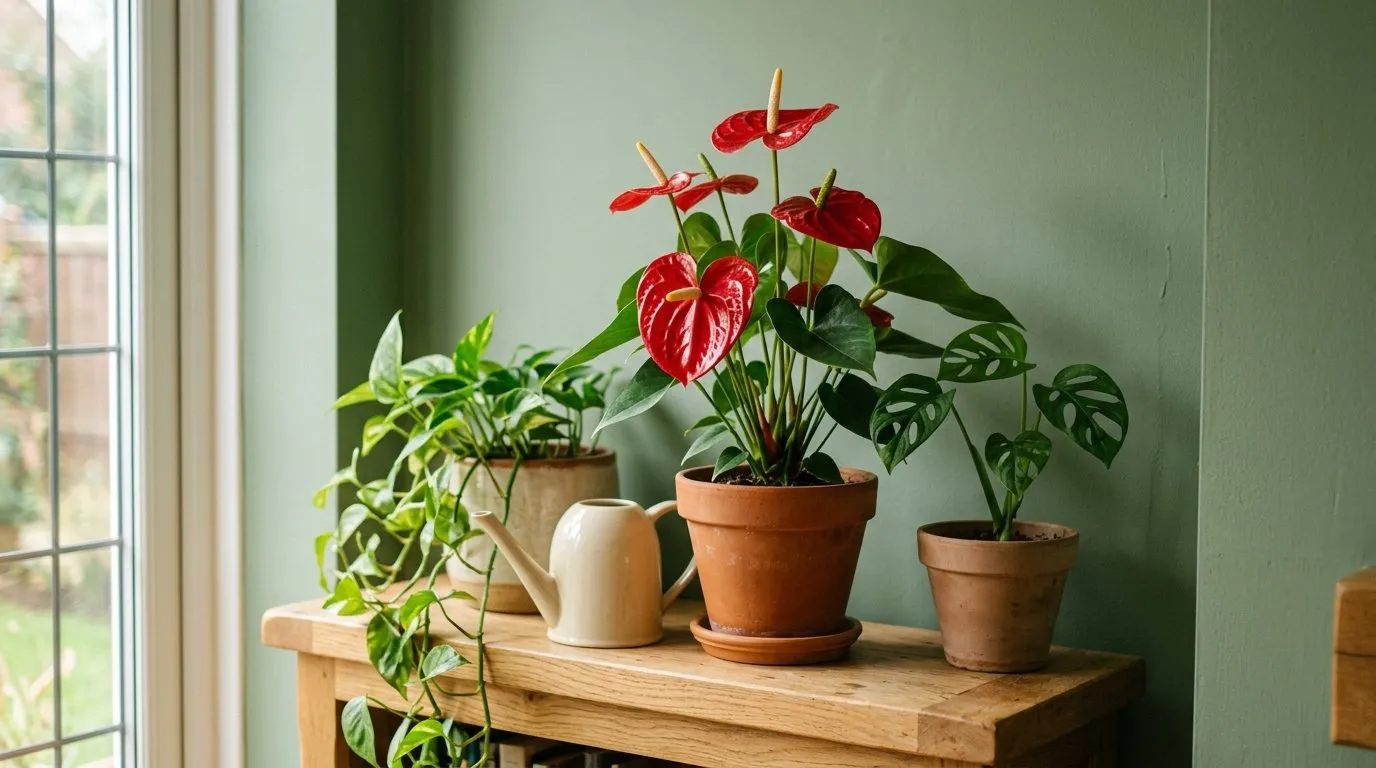 Grouped on a bright shelf out of direct sun. Company raises the humidity around the leaves by a few useful percent.
Why has my anthurium stopped flowering?
Light is the answer in at least eight cases out of ten. An anthurium that produces healthy leaves but no spathes is getting enough light to live and not enough to bloom. The fix costs nothing: move it to an east or west windowsill and wait. New buds usually show within 8-12 weeks of the move.
Before you blame anything else, rule out the normal rest. If the plant flowered well and stopped six weeks ago, it is probably just between flushes. Three months without a bloom after a good flush is not a fault.
If light and patience do not fix it, work down the short list. Feed: give half-strength orchid fertiliser fortnightly from March to September; our houseplant feeding guide explains why weak and regular beats strong and rare. Roots: a plant in the same pot for four years or more may be exhausted rather than snug. Temperature: rooms that fall below 15C at night in winter push the plant into survival mode, and flowering is the first thing it drops.
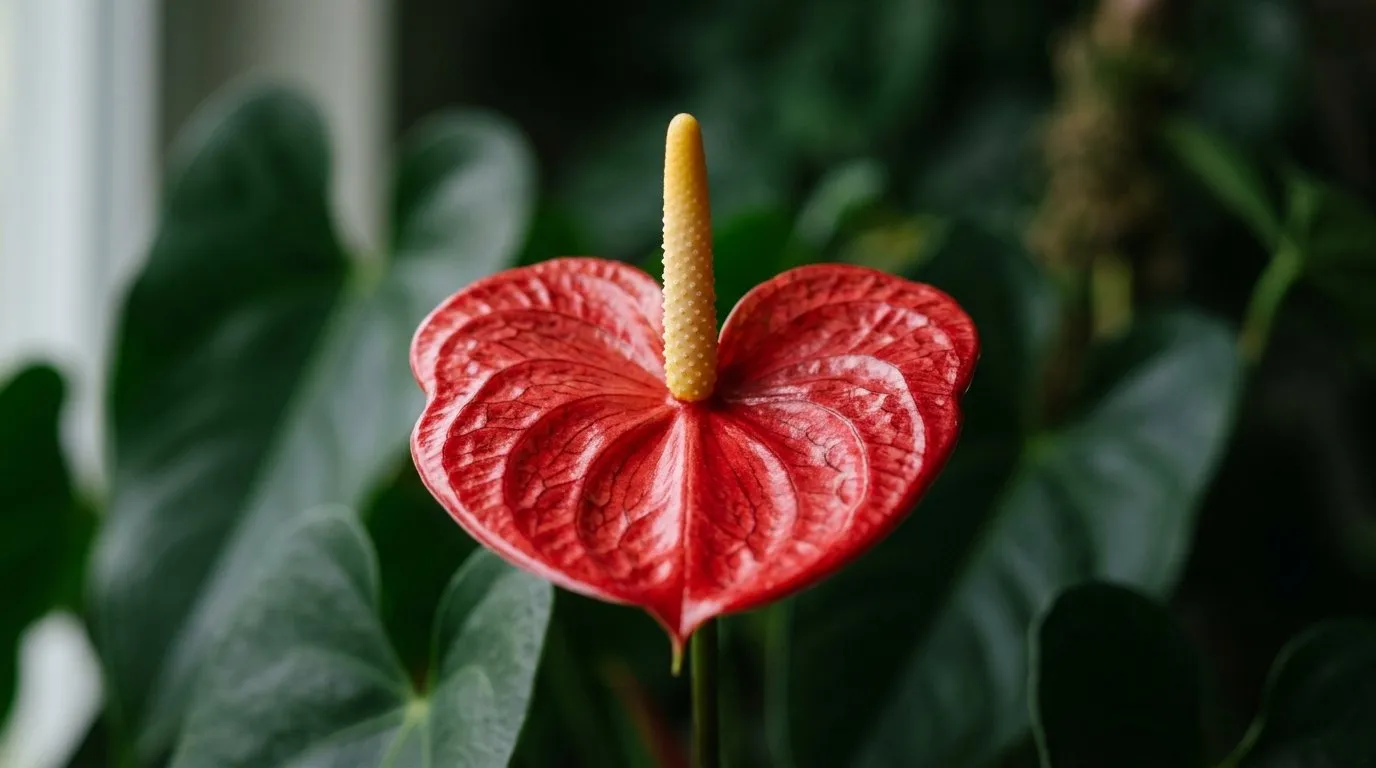 The spadix carries the true flowers. The red spathe behind it is leaf tissue, which is why it lasts so long.
Why are the flowers turning green?
A green spathe means one of two things: the bloom is old, or the plant is short of light.
An ageing bloom opened in full colour and has been on the plant for six weeks or more. Fading to green, then papery brown, is its natural exit. Cut the whole stem off at the base with clean snips. The plant wastes energy maintaining old spathes, and removing them nudges the next flush along.
New blooms opening green or pale are a light complaint. The plant cannot fund proper pigment production in a dim corner, so it turns out washed-out spathes. Some shop plants also arrive with green-tinged blooms because they were forced into flower early at the nursery; those never colour up, but the next home-grown flush will if the light is right.
| Symptom | Cause | Fix |
|---|---|---|
| Old red spathe slowly turning green | Natural ageing after 6-8 weeks | Cut the stem at the base |
| New spathes open green or pale | Too little light | Move to an east or west window |
| Green-edged blooms on a new shop plant | Forced flowering at the nursery | Wait for the next flush in better light |
| Spathes bleached with crispy patches | Direct summer sun | Pull back 1-2m from a south window |
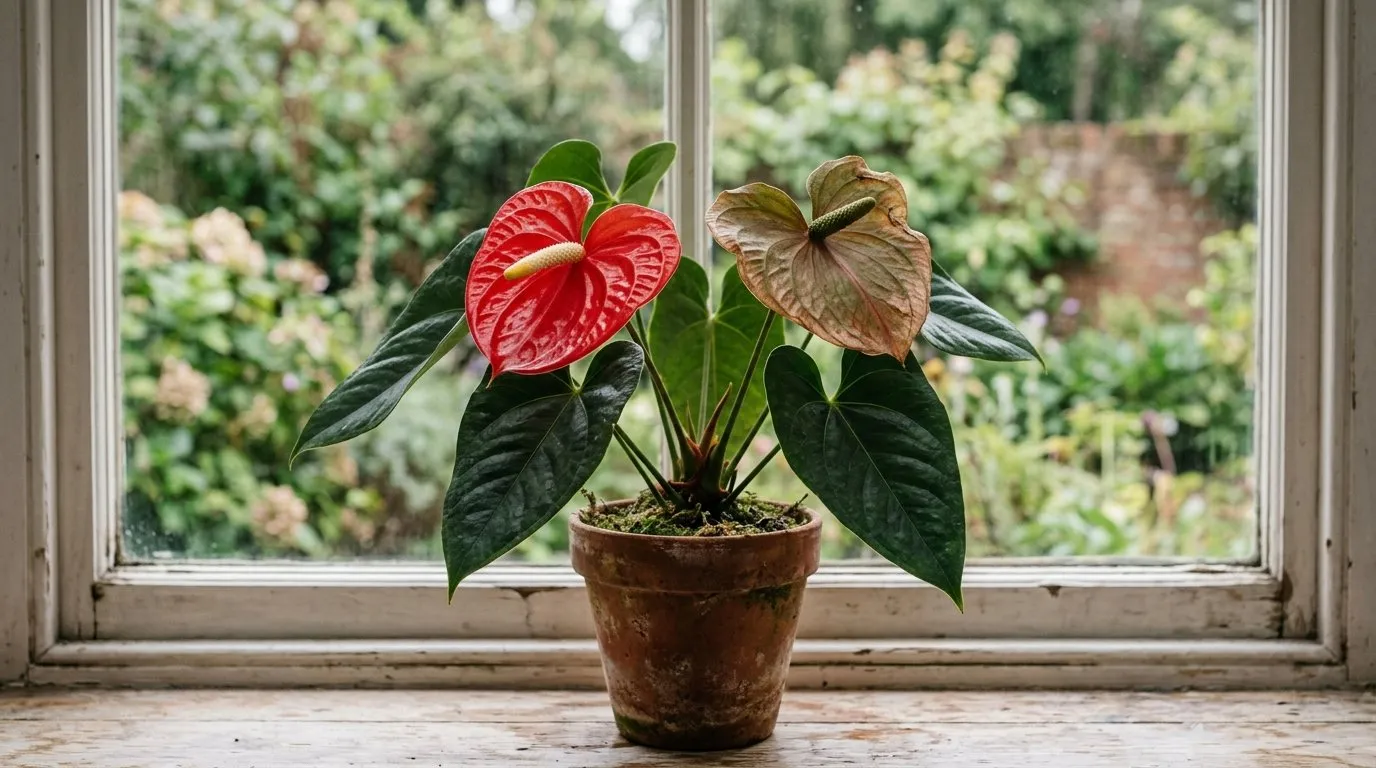 Old and new on one plant. The green-washed spathe is eight weeks old and ready to be cut away.
How often should you water an anthurium?
Water by weight, not by the calendar. Those thick white roots evolved to grip tree bark in a rainforest, soaking up storms and then drying in the air. Sit them in permanently wet compost and they rot, and root rot kills more anthuriums in the UK than everything else combined.
Lift the pot. A freshly watered 14cm pot feels heavy, like a full mug; a dry one feels almost empty. Water only when it feels light, which in practice means every 7-10 days in summer and every 10-14 days or longer in winter. Water thoroughly at the sink with tepid water, let it drain for ten minutes, and never leave the pot standing in a full saucer.
Get this wrong in the wet direction and the plant tells you: yellowing lower leaves, a sour smell from the compost, and brown mushy roots when you slide the rootball out. Err on the dry side. A thirsty anthurium droops slightly and recovers within hours of a drink. A drowned one rarely comes back.
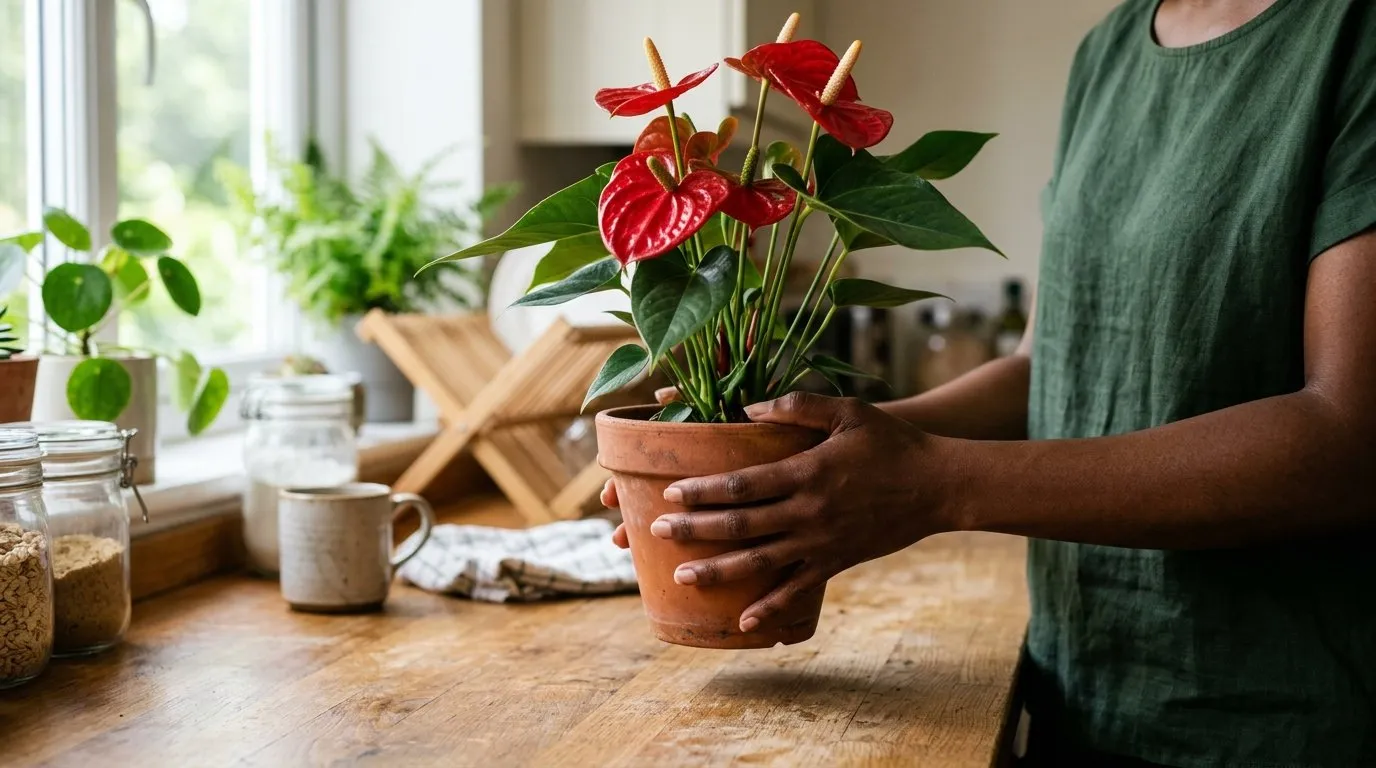 The lift test. A light pot gets watered, a heavy one goes back on the sill, and root rot never gets a look in.
Do you need to mist it? Humidity in UK homes
No, and this is where anthuriums are kinder than their reputation. They are content at 40-50% relative humidity, which is what most UK living rooms sit at for much of the year. A plant that genuinely needs 70% is a different beast; a standard flamingo flower is not one.
The exception is winter, when central heating drags rooms down towards 30-35%. That is when brown, crispy leaf tips appear, almost always on plants sitting near a radiator. The fix is position first: move the plant 1-2 metres from the heat source. Then raise the local humidity cheaply. Stand the pot on a tray of damp gravel, group it with other plants, or give it a bright bathroom or kitchen where steam does the work free.
Misting lifts humidity for about twenty minutes and marks glossy leaves with limescale spots in hard-water areas. A £10 humidity gauge tells you more than a mister ever will. If the dial reads above 40%, the browning tips are a heat problem, not a moisture one.
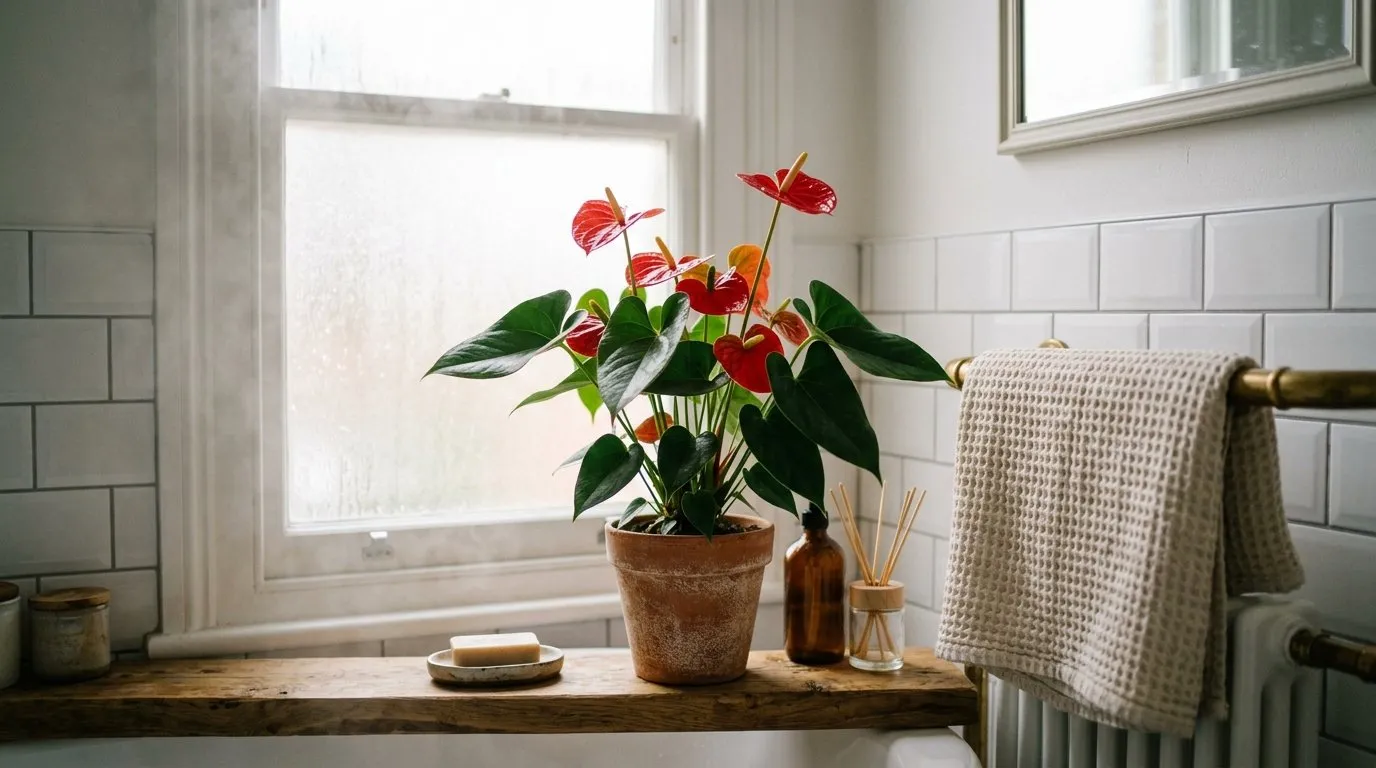 A bright bathroom is the easiest humid spot in a British house. Steam from two showers a day beats any misting bottle.
When should you repot an anthurium?
Repot every 2-3 years in spring, and only go up 2cm in pot diameter each time. A supermarket plant in a 12cm pot moves to a 14cm, nothing bigger. Anthuriums flower best slightly snug, and a small rootball swimming in a big pot of wet compost is a rot sentence. If yours has gone well past snug, with roots circling the base and water running straight through, our root-bound houseplants guide shows how to loosen it safely.
The mix matters more than the pot. Ordinary multipurpose compost suffocates epiphyte roots. The RHS recipe works: 2 parts peat-free ericaceous compost, 1 part orchid bark, 1 part perlite. A 10-litre bag of orchid bark costs £6-9 and a 3-litre bag of perlite £4-6, and one purchase of each repots every aroid in the house for years. The general technique is the same as for any houseplant, covered step by step in our repotting guide, with one anthurium-specific note: leave any aerial roots above the surface alone. They are normal, and burying them invites rot.
Wear gloves. The sap contains the same irritant crystals that make the plant a pet risk, and it can leave itchy patches on bare skin.
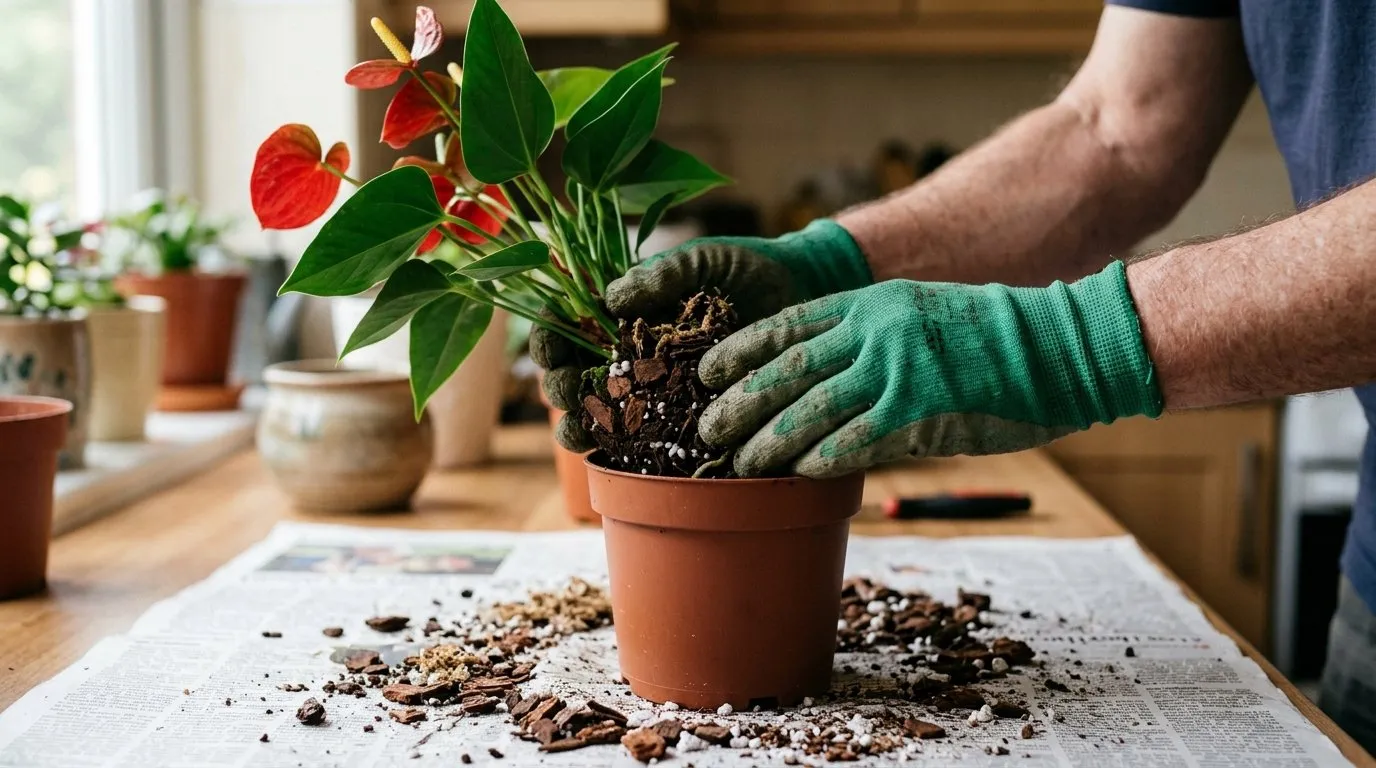 Into the chunky stuff. Bark and perlite keep air around roots that evolved gripping rainforest branches, not sitting in soil.
Is it safe around cats and dogs?
No. Every part of an anthurium contains insoluble calcium oxalate crystals, microscopic needles that fire into the soft tissue of any mouth that chews it. The result is immediate burning pain, drooling, pawing at the mouth, and sometimes vomiting. Cats Protection lists anthurium among the plants to keep away from cats, and the same caution applies to dogs.
The mercy is that the pain is instant, so most animals stop at the first bite and serious poisoning is rare. Even so, treat it as a shelf plant in a pet household: a high bookcase or a hanging position, not a coffee table. Symptoms usually settle within a few hours, but call the vet if drooling or vomiting persists. Our guide to plants toxic to cats covers the wider list, including several houseplants far more dangerous than this one.
If you want a long-flowering plant that is genuinely pet-safe, buy a moth orchid. It is the only one of the big three that a cat can chew without consequence, as the comparison below shows.
Which anthurium should you buy, and what should it cost?
Prices run from £8-12 for a supermarket plant in a 12cm pot to £25-40 for a mature specimen in a 17cm pot from a garden centre or online nursery. The supermarket plants are fine. They are the same Dutch-grown stock, just younger, and a £9 plant reaches specimen size in two to three years of ordinary care.
Colour is the fun part, because breeding has pushed well beyond red. ‘Red Champion’ is the classic scarlet workhorse. ‘White Champion’ gives clean white spathes, ‘Pink Champion’ a strong sugar-pink. ‘Chocolate’ and similar dark cultivars open deep maroon-black, striking against the pale spadix. ‘Livium’ and ‘Zizou’ bring narrow lilac spathes on a smaller plant, usually 30-40cm tall against the standard 45-60cm.
Foliage collectors should look at Anthurium clarinervium, grown not for spathes but for velvet, heart-shaped leaves veined in silver-white. Expect to pay £15-30 for a young plant. It takes identical care to the flowering types, just with even more insistence on the chunky bark mix.
Anthurium vs peace lily vs moth orchid
These are the three long-flowering houseplants people actually choose between, and they suit different homes.
| Anthurium | Peace lily | Moth orchid | |
|---|---|---|---|
| Bloom duration | 6-8 weeks per spathe, 2-3 flushes a year | 4-6 weeks per spathe, spring flush | 2-4 months per spike, often twice a year |
| Care difficulty | Easy once watering is right | Easiest of the three | Moderate, different watering logic |
| Light needed | Bright indirect, east or west sill | Tolerates real shade | Bright indirect, no midday sun |
| Safe with pets | No, calcium oxalate | No, calcium oxalate | Yes, non-toxic |
| Typical price | £8-40 | £6-25 | £10-30 |
The peace lily wins in a shady flat and forgives neglect better. The moth orchid holds individual blooms longest and is the pet-safe pick. The anthurium sits between them: more colour range than either, glossier foliage, and the most reliable repeat flowering in a genuinely bright room.
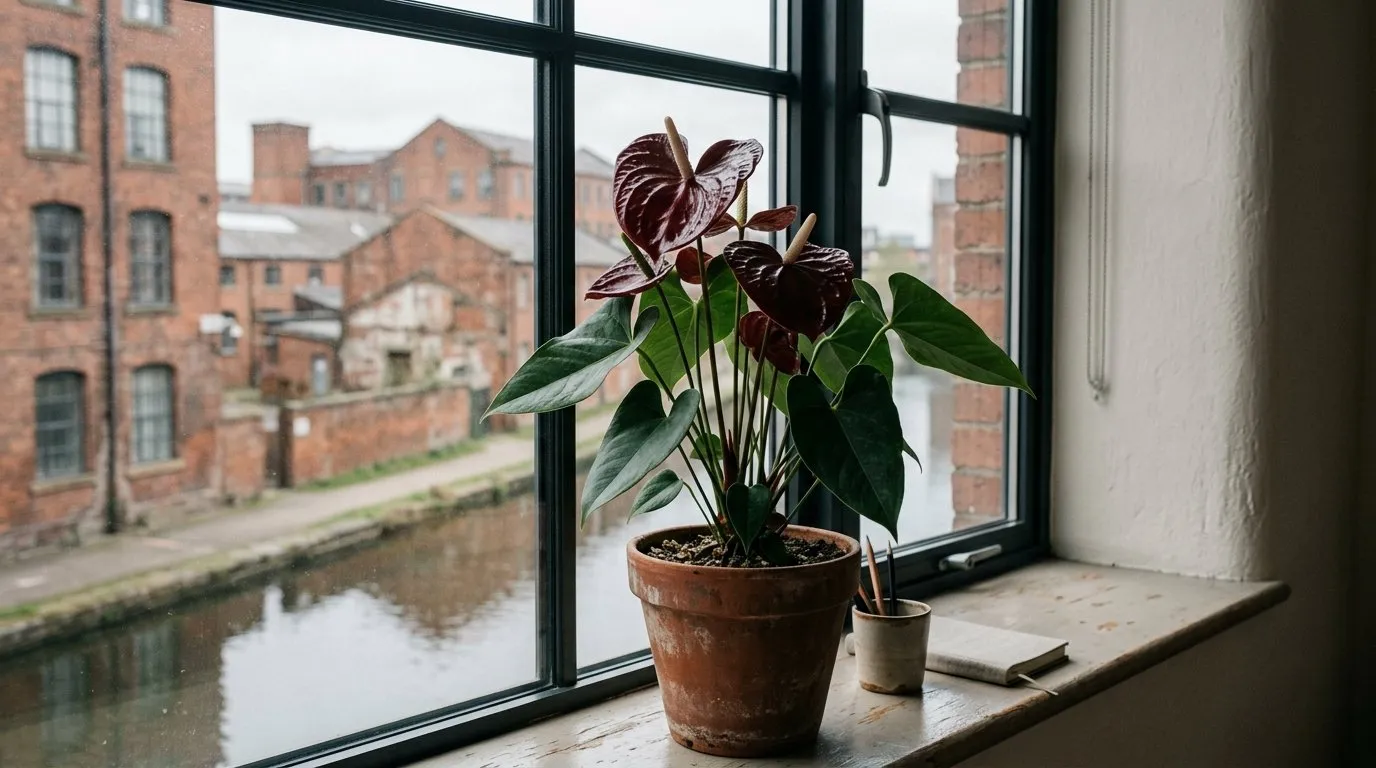 A dark-flowered plant in a Manchester canal-side flat. Modern apartments, warm and bright, suit anthuriums perfectly.
Frequently asked questions
How long do anthurium flowers last?
Each anthurium bloom lasts six to eight weeks on the plant. That is longer than almost any other flowering houseplant. The plant then rests, sometimes for up to three months, before producing the next flush. Cut stems also last around three weeks in a vase, which is why florists use them.
Why is my anthurium not flowering?
Too little light causes most non-flowering anthuriums. A plant that only makes leaves is photosynthesising enough to survive but not enough to bloom. Move it to an east or west windowsill, feed fortnightly with half-strength orchid fertiliser from March to September, and be patient. New spathes usually follow within two to three months.
Why are my anthurium flowers turning green?
Either the bloom is ageing or the plant is short of light. A spathe that opened red and faded after six weeks or more is simply finishing; cut it off at the base. New spathes that open green or stay pale mean the plant needs a brighter position.
How often should I water an anthurium?
Water when the pot feels light, roughly every 7-10 days in summer. In winter that stretches to a fortnight or more. Anthuriums are epiphytes with thick roots that rot quickly in permanently wet compost. Lifting the pot before watering is more reliable than any fixed schedule.
Are anthuriums poisonous to cats and dogs?
Yes, every part contains insoluble calcium oxalate crystals. Chewing a leaf causes intense mouth pain, drooling, and sometimes vomiting, though serious poisoning is rare because the pain stops most pets quickly. Keep the plant on a high shelf out of reach, or choose a moth orchid instead.
Can anthuriums go outside in the UK in summer?
No, not reliably, and it is rarely worth the risk. UK summer nights regularly dip below the 15C floor that anthuriums need, and direct sun scorches the leaves. Unlike hardier houseplants, this one does best staying indoors on the same windowsill all year.
One plant, one bright windowsill, and a set of kitchen scales: that is genuinely most of it. Master the weight check and the flamingo flower will repay you with more weeks of colour per year than anything else in the house.
Our team produces practical UK gardening guidance from source research, contributor records and established horticultural practice. Editorial standards are overseen by Matt W.