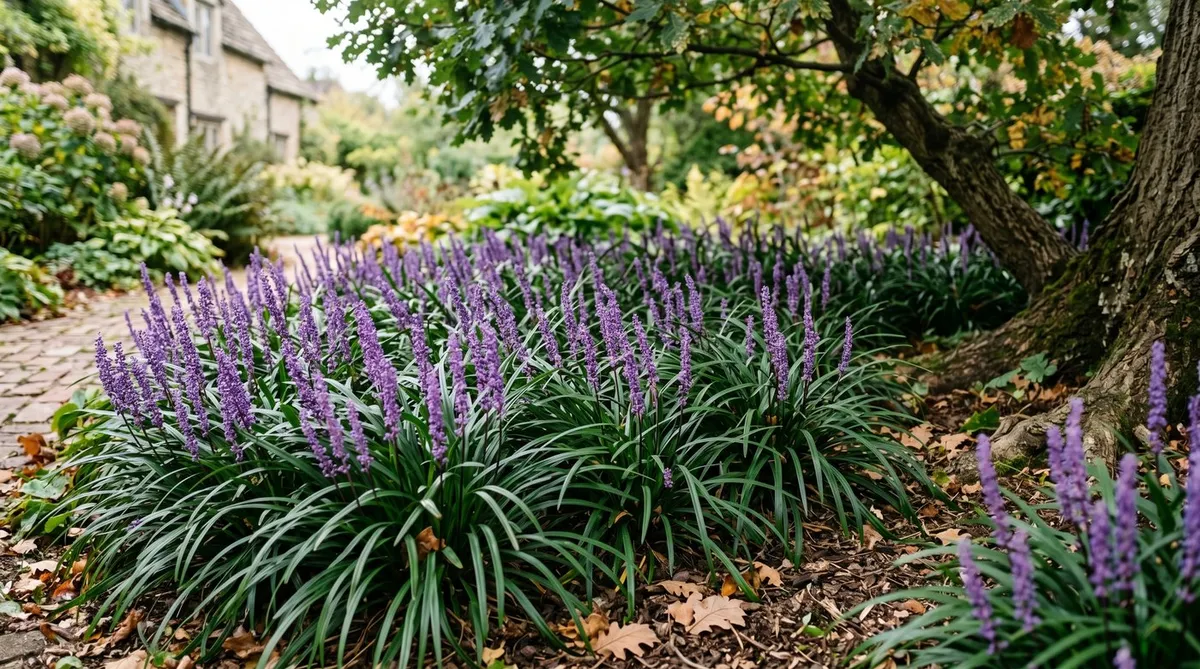
Key takeaways
- Liriope muscari grows 30-40cm tall and flowers violet from August to October, when little else blooms in shade
- Plant 4-5 plants per square metre, 30cm apart, for ground cover that knits together in three seasons
- Cut all old foliage to the ground once a year in late February, before new growth pushes up
- Buy clump-forming Liriope muscari, not running Liriope spicata, which spreads by runners and will not stay put
- Drought tolerant and slug resistant once established, surviving on dry soil under mature trees where grass fails
- Hardy to minus 15C and fully evergreen, holding glossy strappy leaves through every UK winter
Liriope is the toughest evergreen ground cover for dry shade in the UK garden. Known as lily turf, this clump-forming plant thrives in the difficult ground under mature trees and along shaded edges where grass thins out and most perennials give up. Its strappy, grass-like evergreen leaves hold colour all year. Then, from August to October, it throws up violet flower spikes just as the rest of the shade border fades. Black berries follow into winter. It asks for almost nothing: one cut a year, no staking, no spraying, and slugs leave it alone. This guide covers planting spacing for ground cover, the once-a-year chop, the slow establishment, and the one mistake that ruins it before you start.
For a technical reference on the species, the RHS profile of Liriope muscari confirms its hardiness rating and shade tolerance. This guide focuses on the practical decisions: which plant to buy, how to space it, and how to keep it looking sharp under trees.
Why liriope beats grass under trees
Dry shade under a mature tree is the hardest ground in any garden. The canopy steals the light. The roots steal the water. Grass goes thin and patchy, moss takes over, and bare soil washes away. Liriope muscari solves all three problems at once because it is built for exactly these conditions.
The leaves are evergreen and grass-like, so the area reads as a green carpet through every month of the year. The roots are fleshy and reach down past the surface zone where tree roots compete hardest. Once established, the plant draws water from deeper soil and shrugs off the dry spells that kill shallow-rooted ground covers.
Liriope is slower to establish than hardy geranium or Vinca minor, but its evergreen clumps tolerate root competition once settled. That long-term persistence matters more under mature trees than rapid first-season spread.
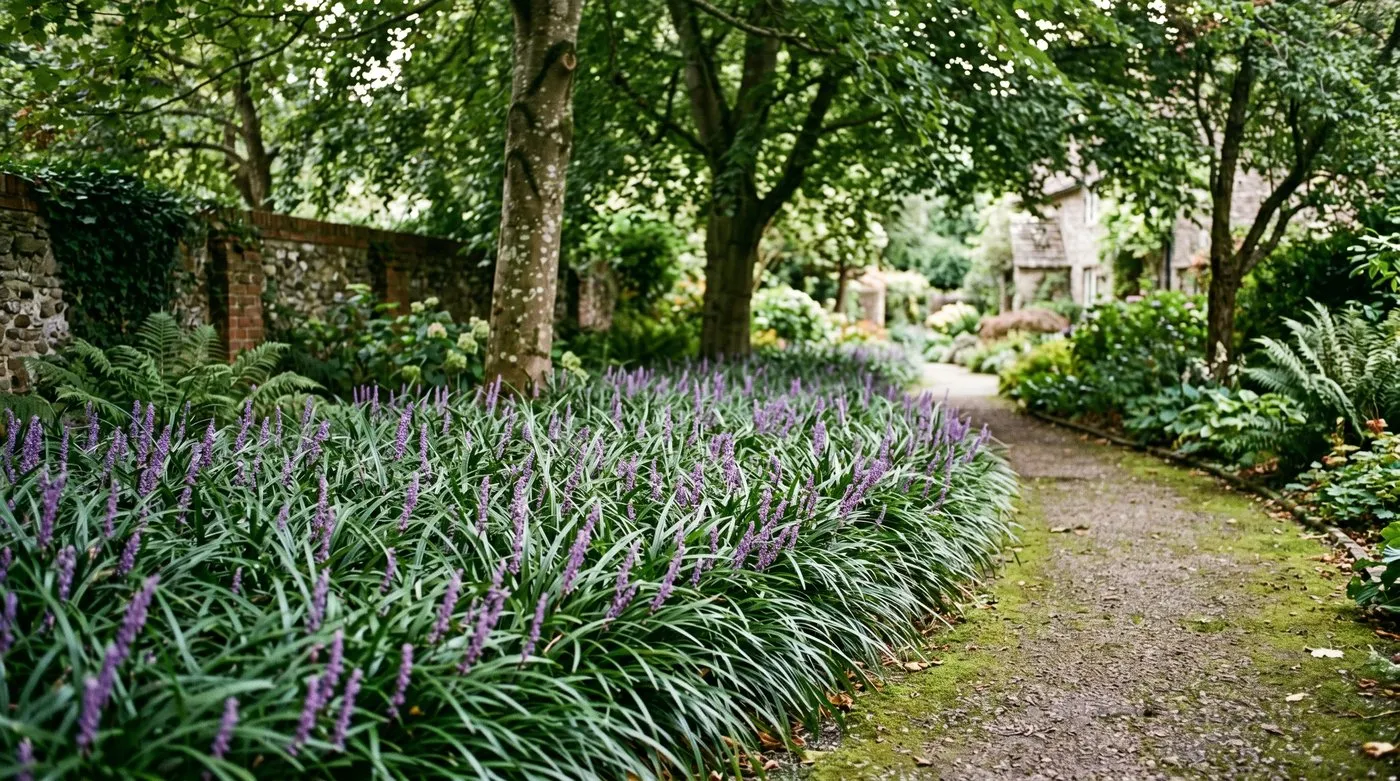 A continuous sweep of liriope under trees holds the ground where grass thins out and bare soil washes away.
Buy the clumping type, not the runner
This is the one mistake that ruins a liriope planting before it begins. There are two plants sold as liriope, and they behave in opposite ways. Get the wrong one and you spend years pulling it out of places it should not be.
Liriope muscari is the clump-forming species. It grows as a tidy, slowly expanding tussock and never runs. This is the plant you want for borders, edging, and ground cover. It stays where you put it.
Liriope spicata is the running species. It spreads by underground stems and forms a loose mat that creeps into lawns, paths, and neighbouring plants. It has its uses for fast erosion cover on a bank, but it is the wrong choice for any tidy planting.
A third lookalike, Ophiopogon planiscapus, the black mondo grass, is often confused with liriope. It is shorter, under 25cm, spreads by stolons, and is grown for its near-black leaves rather than its flowers. The table below sorts the three out before you buy.
| Plant | Habit | Height | Flowers | Evergreen | Dry-shade role |
|---|---|---|---|---|---|
| Liriope muscari | Clump-forming, stays put | 30-40cm | Violet spikes, Aug-Oct | Yes | Best border and edging ground cover |
| Liriope spicata | Running, spreads by stems | 20-30cm | Pale lilac, sparse | Yes | Fast bank cover only, can be a nuisance |
| Ophiopogon planiscapus | Spreading by stolons | Under 25cm | Pale, insignificant | Yes (black leaves) | Front-edge accent, not mass cover |
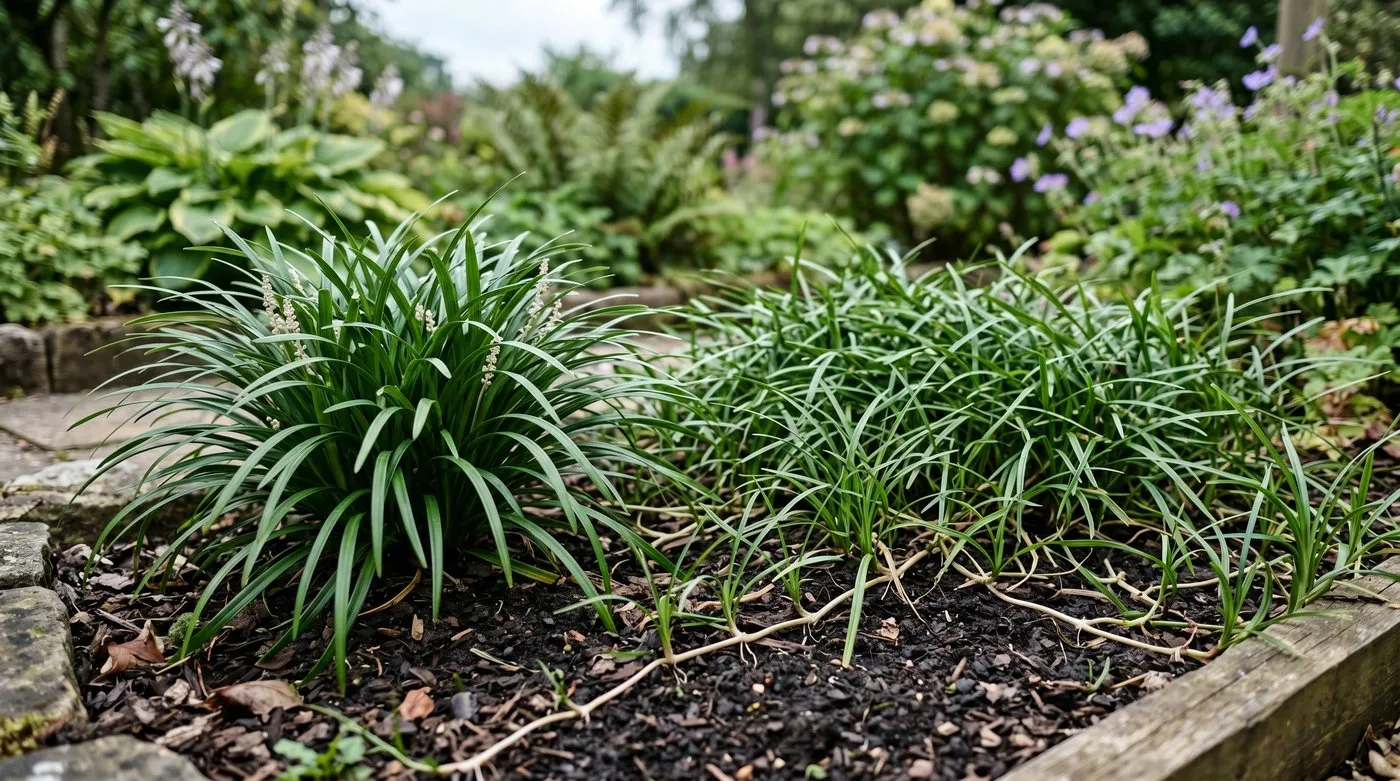 The clump-forming muscari on the left stays as a neat tussock; the running spicata on the right creeps outward by underground stems.
How to plant liriope for ground cover
Liriope succeeds or fails on spacing. Plant too far apart and you wait years for cover while weeds fill the gaps. Plant too close and you waste money. The right spacing balances cost against the time you are prepared to wait.
For ground cover, plant 30cm apart, which works out at 4-5 plants per square metre. At this density the clumps touch and knit into solid evergreen cover in about three growing seasons on decent soil. On dry, root-filled soil under a tree, expect closer to three and a half.
To cover faster, plant 25cm apart, roughly 6 plants per square metre, and the gaps close in two seasons. To save money where you can wait, plant 35cm apart and accept a fourth season before full cover. For a single edging row along a path, space plants 25-30cm apart in a straight line.
Dig each planting hole the width of the pot and the same depth. Sit the crown level with the soil surface, never buried. Firm in, water well, and mulch the whole area with 5cm of bark or leaf mould to lock in moisture while roots establish. Spring, from March to May, is the best planting window because the soil is warming and you get a full season of root growth before winter.
Gardener’s tip: Soak each pot in a bucket of water for ten minutes before planting. Dry-shade soil pulls moisture out of a fresh root ball within days, and a pre-soaked plant establishes far quicker than one dropped in dry.
 Spaced at 25-30cm in a single line, liriope makes a crisp evergreen ribbon to soften a path edge in deep shade.
The one job that matters: the late-winter chop
Liriope is close to no-maintenance, but it needs one job done well: the annual cut-back. The evergreen leaves look fresh through autumn and early winter, then go tatty and brown-tipped by February after months of frost and wet. Left alone, that tired old foliage hides the new spring growth and the planting looks scruffy all summer.
Cut all the old foliage to within 3-5cm of the ground in late February, just before new leaves push up. Use hand shears for a small group or a strimmer with a blade for a large sweep. Time it right and you cut clean stubble before any new growth shows. Leave it too late and you slice the tips off fresh shoots, which then carry brown ends all season.
The cut removes weather-damaged foliage before fresh leaves appear. It also opens the crown to light and air, so time it before new shoots emerge rather than cutting through tender growth later in spring.
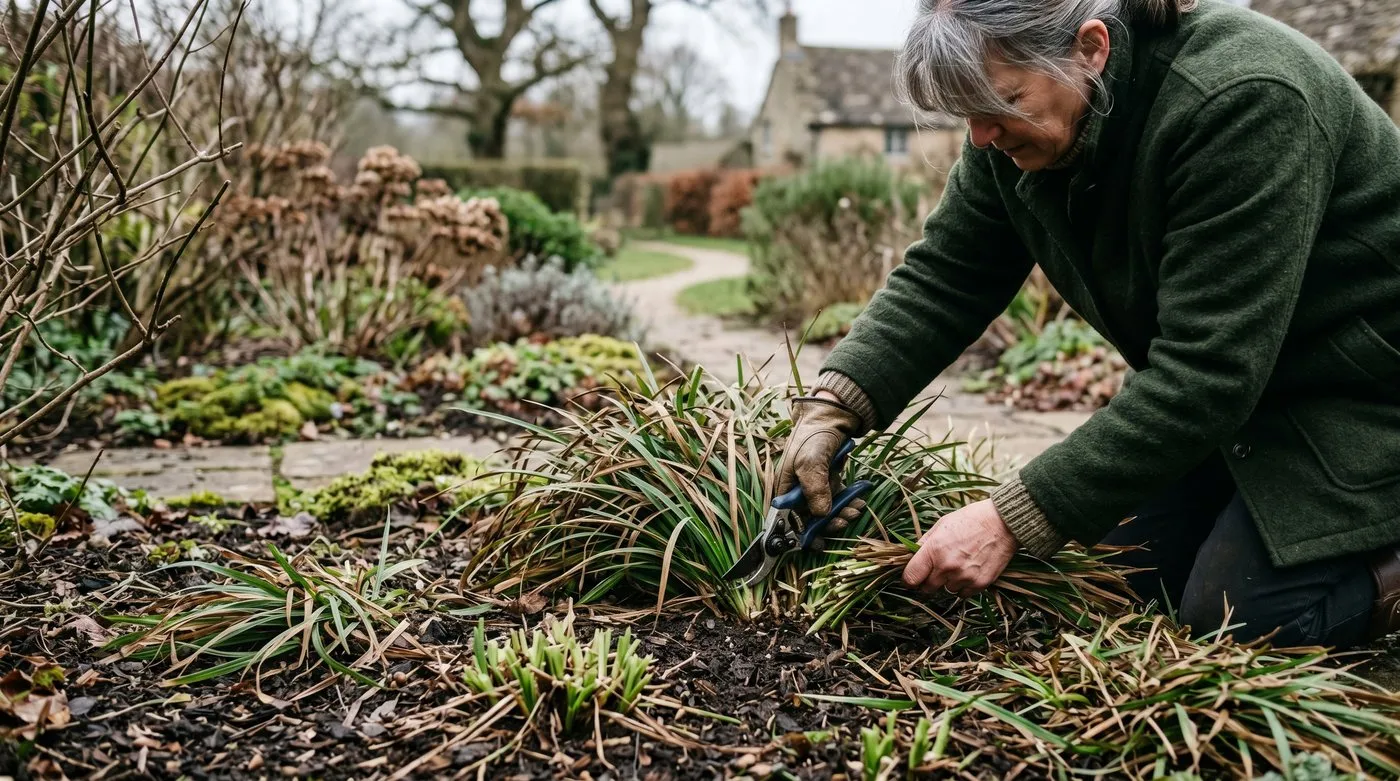 The one job that matters: shear all old foliage to a few centimetres in late February, before new shoots appear.
Watering, feeding, and the slow start
The hardest part of growing liriope is patience. It is slow to establish, especially on dry soil under trees, and a young plant can sit and sulk for a season before it gets going. This is normal. The plant is putting energy into roots, not leaves, and the visible growth comes later.
Through the first two summers, water every 7-10 days in dry spells, more in a heatwave. Tree roots will rob a young liriope of moisture, so it needs help until its own roots reach deep enough. After the second summer it is largely self-sufficient and drought tolerant, surviving long dry spells with no watering at all.
Feeding is light work. A handful of general fertiliser such as blood, fish and bone in March is plenty. An annual spring mulch of leaf mould or bark feeds the soil and holds moisture in one job. Avoid high-nitrogen feeds, which push soft leafy growth at the expense of flowers and frost hardiness.
Liriope is slug and snail resistant. The tough, fibrous leaves do not appeal to them the way hosta leaves do, so you can plant it on slug-heavy clay and forget about pellets, beer traps, and nightly patrols. For a slug-proof shade planting, this alone makes it worth the wait.
Dividing liriope to make more plants
Liriope clumps thicken steadily and benefit from division every four to five years. Division keeps the centre of old clumps vigorous and gives you free plants to extend the cover or fill gaps elsewhere.
Lift a clump in early spring, March or April, just as growth resumes. Use a spade or two forks back to back to split the clump into sections, each with several growing points and a good chunk of root. Discard any dead, woody centre. Replant the divisions at the usual 30cm spacing, water in, and mulch.
A single mature clump split this way gives four to eight new plants. Divided sections re-establish faster than fresh nursery pots because they already carry a deep, drought-ready root system. This is the cheapest way to cover a large area: buy a dozen plants, grow them on for three years, then divide them across the whole bed.
Warning: The black berries that follow the flowers contain saponins and are mildly toxic if eaten in quantity. They are not a serious hazard, but keep that in mind in a garden used by very young children, and do not let anyone mistake them for edible fruit.
Where to use liriope in the garden
Liriope earns its place anywhere shade and dryness defeat softer plants. Its strongest use is mass ground cover under mature trees and large shrubs, where the evergreen carpet holds the soil and the autumn flowers lift a dull corner. Plant in drifts of nine or more for a natural, knitted look.
As path and border edging it makes a crisp evergreen ribbon. A single row softens the hard line of paving and stays neat all year with just the one cut. It suits formal and informal schemes alike, and copes with the dry, compacted soil along a path edge.
It also works in shaded containers and on north-facing aspects where colour is hard to find. Pair it with ferns, epimedium, and hardy geraniums for a layered shade planting, or run it as a uniform underplanting beneath taller shrubs. Other tough shade fillers worth combining with liriope appear in our guide to ground cover lawn alternatives, which ranks plants for difficult sites.
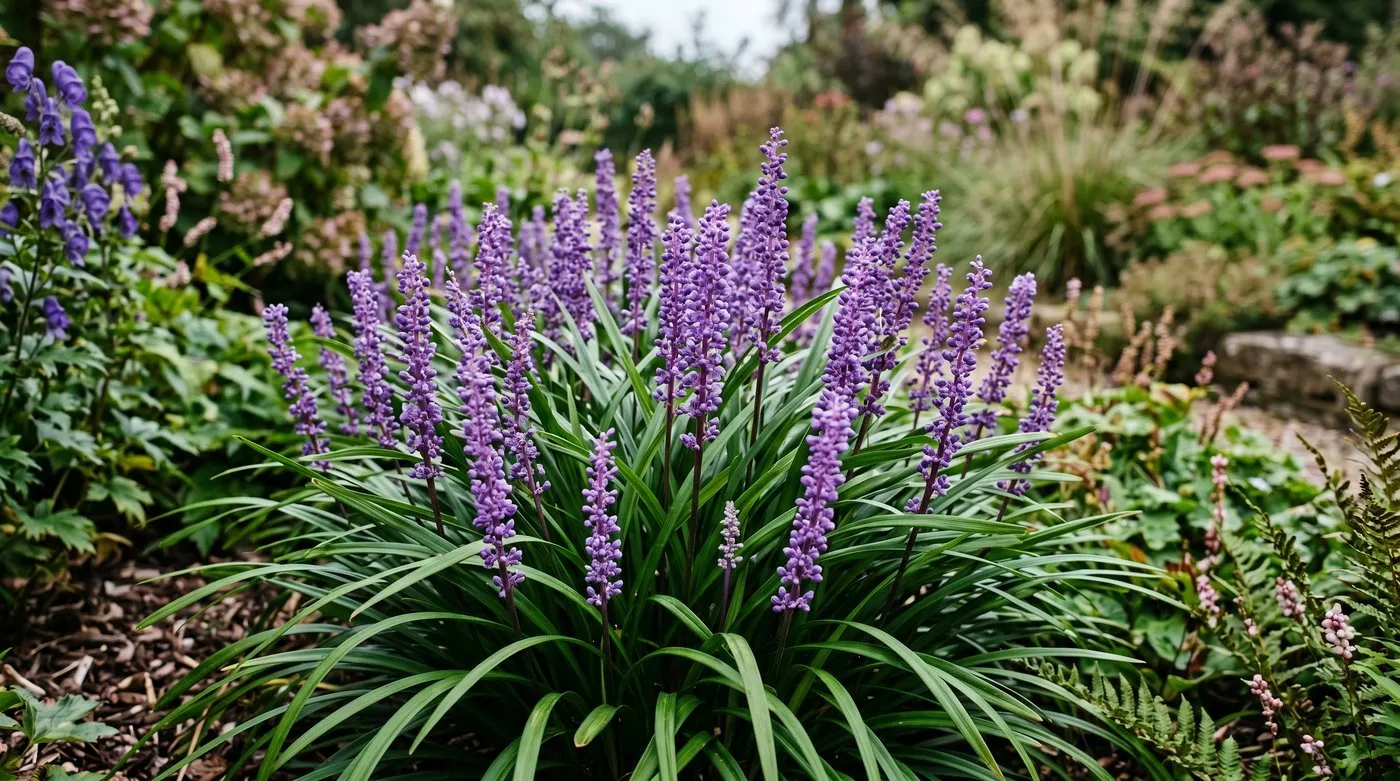 From August to October the violet spikes rise straight out of the evergreen carpet, just as the rest of the shade border fades.
Month-by-month liriope care calendar
| Month | What to do |
|---|---|
| January | Leave clumps standing. Evergreen leaves still protect the crown from frost. No watering needed. |
| February | Shear all old foliage to 3-5cm before new growth starts. This is the key annual job. |
| March | New leaves push up. Apply a handful of blood, fish and bone. Best month to divide old clumps. |
| April | Plant new liriope and replant divisions. Mulch beds with 5cm of leaf mould or bark. |
| May | Steady leaf growth. Water new plants weekly if the soil is dry under trees. |
| June | Keep first and second-year plants watered every 7-10 days in dry spells. Established clumps cope alone. |
| July | Flower spikes begin forming inside the clumps. Continue watering young plants only. |
| August | Violet flower spikes open. Peak display begins. No feeding or cutting now. |
| September | Full flowering continues. Enjoy the colour while the rest of the shade border fades. |
| October | Last flowers fade and black berries set. Foliage still glossy and fresh. |
| November | Berries colour up black. Clear fallen tree leaves off the clumps so they do not smother. |
| December | Nothing to do. The evergreen cover carries the winter garden through to February. |
Common mistakes when growing liriope
Most liriope failures trace back to a handful of avoidable errors. Get these right and the plant looks after itself for years.
Buying the running species by accident. Liriope spicata creeps everywhere and looks nothing like the tidy clump you wanted. Always read the label and buy Liriope muscari for borders and edging. The two are sold side by side and the names are nearly identical.
Expecting fast cover. Liriope is slow for the first two seasons, and gardeners often assume it has failed and rip it out. It has not failed; it is rooting. Give it three seasons before judging the cover.
Skipping the late-winter cut. Leave the old foliage on and the planting looks tired all summer and flowers poorly. The February shear is the single most useful job, and missing it halves the autumn display.
Letting young plants dry out. Under trees, a first-year liriope dries out fast as tree roots take the water. Skipping summer watering in those first two years is the commonest cause of slow establishment or loss.
Planting too deep. Burying the crown rots it. Set the crown level with the soil surface, exactly as it sat in the pot, and firm gently.
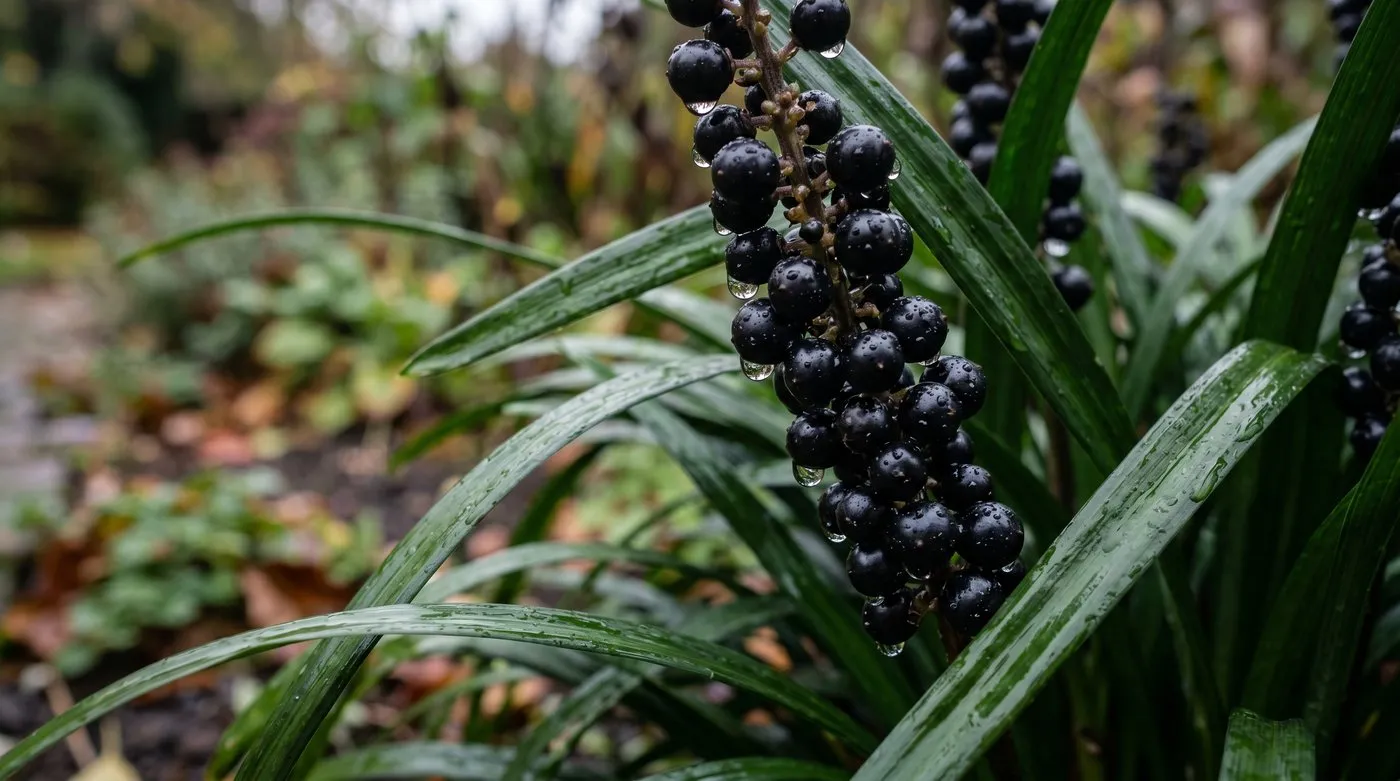 Black berries follow the violet flowers and hold on into winter, extending interest after most shade plants have finished.
Liriope compared to other dry-shade ground covers
Liriope is not the only plant for dry shade, but it scores well across the qualities that matter under trees. The table ranks the common options by their dry-shade tolerance and what each one brings.
| Ground cover | Evergreen | Flowers | Spread habit | Dry-shade tolerance | Role |
|---|---|---|---|---|---|
| Liriope muscari | Yes | Violet, Aug-Oct | Clump, stays put | Excellent once established | Primary evergreen cover and edging |
| Vinca minor | Yes | Blue, spring | Running, can swamp | Good | Fast cover, needs containing |
| Epimedium | Semi | Yellow/pink, spring | Slow clump | Very good | Refined cover, slower to spread |
| Hardy geranium | No | Pink/blue, summer | Spreading clump | Moderate | Summer colour, dies back in winter |
| Bergenia | Yes | Pink, spring | Slow clump | Good | Bold leaves, coarser texture |
| Pachysandra | Yes | White, spring | Running mat | Good | Uniform cover, no flower interest |
Liriope wins on the combination of evergreen leaf, autumn flower, tidy habit, and slug resistance. Vinca covers faster but runs hard and needs cutting back. Epimedium is the closest rival for a refined look. For a wider comparison of shade-tolerant plants, our guides to growing hostas and growing heuchera cover two more options for layering under liriope.
Why choose Liriope muscari for dry shade? It combines evergreen foliage, a clump-forming habit and late flowers without running into neighbouring plants. Allow time for establishment, water during the first two summers and cut old leaves before spring growth starts.
Bringing liriope into a wider shade scheme
Liriope rarely stands alone. It works best as the evergreen base layer of a shade planting, with taller and seasonal plants woven through it. The strappy texture contrasts well with broad leaves and feathery foliage, so it earns its keep visually as well as practically.
For texture contrast, plant liriope through a drift of ornamental grasses, letting the fine grass plumes rise above the solid green carpet. For early-season colour before the liriope flowers, work in spring bulbs and shade shrubs such as camellias at the back of the border. Autumn-flowering nerines extend the late display alongside the violet liriope spikes.
On the heavy, root-filled soil where liriope does its best work, improving the ground before planting pays off for years. Our guide to improving clay soil shows how to open up compacted dry-shade soil so young roots get away faster. For more plant choices that suit these tough sites, browse the full plants section.
Now you’ve learned to grow liriope for dry shade, read our guide on the best plants for clay soil to fill the rest of those difficult, root-filled beds under trees.
Frequently asked questions about growing liriope
Does liriope grow in dry shade?
Yes, liriope is one of the best evergreen ground covers for dry shade. It survives under mature trees where grass and most perennials fail. Establishment is slow on dry soil, so water through the first two summers. Once the roots reach down it copes with drought and root competition without help.
How far apart should I plant liriope for ground cover?
Plant liriope 30cm apart, which is 4-5 plants per square metre. At this spacing the clumps knit into solid cover in about three growing seasons. Plant closer at 25cm for faster cover, or wider at 35cm to save on plants if you can wait an extra season.
When do you cut back liriope?
Cut liriope back once a year in late February. Shear all the old foliage to within a few centimetres of the ground before new leaves push up. Old leaves look tired by late winter and hide the fresh growth. Miss the window and you have to trim around new shoots by hand.
Is liriope invasive in the UK?
Liriope muscari is clump-forming and not invasive. It stays as a tidy expanding clump and never runs. Liriope spicata is the running species that spreads by underground stems and can become a nuisance. Always check the label and buy muscari for borders and edging.
What is the difference between liriope and ophiopogon?
Liriope is taller with violet spikes; ophiopogon is shorter, often black-leaved, and spreads. Liriope muscari makes neat 30-40cm clumps with upright violet flowers. Ophiopogon planiscapus, the black grass, runs by stolons and stays under 25cm. They look similar but behave differently in a border.
Does liriope flower in shade?
Yes, liriope flowers well in partial and full shade. It is one of few plants that flowers freely under trees, sending up violet spikes from August to October. Flowering is heaviest in dappled or part shade. In dense permanent shade it still flowers, though spike counts drop a little.
Is liriope evergreen in the UK?
Yes, Liriope muscari is fully evergreen across the UK. It holds its glossy strappy leaves through winter down to minus 15C. Foliage can scorch at the tips after a hard frost, but the plant is not deciduous. The annual late-February cut refreshes any winter-worn leaves.
Do slugs eat liriope?
No, slugs and snails rarely touch liriope. The tough, grass-like leaves are unappealing to them, unlike hostas. This makes liriope a reliable shade ground cover where slug pressure ruins softer-leaved plants. It is one of the few shade fillers you can plant and forget on slug-heavy clay.
Our team produces practical UK gardening guidance from source research, contributor records and established horticultural practice. Editorial standards are overseen by Matt W.