Key takeaways
- Nigella is among the top 3 easiest hardy annuals to grow from seed, with 80-90% germination on direct-sown fresh seed
- One sowing creates a permanent colony - self-seeds freely and returns every year without further effort for 5+ years
- Autumn-sown plants flower 4-6 weeks earlier than spring-sown ones, starting in late May instead of early July
- Ornamental seed pods are one of the most valuable winter dried arrangement materials, staying attractive for 18 months
- Miss Jekyll is the original blue variety bred in 1890 and still the best-performing cottage garden nigella for UK conditions
- Nigella sativa (black cumin) is a different species grown for culinary seeds and should not be confused with ornamental types
Nigella is the easiest cottage garden flower you will ever grow. Scatter seed on prepared soil in March, rake it in, water once, and wait. Within 10 days green seedlings appear. By June the fern-like foliage is topped with blue, pink, white, or mulberry flowers that look like a jewel floating on green mist. This is how the common name love-in-a-mist came about.
This guide covers the best varieties for UK gardens, the autumn versus spring sowing choice that affects when flowers appear, the ornamental seed pods that make nigella one of the top winter dried arrangement plants, and the companion planting that shows nigella at its best.
What is nigella and where does it come from?
Nigella damascena is a hardy annual in the buttercup family native to southern Europe and North Africa. The common name love-in-a-mist refers to the fine thread-like bracts surrounding each flower, creating a misty green halo. Other common names include devil-in-a-bush and ragged lady.
The plant reaches 30-60cm tall with finely divided fern-like leaves. Flowers appear from June to August in shades of sky blue, deep blue, pink, white, and mulberry. Each flower is 3-4cm across with 5-10 petal-like sepals. After flowering, the seed pods swell into decorative inflated balls with curved horns at the top.
Do not confuse ornamental nigella with Nigella sativa, a separate species grown for its edible black seeds used in Middle Eastern cooking. N. sativa has simpler flowers and smaller seed pods and is rarely grown as an ornamental.
Which nigella variety is best for UK gardens?
Miss Jekyll (AGM)
The classic cornflower-blue nigella bred in 1890 and still the gold standard. Reaches 45-60cm on strong stems. Well suited to cottage gardens and cutting borders. Self-seeds more reliably than any other variety. The best first choice for anyone new to nigella. RHS AGM award winner.
Persian Jewels Mix
A mixed-colour strain with pink, mauve, blue, purple, rose, and white flowers on 40-45cm plants. Excellent for cottage borders where variety matters more than uniformity. Seed pods are slightly smaller than Miss Jekyll but still attractive. Flowers slightly earlier in June than the species.
Miss Jekyll Alba
Pure white form of the classic variety on 45-60cm stems. Elegant in white borders and wedding cut flower arrangements. Pairs with larkspur, Sweet William, and cornflowers. Self-seeds reliably if allowed to set pods. Slightly less vigorous than the blue form.
Mulberry Rose
Rich dusty pink flowers that deepen to almost mulberry colour as they mature. Reaches 45cm. Modern variety popular with cut flower growers. The unusual colour pairs well with silver foliage plants like artemisia and lavender. Compact habit suits smaller gardens and containers.
African Bride
Large pure white flowers with contrasting black centres on 60-75cm stems. The tallest nigella variety, reaching cut-flower-friendly heights. Seed pods are distinctive with black markings. Less vigorous than Miss Jekyll but striking. Best used as a feature in mixed borders rather than mass planted.
Nigella papillosa ‘Midnight’
A separate species with deep navy-almost-black flowers on 60cm stems. Shows up best against pale companions like white cosmos or lemon calendula. Seed pods have a more dramatic shape than N. damascena. Slightly harder to germinate and less prolific self-seeder but worth the effort for the unusual colour.
Best nigella varieties compared
| Variety | Height | Flower colour | Seed pods | Self-seeds |
|---|---|---|---|---|
| Miss Jekyll | 45-60cm | Cornflower blue | Excellent | Prolifically |
| Persian Jewels Mix | 40-45cm | Mixed | Very good | Freely |
| Miss Jekyll Alba | 45-60cm | Pure white | Excellent | Freely |
| Mulberry Rose | 40-45cm | Dusty pink | Good | Moderately |
| African Bride | 60-75cm | White, black centre | Very good | Moderately |
| N. papillosa ‘Midnight’ | 50-60cm | Deep navy-black | Dramatic | Sparingly |
How to sow nigella seeds in the UK
Nigella is the easiest hardy annual to grow from seed. Direct sowing into prepared soil gives the best results. The plant has a delicate taproot that dislikes transplanting.
When to sow
| Sowing time | Flowering period | Plant height |
|---|---|---|
| September | Late May to July | 50-60cm (tallest) |
| March | July to August | 45-55cm |
| April | July to August | 40-50cm |
| May | August to September | 35-45cm |
Autumn sowings produce the tallest, strongest plants. Spring sowings are easier to remember but flower later and stay shorter. Make successive sowings 3 weeks apart through spring for continuous flowers.
The direct sowing method
- Choose a sunny, well-drained spot where nigella will flower
- Rake the soil to a fine tilth in the top 5cm
- Firm gently with the back of a rake
- Scatter seed thinly across the prepared area at about 2g per square metre
- Cover with 5mm of sieved soil or vermiculite
- Firm lightly and water with a fine rose
- Keep moist for 10-14 days until germination
Seedlings appear in 10-14 days in warm weather, up to 21 days in cool conditions. Germination rate on fresh seed is 80-90%. Thin to 15-20cm apart once seedlings are 5cm tall.
Successive sowings for continuous flowers
Sow in small batches every 3 weeks from March to early May. The first batch flowers in June, the last batch in September. This extends total nigella colour from 6-10 weeks (single sowing) to 16-20 weeks (successive sowings). For the longest display, combine successive sowings with an autumn sowing.
How to grow nigella in the UK
Nigella needs full sun, well-drained soil, and almost no care once established. It is the perfect beginner annual for anyone new to growing flowers from seed.
Choosing the right spot
Full sun for at least 6 hours daily produces the most flowers. Nigella tolerates light shade but becomes leggy with fewer blooms. Avoid damp hollows where water collects in winter, as spring seedlings rot in standing water.
Soil preparation
Nigella grows in most UK soils from light sand to heavy clay, but prefers neutral to slightly alkaline conditions (pH 6.0-7.5). On very heavy clay, fork in 5cm of garden compost before sowing to improve texture. Avoid rich or freshly manured soils, which produce leafy growth at the expense of flowers.
Watering
Water seedlings through dry spells in April and May. Once plants are 15cm tall they become drought-tolerant and rarely need watering except in prolonged drought. Overwatering mature plants causes crown rot.
Feeding
Nigella is one of the few annuals that needs no feeding at all. Feeding produces tall, floppy foliage and reduces flower production. Poor soil produces the best flowers.
Support
Most nigella varieties need no support. In very exposed sites the taller African Bride may flop in storms. Push twiggy pea sticks between plants in May to provide gentle support without being visible.
How to harvest and dry nigella seed pods
Nigella seed pods are among the best dried materials for winter arrangements. The inflated balls with curved horns hold their shape and colour for 18 months or more. One mature plant produces 30-50 seed pods.
When to harvest
Cut seed pods when they turn from bright green to papery straw-beige in July or August. Earlier harvesting produces pods that shrivel on drying. Later harvesting risks the pods splitting open and losing seeds.
Harvesting method
- Cut stems with sharp scissors leaving 20-25cm lengths
- Harvest on a dry afternoon after any morning dew has evaporated
- Strip most of the foliage from each stem
- Bundle 10-15 stems together with elastic bands or twine
- Hang upside down in a cool, dark, airy place
- Leave for 2-3 weeks until fully crisp to the touch
- Store finished bunches in cardboard boxes away from direct light
The dried pods work in cut flower arrangements, autumn wreaths, Christmas decorations, and table centrepieces. They also pair well with dried larkspur, achillea, and ornamental grasses for mixed winter displays.
How to use nigella in cottage garden borders
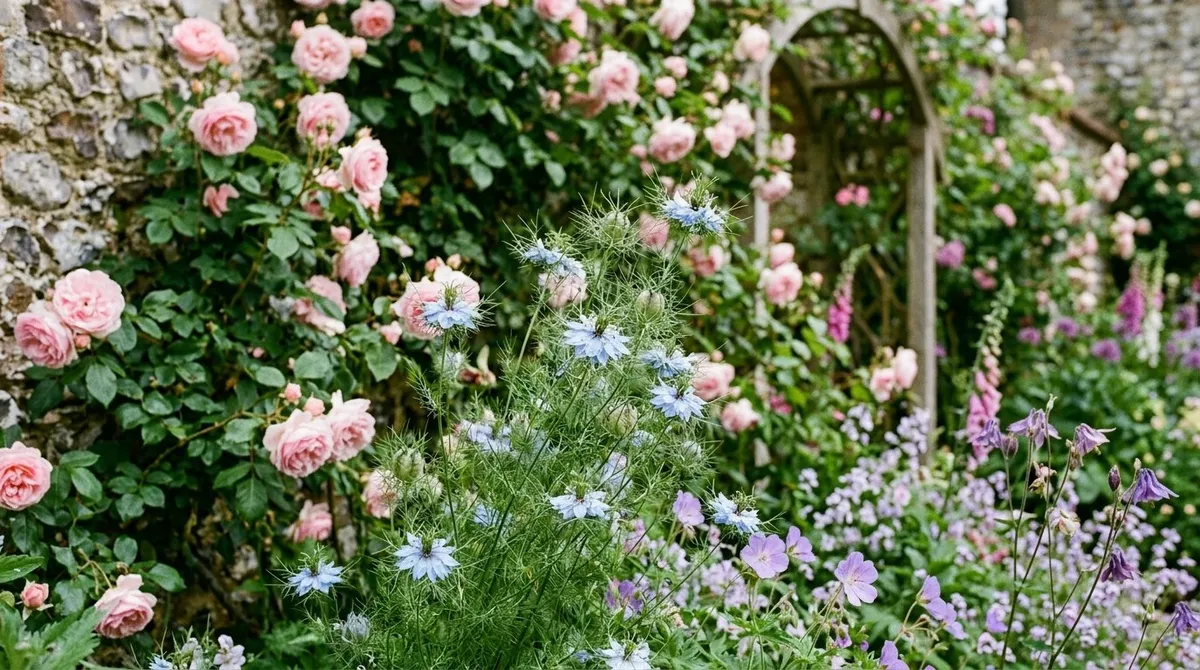
Nigella plays a quiet supporting role rather than a headline part. The fine misty foliage and delicate flowers pair perfectly with bolder plants, softening and filling between stronger shapes.
Classic cottage combinations
| Partner plant | Height | Flowers | Why it works with nigella |
|---|---|---|---|
| Larkspur | 90-120cm | Jun-Aug | Tall spires rise above nigella mist |
| Cornflower | 80cm | Jun-Sep | Blue with blue for harmony |
| Calendula | 60cm | May-Oct | Orange contrasts with blue |
| Old-fashioned roses | 120-180cm | Jun-Jul | Classic cottage pairing |
| Lady’s mantle | 40cm | Jun-Aug | Chartreuse foam at the front |
| Sweet william | 45cm | May-Jul | Flat clusters contrast with mist |
Plant in drifts of 10 or more, scattered informally rather than in rows. The self-seeding habit means plants migrate each year, creating the natural untidy look that defines cottage style. Read our self-seeding plants guide for more low-effort cottage favourites that return year after year.
Month-by-month nigella care calendar
| Month | Task |
|---|---|
| February | Order fresh seed for spring sowing |
| March | First direct sowing. Thin autumn sowings |
| April | Water autumn sowings in dry spells |
| May | Second sowing. Autumn-sown plants nearly flowering |
| June | Flowering begins. Make third sowing |
| July | Peak flowering. Harvest first seed pods for drying |
| August | Continue flowering. Harvest remaining seed pods |
| September | Autumn sowing for next year |
| October | Autumn seedlings emerge |
| November | Seedlings overwinter unprotected |
| December | No action needed |
Common mistakes when growing nigella
Transplanting seedlings
Nigella has a long delicate taproot. Transplanting rarely works as plants are stunted and die. Always direct sow where plants will flower, and never move self-sown seedlings once they have true leaves.
Sowing in rich soil
Rich or recently manured soil produces tall leafy plants with few flowers. Plant nigella on poor-to-average soil for the best flowering results.
Deadheading for more flowers
Deadheading removes the ornamental seed pods that are half the value of nigella. It also prevents self-seeding. Accept that nigella flowers for 6-10 weeks and move on to harvesting pods instead of extending the display.
Using old seed
Nigella seed is short-lived. Fresh seed germinates at 80-90%, but 3-year-old seed drops below 30%. Always buy fresh seed each spring or collect your own from the previous autumn’s pods.
Overwatering established plants
Mature nigella rarely needs watering except in severe drought. Over-watered plants develop crown rot and die suddenly in midsummer. Let them dry out between waterings.
Frequently asked questions
When do you sow nigella seeds in the UK?
Sow nigella directly where it will flower from March to May, or in September for earlier flowers. Autumn-sown plants overwinter as small seedlings and flower from late May. Spring-sown plants flower from July. Both work well - nigella germinates in 10-14 days at soil temperatures of 10-15C. Successive sowings 3 weeks apart give continuous flowers through the summer. Nigella does not transplant well, so always direct sow.
Does nigella come back every year?
Yes, nigella self-seeds so freely that it returns every year without any effort. One initial sowing typically produces a permanent colony lasting 5-10 years. Allow a few plants to set seed pods each summer rather than deadheading. The seeds drop and germinate in autumn and spring. Each plant produces 30-50 seed pods containing 100+ seeds each. Gently thin self-seedlings to 15-20cm apart in April for stronger plants.
Why is my nigella not flowering?
Nigella needs full sun and well-drained soil to flower well. Plants in shade produce leggy foliage and few flowers. Overwatering or rich compost also leads to leafy growth at the expense of blooms. Other causes include old seed with poor germination, crowded plants (thin to 20cm apart), and very heavy clay that stays wet through summer. Move future sowings to a sunnier spot with better drainage.
What is the difference between Nigella damascena and Nigella sativa?
Nigella damascena is the ornamental love-in-a-mist grown for flowers and decorative seed pods. Nigella sativa is black cumin, a different species grown for its edible black seeds used in cooking and traditional medicine. They look similar but N. sativa has simpler flowers, smaller seed pods, and is never grown as a garden ornamental. Only N. sativa seeds are safe to eat. N. damascena seeds contain toxic compounds and should not be consumed.
How do you harvest and dry nigella seed pods?
Cut nigella seed pods when they turn from green to papery beige in July or August. Harvest on a dry day with sharp scissors, leaving 20cm stems. Strip the foliage and hang bunches of 10-15 stems upside down in a dark, airy place for 2-3 weeks. The dried pods hold their shape and colour for 18 months. Store finished bunches in boxes away from direct light. Dried pods work in wreaths, winter arrangements, and Christmas decorations.
Can I grow nigella in pots?
Yes, nigella grows well in pots of 25cm or larger. Use multipurpose compost with added grit for drainage. Sow 4-5 seeds per pot in March or September and thin to 2-3 strong seedlings. Water regularly but never waterlog. Nigella in containers flowers for 6-8 weeks before declining. The compact variety ‘Nigella Mulberry Rose’ stays tidy and is best for container growing. Feed fortnightly with liquid tomato feed from June.
How long does nigella flower for?
Individual nigella flowers last only 2-3 days, but each plant produces flowers in succession for 6-10 weeks. Each plant opens new flowers continuously from June to August. To extend the overall display, make successive sowings 3 weeks apart from March to May. Or combine autumn-sown plants (flowering May-June) with spring-sown plants (flowering July-August) for nearly 4 months of continuous colour. Do not deadhead if you want the ornamental seed pods.
Now that you know how to grow nigella, read our guide on the easiest flowers to grow from seed for more beginner-friendly hardy annuals. The Royal Horticultural Society also lists Miss Jekyll as one of their top-performing cottage garden annuals.
Our team produces practical UK gardening guidance from source research, contributor records and established horticultural practice. Editorial standards are overseen by Matt W.