Key takeaways
- Penstemon flowers June to October, one of the longest-flowering perennials for UK borders
- Hardiness varies hugely: Garnet survives -15C but Alice Hindley dies below -5C
- Take softwood cuttings in September as insurance against winter losses
- Never cut back in autumn — old growth protects the crown from frost
- Garnet (wine-red) and Husker Red (white with purple foliage) are the toughest UK varieties
- Free-draining soil is more important than shelter — waterlogging kills more penstemons than cold
Penstemon is the plant that fills the gap when everything else takes a break. From June right through to the first hard frosts in October, the tubular flowers keep coming in waves. Each bloom looks like a miniature foxglove, flared at the lip and carried in loose spires above neat, semi-evergreen foliage.
The genus contains over 250 species, almost all native to North America. Fewer than 30 cultivars are commonly grown in UK gardens, but the best of them are among the most rewarding perennials you can plant. The catch is hardiness. Some varieties shrug off -15C. Others collapse at -5C. Knowing which is which saves money and heartbreak.
Which penstemons are hardiest in the UK?
Hardiness is the first thing to consider when choosing penstemon for a UK garden. The difference between the toughest and most tender varieties is the difference between a plant that lasts a decade and one that dies in its first winter.
The hardiest cultivars descend from North American mountain species that endure brutal winters. Andenken an Friedrich Hahn, universally sold as Garnet, is the gold standard. It survives -15C without protection and flowers reliably from June to October. The wine-red flowers are produced in such quantity that a mature clump is never without colour during the summer months.
Husker Red is equally tough, with an added bonus: dark bronze-purple foliage that provides contrast even when the plant is not in flower. The white flowers with faint pink veining appear from July to September. It was bred at the University of Nebraska and handles cold, heat, and drought.
| Cultivar | Flower colour | Height | Hardiness | RHS AGM | Notes |
|---|---|---|---|---|---|
| Garnet (A.a.F. Hahn) | Wine-red | 75cm | -15C | Yes | The indestructible one; every garden should have it |
| Husker Red | White, purple foliage | 80cm | -15C | Yes | Foliage is the main event; tough as nails |
| Raven | Deep purple | 90cm | -10C | Yes | Rich colour; reasonably hardy |
| Pensham Plum Jerkum | Plum-purple, white throat | 80cm | -8C | Yes | Striking bicolour; needs good drainage |
| Alice Hindley | Lilac-blue, white throat | 100cm | -5C | Yes | Beautiful but tender; cuttings essential |
| Blackbird | Deep purple-black | 90cm | -5C | No | Darkest colour; treat as half-hardy |
| Osprey | White, pink-edged | 85cm | -8C | Yes | Soft colouring; good in mixed borders |
| Stapleford Gem | Lilac, purple, mauve | 70cm | -7C | Yes | Colour changes with age; compact habit |
The tender varieties, Alice Hindley and Blackbird, are worth growing for their colour alone. Treat them as plants you propagate annually from cuttings rather than permanent fixtures in the border. This way, a bad winter costs you nothing.
How do you plant penstemon in UK gardens?
Plant penstemon in spring (April to May) after the last frost, or in early autumn (September) to allow root establishment before winter. Spring planting is safer in cold or exposed gardens because the plant has a full season to settle before facing its first winter.
Choose a spot in full sun or very light shade. Penstemons flower best with at least 6 hours of direct sun daily. The soil must drain freely. This matters more than almost anything else. On heavy clay, dig a planting hole twice the width of the pot and mix the excavated soil with an equal volume of horticultural grit. Plant the crown 2-3cm higher than the surrounding soil to shed rain away from the base.
Space plants 40-50cm apart. Water well after planting and keep the soil moist through the first summer. Once established, penstemons are reasonably drought tolerant and need watering only during prolonged dry spells. A light mulch of gravel or grit around the base looks attractive and keeps the crown dry through winter. Avoid organic mulch touching the stems.
How do you take penstemon cuttings?
Taking cuttings in September is the single most important skill for penstemon growers. A 10-minute session in early autumn provides insurance plants for every variety in your garden. If the parent survives winter, you have spare plants to give away. If it does not, you have replacements ready.
Select non-flowering shoot tips 7-10cm long. Cut just below a leaf joint with a clean, sharp blade. Remove the lower 2-3 pairs of leaves, keeping only the top pair or two. Dip the base in hormone rooting powder. Insert the cuttings around the edge of a 9cm pot filled with a 50:50 mix of perlite and peat-free compost.
Water gently and place in a cold frame, unheated greenhouse, or on a bright windowsill. Cover loosely with a clear polythene bag to maintain humidity. Rooting takes 4-6 weeks. Once new growth appears at the tips, the cuttings have rooted. Remove the cover and grow on in a cool, bright spot over winter. Pot on individually in March and plant out after the last frost in May.
Why should you never cut back penstemon in autumn?
This is the rule that saves more penstemons than any other. Never cut back the old stems in autumn or early winter. The instinct to tidy up borders in November leads to more penstemon deaths than any pest or disease.
The old growth serves two purposes over winter. First, it insulates the crown. The mass of stems and semi-evergreen leaves traps a layer of still air around the base of the plant, buffering it against sudden temperature drops. Second, it sheds rain. The leaves channel water away from the crown, reducing the waterlogging that rots roots on heavy soils.
Wait until mid-April to cut back. By then, new shoots will be visible at the base of the plant. Cut each old stem back to just above the lowest pair of fresh leaves. If no new growth is visible by late April, scrape the bark gently with a thumbnail. Green tissue underneath means the plant is alive but slow. Brown tissue means it is dead.
What soil and conditions do penstemons need?
Penstemons evolved in North American habitats ranging from mountain scree to prairie grassland. The one condition they all share is good drainage. No penstemon thrives in soil that sits wet through winter.
On free-draining sandy or loamy soil, penstemons need almost no special treatment. Plant them, water the first summer, and let them get on with it. On heavy clay, you need to amend the planting area. Mix in sharp grit at a ratio of one part grit to two parts soil. Plant the crown slightly raised. Consider planting on a 5cm mound of grit to lift the crown above winter water.
Penstemons tolerate a wide pH range from 5.5 to 7.5. They do not need rich soil. In fact, over-feeding with nitrogen produces lush leaf growth at the expense of flowers. A single handful of general-purpose fertiliser worked into the soil in April is enough for the season. They pair well with other sun-loving perennials like salvias and geraniums that share the same drainage requirements.
How do you deadhead penstemon for longer flowering?
Deadheading penstemons extends the flowering season by several weeks. Without deadheading, plants put energy into seed production and flowering drops off by August. With regular deadheading, most varieties flower continuously from June to October.
Cut spent flower spikes back to a strong side shoot or leaf pair lower down the stem. New flowering stems will grow from these points within 2-3 weeks. Do not remove the entire stem to ground level during the growing season, as this reduces the number of flowering points.
In late September, stop deadheading and allow the final flowers to set seed. This sends a signal to the plant to begin hardening off for winter. The remaining stems provide winter protection. Self-sown seedlings occasionally appear around the parent plant. These will not come true to named varieties but can produce interesting colour variations.
Regular deadheading also keeps the plant looking tidy. Without it, spent flower spikes turn brown and hang at awkward angles. A weekly pass through the border with secateurs takes 5 minutes and keeps summer-flowering perennials looking sharp from June to October.
What pests and diseases affect penstemon?
Penstemons are remarkably trouble-free plants. The most serious threat is not a pest or disease at all but winter cold and wet, which is a cultural problem rather than a pathological one.
Slugs and snails occasionally graze new shoots in spring, particularly in damp weather. The semi-evergreen foliage is less attractive to slugs than softer perennials like hostas, so damage is usually minor. Protect emerging growth with a scattering of organic slug pellets or copper tape if your garden has a heavy slug population.
Aphids sometimes cluster on flower buds in June. A strong jet of water from a hose dislodges them effectively. Ladybirds, hoverflies, and lacewings will control aphid populations naturally if you avoid using broad-spectrum insecticides. Leaf spot fungi can appear in wet summers but rarely cause lasting damage. Remove affected leaves and improve air circulation.
Penstemon rust, caused by Puccinia species, occasionally appears as orange pustules on leaf undersides. It is more common in overcrowded plantings with poor airflow. Thin congested clumps, remove infected leaves, and ensure plants are not shaded by taller neighbours.
Which penstemons work best in cottage garden borders?
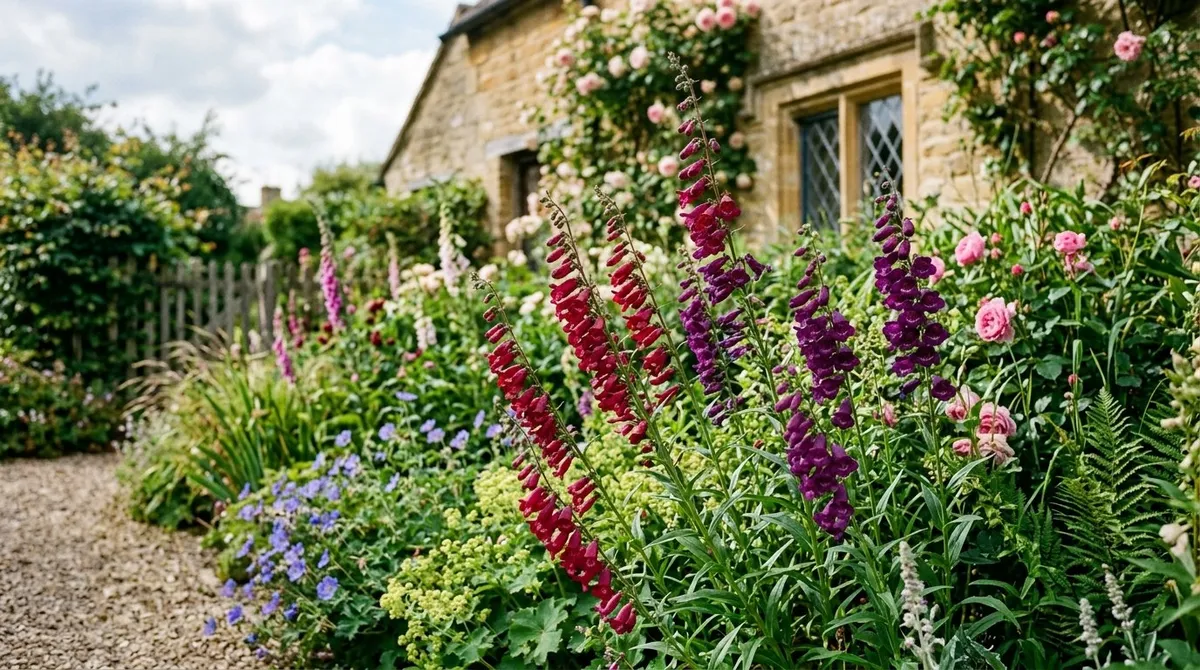
Penstemons are a cottage garden staple because they flower for months, mix well with other plants, and fill vertical space with their upright spires. The best cottage garden varieties combine long flowering with enough hardiness to survive most UK winters.
Garnet is the obvious starting point. Its deep wine-red flowers complement roses, lavender, and silver-leaved plants. Plant it in groups of three for impact, spaced 40cm apart. Raven offers a similar effect in deeper purple. Osprey brings a softer, paler tone that works alongside white and pink planting schemes.
For height at the back of borders, Alice Hindley reaches 100cm and produces lilac-blue flowers that are among the most beautiful of any penstemon. Partner it with tall foxgloves and Japanese anemones for a scheme that flows from May to October. Just remember to take cuttings in September because Alice Hindley is one of the tender ones.
Stapleford Gem is useful for the front and middle of borders at 70cm. Its flowers change colour as they age, opening lilac and maturing through shades of mauve and purple. This gives a single plant a multicoloured appearance that works with almost any colour scheme.
Frequently asked questions
Are penstemons perennial or annual?
Penstemons are perennial plants, not annuals. Most garden varieties are semi-evergreen, keeping some foliage through mild winters. They flower from June to October and return each spring. However, tender varieties can behave like short-lived perennials in cold UK gardens, lasting only 3-5 years before winter losses claim them.
When should I take penstemon cuttings?
Take penstemon cuttings in September for the highest success rate. Select non-flowering shoot tips 7-10cm long. Root in a 50:50 mix of perlite and peat-free compost. Place in a cold frame or unheated greenhouse. Rooting takes 4-6 weeks. September cuttings root more reliably than spring cuttings.
Why did my penstemon die over winter?
Waterlogged soil kills more penstemons than cold temperatures. Heavy clay that stays wet through winter rots the crown and roots. Improve drainage by working grit into the planting hole or planting on a slight mound. Cutting back in autumn removes protective old growth and increases winter losses.
Should I cut back penstemon in autumn?
No, never cut back penstemon in autumn. The old stems and foliage protect the crown from frost and cold rain. Leave all top growth in place until mid-April, when new shoots appear at the base. Then cut back to just above the lowest pair of new leaves.
What is the hardiest penstemon for the UK?
Andenken an Friedrich Hahn (sold as Garnet) is the hardiest widely available penstemon. It survives temperatures down to -15C and has come through every recent UK winter unscathed. The flowers are deep wine-red from June to October. Husker Red is similarly tough, with white flowers above dark purple foliage.
Do penstemons attract bees?
Yes, the tubular flowers are excellent for bumblebees and other long-tongued pollinators. Bumblebees work penstemon flowers throughout the day, particularly Bombus hortorum (garden bumblebee). Hoverflies and butterflies also visit. The long flowering season provides food when many other plants have finished.
Can I grow penstemon in pots?
Penstemons grow well in pots of 30cm diameter or larger. Use free-draining, loam-based compost mixed with extra grit. Water regularly in summer but ensure pots drain freely. Move containers to a sheltered wall in winter. Pot-grown plants are more vulnerable to frost than those in the ground.
Our team produces practical UK gardening guidance from source research, contributor records and established horticultural practice. Editorial standards are overseen by Matt W.