Key takeaways
- Sweet woodruff grows 15-25cm tall and carpets 1m of ground within two to three seasons
- It flowers white from mid-April to late May, then sets seed as foliage matures
- Best in moist humus-rich shade, but it tolerates dry shade under trees once roots are down
- It spreads by rhizome and seed, so contain it away from rich, moist beds where it runs hardest
- Wilted leaves smell of fresh hay and vanilla from coumarin, used in May wine and linen sachets
- Divide clumps in autumn or early spring; plants cost 4 to 7 pounds at UK nurseries
Learning how to grow sweet woodruff gives you one of the most useful plants for difficult shade. Sweet woodruff (Galium odoratum) is a low woodland perennial that carpets the ground under trees and shrubs where grass and most flowers give up. It earns its place twice over: a froth of white star flowers in spring, then a sweet hay-and-vanilla scent from the dried leaves later in the year.
What sweet woodruff is and where it grows wild
Sweet woodruff is a hardy perennial in the bedstraw family, native to woodland across Britain and much of Europe. In the wild it forms loose green carpets on the floor of beech and oak woods, particularly on lime-rich soils. You find it on shaded banks, in old hedge bottoms and along damp woodland paths.
The plant grows 15-25cm tall. Its stems are square, a family trait it shares with mint and bedstraw. The leaves are the giveaway: narrow, lance-shaped and arranged in neat whorls of 6 to 8 around the stem, like the spokes of a wheel. This whorled habit is why it knits into such a tidy ground layer.
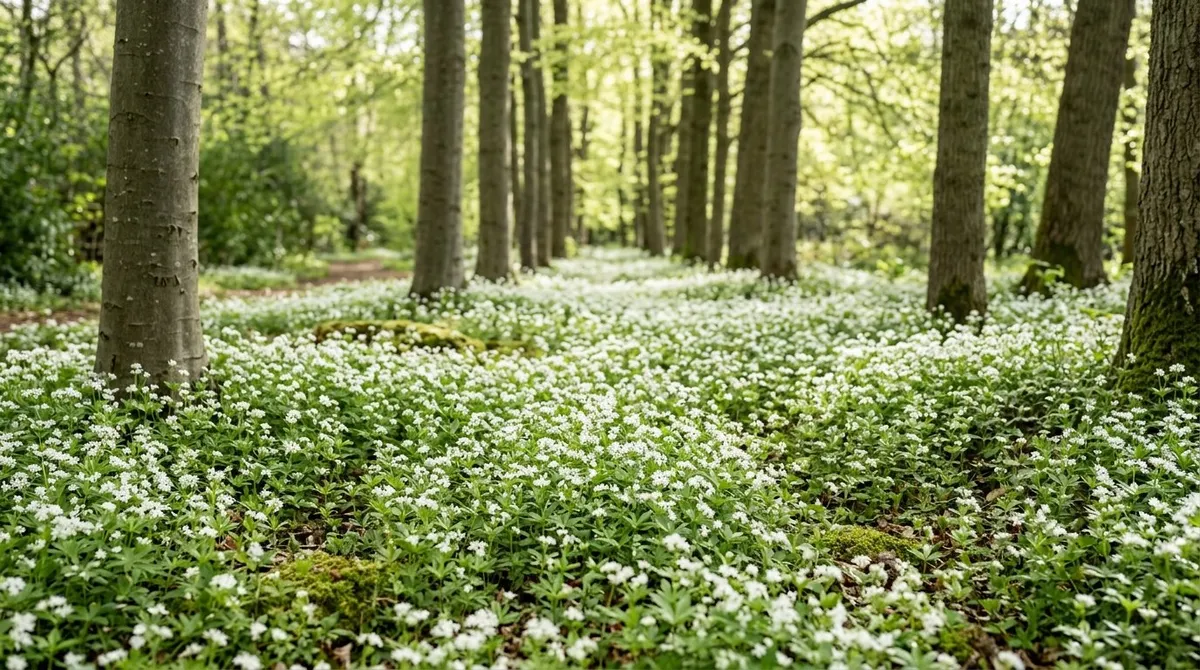
It spreads by creeping underground rhizomes and by seed. In good woodland conditions a single plant covers a square metre in two to three years. The Wildlife Trusts describe Galium odoratum as a classic ancient-woodland indicator, which tells you exactly what it wants: cool, shaded, leafy ground.
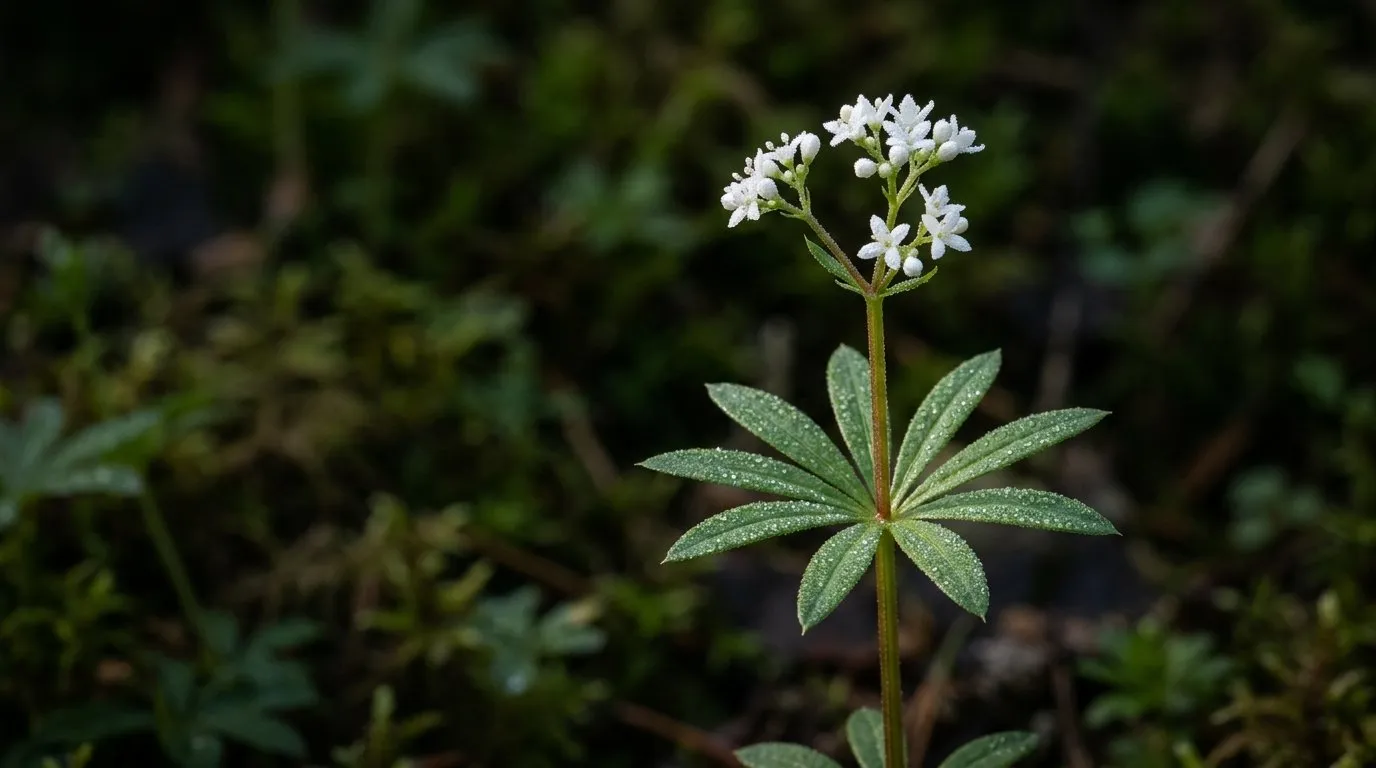 The whorls of 6 to 8 narrow leaves and tiny white four-petalled stars that identify Galium odoratum
The fragrant shade ground cover few gardeners use
Sweet woodruff is the answer to a problem most gardens have: a dry, dappled corner under trees where nothing looks happy. It thrives in full to part shade and fills these spots with fresh green foliage from March to autumn.
Most fragrant plants demand sun. Woodruff does not. Its scent comes later and differently, from the foliage rather than the flowers. Run your hand through a clump on a warm day and you get almost nothing. Cut a handful and leave it to wilt, and within hours it releases a clean smell of new-mown hay and vanilla.
That makes it a rare thing: a shade plant that earns its place by scent as well as cover. It suits woodland gardens, the base of a shady wall, and the front of a north-facing border. For a wider planting palette in these spots, our guide to the best plants for shade in UK gardens sets out the supporting cast. Woodruff also slots neatly into the lower tier of any ground cover planting scheme.
Soil, light and the conditions woodruff prefers
Sweet woodruff prefers cool, moist, humus-rich soil in shade, but it tolerates dry shade once established. This split is the single most important thing to understand before planting, because the soil decides how fast it runs.
On rich, moist, fed ground it grows lush and spreads hard. On lean, dry soil under trees it grows more slowly and stays restrained. Neither is wrong. You choose the soil to suit the role you want the plant to play.
Light is forgiving. It takes everything from light dappled shade to deep shade under a dense canopy. Full sun is the one thing it dislikes; the foliage scorches and the plant sulks. A neutral to slightly alkaline soil suits it best, matching its woodland origins on limestone.
Gardener’s tip: Before planting, decide whether you want a carpet or a contained patch. Improve the soil with leaf mould for a fast carpet. Leave the soil lean and dry to slow it right down. The same plant behaves completely differently depending on this one choice.
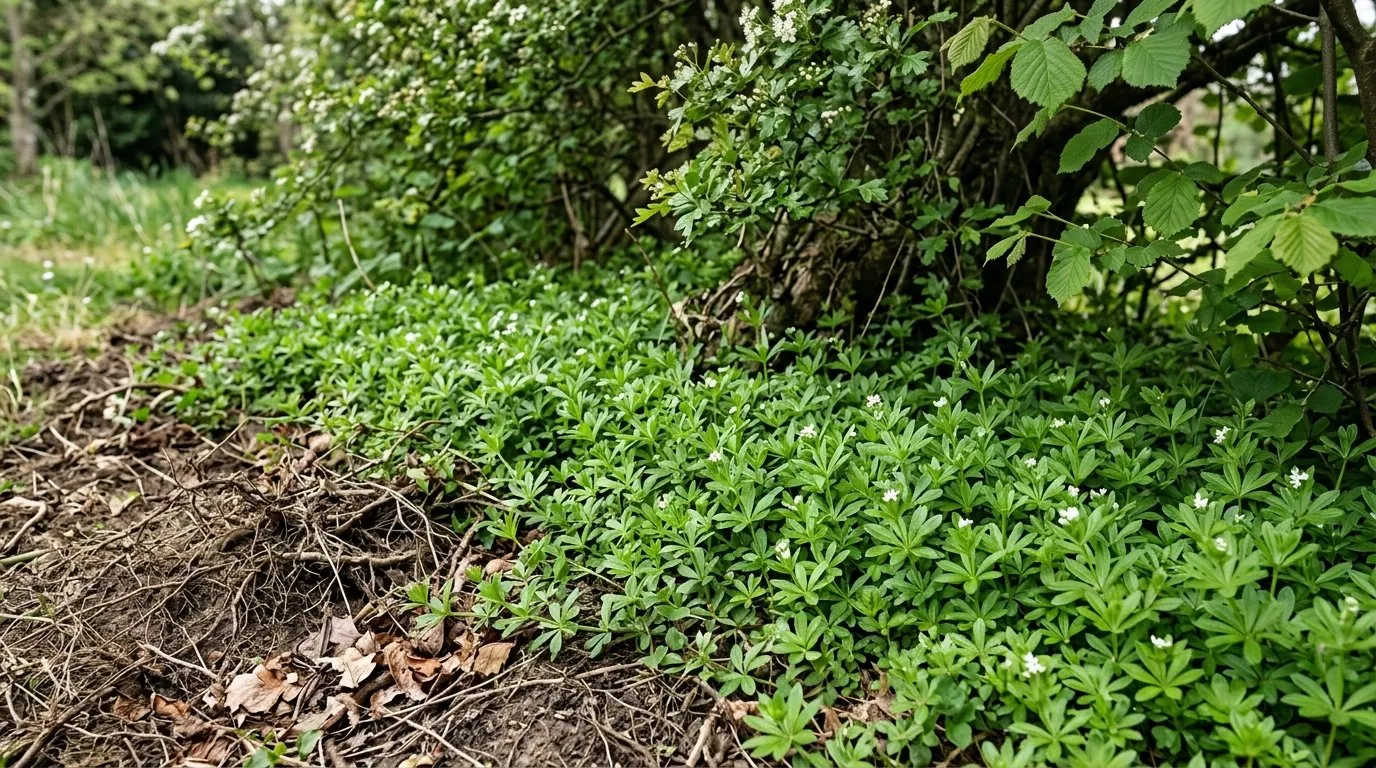 Woodruff established in dry shade at the foot of a hedge, where its spread stays naturally restrained
Sweet woodruff compared to other shade ground covers
Woodruff is one of several plants that solve shade. Each has a different habit, so the right choice depends on whether you want evergreen cover, deep-shade tolerance or seasonal flowers. The table ranks them by how reliably they cover ground in typical UK shade.
| Plant | Spread habit | Flowers | Evergreen? | Shade depth | Coverage rating |
|---|---|---|---|---|---|
| Vinca (Vinca minor) | Trailing stems that root | Blue, March-May | Yes | Part to deep | Excellent |
| Epimedium | Slow rhizome, clump-forming | Yellow/pink, April | Semi | Dry deep shade | Very good |
| Sweet woodruff (Galium odoratum) | Rhizome plus self-seeds | White, April-May | No | Part to deep | Very good |
| Bugle (Ajuga reptans) | Surface runners | Blue spikes, May-June | Yes | Part shade | Good |
Vinca gives the densest year-round cover but smothers smaller plants. Epimedium is the toughest for dry deep shade but slow to fill in. Woodruff sits between them: faster than epimedium, gentler than vinca, and the only one of the four with scent and a tidy whorled texture. Bugle is quick but needs moisture and more light. For an evergreen edge to a path, see how woodruff compares with the picks in our lawn alternatives and ground cover guide.
The coumarin scent and its traditional uses
The sweet smell of woodruff comes from coumarin, a compound released as the leaves wilt and dry. Fresh foliage holds the coumarin in an unscented form. Cutting and drying breaks this down, and the scent develops over a few hours and peaks after a week or two.
For centuries this made woodruff a strewing herb and a linen freshener. Dried sprigs went into sachets among bedsheets and clothes, where the hay-and-vanilla smell lasts for months and deters moths. It also flavoured German May wine (Maiwein), a few wilted sprigs steeped in white wine for May Day.
Here the honest caution matters. Coumarin in large quantities is not advised, and modern food guidance treats it cautiously. Use only a few sprigs, steep them briefly, and remove them before serving. Anyone pregnant, breastfeeding, or taking blood-thinning medication should avoid consuming it. Enjoy the dried sachets freely; treat any culinary use as a light, occasional flavouring.
 Dried woodruff sprigs and a linen sachet, the traditional use of the plant’s hay-and-vanilla coumarin scent
Keeping sweet woodruff in bounds
Woodruff has a reputation as a thug, and on the right soil it deserves it. The good news is that the same trait that makes it spread also makes it easy to remove. Its rhizomes sit shallow, and unwanted runners pull up by hand.
For a contained patch near valued perennials, sink a physical barrier. Follow these stages:
- Mark the area you want the woodruff to fill, allowing for two seasons of growth.
- Sink a root barrier of paving slabs on edge or thick plastic edging to a depth of 15-20cm around the patch.
- Plant inside the barrier at 30cm spacing in autumn or early spring.
- Patrol the edges each March and pull any rhizomes that have crept over the top.
- Lift and divide the centre every three to four years to keep it vigorous and remove excess.
The single critical mistake is planting woodruff in a small, rich, moist border alongside slow choice plants with no barrier. Within two seasons it threads through their crowns and is then very hard to separate. Decide its role before the trowel goes in, not after.
Warning: Never plant sweet woodruff in a sink, trough or alpine bed with slow, precious plants. On the rich compost these containers use, it will smother neighbours within a single season and is almost impossible to pick out of their roots.
Planting woodruff with ferns, hostas and woodland companions
Sweet woodruff makes an ideal under-layer for taller shade plants because its low whorled foliage threads between them without smothering. This is where it shines as a designed plant rather than a wild colonist.
Pair it with ferns for a contrast of textures: the fine whorls of woodruff against the bold fronds of a hardy fern read beautifully in dappled light. Underplant hostas and let the woodruff fill the gaps before the hosta leaves unfurl, then recede beneath them through summer.
It also works under deciduous shrubs, around the feet of shade-loving shrubs, and among woodland bulbs such as wood anemones and snowdrops. The bulbs flower first, the woodruff covers the dying foliage, and the bed never looks bare. Just keep the soil leaner than you would for the hostas, or the woodruff will outpace them.
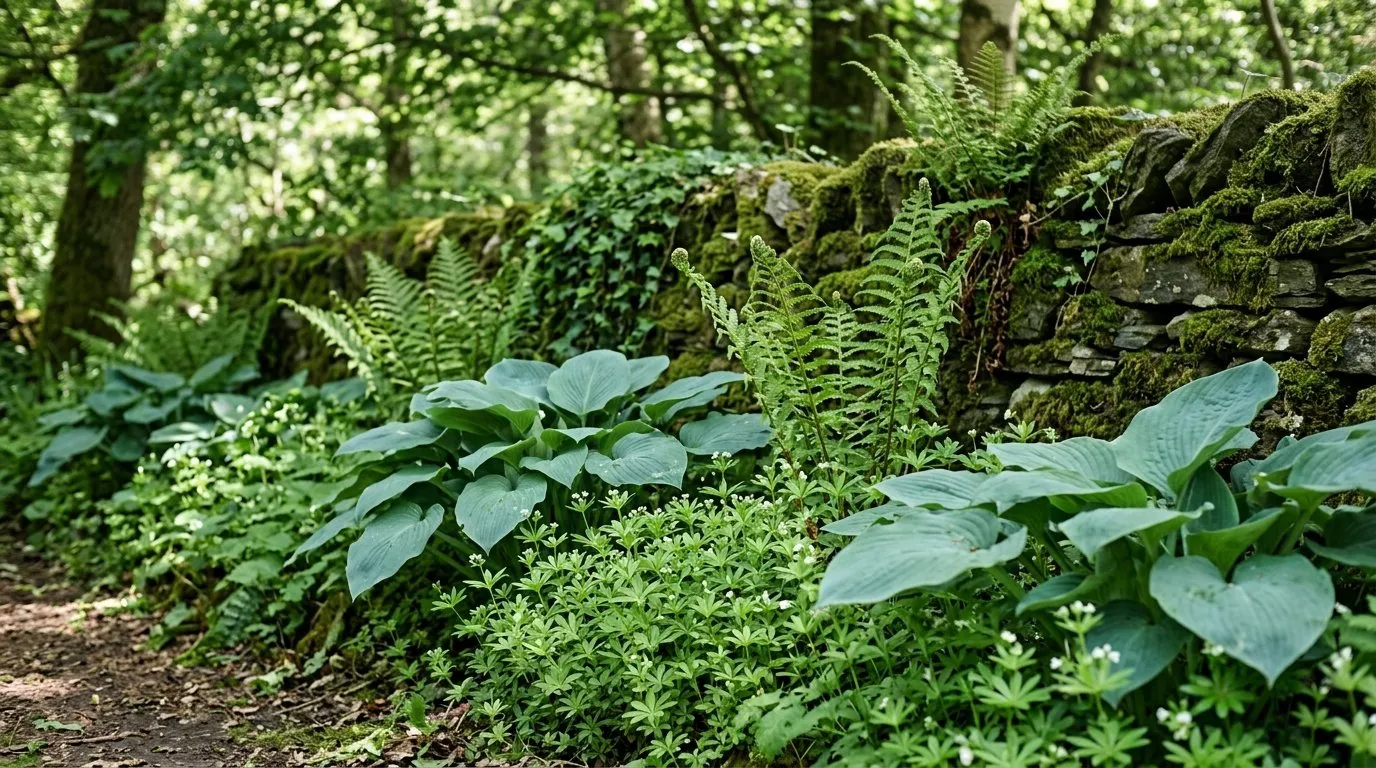 Woodruff filling the gaps between hostas and ferns in a shaded Lake District border
Month-by-month sweet woodruff calendar
Woodruff is low effort, but a few timed jobs keep it healthy and contained. This UK calendar covers the key tasks through the year.
| Month | Task |
|---|---|
| March | Patrol edges, pull stray rhizomes, top-dress with leaf mould |
| April | First flowers open, weed around young clumps |
| May | Peak flowering, cut a few sprigs to dry for sachets |
| June | Flowering ends, plants set seed, watch for self-sown spread |
| July | Light trim if foliage flops, water new plants in dry spells |
| August | Collect ripe seed if wanted, lift surplus seedlings |
| September | Divide and replant clumps as soil cools |
| October | Mulch with leaf mould, plant new clumps |
| November | Cut back tired foliage, clear fallen leaves that smother it |
| December | Dormant, no work needed |
| January | Plan new shade plantings, order plants |
| February | Final tidy before spring growth begins |
The two jobs that matter most are the March edge patrol and the autumn division. Skip the patrol and a contained patch becomes a colony. For more on lifting and splitting clumps, our guide to dividing perennials in May covers the technique that works for woodruff too.
Propagating sweet woodruff by division
Division is the fastest and most reliable way to make more woodruff. Seed works but germinates slowly and unevenly. A lifted clump gives you a dozen new plants in minutes.
Work in autumn or early spring when the soil is moist and the plant is not in full growth. Follow these stages:
- Water the clump the day before so the soil holds together.
- Lift the whole clump with a fork, taking a good ball of roots and rhizome.
- Tease the clump apart by hand into rooted sections the size of a fist.
- Trim any long, bare rhizomes back to the rooted portion.
- Replant immediately at 30cm spacing, firm in, and water well.
- Keep the new plants moist for the first six weeks while they settle.
The critical mistake here is letting the divisions dry out. Woodruff roots are fine and shallow, and a few hours in dry air on a potting bench can kill small pieces. Pot or replant them the same hour you lift them.
 Splitting a woodruff clump into rooted sections, the quickest way to propagate it
Why woodruff runs: the cause behind the spread
The real reason woodruff overruns some gardens is not the plant. It is the soil. Woodruff is a woodland-edge plant adapted to grab open ground fast before competitors arrive. Rich, moist, weed-free border soil is open ground from its point of view, so it sprints.
This is why the same species is a treasured carpet in one garden and a menace in the next. The fix is not a stronger plant or a different cultivar. It is matching the planting position to the soil. Lean dry shade gives you a polite woodruff; rich damp soil gives you a coloniser.
 Woodruff colonising the edge of a woodland path, doing exactly the job it evolved for
Common mistakes when growing sweet woodruff
A few errors account for most disappointments with this plant. Each is easy to avoid once you know the cause.
Planting it in full sun. Woodruff scorches and stalls in sun because it is a woodland plant. The cause is treating it like a typical scented herb. Plant it in shade or part shade only, and reserve sunny spots for plants from our best scented plants for UK gardens list.
Planting it in rich soil next to choice plants. It overruns slow neighbours within two seasons. This happens because gardeners site it for looks without thinking about spread. Use a barrier, or give it lean ground, or keep it well away from precious perennials.
Expecting instant scent. Fresh foliage barely smells, so new growers think they bought the wrong plant. The coumarin only develops as leaves wilt and dry. Cut a handful, let it sit a day, and the hay-and-vanilla scent appears.
Letting divisions dry out. New pieces fail when left on a bench. Woodruff has fine shallow roots that cannot survive drying. Replant within the hour and keep moist for six weeks.
Using woodruff in difficult town and small gardens
Sweet woodruff is one of the few plants that genuinely thrives in a north-facing town garden bed. These spots get little direct sun, often have dry soil against walls, and defeat most flowering plants. Woodruff treats them as home.
In a small garden, the contained-patch method from earlier is essential. There is no room for a coloniser. Sink an edging barrier, plant inside it, and patrol the rim each March. Done this way, woodruff gives city gardeners scent, spring flowers and reliable green cover in the hardest corner of the plot.
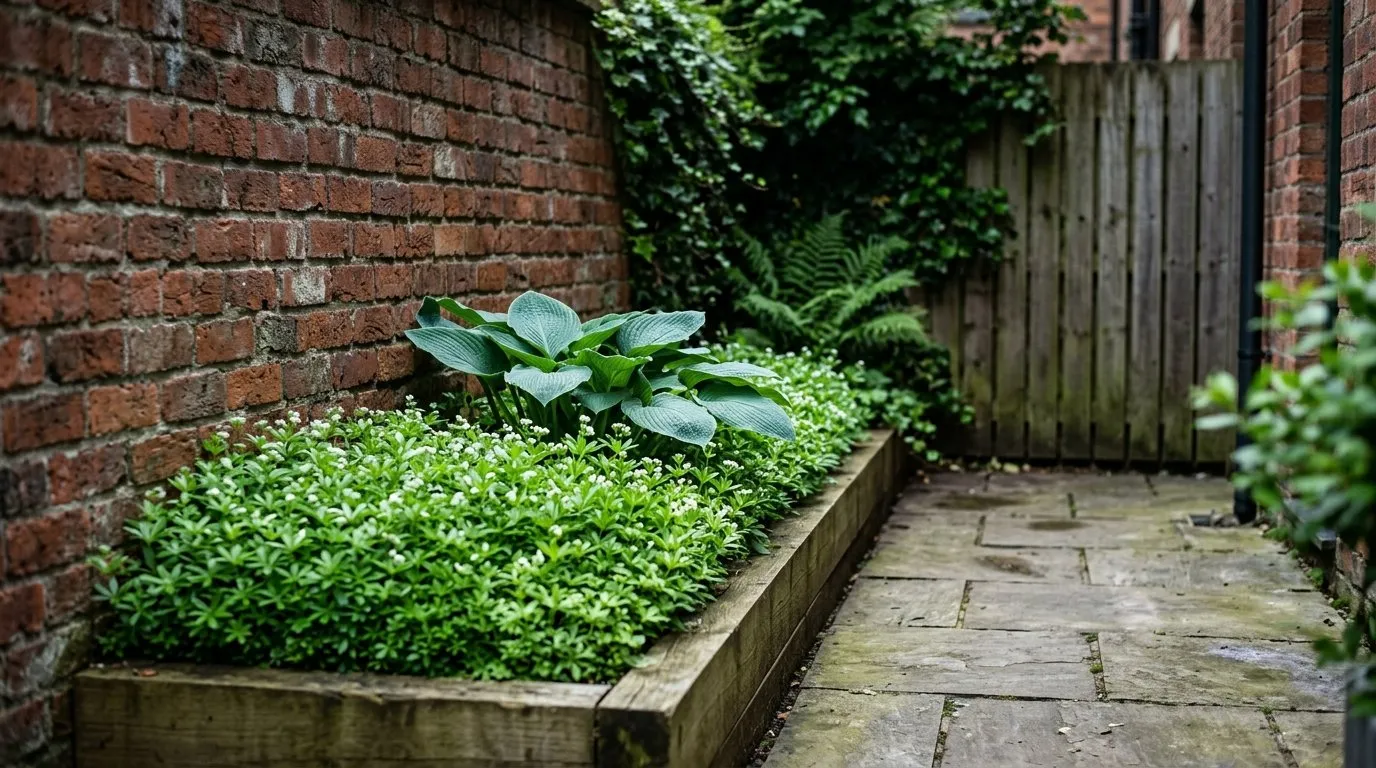 Woodruff thriving in a north-facing town garden bed, a position that defeats most flowering plants
Frequently asked questions
How do you grow sweet woodruff in the UK?
Plant sweet woodruff in shade on moist, humus-rich soil. Space plants 30cm apart in autumn or spring. Water through the first summer until established. It tolerates dry shade under trees once its rhizomes are down. Mulch with leaf mould each autumn. Divide congested clumps every few years to keep them vigorous.
Does sweet woodruff spread aggressively?
Yes, on rich moist soil sweet woodruff spreads quickly. It runs by underground rhizome and self-seeds freely. On lean dry soil under trees it stays far more restrained. Plant it where you want a carpet, or edge it with a buried barrier near choice plants. Pull stray runners in spring to keep it in bounds.
Why does sweet woodruff smell of hay?
The scent comes from coumarin in the leaves. Fresh foliage has little smell, but wilted or dried leaves release a sweet hay-and-vanilla fragrance. This is why woodruff was traditionally dried for linen sachets and strewing. The scent strengthens for a week or two after cutting, then fades slowly over months.
Is sweet woodruff safe to use in May wine?
In small quantities it is the traditional flavouring for German May wine. Coumarin is the active compound, and large amounts are not advised. Use only a few wilted sprigs steeped briefly, and remove them before serving. Anyone on blood-thinning medication or who is pregnant should avoid it. Treat it as a flavouring, not a daily ingredient.
Will sweet woodruff grow in dry shade under trees?
Yes, once established it is one of the best plants for dry shade. It needs moisture and care for the first one to two summers while rhizomes develop. After that it copes with the dry, root-filled soil under beech, oak and hedges. It spreads more slowly there, which makes it easier to manage.
When does sweet woodruff flower?
Sweet woodruff flowers from mid-April to late May in most of the UK. The tiny white four-petalled stars appear above whorled green leaves. Flowering lasts three to five weeks. In a cold Scottish spring it may start in early May. After flowering it sets seed, which is how new plants appear nearby.
How do you propagate sweet woodruff?
Division is the easiest method. Lift a clump in autumn or early spring and pull apart rooted sections. Replant each piece 30cm apart and water in. You can also collect ripe seed in summer, though germination is slow and erratic. Most gardeners simply move self-sown seedlings or rooted runners to new spots.
Now you have the full picture on this woodland carpeter, read our guide to the best perennial plants for UK gardens for more reliable choices to fill your borders year after year.
Our team produces practical UK gardening guidance from source research, contributor records and established horticultural practice. Editorial standards are overseen by Matt W.