Key takeaways
- Phacelia does two jobs: a fast green manure and a top-five nectar plant for bees and hoverflies
- Broadcast at 1 to 2 g per square metre, March to September; it germinates in 7 to 14 days
- It flowers 6 to 8 weeks after sowing at 60 to 90cm, sometimes reaching 1m tall
- Phacelia fixes no nitrogen; it is a biomass crop that holds nutrients and improves structure
- In the borage family, it shares no crop family, so it fits any vegetable rotation as a break crop
- Cut or pull it before seed sets, roughly 2 weeks after flowering, or it self-seeds everywhere
Phacelia is the plant that earns its keep twice over in a UK garden. Grow phacelia (Phacelia tanacetifolia) as a fast green manure and you get a dense weed-smothering cover crop in 6 to 8 weeks. Leave the same plants to flower and you have one of the best nectar sources for bees and hoverflies in the country. Few plants do two such different jobs so well.
That dual purpose is the whole point of phacelia. Allotment holders sow it to protect and improve bare soil. Wildlife gardeners sow it because honeybees and hoverflies swarm the lacy blue flowers. This guide covers both roles in full. It shows how to sow it as a cover crop and how to grow it for pollinators. It also covers the frost and self-seeding quirks that catch people out.
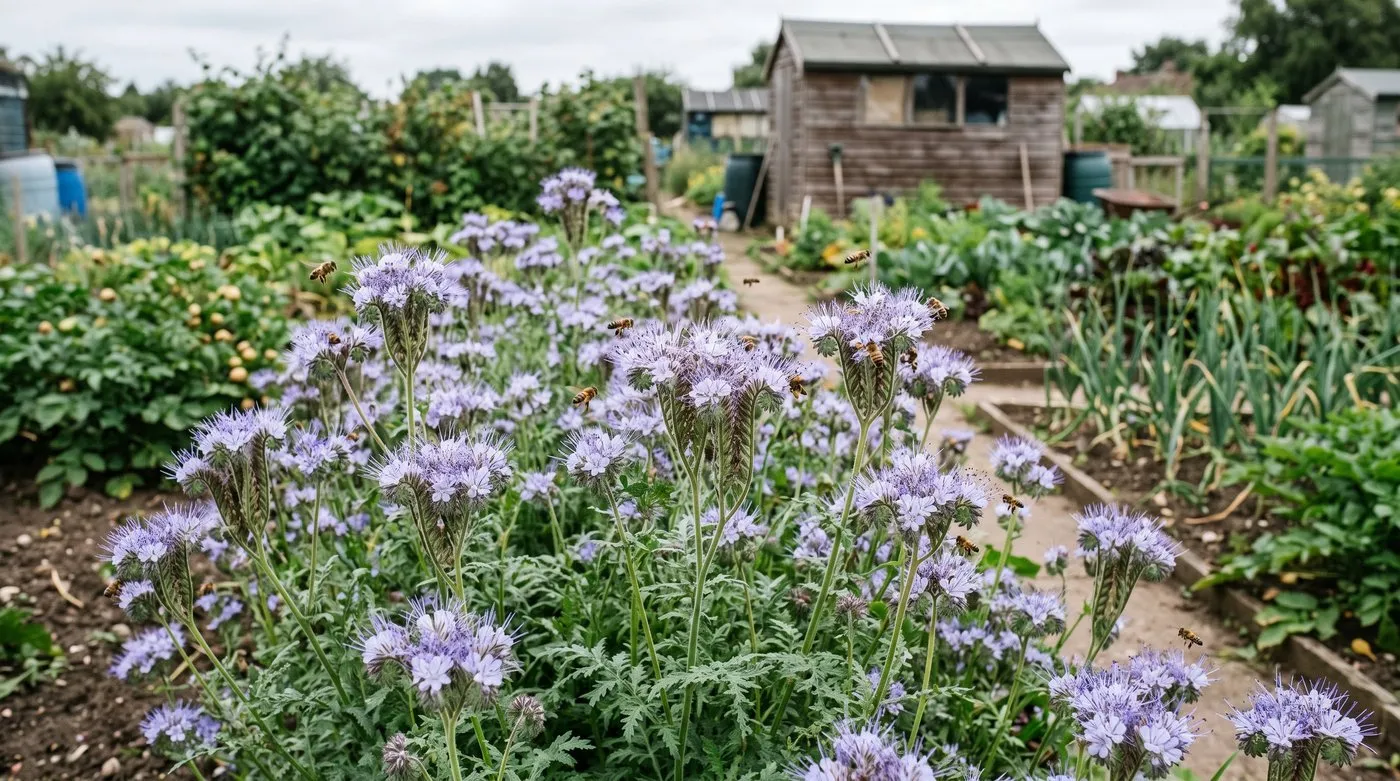 Phacelia does two jobs at once: a fast soil-improving cover crop and a magnet for bees and hoverflies.
Why grow phacelia, the bee plant and green manure in one
Phacelia tanacetifolia goes by several names: lacy phacelia, fiddleneck, and the telling German name Bienenfreund, meaning bee’s friend. It belongs to the borage family, Boraginaceae, and comes originally from the deserts of south-west USA and Mexico. In the UK it grows as a hardy to half-hardy annual.
The plant reaches 60 to 90cm tall, sometimes a full 1m in rich soil. The foliage is ferny, finely cut, and grey-green. The flowers are the giveaway: lavender-blue, held in coiled heads that unroll like a scorpion’s tail. Botanists call this a scorpioid cyme. Long stamens poke out beyond the petals, giving each head a hazy, whiskered look.
Two traits make phacelia worth a packet of seed. First, it grows fast and dense, so it works as a quick green manure. Second, it is among the highest-ranked plants for nectar in UK insect trials. You can pick either job, or run both by digging some in young and letting the rest flower.
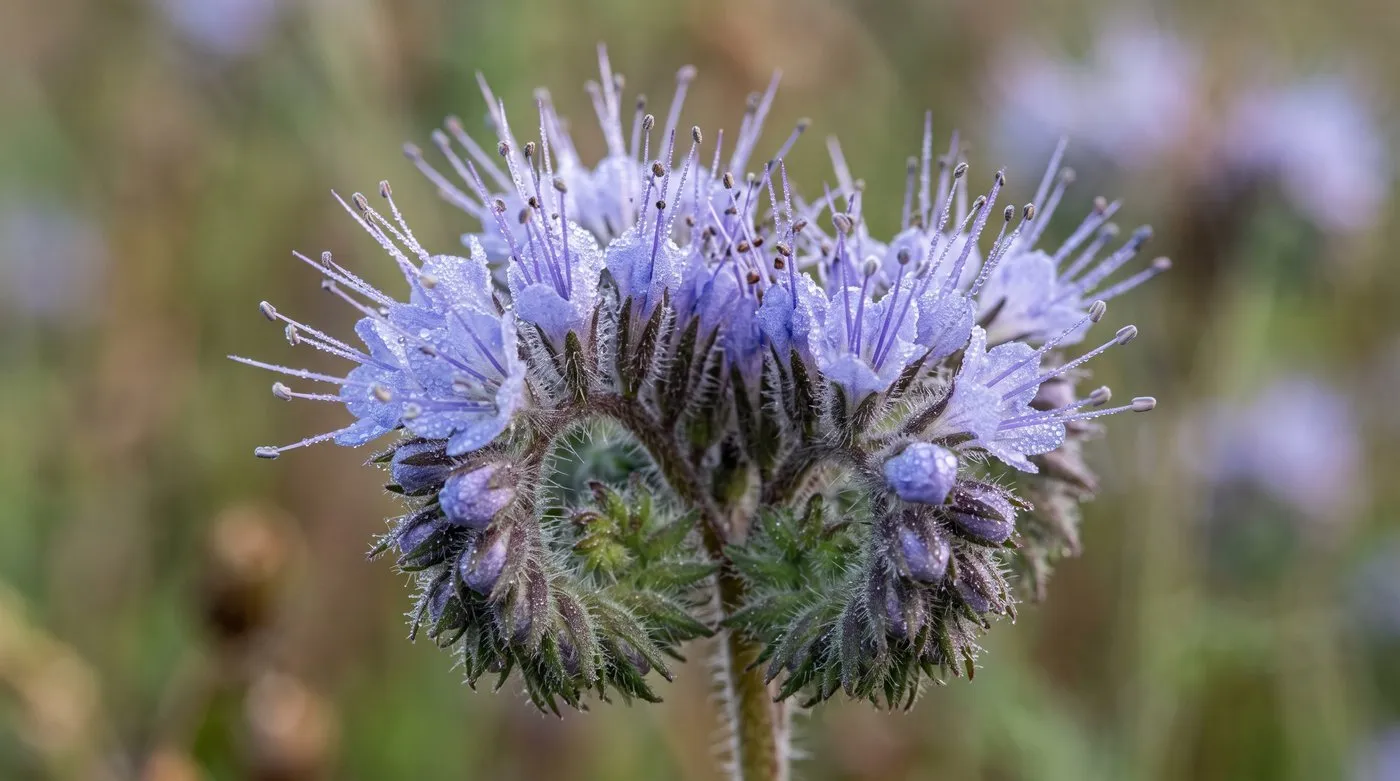 The coiled flower head unrolls as it opens, each bloom fringed with long stamens that bees cannot resist.
What conditions does phacelia need, and where it grows best
Phacelia is one of the easiest plants to grow. It is not fussy about soil and copes across most of the UK. That said, a few conditions bring out its best.
Sun: Full sun to light shade. Flowers are heaviest and bees busiest in an open, sunny spot. In deep shade plants grow lax and flower thinly.
Soil: Almost any soil, from sand to clay. It tolerates poor ground and does not need feeding. As a desert native it handles dry spells well, though very parched soil shortens flowering.
Moisture: Free-draining ground suits it. Waterlogged winter soil rots young autumn sowings, so sow autumn cover on lighter, better-drained beds.
Temperature: Seed germinates from about 3°C, with 12 to 20°C ideal. Young plants shrug off light frost. Hard frost below roughly -5°C kills them outright.
This tolerance is why phacelia suits allotments, veg beds, new borders, and awkward gaps alike. It asks for very little and delivers fast.
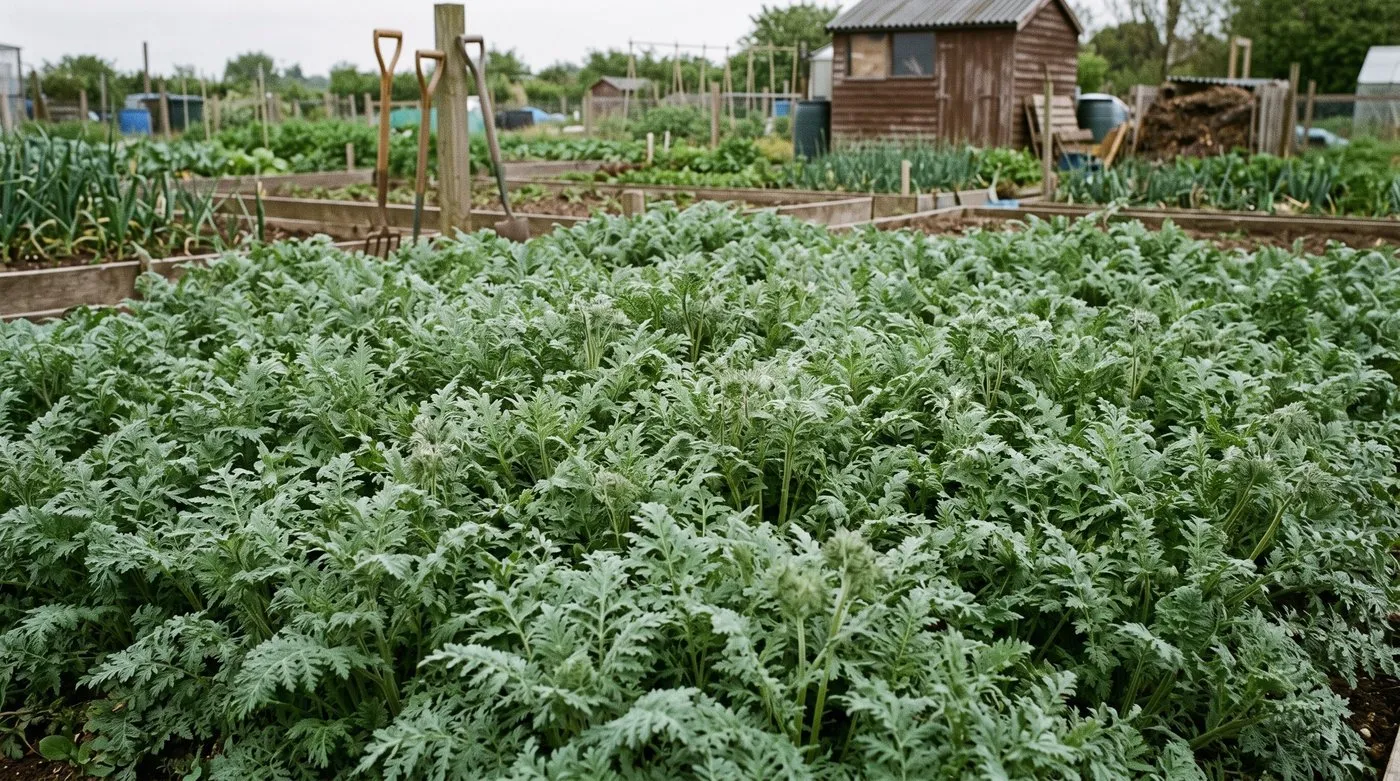 Within six weeks phacelia throws a dense ferny canopy over bare soil, shading out weed seedlings.
Phacelia versus mustard, rye and other green manures
Phacelia is a non-legume, biomass green manure. It does not fix nitrogen. Its value is fast ground cover, weed suppression, and fibrous roots that open up the soil. Nutrients it takes up are held in the leaves, then released as the plant rots down.
The table below sets phacelia against the other common UK green manures. Note the nitrogen column: only the legumes fix it. Phacelia and mustard are catch crops that hold nutrients rather than add them.
| Green manure | Family | Fixes nitrogen? | Speed | Main use | Overwinter hardiness |
|---|---|---|---|---|---|
| Phacelia | Boraginaceae | No | Fast, 6-8 weeks | Weed cover, soil structure, bees | Half-hardy, frost-killed below -5°C |
| Mustard | Brassicaceae | No | Very fast, 5-8 weeks | Weed cover, biofumigation | Half-hardy, frost-killed |
| Buckwheat | Polygonaceae | No | Fast, 6-8 weeks | Summer cover, phosphorus, bees | Tender, killed by first frost |
| Field beans | Fabaceae (legume) | Yes | Slow, over winter | Nitrogen fixing, winter cover | Hardy, overwinters |
| Grazing rye | Poaceae (grass) | No | Slow to bulk up | Winter cover, holds nutrients | Very hardy, overwinters |
| Crimson clover | Fabaceae (legume) | Yes | Moderate, 8-12 weeks | Nitrogen fixing, bees | Half-hardy to hardy |
Key point: mustard shares the brassica family with cabbages, so it does not suit a bed heading into brassicas. Phacelia shares no family with any common crop. That makes it the safest green manure to slot anywhere in a rotation.
How to sow phacelia as a green manure
As a cover crop, phacelia goes in fast and cheap. Broadcast the seed over a prepared bed and rake it in. No fuss.
When to sow: March to September. Spring and summer sowings grow into full cover. Late-summer and early-autumn sowings give thinner growth, then frost kills them for a winter mulch.
Sowing rate: Broadcast at 1 to 2 g per square metre, roughly 10 to 20 kg per hectare on a field scale. Aim for even, moderate coverage, not a thick carpet.
How to sow:
- Clear and roughly level the bed. Firm any loose soil.
- Scatter seed evenly by hand across the surface.
- Rake in lightly to cover the seed 5 to 10mm deep. It germinates better in some darkness.
- Water if the soil is dry. Seedlings appear in 7 to 14 days.
- Let it grow for 6 to 8 weeks into a dense green canopy.
- Chop it down and dig into the top 15cm while soft and green, before flowering.
- Wait 2 to 4 weeks for it to break down before sowing your next crop.
Sowing direct like this follows the same method as our guide to sowing hardy annuals direct. The trick with green manure is to dig it in young, while the stems are lush and easy to bury.
 Broadcast phacelia seed evenly at 1 to 2 grams per square metre, then rake it in to about 5mm deep.
Gardener’s tip: For a soil-only green manure, dig it in at 6 weeks before any flowers open. To feed bees as well, let a third of the patch flower, then chop and drop it once the bees have finished. You get soil cover, pollinator food, and a mulch from one sowing.
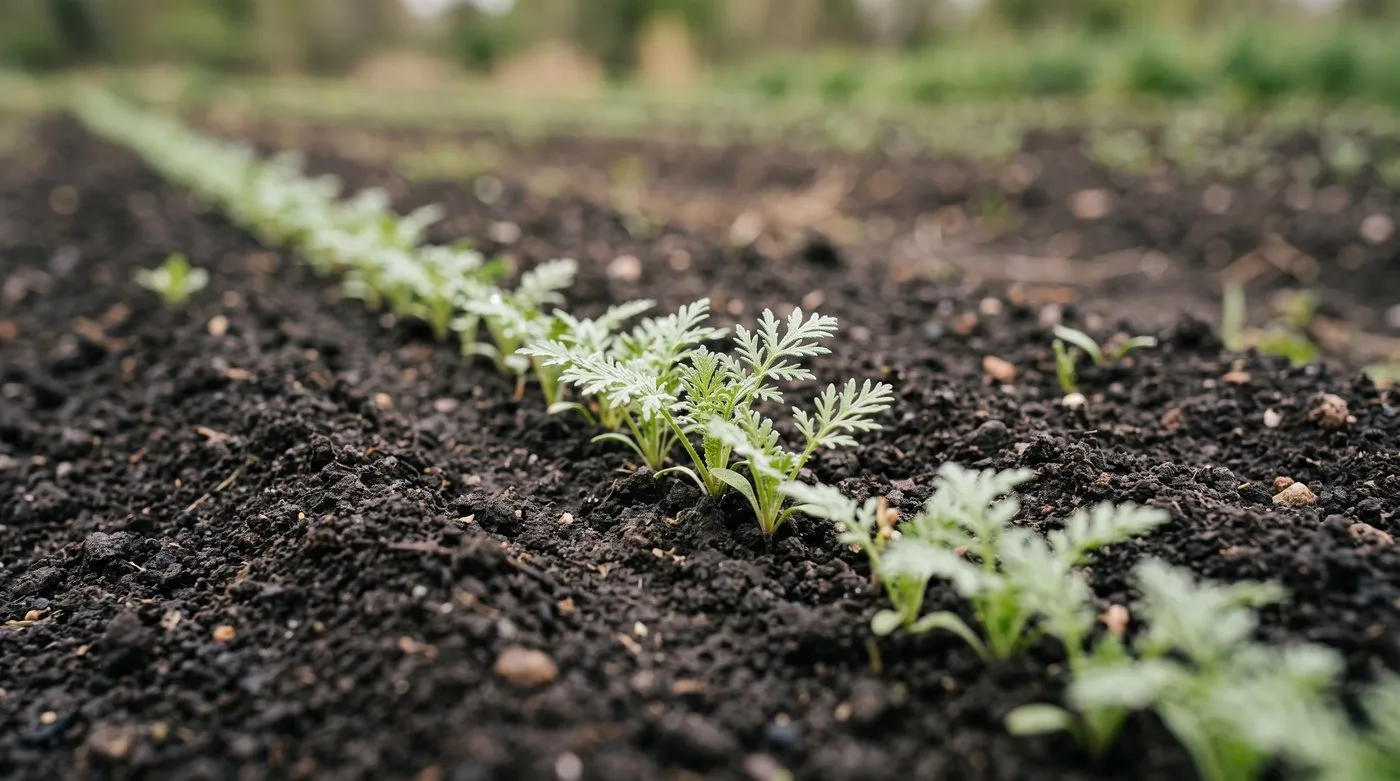 Phacelia seedlings break ground in 7 to 14 days, quickly forming a weed-suppressing mat.
Growing phacelia as an ornamental and pollinator plant
Phacelia is far more than a veg-patch workhorse. The hazy blue flowers and ferny foliage look lovely in a border, and the bees turn it into a living, humming feature.
Where to grow it: Sow into gaps in beds, along path edges, or in drifts through a wildlife border. It suits cottage and naturalistic schemes, sitting well among cornflowers, calendula, and ornamental grasses.
How to grow it for flowers: Sow direct where it is to bloom. Thin seedlings to 15 to 20cm apart for bushy, well-branched plants. Unlike the green-manure crop, you leave these to flower fully. Each plant blooms for 4 to 6 weeks.
Successional sowing: For unbroken colour and nectar, sow a fresh short row every 3 to 4 weeks from April to July. The first flowers open in June, the last in October. This keeps bees fed right through the season.
Phacelia self-seeds freely, so a single sown drift often returns for years. Pull surplus seedlings, or let them stand where you want more.
Month-by-month phacelia growing calendar
Phacelia’s long sowing window makes it flexible. Use this calendar to line up green-manure cover, flowering displays, and the winter mulch.
| Month | Task |
|---|---|
| February | Order seed. Too cold to sow outdoors in most regions |
| March | First green-manure sowings on warm, dry beds. Cover seed lightly |
| April | Sow for green manure or flowers. Begin successional flower sowings |
| May | Main sowing month. Fast growth. Thin flower drifts to 15-20cm |
| June | First flowers open on April sowings. Bees arrive in force |
| July | Peak flowering. Keep sowing every 3-4 weeks for late nectar |
| August | Sow autumn cover on cleared beds. Dig in early green manures |
| September | Last useful sowing for a frost-killed winter mulch |
| October | Late flowers feed bees. Cut or pull plants before seed sets |
| November | Frost flattens autumn sowings into a soil-protecting mulch |
| December | Frost-killed cover shields bare soil. No action needed |
| January | Plan next year’s rotation. Note where volunteers may appear |
Why phacelia is the ultimate rotation break crop
Here is the root-cause reason phacelia fits a veg plot so cleanly. Most green manures belong to a crop family. Mustard is a brassica. Field beans and clover are legumes. Grazing rye is a grass, like sweetcorn. Sow the wrong one and you double up on a family, which builds up soil pests and disease.
Phacelia sidesteps that entirely. It sits in the borage family, Boraginaceae, which contains no common vegetable crop. So it never clashes with brassicas, legumes, alliums, roots, or the potato family. You can drop it into any slot in a rotation as a break crop without upsetting the plan.
That is a real, practical advantage. A gap between crops can be covered with phacelia whatever grew there before and whatever follows. It protects the soil, holds spare nutrients that would otherwise wash out, and improves structure with its fibrous roots. Because it fixes no nitrogen, pair it with a legume elsewhere in the rotation if you need to build fertility. Our guide to NPK and pollinators explains how the two roles fit together.
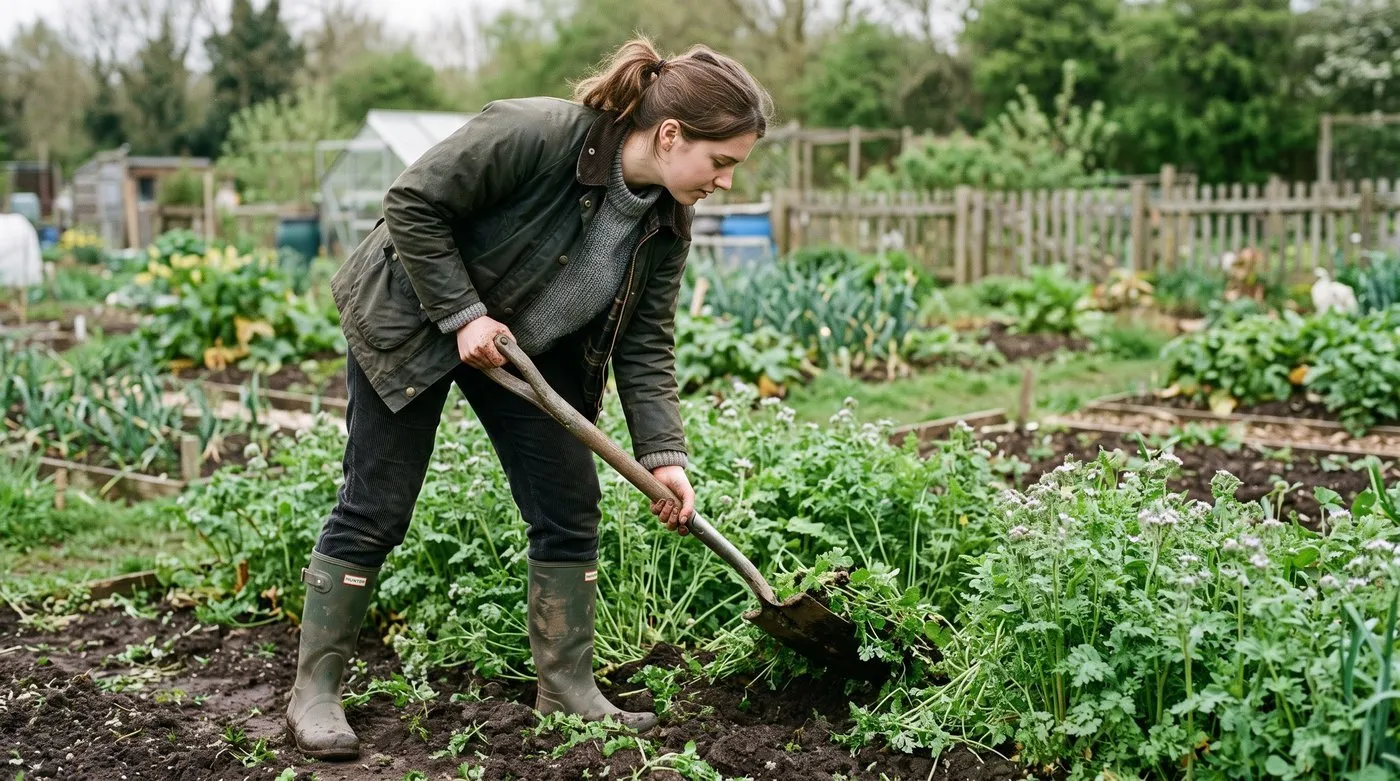 Chop phacelia in with a spade while the growth is soft and green, then leave it 2 to 4 weeks to rot down.
Phacelia for bees, hoverflies and natural pest control
This is where phacelia truly stands out. In insect-count trials it ranks among the very best plants for nectar and for pulling in bees and hoverflies. The open flowers offer easy access, and they refill nectar fast through the day.
Honeybees work it from dawn to dusk. Bumblebees and many solitary bees join them, so it feeds a wide spread of species from spring queens to late workers. The RHS Plants for Pollinators scheme lists phacelia as a high-value insect plant.
Hoverflies are the second win, and they double as pest control. Adult hoverflies feed on the pollen and nectar. Their larvae are voracious aphid predators. A single hoverfly larva can eat hundreds of aphids before it pupates. Sow phacelia beside aphid-prone crops and you draw in the adults, whose larvae then clear the aphids for free. It sits comfortably in a list of bee-friendly garden plants.
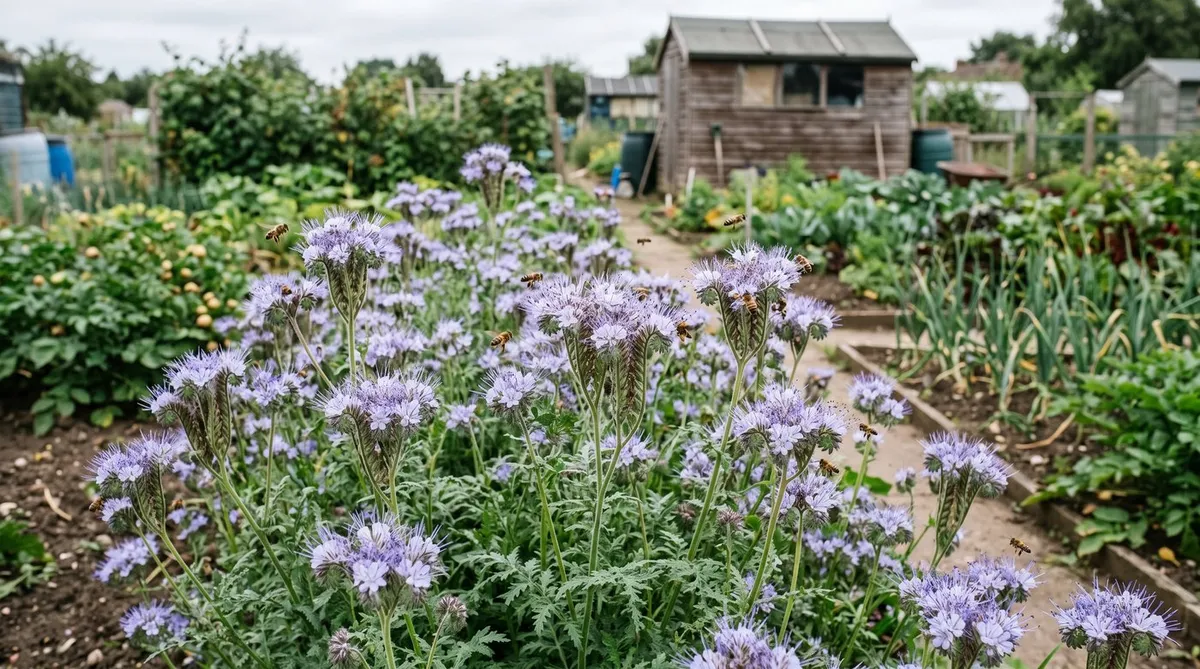
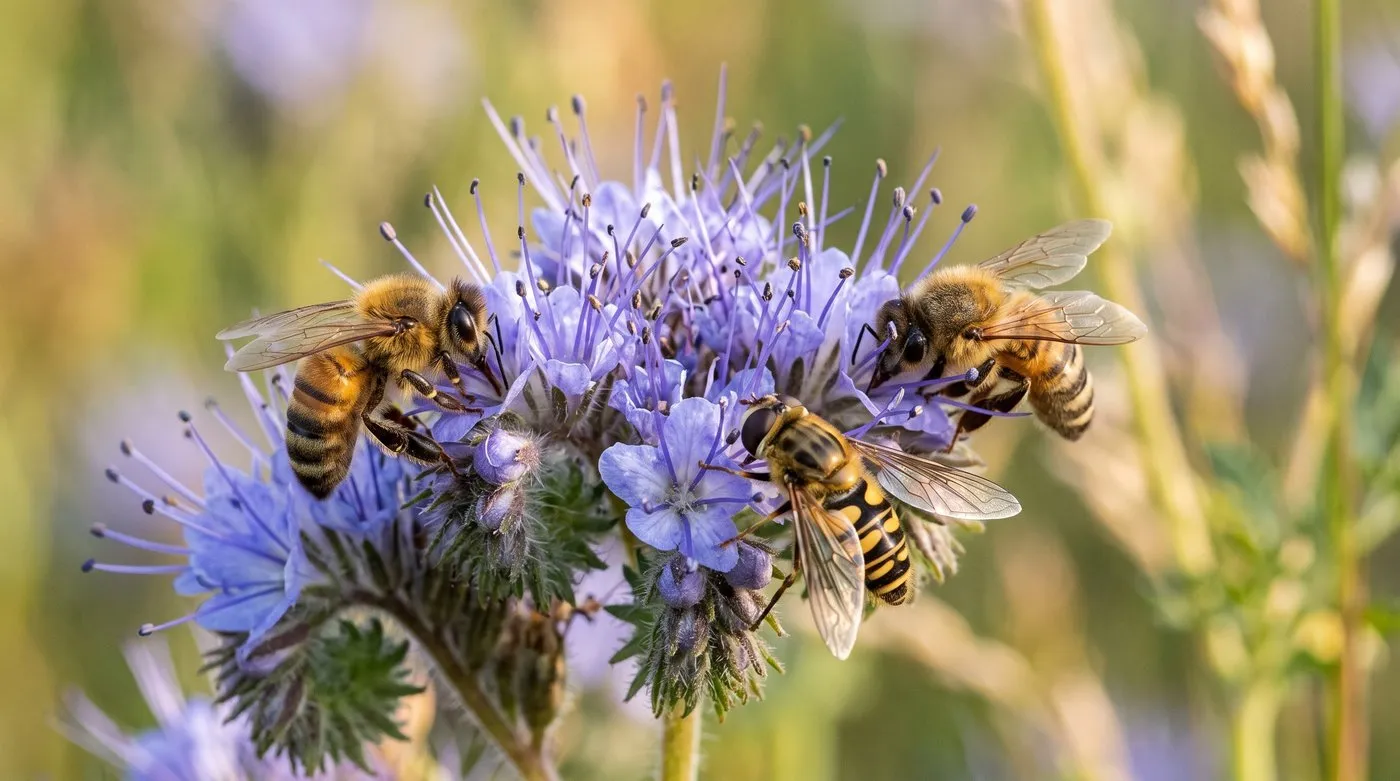 Honeybees and hoverflies share the flowers. The hoverfly larvae go on to eat aphids on nearby crops.
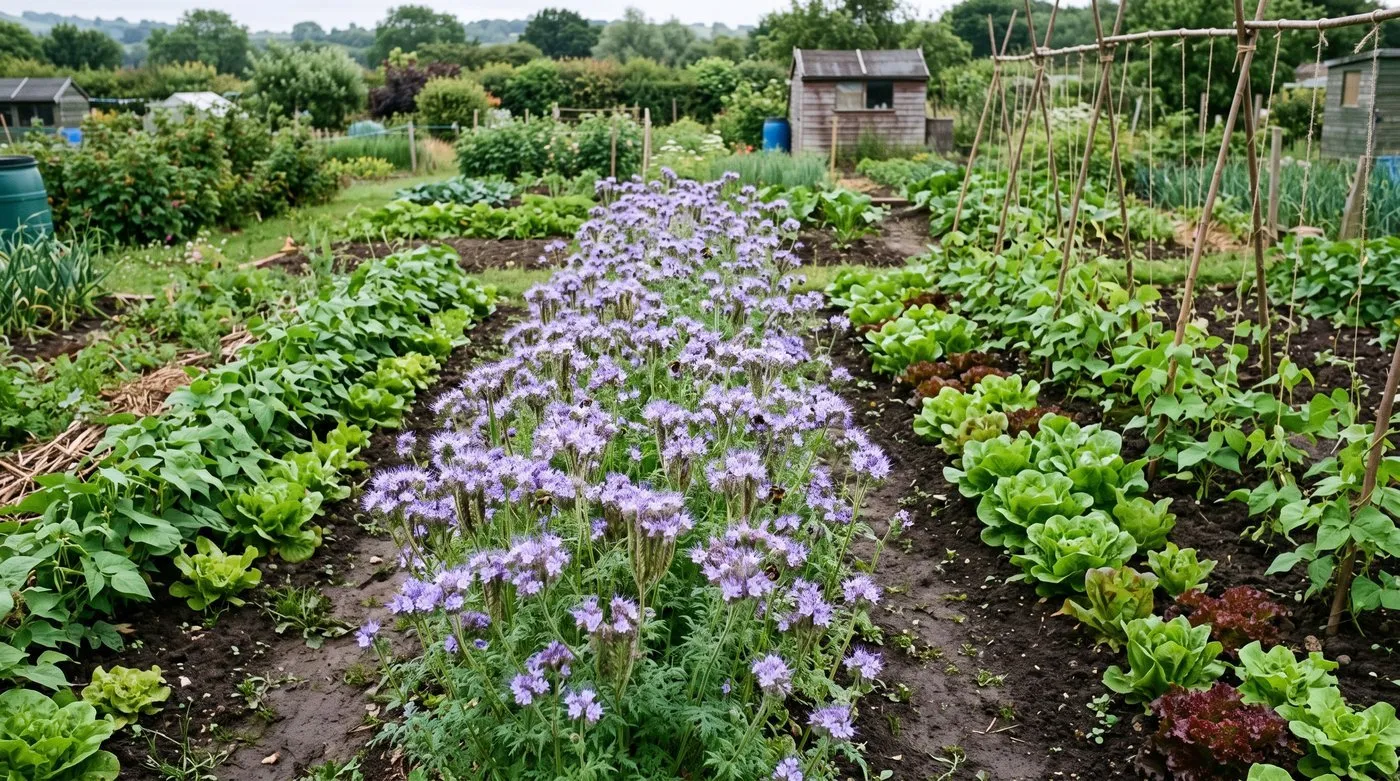 A flowering strip of phacelia beside the veg rows draws in hoverflies whose larvae clear crop aphids.
Problems, limitations and self-seeding
Phacelia is close to trouble-free. It is virtually free of pests and diseases. Its two real limitations are self-seeding and frost tenderness, not any bug or blight. The table ranks them by how much they matter.
| Issue | Cause | How much it matters | What to do |
|---|---|---|---|
| Vigorous self-seeding | Flowers left to set seed | High, can become weedy | Cut or pull before seed ripens, about 2 weeks after flowering |
| Frost tenderness | Hard frost below about -5°C | Medium, kills autumn sowings | Time it as a frost mulch, or sow spring to late summer |
| Slug damage to seedlings | Soft young growth in wet spells | Low to medium | Sow into warm soil, thin evenly, watch new drills |
| Pests and diseases | None of note | Very low, near immune | No action, phacelia is essentially trouble-free |
Self-seeding is the one that catches people out. A patch left to ripen scatters plenty of seed, and volunteers pop up for a couple of years. That is a bonus if you want more, a nuisance if you do not. It behaves much like other easy self-seeding plants: welcome in the right spot, weedy in the wrong one.
Frost tenderness is simply part of its annual nature. Autumn sowings die back once hard frost bites. That is often the plan, since the dead top growth mulches the soil until spring.
Warning: Cut phacelia down before the seed sets if you do not want it spreading. Once the flowers fade and the coiled heads brown, seed ripens fast. Leave it a fortnight too long and you will be pulling seedlings across the plot for two seasons.
Common mistakes to avoid
Expecting it to fix nitrogen. Phacelia is not a legume. It holds nutrients and builds structure, but adds no nitrogen. Sow beans or clover if fertility is the goal.
Letting it seed everywhere. The commonest error. Flowers left to ripen self-seed hard. Cut or pull before the heads brown unless you want volunteers.
Sowing too thickly. A dense carpet gives weak, drawn plants that flop. Stick to 1 to 2 g per square metre for green manure, and thin flower drifts to 15 to 20cm.
Digging in too late. Green manure buried after flowering has tough, woody stems that rot slowly and may shed seed. Dig it in young, at 6 to 8 weeks, while soft.
Sowing in the wrong season. A midwinter sowing sits cold and rots. Keep to March to September, and treat any winter survival as a lucky bonus.
Now you know how to grow phacelia, read our guide to green manures and cover crops to plan a full year of soil-building on your plot.
Frequently asked questions
Does phacelia fix nitrogen in the soil?
No, phacelia does not fix nitrogen. It is not a legume, so it cannot pull nitrogen from the air. Instead it works as a biomass green manure, mopping up spare nutrients, smothering weeds, and improving structure with its fibrous roots. For nitrogen, sow field beans or clover instead.
When should I sow phacelia in the UK?
Sow phacelia from March to September in the UK. Spring and summer sowings grow fast and can be dug in or left to flower. An August or September sowing usually flowers little, then frost kills it, leaving a protective winter mulch. Avoid sowing in the depths of winter.
How long does phacelia take to flower?
Phacelia flowers about 6 to 8 weeks after sowing. A May sowing typically blooms by late June or early July. The lavender-blue flowers then last 4 to 6 weeks per plant. Sow a fresh patch every 3 to 4 weeks for continuous nectar from June to October.
Is phacelia good for bees?
Yes, phacelia is one of the best bee plants you can grow. It ranks among the top nectar sources in UK insect studies. Honeybees, bumblebees, and hoverflies work the flowers heavily from morning to dusk. Its German name, Bienenfreund, means bee’s friend.
Does phacelia come back every year?
Phacelia is an annual, so the parent plant does not return. It readily self-seeds, though, and volunteer seedlings often appear the next spring. To keep it in check, cut or pull plants before the seed ripens. To keep it going for free, let a few plants shed seed.
How do I dig phacelia in as a green manure?
Chop the top growth down, then dig it into the top 15cm of soil. Do this at 6 to 8 weeks, before flowering, while the stems are soft and green. Leave the soil 2 to 4 weeks before sowing a crop, so the material breaks down first.
Will phacelia survive a UK winter?
Autumn-sown phacelia is usually killed by hard frost below about -5°C. Young plants tolerate light frost, but a cold snap flattens them into a mulch. In mild coastal or city gardens, some autumn sowings scrape through and flower early the next spring. Treat winter survival as a bonus.
Further reading
- Cottage garden planting plan, design ideas that use phacelia among cornflowers, calendula, and grasses
- Seed sowing calendar for the UK, line up phacelia sowings with the rest of your growing year
- Solitary bees garden guide, the wild bees that phacelia feeds alongside honeybees and bumblebees
Our team produces practical UK gardening guidance from source research, contributor records and established horticultural practice. Editorial standards are overseen by Matt W.