Key takeaways
- Verbena bonariensis grows 150-180cm with wiry see-through stems, ideal for front, middle or back of border planting
- Trailing verbena is frost-tender in most of the UK and must be overwintered from August cuttings or treated as annual
- Verbena rigida is the hardiest type at 60cm tall and survives most winters on heavy clay without protection
- All verbenas need full sun and sharp drainage - waterlogged winter soil kills bonariensis and rigida in zones below -10C
- V. bonariensis self-seeds freely once established, producing a drift of 15-30 new plants per parent each spring
- Single-flowered verbenas attract 3-5 times more pollinators than double-flowered varieties, with butterflies the main visitors
Verbenas are among the most useful flowering plants in British gardens, yet they cause endless confusion. The name covers two completely different types of plant. Tall, statuesque Verbena bonariensis sends wiry stems up to 180cm, creating a see-through effect above border planting. Trailing verbenas spill from hanging baskets and window boxes in summer bedding displays. They share a name but almost nothing else.
This guide separates the two groups clearly. It covers the best varieties for UK conditions, the overwintering problem that kills most trailing verbenas, the self-seeding habit of bonariensis that gives you free plants year after year, and how to combine verbenas with grasses, echinacea, and asters for a long-season pollinator border.
What is the difference between Verbena bonariensis and trailing verbena?
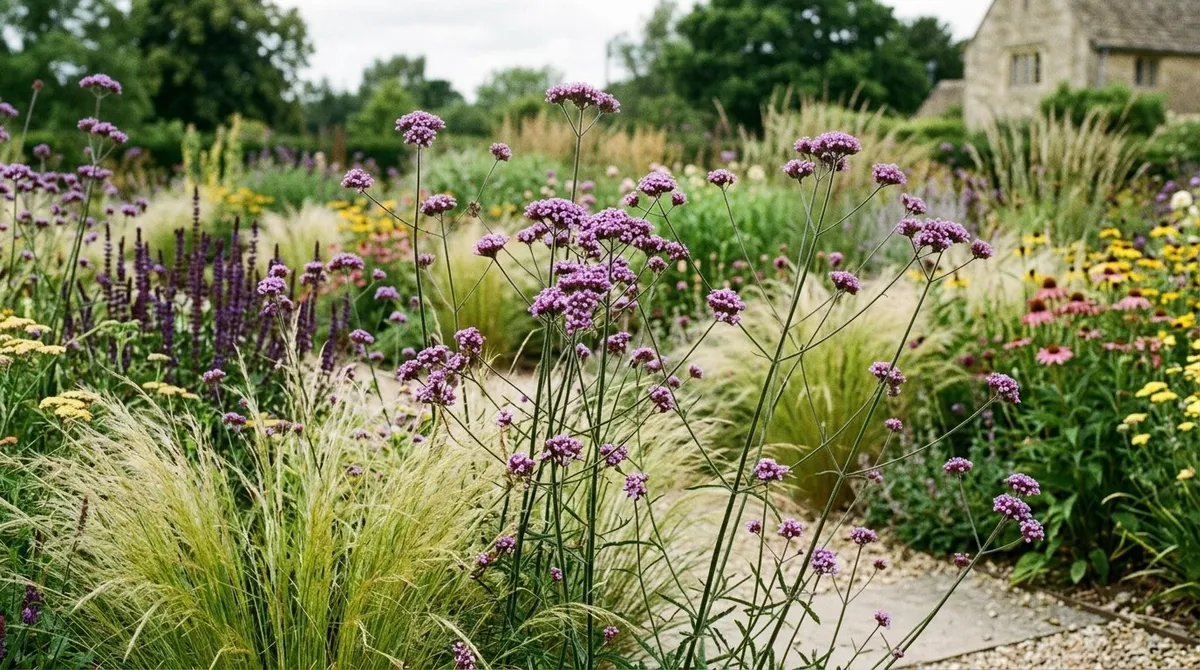
Verbena bonariensis is a tall perennial species native to South America. It grows from a basal crown, sending up wiry stems to 150-180cm topped with small clusters of bright purple flowers. The plant is see-through, meaning you can plant it at the front of a border without blocking what grows behind.
Trailing verbenas are mostly hybrids of Verbena x hybrida, bred for summer bedding and baskets. They spread horizontally to 60cm and cascade over container edges. Colours include red, pink, white, purple, and bi-colours. These are the verbenas you see in garden centres from May onward. They are frost-tender and die in UK winters.
A third group sits between the two. Verbena rigida grows to 60cm with stiff upright stems and purple flowers from July to October. It is much hardier than trailing types and self-seeds like bonariensis. It is the best choice for front-of-border planting in colder UK gardens where bonariensis struggles.
Which verbena is best for UK gardens?
Verbena bonariensis (species form)
The classic tall see-through verbena. 150-180cm stems topped with small purple flower clusters from July to November. Borderline hardy but self-seeds so freely that replacement plants appear every spring. Essential for butterfly borders and naturalistic planting. AGM-awarded by the RHS. Our full guide to growing Verbena bonariensis covers sowing, overwintering and self-seeding in detail.
Verbena bonariensis ‘Lollipop’
A compact selection growing 50-60cm tall with the same purple flower clusters. Better for small gardens, pots, and front-of-border positions. Flowers slightly earlier than the species. Less prone to flopping in exposed sites. Does not self-seed as freely but still spreads gently.
Verbena rigida
Verbena ‘Homestead Purple’
A trailing type with deep purple flowers from June until frost. Frost-tender and treated as annual in the UK. Vigorous and weather-resistant in baskets and window boxes. Roots easily from 8cm cuttings taken in August. Flowers are single and attract excellent numbers of pollinators.
Verbena Tapien series
Finely cut feathery foliage with masses of small flowers in pink, purple, blue, and white. Spreads to 60cm as ground cover or trailer. Frost-tender. The most compact trailing type, ideal for small containers and window boxes. Flowers June to November.
Verbena Quartz series
Upright bedding verbena growing 25-30cm tall with large flower heads in strong colours. Treated as half-hardy annual and sown indoors in February. Flowers June until frost. A good choice for formal bedding schemes and front-of-border planting in beds that are cleared each autumn.
Best verbena varieties compared
| Variety | Height | Type | Flowers | Hardiness | Self-seeds |
|---|---|---|---|---|---|
| V. bonariensis | 150-180cm | Perennial | Jul-Nov | -10C | Yes, prolifically |
| V. bonariensis ‘Lollipop’ | 50-60cm | Perennial | Jul-Oct | -10C | Moderately |
| V. rigida | 50-60cm | Perennial | Jul-Oct | -15C | Yes |
| ’Homestead Purple’ | 30cm trailing | Annual | Jun-Nov | Frost-tender | No |
| Tapien series | 20cm trailing | Annual | Jun-Nov | Frost-tender | No |
| Quartz series | 25-30cm | Annual | Jun-Nov | Frost-tender | No |
How to plant verbena in the UK
Plant pot-grown verbenas from late May after the last frost. In milder areas bonariensis and rigida can go in from late April. Bedding and trailing types must wait until frost risk passes completely.
Choosing the right spot
All verbenas need full sun for 6-8 hours daily. They tolerate no more than light afternoon shade. Good air movement reduces mildew problems on crowded plants. Avoid damp corners where water sits in winter.
Soil preparation
Verbenas need well-drained soil above all else. On heavy clay, dig in 5-10cm of horticultural grit plus garden compost to improve winter drainage. Read our guide on improving clay soil for the full method. Neutral to slightly alkaline pH (6.5-7.5) is ideal.
Planting method
- Space bonariensis and rigida 45-60cm apart in drifts of 5 or more
- Space trailing verbenas 30cm apart in containers and beds
- Dig holes twice the rootball width
- Plant at the original soil level, never deeper
- Water in with 2 litres per plant
- Mulch with 3cm of grit or gravel (not bark) to reduce winter crown rot
First-year care
Water twice weekly through the first summer. Once established, perennial verbenas tolerate drought well. Feed bedding types fortnightly with liquid tomato feed from June onward. Do not feed bonariensis or rigida at all, as nitrogen produces soft growth that fails to overwinter.
How to overwinter trailing verbena
Trailing verbenas are frost-tender and must be propagated from cuttings to keep varieties going. The parent plants die at the first hard frost without fail. This is the single biggest reason gardeners give up on them.
Taking cuttings in August
Cuttings rooted in August overwinter under glass and produce strong plants by May. One parent yields 6-10 cuttings with a single pass.
- Choose non-flowering shoots 8-10cm long from healthy parents
- Cut just below a leaf node with a clean blade
- Strip lower leaves leaving only the top two pairs
- Dip in hormone rooting powder (optional but improves success)
- Insert into gritty compost (50:50 multipurpose and perlite)
- Water once and cover with a clear plastic bag or propagator lid
- Keep at 15-18C in bright but indirect light for 3-4 weeks
- Pot on once roots fill the 9cm pot in autumn
Cuttings need a minimum 7C through winter, so a heated greenhouse or cool conservatory is essential. Water sparingly from November to February to prevent rot.
Storing parent plants
Lifting entire parent plants and potting them up is less reliable than cuttings. The woody stems produce fewer new shoots the following spring. If you must try, cut stems back to 10cm, pot in John Innes No. 2, keep frost-free at 5-10C, and water sparingly.
How to prevent Verbena bonariensis dying in winter
Verbena bonariensis is rated hardy to -10C but fails on cold, wet clay in zones below -5C. The problem is not temperature alone but waterlogged soil around the crown. Winter drainage solves most survival problems.
Four steps that work
- Plant on a raised mound 15cm above surrounding soil to improve drainage
- Mulch with 5cm of grit or gravel around the crown in November, not bark
- Leave the old stems standing through winter to trap snow and protect the crown
- Do not cut back until March when new growth appears at the base
The backup strategy
Even with all these precautions, losses happen in severe winters. The solution is to rely on the plant’s self-seeding habit. Leave 2-3 plants to go to seed each autumn. The following spring you will find 15-30 seedlings in the surrounding ground. Transplant these in April to exactly where you want them. Free replacements every year.
Verbenas as pollinator plants
Verbenas are among the top 10 UK butterfly plants. Their flat flower clusters provide perfect landing platforms for butterflies, while the shallow tubes allow bees and hoverflies to reach the nectar easily. Few plants match them for volume of pollinator visits over such a long flowering period.
What visits verbenas
- Peacock, red admiral, small tortoiseshell, and painted lady butterflies visit in large numbers
- Honeybees and bumblebees forage throughout July to October
- Hoverflies especially favour Verbena bonariensis flower heads
- Moths including silver Y and hummingbird hawk-moth feed at dusk
- Late solitary bees including ivy bees (Colletes hederae) on October blooms
For the ultimate butterfly and bee border, combine V. bonariensis with echinacea, sedum, asters, and ornamental grasses. These plants together provide nectar from July right through to November.
Companion planting with verbena
Verbena bonariensis is one of the best companion plants in British gardening. Its wiry transparent habit allows you to place it almost anywhere without blocking other plants. The tall stems rise above shorter perennials, adding height and movement without shade.
Winning combinations
| Partner plant | Height | Flowers | Why it works with verbena |
|---|---|---|---|
| Echinacea purpurea | 90cm | Jul-Oct | Matching flowering period, contrasting flower shape |
| Rudbeckia ‘Goldsturm’ | 60cm | Jul-Oct | Orange and purple colour contrast |
| Stipa tenuissima | 60cm | Jul-Oct | Feathery grass adds movement beneath wiry stems |
| Miscanthus sinensis | 180cm | Sep-Nov | Matches verbena height with autumn plumes |
| Aster x frikartii ‘Monch’ | 75cm | Jul-Oct | Both attract late-summer pollinators |
| Sedum ‘Autumn Joy’ | 45cm | Sep-Nov | Flat heads contrast with airy verbena stems |
Plant bonariensis in drifts of at least 5-7 plants for visual impact. Single specimens disappear in a mixed border. The repetition is what creates the see-through drift effect that makes this plant so distinctive. For more combinations, see our guide to the best plant combinations for UK borders.
Month-by-month verbena care calendar
| Month | Task |
|---|---|
| February | Sow Quartz series under glass at 18C |
| March | Cut old bonariensis stems to 5cm above ground |
| April | Transplant self-seeded bonariensis seedlings |
| May (late) | Plant out trailing and bedding verbenas after frost |
| June | First flowers on trailing types. Water container plants daily |
| July | Main flowering begins on bonariensis and rigida |
| August | Take cuttings from trailing verbenas for next year |
| September | Peak flowering. Record pollinator activity |
| October | Continue flowering. Allow some seed heads to set |
| November | Flowering finishes at first hard frost |
| December | Leave stems standing for winter crown protection |
Common mistakes when growing verbena
Cutting back bonariensis in autumn
Removing old stems before March destroys winter crown protection and removes self-seeding potential. Always wait until new shoots appear at the base in spring before cutting back.
Planting in waterlogged soil
Verbenas need sharp drainage year-round. Bonariensis and rigida fail on wet clay not because of cold but because the crowns rot. Improve drainage with grit before planting.
Feeding with high nitrogen
Soft, leafy growth from nitrogen-rich feeds fails to flower well and dies in winter. Use only potash-rich liquid feeds on trailing types, and never feed perennial verbenas.
Buying trailing types expecting them to return
Garden centre trailing verbenas are not hardy in UK winters. Accept they are annuals or take cuttings in August. Do not spend money replacing them every spring.
Planting bonariensis singly
A single plant looks sparse and fails to create the signature see-through drift effect. Always plant 5-7 minimum, spaced 45cm apart.
Frequently asked questions
Is Verbena bonariensis hardy in the UK?
Verbena bonariensis is borderline hardy to -10C in most UK regions. It survives winters in southern and central England on well-drained soil. On cold, wet clay or in exposed northern gardens it often dies out. The plant self-seeds so reliably that replacement plants appear each spring even when the parents are lost to frost. Avoid cutting stems back until March for crown protection.
Does trailing verbena come back every year?
Trailing verbena is frost-tender and dies in UK winters. Varieties like Tapien, Temari, Quartz, and Homestead Purple are treated as annuals by most gardeners. Take 8cm soft cuttings in August, root them in gritty compost, and overwinter indoors at 7-10C. Cuttings are ready to plant out the following May after frosts pass. One plant yields 6-10 rooted cuttings in a single take.
How tall does Verbena bonariensis grow?
Verbena bonariensis reaches 150-180cm tall and 45-60cm wide. The stems are thin and wiry, creating a see-through effect that allows plants behind to show through. This habit makes it useful at the front or middle of borders rather than only at the back. The variety ‘Lollipop’ is a compact form growing only 60cm tall for smaller gardens and containers.
Does Verbena bonariensis self-seed?
Yes, Verbena bonariensis self-seeds prolifically in UK gardens. A single established plant produces 15-30 seedlings per spring on open ground. Seedlings appear in April and May and flower by late July the same year. Leave seed heads standing through autumn and winter for maximum reseeding. Remove unwanted seedlings with a hoe before they reach 5cm tall. The seed stays viable for 2 years in soil.
Can I grow verbena in pots?
Trailing verbenas are excellent in pots, baskets and window boxes. Use a loam-based compost like John Innes No. 2 with added grit. Water daily in hot weather and feed weekly with liquid tomato fertiliser from June. Verbena bonariensis also grows in large pots 40cm deep but needs extra winter drainage. V. rigida suits pots 30cm across and returns each year in mild winters on a sheltered patio.
When does verbena flower in the UK?
Verbena flowers from late June until the first hard frost in November. Trailing types start earliest once planted out in late May. Verbena bonariensis flowers from mid-July and often continues into December in mild years. V. rigida flowers from July to October. The long flowering season makes verbenas among the top 5 late-summer perennials for UK pollinator borders.
What is the difference between verbena and Verbena bonariensis?
Verbena is the genus containing over 150 species, while bonariensis is one specific tall perennial species. Most garden centres sell trailing annual verbenas (hybrids of V. x hybrida) alongside the tall V. bonariensis. They look and grow completely differently. Trailing types spread horizontally to 60cm, while bonariensis sends up tall wiry stems to 180cm. Both need full sun and well-drained soil.
Now that you know how to grow verbena successfully, read our guide on the best perennial plants for UK gardens to build a border that performs from spring through to autumn. For more pollinator-friendly planting, the Royal Horticultural Society lists Verbena bonariensis among their recommended nectar plants.
Our team produces practical UK gardening guidance from source research, contributor records and established horticultural practice. Editorial standards are overseen by Matt W.